
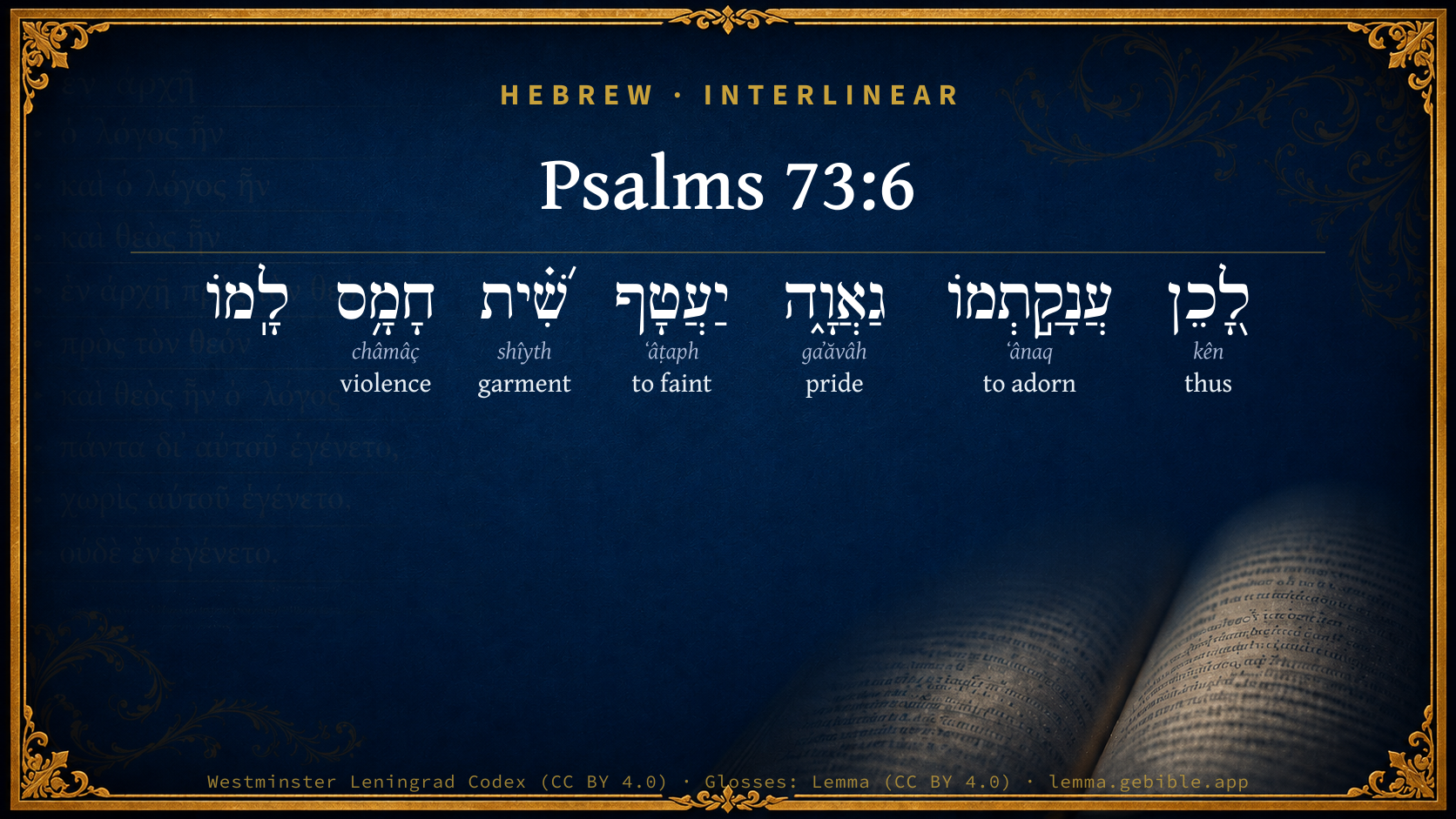
Psalms 73:6

Hebrew (Westminster Leningrad Codex) Psalms 73:6 appears in the Hebrew Old Testament. The text above is from the Westminster Leningrad Codex. Each word links to its Strong’s number, a concise gloss, and parsing drawn from the Open Scriptures Hebrew Bible morphology. Click any word for its full Brown-Driver-Briggs (BDB) entry.
Download image
Cite this verse

Psalms 73:6 (World English Bible). Public Domain. Lemma interlinear Bible study tool, https://lemma.gebible.app/v/psalms/73/6.

Show BibTeX & RIS
BibTeX
RIS
English Translation
Therefore pride is like a chain around their neck. Violence covers them like a garment.
World English Bible · Public Domain
Highlights
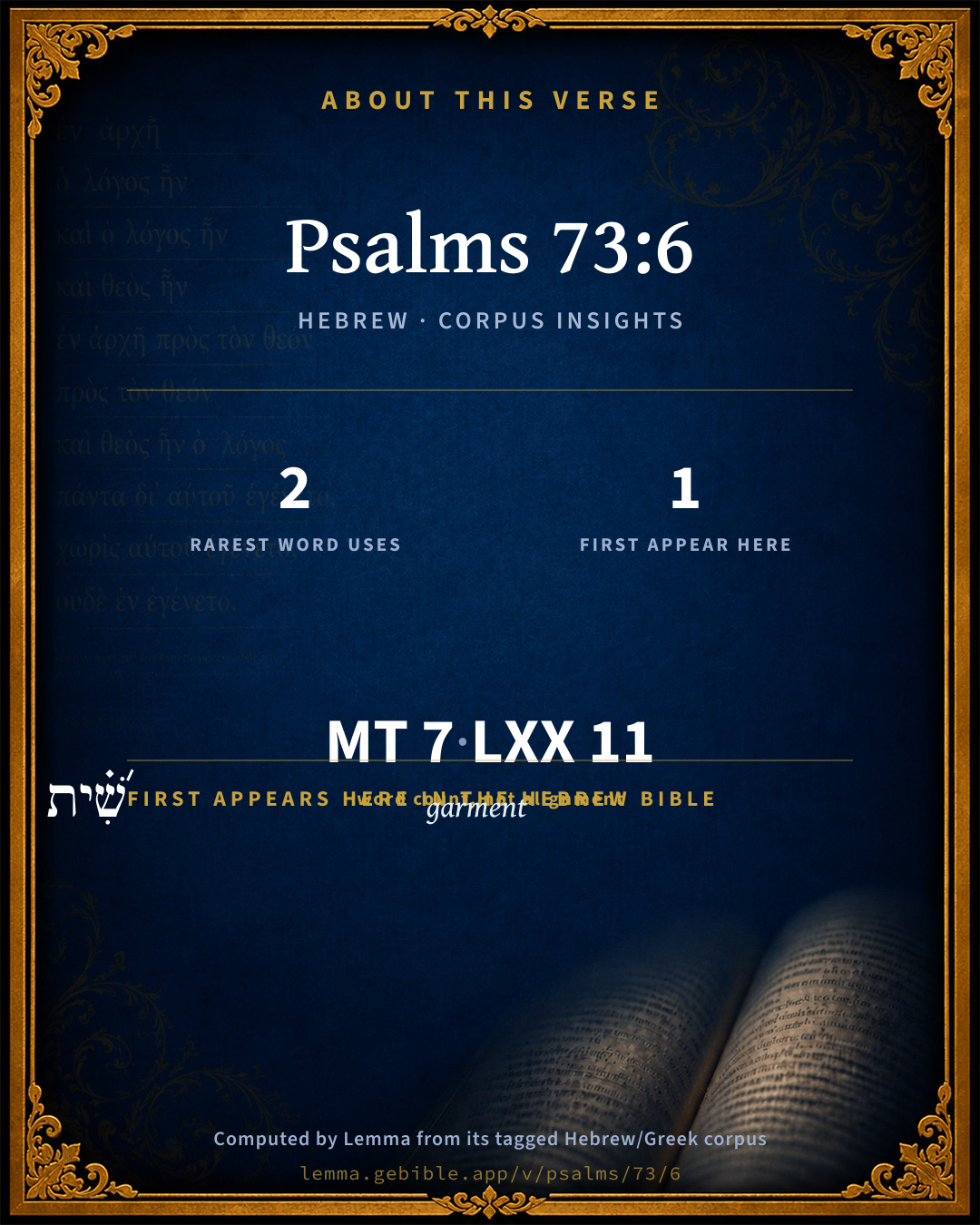
  • 1 first appearance in the Hebrew Bible
Full analysis ↓
Download a study sheet

One document with this verse’s original text, its word-by-word gloss line, the meaning frame, cross-references with their text, attributed commentary, and full source and license credits — printable, and it pastes into notes with its structure intact.

This verse Autodidact and up

Study sheet (.html) Plain text (.txt)

A passage Seminary Student

Up to 50 verses in one chapter. A passage sheet keeps up to 6 commentary sources and 12 cross-references per verse, in the order this page ranks them, and says so on the sheet whenever that leaves anything out. Ask for a single verse and you get the Autodidact verse sheet above.

Everything on this page stays free to read, with no account — the sheet is a download of what is already on screen, not access to it.

Want to remove ads? Support Godless Engineer
Compare translations 3

The same verse in 3 English versions, stacked beneath the original-language interlinear above. Click any original word for its lexicon entry.

Each is an independent rendering of the whole verse — the interlinear is not word-aligned to these translations.

Highlighted words mark where these versions differ — a whole-verse word diff, not a word-by-word alignment.

  • World English Bible Public Domain
    Therefore pride is like a chain around their neck. Violence covers them like a garment.
  • King James Version Public Domain
    Therefore pride compasseth them about as a chain; violence covereth them as a garment.
  • unfoldingWord Literal Text CC BY-SA 4.0
    Therefore pride is a necklace for them; a garment of violence covers them.

unfoldingWord Literal Text — © unfoldingWord, licensed CC BY-SA 4.0. Word-aligned USFM3 via Door43 (git.door43.org/unfoldingWord/en_ult).

Versions to compare (up to 4)

3 of 4 selected

Show all 17 translations

Every available English version of this verse, each an independent rendering of the whole verse.

  • World English Bible Public Domain
    Therefore pride is like a chain around their neck. Violence covers them like a garment.
  • Berean Standard Bible Public Domain
    Therefore pride is their necklace; a garment of violence covers them.
  • Majority Standard Bible Public Domain
    Therefore pride is their necklace; a garment of violence covers them.
  • King James Version Public Domain
    Therefore pride compasseth them about as a chain; violence covereth them as a garment.
  • American Standard Version (1901) Public Domain
    Therefore pride is as a chain about their neck; Violence covereth them as a garment.
  • Revised Version (1885) Public Domain
    Therefore pride is as a chain about their neck; violence covereth them as a garment.
  • Geneva Bible (1599) Public Domain
    Therefore pride is as a chayne vnto them, and crueltie couereth them as a garment.
  • Young's Literal Translation Public Domain
    Therefore hath pride encircled them, Violence covereth them as a dress.
  • Literal Standard Version CC BY-SA 4.0
    Therefore pride has encircled them, || Violence covers them as a dress.
  • Unlocked Literal Bible CC BY-SA 4.0
    Pride adorns them like a necklace around their neck; violence clothes them like a robe.
  • unfoldingWord Literal Text CC BY-SA 4.0
    Therefore pride is a necklace for them; a garment of violence covers them.
  • Darby Bible Public Domain
    Therefore pride encompasseth them as a neck-chain, violence covereth them [as] a garment;
  • World Messianic Bible Public Domain
    Therefore pride is like a chain around their neck. Violence covers them like a garment.
  • Webster's Bible Public Domain
    Therefore pride encompasseth them as a chain; violence covereth them as a garment.
  • Free Bible Version CC BY-SA 4.0
    They wear their pride like a necklace; they clothe themselves with violence.
  • Bible in Basic English Public Domain
    For this reason pride is round them like a chain; they are clothed with violent behaviour as with a robe.
  • JPS Tanakh (1917) Public Domain
    Therefore pride is as a chain about their neck; violence covereth them as a garment.

Literal Standard Version (2020), Covenant Press — licensed CC BY-SA 4.0. Text via the HelloAO Bible API (eBible.org). Unlocked Literal Bible (unfoldingWord) — licensed CC BY-SA 4.0. Text via the HelloAO Bible API (eBible.org). unfoldingWord Literal Text — © unfoldingWord, licensed CC BY-SA 4.0. Word-aligned USFM3 via Door43 (git.door43.org/unfoldingWord/en_ult). Free Bible Version, Dr. Jonathan Gallagher — licensed CC BY-SA 4.0. Text via the HelloAO Bible API (eBible.org).

Word by word

More ways to search: Search by grammar → Find every occurrence → Compare this word →

Practice this passage: Drill this verse → Learn its vocabulary →

About this verse

These counts appear in no published source. They are computed here, from the morphology-tagged text and Lemma’s own curated glosses. What Lemma adds →

7
words
6
distinct lemmas
Wisdom
section

Notable vocabulary

The rarest word here is שִׁ֝֗ית garment H7897 — appearing just 2 times in the whole Hebrew Bible.

First appearance in Scripture

This word makes its first canonical appearance in the Hebrew Bible here:

  • שִׁ֝֗ית garment H7897

Shared distinctive vocabulary

שִׁ֝֗ית garment H7897 occurs in 2 verses of the Hebrew Bible. Also found in:

Grammatical profile

  • 2 verbs
  • 3 nouns
  • 1 preposition
  • 1 adverb

Verb forms

  • עֲנָקַ֣תְמוֹ Qal · Perfect
  • יַעֲטָף Qal · Imperfect

Hebrew & Septuagint length

In English translation the verse runs 15 words from the Hebrew and 14 from the Septuagint (LXX English) — closely comparable.

A rough comparison of the two English renderings, which tokenize alike — not a word-level alignment.

Word counts can differ between the Hebrew and the Greek without any difference in meaning — e.g. the Hebrew direct-object marker אֵת has no separate Greek word, and Greek often adds the article ὁ.

In the original languages it is 7 Hebrew tokens and 11 Greek tokens — but the two are counted differently (Hebrew bundles its prefixes and suffixes into one token; the Greek is in lemma form), so that isn’t a like-for-like length.

Cross-references

25

Topical passages linked to Psalms 73:6 in the Treasury of Scripture Knowledge — connected by theme and wording, ordered by reader-vote popularity; previews shown in the World English Bible.

  • Psalms 109:18 He clothed himself also with cursing as with his garment. It came into his inward parts like water, Like oil into his bones.
  • 1 Peter 5:5 Likewise, you younger ones, be subject to the elder. Yes, all of you gird yourselves with humility, to subject yourselves to one another; for "God resists the proud, but gives grace to the humble."
  • Judges 8:26 The weight of the golden ear-rings that he requested was one thousand and seven hundred [shekels] of gold, besides the crescents, and the pendants, and the purple clothing that was on the kings of Midian, and besides the chains that were about their camels' necks.
  • Proverbs 1:9 For they will be a garland to grace your head, And chains around your neck.
  • Proverbs 3:31 Don't envy the man of violence. Choose none of his ways.
  • Daniel 4:30 The king spoke and said, Is not this great Babylon, which I have built for the royal dwelling-place, by the might of my power and for the glory of my majesty?
  • Genesis 41:42 Pharaoh took off his signet ring from his hand, and put it on Joseph's hand, and arrayed him in robes of fine linen, and put a gold chain about his neck,
  • Deuteronomy 8:13–14 and when your herds and your flocks multiply, and your silver and your gold is multiplied, and all that you have is multiplied;
  • Deuteronomy 32:15 But Jeshurun grew fat, and kicked: You have grown fat, you are grown thick, you are become sleek; Then he forsook God who made him, Lightly esteemed the Rock of his salvation.
  • Esther 3:1 After these things did king Ahasuerus promote Haman the son of Hammedatha the Agagite, and advanced him, and set his seat above all the princes who were with him.
  • Esther 3:5–6 When Haman saw that Mordecai didn't bow down, nor did him reverence, then was Haman full of wrath.
  • Esther 5:9–11 Then went Haman forth that day joyful and glad of heart: but when Haman saw Mordecai in the king's gate, that he didn't stand up nor move for him, he was filled with wrath against Mordecai.
  • Job 21:7–15 "Why do the wicked live, Become old, yes, and grow mighty in power?
  • Psalms 109:29 Let my adversaries be clothed with dishonor. Let them cover themselves with their own shame as with a robe.
  • Proverbs 4:17 For they eat the bread of wickedness, And drink the wine of violence.
  • Ecclesiastes 8:11 Because sentence against an evil work is not executed speedily, therefore the heart of the sons of men is fully set in them to do evil.
  • Song of Solomon 4:9 You have ravished my heart, my sister, my bride. You have ravished my heart with one of your eyes, With one chain of your neck.
  • Isaiah 3:19 the earrings, the bracelets, the veils,
  • Jeremiah 48:11 Moab has been at ease from his youth, and he has settled on his lees, and has not been emptied from vessel to vessel, neither has he gone into captivity: therefore his taste remains in him, and his scent is not changed.
  • Jeremiah 48:29 We have heard of the pride of Moab, [that] he is very proud; his loftiness, and his pride, and his arrogance, and the haughtiness of his heart.
  • Ezekiel 16:11 I decked you with ornaments, and I put bracelets on your hands, and a chain on your neck.
  • Ezekiel 28:2–5 Son of man, tell the prince of Tyre, Thus says the Lord Yahweh: Because your heart is lifted up, and you have said, I am a god, I sit in the seat of God, in the midst of the seas; yet you are man, and not God, though you did set your heart as the heart of God;-
  • Micah 2:1–2 Woe to those who devise iniquity And work evil on their beds! When the morning is light, they practice it, Because it is in the power of their hand.
  • Micah 3:5 Thus says Yahweh concerning the prophets who lead my people astray; for those who feed their teeth, they proclaim, "Peace!" and whoever doesn't provide for their mouths, they prepare war against him:
  • James 5:4–6 Behold, the wages of the laborers who mowed your fields, which you have kept back by fraud, cry out, and the cries of those who reaped have entered into the ears of the Lord of Hosts.

Cross-references courtesy of OpenBible.info (CC BY 4.0).

Hebrew and Greek witnesses Masoretic Hebrew ↔ Greek Septuagint

The same verse in the two great witnesses to the Old Testament, shown verse-for-verse.

You’re reading Greek Psalm 72 (Hebrew Psalm 73). The Septuagint counts the superscription, so verse numbers can differ from the Hebrew — chapter-level alignment, not verse-by-verse. Numbering follows Rahlfs.

These are two independent witnesses, not word-aligned to each other, and the Septuagint is shown in lemma (dictionary) form.

Hebrew Psalms 73:6 Masoretic · Westminster Leningrad Codex

לָ֭כֵן עֲנָקַ֣תְמוֹ גַאֲוָ֑ה יַעֲטָף שִׁ֝֗ית חָמָ֥ס לָֽמוֹ

Therefore pride is like a chain around their neck. Violence covers them like a garment.

World English Bible · Public Domain

Greek LXX Greek Psalm 72:6 Septuagint · lemma form

διά οὗτος κρατέω αὐτός ὁ ὑπερηφανία περιβάλλω ἀδικία καί ἀσέβεια αὐτός

Therefore pride has possessed them; they have clothed themselves with their injustice and ungodliness.

LXX2012 (modern English Septuagint) · Public Domain

Hebrew: Westminster Leningrad Codex (CC BY 4.0). Greek: Septuagint (public domain); English from LXX2012 (modern English Septuagint) (Public Domain). How the Septuagint differs from the Hebrew →

Commentary

Notes on Psalms 73:6 from classic Christian and Jewish commentators (each source and its license shown beneath its notes). The classic Christian expositions comment on the surrounding passage and are grouped to its opening verse, so a note may address several verses; the Jewish commentaries on the Tanakh (Rashi and others) are per-verse, so they appear only where the commentator wrote on this verse.

Lemma curates 59 commentaries, every one of them public domain or Creative Commons licensed, each selected and text-cleaned for this edition rather than reprinted as found. About our sources →

Trapp's Complete Commentary

John Trapp

Psa 73:6 Therefore pride compasseth them about as a chain; violence covereth them [as] a garment.

Ver. 6. Therefore pride compasseth them about as a chain] The pride of their hearts breaketh forth in their costly habits, while they are torquati, et auro ac gemmis amicti, setting up their plumes, as peacocks, which have their names in Hebrew from the joy they take in their fair feathers; so do these glory in their pride, and are puffed up with a foolish persuasion of their own prudence. Vermis divitiarum est superbia, Charge the rich that they be not high minded, 1Ti 6:17. He is a great rich man, says Austin, and greater than his riches, who doth not therefore think himself great because he is rich. Magna cognatio, saith another, ut rei sic nominis, divitiis et vitiis, He is a rare rich man that is not the worse for his wealth. The palm tree, they say, will not grow in a rich ground, but salt and ashes must, in that case, be cast at the root, to qualify the strength of the soil; so grace will not grow in a fat heart, without the salt of mortification aud ashes of humiliation. "Their heart is fat as grease, but I delight in thy law," Psa 119:70.

Violence covereth them as a garment] Violence or wrong-dealing, is the perpetual companion of pride, and covereth them as a garment finely fitted to their bodies, as was the harlot’s habit Pro 7:10. Aben-Ezra rendereth it, obruit cos, overwhelmeth them; that is, domineereth over them. Some Rabbis render, Nates eorum violentia tegit.

John Trapp, A Commentary or Exposition upon All the Books of the Old and New Testament (1647–1656) — public domain. Text from a community e-Sword module.

J. A. Alexander on Psalms

Joseph Addison Alexander

Psa 73:6. Therefore pride has enchained them, the garb of violence (injustice or cruelty) covers them. The first verb strictly means to encircle or adorn the neck, perhaps with allusion to the carriage of that member as indicative of pride. See Isa 3:16, Job 15:26.

Joseph Addison Alexander, The Psalms Translated and Explained (1850) — public domain. Text from a community e-Sword module.

Tyndale Open Study Notes

Tyndale Open Resources

73:6 The proud adorn themselves with pride and cruelty rather than wisdom (Prov 1:9).

Tyndale Open Study Notes — © Tyndale Open Resources, licensed CC BY-SA 4.0. Text via the HelloAO Bible API.

Geneva Bible (1599)

Geneva Bible translators

They glory in their pride as some do in their chains, and in cruelty, as some do in apparel.

Geneva Bible (1599) marginal notes — public domain. Text via Bolls.life.

Adam Clarke's Commentary

Verse 6. Pride compasseth them about as a chain] Perhaps there is an allusion here to the office which some of them bore. Chains of gold, and golden rings, were ensigns of magistracy and civil power. As these chains encompassed their necks, or the rings their wrists and fingers, as the signs of the offices in virtue of which they acted; so חמס chamas, violence, oppressive conduct, encompassed them. They made no other use of their great power, than to oppress the poor and the needy; and to drive things to extremities. The Chaldee, instead of a chain, represents this as a crown or diadem, which they had formed out of the plunder of the poor and defenceless.

Adam Clarke's Commentary on the Bible (1810–1826) — public domain. Text from a community e-Sword/MySword module.

John Calvin's Commentaries

6. Therefore pride compasseth them as a chain. This complaint proceeds farther than the preceding; for we are here told that although God sees the ungodly shamefully and wickedly abusing his kindness and clemency, he notwithstanding bears with their ingratitude and rebellion. The Psalmist employs a similitude taken from the dress and attire of the body, to show that such persons glory in their evil deeds. The verb ענק, anak, which we have rendered, encompasseth them as a chain, comes from a noun which signifies a chain. The language, therefore, implies that the ungodly glory in their audacity and madness, as if they were richly adorned with a chain of gold: and that violence serves them for raiment, thinking, as they do, that it renders them very stately and honorable. Some translate the Hebrew word שית, shith, which we have rendered raiment, by buttocks; but this is a sense which the scope of the passage will by no means admit. David, I have no doubt, after having commenced at the neck or head — for the Hebrew verb ענק, anak which he uses, signifies also sometimes to crown — now meant to comprehend, in one word, the whole attire of the person. The amount of what is stated is, that the wicked are so blinded with their prosperity, as to become more and more proud and insolent The Psalmist has very properly put pride first in order, and then added violence to it as its companion; for what is the reason why the ungodly seize and plunder whatever they can get on all sides, and exercise so much cruelty, but because they account all other men as nothing in comparison of themselves; or rather persuade themselves that mankind are born only for them? The source, then, and, as it were, the mother of all violence, is pride.

John Calvin's Commentaries (1540-1563) — public domain. Text from the Calvin Translation Society English edition (1840s-50s) via the Christian Classics Ethereal Library (ccel.org). Calvin's coverage is partial (roughly two-thirds of the Bible); uncommented books and verses are honest gaps, never fabricated. The 19th-century editor's footnotes and remarks are omitted so the notes are faithfully Calvin's own voice.

Ellicott's Commentary for English Readers

(6) Therefore.—Better,

“Therefore pride is their necklace,

And violence their mantle.”

The first metaphor might have been suggested either by the fact that the rich lavished large sums on jewellery, especially necklaces (see Note, Son_1:10), or possibly from the usual description of the proud as “stiffnecked.”

A Bible Commentary for English Readers, edited by Charles John Ellicott (1878–1897) — public domain. Text from a community e-Sword module.

John Gill's Exposition

Therefore pride compasseth them about as a chain, Which was the sin of the devils, and of our first parents, and of Sodom, and is the sin of antichrist; and which, of all sins, is most hateful to God; this arises from, at least is increased by, outward prosperity. Jeshurun waxed fat and kicked; pride and fulness of bread went together in Sodom; and, where it is predominant, it binds as a chain; such who are under the power of it are slaves unto it, they are chained and fettered by it, and it possesses them wholly; it shows itself in the several members of their bodies, in their eyes and feet, their walk and gait, and in their conduct and behaviour, and in the several actions of their lives, and is rightly called "the pride of life"; or rather they bind it about themselves as a chain, fancying it to be an ornament to them, what sets them off, and makes them look great in the eyes of others; whereas the reverse is what is of great price, and in high esteem with God and good men; namely, the ornament of a meek and quiet spirit:

violence covereth them as a garment; wicked men that are prosperous and proud are generally oppressive to others; and are very often open in their acts of violence, which are as openly done and to be seen of all men, as the clothes upon their backs; and frequently the clothes they wear are got by rapine and oppression, so that they may properly be called garments of violence; see Isa 59:6.

John Gill's Exposition of the Whole Bible (1746–1763) — public domain (CC PDM 1.0). Text via the HelloAO Bible API.

Albert Barnes' Notes on the Bible

Therefore pride compasseth them about as a chain - Therefore they are proud, haughty, imperious. They put on the ornaments and trappings of pride; their clothing and their adorning all are indicative of a proud heart. They seem to imagine that they are better than others, and that they are treated in this manner “because” they are better than others. In the original it is a single word which is rendered “compasseth about as a chain.” The word means “to adorn with a necklace or collar;” and the idea is, that pride surrounds them as with a neck-chain, or a collar for the neck. They wear it as an ornament. They make it conspicuous. It is apparent on a haughty neck - in an erect and stiff demeanour. Compare the notes at Isa 3:16 : “The daughters of Zion walk with stretched forth necks.”

Violence covereth them as a garment - Injustice or cruelty seems to be their very clothing. It is manifest in their whole gait and demeanor that they are men of haughtiness and pride; that they are destitute of tenderness, sympathy, sensibility.

Albert Barnes' Notes on the Bible (1834–1885) — public domain. Text from a community e-Sword/MySword module.

Matthew Poole's English Annotations

Pride compasseth them about as a chain: this phrase notes both the extent of their pride, which appears on every side of them, in their countenances, discourses, gestures, &c, and their glorying in it. The like may be said of the next phrase.

Matthew Poole's English Annotations on the Holy Bible (1683–1685) — public domain. Text from a community e-Sword/MySword module.

The Treasury of David

Charles H. Spurgeon

Ver. 6. Therefore pride compasseth them about as a chain. They are as great in their own esteem as if they were aldermen of the New Jerusalem; they want no other ornament than their own pomposity. No jeweller could sufficiently adorn them; they wear their own pride as a better ornament than a gold chain.

Violence covereth them as a garment. In their boastful arrogance they array themselves; they wear the livery of the devil, and are fond of it. As soon as you see them, you perceive that room must be made for them, for, regardless of the feelings and rights of others, they intend to have their way, and achieve their own ends. They brag and bully, bluster and browbeat, as if they had taken out license to ride roughshod over all mankind.

Ver. 6. A chain of pearl doth not better become their necks, nor the richest robes adorn their backs, than sin doth, in their judgments, become and suit their souls; they glory in their shame. Plato saith of Protagoras that he boasted, whereas he had lived sixty years, he had spent forty years in corrupting youth. They brag of that which they ought to bewail. George Swinnock.

Ver. 6. Violence covereth them as a garment. They wear it, and shew it openly as their garment. See the like phrase of cursing, Ps 109:18-19. But the meek, and godly, cover themselves otherwise, Eph 4:24 Col 3:10, 12, 14, etc. John Richardson.

None.

Psalms 73:7*

Charles H. Spurgeon's The Treasury of David (1869–1885) — public domain. Psalms only. Text from a community e-Sword/MySword module.

Whedon's Commentary on the Bible

Daniel D. Whedon

6. Pride compasseth them… as a chain—Pride has stretched out their neck, or, has necklaced them. The neck is here alluded to and regarded as the seat of expression to pride, by which it is carried loftily and with rich ornamentation. See Psa_75:5; Isa_3:6; Pro_1:9; Son_4:9. Thrupp, who considers this psalm to belong to the occasion of Sennacherib’s invasion, thinks he sees here an allusion to the ornamental necklaces of the Assyrians, as described in Bonomi’s “Nineveh.” So also of the luxurious attire, colouring of eyelids, etc., in the following verses.

As a garment—A robe, covering the entire person. See Psa_109:18

Daniel D. Whedon (gen. ed.), Commentary on the Old and New Testaments (1874–1909) — public domain. Text from a community e-Sword module.

The Pulpit Commentary

Therefore pride compasseth them about as a chain; or, is as a chain about their neck (Revised Version) makes them stiffen their neck, and hold their head aloft. Not being afflicted, they regard themselves as favourites of Heaven, and are therefore puffed up with pride, which they show in their gait and bearing. Violence covereth them as a garment. Pride and self-conceit naturally lead on to violence, which becomes so habitual to them that it seems like their ordinary apparel. (comp. Psa_109:18, Psa_109:19) The violence of the great ones in Israel is continually denounced, both by psalmists and prophets. (see Psa_11:2 Psa_55:9 Psa_58:2 Psa_72:14, etc.; Isa_1:15 Isa_3:15 Isa_59:3-7 Hos_4:1, 2 Amo_3:10, etc.)

The Pulpit Commentary (1880–1919), ed. H.D.M. Spence-Jones & Joseph S. Exell — public domain. Text from a community e-Sword module.

unfoldingWord translationNotes

Door43 World Missions Community

General Information:

Asaph continues to describe how he sometimes wants to complain to God about those who are "arrogant" and "wicked" (Psalms 73:3).

Pride adorns them like a necklace around their neck; violence clothes them like a robe

This means the wicked show everyone how proud and violent they are as if they were wearing a necklace or beautiful robe. (See: Simile)

necklace ... robe

This refers to things that rich and important people wear.

necklace

a chain usually made of gold or jewels that goes around the neck

Out of such blindness comes sin

Because they are like blind people who cannot see where they are going, they sin without knowing it. Being blind is a metaphor for a person being unable to see how wicked he is. (See: Metaphor)

evil thoughts pass through their hearts

Here the psalmist describes people's thoughts as if they were people. He also describes the inner beings of wicked people as if they were a building in which those people could walk. AT: "in their inner beings they are always thinking about more evil things to do" (See: Metaphor)

translationWords

proud

clothe

robe

sin

heart

unfoldingWord translationNotes — © Distant Shores Media and the Door43 World Missions Community, licensed CC BY-SA 4.0. Source: git.door43.org/Door43/en_tn.

Rashi

Rabbi Shlomo Yitzchaki (Rashi)

Therefore, they wear pride as a necklace Because of this, pride adorns them as a necklace, insofar as it ascends upon his neck.

the robbery that they commit envelopes their hips The robbery they commit makes them fat, enveloping their buttocks and hips with thickness of fat and flesh.

Rashi on the Tanakh — English translations: “The Judaica Press complete Tanach with Rashi, translated by A. J. Rosenberg” (CC BY 4.0); “Pentateuch with Rashi's commentary by M. Rosenbaum and A.M. Silbermann, 1929-1934” (public domain); “The Metsudah Tanach series, Lakewood, N.J” (CC BY 4.0); and “The Book of Joshua, Metsudah Publications, 1997” (CC BY 4.0). Text via Sefaria.

Lesson kit

Teaching starters — assembled from the data on this page, not authored interpretation. Every prompt links to the verse data it draws on. Edit before teaching.

Psalms, in the Wisdom, opens this verse with 7 words (6 distinct Hebrew lemmas). Its most distinctive word is shîyth (“garment”). A historical commentator’s framing appears above. Read the whole chapter for the surrounding context.

Discussion questions

  1. The word shîyth carries the sense “garment.” How does it shape the verse?
  2. The word “garment” first appears here in Scripture. What is being introduced at this debut?
  3. Proverbs 7:10 shares the word «garment» with this verse. How do the two illuminate each other?
  4. These translations render this verse differently. What is at stake in choosing one wording over another?
  5. The verb «עֲנָקַ֣תְמוֹ» is Qal Perfect. How does its form color the action?
  6. Reading how Trapp's Complete Commentary and J. A. Alexander on Psalms read this verse, where do the two commentators agree and where do they part?

Things to notice

Reading settings

Reading text

Shown beneath each verse's original-language words.

Old Testament
Old Testament edition

Read the OT as the Masoretic Hebrew (MT) or the Greek Septuagint (LXX).

English shown for the Greek Septuagint (in the Hebrew ↔ Greek comparison).

Comparing translations? Open the Compare panel on any verse page to stack up to four side by side.