
Psalms 35:11

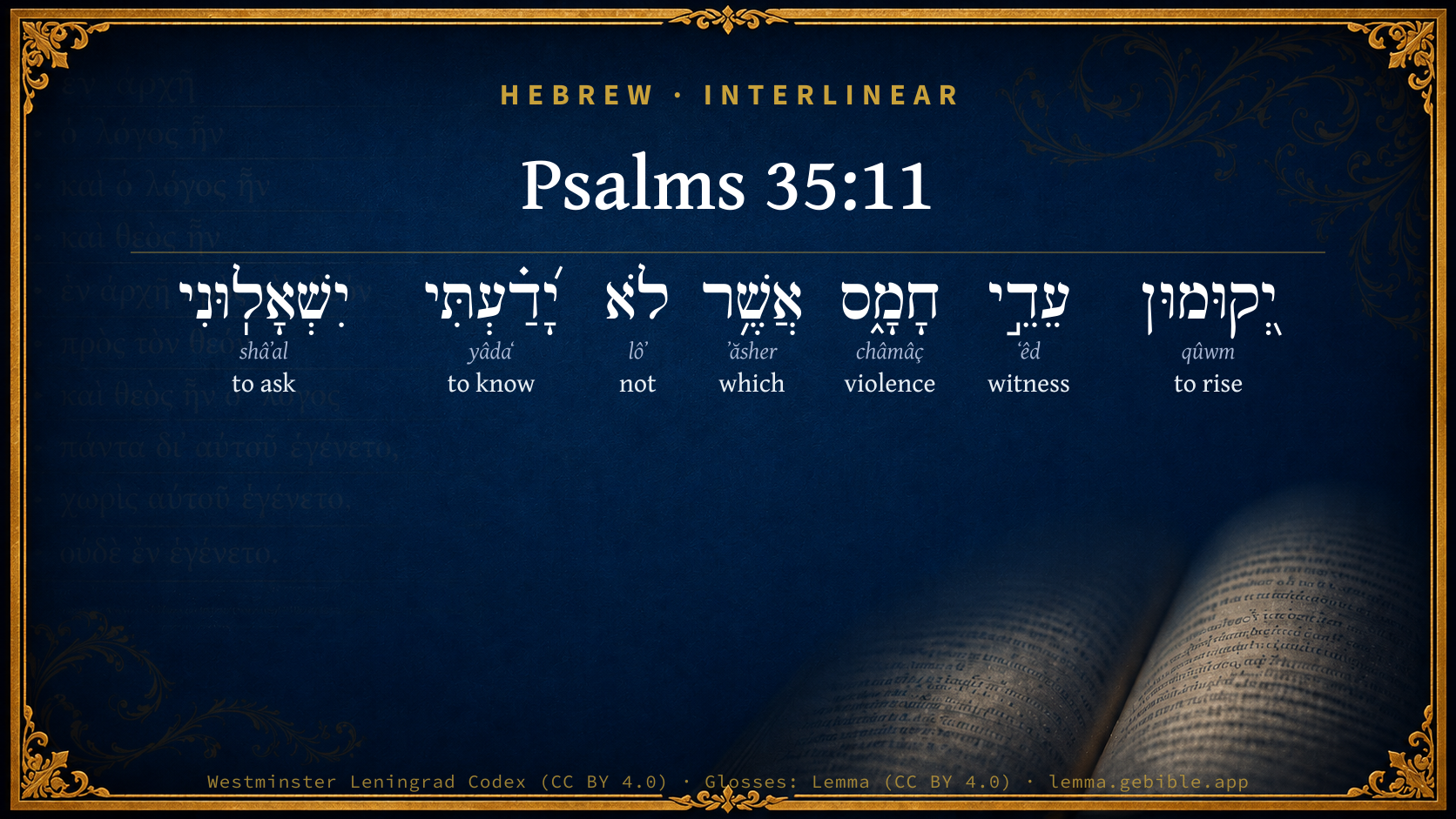
Hebrew (Westminster Leningrad Codex) Psalms 35:11 appears in the Hebrew Old Testament. The text above is from the Westminster Leningrad Codex. Each word links to its Strong’s number, a concise gloss, and parsing drawn from the Open Scriptures Hebrew Bible morphology. Click any word for its full Brown-Driver-Briggs (BDB) entry.
Download image
Cite this verse

Psalms 35:11 (World English Bible). Public Domain. Lemma interlinear Bible study tool, https://lemma.gebible.app/v/psalms/35/11.

Show BibTeX & RIS
BibTeX
RIS
English Translation
Unrighteous witnesses rise up. They ask me about things that I don't know about.
World English Bible · Public Domain
Download a study sheet

One document with this verse’s original text, its word-by-word gloss line, the meaning frame, cross-references with their text, attributed commentary, and full source and license credits — printable, and it pastes into notes with its structure intact.

This verse Autodidact and up

Study sheet (.html) Plain text (.txt)

A passage Seminary Student

Up to 50 verses in one chapter. A passage sheet keeps up to 6 commentary sources and 12 cross-references per verse, in the order this page ranks them, and says so on the sheet whenever that leaves anything out. Ask for a single verse and you get the Autodidact verse sheet above.

Everything on this page stays free to read, with no account — the sheet is a download of what is already on screen, not access to it.

Want to remove ads? Support Godless Engineer
Compare translations 3

The same verse in 3 English versions, stacked beneath the original-language interlinear above. Click any original word for its lexicon entry.

Each is an independent rendering of the whole verse — the interlinear is not word-aligned to these translations.

Highlighted words mark where these versions differ — a whole-verse word diff, not a word-by-word alignment.

  • World English Bible Public Domain
    Unrighteous witnesses rise up. They ask me about things that I don't know about.
  • King James Version Public Domain
    False witnesses did rise up; they laid to my charge things that I knew not.
  • unfoldingWord Literal Text CC BY-SA 4.0
    Witnesses of violence rise up; what I do not know they ask me.

unfoldingWord Literal Text — © unfoldingWord, licensed CC BY-SA 4.0. Word-aligned USFM3 via Door43 (git.door43.org/unfoldingWord/en_ult).

Versions to compare (up to 4)

3 of 4 selected

Show all 18 translations

Every available English version of this verse, each an independent rendering of the whole verse.

  • World English Bible Public Domain
    Unrighteous witnesses rise up. They ask me about things that I don't know about.
  • Berean Standard Bible Public Domain
    Hostile witnesses come forward; they make charges I know nothing about.
  • Majority Standard Bible Public Domain
    Hostile witnesses come forward; they make charges I know nothing about.
  • King James Version Public Domain
    False witnesses did rise up; they laid to my charge things that I knew not.
  • American Standard Version (1901) Public Domain
    Unrighteous witnesses rise up; They ask me of things that I know not.
  • Revised Version (1885) Public Domain
    Unrighteous witnesses rise up; they ask me of things that I know not.
  • Geneva Bible (1599) Public Domain
    Cruell witnesses did rise vp: they asked of me things that I knewe not.
  • Douay-Rheims (1899) Public Domain
    Unjust witnesses rising up have asked me things I knew not.
  • Young's Literal Translation Public Domain
    Violent witnesses rise up, That which I have not known they ask me.
  • Literal Standard Version CC BY-SA 4.0
    Violent witnesses rise up, || That which I have not known they ask me.
  • Unlocked Literal Bible CC BY-SA 4.0
    Unrighteous witnesses rise up; they accuse me falsely.
  • unfoldingWord Literal Text CC BY-SA 4.0
    Witnesses of violence rise up; what I do not know they ask me.
  • Darby Bible Public Domain
    Unrighteous witnesses rise up; they lay to my charge things which I know not.
  • World Messianic Bible Public Domain
    Unrighteous witnesses rise up. They ask me about things that I don’t know about.
  • Webster's Bible Public Domain
    False witnesses arose; they laid to my charge things that I knew not.
  • Free Bible Version CC BY-SA 4.0
    Hostile witnesses stand up to testify against me, accusing me of crimes I don't know anything about.
  • Bible in Basic English Public Domain
    False witnesses got up: they put questions to me about crimes of which I had no knowledge.
  • JPS Tanakh (1917) Public Domain
    Unrighteous witnesses rise up; they ask me of things that I know not.

Literal Standard Version (2020), Covenant Press — licensed CC BY-SA 4.0. Text via the HelloAO Bible API (eBible.org). Unlocked Literal Bible (unfoldingWord) — licensed CC BY-SA 4.0. Text via the HelloAO Bible API (eBible.org). unfoldingWord Literal Text — © unfoldingWord, licensed CC BY-SA 4.0. Word-aligned USFM3 via Door43 (git.door43.org/unfoldingWord/en_ult). Free Bible Version, Dr. Jonathan Gallagher — licensed CC BY-SA 4.0. Text via the HelloAO Bible API (eBible.org).

Word by word

More ways to search: Search by grammar → Find every occurrence → Compare this word →

Practice this passage: Drill this verse → Learn its vocabulary →

About this verse

These counts appear in no published source. They are computed here, from the morphology-tagged text and Lemma’s own curated glosses. What Lemma adds →

7
words
7
distinct lemmas
Wisdom
section

Shared distinctive vocabulary

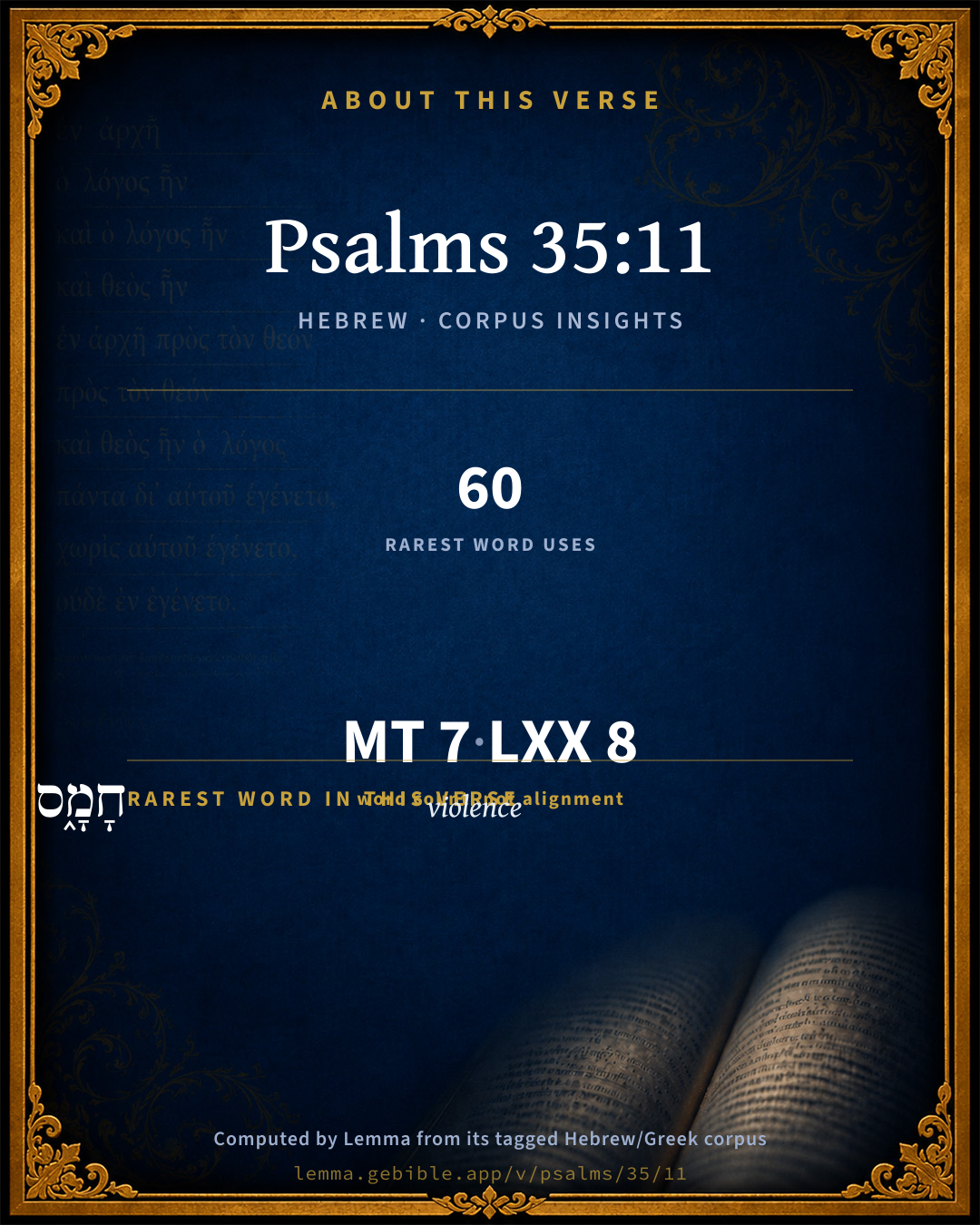
חָמָ֑ס violence H2555 occurs in 59 verses of the Hebrew Bible. Also found in:

Grammatical profile

  • 3 verbs
  • 2 nouns
  • 2 particles

Verb forms

  • יְ֭קוּמוּן Qal · Imperfect
  • יָ֝דַ֗עְתִּי Qal · Perfect
  • יִשְׁאָלֽוּנִי Qal · Imperfect

Hebrew & Septuagint length

In English translation the verse runs 14 words from the Hebrew and 11 from the Septuagint (LXX English) — closely comparable.

A rough comparison of the two English renderings, which tokenize alike — not a word-level alignment.

Word counts can differ between the Hebrew and the Greek without any difference in meaning — e.g. the Hebrew direct-object marker אֵת has no separate Greek word, and Greek often adds the article ὁ.

In the original languages it is 7 Hebrew tokens and 8 Greek tokens — but the two are counted differently (Hebrew bundles its prefixes and suffixes into one token; the Greek is in lemma form), so that isn’t a like-for-like length.

Cross-references

7

Topical passages linked to Psalms 35:11 in the Treasury of Scripture Knowledge — connected by theme and wording, ordered by reader-vote popularity; previews shown in the World English Bible.

  • Psalms 27:12 Don't deliver me over to the desire of my adversaries, For false witnesses have risen up against me, Such as breathe out cruelty.
  • Matthew 26:59–60 Now the chief priests, the elders, and the whole council sought false testimony against Jesus, that they might put him to death;
  • 1 Samuel 24:9 David said to Saul, Why listen you to men's words, saying, Behold, David seeks your hurt?
  • Acts 6:13 and set up false witnesses who said, "This man never stops speaking blasphemous words against this holy place and the law.
  • 1 Samuel 25:10 Nabal answered David's servants, and said, Who is David? and who is the son of Jesse? there are many servants now-a-days who break away every man from his master.
  • Acts 24:5–6 For we have found this man to be a plague, an instigator of insurrections among all the Jews throughout the world, and a ringleader of the sect of the Nazarenes.
  • Acts 24:12–13 In the temple they didn't find me disputing with anyone or stirring up a crowd, either in the synagogues, or in the city.

Cross-references courtesy of OpenBible.info (CC BY 4.0).

Hebrew and Greek witnesses Masoretic Hebrew ↔ Greek Septuagint

The same verse in the two great witnesses to the Old Testament, shown verse-for-verse.

You’re reading Greek Psalm 34 (Hebrew Psalm 35). The Septuagint counts the superscription, so verse numbers can differ from the Hebrew — chapter-level alignment, not verse-by-verse. Numbering follows Rahlfs.

These are two independent witnesses, not word-aligned to each other, and the Septuagint is shown in lemma (dictionary) form.

Hebrew Psalms 35:11 Masoretic · Westminster Leningrad Codex

יְ֭קוּמוּן עֵדֵ֣י חָמָ֑ס אֲשֶׁ֥ר לֹא יָ֝דַ֗עְתִּי יִשְׁאָלֽוּנִי

Unrighteous witnesses rise up. They ask me about things that I don't know about.

World English Bible · Public Domain

Greek LXX Greek Psalm 34:11 Septuagint · lemma form

ἀναἵστημι μάρτυς ἄδικος ὅς οὐ γιγνώσκω ἔρως ἐγώ

Unjust witnesses arose, and asked me of things I new not.

LXX2012 (modern English Septuagint) · Public Domain

On this verse, Keil & Delitzsch discusses the Septuagint’s reading. Read the note in Commentary ↓

Hebrew: Westminster Leningrad Codex (CC BY 4.0). Greek: Septuagint (public domain); English from LXX2012 (modern English Septuagint) (Public Domain). How the Septuagint differs from the Hebrew →

Commentary

Notes on Psalms 35:11 from classic Christian and Jewish commentators (each source and its license shown beneath its notes). The classic Christian expositions comment on the surrounding passage and are grouped to its opening verse, so a note may address several verses; the Jewish commentaries on the Tanakh (Rashi and others) are per-verse, so they appear only where the commentator wrote on this verse.

Lemma curates 59 commentaries, every one of them public domain or Creative Commons licensed, each selected and text-cleaned for this edition rather than reprinted as found. About our sources →

Matthew Henry's Commentary

Two very wicked things David here lays to the charge of his enemies, to make good his appeal to God against them - perjury and ingratitude.

I. Perjury, Psa 35:11. When Saul would have David attainted of treason, in order to his being outlawed, perhaps he did it with the formalities of a legal prosecution, produced witnesses who swore some treasonable words or overt acts against him, and he being not present to clear himself (or, if he was, it was all the same), Saul adjudged him a traitor. This he complains of here as the highest piece of injustice imaginable: False witnesses did rise up, who would swear anything; they laid to my charge things that I knew not, nor ever thought of. See how much the honours, estates, liberties, and lives, even of the best men, lie at the mercy of the worst, against whose false oaths innocency itself is no fence; and what reason we have to acknowledge with thankfulness the hold God has of the consciences even of bad men, to which it is owing that there is not more mischief done in that way than is. This instance of the wrong done to David was typical, and had its accomplishment in the Son of David, against whom false witnesses did arise, Mat 26:60. If we be at any time charged with what we are innocent of let us not think it strange, as though some new thing happened to us; so persecuted they the prophets, even the great prophet.

II. Ingratitude. Call a man ungrateful and you can call him no worse. This was the character of David's enemies (Psa 35:12): They rewarded me evil for good. A great deal of good service he had done to his king, witness his harp, witness Goliath's sword, witness the foreskins of the Philistines; and yet his king vowed his death, and his country was made too hot for him. This is to the spoiling of his soul; this base unkind usage robs him of his comfort, and cuts him to the heart, more than any thing else. Nay, he had deserved well not only of the public in general, but of those particular persons that were now most bitter against him. Probably it was then well known whom he meant; it may be Saul himself for one, whom he was sent for to attend upon when he was melancholy and ill, and to whom he was serviceable to drive away the evil spirit, not with his harp, but with his prayers; to others of the courtiers, it is likely, he had shown this respect, while he lived at court, who now were, of all others, most abusive to him. Herein he was a type of Christ, to whom this wicked world was very ungrateful. Joh 10:32. Many good works have I shown you from my Father; for which of those do you stone me? David here shows,

1. How tenderly, and with what a cordial affection, he had behaved towards them in their afflictions (Psa 35:13, Psa 35:14): They were sick. Note, Even the palaces and courts of princes are not exempt from the jurisdiction of death and the visitation of sickness. Now when these people were sick, (1.) David mourned for them and sympathized with them in their grief. They were not related to him; he was under no obligations to them; he would lose nothing by their death, but perhaps be a gainer by it; and yet he behaved himself as though they had been his nearest relations, purely from a principle of compassion and humanity. David was a man of war, and of a bold stout spirit, and yet was thus susceptible of the impressions of sympathy, forgot the bravery of the hero, and seemed wholly made up of love and pity; it was a rare composition of hardiness and tenderness, courage and compassion, in the same breast. Observe, He mourned as for a brother or mother, which intimates that it is our duty, and well becomes us, to lay to heart the sickness, and sorrow, and death of our near relations. Those that do not are justly stigmatized as without natural affection. (2.) He prayed for them. He discovered not only the tender affection of a man, but the pious affection of a saint. He was concerned for their precious souls, and, since he helped them with his prayers to God for mercy and grace; and the prayers of one who had so great an interest in heaven were of more value than perhaps they knew or considered. With his prayers he joined humiliation and self-affliction, both in his diet (he fasted, at least from pleasant bread) and in his dress; he clothed himself with sackcloth, thus expressing his grief, not only for their affliction, but for their sin; for this was the guise and practice of a penitent. We ought to mourn for the sins of those that do not mourn for them themselves. His fasting also put an edge upon his praying, and was an expression of the fervour of it; he was so intent in his devotions that he had no appetite to meat, nor would allow himself time for eating: "My prayer returned into my own bosom; I had the comfort of having done my duty, and of having approved myself a loving neighbour, though I could not thereby win upon them nor make them my friends." We shall not lose by the good offices we have done to any, how ungrateful soever they are; for our rejoicing will be this, the testimony of our conscience.

2. How basely and insolently and with what a brutish enmity, and worse than brutish, they had behaved towards him (Psa 35:15, Psa 35:16); In my adversity they rejoiced. When he fell under the frowns of Saul, was banished the court, and persecuted as a criminal, they were pleased, were glad at his calamities, and got together in their drunken clubs to make themselves and one another merry with the disgrace of this great favourite. Well, might he call them abjects, for nothing could be more vile and sordid than to triumph in the fall of a man of such unstained honour and consummate virtue. But this was not all. (1.) They tore him, rent his good name without mercy, said all the ill they could of him and fastened upon him all the reproach their cursed wit and malice could reach to. (2.) They gnashed upon him with their teeth; they never spoke of him but with the greatest indignation imaginable, as those that would have eaten him up if they could. David was the fool in the play, and his disappointment all the table-talk of the hypocritical mockers at feasts; it was the song of the drunkards. The comedians, who may fitly be called hypocritical mockers (for which does a hypocrite signify but a stage-player?) and whose comedies, it is likely, were acted at feasts and balls, chose David for their subject, bantered and abused him, while the auditory, in token of their agreement with the plot, hummed, and gnashed upon him with their teeth. Such has often been the hard fate of the best of men. The apostles were made a spectacle to the world. David was looked upon with ill-will for no other reason than because he was caressed by the people. It is a vexation of spirit which attends even a right work that for this a man is envied of his neighbour, Ecc 4:4. And who can stand before envy? Pro 27:4.

Matthew Henry's Commentary on the Whole Bible (1708–1710) — public domain (CC PDM 1.0). Text via the HelloAO Bible API.

Trapp's Complete Commentary

John Trapp

Psa 35:11 False witnesses did rise up; they laid to my charge [things] that I knew not.

Ver. 11. False witnesses did rise up] So they did afterward against the Lord Christ and sundry of his faithful servants, as St Paul, Athanasius, Eustathius, bishop of Antioch (falsely accused of adultery, and deposed, about the end of Constantine the Great’s reign), Cranmer, charged with adultery, heresy, and treason; Philpot, with parricide; Latimer, with sedition; whereof he was so innocent, that he feared not to say in a sermon before the king, As for sedition, for aught that I know, methinks I should not need Christ, if I may so say.

They laid to my charge things that I knew not] Such as whereof I was not only innocent, but ignorant also. The Hebrew is, They asked me, and so would have, by cunningly contrived questions, made me mine own accuser.

John Trapp, A Commentary or Exposition upon All the Books of the Old and New Testament (1647–1656) — public domain. Text from a community e-Sword module.

Joseph Benson's Commentary

Psa 35:11-12. They laid to my charge things I knew not — They accused me to Saul of treacherous designs against his crown and life, and of other crimes of which I was wholly innocent and ignorant. They rewarded me evil for good — For the good offices which I performed to divers of them when I had favour and power in Saul’s court and camp. To the spoiling of my soul — That is, to the stripping of my person of all my comforts and hopes, and of my life itself. This interpretation of the passage, the reader will observe, is given according to the present translation. But the Hebrew verbs, יקומו, ישׁאלו, ישׁלמו, jeshallemu, jishalu, jekumu, are all in the future tense, and the clauses are more properly rendered, False witnesses will rise up, &c.; They will lay to my charge, &c.; They will reward me, &c., which seems to intimate that the prophet was speaking of what was then future, and in the person of him against whom false witnesses did arise, to whose charge they laid things he knew not, and whom they rewarded evil for good; “who, because our souls were sick, clothed himself with the sackcloth of our flesh; mourning at the very thought that his prayers, in any measure, should return into his own bosom.” See Fenwick.

Joseph Benson's Commentary on the Old and New Testaments (1811–1818) — public domain. Text from a community e-Sword module.

Keil & Delitzsch

C. F. Keil & F. Delitzsch

The second part begins with two strophes of sorrowful description of the wickedness of the enemy. The futures in Psa 35:11, Psa 35:12 describe that which at present takes place. עדי חמס are μάρτυρες ἄδικοι (lxx). They demand from him a confession of acts and things which lie entirely outside his consciousness and his way of acting (cf. Psa 69:5): they would gladly brand him as a perjurer, as an usurper, and as a plunderer. What David complains of in Psa 35:12, we hear Saul confess in Sa1 24:18; the charge of ingratitude is therefore well-grounded. שׁכול לנפשׁי is not dependent on ישׁלּמוּני, in which case one would have looked for כּשׁול rather than שׁכול, but a substantival clause: "bereavement is to my soul," its condition is that of being forsaken by all those who formerly showed me marks of affection; all these have, as it were, died off so far as I am concerned. Not only had David been obliged to save his parents by causing them to flee to Moab, but Michal was also torn from him, Jonathan removed, and all those at the court of Saul, who had hitherto sought the favour and friendship of the highly-gifted and highly-honoured son-in-law of the king, were alienated from him. And how sincerely and sympathisingly had he reciprocated their leanings towards himself! By ואני in Psa 35:13, he contrasts himself with the ungrateful and unfeeling ones. Instead of לבשׁתּי שׁק, the expression is לבוּשׁי שׁק; the tendency of poetry for the use of the substantival clause is closely allied to its fondness for well-conceived brevity and pictorial definition. He manifested towards them a love which knew no distinction between the ego and tu, which regarded their sorrow and their guilt as his own, and joined with them in their expiation for it; his head was lowered upon his breast, or he cowered, like Elijah (Kg1 18:42), upon the ground with his head hanging down upon his breast even to his knees, so that that which came forth from the inmost depths of his nature returned again as it were in broken accents into his bosom. Riehm's rendering, "at their ungodliness and hostility my prayer for things not executed came back," is contrary to the connection, and makes one look for אלי instead of אל־חיקי. Perret-Gentil correctly renders it, Je priai la tte penche sur la poitrine.

The Psalmist goes on to say in Psa 35:14, I went about as for a friend, for a brother to me, i.e., as if the sufferer had been such to me. With התחלּך, used of the solemn slowness of gait, which corresponds to the sacredness of pain, alternates שׁחח used of the being bowed down very low, in which the heavy weight of pain finds expression. כּאבל־אם, not: like the mourning (from אבל, like הבל from הבל) of a mother (Hitzig), but, since a personal אבל is more natural, and next to the mourning for an only child the loss of a mother (cf. Gen 24:67) strikes the deepest wound: like one who mourns (אבל־,

(Note: According to the old Babylonian reading (belonging to a period when Pathach and Segol were as yet not distinguished from one another), כּאבל (with the sign of Pathach and the stroke for Raphe below = ); vid., Pinsker, Zur Geschichte des Karaismus, S. 141, and Einleitung, S. 118.)

like לבן־, Gen 49:12, from אבל, construct state, like טמא) for a mother (the objective genitive, as in Gen 27:41; Deu 34:8; Amo 8:10; Jer 6:26). קדר signifies the colours, outward appearance, and attire of mourning: with dark clothes, with tearful unwashed face, and with neglected beard. But as for them - how do they act at the present time, when he finds himself in צלע (Psa 38:17; Job 18:12), a sideway direction, i.e., likely to fall (from צלע, Arab. ḍl‛, to incline towards the side)? They rejoice and gather themselves together, and this assemblage of ungrateful friends rejoicing over another's misfortune, is augmented by the lowest rabble that attach themselves to them. The verb נכה means to smite; Niph. נכּא, Job 30:6, to be driven forth with a whip, after which the lxx renders it μάστιγες, Symm. πλῆκται, and the Targum conterentes me verbis suis; cf. הכּה בּלשׂון, Jer 18:18. But נכים cannot by itself mean smiters with the tongue. The adjective נכה signifies elsewhere with רגלים, one who is smitten in the feet, i.e., one who limps or halts, and with רוּח, but also without any addition, in Isa 16:7, one smitten in spirit, i.e., one deeply troubled or sorrowful. Thus, therefore, נכים from נכה, like גּאים from גּאה, may mean smitten, men, i.e., men who are brought low or reduced (Hengstenberg). It might also, after the Arabic nawika, to be injured in mind, anwak, stupid, silly (from the same root נך, to prick, smite, wound, cf. ichtalla, to be pierced through = mad), be understood as those mentally deranged, enraged at nothing or without cause. But the former definition of the notion of the word is favoured by the continuation of the idea of the verbal adjective נכים by ולא ידעתּי, persons of whom I have hitherto taken no notice because they were far removed from me, i.e., men belonging to the dregs of the people (cf. Job 19:18; Job 30:1). The addition of ולא ידעתי certainly makes Olshausen's conjecture that we should read נכרים somewhat natural; but the expression then becomes tautological, and there are other instances also in which psalm-poesy goes beyond the ordinary range of words, in order to find language to describe that which is loathsome, in the most glaring way. פרע, to tear, rend in pieces, viz., with abusive and slanderous words (like Arab. qr‛ II) also does not occur anywhere else.

And what remarkable language we now meet with in Psa 35:16! מעוג does not mean scorn or buffoonery, as Bttcher and Hitzig imagine,

(Note: The Talmudic עגה (לשׁון), B. Sanhedrin 101b, which is said to mean "a jesting way of speaking," has all the less place here, as the reading wavers between עגה (עגא) and אגא.)

but according to Kg1 17:12, a cake of a round formation (like the Talmudic עגּה, a circle); לעג, jeering, jesting. Therefore לעגי מעוג means: mockers for a cake, i.e., those who for a delicate morsel, for the sake of dainty fare, make scornful jokes, viz., about me, the persecuted one, vile parasites; German Tellerlecker, Bratenriecher, Greek κνισσοκόλακες, ψωμοκόλακες, Mediaeval Latin buccellarii. This לעגי מלוג, which even Rashi interprets in substantially the same manner, stands either in a logical co-ordinate relation (vid., on Isa 19:11) or in a logical as well as grammatical subordinate relation to its regens חנפי. In the former case, it would be equivalent to: the profane, viz., the cake-jesters; in the latter, which is the more natural, and quite suitable: the profane (= the profanest, vid., Psa 45:13; Isa 29:19; Eze 7:24) among cake-jesters. The בּ is not the Beth of companionship or fellowship, to express which עם or את (Hos 7:5) would have been used, but Beth essentiae or the Beth of characterisation: in the character of the most abject examples of this class of men do they gnash upon him with their teeth. The gerund חרק (of the noise of the teeth being pressed together, like Arab. ḥrq, of the crackling of a fire and the grating of a file), which is used according to Ges. 131, 4, b, carries its subject in itself. They gnash upon him with their teeth after the manner of the profanest among those, by whom their neighbour's honour is sold for a delicate morsel.

Keil & Delitzsch — Biblical Commentary on the Old Testament (1861–1891) — public domain (CC PDM 1.0). Text via the HelloAO Bible API. (Old Testament only.)

J. A. Alexander on Psalms

Joseph Addison Alexander

11. (Psa 35:11) There rise up witnesses of violence; (as to) that which I have not known they ask me. The future verbs describe the acts as still in progress, and as likely to be long continued. They are rising or about to rise, asking or about to ask. The word translated violence is one of very frequent occurrence in the psalms, and includes the ideas of injustice and cruelty. See above, on Psa 7:17 (16), Psa 10:5; Psa 18:49 (48), Psa 25:19; Psa 27:12. "They endeavour to draw from me the acknowledgment of crimes which I have not committed, and of which I have no knowledge."

Joseph Addison Alexander, The Psalms Translated and Explained (1850) — public domain. Text from a community e-Sword module.

Tyndale Open Study Notes

Tyndale Open Resources

35:11-18 The psalmist presents the Lord with the reasons for his suffering. Evil has many faces. He is tired and worn out, and he knows that only the Lord can help him.

35:11 Malicious witnesses want nothing but violence (see 11:4-6; 54:3).

Tyndale Open Study Notes — © Tyndale Open Resources, licensed CC BY-SA 4.0. Text via the HelloAO Bible API.

Geneva Bible (1599)

Geneva Bible translators

That would not suffer me to purge myself.

Geneva Bible (1599) marginal notes — public domain. Text via Bolls.life.

Jamieson, Fausset & Brown

Robert Jamieson, A. R. Fausset & David Brown

False witnesses--literally, "Witnesses of injustice and cruelty" (compare Psa 11:5; Psa 25:19).

Jamieson, Fausset & Brown — Commentary Critical and Explanatory on the Whole Bible (1871) — public domain (CC PDM 1.0). Text via the HelloAO Bible API.

Adam Clarke's Commentary

Verse 11. False witnesses did rise up] There is no doubt that several of this kind were found to depose against the life of David; and we know that the wicked Jews employed such against the life of Christ. See Mt 26:59-60.

They laid to my charge things that I knew not.] They produced the most unfounded charges; things of which I had never before heard.

Adam Clarke's Commentary on the Bible (1810–1826) — public domain. Text from a community e-Sword/MySword module.

John Calvin's Commentaries

11. Violent witnesses “עדי חמס witnesses of wrong or violence; i.e., witnesses deponing to acts of violence, as committed by the person accused. See Psalm 27:12.” — Horsley.

John Calvin's Commentaries (1540-1563) — public domain. Text from the Calvin Translation Society English edition (1840s-50s) via the Christian Classics Ethereal Library (ccel.org). Calvin's coverage is partial (roughly two-thirds of the Bible); uncommented books and verses are honest gaps, never fabricated. The 19th-century editor's footnotes and remarks are omitted so the notes are faithfully Calvin's own voice.

The Cambridge Bible for Schools and Colleges

gen. ed. J. J. S. Perowne

11. False witnesses] Rather, unrighteous, or, malicious, witnesses rise up; lit., witnesses of violence, as in Exo_23:1; Deu_19:16. Cp. Psa_27:12 (A.V. cruelty).

they laid to my charge &c.] R.V. they ask of me things that I know not: calling me to account for crimes, of which I have not even any knowledge. Cp. Psa_69:4. The phraseology is that of a court; not that the Psalmist is to be thought of as actually put upon his trial. David was falsely and maliciously accused of treason and conspiracy against the king’s life (1Sa_24:9). Cp. Mat_26:59 ff.

11–18. The causelessness of the Psalmist’s persecution and the ingratitude of his persecutors are urged as reasons for God’s interference on his behalf.

The Cambridge Bible for Schools and Colleges (gen. ed. J. J. S. Perowne; Cambridge University Press, 1878–1918) — public domain. Text from a community e-Sword module.

John Gill's Exposition

False witnesses did rise up,.... Against David, saying he sought the hurt of Saul, Sa1 24:9, as did against David's antitype, the Lord Jesus Christ, Mat 26:59; and against his apostles, Act 24:5; and very frequently do they rise up and bear false witness against his people, which is a very heinous crime;

they laid to my charge things that I knew not: such as David was not conscious of, never thought of doing, much less attempted to do; as the taking away of Saul's life, the contrary of which appeared by his cutting off his skirt only when he was in his hands, and taking away his spear from his bolster when he could have taken off his head; and such were the things laid to the charge of the Messiah, David's son, who knew no sin, nor did any; and the like are exhibited against his members, who go through good report and bad report, and whose good conversation is falsely accused by malicious men.

John Gill's Exposition of the Whole Bible (1746–1763) — public domain (CC PDM 1.0). Text via the HelloAO Bible API.

Albert Barnes' Notes on the Bible

False witnesses did rise up - Margin, “witnesses of wrong.” The Hebrew is, “witnesses of “violence,”” חמס châmâs. That is, they were persons who, in what they said of me, were guilty of injustice and wrong. Their conduct was injurious to me as an act of “violence” would be.

They laid to my charge - Margin, as in Hebrew: “they asked me.” The word “asked” here seems to be used in the sense of “demand;” that is, they demanded an “answer” to what was said. The usage appears to have been derived from courts, where the forms of trial may have been in the way of question and answer - the mode of accusation having been in the form of “asking” how a thing was, or whether it was so; and the defense being regarded as an “answer” to such an inquiry. Hence, it is synonymous with our expression of laying to the charge of anyone; or of accusing anyone.

Things that I knew not - Of which I had no knowledge; which never came into my mind. What those charges were the psalmist does not specify; but it is not uncommon for a good man to be falsely accused, and we are certain that such things occurred in the life of David.

Albert Barnes' Notes on the Bible (1834–1885) — public domain. Text from a community e-Sword/MySword module.

Matthew Poole's English Annotations

They accused me to Saul of treachery and designs against his crown and life, and other crimes whereof I was wholly innocent and ignorant.

Matthew Poole's English Annotations on the Holy Bible (1683–1685) — public domain. Text from a community e-Sword/MySword module.

The Treasury of David

Charles H. Spurgeon

Ver. 11. False witnesses did rise up. This is the old device of the ungodly, and we must not wonder if it be used against us as against our Master. To please Saul, there were always men to be found mean enough to impeach David. They laid to my charge things that I knew not. He had not even a though of sedition; he was loyal even to excess; yet they accused him of conspiring against the Lord's anointed. He was not only innocent, but ignorant of the fault alleged. It is well when our hands are so clean that no trace of dirt is upon them.

Ver. 11. They laid to my charge things that I knew not. You will say, Why does God permit wicked people to lay to the charge of the godly such things as they are clear of: God if he pleased could prevent it, and stop the mouths of the wicked, that they should not be able to speak against his children? Answer--As all things work for the best to them that love God, so this works for the good of God's people. God doth permit it for the good of his people, and thus he frustrates the hopes of the wicked: they intend evil against the godly, and God disposes of it for good. As Joseph said to his brethren, "You intended evil against me, and God disposed of it for good; "so we may say to such as falsely slander God's people, You intended evil against the people of God, but God disposes of it for good. There is fivefold good that God brings out of it to his people.

First, God doth by this means humble them, and brings them to examine what is amiss: so that though they be clear of that crime laid to their charge, yet they will then examine whether there be nothing else amiss betwixt God and them; they will search their hearts, and walk more humbly, and cleave more close to the Lord.

Secondly, God doth by this means bring them oftener upon their knees, to seek unto him, to plead their cause, and to clear their innocency. How oft did the prophet speak unto God when the wicked did falsely accuse him; how did he make his moan at the throne of grace unto God, beseeching him to plead his cause, and to keep him close in his way, that the wicked might not rejoice at his downfall! So when God's people see that it is that which the wicked would have, that which is their joy, to see the godly fall into such and such a sin; then the godly will pray more earnestly with David, Lord, lead me in a right path because of my observers; then they will be earnest with God to keep them from falling into that sin that the wicked desire they might fall into; and this is a second good that comes of it.

Thirdly, God doth us the reproach of the wicked as a preventing medicine against that crime which the wicked lay to their charge. The godly have unrenewed nature as well as renewed, and if God should leave them never so little to themselves, they are not their own keepers, they might fall into that sin which the wicked lay to their charge: and every godly man and woman may say when they are falsely accused, It is God's mercy that I did not fall into that sin they lay to my charge. God doth use wicked people's tongues as a warning against such a sin, that when they see how the wicked joy at a brat of their own hatching, then they consider, if the wicked thus joy without a cause, what would they do if they had just cause? Well, by the help of God this shall be a warning to me for ever to watch against that sin: for the time to come I will pray more against that particular sin than I have done, and watch more against that sin than I have done; through God's help they shall never have occasion to rejoice over me in that kind. Truly, I verily believe many a child of God can say by experience, I never should have prayed and watched against such a sin so much, had not God used the tongues of the wicked as preventing physic: I know not my own heart, but that I might have fallen into such and such a sin had not God by this means hedged up my way with thorns; and this is the third good comes of it.

Fourthly, God doth by this means exercise the graces of his people by letting them undergo bad report as well as good report: he tries whether they will cleave close to him in all conditions, as Ps 94:15-17.

Fifthly, God doth by this means teach them how to judge of others when they are falsely accused. For the time to come they will not receive a false report against their neighbour; they will know the truth of a thing before they believe it, and they know how to comfort others in the like condition; and thus God disposes of it for good, and thus God makes the wicked the servant of his people in that very thing which the wicked think to wrong them most in; for he uses the wicked as the rod and wisp, to scour off the rust of their graces and to correct their security; and when the rod hath done its office then it is thrown into the fire; and thus you see how God disposes of the wicked's false accusations of his people for good. Zephaniah Smyth's Sermon, "The Malignant's Plot", 1647.

Ver. 11. The meanness, cruelty, sinfulness, and commonness of slander.

Psalms 35:12*

Charles H. Spurgeon's The Treasury of David (1869–1885) — public domain. Psalms only. Text from a community e-Sword/MySword module.

Whedon's Commentary on the Bible

Daniel D. Whedon

11. The second division of the psalm opens with unalleviated complaint, in a comparison of his own conduct with that of his enemies.

False witnesses—Violent witnesses. They vehemently accuse him. The scene is changed from a battle to a court. Laid to my charge, etc.—They made legal inquiry of things of which he was ignorant. Though the tenses are future, the present and the past are evidently intended, and it would seem as a reminiscence of experience while in the court of Saul. Compare with this the trial of Jesus. Such must ever be the method of procedure where the court and the witnesses are pre-determined to reward evil for good, and condemn the accused.

Daniel D. Whedon (gen. ed.), Commentary on the Old and New Testaments (1874–1909) — public domain. Text from a community e-Sword module.

The Pulpit Commentary

Vers. 11-18. The second part of the psalm begins with a long complaint, David sets forth the woes under which he is suffering. There are:

1. Calumny (ver. 11).

2. Ingratitude (vers. 12-14).

3. Malevolence (ver. 15).

4. Insult from the vile and base (ver. 16).

He then passes to prayer: Will not God rescue him (ver. 17)? In conclusion, he for the second time promises praise and thanks (ver. 18).

Vers. 11-18. The wicked and the good.

The general subject in this section of the psalm is a contrast between the wicked and the good, setting forth the baseness of the wicked nature, and the generous sympathies of the good.

I THE BASENESS OF THE WICKED. Their general characteristics are:

1. They often bring false malicious charges against good men. (Ver. 11) "They demand satisfaction at my hands for injuries of which I have never even heard.

2. They return evil for good. (Ver. 12) They had been former friends: this was the sting of their ingratitude and injustice. Former favours sour the minds of the ungrateful, and intensify their hatred.

3. They exult over the calamities of the good, and insult and injure them. (Ver. 15) "The tender mercies of the wicked are cruel," and cruelty always embrutes the bad mind.

4. They incite the senseless rabble to persecute good men. (Ver. 16) The multitude ever ready without reason to join in a hue and cry, and, without thinking, are ready to become the instruments of bad men.

II THE NOBILITY OF THE GOOD.

1. Broken friendships fill them with a sense of bereavement. (Ver. 12) The good hunger for love, as well as give it; and, when denied it, are afflicted with a sense of loneliness.

2. They are deeply sympathetic with the afflictions of others. (Vers. 13, 14) They fast and pray in token of the sincerity and depth of their sympathy.

3. In the calamities and sorrows of life the good turn to God for help and deliverance. (Ver. 17) Especially the more they feel deserted by former friends.

4. They are constrained to give thanks to God for his mercies. (Ver. 18) They are not ungrateful, like the wicked. Gratitude is a joy to the generous and religious mind. S. False witnesses did rise up; they laid to my charge things that I know not; (comp. Psa_27:12) literally, malicious, or unrighteous witnesses. (see Exo_23:1) It is not probable that witnesses in a court are intended. David"s calumniators accused him privately to Saul of "seeking his hurt", (1Sa_24:9) and so stirred Saul up against him. (1Sa_26:19) By what is here said, they appear to have accused him to his face, and to have endeavoured to extort from him a confession of guilt.

The Pulpit Commentary (1880–1919), ed. H.D.M. Spence-Jones & Joseph S. Exell — public domain. Text from a community e-Sword module.

Kretzmann's Popular Commentary

Paul E. Kretzmann

The Hypocrisy and Malice of the Wicked

v. 11. False witnesses, literally, "witnesses of violence," did rise up, with unjust accusations; they laid to my charge things that I knew not, of which he knew himself to be innocent.

v. 12. They rewarded me evil for good, which he, on his part, was trying to show them, to the spoiling of my soul, to make his soul bereaved, to make him friendless, to isolate him.

v. 13. But as for me, when they were sick, my clothing was sackcloth, in sympathetic mourning for their trouble; I humbled my soul with fasting, in making their sorrow his own; and my prayer returned into mine own bosom, for he was bowed forward so far, with his head lowered, that his voice sounded against his own bosom. Thus he had entreated for his enemies in the greatest earnestness and humility.

v. 14. I behaved myself as though he, the enemy in distress, had been my friend or brother; I bowed down heavily, in dust and ashes, so that he appeared squalid and dirty, as one that mourneth for his mother, in the very deepest grief.

v. 15. But in mine adversity, his halting, lameness, said of any deep distress, they rejoiced, and gathered themselves together, to witness the spectacle of his great trouble; yea, the abjects, contemptible, degraded persons, gathered themselves together against me, and I knew it not, people of whom he had till then not even taken notice; they did tear me and ceased not, attacked him with scorn and laughter, and were not silent;

v. 16. with hypocritical mockers in feasts, those who love to make sport of a poor sufferer by cracking biting jokes at his expense, they gnashed upon me with their teeth, in a gesture of sneering contempt, probably also with stammering of distorted things.

v. 17. Lord, how long wilt Thou look on? namely, without doing something to effect deliverance for him. Rescue my soul from their destruction, my darling, literally, "my only one," from the lions, from the wild and ravenous people who were treating him so contemptuously.

v. 18. I will give Thee thanks in the great congregation, paying his vows of thanksgiving with all the other believers; I will praise Thee among much people, people. of numbers and might. The congregation of believers may seem small and weak in the eyes of the world, but before the Lord and in His might they are invincible.

Paul E. Kretzmann, Popular Commentary of the Bible (1921–1924) — public domain. Text from a community e-Sword module.

unfoldingWord translationNotes

Door43 World Missions Community

rise up

This means they testify in a trial. AT: "volunteer to give a testimony" (See: Idiom)

They repay me evil for good

This is a metaphor which means they give back evil in exchange for the good they have received. AT: "In return for my doing good things for them, they do evil things to me" (See: Metaphor)

evil ... good

These abstract nouns can be stated in other forms. AT: "evil things ... good things" (See: Abstract Nouns)

I am sorrowful

"I am extremely sad"

translationWords

righteous

corrupt witness

raise

accuse

evil

good

unfoldingWord translationNotes — © Distant Shores Media and the Door43 World Missions Community, licensed CC BY-SA 4.0. Source: git.door43.org/Door43/en_tn.

Rashi

Rabbi Shlomo Yitzchaki (Rashi)

False witnesses rise up constantly against me, etc.

Rashi on the Tanakh — English translations: “The Judaica Press complete Tanach with Rashi, translated by A. J. Rosenberg” (CC BY 4.0); “Pentateuch with Rashi's commentary by M. Rosenbaum and A.M. Silbermann, 1929-1934” (public domain); “The Metsudah Tanach series, Lakewood, N.J” (CC BY 4.0); and “The Book of Joshua, Metsudah Publications, 1997” (CC BY 4.0). Text via Sefaria.

Lesson kit

Teaching starters — assembled from the data on this page, not authored interpretation. Every prompt links to the verse data it draws on. Edit before teaching.

Psalms, in the Wisdom, opens this verse with 7 words (7 distinct Hebrew lemmas). Its most distinctive word is châmâç (“violence”). A historical commentator’s framing appears above. Read the whole chapter for the surrounding context.

Discussion questions

  1. The word châmâç carries the sense “violence.” How does it shape the verse?
  2. Genesis 6:11 shares the word «violence» with this verse. How do the two illuminate each other?
  3. These translations render this verse differently; the difference is in the English rendering, not the original. What questions does that raise?
  4. The verb «יְ֭קוּמוּן» is Qal Imperfect. How does its form color the action?
  5. Reading how Matthew Henry's Commentary and Trapp's Complete Commentary read this verse, where do the two commentators agree and where do they part?

Things to notice

Reading settings

Reading text

Shown beneath each verse's original-language words.

Old Testament
Old Testament edition

Read the OT as the Masoretic Hebrew (MT) or the Greek Septuagint (LXX).

English shown for the Greek Septuagint (in the Hebrew ↔ Greek comparison).

Comparing translations? Open the Compare panel on any verse page to stack up to four side by side.