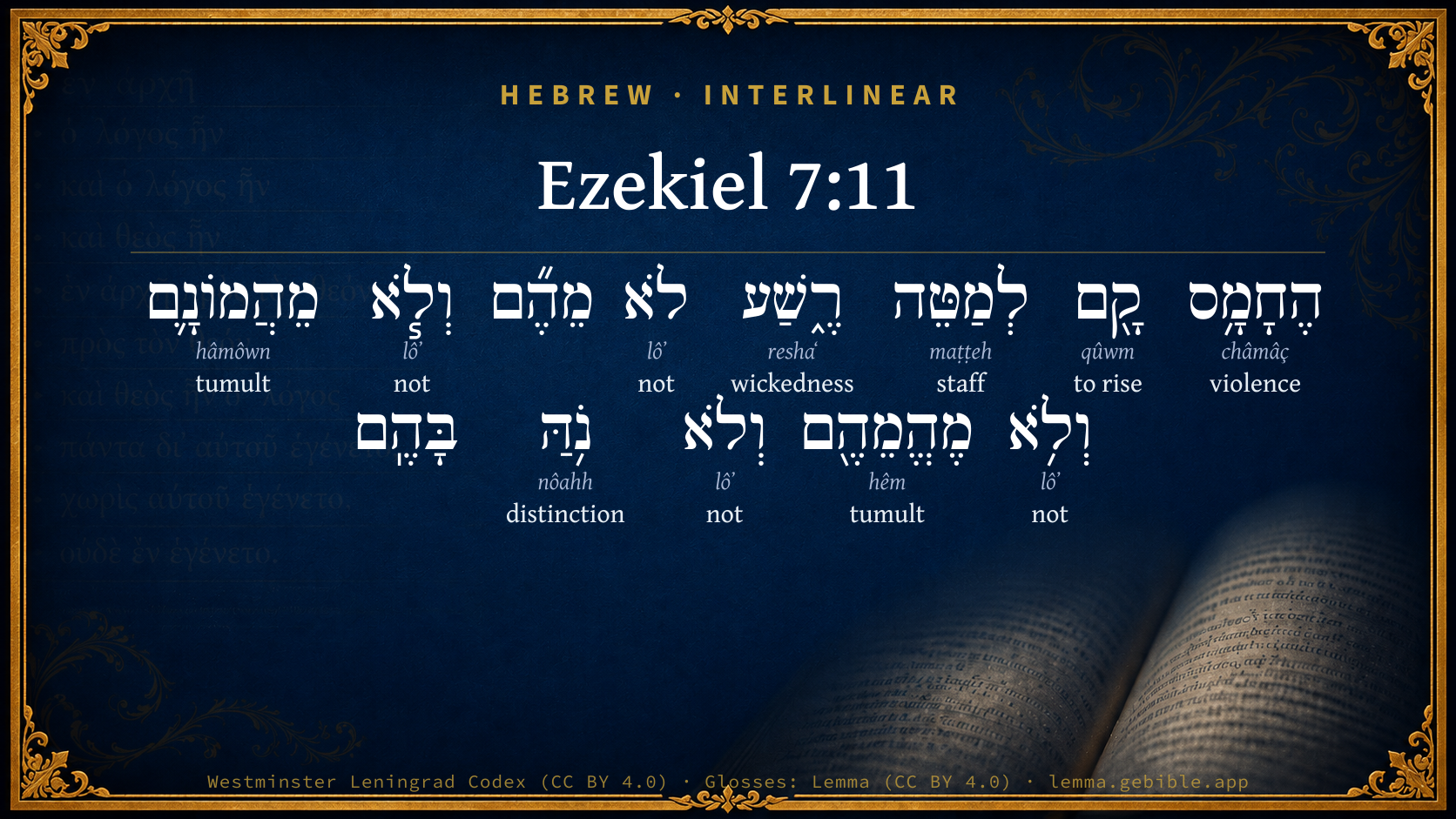
Ezekiel 7:11

Hebrew (Westminster Leningrad Codex) Ezekiel 7:11 appears in the Hebrew Old Testament. The text above is from the Westminster Leningrad Codex. Each word links to its Strong’s number, a concise gloss, and parsing drawn from the Open Scriptures Hebrew Bible morphology. Click any word for its full Brown-Driver-Briggs (BDB) entry.
Download image
Cite this verse

Ezekiel 7:11 (World English Bible). Public Domain. Lemma interlinear Bible study tool, https://lemma.gebible.app/v/ezekiel/7/11.

Show BibTeX & RIS
BibTeX
RIS
English Translation
Violence is risen up into a rod of wickedness; none of them [shall remain], nor of their multitude, nor of their wealth: neither shall there be eminency among them.
World English Bible · Public Domain
Highlights
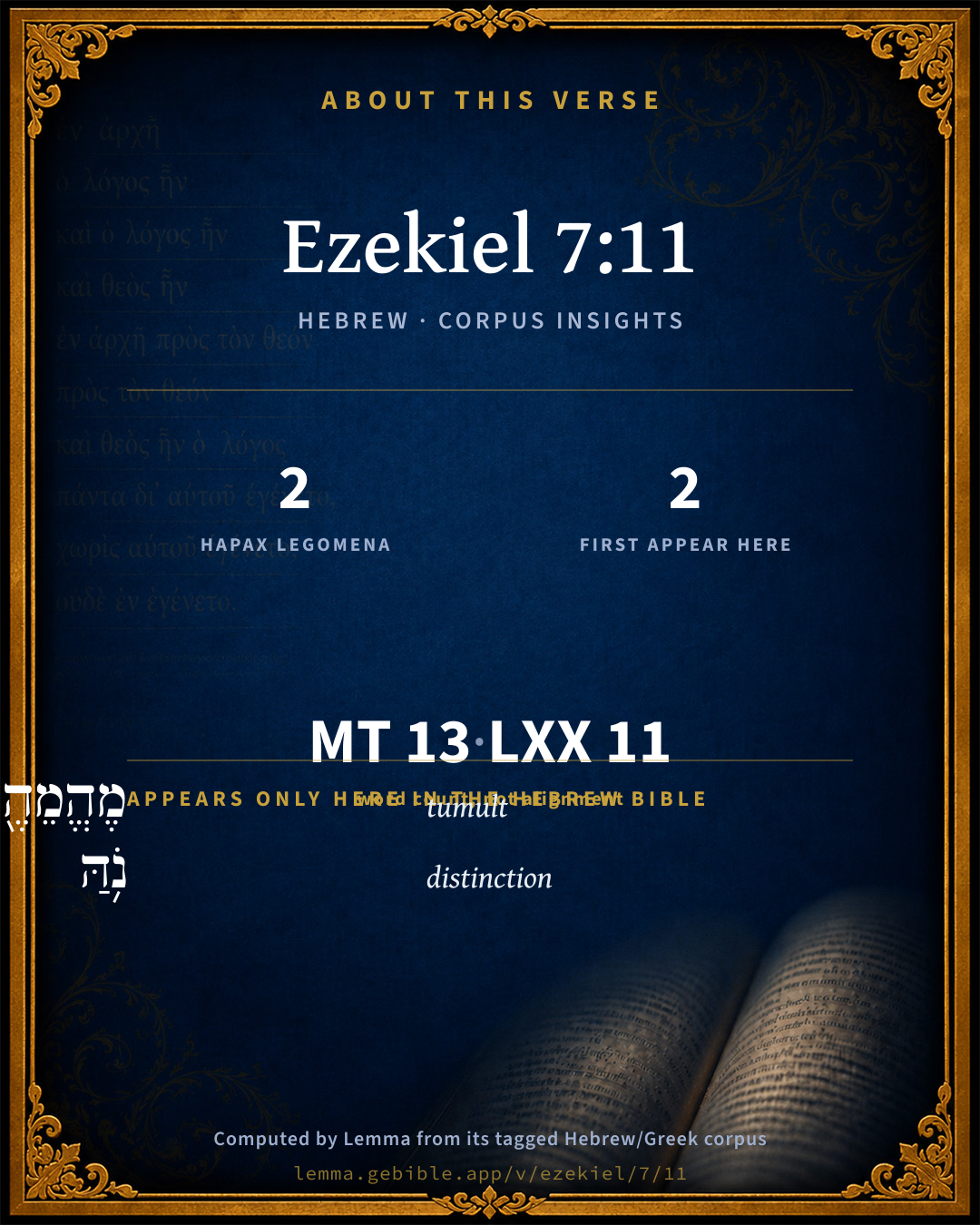
  • 2 hapax legomena — only here in the Hebrew Bible
  • 2 first appearances in the Hebrew Bible
Full analysis ↓
Download a study sheet

One document with this verse’s original text, its word-by-word gloss line, the meaning frame, cross-references with their text, attributed commentary, and full source and license credits — printable, and it pastes into notes with its structure intact.

This verse Autodidact and up

Study sheet (.html) Plain text (.txt)

A passage Seminary Student

Up to 50 verses in one chapter. A passage sheet keeps up to 6 commentary sources and 12 cross-references per verse, in the order this page ranks them, and says so on the sheet whenever that leaves anything out. Ask for a single verse and you get the Autodidact verse sheet above.

Everything on this page stays free to read, with no account — the sheet is a download of what is already on screen, not access to it.

Want to remove ads? Support Godless Engineer
Compare translations 3

The same verse in 3 English versions, stacked beneath the original-language interlinear above. Click any original word for its lexicon entry.

Each is an independent rendering of the whole verse — the interlinear is not word-aligned to these translations.

Highlighted words mark where these versions differ — a whole-verse word diff, not a word-by-word alignment.

  • World English Bible Public Domain
    Violence is risen up into a rod of wickedness; none of them [shall remain], nor of their multitude, nor of their wealth: neither shall there be eminency among them.
  • King James Version Public Domain
    Violence is risen up into a rod of wickedness: none of them shall remain, nor of their multitude, nor of any of their's: neither shall there be wailing for them.
  • unfoldingWord Literal Text CC BY-SA 4.0
    Violence has grown up into a rod of wickedness— none of them, and none of their multitude, none of their wealth, and none of their importance will last!

unfoldingWord Literal Text — © unfoldingWord, licensed CC BY-SA 4.0. Word-aligned USFM3 via Door43 (git.door43.org/unfoldingWord/en_ult).

Versions to compare (up to 4)

3 of 4 selected

Show all 18 translations

Every available English version of this verse, each an independent rendering of the whole verse.

  • World English Bible Public Domain
    Violence is risen up into a rod of wickedness; none of them [shall remain], nor of their multitude, nor of their wealth: neither shall there be eminency among them.
  • Berean Standard Bible Public Domain
    Their violence has grown into a rod to punish their wickedness. None of them will remain: none of their multitude, none of their wealth, and nothing of value.
  • Majority Standard Bible Public Domain
    Their violence has grown into a rod to punish their wickedness. None of them will remain: none of their multitude, none of their wealth, and nothing of value.
  • King James Version Public Domain
    Violence is risen up into a rod of wickedness: none of them shall remain, nor of their multitude, nor of any of their's: neither shall there be wailing for them.
  • American Standard Version (1901) Public Domain
    Violence is risen up into a rod of wickedness; none of them `shall remain', nor of their multitude, nor of their wealth: neither shall there be eminency among them.
  • Revised Version (1885) Public Domain
    Violence is risen up into a rod of wickedness; none of them shall remain, nor of their multitude, nor of their wealth: neither shall there be eminency among them.
  • Geneva Bible (1599) Public Domain
    Crueltie is risen vp into a rod of wickednes: none of them shall remaine, nor of their riches, nor of any of theirs, neither shall there bee lamentation for them.
  • Douay-Rheims (1899) Public Domain
    Iniquity is risen up into a rod of impiety: nothing of them shall remain, nor of their people, nor of the noise of them: and there shall be no rest among them.
  • Young's Literal Translation Public Domain
    The violence hath risen to a rod of wickedness, There is none of them, nor of their multitude, Nor of their noise, nor is there wailing for them.
  • Literal Standard Version CC BY-SA 4.0
    The violence has risen to a rod of wickedness, || There is none of them, nor of their multitude, || Nor of their noise, nor is there wailing for them.
  • Unlocked Literal Bible CC BY-SA 4.0
    Violence has grown up into a rod of wickedness— none of them, and none of their multitude, none of their wealth, and none of their importance will last!
  • unfoldingWord Literal Text CC BY-SA 4.0
    Violence has grown up into a rod of wickedness— none of them, and none of their multitude, none of their wealth, and none of their importance will last!
  • Darby Bible Public Domain
    Violence is risen up into a rod of wickedness: nothing of them [shall remain], nor of their multitude, nor of their wealth, nor of the magnificence in the midst of them.
  • World Messianic Bible Public Domain
    Violence has risen up into a rod of wickedness. None of them will remain, nor of their multitude, nor of their wealth. There will be nothing of value among them.
  • Webster's Bible Public Domain
    Violence hath risen into a rod of wickedness: none of them shall remain, nor of their multitude, nor of any of theirs: neither shall there be wailing for them.
  • Free Bible Version CC BY-SA 4.0
    Their way of violence has turned into a rod to punish them for their wickedness. None of them will survive—none of that whole crowd, and none of their wealth or honor.
  • Bible in Basic English Public Domain
    Violent behaviour has been lifted up into a rod of evil; it will not be slow in coming, it will not keep back.
  • JPS Tanakh (1917) Public Domain
    Violence is risen up into a rod of wickedness; nought cometh from them, nor from their tumult, nor from their turmoil, neither is there eminency among them.

Literal Standard Version (2020), Covenant Press — licensed CC BY-SA 4.0. Text via the HelloAO Bible API (eBible.org). Unlocked Literal Bible (unfoldingWord) — licensed CC BY-SA 4.0. Text via the HelloAO Bible API (eBible.org). unfoldingWord Literal Text — © unfoldingWord, licensed CC BY-SA 4.0. Word-aligned USFM3 via Door43 (git.door43.org/unfoldingWord/en_ult). Free Bible Version, Dr. Jonathan Gallagher — licensed CC BY-SA 4.0. Text via the HelloAO Bible API (eBible.org).

Word by word

More ways to search: Search by grammar → Find every occurrence → Compare this word →

Practice this passage: Drill this verse → Learn its vocabulary →

מֶהֱמֵהֶ֖ם
hêm
H1991
“from · tumult · their”
Preposition + Noun, Common, Masculine, Singular, Construct + Suffix, Personal, 3rd Person, Masculine, Plural
Part of Speech
Preposition + Noun
Type
Common
Gender
Masculine
Number
Singular
State
Construct
Full BDB Definition

Origin: from H1993

TWOT: 505 ?

abundance, clamour (meaning uncertain)
  1. הֶחָמָ֥ס châmâç H2555 “the · violence” Particle, Definite Article + Noun, Common, Masculine, Singular, Absolute
  2. קָ֖ם qûwm H6965 “to rise” Verb, Qal, Perfect, 3rd Person, Masculine, Singular
  3. לְמַטֵּה maṭṭeh H4294 “to/for · staff of” Preposition + Noun, Common, Masculine, Singular, Construct
  4. רֶ֑שַׁע reshaʻ H7562 “wickedness” Noun, Common, Masculine, Singular, Absolute
  5. לֹא lôʼ H3808 “not” Particle, Negative
  6. וְלֹ֧א lôʼ H3808 “and · not” Conjunction + Particle, Negative
  7. מֵהֲמוֹנָ֛ם hâmôwn H1995 “from · tumult · their” Preposition + Noun, Common, Masculine, Singular, Construct + Suffix, Personal, 3rd Person, Masculine, Plural
  8. וְלֹ֥א lôʼ H3808 “and · not” Conjunction + Particle, Negative
  9. וְלֹא lôʼ H3808 “and · not” Conjunction + Particle, Negative
  10. נֹ֥הַּ nôahh H5089 “distinction” Noun, Common, Masculine, Singular, Absolute

About this verse

These counts appear in no published source. They are computed here, from the morphology-tagged text and Lemma’s own curated glosses. What Lemma adds →

13
words
8
distinct lemmas
Prophets
section

Notable vocabulary

2 hapax legomena — words that appear only here in the entire Hebrew Bible:

  • מֶהֱמֵהֶ֖ם tumult H1991
  • נֹ֥הַּ distinction H5089

First appearance in Scripture

These words make their first canonical appearance in the Hebrew Bible here:

  • מֶהֱמֵהֶ֖ם tumult H1991
  • נֹ֥הַּ distinction H5089

Shared distinctive vocabulary

רֶ֑שַׁע wickedness H7562 occurs in 29 verses of the Hebrew Bible. Also found in:

Grammatical profile

  • 1 verb
  • 6 nouns
  • 2 prepositions
  • 4 particles

Verb forms

  • קָ֖ם Qal · Perfect

Repetition

A word recurs within this verse — often emphatic in Hebrew:

Hebrew & Septuagint length

In English translation the verse runs 29 words from the Hebrew and 21 from the Septuagint (LXX English) — closely comparable.

A rough comparison of the two English renderings, which tokenize alike — not a word-level alignment.

Word counts can differ between the Hebrew and the Greek without any difference in meaning — e.g. the Hebrew direct-object marker אֵת has no separate Greek word, and Greek often adds the article ὁ.

In the original languages it is 13 Hebrew tokens and 11 Greek tokens — but the two are counted differently (Hebrew bundles its prefixes and suffixes into one token; the Greek is in lemma form), so that isn’t a like-for-like length.

Cross-references

23

Topical passages linked to Ezekiel 7:11 in the Treasury of Scripture Knowledge — connected by theme and wording, ordered by reader-vote popularity; previews shown in the World English Bible.

  • Zephaniah 1:18 Neither their silver nor their gold will be able to deliver them in the day of Yahweh's wrath, but the whole land will be devoured by the fire of his jealousy; for he will make an end, yes, a terrible end, of all those who dwell in the land.
  • Isaiah 59:6–8 Their webs shall not become garments, neither shall they cover themselves with their works: their works are works of iniquity, and the act of violence is in their hands.
  • Jeremiah 16:5–6 For thus says Yahweh, Don't enter into the house of mourning, neither go to lament, neither bemoan them; for I have taken away my peace from this people, says Yahweh, even loving kindness and tender mercies.
  • Ezekiel 7:23 Make the chain; for the land is full of bloody crimes, and the city is full of violence.
  • Psalms 78:64 Their priests fell by the sword, And their widows couldn't weep.
  • Isaiah 5:7 For the vineyard of Yahweh of Hosts is the house of Israel, And the men of Judah his pleasant plant: And he looked for justice, but, behold, oppression; For righteousness, but, behold, a cry of distress.
  • Isaiah 9:4 For the yoke of his burden, and the staff of his shoulder, the rod of his oppressor, you have broken as in the day of Midian.
  • Isaiah 14:29 Don't rejoice, O Philistia, all of you, because the rod that struck you is broken; for out of the serpent's root shall come forth an adder, and his fruit shall be a fiery flying serpent.
  • Jeremiah 6:7 As a well casts forth its waters, so she casts forth her wickedness: violence and destruction is heard in her; before me continually is sickness and wounds.
  • Jeremiah 22:18 Therefore thus says Yahweh concerning Jehoiakim the son of Josiah, king of Judah: they shall not lament for him, [saying], Ah my brother! or, Ah sister! They shall not lament for him, [saying] Ah lord! or, Ah his glory!
  • Jeremiah 25:33 The slain of Yahweh shall be at that day from one end of the earth even to the other end of the earth: they shall not be lamented, neither gathered, nor buried; they shall be dung on the surface of the ground.
  • Ezekiel 5:4 Of these again shall you take, and cast them into the midst of the fire, and burn them in the fire; from it shall a fire come forth into all the house of Israel.
  • Ezekiel 5:11 Therefore, as I live, says the Lord Yahweh, surely, because you have defiled my sanctuary with all your detestable things, and with all your abominations, therefore will I also diminish [you]; neither shall my eye spare, and I also will have no pity.
  • Ezekiel 6:11 Thus says the Lord Yahweh: Smite with your hand, and stamp with your foot, and say, Alas! because of all the evil abominations of the house of Israel; for they shall fall by the sword, by the famine, and by the pestilence.
  • Ezekiel 7:2 You, son of man, thus says the Lord Yahweh to the land of Israel, An end: the end is come on the four corners of the land.
  • Ezekiel 7:16 But those of those who escape shall escape, and shall be on the mountains like doves of the valleys, all of them moaning, every one in his iniquity.
  • Ezekiel 24:16–24 Son of man, behold, I take away from you the desire of your eyes with a stroke: yet you shall neither mourn nor weep, neither shall your tears run down.
  • Amos 3:10 "Indeed they don't know to do right," says Yahweh, "Who hoard plunder and loot in their palaces."
  • Amos 6:3 Those who put far away the evil day, And cause the seat of violence to come near;
  • Micah 2:2 They covet fields, and seize them; And houses, and take them away: And they oppress a man and his house, Even a man and his heritage.
  • Micah 3:3 Who also eat the flesh of my people, And flay their skin from off them, And break their bones, And chop them in pieces, as for the pot, And as flesh within the caldron.
  • Micah 6:12 Her rich men are full of violence, Her inhabitants speak lies, And their tongue is deceitful in their speech.
  • James 2:13 For judgment is without mercy to him who has shown no mercy. Mercy triumphs over judgment.

Cross-references courtesy of OpenBible.info (CC BY 4.0).

Hebrew and Greek witnesses Masoretic Hebrew ↔ Greek Septuagint

The same verse in the two great witnesses to the Old Testament, shown verse-for-verse.

These are two independent witnesses, not word-aligned to each other, and the Septuagint is shown in lemma (dictionary) form.

Hebrew Ezekiel 7:11 Masoretic · Westminster Leningrad Codex

הֶחָמָ֥ס קָ֖ם לְמַטֵּה רֶ֑שַׁע לֹא מֵהֶ֞ם וְלֹ֧א מֵהֲמוֹנָ֛ם וְלֹ֥א מֶהֱמֵהֶ֖ם וְלֹא נֹ֥הַּ בָּהֶֽם

Violence is risen up into a rod of wickedness; none of them [shall remain], nor of their multitude, nor of their wealth: neither shall there be eminency among them.

World English Bible · Public Domain

Greek LXX Ezekiel 7:11 Septuagint · lemma form

καί συντρίβω στήριγμα ἄνομος καί οὐ μετά θορύβος οὐδέ μετά σπουδή

pride has sprung up, and will break the staff of the wicked one, and that not with tumult, nor with haste.

LXX2012 (modern English Septuagint) · Public Domain

On this verse, The Cambridge Bible for Schools and Colleges discusses the Septuagint’s reading. Read the note in Commentary ↓

Hebrew: Westminster Leningrad Codex (CC BY 4.0). Greek: Septuagint (public domain); English from LXX2012 (modern English Septuagint) (Public Domain). How the Septuagint differs from the Hebrew →

Targum (Aramaic paraphrase)

1

The Targum is the ancient Jewish Aramaic paraphrase of the Hebrew Scriptures — an interpretive translation, not the Hebrew text itself. Onkelos (literal) and Pseudo-Jonathan (expansive) render the Torah, and Jonathan the Prophets. Coverage is partial: where no permissively-licensed English translation exists for a verse, only the Aramaic is shown. This is verse-level text, not a word-by-word alignment to the Hebrew.

  1. Targum Jonathan Prophets (Joshua–Malachi)
    חֲטוֹפִין קָמוּ לְמִסְעַר רַשִׁיעִין לָא מִנְהוֹן וְלָא מְאִתְרְגוּשְׁתְּהוֹן וְלָא מִבְּנֵיהוֹן וְלָא מִבְּנֵי בְּנֵיהוֹן:

    (no public-domain English translation for this verse)

    Targum Jonathan — Aramaic: “Mikraot Gedolot” (public domain). English: “Sefaria Community Translation” (CC0 1.0 (public-domain dedication)); “London "Chaldee Paraphrase," 1871” (public domain). Text via Sefaria.

Commentary

Notes on Ezekiel 7:11 from classic Christian and Jewish commentators (each source and its license shown beneath its notes). The classic Christian expositions comment on the surrounding passage and are grouped to its opening verse, so a note may address several verses; the Jewish commentaries on the Tanakh (Rashi and others) are per-verse, so they appear only where the commentator wrote on this verse.

Lemma curates 59 commentaries, every one of them public domain or Creative Commons licensed, each selected and text-cleaned for this edition rather than reprinted as found. About our sources →

The Cambridge Bible for Schools and Colleges

gen. ed. J. J. S. Perowne

11. “Violence” must be that in Israel, not that of the enemy. This violence has risen up so as to be, or to bring down a rod of wickedness, i.e. a rod due to wickedness or in chastisement of it (Eze_7:23). All this, however, is language very unnatural.

The rest of Eze_7:11 is very obscure, and the text certainly corrupt. The general sense conveyed when the words shall remain (A.V.) are inserted is that Israel and her multitude and her possessions shall be wholly swept away.

nor of any of theirs] Ges. conjectured: nor of their wealth, so R.V.

wailing for them] Ges. conjectured: magnificence, so R.V. neither shall there be eminency among them. Both words rendered “wealth” and “eminency” are entirely unknown; the former is probably no word at all but a false repetition of the previous expression “none of them;” if it be a word the natural rendering is that of Ew., moaning or sighing (Eze_7:16 of doves), or unquietness. For the word “eminency” recourse is had to the Arab., generally a precarious proceeding. LXX. renders no account of either of the words. In his reconstruction of the text Corn. follows LXX. generally to the end of Eze_7:9; Eze_7:10-11 he emends thus: “Behold the crown (as Isa_28:5) is come forth, the sceptre blossoms; but the crown shall wither 11 and the sceptre fade; what are they, and what their multitude?” The crown and sceptre are those of Israel. The emendation may be left to itself.

The Cambridge Bible for Schools and Colleges (gen. ed. J. J. S. Perowne; Cambridge University Press, 1878–1918) — public domain. Text from a community e-Sword module.

Trapp's Complete Commentary

John Trapp

Eze 7:11 Violence is risen up into a rod of wickedness: none of them [shall remain], nor of their multitude, nor of any of theirs: neither [shall there be] wailing for them.

Ver. 11. Violence is risen up into a rod of wickedness.] Their oppressions speak them most wicked, and will make them most wretched.

Nor of their multitude.] Or, Their tumultuous persons, their Thrasos, saith Tremellius, quantumvis circumstrepant famulitio numeroso, with all their train and retinue, that keep a clutter.

Neither shall there be wailing for them.] Their dearest friends shall not dare to lament the loss of them, for fear of the enemies who are present would punish it. We read in the Roman history of one Vitia, who was put to death by the command of Tiberius, for that she had lamented Geminus her son executed as a friend to Sejanus. {a}

{a} Tacit.

John Trapp, A Commentary or Exposition upon All the Books of the Old and New Testament (1647–1656) — public domain. Text from a community e-Sword module.

Tyndale Open Study Notes

Tyndale Open Resources

7:11 Their violence has grown into a rod that will beat them: God would use their own violence to punish them by giving them over to internal strife and conflict (cp. Prov 6:27). Wealth and prestige could not save them against the coming torrent of destruction.

Tyndale Open Study Notes — © Tyndale Open Resources, licensed CC BY-SA 4.0. Text via the HelloAO Bible API.

Geneva Bible (1599)

Geneva Bible translators

This cruel enemy shall be a sharp scourge for their wickedness.

Their own affliction shall be so great, that they shall have no regard to lament for others.

Geneva Bible (1599) marginal notes — public domain. Text via Bolls.life.

Jamieson, Fausset & Brown

Robert Jamieson, A. R. Fausset & David Brown

Violence (that is, the violent foe) is risen up as a rod of (that is, to punish the Jews') wickedness (Zac 5:8).

theirs--their possessions, or all that belongs to them, whether children or goods. GROTIUS translates from a different Hebrew root, "their nobles," literally, "their tumultuous trains" (Margin) which usually escorted the nobles. Thus "nobles" will form a contrast to the general "multitude."

neither . . . wailing-- (Jer 16:4-7; Jer 25:33). GESENIUS translates, "nor shall there be left any beauty among them." English Version is supported by the old Jewish interpreters. So general shall be the slaughter, none shall be left to mourn the dead.

Jamieson, Fausset & Brown — Commentary Critical and Explanatory on the Whole Bible (1871) — public domain (CC PDM 1.0). Text via the HelloAO Bible API.

Adam Clarke's Commentary

Verse 11. Violence is risen, up into a rod of wickedness] The prophet continues his metaphor: "Pride has budded." - And what has it brought forth? Violence and iniquity. To meet these, the rod of God cometh. There is such a vast rapidity of succession in the ideas of the prophet that he cannot wait to find language to clothe each. Hence we have broken sentences; and, consequently, obscurity. Something must be supplied to get the sense, and most critics alter words in the text. Houbigant, who rarely acknowledges himself to be puzzled, appears here completely nonplussed. He has given a meaning; it is this: "Violence hath burst forth from the rod; salvation shall not proceed from them, nor from their riches, nor from their turbulence: there shall be no respite for them." Calmet has given no less than five interpretations to this verse. The simple meaning seems to be, that such and so great is their wickedness that it must be punished; and from this punishment, neither their multitude nor struggles shall set them free. They may strive to evade the threatened stroke; but they shall not succeed, nor shall they have any respite. Our Version is to be understood as saying, - None of the people shall be left; all shall be slain, or carried into captivity: nor shall any of theirs, their princes, priests, wives, or children, escape. And so deserved shall their desolation appear, that none shall lament them. This may be as good a sense as any, and it is nearest to the letter.

Adam Clarke's Commentary on the Bible (1810–1826) — public domain. Text from a community e-Sword/MySword module.

John Calvin's Commentaries

This is an explanation of the words, that pride had budded: now he adds violence to pride, which is its fruit: for contempt of God always begets cruelty and savagery, and rapine, and all injustice. But he speaks, as I have said, concerning the Israelites. He says that violence had risen up into a rod of wickedness Thus he confirms what he had touched upon, that the rod of God’s vengeance was not to be sought elsewhere than among the Israelites. God indeed had stirred up the king of Babylon to punish them: but the rod had grown up from the root of their wickedness by which the Israelites had provoked God’s anger: and so he adds, that nothing should be left of them: nothing, says he, should remain safe, either of themselves or of their opulence: for so I interpret המון, hemon: then, of their noise or multitude; either will do moderately well; and there shall not be wailing for them Jerome reads, נה, neh, and hence translates — there shall not be rest among them: but the Prophet means that there shall be neither sorrow nor lament, because the slaughter of all would be promiscuous. And we saw the same in Jeremiah: when one family has perished, friends and acquaintances assemble, and celebrate the funeral of the deceased; but when a pestilence pervades the whole city, and no house is free from death: nay when fathers are mingled with sons, so that their carcases can scarcely be drawn out for multitude, all sorrow ceases. With this intention then the Prophet says, there shall be no grief nor lamentation. For נהה, neheh, means lamentation. But we have already explained its meaning, namely, that all the Israelites were so destined to destruction that there should be, no survivors to lament the dead, and even should there be any, they should be so astonished amidst the multitude of the dead, that every duty of humanity towards them would perish. Now it follows —

John Calvin's Commentaries (1540-1563) — public domain. Text from the Calvin Translation Society English edition (1840s-50s) via the Christian Classics Ethereal Library (ccel.org). Calvin's coverage is partial (roughly two-thirds of the Bible); uncommented books and verses are honest gaps, never fabricated. The 19th-century editor's footnotes and remarks are omitted so the notes are faithfully Calvin's own voice.

Ellicott's Commentary for English Readers

(11) Neither shall there be wailing for them.—The word for wailing is another of those words occurring only in this passage which have been variously understood. It is now generally taken for that which is glorious or beautiful. Israel has run its circle; prosperity has developed pride, and pride has culminated in all wickedness; now the end has come, they and their tumult (marg., for multitude) disappear together, and of their glory there shall be nothing left.

A Bible Commentary for English Readers, edited by Charles John Ellicott (1878–1897) — public domain. Text from a community e-Sword module.

John Gill's Exposition

The time is come, the day draweth near,.... According to the Targum, the time of the recompence of iniquities, and the day of punishment of sins; of the sins of the Jews, by the Chaldean army, which no doubt is true; but it seems chiefly to refer to what follows: and the sense is, the time was coming on, in which

let not the buyer rejoice, nor the seller mourn; it is usual for the buyer of houses or lands to rejoice, because an addition is made to his estate, and especially when he has made, as he thinks, a good purchase; and the seller, he mourns because he is obliged to part with his estate to pay his debts, and so is reduced in his circumstances; but now the time was coming when the one would have no occasion to rejoice, nor the other to mourn; not the buyer rejoice, because, being carried captive, he cannot enjoy his possessions; nor the seller mourn, because, if he had not sold his house or field, he must have left it:

for wrath is upon all the multitude thereof; upon the whole body of the Jewish nation, high and low, rich and poor, bond and free, buyer and seller; those that are in good circumstances, and those that are in bad ones; so that hereby they were all upon a level, in the same case and condition.

John Gill's Exposition of the Whole Bible (1746–1763) — public domain (CC PDM 1.0). Text via the HelloAO Bible API.

Haydock's Catholic Bible Commentary

Iniquity. What other fruit could be expected from wickedness? It draws on chastisement. --- Noise, or grandees. None will repent, and therefore none shall escape, from the highest to the lowest.

George Leo Haydock (1774–1849), Haydock's Catholic Family Bible and Commentary, 1859 edition — public domain. Excludes Psalms (Douay-Rheims chapter numbering differs from Protestant) and Deuterocanonical books (Catholic canon only).

Matthew Poole's English Annotations

Violence; with fierceness, which is their natural temper, a bitter and hasty nation, Hab 1:6; with eagerness and impetuous vigour executing, and with injustice and violence oppressing all.

Is risen up; is grown up to be, though a rod to punish bad men, yet to be worse than those it punisheth; in brief, you may expect the very worst from the power, pride, and violence of those I am now letting in upon you. Or,

2. It may refer to Israel; thus your tribe (or rod, the same word) blossometh, but it is in sin, and that in pride and violence, so grown that it is a most wicked rod of injustice and oppression to your neighbours, brethren, servants, &c., as Jeremiah, Moses, and other prophets as well as Ezekiel complained; and now, your sins thus ripe, your sorrows must be very near, as it is not many months between the budding of the tree, and the ripening and gathering of the fruit.

None of them: this also is fairly applicable to both Chaldeans and Jews; the Jews should be utterly wasted first for their sins, which God will punish by this violent, proud, mighty enemy, and afterwards he will destroy root and branch of that mighty oppressor; and so sad shall the sufferings of both be, that the living shall not bewail their dead friends, because they shall judge the dead in better case than the living. And though the words may have this double aspect, yet I take them to refer principally and first to the Jews, and their near approaching sorrows.

Matthew Poole's English Annotations on the Holy Bible (1683–1685) — public domain. Text from a community e-Sword/MySword module.

Whedon's Commentary on the Bible

Daniel D. Whedon

11. A rod of wickedness — Rather, a rod for wickedness. Their own violence (see Eze_7:22; Jer_6:7) has become the rod with which they are scourged. This refers to a little-appreciated historic fact. The history of that era shows that when Jerusalem was quiet and peaceful, Egypt and Babylon hurled their armies at each other, along the Palestinian and Syrian highways, without paying any attention to the Israelitish capital hidden in the hills; but when Jerusalem became proud and boastful and aggressive, and took sides with either party, then her own warlike spirit brought upon her speedily a scourge of punishment. This verse is so mutilated that it is impossible to do more than translate a single word here and there. The general sense points to the complete destruction of the national pride and the carrying away of the tumultuous population of the capital city.

Daniel D. Whedon (gen. ed.), Commentary on the Old and New Testaments (1874–1909) — public domain. Text from a community e-Sword module.

The Pulpit Commentary

Violence is risen up, etc. The "violence" admits of the same twofold interpretation as the "pride" of ver. 10. None of them shall remain. The interpolated verb, though grammatically necessary, weakens the force of the Hebrew. "None of them; none of their multitude; none of their wealth." Neither shall there be wailing for them. The noun is not found elsewhere. Taken, as the Authorized Version takes it, the thought, like that of Eze_24:16 and Jer_16:4, is that the usual rites of burial would be neglected, and that there would be "no widows to make lamentation". (Psa_78:64) The Revised Version "eminency" implies the loss of all that constituted greatness. Cornill and the LXX ("beauty" or "gaiety") practically agree with this. The Vulgate gives requies, and Furst "a gathering, or tumult of the people." Probably the text is corrupt.

The Pulpit Commentary (1880–1919), ed. H.D.M. Spence-Jones & Joseph S. Exell — public domain. Text from a community e-Sword module.

John Wesley's Explanatory Notes

None - They shall be utterly wasted for their sins. Wailing - The living shall not bewail their dead friends, because they shall judge the dead in a better case than the living.

John Wesley, Explanatory Notes Upon the Whole Bible (1754–1765) — public domain. Text via the GEBible commentary corpus.

Rashi

Rabbi Shlomo Yitzchaki (Rashi)

The violence has arisen, etc. The violence in your hands has risen upon you as a staff of wickedness to destroy you.

neither from them So said the Holy One, blessed be He, to the Destroyer: You are not required to spare a soul [from the wicked of Israel], for no good will come from them or from their children or from their multitude.

and no one among them longs No one among them longs or gives thought to Me, as in (I Sam. 7:2): “and all the house of Israel longed (וַיִנָהוּ) for the Lord.” This is an Aramaism: “And they longed (וְאִתְנְהִיאוּ) for My worship,” an expression of desire and longing. Menachem (p. 69) associated it with יללה, an expression of wailing, and the word retains only the ‘hey’ as a radical.

Rashi on the Tanakh — English translations: “The Judaica Press complete Tanach with Rashi, translated by A. J. Rosenberg” (CC BY 4.0); “Pentateuch with Rashi's commentary by M. Rosenbaum and A.M. Silbermann, 1929-1934” (public domain); “The Metsudah Tanach series, Lakewood, N.J” (CC BY 4.0); and “The Book of Joshua, Metsudah Publications, 1997” (CC BY 4.0). Text via Sefaria.

Lesson kit

Teaching starters — assembled from the data on this page, not authored interpretation. Every prompt links to the verse data it draws on. Edit before teaching.

Ezekiel, in the Prophets, opens this verse with 13 words (8 distinct Hebrew lemmas). Its most distinctive word is hêm (“tumult”). A historical commentator’s framing appears above. Read the whole chapter for the surrounding context.

Discussion questions

  1. The word hêm carries the sense “tumult.” How does it shape the verse?
  2. This verse holds 2 words here found nowhere else in the Hebrew Bible. What might the rare words draw attention to?
  3. 2 words here appear for the first time in Scripture. What is being introduced at this debut?
  4. Deuteronomy 9:27 shares the word «wickedness» with this verse. How do the two illuminate each other?
  5. “not” occurs 4× in this one verse. What is the effect of the repetition?
  6. The translations on this page render this verse differently — a whole-verse word diff, not a word-by-word alignment. What might account for the different wordings?
  7. The verb «קָ֖ם» is Qal Perfect. How does its form color the action?
  8. Reading how The Cambridge Bible for Schools and Colleges and Trapp's Complete Commentary read this verse, where do the two commentators agree and where do they part?

Things to notice

  • 2 words in this verse appear nowhere else in the Hebrew Bible.
  • 2 words make their first canonical appearance in Scripture here.
  • This verse counts 13 Hebrew ↔ 11 Greek words.
  • These translations choose different wording for 16 words in this verse.
  • “not” occurs 4× in this single verse.

Reading settings

Reading text

Shown beneath each verse's original-language words.

Old Testament
Old Testament edition

Read the OT as the Masoretic Hebrew (MT) or the Greek Septuagint (LXX).

English shown for the Greek Septuagint (in the Hebrew ↔ Greek comparison).

Comparing translations? Open the Compare panel on any verse page to stack up to four side by side.