
1 Kings 12:29

Hebrew (Westminster Leningrad Codex) 1 Kings 12:29 appears in the Hebrew Old Testament. The text above is from the Westminster Leningrad Codex. Each word links to its Strong’s number, a concise gloss, and parsing drawn from the Open Scriptures Hebrew Bible morphology. Click any word for its full Brown-Driver-Briggs (BDB) entry.
Download image
Cite this verse

1 Kings 12:29 (World English Bible). Public Domain. Lemma interlinear Bible study tool, https://lemma.gebible.app/v/1-kings/12/29.

Show BibTeX & RIS
BibTeX
RIS
English Translation
He set the one in Bethel, and the other put he in Dan.
World English Bible · Public Domain
Download a study sheet

One document with this verse’s original text, its word-by-word gloss line, the meaning frame, cross-references with their text, attributed commentary, and full source and license credits — printable, and it pastes into notes with its structure intact.

This verse Autodidact and up

Study sheet (.html) Plain text (.txt)

A passage Seminary Student

Up to 50 verses in one chapter. A passage sheet keeps up to 6 commentary sources and 12 cross-references per verse, in the order this page ranks them, and says so on the sheet whenever that leaves anything out. Ask for a single verse and you get the Autodidact verse sheet above.

Everything on this page stays free to read, with no account — the sheet is a download of what is already on screen, not access to it.

Want to remove ads? Support Godless Engineer
Compare translations 3

The same verse in 3 English versions, stacked beneath the original-language interlinear above. Click any original word for its lexicon entry.

Each is an independent rendering of the whole verse — the interlinear is not word-aligned to these translations.

Highlighted words mark where these versions differ — a whole-verse word diff, not a word-by-word alignment.

  • World English Bible Public Domain
    He set the one in Bethel, and the other put he in Dan.
  • King James Version Public Domain
    And he set the one in Bethel, and the other put he in Dan.
  • unfoldingWord Literal Text CC BY-SA 4.0
    And he set one in Bethel, and he put one in Dan.

unfoldingWord Literal Text — © unfoldingWord, licensed CC BY-SA 4.0. Word-aligned USFM3 via Door43 (git.door43.org/unfoldingWord/en_ult).

Versions to compare (up to 4)

3 of 4 selected

Show all 18 translations

Every available English version of this verse, each an independent rendering of the whole verse.

  • World English Bible Public Domain
    He set the one in Bethel, and the other put he in Dan.
  • Berean Standard Bible Public Domain
    One calf he set up in Bethel, and the other in Dan.
  • Majority Standard Bible Public Domain
    One calf he set up in Bethel, and the other in Dan.
  • King James Version Public Domain
    And he set the one in Bethel, and the other put he in Dan.
  • American Standard Version (1901) Public Domain
    And he set the one in Beth-el, and the other put he in Dan.
  • Revised Version (1885) Public Domain
    And he set the one in Beth-el, and the other put he in Dan.
  • Geneva Bible (1599) Public Domain
    And he set the one in Beth-el, and the other set he in Dan.
  • Douay-Rheims (1899) Public Domain
    And he set the one in Bethel, and the other in Dan:
  • Young's Literal Translation Public Domain
    And he setteth the one in Beth-El, and the other he hath put in Dan,
  • Literal Standard Version CC BY-SA 4.0
    And he sets the one in Beth-El, and the other he has put in Dan,
  • Unlocked Literal Bible CC BY-SA 4.0
    He set up one in Bethel and the other in Dan.
  • unfoldingWord Literal Text CC BY-SA 4.0
    And he set one in Bethel, and he put one in Dan.
  • Darby Bible Public Domain
    And he set the one in Bethel, and the other he put in Dan.
  • World Messianic Bible Public Domain
    He set the one in Bethel, and the other he put in Dan.
  • Webster's Bible Public Domain
    And he set the one in Beth-el, and the other he placed in Dan.
  • Free Bible Version CC BY-SA 4.0
    He placed one in Bethel, and the other in Dan.
  • Bible in Basic English Public Domain
    And he put one in Beth-el and the other in Dan.
  • JPS Tanakh (1917) Public Domain
    And he set the one in Beth-el, and the other put he in Dan.

Literal Standard Version (2020), Covenant Press — licensed CC BY-SA 4.0. Text via the HelloAO Bible API (eBible.org). Unlocked Literal Bible (unfoldingWord) — licensed CC BY-SA 4.0. Text via the HelloAO Bible API (eBible.org). unfoldingWord Literal Text — © unfoldingWord, licensed CC BY-SA 4.0. Word-aligned USFM3 via Door43 (git.door43.org/unfoldingWord/en_ult). Free Bible Version, Dr. Jonathan Gallagher — licensed CC BY-SA 4.0. Text via the HelloAO Bible API (eBible.org).

Word by word

More ways to search: Search by grammar → Find every occurrence → Compare this word →

Practice this passage: Drill this verse → Learn its vocabulary →

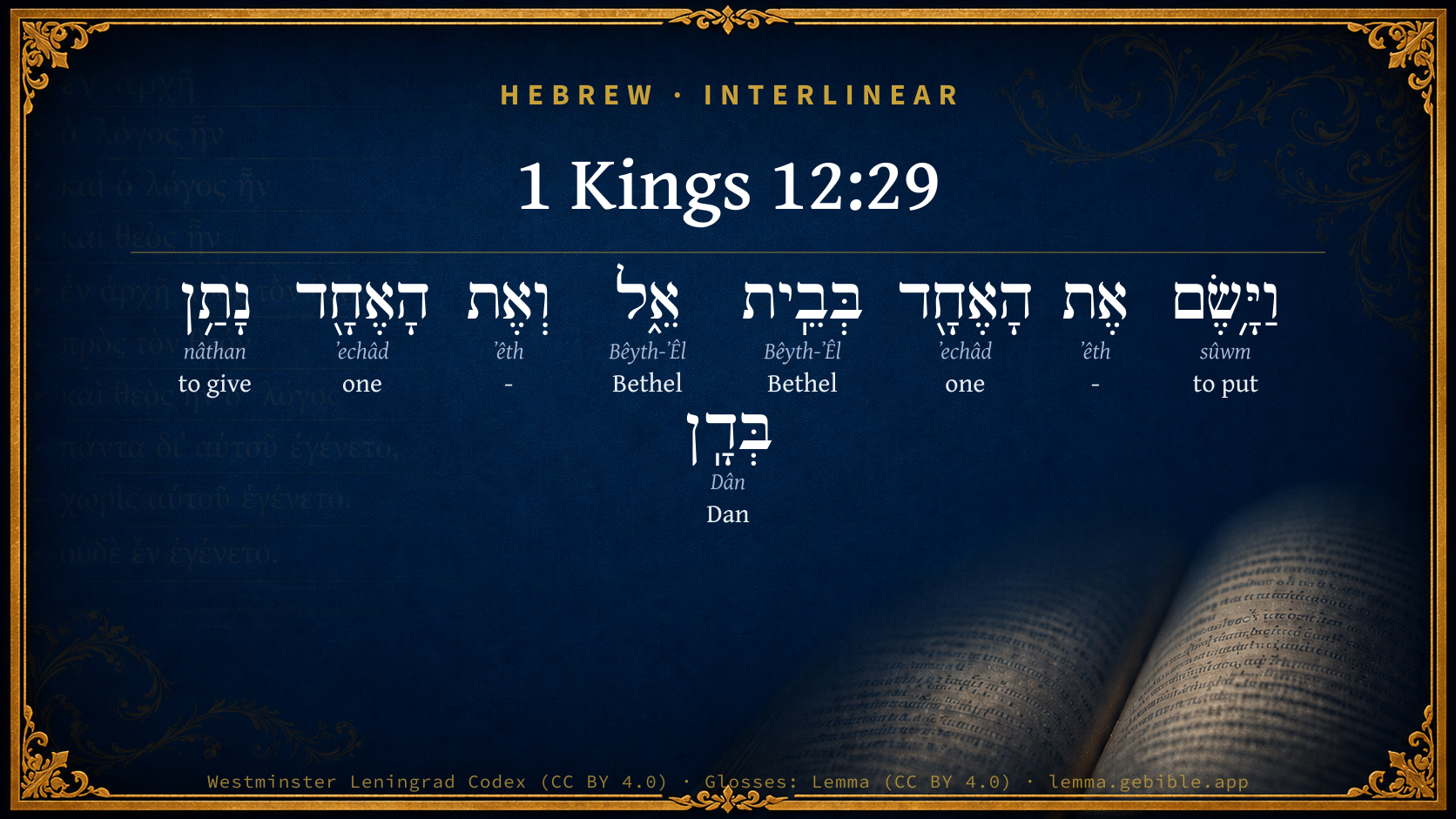
בְּדָֽן
Dân
H1835
“in/at · Dan”
Preposition + Noun, Proper
Part of Speech
Preposition + Noun
Type
Proper
Full BDB Definition

Origin: from H1777

TWOT: None

Dan = "a judge" - the 5th son of Jacob, the 1st of Bilhah, Rachel's handmaid (noun proper masculine) - the tribe descended from Dan, the son of Jacob (noun proper masculine) - a city in Dan, the most northern landmark of Palestine (noun proper locative)
  1. וַיָּ֥שֶׂם sûwm H7760 “and · to put” Conjunction + Verb, Qal, Sequential Imperfect, 3rd Person, Masculine, Singular
  2. אֶת ʼêth H853 “-” Particle, Direct Object
  3. הָאֶחָ֖ד ʼechâd H259 “the · one” Particle, Definite Article + Adjective, Cardinal number, Masculine, Singular, Absolute
  4. בְּבֵֽית Bêyth-ʼÊl H1008 “in/at · Bethel” Preposition + Noun, Proper
  5. אֵ֑ל Bêyth-ʼÊl H1008 “Bethel” Noun, Proper
  6. וְאֶת ʼêth H853 “and · -” Conjunction + Particle, Direct Object
  7. הָאֶחָ֖ד ʼechâd H259 “the · one” Particle, Definite Article + Adjective, Cardinal number, Masculine, Singular, Absolute
  8. נָתַ֥ן nâthan H5414 “to give” Verb, Qal, Perfect, 3rd Person, Masculine, Singular

About this verse

These counts appear in no published source. They are computed here, from the morphology-tagged text and Lemma’s own curated glosses. What Lemma adds →

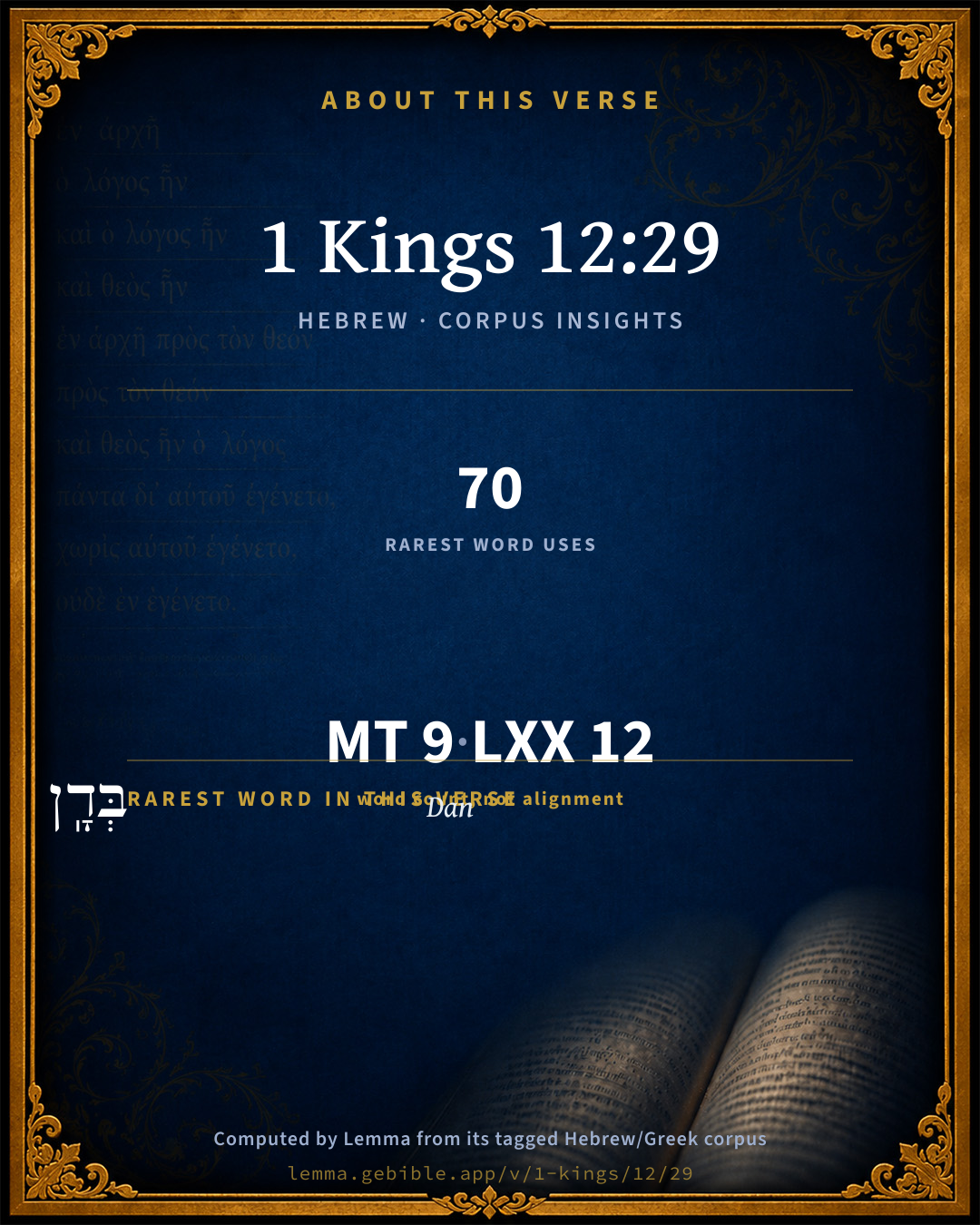
9
words
6
distinct lemmas
Historical
section

Grammatical profile

  • 2 verbs
  • 3 nouns
  • 2 adjectives
  • 2 particles

Verb forms

  • וַיָּ֥שֶׂם Qal · Sequential Imperfect
  • נָתַ֥ן Qal · Perfect

Repetition

Words recur within this verse — often emphatic in Hebrew:

  • הָאֶחָ֖ד one H259 ×2
  • בְּבֵֽית Bethel H1008 ×2

Hebrew & Septuagint length

In English translation the verse runs 13 words from the Hebrew and 13 from the Septuagint (LXX English) — the same length.

A rough comparison of the two English renderings, which tokenize alike — not a word-level alignment.

Word counts can differ between the Hebrew and the Greek without any difference in meaning — e.g. the Hebrew direct-object marker אֵת has no separate Greek word, and Greek often adds the article ὁ.

In the original languages it is 9 Hebrew tokens and 12 Greek tokens — but the two are counted differently (Hebrew bundles its prefixes and suffixes into one token; the Greek is in lemma form), so that isn’t a like-for-like length.

Cross-references

11

Topical passages linked to 1 Kings 12:29 in the Treasury of Scripture Knowledge — connected by theme and wording, ordered by reader-vote popularity; previews shown in the World English Bible.

  • Genesis 28:19 He called the name of that place Bethel, but the name of the city was Luz at the first.
  • Judges 18:27–31 They took that which Micah had made, and the priest whom he had, and came to Laish, to a people quiet and secure, and struck them with the edge of the sword; and they burnt the city with fire.
  • Genesis 12:8 He left from there to the mountain on the east of Bethel, and pitched his tent, having Bethel on the west, and Ai on the east. There he built an altar to Yahweh, and called on the name of Yahweh.
  • Genesis 14:14 When Abram heard that his relative was taken captive, he led forth his trained men, born in his house, three hundred and eighteen, and pursued as far as Dan.
  • Genesis 35:1 God said to Jacob, "Arise, go up to Bethel, and live there. Make there an altar to God, who appeared to you when you fled from the face of Esau your brother."
  • Deuteronomy 34:1 Moses went up from the plains of Moab to Mount Nebo, to the top of Pisgah, that is over against Jericho. Yahweh shown him all the land of Gilead, to Dan,
  • Judges 20:1 Then all the children of Israel went out, and the congregation was assembled as one man, from Dan even to Beersheba, with the land of Gilead, to Yahweh at Mizpah.
  • 2 Kings 10:29 However from the sins of Jeroboam the son of Nebat, with which he made Israel to sin, Jehu didn't depart from after them, [to wit], the golden calves that were in Bethel, and that were in Dan.
  • Jeremiah 8:16 The snorting of his horses is heard from Dan: at the sound of the neighing of his strong ones the whole land trembles; for they are come, and have devoured the land and all that is in it; the city and those who dwell therein.
  • Hosea 4:15 "Though you, Israel, play the prostitute, Yet don't let Judah offend; And don't come to Gilgal, Neither go up to Beth Aven, Nor swear, 'As Yahweh lives.'
  • Amos 8:14 Those who swear by the sin of Samaria, And say, 'As your god, Dan, lives;' And, 'As the way of Beersheba lives;' They will fall, and never rise up again."

Cross-references courtesy of OpenBible.info (CC BY 4.0).

Hebrew and Greek witnesses Masoretic Hebrew ↔ Greek Septuagint

The same verse in the two great witnesses to the Old Testament, shown verse-for-verse.

These are two independent witnesses, not word-aligned to each other, and the Septuagint is shown in lemma (dictionary) form.

Hebrew 1 Kings 12:29 Masoretic · Westminster Leningrad Codex

וַיָּ֥שֶׂם אֶת הָאֶחָ֖ד בְּבֵֽית אֵ֑ל וְאֶת הָאֶחָ֖ד נָתַ֥ן בְּדָֽן

He set the one in Bethel, and the other put he in Dan.

World English Bible · Public Domain

Greek LXX 1 Kings 12:29 Septuagint · lemma form

καί τίθημι ὁ εἷς ἐν βαιθηλ καί ὁ εἷς δίδωμι ἐν δαν

And he put one in Bethel, and he put the other in Dan.

LXX2012 (modern English Septuagint) · Public Domain

On this verse, Haydock's Catholic Bible Commentary discusses the Septuagint’s reading. Read the note in Commentary ↓

Hebrew: Westminster Leningrad Codex (CC BY 4.0). Greek: Septuagint (public domain); English from LXX2012 (modern English Septuagint) (Public Domain). How the Septuagint differs from the Hebrew →

Targum (Aramaic paraphrase)

1

The Targum is the ancient Jewish Aramaic paraphrase of the Hebrew Scriptures — an interpretive translation, not the Hebrew text itself. Onkelos (literal) and Pseudo-Jonathan (expansive) render the Torah, and Jonathan the Prophets. Coverage is partial: where no permissively-licensed English translation exists for a verse, only the Aramaic is shown. This is verse-level text, not a word-by-word alignment to the Hebrew.

  1. Targum Jonathan Prophets (Joshua–Malachi)
    וְשַׁוִי יַת חַד בְּבֵית אֵל וְיַת חַד יְהַב בְּדָן:

    (no public-domain English translation for this verse)

    Targum Jonathan — Aramaic: “Mikraot Gedolot” (public domain). English: “Sefaria Community Translation” (CC0 1.0 (public-domain dedication)); “London "Chaldee Paraphrase," 1871” (public domain). Text via Sefaria.

Commentary

Notes on 1 Kings 12:29 from classic Christian and Jewish commentators (each source and its license shown beneath its notes). The classic Christian expositions comment on the surrounding passage and are grouped to its opening verse, so a note may address several verses; the Jewish commentaries on the Tanakh (Rashi and others) are per-verse, so they appear only where the commentator wrote on this verse.

Lemma curates 59 commentaries, every one of them public domain or Creative Commons licensed, each selected and text-cleaned for this edition rather than reprinted as found. About our sources →

Trapp's Complete Commentary

John Trapp

1Ki 12:29 And he set the one in Bethel, and the other put he in Dan.

Ver. 29. And he set the one in Bethel.] At both ends of the land.

John Trapp, A Commentary or Exposition upon All the Books of the Old and New Testament (1647–1656) — public domain. Text from a community e-Sword module.

Joseph Benson's Commentary

1Ki 12:29. He set the one in Beth-el, &c. — Which two places he chose for the people’s convenience, Beth-el being in the southern, and Dan in the northern part of his kingdom. Add to this, that as Bethel was in every body’s opinion a sacred place, having been consecrated by God’s appearing there more than once to Jacob; so Dan had been famous for the teraphim of Micah, unto which there had been great resort for a long time, Jdg 18:30. For such reasons as these it is likely he waived his royal city, which was Shechem, and chose these two places for the worship of the Divine Majesty, whom he pretended he did not forsake, but worshipped by these symbols of his presence.

Joseph Benson's Commentary on the Old and New Testaments (1811–1818) — public domain. Text from a community e-Sword module.

Tyndale Open Study Notes

Tyndale Open Resources

12:29-30 By placing the calf idols in Bethel (the southern part of Israel) and in Dan (the far northern section) Jeroboam gave his people two choice sites with long religious traditions (see Gen 12:8; 28:11-19; Judg 18:30-31). Archaeological excavations confirm the existence of a high place—an altar for pagan worship—in Dan. Bethel was where Jacob had his dream (Gen 28:10-22), and it was the resting place of the Ark of the Covenant in the days of the judges (Judg 20:18-28) and a sanctuary in Samuel’s time (1 Sam 7:16; 10:3).

Tyndale Open Study Notes — © Tyndale Open Resources, licensed CC BY-SA 4.0. Text via the HelloAO Bible API.

Adam Clarke's Commentary

Verse 29. One in Beth-el, and the other - in Dan.] One at the southern and the other at the northern extremity of the land. Solomon's idolatry had prepared the people for Jeroboam's abominations!

Adam Clarke's Commentary on the Bible (1810–1826) — public domain. Text from a community e-Sword/MySword module.

Ellicott's Commentary for English Readers

(29) Bethel and Dan, chosen as the frontier towns of the kingdom, had, however, associations of their own, which lent themselves naturally to Jeroboam’s design. Bethel—preserving in its name the memory of Jacob’s vision, and of his consecration of the place as a sanctuary (Gen_28:19; Gen_35:14-15)—had been (see Jdg_20:18; Jdg_20:26; Jdg_20:31; Jdg_21:2; 1Sa_7:16) a place of religious assembly, and, possibly, of occasional sojourn of the Ark. At Dan, it is not unlikely that the use of the local sanctuary, set up at the conquest of the city by the Danites, still lingered; and from the notice in Jdg_18:30, that the posterity of Jonathan, the grandson of Moses, were priests till “the day of the captivity of the land,” it seems as if these priests of this old worship became naturally the appointed ministers of the new.

A Bible Commentary for English Readers, edited by Charles John Ellicott (1878–1897) — public domain. Text from a community e-Sword module.

The Cambridge Bible for Schools and Colleges

gen. ed. J. J. S. Perowne

29. in Beth-el] The well-known city in the extreme south of the tribe of Ephraim, and so just on the southern border of the new kingdom of Israel.

in Dan] The town, formerly called Laish, in the very north of Palestine, and always mentioned as a limit of the land in the phrase ‘from Dan to Beersheba.’ It was so remote from the influence of the rest of the nation that its inhabitants lived ‘after the manner of the Zidonians.’ They were, that is, sea-faring people, rather than shepherds and husbandmen like the rest of their brethren. The places chosen by Jeroboam were at either limit of his kingdom, and had been associated with religious worship in ancient times. See Jdg_18:30; Jdg_20:18; Jdg_20:26; 1Sa_10:3.

The Cambridge Bible for Schools and Colleges (gen. ed. J. J. S. Perowne; Cambridge University Press, 1878–1918) — public domain. Text from a community e-Sword module.

John Gill's Exposition

And he made an house of high places,.... Or "altars" (s), built a temple at Dan, and set up several altars in it for sacrifice, both for burnt offerings, and for incense, as at Jerusalem:

and made priests of the lowest of the people; this clause seems not so well rendered; for this would have been very unpopular, and brought his new form of worship into contempt, to make the dregs of the people priests, which was not only a very sacred office, but of great honour; it was usual in some nations for kings to be priests also (t), and Jeroboam himself exercised this office, Kg1 12:33 and therefore would never put the meanest of the people into it, but rather those of higher rank: the words may be literally rendered, "from the extremities" or "ends of the people" (u); meaning not merely from the extremist parts of his country, but rather out of the whole of the people; out of all sorts of them, out of any of them, without any distinction of tribe: for so it follows,

which were not of the sons of Levi; and as by this means he enriched himself, by taking the cities that belonged to the priests and Levites, which they were obliged to leave, and from whence he drove them, Ch2 11:14 so he pleased the people by laying open the priesthood common to them, and freeing them from the payment of tithes, and the like.

(s) "altarium", Vatablus. (t) Rex Anius, &c. Virgil. l. 3. Vid. Servium in ib. (u) "de extremitatibus populi", Vatablus, Piscator.

John Gill's Exposition of the Whole Bible (1746–1763) — public domain (CC PDM 1.0). Text via the HelloAO Bible API.

Albert Barnes' Notes on the Bible

In the first place, Jeroboam consulted the convenience of his subjects, who would thus in no case have very far to go in order to reach one or the other sanctuary. Further, he avoided the danger of reminding them continually that they had no ark - a danger which would have been imminent, had the two cherubs been placed together in one shrine.

He selected Bethel (in the south) for one of his seats of worship, on account of its pre-eminent sanctity. (See the marginal reference; Jdg 20:26-28; 1Sa 7:16.)

The north of Palestine did not furnish a spot possessing an equally sacred character, but still Dan had to some extent the character of a “holy city” (marginal reference).

Albert Barnes' Notes on the Bible (1834–1885) — public domain. Text from a community e-Sword/MySword module.

Haydock's Catholic Bible Commentary

Bethel and Dan. Bethel was a city of the tribe of Ephraim, in the southern parts of the dominions of Jeroboam, about six leagues from Jerusalem: Dan was in the extremity of his dominions, to the north, on the confines of Syria. (Challoner) --- The Israelites did not hesitate to travel so far, ver. 30. (Calmet) --- Those who lived nearer Bethel, went thither along with their king. (Salien) --- The latter city was assigned to Benjamin, Josue xviii. 22. (Menochius) --- But probably many of the subjects of Jeroboam dwelt in it; so that it was the most southern city of his dominions. It had been consecrated by Jacob, (Genesis xxviii. 19.) and was a famous place of devotion, 1 Kings x. 3. Septuagint (Alexandrian) and St. Cyril (in Osee, p. 5.) read Galgal. Dan had been long before infected with idolatry, Judges xviii. 30.

George Leo Haydock (1774–1849), Haydock's Catholic Family Bible and Commentary, 1859 edition — public domain. Excludes Psalms (Douay-Rheims chapter numbering differs from Protestant) and Deuterocanonical books (Catholic canon only).

Matthew Poole's English Annotations

Which two places he chose for his people’s conveniency;

Beth-el being in the southern, and

Dan in the northern parts of his kingdom.

Matthew Poole's English Annotations on the Holy Bible (1683–1685) — public domain. Text from a community e-Sword/MySword module.

Whedon's Commentary on the Bible

Daniel D. Whedon

29. Beth-el… Dan — Since one of the objects he professed to seek was the convenience of the people, two places of worship would of course be better than one — Beth-el in the southern and Dan in the northern part of the kingdom. Perhaps, also, here was a still closer imitation of the Egyptian calf-worship, in that the two calves might resemble, the one Apis, who was worshipped at Memphis, and the other Mne, who was worshipped at On. There was reason, and policy too, in fixing on Beth-el and Dan. The one was consecrated in the traditions of the people as the place where God appeared to Jacob, and that patriarch had himself called it the house of God. Gen_28:11-22. There, too, the people had formerly been wont to go up to worship God. 1Sa_10:3. And at Dan the teraphim of Micah had been set up, and a religious service established in connexion with it in the days of the judges. Jdg_18:30.

Daniel D. Whedon (gen. ed.), Commentary on the Old and New Testaments (1874–1909) — public domain. Text from a community e-Sword module.

The Pulpit Commentary

And he set the one in Bethel, and the other put he in Daniel Two considerations seem to have influenced Jeroboam in his choice of these sites. First, both these places were in some sort sanctuaries already. Bethel was already a makom, or holy place, in the days of Abraham; was consecrated by the visions and altar of Jacob, (Gen_28:11-19 Gen_31:13 Gen_35:1, Gen_35:7, Gen_35:15) and by the ark having been there (Jud 20:26-28, Hebrews; cf. Jos., Ant., 5:2. 10). And though Dan (Joshua Jud_1:18:29 20:1) can hardly have had as sacred a character as the "house of God and the gate of heaven" (Gen_28:17) had, still it had its shrine and its schismatic priesthood. A grandson of Moses (Jud_1:18:13, true reading) had ministered there, and his sons were the priests of Dan still. Secondly, these localities would suit the convenience of his subjects, being respectively at the southern and northern extremities of the kingdom. And this, no doubt, was one reason why Dan was chosen in preference to other places, such as Shiloh, which, though more sacred, were less conveniently situated. A sanctuary at Dan would save the northern tribes many tedious journeys. It should be remarked that Bethel properly belonged to Benjamin, (Jos_18:13, Jos_18:22) though it was also on the border of Ephraim; and it has been suggested that it was Jeroboam"s selection of this place as a seat of the calf worship decided the tribe of Benjamin to follow the lead of Judah. But the narrative seems to imply that their choice had been made at an earlier period (ver. 21), and the city would seem to have been long in the possession of the house of Joseph. (Jud_1:22) It is now known as Beitin, and is one of the most naked and dreary spots in Palestine. "The place seems, as it were, turned to stone; and we can well imagine that the patriarch found nothing softer than a stone for his pillow." Conder, p. 252, who suggests that from the time of Abraham Bethel was a a sacred place merely, (Gen_28:11) and distinct from the adjoining city of Luz (ver. 19).

The Pulpit Commentary (1880–1919), ed. H.D.M. Spence-Jones & Joseph S. Exell — public domain. Text from a community e-Sword module.

John Wesley's Explanatory Notes

Beth-el, &c. - Which two places he chose for his peoples conveniency; Beth-el being in the southern, and Dan. in the northern parts of his kingdom.

John Wesley, Explanatory Notes Upon the Whole Bible (1754–1765) — public domain. Text via the GEBible commentary corpus.

Lesson kit

Teaching starters — assembled from the data on this page, not authored interpretation. Every prompt links to the verse data it draws on. Edit before teaching.

1 Kings, in the Historical, opens this verse with 9 words (6 distinct Hebrew lemmas). Its most distinctive word is Dân (“Dan”). A historical commentator’s framing appears above. Read the whole chapter for the surrounding context.

Discussion questions

  1. The word Dân carries the sense “Dan.” How does it shape the verse?
  2. How does Genesis 28:19, which shares this passage’s theme, read alongside this verse?
  3. What does the repetition of “one” (2× in this one verse) do in this verse?
  4. These translations render this verse differently; the difference is in the English rendering, not the original. What questions does that raise?
  5. «וַיָּ֥שֶׂם» is a Qal Sequential Imperfect verb. How does that grammatical form shape the action described?
  6. Compare how Trapp's Complete Commentary and Joseph Benson's Commentary read this verse. Where do they agree or differ?

Things to notice

Reading settings

Reading text

Shown beneath each verse's original-language words.

Old Testament
Old Testament edition

Read the OT as the Masoretic Hebrew (MT) or the Greek Septuagint (LXX).

English shown for the Greek Septuagint (in the Hebrew ↔ Greek comparison).

Comparing translations? Open the Compare panel on any verse page to stack up to four side by side.