
Joshua 12:9

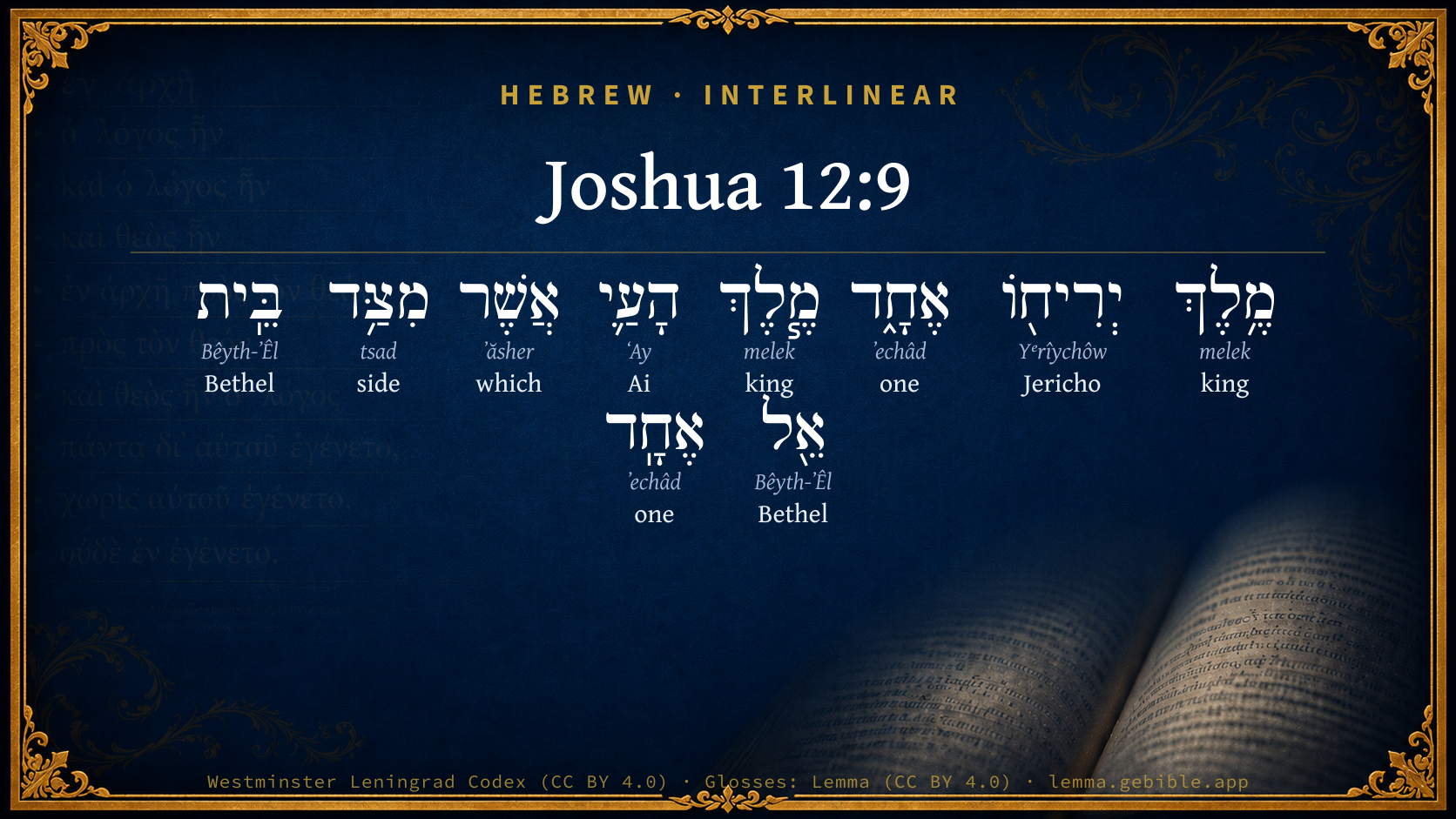
Hebrew (Westminster Leningrad Codex) Joshua 12:9 appears in the Hebrew Old Testament. The text above is from the Westminster Leningrad Codex. Each word links to its Strong’s number, a concise gloss, and parsing drawn from the Open Scriptures Hebrew Bible morphology. Click any word for its full Brown-Driver-Briggs (BDB) entry.
Download image
Cite this verse

Joshua 12:9 (World English Bible). Public Domain. Lemma interlinear Bible study tool, https://lemma.gebible.app/v/joshua/12/9.

Show BibTeX & RIS
BibTeX
RIS
English Translation
the king of Jericho, one; the king of Ai, which is beside Bethel, one;
World English Bible · Public Domain
Download a study sheet

One document with this verse’s original text, its word-by-word gloss line, the meaning frame, cross-references with their text, attributed commentary, and full source and license credits — printable, and it pastes into notes with its structure intact.

This verse Autodidact and up

Study sheet (.html) Plain text (.txt)

A passage Seminary Student

Up to 50 verses in one chapter. A passage sheet keeps up to 6 commentary sources and 12 cross-references per verse, in the order this page ranks them, and says so on the sheet whenever that leaves anything out. Ask for a single verse and you get the Autodidact verse sheet above.

Everything on this page stays free to read, with no account — the sheet is a download of what is already on screen, not access to it.

Want to remove ads? Support Godless Engineer
Compare translations 3

The same verse in 3 English versions, stacked beneath the original-language interlinear above. Click any original word for its lexicon entry.

Each is an independent rendering of the whole verse — the interlinear is not word-aligned to these translations.

Highlighted words mark where these versions differ — a whole-verse word diff, not a word-by-word alignment.

  • World English Bible Public Domain
    the king of Jericho, one; the king of Ai, which is beside Bethel, one;
  • King James Version Public Domain
    The king of Jericho, one; the king of Ai, which is beside Bethel, one;
  • unfoldingWord Literal Text CC BY-SA 4.0
    the king of Jericho, one; the king of Ai, which from the side of Bethel, one;

unfoldingWord Literal Text — © unfoldingWord, licensed CC BY-SA 4.0. Word-aligned USFM3 via Door43 (git.door43.org/unfoldingWord/en_ult).

Versions to compare (up to 4)

3 of 4 selected

Show all 18 translations

Every available English version of this verse, each an independent rendering of the whole verse.

  • World English Bible Public Domain
    the king of Jericho, one; the king of Ai, which is beside Bethel, one;
  • Berean Standard Bible Public Domain
    the king of Jericho, one; the king of Ai, which is near Bethel, one;
  • Majority Standard Bible Public Domain
    the king of Jericho, one; the king of Ai, which is near Bethel, one;
  • King James Version Public Domain
    The king of Jericho, one; the king of Ai, which is beside Bethel, one;
  • American Standard Version (1901) Public Domain
    the king of Jericho, one; the king of Ai, which is beside Bethel, one;
  • Revised Version (1885) Public Domain
    the king of Jericho, one; the king of Ai, which is beside Beth-el, one;
  • Geneva Bible (1599) Public Domain
    The King of Iericho was one: the King of Ai, which is beside Beth-el, one:
  • Douay-Rheims (1899) Public Domain
    The king of Jericho one: the king of Hai, which is on the side of Bethel, one:
  • Young's Literal Translation Public Domain
    The king of Jericho, one; The king of Ai, which `is' beside Bethel, one;
  • Literal Standard Version CC BY-SA 4.0
    the king of Jericho, one; the king of Ai, which [is] beside Bethel, one;
  • Unlocked Literal Bible CC BY-SA 4.0
    The kings included the king of Jericho, the king of Ai which is beside Bethel,
  • unfoldingWord Literal Text CC BY-SA 4.0
    the king of Jericho, one; the king of Ai, which from the side of Bethel, one;
  • Darby Bible Public Domain
    The king of Jericho, one; the king of Ai, which is beside Bethel, one;
  • World Messianic Bible Public Domain
    the king of Jericho, one; the king of Ai, which is beside Bethel, one;
  • Webster's Bible Public Domain
    The king of Jericho one; the king of Ai, which is beside Beth-el, one;
  • Free Bible Version CC BY-SA 4.0
    The king of Jericho. The king of Ai, near Bethel.
  • Bible in Basic English Public Domain
    The king of Jericho, one; the king of Ai, which is near Beth-el, one;
  • JPS Tanakh (1917) Public Domain
    the king of Jericho, one; the king of Ai, which is beside Beth-el, one;

Literal Standard Version (2020), Covenant Press — licensed CC BY-SA 4.0. Text via the HelloAO Bible API (eBible.org). Unlocked Literal Bible (unfoldingWord) — licensed CC BY-SA 4.0. Text via the HelloAO Bible API (eBible.org). unfoldingWord Literal Text — © unfoldingWord, licensed CC BY-SA 4.0. Word-aligned USFM3 via Door43 (git.door43.org/unfoldingWord/en_ult). Free Bible Version, Dr. Jonathan Gallagher — licensed CC BY-SA 4.0. Text via the HelloAO Bible API (eBible.org).

Word by word

More ways to search: Search by grammar → Find every occurrence → Compare this word →

Practice this passage: Drill this verse → Learn its vocabulary →

About this verse

These counts appear in no published source. They are computed here, from the morphology-tagged text and Lemma’s own curated glosses. What Lemma adds →

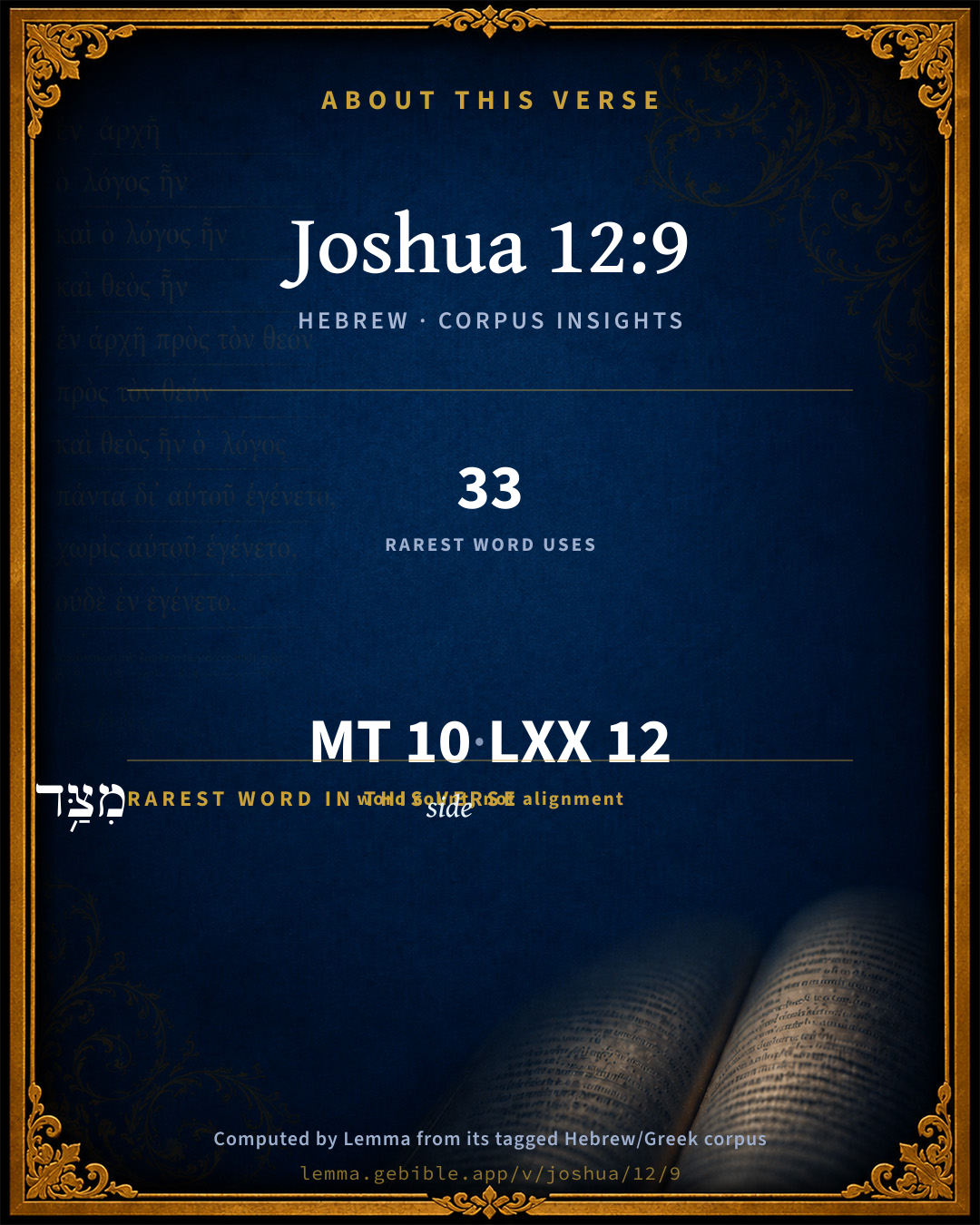
10
words
7
distinct lemmas
Historical
section

Shared distinctive vocabulary

מִצַּ֥ד side H6654 occurs in 27 verses of the Hebrew Bible. Also found in:

Grammatical profile

  • 7 nouns
  • 2 adjectives
  • 1 particle

Repetition

Words recur within this verse — often emphatic in Hebrew:

  • מֶ֥לֶךְ king H4428 ×2
  • אֶחָ֑ד one H259 ×2
  • בֵּֽית Bethel H1008 ×2

Hebrew & Septuagint length

In English translation the verse runs 14 words from the Hebrew and 13 from the Septuagint (LXX English) — closely comparable.

A rough comparison of the two English renderings, which tokenize alike — not a word-level alignment.

Word counts can differ between the Hebrew and the Greek without any difference in meaning — e.g. the Hebrew direct-object marker אֵת has no separate Greek word, and Greek often adds the article ὁ.

In the original languages it is 10 Hebrew tokens and 12 Greek tokens — but the two are counted differently (Hebrew bundles its prefixes and suffixes into one token; the Greek is in lemma form), so that isn’t a like-for-like length.

Cross-references

4

Topical passages linked to Joshua 12:9 in the Treasury of Scripture Knowledge — connected by theme and wording, ordered by reader-vote popularity; previews shown in the World English Bible.

  • Joshua 8:29–35 The king of Ai he hanged on a tree until the evening: and at the going down of the sun Joshua commanded, and they took his body down from the tree, and cast it at the entrance of the gate of the city, and raised thereon a great heap of stones, to this day.
  • Joshua 6:2–21 Yahweh said to Joshua, Behold, I have given into your hand Jericho, and the king of it, and the mighty men of valor.
  • Joshua 8:1 Yahweh said to Joshua, Don't be afraid, neither be dismayed: take all the people of war with you, and arise, go up to Ai; behold, I have given into your hand the king of Ai, and his people, and his city, and his land;
  • Joshua 8:17 There was not a man left in Ai or Beth El, who didn't go out after Israel: and they left the city open, and pursued after Israel.

Cross-references courtesy of OpenBible.info (CC BY 4.0).

Hebrew and Greek witnesses Masoretic Hebrew ↔ Greek Septuagint

The same verse in the two great witnesses to the Old Testament, shown verse-for-verse.

These are two independent witnesses, not word-aligned to each other, and the Septuagint is shown in lemma (dictionary) form.

Hebrew Joshua 12:9 Masoretic · Westminster Leningrad Codex

מֶ֥לֶךְ יְרִיח֖וֹ אֶחָ֑ד מֶ֧לֶךְ הָעַ֛י אֲשֶׁר מִצַּ֥ד בֵּֽית אֵ֖ל אֶחָֽד

the king of Jericho, one; the king of Ai, which is beside Bethel, one;

World English Bible · Public Domain

Greek LXX Joshua 12:9 Septuagint · lemma form

ὁ βασιλεύς ιεριχω καί ὁ βασιλεύς ὁ γαι ὅς εἰμί πλησίον βαιθηλ

The king of Jericho, and the king of Gai, which is near Baethel;

LXX2012 (modern English Septuagint) · Public Domain

Hebrew: Westminster Leningrad Codex (CC BY 4.0). Greek: Septuagint (public domain); English from LXX2012 (modern English Septuagint) (Public Domain). How the Septuagint differs from the Hebrew →

Targum (Aramaic paraphrase)

1

The Targum is the ancient Jewish Aramaic paraphrase of the Hebrew Scriptures — an interpretive translation, not the Hebrew text itself. Onkelos (literal) and Pseudo-Jonathan (expansive) render the Torah, and Jonathan the Prophets. Coverage is partial: where no permissively-licensed English translation exists for a verse, only the Aramaic is shown. This is verse-level text, not a word-by-word alignment to the Hebrew.

  1. Targum Jonathan Prophets (Joshua–Malachi)
    מַלְכָּא דִירִיחוֹ חָד מַלְכָּא דְעַי דְבִסְטַר בֵּית אֵל חָד:

    (no public-domain English translation for this verse)

    Targum Jonathan — Aramaic: “Mikraot Gedolot” (public domain). English: “Sefaria Community Translation” (CC0 1.0 (public-domain dedication)); “London "Chaldee Paraphrase," 1871” (public domain). Text via Sefaria.

Commentary

Notes on Joshua 12:9 from classic Christian and Jewish commentators (each source and its license shown beneath its notes). The classic Christian expositions comment on the surrounding passage and are grouped to its opening verse, so a note may address several verses; the Jewish commentaries on the Tanakh (Rashi and others) are per-verse, so they appear only where the commentator wrote on this verse.

Lemma curates 59 commentaries, every one of them public domain or Creative Commons licensed, each selected and text-cleaned for this edition rather than reprinted as found. About our sources →

Trapp's Complete Commentary

John Trapp

Jos 12:9 The king of Jericho, one; the king of Ai, which [is] beside Bethel, one;

Ver. 9. The king of Jericho, one.] In this one country of Judea - which was not above two hundred miles long, and sixty miles broad: not near the half of England, as good authors compute it - what abundance of kings find we, and what a huge multitude of inhabitants! So here in England of old, were so many cities, so many kings almost. When Caesar entered this island, Kent had four kings that ruled in it: viz., Cingentorix, Carvilius, Taximagulus, and Segonax. Hence Jerome calleth this island Fertilem tyrannorum, full of tyrants.

John Trapp, A Commentary or Exposition upon All the Books of the Old and New Testament (1647–1656) — public domain. Text from a community e-Sword module.

Adam Clarke's Commentary

Verse 9. The king of Jericho, &c.] On this and the following verses see the notes on Jos 10:1-3.

Adam Clarke's Commentary on the Bible (1810–1826) — public domain. Text from a community e-Sword/MySword module.

The Cambridge Bible for Schools and Colleges

gen. ed. J. J. S. Perowne

9. the king of Jericho] The kings are enumerated generally in the order in which they were conquered. For the overthrow of the kings of Jericho, Ai, Jerusalem, Hebron, Jarmuth, Lachish, Eglon, and Gezer see (a) Jos_6:2 ff.; (b) Jos_8:29; (c) Jos_10:1-5; Jos_10:33.

The Cambridge Bible for Schools and Colleges (gen. ed. J. J. S. Perowne; Cambridge University Press, 1878–1918) — public domain. Text from a community e-Sword module.

John Gill's Exposition

The king of Jericho, one,.... Who was first taken, and so named first, Jos 6:21,

the king of Ai, which is beside Bethel, one; who was next taken and though Bethel was so near Ai, it had a king of its own, after mentioned, see Jos 7:1.

John Gill's Exposition of the Whole Bible (1746–1763) — public domain (CC PDM 1.0). Text via the HelloAO Bible API.

Matthew Poole's English Annotations

Which is beside Beth-el: this is added to distinguish it from Ai of the Ammonites, of which Jer 49:3.

Matthew Poole's English Annotations on the Holy Bible (1683–1685) — public domain. Text from a community e-Sword/MySword module.

The Pulpit Commentary

The list of the cities subdued. The king of Jericho, one. Here follows a list of the royal cities of the Canaanites, the remainder being daughter, or dependent cities, or else, perhaps, like Gibeon, cities whose government was not regal. See Jos_9:3, and Introduction.

The Pulpit Commentary (1880–1919), ed. H.D.M. Spence-Jones & Joseph S. Exell — public domain. Text from a community e-Sword module.

Keil & Delitzsch

C. F. Keil & F. Delitzsch

The different kings are given in the order in which they were defeated: Jericho (Jos 6:1); Ai (Jos 7:2); Jerusalem, Hebron, Jarmuth, Lachish, and Eglon (Jos 10:3); Gezer (Jos 10:33); and Debir (Jos 10:38). Those given in Jos 12:13 and Jos 12:14 are not mentioned by name in Josh 10. Geder, possibly the same as Gedor upon the mountains of Judah (Jos 15:58), which has been preserved under the old name of Jedur (Rob. Pal. ii. p. 186, and Bibl. Res. p. 282). Hormah (i.e., banning) was in the south of Judah (Jos 15:30), and was allotted to the Simeonites (Jos 19:4). It was called Zephath by the Canaanites (Jdg 1:17; see at Num 21:3), was on the southern slope of the mountains of the Amalekites or Amorites, the present ruins of Septa, on the western slope of the table-land of Rakhma, two hours and a half to the south-west of Khalasa (Elusa: see Ritter, Erdk. xiv. p. 1085). Arad, also in the Negeb, has been preserved in Tell Arad (see at Num 21:1). Libnah (see at Jos 10:29). Adullam, which is mentioned in Jos 15:35 among the towns of the plain between Jarmuth and Socoh, was in the neighbourhood of a large cave in which David took refuge when flying from Saul (Sa1 22:1; Sa2 23:13). It was fortified by Rehoboam (Ch2 11:7), and is mentioned in 2 Macc. 12:38 as the city of Odollam. The Onomast. describes it as being ten Roman miles to the east of Eleutheropolis; but this is a mistake, though it has not yet been discovered. So far as the situation is concerned, Deir Dubbn would suit very well, a place about two hours to the north of Beit Jibrin, near to a large number of caves in the white limestone, which form a kind of labyrinth, as well as some vaulted grottos (see Rob. Pal. ii. p. 353, and Van de Velde, Reise, pp. 162-3). Makkedah: possibly Summeil (see at Jos 10:10). Bethel, i.e., Beitin (see Jos 8:17). The situation of the towns which follow in Jos 12:17 and Jos 12:18 cannot be determined with certainty, as the names Tappuach, Aphek, and Hefer are met with again in different parts of Canaan, and Lassaron does not occur again. But if we observe, that just as from Jos 12:10 onwards those kings'-towns are first of all enumerated, the capture of which has already been described in Josh 10, and then in Jos 12:15 and Jos 12:16 certain other towns are added which had been taken in the war with the Canaanites of the south, so likewise in Jos 12:19 and Jos 12:20 the capitals of the allied kings of northern Canaan are given first, and after that the other towns that were taken in the northern war, but had not been mentioned by name in Josh 11: there can be no doubt whatever that the four towns in Jos 12:17 and Jos 12:18 are to be classed among the kings'-towns taken in the war with the king of Jerusalem and his allies, and therefore are to be sought for in the south of Canaan and not in the north. Consequently we cannot agree with Van de Velde and Knobel in identifying Tappuach with En-Tappuach (Jos 17:7), and looking for it in Atf, a place to the north-east of Nablus and near the valley of the Jordan; we connect it rather with Tappuach in the lowlands of Judah (Jos 15:34), though the place itself has not yet been discovered. Hefer again is neither to be identified with Gath-hepher in the tribe of Zebulun (Jos 19:13), nor with Chafaraim in the tribe of Issachar (Jos 19:19), but is most probably the capital of the land of Hefer (Kg1 4:10), and to be sought for in the neighbourhood of Socoh in the plain of Judah. Aphek is probably the town of that name not far from Ebenezer (Sa1 4:1), where the ark was taken by the Philistines, and is most likely to be sought for in the plain of Judah, though not in the village of Ahbek (Rob. Pal. ii. p. 343); but it has not yet been traced. Knobel imagines that it was Aphek near to Jezreel (Sa1 29:1), which was situated, according to the Onom., in the neighbourhood of Endor (Sa1 29:1; Kg1 20:25, Kg1 20:30); but this Aphek is too far north. Lassaron only occurs here, and hitherto it has been impossible to trace it. Knobel supposes it to be the place called Saruneh, to the west of the lake of Tiberias, and conjectures that the name has been contracted from Lassaron by aphaeresis of the liquid. This is quite possible, if only we could look for Lassaron so far to the north. Bachienne and Rosenmller imagine it to be the village of Sharon in the celebrated plain of that name, between Lydda and Arsuf.

Keil & Delitzsch — Biblical Commentary on the Old Testament (1861–1891) — public domain (CC PDM 1.0). Text via the HelloAO Bible API. (Old Testament only.)

unfoldingWord translationNotes

Door43 World Missions Community

Enaim ... Jarmuth ... Lachish ... Eglon ... Gezer

These are the names of cities. Translate "Jarmuth," "Lachish," and "Eglon" in the same way you did in Joshua 10:3. (See: How to Translate Names)

translationWords

king

Jericho

Ai

Bethel

Jerusalem

unfoldingWord translationNotes — © Distant Shores Media and the Door43 World Missions Community, licensed CC BY-SA 4.0. Source: git.door43.org/Door43/en_tn.

Lesson kit

Teaching starters — assembled from the data on this page, not authored interpretation. Every prompt links to the verse data it draws on. Edit before teaching.

Joshua, in the Historical, opens this verse with 10 words (7 distinct Hebrew lemmas). Its most distinctive word is tsad (“side”). A historical commentator’s framing appears above. Read the whole chapter for the surrounding context.

Discussion questions

  1. How does “side” (tsad) shape what this verse is saying?
  2. Genesis 6:16 shares the word «side» with this verse. How do the two illuminate each other?
  3. “king” occurs 2× in this one verse. What is the effect of the repetition?
  4. The translations on this page render this verse differently — a whole-verse word diff, not a word-by-word alignment. What might account for the different wordings?
  5. Reading how Trapp's Complete Commentary and Adam Clarke's Commentary read this verse, where do the two commentators agree and where do they part?

Things to notice

Reading settings

Reading text

Shown beneath each verse's original-language words.

Old Testament
Old Testament edition

Read the OT as the Masoretic Hebrew (MT) or the Greek Septuagint (LXX).

English shown for the Greek Septuagint (in the Hebrew ↔ Greek comparison).

Comparing translations? Open the Compare panel on any verse page to stack up to four side by side.