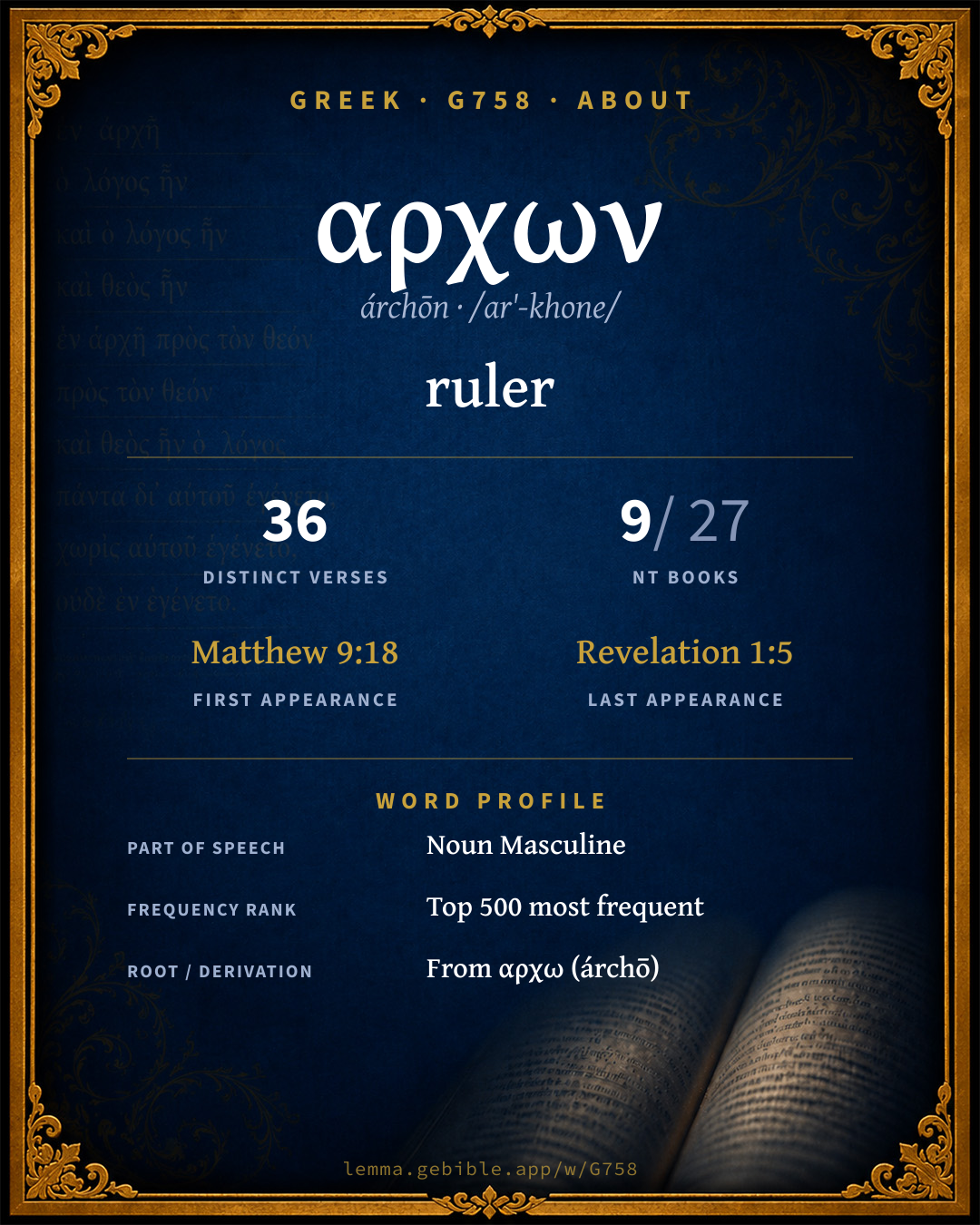
ἄρχων
ruler
Full lexicon entry — Thayer's Greek Lexicon
From Thayer's Greek Lexicon
Where this word appears
Grammar key — what these labels mean
Part of speech
- Noun
- A naming word — a person, place, thing, or idea.
Case
- Nominative
- The case of the subject (and the predicate nominative).
- Accusative
- The case of the direct object and of extent.
- Genitive
- The case of source, possession, or “of” — answers “whose / from what.”
- Dative
- The case of the indirect object, means, or location — “to / for / with / in.”
- Vocative
- The case of direct address (“O Lord”).
Gender
- Masculine
- Grammatically masculine.
Number
- Plural
- More than one.
- Singular
- One.
Every verse where G758 appears in the Book of 1 Corinthians — 2 distinct verses. Click any verse to open its interlinear word-by-word view. Verse text shown in the World English Bible for context — . Each verse’s Greek form is shown with its reference; the English is not keyword-highlighted, since the data carries no word-level English alignment. Use “Compare translations” on any verse to read it across multiple English versions. This concordance covers the Greek New Testament; Septuagint (Greek Old Testament) occurrences of this word are not indexed here.
1 Corinthians
- 1 Corinthians 2:6 ἀρχόντων n gen pl masc We speak wisdom, however, among those who are full grown; yet a wisdom not of this world, nor of the rulers of this world, who are coming to nothing.
- 1 Corinthians 2:8 ἀρχόντων n gen pl masc which none of the rulers of this world has known. For had they known it, they wouldn't have crucified the Lord of glory.
About this entry
At a glance — auto-summarized from this page’s data, not written by a person. Every figure links to its source below. This summary describes the numbers; it doesn’t interpret them.
αρχων (árchōn) is a Greek noun most often rendered “ruler.” It first appears in Matthew 9:18. Spanning 36 verses in 9 books, it ranks among the moderately common words of the Greek New Testament. Acts dominates its distribution — 10 of 36 verses. Related forms include αρχω, αρχαγγελος and αρχομαι. For the data behind this summary, explore the sense tree and the renderings breakdown below.
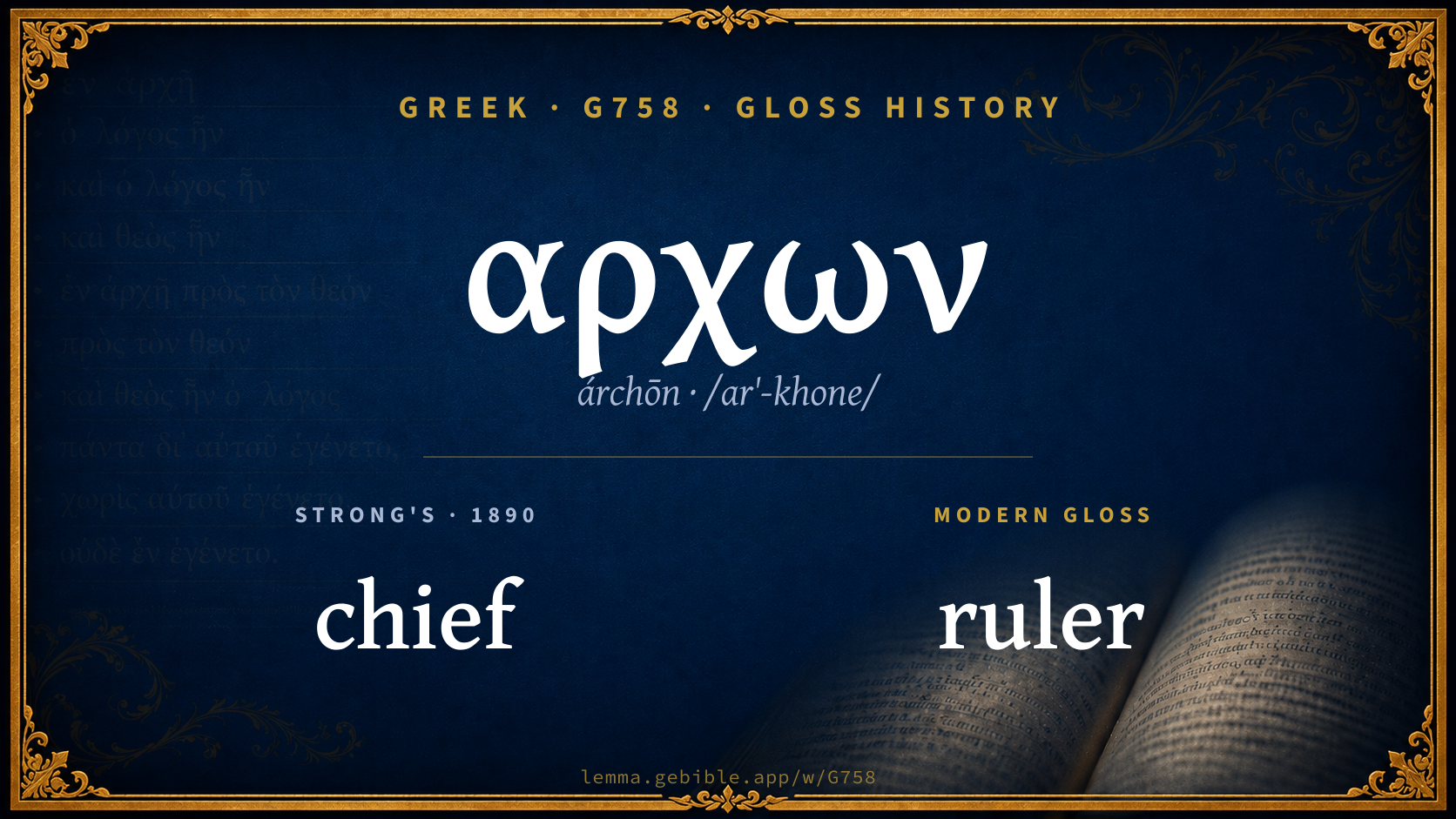
Gloss history
Strong's 1890 vs modern scholarship
About this word
Strong's G758 catalogs a Greek word from the Greek New Testament.
These counts are not copied from any lexicon or concordance. They are computed here, from the morphology-tagged Greek New Testament. What Lemma adds →
- 36
- distinct verses
- The word appears in 36 distinct verses.
- 9 / 27
- NT books
- The word appears in 9 of 27 New Testament books.
- #397
- by frequency
- Top 500 most frequent Greek words (rank 397 of 5,347 Greek words by occurrence).
View all 36 occurrences in the concordance →
By section of the New Testament
By traditional corpus
Conventional, traditional groupings — biblical authorship is debated, so this is a traditional corpus grouping, not an authorship claim. Some books belong to more than one corpus (Luke is in both the Gospels and the Lukan corpus, and so on), so these shares overlap and need not total 100%. Each figure is a share of the word’s 36 distinct verses.
- Gospels 21 verses · 58%
- Lukan (Luke–Acts) 18 verses · 50%
- Johannine 8 verses · 22%
- Pauline corpus 4 verses · 11%
- Revelation 1 verse · 3%
How translations render this word
Counts come from each version’s own published word-to-Strong’s tagging or interlinear alignment — an approximate guide to how each version renders this word, not a word-level alignment the data otherwise carries. Because each total is that version’s own tagged count, the per-version totals vary from one another and need not match the appearance or distinct-verse counts above. These counts may also differ from a printed concordance because Lemma counts each distinctly tagged rendering and does not collapse phrase taggings into a single head-word total. This is a fixed set of word-tagged versions (KJV, ASV, BSB, ULT) and does not change with the reading translation you choose elsewhere. Each version’s license is shown beside its name below (and on Sources).
- King James Version: Rulers 12×, Prince 8×, Ruler 7×
- American Standard Version: Rulers 16×, Ruler 9×, Prince 8×
- Berean Standard Bible: Rulers 14×, Prince 7×, Ruler 6×
- unfoldingWord Literal Text: Rulers 18×, Ruler 16×, A 2×
King James Version Public Domain
Renders G758 across 37 tagged occurrences — most commonly:
Plus 5 renderings that appear only once — usually multi-word phrases or single function words the recovered tagging swept in, not distinct renderings.
American Standard Version Public Domain
Renders G758 across 36 tagged occurrences — most commonly:
Plus 3 renderings that appear only once — usually multi-word phrases or single function words the recovered tagging swept in, not distinct renderings.
Berean Standard Bible Public Domain
Renders G758 across 37 tagged occurrences — most commonly:
Plus 4 renderings that appear only once — usually multi-word phrases or single function words the recovered tagging swept in, not distinct renderings.
unfoldingWord Literal Text CC BY-SA 4.0
Renders G758 across 39 tagged occurrences — most commonly:
Plus 1 rendering that appears only once — usually multi-word phrases or single function words the recovered tagging swept in, not distinct renderings.
Senses in Thayer's
The 1 sense Thayer's distinguishes for this word, in lexicon order (not ranked by frequency or importance). The full entry — with sub-senses — is in the Lexicon Entry tab.
- a ruler, commander, chief, leader
Word origin
Derived from αρχω (árchō) (G757) — to rule.
Present participle of G757 ; a first (in rank or power): - chief (ruler) magistrate prince ruler.
— Strong’s Exhaustive Concordance (1890), public domain.
Forms in the corpus
The 8 distinct written forms G758 takes in the Greek New Testament, most frequent first — each parse links to that case’s occurrences in the concordance.
| Form | Parsing | Example | Uses |
|---|---|---|---|
| ἄρχοντες árchontes | Noun, Nominative, Plural, Masculine | Matthew 20:25 | 9 |
| ἄρχων árchōn | Noun, Nominative, Singular, Masculine | Matthew 9:18 | 8 |
| ἄρχοντα árchonta | Noun, Accusative, Singular, Masculine | Luke 12:58 | 6 |
| ἀρχόντων archóntōn | Noun, Genitive, Plural, Masculine | Luke 14:1 | 5 |
| ἄρχοντι árchonti | Noun, Dative, Singular, Masculine | Matthew 9:34 | 4 |
| ἄρχοντας árchontas | Noun, Accusative, Plural, Masculine | Luke 23:13 | 3 |
| ἄρχοντος árchontos | Noun, Genitive, Singular, Masculine | Matthew 9:23 | 1 |
| ἄρχουσιν árchousin | Noun, Dative, Plural, Masculine | Acts 14:5 | 1 |
Same root — word family
Other Thayer's entries built from the same root as G758, grouped by Strong’s listed origin. These share a root / origin per the lexicon — not necessarily a shared meaning. Each links to that word’s own entry.
Derives from
Shares the same root
Proper names from this root
People and places named from this root — a name, not an additional meaning of the word.
Compare all same-root words → Showing 4 of 5 — not the complete family. 1 of the same-root words is a proper name (a person or place). They share a root, not necessarily a meaning.
Septuagint usage
The same Greek word αρχων appears 555 times in the Greek Old Testament (Septuagint), across 501 verses in 28 books.
- 555
- LXX occurrences
- Tagged occurrences of this Greek word in the Septuagint.
- 501
- verses
- Distinct Septuagint verses containing this word.
- 28 / 39
- OT books
- The word appears in 28 of the 39 Old Testament books.
Sample Septuagint occurrences
- Genesis 12:15 ἄρχων
- Exodus 2:14 ἄρχων
- Leviticus 4:22 ἄρχων
- Numbers 1:4 ἄρχων
- Deuteronomy 17:14 ἄρχων
- Joshua 9:14 ἄρχων
- Judges 4:7 ἄρχων
- 1 Samuel 6:4 ἄρχων
- 2 Samuel 6:2 ἄρχων
- 1 Kings 1:19 ἄρχων
- 2 Kings 4:13 ἄρχων
- 1 Chronicles 2:10 ἄρχων
Septuagint occurrences (same lexeme)
Every verse where the same Strong’s number (G758) appears in the Greek Septuagint — showing the first 50 of 501. Verse text shown in the World English Bible for context; the Greek form is the matched word — the English is not keyword-highlighted.
- Genesis 12:15 ἄρχων The princes of Pharaoh saw her, and praised her to Pharaoh; and the woman was taken into Pharaoh's house.
- Genesis 14:7 ἄρχων They returned, and came to En-mishpat (the same is Kadesh), and struck all the country of the Amalekites, and also the Amorites, that lived in Hazazon Tamar.
- Genesis 24:2 ἄρχων Abraham said to his servant, the elder of his house, who ruled over all that he had, "Please put your hand under my thigh.
- Genesis 25:16 ἄρχων These are the sons of Ishmael, and these are their names, by their villages, and by their encampments: twelve princes, according to their nations.
- Genesis 27:29 ἄρχων Let peoples serve you, Nations bow down to you. Be lord over your brothers, Let your mother's sons bow down to you. Cursed be everyone who curses you, Blessed be everyone who blesses you."
- Genesis 34:2 ἄρχων Shechem the son of Hamor the Hivite, the prince of the land, saw her. He took her, lay with her, and humbled her.
- Genesis 42:6 ἄρχων Joseph was the governor over the land. It was he who sold to all the people of the land. Joseph's brothers came, and bowed themselves down to him with their faces to the earth.
- Genesis 45:8 ἄρχων So now it wasn't you who sent me here, but God, and he has made me a father to Pharaoh, lord of all his house, and ruler over all the land of Egypt.
- Genesis 47:5 ἄρχων Pharaoh spoke to Joseph, saying, "Your father and your brothers have come to you.
- Genesis 49:10 ἄρχων The scepter will not depart from Judah, Nor the ruler's staff from between his feet, Until he comes to whom it belongs. To him will the obedience of the peoples be.
- Genesis 49:20 ἄρχων Out of Asher his bread will be fat, He will yield royal dainties.
- Exodus 2:14 ἄρχων He said, "Who made you a prince and a judge over us? Do you plan to kill me, as you killed the Egyptian?" Moses was afraid, and said, "Surely this thing is known."
- Exodus 15:15 ἄρχων Then the chiefs of Edom were dismayed. Trembling takes hold of the mighty men of Moab. All the inhabitants of Canaan are melted away.
- Exodus 16:22 ἄρχων It happened that on the sixth day they gathered twice as much bread, two omers for each one, and all the rulers of the congregation came and told Moses.
- Exodus 22:27 ἄρχων for that is his only covering, it is his garment for his skin. What would he sleep in? It will happen, when he cries to me, that I will hear, for I am gracious.
- Exodus 34:31 ἄρχων Moses called to them, and Aaron and all the rulers of the congregation returned to him; and Moses spoke to them.
- Exodus 35:27 ἄρχων The rulers brought the onyx stones, and the stones to be set, for the ephod and for the breastplate;
- Leviticus 4:22 ἄρχων "'When a ruler sins, and unwittingly does any one of all the things which Yahweh his God has commanded not to be done, and is guilty;
- Leviticus 18:21 ἄρχων "'You shall not give any of your children to sacrifice to Molech; neither shall you profane the name of your God: I am Yahweh.
- Leviticus 20:2 ἄρχων "Moreover, you shall tell the children of Israel, 'Anyone of the children of Israel, or of the strangers who live as foreigners in Israel, who gives any of his seed to Molech; he shall surely be put to death. The people of the land shall stone him with stones.
- Leviticus 20:3 ἄρχων I also will set my face against that person, and will cut him off from among his people because he has given of his seed to Molech, to defile my sanctuary, and to profane my holy name.
- Leviticus 20:4 ἄρχων If the people of the land all hide their eyes from that person, when he gives of his seed to Molech, and don't put him to death;
- Leviticus 20:5 ἄρχων then I will set my face against that man, and against his family, and will cut him off, and all who play the prostitute after him, to play the prostitute with Molech, from among their people.
- Numbers 1:4 ἄρχων With you there shall be a man of every tribe; everyone head of his fathers' house.
- Numbers 1:16 ἄρχων These are those who were called of the congregation, the princes of the tribes of their fathers; they were the heads of the thousands of Israel.
- Numbers 1:44 ἄρχων These are those who were numbered, whom Moses and Aaron numbered, and the princes of Israel, being twelve men: they were each one for his fathers' house.
- Numbers 2:3 ἄρχων Those who encamp on the east side toward the sunrise shall be of the standard of the camp of Judah, according to their divisions: and the prince of the children of Judah shall be Nahshon the son of Amminadab.
- Numbers 2:5 ἄρχων Those who encamp next to him shall be the tribe of Issachar: and the prince of the children of Issachar shall be Nethanel the son of Zuar.
- Numbers 2:7 ἄρχων The tribe of Zebulun: and the prince of the children of Zebulun shall be Eliab the son of Helon.
- Numbers 2:10 ἄρχων "On the south side shall be the standard of the camp of Reuben according to their divisions. The prince of the children of Reuben shall be Elizur the son of Shedeur.
- Numbers 2:12 ἄρχων "Those who encamp next to him shall be the tribe of Simeon. The prince of the children of Simeon shall be Shelumiel the son of Zurishaddai.
- Numbers 2:14 ἄρχων "The tribe of Gad: and the prince of the children of Gad shall be Eliasaph the son of Reuel.
- Numbers 2:18 ἄρχων "On the west side shall be the standard of the camp of Ephraim according to their divisions: and the prince of the children of Ephraim shall be Elishama the son of Ammihud.
- Numbers 2:20 ἄρχων "Next to him shall be the tribe of Manasseh: and the prince of the children of Manasseh shall be Gamaliel the son of Pedahzur.
- Numbers 2:22 ἄρχων "The tribe of Benjamin: and the prince of the children of Benjamin shall be Abidan the son of Gideoni.
- Numbers 2:25 ἄρχων "On the north side shall be the standard of the camp of Dan according to their divisions: and the prince of the children of Dan shall be Ahiezer the son of Ammishaddai.
- Numbers 2:27 ἄρχων "Those who encamp next to him shall be the tribe of Asher: and the prince of the children of Asher shall be Pagiel the son of Ochran.
- Numbers 2:29 ἄρχων "The tribe of Naphtali: and the prince of the children of Naphtali shall be Ahira the son of Enan.
- Numbers 3:24 ἄρχων The prince of the fathers' house of the Gershonites shall be Eliasaph the son of Lael.
- Numbers 3:30 ἄρχων The prince of the fathers' house of the families of the Kohathites shall be Elizaphan the son of Uzziel.
- Numbers 3:32 ἄρχων Eleazar the son of Aaron the priest shall be prince of the princes of the Levites, with the oversight of those who keep the charge of the sanctuary.
- Numbers 3:35 ἄρχων The prince of the fathers' house of the families of Merari was Zuriel the son of Abihail. They shall encamp on the north side of the tabernacle.
- Numbers 4:34 ἄρχων Moses and Aaron and the princes of the congregation numbered the sons of the Kohathites by their families, and by their fathers' houses,
- Numbers 4:46 ἄρχων All those who were numbered of the Levites, whom Moses and Aaron and the princes of Israel numbered, by their families, and by their fathers' houses,
- Numbers 7:2 ἄρχων that the princes of Israel, the heads of their fathers' houses, offered. These were the princes of the tribes. These are they who were over those who were numbered:
- Numbers 7:3 ἄρχων and they brought their offering before Yahweh, six covered wagons, and twelve oxen; a wagon for every two of the princes, and for each one an ox: and they presented them before the tabernacle.
- Numbers 7:10 ἄρχων The princes gave offerings for the dedication of the altar in the day that it was anointed, even the princes gave their offerings before the altar.
- Numbers 7:11 ἄρχων Yahweh said to Moses, "They shall offer their offering, each prince on his day, for the dedication of the altar."
- Numbers 7:12 ἄρχων He who offered his offering the first day was Nahshon the son of Amminadab, of the tribe of Judah,
- Numbers 7:18 ἄρχων On the second day Nethanel the son of Zuar, prince of Issachar, gave his offering.
These are occurrences of the same Greek lexeme (G758) in the Septuagint — not a translation of any one Hebrew word. The store carries no word-level Hebrew↔Greek alignment, so no Hebrew original is asserted here. Counts come from the recovered LXX Strong's tagging — high-frequency vocabulary is well covered, while rare or late forms may be untagged — so they reflect tagged occurrences and may slightly undercount.