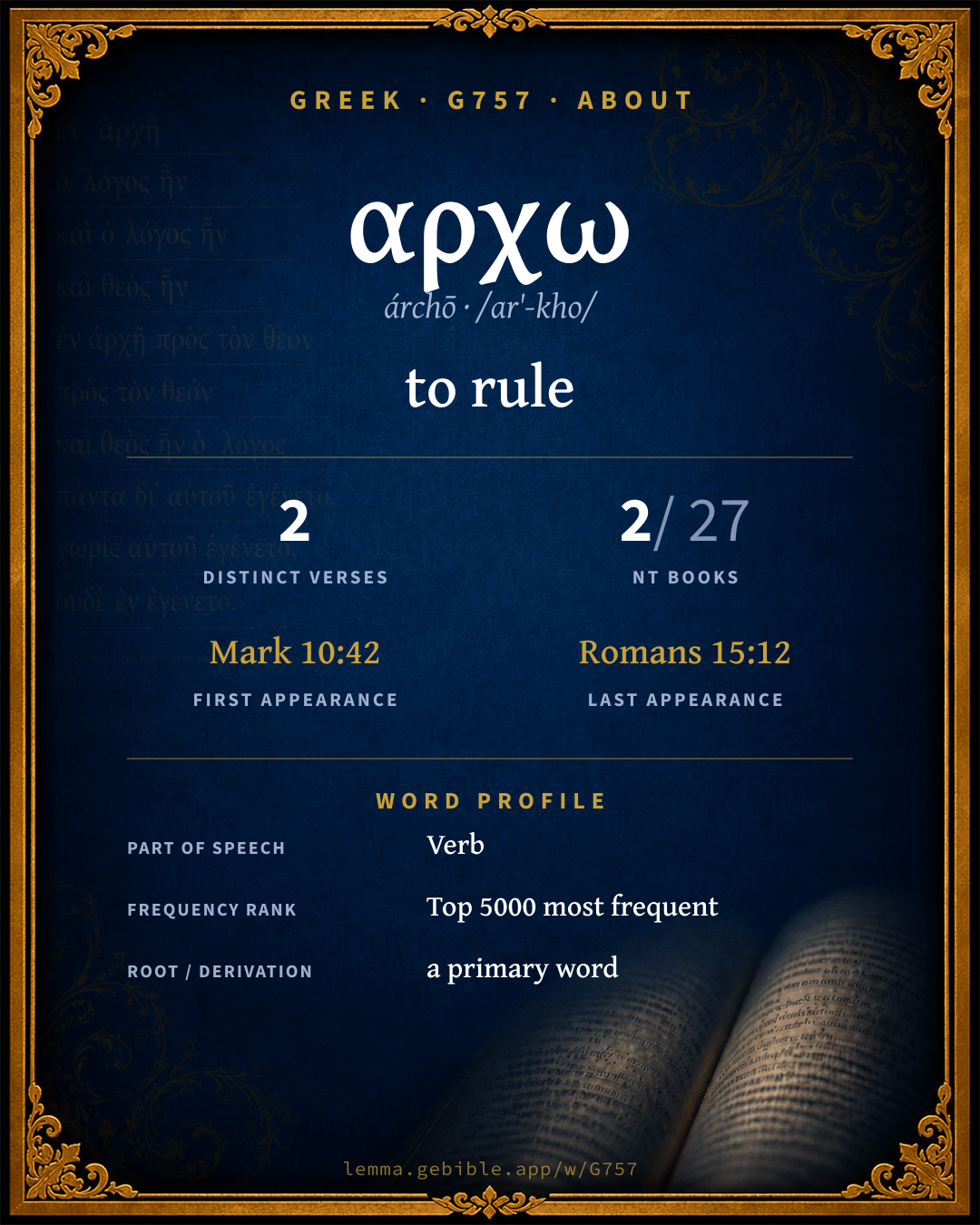
ἄρχω
to rule
Full lexicon entry — Thayer's Greek Lexicon
From Thayer's Greek Lexicon
Where this word appears
Grammar key — what these labels mean
Part of speech
- Verb
- An action or state-of-being word.
Tense
- Present
- Ongoing or general action in present time (imperfective aspect).
Voice
- Active
- The subject performs the action.
Mood
- Infinitive
- A verbal noun (“to write”), unmarked for person or number.
Every verse where G757 appears — 2 distinct verses across 2 books. Click any verse to open its interlinear word-by-word view. Verse text shown in the World English Bible for context — . Each verse’s Greek form is shown with its reference; the English is not keyword-highlighted, since the data carries no word-level English alignment. Use “Compare translations” on any verse to read it across multiple English versions. This concordance covers the Greek New Testament; Septuagint (Greek Old Testament) occurrences of this word are not indexed here.
Mark 1 verse
Romans 1 verse
About this entry
At a glance — auto-summarized from this page’s data, not written by a person. Every figure links to its source below. This summary describes the numbers; it doesn’t interpret them.
The Greek verb αρχω centers on the idea of “to rule.” With only 2 verses it sits in the long tail of Greek New Testament vocabulary. Mark dominates its distribution — 1 of 2 verses. First canonically at Mark 10:42, it enters the text early. Related forms include αρχαγγελος, αρχομαι and αρχων. Dig into 2-verse concordance and the renderings breakdown below.
Gloss history
Strong's 1890 vs modern scholarship

About this word
Strong's G757 catalogs a Greek word from the Greek New Testament.
These counts are not copied from any lexicon or concordance. They are computed here, from the morphology-tagged Greek New Testament. What Lemma adds →
- 2
- distinct verses
- The word appears in 2 distinct verses.
- 2 / 27
- NT books
- The word appears in 2 of 27 New Testament books.
- #2,678
- by frequency
- Top 5000 most frequent Greek words (rank 2,678 of 5,347 Greek words by occurrence).
View all 2 occurrences in the concordance →
By traditional corpus
Conventional, traditional groupings — biblical authorship is debated, so this is a traditional corpus grouping, not an authorship claim. Some books belong to more than one corpus (Luke is in both the Gospels and the Lukan corpus, and so on), so these shares overlap and need not total 100%. Each figure is a share of the word’s 2 distinct verses.
- Gospels 1 verse · 50%
- Pauline corpus 1 verse · 50%
How translations render this word
Counts come from each version’s own published word-to-Strong’s tagging or interlinear alignment — an approximate guide to how each version renders this word, not a word-level alignment the data otherwise carries. Because each total is that version’s own tagged count, the per-version totals vary from one another and need not match the appearance or distinct-verse counts above. These counts may also differ from a printed concordance because Lemma counts each distinctly tagged rendering and does not collapse phrase taggings into a single head-word total. This is a fixed set of word-tagged versions (KJV, ASV, BSB, ULT) and does not change with the reading translation you choose elsewhere. Each version’s license is shown beside its name below (and on Sources).
- King James Version: Reign over 1×, Rule 1×
- American Standard Version: Rule over 2×
- Berean Standard Bible: Rule over 1×, Rulers 1×
- unfoldingWord Literal Text: Began 35×, He began 18×, Beginning 9×
King James Version Public Domain
Renders G757 across 2 tagged occurrences — most commonly:
American Standard Version Public Domain
Renders G757 across 2 tagged occurrences — most commonly:
Berean Standard Bible Public Domain
Renders G757 across 2 tagged occurrences — most commonly:
unfoldingWord Literal Text CC BY-SA 4.0
Renders G757 across 91 tagged occurrences — most commonly:
Plus 10 renderings that appear only once — usually multi-word phrases or single function words the recovered tagging swept in, not distinct renderings.
Senses in Thayer's
The 1 sense Thayer's distinguishes for this word, in lexicon order (not ranked by frequency or importance). The full entry — with sub-senses — is in the Lexicon Entry tab.
- to be chief, to lead, to rule
Word origin
Origin: a primary word
A primary verb; to be first (in political rank or power): - reign (rule) over.
— Strong’s Exhaustive Concordance (1890), public domain.
Same root — word family
Other Thayer's entries built from the same root as G757, grouped by Strong’s listed origin. These share a root / origin per the lexicon — not necessarily a shared meaning. Each links to that word’s own entry.
Derived from this word
Proper names from this root
People and places named from this root — a name, not an additional meaning of the word.
Compare all same-root words → Showing 4 of 5 — not the complete family. 1 of the same-root words is a proper name (a person or place). They share a root, not necessarily a meaning.
Septuagint usage
The same Greek word αρχω appears 152 times in the Greek Old Testament (Septuagint), across 143 verses in 24 books.
- 152
- LXX occurrences
- Tagged occurrences of this Greek word in the Septuagint.
- 143
- verses
- Distinct Septuagint verses containing this word.
- 24 / 39
- OT books
- The word appears in 24 of the 39 Old Testament books.
Sample Septuagint occurrences
- Genesis 1:18 ἄρχω
- Exodus 4:10 ἄρχω
- Numbers 17:11 ἄρχω
- Deuteronomy 1:5 ἄρχω
- Joshua 3:7 ἄρχω
- Judges 1:27 ἄρχω
- 1 Samuel 2:13 ἄρχω
- 2 Samuel 7:29 ἄρχω
- 1 Kings 2:46 ἄρχω
- 2 Kings 3:20 ἄρχω
- 1 Chronicles 1:10 ἄρχω
- 2 Chronicles 3:1 ἄρχω
Septuagint occurrences (same lexeme)
Every verse where the same Strong’s number (G757) appears in the Greek Septuagint — showing the first 50 of 143. Verse text shown in the World English Bible for context; the Greek form is the matched word — the English is not keyword-highlighted.
- Genesis 1:18 ἄρχω and to rule over the day and over the night, and to divide the light from the darkness. God saw that it was good.
- Genesis 1:26 ἄρχω God said, "Let us make man in our image, after our likeness: and let them have dominion over the fish of the sea, and over the birds of the sky, and over the cattle, and over all the earth, and over every creeping thing that creeps on the earth."
- Genesis 1:28 ἄρχω God blessed them. God said to them, "Be fruitful, multiply, fill the earth, and subdue it. Have dominion over the fish of the sea, over the birds of the sky, and over every living thing that moves on the earth."
- Genesis 2:3 ἄρχω God blessed the seventh day, and made it holy, because he rested in it from all his work which he had created and made.
- Genesis 4:7 ἄρχω If you do well, will it not be lifted up? If you don't do well, sin crouches at the door. Its desire is for you, but you are to rule over it."
- Genesis 6:1 ἄρχω It happened, when men began to multiply on the surface of the ground, and daughters were born to them,
- Genesis 9:20 ἄρχω Noah began to be a farmer, and planted a vineyard.
- Genesis 10:8 ἄρχω Cush became the father of Nimrod: he began to be a mighty one in the earth.
- Genesis 11:6 ἄρχω Yahweh said, "Behold, they are one people, and they have all one language; and this is what they begin to do. Now nothing will be withheld from them, which they intend to do.
- Genesis 18:27 ἄρχω Abraham answered, "See now, I have taken it on myself to speak to the Lord, who am but dust and ashes.
- Genesis 37:25 ἄρχω They sat down to eat bread, and they lifted up their eyes and looked, and saw a caravan of Ishmaelites was coming from Gilead, with their camels bearing spices and balm and myrrh, going to carry it down to Egypt.
- Genesis 41:54 ἄρχω The seven years of famine began to come, just as Joseph had said. There was famine in all lands, but in all the land of Egypt there was bread.
- Genesis 44:12 ἄρχω He searched, beginning with the eldest, and ending at the youngest. The cup was found in Benjamin's sack.
- Genesis 45:26 ἄρχω They told him, saying, "Joseph is still alive, and he is ruler over all the land of Egypt." His heart fainted, for he didn't believe them.
- Genesis 48:7 ἄρχω As for me, when I came from Paddan, Rachel died by me in the land of Canaan in the way, when there was still some distance to come to Ephrath, and I buried her there in the way to Ephrath (the same is Bethlehem)."
- Exodus 4:10 ἄρχω Moses said to Yahweh, "Oh, Lord, I am not eloquent, neither before now, nor since you have spoken to your servant; for I am slow of speech, and of a slow tongue."
- Numbers 17:11 ἄρχω Thus did Moses: as Yahweh commanded him, so did he.
- Numbers 22:37 ἄρχω Balak said to Balaam, Didn't I earnestly send to you to call you? why didn't you come to me? am I not able indeed to promote you to honor?
- Deuteronomy 1:5 ἄρχω Beyond the Jordan, in the land of Moab, began Moses to declare this law, saying,
- Deuteronomy 2:31 ἄρχω Yahweh said to me, Behold, I have begun to deliver up Sihon and his land before you: begin to possess, that you may inherit his land.
- Deuteronomy 3:24 ἄρχω Lord Yahweh, you have begun to show your servant your greatness, and your strong hand: for what god is there in heaven or in earth, that can do according to your works, and according to your mighty acts?
- Deuteronomy 15:6 ἄρχω For Yahweh your God will bless you, as he promised you: and you shall lend to many nations, but you shall not borrow; and you shall rule over many nations, but they shall not rule over you.
- Deuteronomy 16:9 ἄρχω Seven weeks shall you number to you: from the time you begin to put the sickle to the standing grain shall you begin to number seven weeks.
- Deuteronomy 28:12 ἄρχω Yahweh will open to you his good treasure in the sky, to give the rain of your land in its season, and to bless all the work of your hand: and you shall lend to many nations, and you shall not borrow.
- Joshua 3:7 ἄρχω Yahweh said to Joshua, This day will I begin to magnify you in the sight of all Israel, that they may know that, as I was with Moses, so I will be with you.
- Joshua 11:10 ἄρχω Joshua turned back at that time, and took Hazor, and struck the king of it with the sword: for Hazor before was the head of all those kingdoms.
- Joshua 12:5 ἄρχω and ruled in Mount Hermon, and in Salecah, and in all Bashan, to the border of the Geshurites and the Maacathites, and half Gilead, the border of Sihon king of Heshbon.
- Joshua 17:12 ἄρχω Yet the children of Manasseh couldn't drive out [the inhabitants of] those cities; but the Canaanites would dwell in that land.
- Judges 1:27 ἄρχω Manasseh did not drive out [the inhabitants of] Beth-shean and its towns, nor [of] Taanach and its towns, nor the inhabitants of Dor and its towns, nor the inhabitants of Ibleam and its towns, nor the inhabitants of Megiddo and its towns; but the Canaanites would dwell in that land.
- Judges 1:35 ἄρχω but the Amorites would dwell in Mount Heres, in Aijalon, and in Shaalbim: yet the hand of the house of Joseph prevailed, so that they became subject to forced labor.
- Judges 4:2 ἄρχω Yahweh sold them into the hand of Jabin king of Canaan, who reigned in Hazor; the captain of whose host was Sisera, who lived in Harosheth of the Gentiles.
- Judges 5:29 ἄρχω Her wise ladies answered her, Yes, she returned answer to herself,
- Judges 6:5 ἄρχω For they came up with their cattle and their tents; they came in as locusts for multitude; both they and their camels were without number: and they came into the land to destroy it.
- Judges 8:22 ἄρχω Then the men of Israel said to Gideon, Rule you over us, both you, and your son, and your son's son also; for you have saved us out of the hand of Midian.
- Judges 8:23 ἄρχω Gideon said to them, I will not rule over you, neither shall my son rule over you: Yahweh shall rule over you.
- Judges 9:22 ἄρχω Abimelech was prince over Israel three years.
- Judges 9:30 ἄρχω When Zebul the ruler of the city heard the words of Gaal the son of Ebed, his anger was kindled.
- Judges 10:18 ἄρχω The people, the princes of Gilead, said one to another, What man is he who will begin to fight against the children of Ammon? he shall be head over all the inhabitants of Gilead.
- Judges 13:5 ἄρχω for, behold, you shall conceive, and bear a son; and no razor shall come on his head; for the child shall be a Nazirite to God from the womb: and he shall begin to save Israel out of the hand of the Philistines.
- Judges 13:25 ἄρχω The Spirit of Yahweh began to move him in Mahaneh-dan, between Zorah and Eshtaol.
- Judges 16:19 ἄρχω She made him sleep on her knees; and she called for a man, and shaved off the seven locks of his head; and she began to afflict him, and his strength went from him.
- Judges 16:22 ἄρχω However the hair of his head began to grow again after he was shaved.
- Judges 17:11 ἄρχω The Levite was content to dwell with the man; and the young man was to him as one of his sons.
- Judges 19:16 ἄρχω Behold, there came an old man from his work out of the field at even: now the man was of the hill-country of Ephraim, and he sojourned in Gibeah; but the men of the place were Benjamites.
- Judges 20:31 ἄρχω The children of Benjamin went out against the people, and were drawn away from the city; and they began to strike and kill of the people, as at other times, in the highways, of which one goes up to Bethel, and the other to Gibeah, in the field, about thirty men of Israel.
- Judges 20:39 ἄρχω The men of Israel turned in the battle, and Benjamin began to strike and kill of the men of Israel about thirty persons; for they said, Surely they are struck down before us, as in the first battle.
- 1 Samuel 2:13 ἄρχω The custom of the priests with the people was that when any man offered sacrifice, the priest's servant came, while the flesh was boiling, with a flesh-hook of three teeth in his hand;
- 1 Samuel 2:15 ἄρχω Yes, before they burnt the fat, the priest's servant came, and said to the man who sacrificed, Give flesh to roast for the priest; for he will not have boiled flesh of you, but raw.
- 1 Samuel 3:2 ἄρχω It happened at that time, when Eli was laid down in his place (now his eyes had begun to grow dim, so that he could not see),
- 1 Samuel 3:12 ἄρχω In that day I will perform against Eli all that I have spoken concerning his house, from the beginning even to the end.
These are occurrences of the same Greek lexeme (G757) in the Septuagint — not a translation of any one Hebrew word. The store carries no word-level Hebrew↔Greek alignment, so no Hebrew original is asserted here. Counts come from the recovered LXX Strong's tagging — high-frequency vocabulary is well covered, while rare or late forms may be untagged — so they reflect tagged occurrences and may slightly undercount.