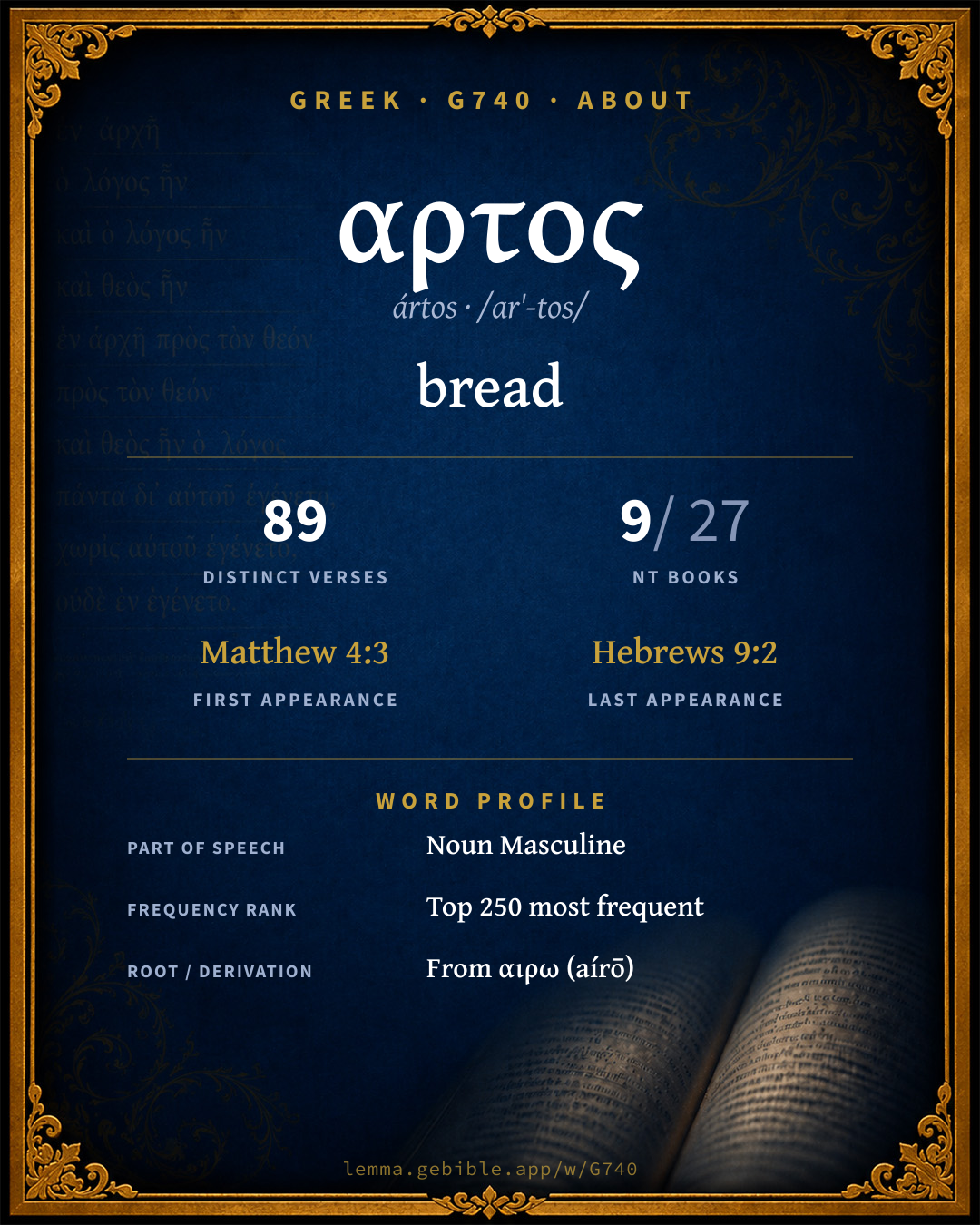
ἄρτος
bread
‘bread’ is one of 2 main senses fuller range ↓
Full lexicon entry — Thayer's Greek Lexicon
From Thayer's Greek Lexicon
Where this word appears
See every Accusative-case word in the Greek New Testament →
Grammar key — what these labels mean
Part of speech
- Noun
- A naming word — a person, place, thing, or idea.
Case
- Accusative
- The case of the direct object and of extent.
- Nominative
- The case of the subject (and the predicate nominative).
- Genitive
- The case of source, possession, or “of” — answers “whose / from what.”
- Dative
- The case of the indirect object, means, or location — “to / for / with / in.”
Gender
- Masculine
- Grammatically masculine.
Number
- Singular
- One.
- Plural
- More than one.
1 verse where G740 appears in the Genitive case in the Book of Acts. Filtered view — show all forms. Click any verse to open its interlinear word-by-word view. Verse text shown in the World English Bible for context — . Each verse’s Greek form is shown with its reference; the English is not keyword-highlighted, since the data carries no word-level English alignment. Use “Compare translations” on any verse to read it across multiple English versions. This concordance covers the Greek New Testament; Septuagint (Greek Old Testament) occurrences of this word are not indexed here.
Acts
About this entry
At a glance — auto-summarized from this page’s data, not written by a person. Every figure links to its source below. This summary describes the numbers; it doesn’t interpret them.
“bread” is the headline sense of the Greek noun αρτος (ártos). Scripture first uses it in Matthew 4:3. It appears 89 verses across 9 books of the Greek New Testament, among its moderately common vocabulary. Catalogued under 2 senses, its meaning is not single-sense. It shares a root with αιρω, αιρεομαι and αρα. The sections below give every sense, occurrence, and version rendering.
Gloss history
Strong's 1890 vs modern scholarship
About this word
Strong's G740 catalogs a Greek word from the Greek New Testament.
These counts are not copied from any lexicon or concordance. They are computed here, from the morphology-tagged Greek New Testament. What Lemma adds →
- 89
- distinct verses
- The word appears in 89 distinct verses.
- 9 / 27
- NT books
- The word appears in 9 of 27 New Testament books.
- #174
- by frequency
- Top 250 most frequent Greek words (rank 174 of 5,347 Greek words by occurrence).
View all 89 occurrences in the concordance →
By section of the New Testament
By traditional corpus
Conventional, traditional groupings — biblical authorship is debated, so this is a traditional corpus grouping, not an authorship claim. Some books belong to more than one corpus (Luke is in both the Gospels and the Lukan corpus, and so on), so these shares overlap and need not total 100%. Each figure is a share of the word’s 89 distinct verses.
- Gospels 74 verses · 83%
- Lukan (Luke–Acts) 21 verses · 24%
- Johannine 20 verses · 22%
- Pauline corpus 9 verses · 10%
- Hebrews 1 verse · 1%
How translations render this word
Counts come from each version’s own published word-to-Strong’s tagging or interlinear alignment — an approximate guide to how each version renders this word, not a word-level alignment the data otherwise carries. Because each total is that version’s own tagged count, the per-version totals vary from one another and need not match the appearance or distinct-verse counts above. These counts may also differ from a printed concordance because Lemma counts each distinctly tagged rendering and does not collapse phrase taggings into a single head-word total. This is a fixed set of word-tagged versions (KJV, ASV, BSB, ULT) and does not change with the reading translation you choose elsewhere. Each version’s license is shown beside its name below (and on Sources).
- King James Version: Bread 70×, Loaves 22×, Shewbread 3×
- American Standard Version: Bread 61×, Loaves 23×, The 9×
- Berean Standard Bible: Bread 60×, Loaves 20×, Consecrated bread 3×
- unfoldingWord Literal Text: Bread 53×, Loaves 38×, Bread loaves 3×
King James Version Public Domain
Renders G740 across 98 tagged occurrences — most commonly:
Plus 3 renderings that appear only once — usually multi-word phrases or single function words the recovered tagging swept in, not distinct renderings. Not rendered by a distinct English word in 1 further occurrence.
American Standard Version Public Domain
Renders G740 across 104 tagged occurrences — most commonly:
Plus 3 renderings that appear only once — usually multi-word phrases or single function words the recovered tagging swept in, not distinct renderings.
Berean Standard Bible Public Domain
Renders G740 across 90 tagged occurrences — most commonly:
Not rendered by a distinct English word in 7 further occurrences.
unfoldingWord Literal Text CC BY-SA 4.0
Renders G740 across 97 tagged occurrences — most commonly:
Plus 3 renderings that appear only once — usually multi-word phrases or single function words the recovered tagging swept in, not distinct renderings.
Senses in Thayer's
The 2 senses Thayer's distinguishes for this word, in lexicon order (not ranked by frequency or importance). The full entry — with sub-senses — is in the Lexicon Entry tab.
- food composed of flour mixed with water and baked
- food of any kind
Word origin
Derived from αιρω (aírō) (G142) — to raise up.
From G142 ; bread (as raised ) or a loaf : - (shew-) bread loaf.
— Strong’s Exhaustive Concordance (1890), public domain.
Forms in the corpus
The 8 distinct written forms G740 takes in the Greek New Testament, most frequent first — each parse links to that case’s occurrences in the concordance.
| Form | Parsing | Example | Uses |
|---|---|---|---|
| ἄρτον árton | Noun, Accusative, Singular, Masculine | Matthew 6:11 | 39 |
| ἄρτους ártous | Noun, Accusative, Plural, Masculine | Matthew 12:4 | 30 |
| ἄρτος ártos | Noun, Nominative, Singular, Masculine | Luke 4:3 | 10 |
| ἄρτων ártōn | Noun, Genitive, Plural, Masculine | Matthew 16:11 | 6 |
| ἄρτου ártou | Noun, Genitive, Singular, Masculine | Luke 24:35 | 5 |
| ἄρτοι ártoi | Noun, Nominative, Plural, Masculine | Matthew 4:3 | 4 |
| ἄρτῳ ártō | Noun, Dative, Singular, Masculine | Matthew 4:4 | 2 |
| ἄρτοις ártois | Noun, Dative, Plural, Masculine | Mark 6:52 | 1 |
Same root — word family
Other Thayer's entries built from the same root as G740, grouped by Strong’s listed origin. These share a root / origin per the lexicon — not necessarily a shared meaning. Each links to that word’s own entry.
Derives from
Shares the same root
- αιρεομαι hairéomai G138 to choose
- αρα ará G685 curse
- αρα ára G686 therefore
- αρεσκω aréskō G700 to please
- αριθμος arithmós G706 number
- αρκεω arkéō G714 to ward off
- αρρην árrhēn G730 male
- αρτι árti G737 now
- αρτυω artýō G741 to season
- αρωμα árōma G759 spice
- ορος óros G3735 mountain
Compare all same-root words → Showing 4 of 13 — not the complete family. They share a root, not necessarily a meaning.
Septuagint usage
The same Greek word αρτος appears 265 times in the Greek Old Testament (Septuagint), across 242 verses in 29 books.
- 265
- LXX occurrences
- Tagged occurrences of this Greek word in the Septuagint.
- 242
- verses
- Distinct Septuagint verses containing this word.
- 29 / 39
- OT books
- The word appears in 29 of the 39 Old Testament books.
Sample Septuagint occurrences
- Genesis 3:19 ἄρτος
- Exodus 2:20 ἄρτος
- Leviticus 2:4 ἄρτος
- Numbers 4:7 ἄρτος
- Deuteronomy 8:3 ἄρτος
- Joshua 9:5 ἄρτος
- Judges 7:13 ἄρτος
- Ruth 1:6 ἄρτος
- 1 Samuel 1:24 ἄρτος
- 2 Samuel 3:29 ἄρτος
- 1 Kings 5:23 ἄρτος
- 2 Kings 4:8 ἄρτος
Septuagint occurrences (same lexeme)
Every verse where the same Strong’s number (G740) appears in the Greek Septuagint — showing the first 50 of 242. Verse text shown in the World English Bible for context; the Greek form is the matched word — the English is not keyword-highlighted.
- Genesis 3:19 ἄρτος By the sweat of your face will you eat bread until you return to the ground, for out of it you were taken. For you are dust, and to dust you shall return."
- Genesis 14:18 ἄρτος Melchizedek king of Salem brought forth bread and wine: and he was priest of God Most High.
- Genesis 18:5 ἄρτος I will get a morsel of bread so you can refresh your heart. After that you may go your way, now that you have come to your servant." They said, "Very well, do as you have said."
- Genesis 21:14 ἄρτος Abraham rose up early in the morning, and took bread and a bottle of water, and gave it to Hagar, putting it on her shoulder, and gave her the child, and sent her away. She departed, and wandered in the wilderness of Beersheba.
- Genesis 24:33 ἄρτος Food was set before him to eat. But he said, "I will not eat until I have told my message." He said, "Speak on."
- Genesis 25:34 ἄρτος Jacob gave Esau bread and stew of lentils. He ate and drank, rose up, and went his way. So Esau despised his birthright.
- Genesis 27:17 ἄρτος She gave the savory food and the bread, which she had prepared, into the hand of her son Jacob.
- Genesis 28:20 ἄρτος Jacob vowed a vow, saying, "If God will be with me, and will keep me in this way that I go, and will give me bread to eat, and clothing to put on,
- Genesis 37:25 ἄρτος They sat down to eat bread, and they lifted up their eyes and looked, and saw a caravan of Ishmaelites was coming from Gilead, with their camels bearing spices and balm and myrrh, going to carry it down to Egypt.
- Genesis 39:6 ἄρτος He left all that he had in Joseph's hand. He didn't concern himself with anything, except for the food which he ate. Joseph was well-built and handsome.
- Genesis 41:54 ἄρτος The seven years of famine began to come, just as Joseph had said. There was famine in all lands, but in all the land of Egypt there was bread.
- Genesis 41:55 ἄρτος When all the land of Egypt was famished, the people cried to Pharaoh for bread, and Pharaoh said to all the Egyptians, "Go to Joseph. What he says to you, do."
- Genesis 43:16 ἄρτος When Joseph saw Benjamin with them, he said to the steward of his house, "Bring the men into the house, and butcher an animal, and make ready; for the men will dine with me at noon."
- Genesis 43:31 ἄρτος He washed his face, and came out. He controlled himself, and said, "Serve the meal."
- Genesis 43:32 ἄρτος They served him by himself, and them by themselves, and the Egyptians, that ate with him, by themselves, because the Egyptians don't eat bread with the Hebrews, for that is an abomination to the Egyptians.
- Genesis 45:23 ἄρτος To his father, he sent after this manner: ten donkeys loaded with the good things of Egypt, and ten female donkeys loaded with grain and bread and provision for his father by the way.
- Genesis 47:15 ἄρτος When the money was all spent in the land of Egypt, and in the land of Canaan, all the Egyptians came to Joseph, and said, "Give us bread, for why should we die in your presence? For our money fails."
- Genesis 47:16 ἄρτος Joseph said, "Give your cattle; and I will give you food for your cattle, if money fails."
- Genesis 47:17 ἄρτος They brought their cattle to Joseph, and Joseph gave them bread in exchange for the horses, and for the flocks, and for the herds, and for the donkeys: and he fed them with bread in exchange for all their cattle for that year.
- Genesis 47:19 ἄρτος Why should we die before your eyes, both we and our land? Buy us and our land for bread, and we and our land will be servants to Pharaoh. Give us seed, that we may live, and not die, and that the land won't be desolate."
- Genesis 49:20 ἄρτος Out of Asher his bread will be fat, He will yield royal dainties.
- Exodus 2:20 ἄρτος He said to his daughters, "Where is he? Why is it that you have left the man? Call him, that he may eat bread."
- Exodus 16:3 ἄρτος and the children of Israel said to them, "We wish that we had died by the hand of Yahweh in the land of Egypt, when we sat by the flesh-pots, when we ate our fill of bread, for you have brought us out into this wilderness, to kill this whole assembly with hunger."
- Exodus 16:4 ἄρτος Then said Yahweh to Moses, "Behold, I will rain bread from the sky for you, and the people shall go out and gather a day's portion every day, that I may test them, whether they will walk in my law, or not.
- Exodus 16:8 ἄρτος Moses said, "Now Yahweh shall give you meat to eat in the evening, and in the morning bread to satisfy you; because Yahweh hears your murmurings which you murmur against him. And who are we? Your murmurings are not against us, but against Yahweh."
- Exodus 16:12 ἄρτος "I have heard the murmurings of the children of Israel. Speak to them, saying, 'At evening you shall eat meat, and in the morning you shall be filled with bread: and you shall know that I am Yahweh your God.'"
- Exodus 16:15 ἄρτος When the children of Israel saw it, they said one to another, "What is it?" For they didn't know what it was. Moses said to them, "It is the bread which Yahweh has given you to eat."
- Exodus 16:29 ἄρτος Behold, because Yahweh has given you the Sabbath, therefore he gives you on the sixth day the bread of two days. Everyone stay in his place. Let no one go out of his place on the seventh day."
- Exodus 16:32 ἄρτος Moses said, "This is the thing which Yahweh has commanded, 'Let an omer-full of it be kept throughout your generations, that they may see the bread with which I fed you in the wilderness, when I brought you forth from the land of Egypt."
- Exodus 18:12 ἄρτος Jethro, Moses' father-in-law, took a burnt offering and sacrifices for God. Aaron came with all of the elders of Israel, to eat bread with Moses' father-in-law before God.
- Exodus 23:25 ἄρτος You shall serve Yahweh your God, and he will bless your bread and your water, and I will take sickness away from your midst.
- Exodus 25:30 ἄρτος You shall set bread of the presence on the table before me always.
- Exodus 29:2 ἄρτος unleavened bread, unleavened cakes mixed with oil, and unleavened wafers anointed with oil: you shall make them of fine wheat flour.
- Exodus 29:23 ἄρτος and one loaf of bread, one cake of oiled bread, and one wafer out of the basket of unleavened bread that is before Yahweh.
- Exodus 29:32 ἄρτος Aaron and his sons shall eat the flesh of the ram, and the bread that is in the basket, at the door of the tent of meeting.
- Exodus 29:34 ἄρτος If anything of the flesh of the consecration, or of the bread, remains to the morning, then you shall burn the remainder with fire: it shall not be eaten, because it is holy.
- Exodus 34:28 ἄρτος He was there with Yahweh forty days and forty nights; he neither ate bread, nor drank water. He wrote on the tablets the words of the covenant, the ten commandments.
- Exodus 39:17 ἄρτος They put the two braided chains of gold in the two rings at the ends of the breastplate.
- Exodus 40:23 ἄρτος He set the bread in order on it before Yahweh, as Yahweh commanded Moses.
- Leviticus 2:4 ἄρτος "'When you offer an offering of a meal offering baked in the oven, it shall be unleavened cakes of fine flour mixed with oil, or unleavened wafers anointed with oil.
- Leviticus 7:12 ἄρτος If he offers it for a thanksgiving, then he shall offer with the sacrifice of thanksgiving unleavened cakes mixed with oil, and unleavened wafers anointed with oil, and cakes mixed with oil.
- Leviticus 7:13 ἄρτος With cakes of leavened bread he shall offer his offering with the sacrifice of his peace offerings for thanksgiving.
- Leviticus 8:26 ἄρτος and out of the basket of unleavened bread, that was before Yahweh, he took one unleavened cake, and one cake of oiled bread, and one wafer, and placed them on the fat, and on the right thigh.
- Leviticus 8:31 ἄρτος Moses said to Aaron and to his sons, "Boil the flesh at the door of the Tent of Meeting, and there eat it and the bread that is in the basket of consecration, as I commanded, saying, 'Aaron and his sons shall eat it.'
- Leviticus 8:32 ἄρτος What remains of the flesh and of the bread you shall burn with fire.
- Leviticus 22:7 ἄρτος When the sun is down, he shall be clean; and afterward he shall eat of the holy things, because it is his bread.
- Leviticus 22:11 ἄρτος But if a priest buys a slave, purchased by his money, he shall eat of it; and such as are born in his house, they shall eat of his bread.
- Leviticus 22:13 ἄρτος But if a priest's daughter is a widow, or divorced, and has no child, and has returned to her father's house, as in her youth, she may eat of her father's bread: but no stranger shall eat any of it.
- Leviticus 23:14 ἄρτος You shall eat neither bread, nor roasted grain, nor fresh grain, until this same day, until you have brought the offering of your God. This is a statute forever throughout your generations in all your dwellings.
- Leviticus 23:17 ἄρτος You shall bring out of your habitations two wave-loaves of two tenth parts of an ephah: they shall be of fine flour, they shall be baked with yeast, for first fruits to Yahweh.
These are occurrences of the same Greek lexeme (G740) in the Septuagint — not a translation of any one Hebrew word. The store carries no word-level Hebrew↔Greek alignment, so no Hebrew original is asserted here. Counts come from the recovered LXX Strong's tagging — high-frequency vocabulary is well covered, while rare or late forms may be untagged — so they reflect tagged occurrences and may slightly undercount.