2 Timothy 1:4

Greek (Tischendorf 8th ed.) 2 Timothy 1:4 appears in the Greek New Testament. The text above is from the Tischendorf 8th edition. Each word links to its Strong’s number and a concise gloss. Click any word for its full Thayer’s Greek Lexicon entry.
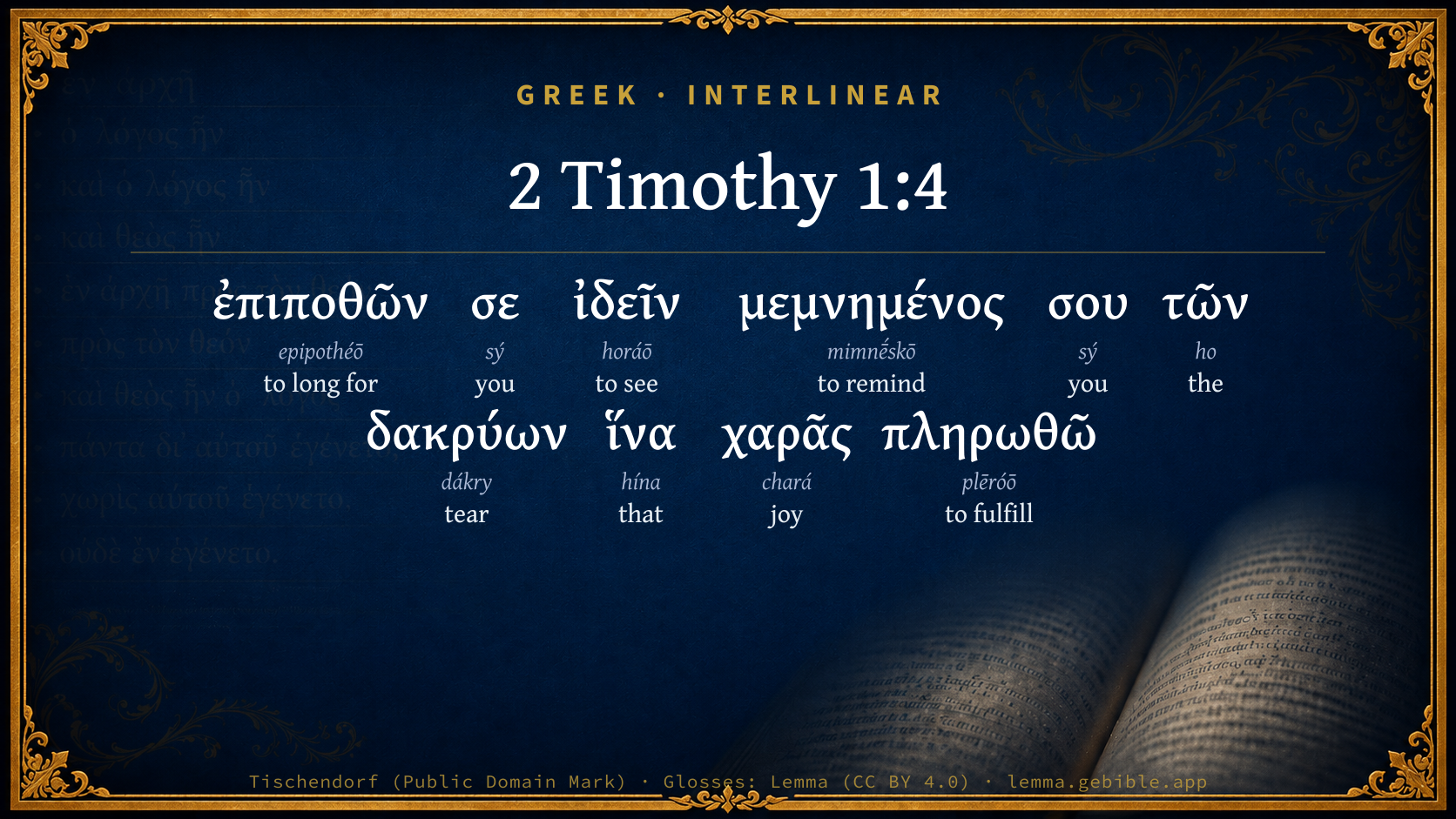
Download image
Cite this verse

2 Timothy 1:4 (World English Bible). Public Domain. Lemma interlinear Bible study tool, https://lemma.gebible.app/v/2-timothy/1/4.

Show BibTeX & RIS
BibTeX
RIS
English Translation
longing to see you, remembering your tears, that I may be filled with joy;
World English Bible · Public Domain
Download a study sheet

One document with this verse’s original text, its word-by-word gloss line, the meaning frame, cross-references with their text, attributed commentary, and full source and license credits — printable, and it pastes into notes with its structure intact.

This verse Autodidact and up

Study sheet (.html) Plain text (.txt)

A passage Seminary Student

Up to 50 verses in one chapter. A passage sheet keeps up to 6 commentary sources and 12 cross-references per verse, in the order this page ranks them, and says so on the sheet whenever that leaves anything out. Ask for a single verse and you get the Autodidact verse sheet above.

Everything on this page stays free to read, with no account — the sheet is a download of what is already on screen, not access to it.

Want to remove ads? Support Godless Engineer
Compare translations 3

The same verse in 3 English versions, stacked beneath the original-language interlinear above. Click any original word for its lexicon entry.

Each is an independent rendering of the whole verse — the interlinear is not word-aligned to these translations.

Highlighted words mark where these versions differ — a whole-verse word diff, not a word-by-word alignment.

  • World English Bible Public Domain
    longing to see you, remembering your tears, that I may be filled with joy;
  • King James Version Public Domain
    Greatly desiring to see thee, being mindful of thy tears, that I may be filled with joy;
  • unfoldingWord Literal Text CC BY-SA 4.0
    longing to see you, remembering your tears, so that I may be filled with joy,

unfoldingWord Literal Text — © unfoldingWord, licensed CC BY-SA 4.0. Word-aligned USFM3 via Door43 (git.door43.org/unfoldingWord/en_ult).

Versions to compare (up to 4)

3 of 4 selected

Show all 19 translations

Every available English version of this verse, each an independent rendering of the whole verse.

  • World English Bible Public Domain
    longing to see you, remembering your tears, that I may be filled with joy;
  • Berean Standard Bible Public Domain
    Recalling your tears, I long to see you so that I may be filled with joy.
  • Majority Standard Bible Public Domain
    Recalling your tears, I long to see you so that I may be filled with joy.
  • King James Version Public Domain
    Greatly desiring to see thee, being mindful of thy tears, that I may be filled with joy;
  • American Standard Version (1901) Public Domain
    longing to see thee, remembering thy tears, that I may be filled with joy;
  • Revised Version (1885) Public Domain
    longing to see thee, remembering thy tears, that I may be filled with joy;
  • Geneva Bible (1599) Public Domain
    Desiring to see thee, mindefull of thy teares, that I may be filled with ioy:
  • Douay-Rheims (1899) Public Domain
    Desiring to see thee, being mindful of thy tears, that I may be filled with joy,
  • Young's Literal Translation Public Domain
    desiring greatly to see thee, being mindful of thy tears, that with joy I may be filled,
  • Literal Standard Version CC BY-SA 4.0
    desiring to see you greatly, being mindful of your tears, that I may be filled with joy,
  • Unlocked Literal Bible CC BY-SA 4.0
    As I remember your tears, I long to see you, that I may be filled with joy.
  • unfoldingWord Literal Text CC BY-SA 4.0
    longing to see you, remembering your tears, so that I may be filled with joy,
  • Darby Bible Public Domain
    earnestly desiring to see thee, remembering thy tears, that I may be filled with joy;
  • World Messianic Bible Public Domain
    longing to see you, remembering your tears, that I may be filled with joy;
  • Webster's Bible Public Domain
    Greatly desiring to see thee, being mindful of thy tears, that I may be filled with joy;
  • Free Bible Version CC BY-SA 4.0
    I remember how you cried, and I so want to see you! That would make me really happy.
  • Bible in Basic English Public Domain
    Desiring to see you, keeping in my memory your weeping, so that I may be full of joy;
  • Text-Critical English NT CC BY 4.0
    Recalling yoʋr tears, I long to see yoʋ so that I may be filled with joy.
  • Tyndale New Testament (1534) Public Domain
    desyrynge to se the myndfull of thy teares: so that I am filled with ioye

Literal Standard Version (2020), Covenant Press — licensed CC BY-SA 4.0. Text via the HelloAO Bible API (eBible.org). Unlocked Literal Bible (unfoldingWord) — licensed CC BY-SA 4.0. Text via the HelloAO Bible API (eBible.org). unfoldingWord Literal Text — © unfoldingWord, licensed CC BY-SA 4.0. Word-aligned USFM3 via Door43 (git.door43.org/unfoldingWord/en_ult). Free Bible Version, Dr. Jonathan Gallagher — licensed CC BY-SA 4.0. Text via the HelloAO Bible API (eBible.org).

Word by word

More ways to search: Search by grammar → Find every occurrence → Compare this word →

Practice this passage: Drill this verse → Learn its vocabulary →

About this verse

These counts appear in no published source. They are computed here, from the morphology-tagged text and Lemma’s own curated glosses. What Lemma adds →

10
words
9
distinct lemmas
Pauline Epistles
section

Notable vocabulary

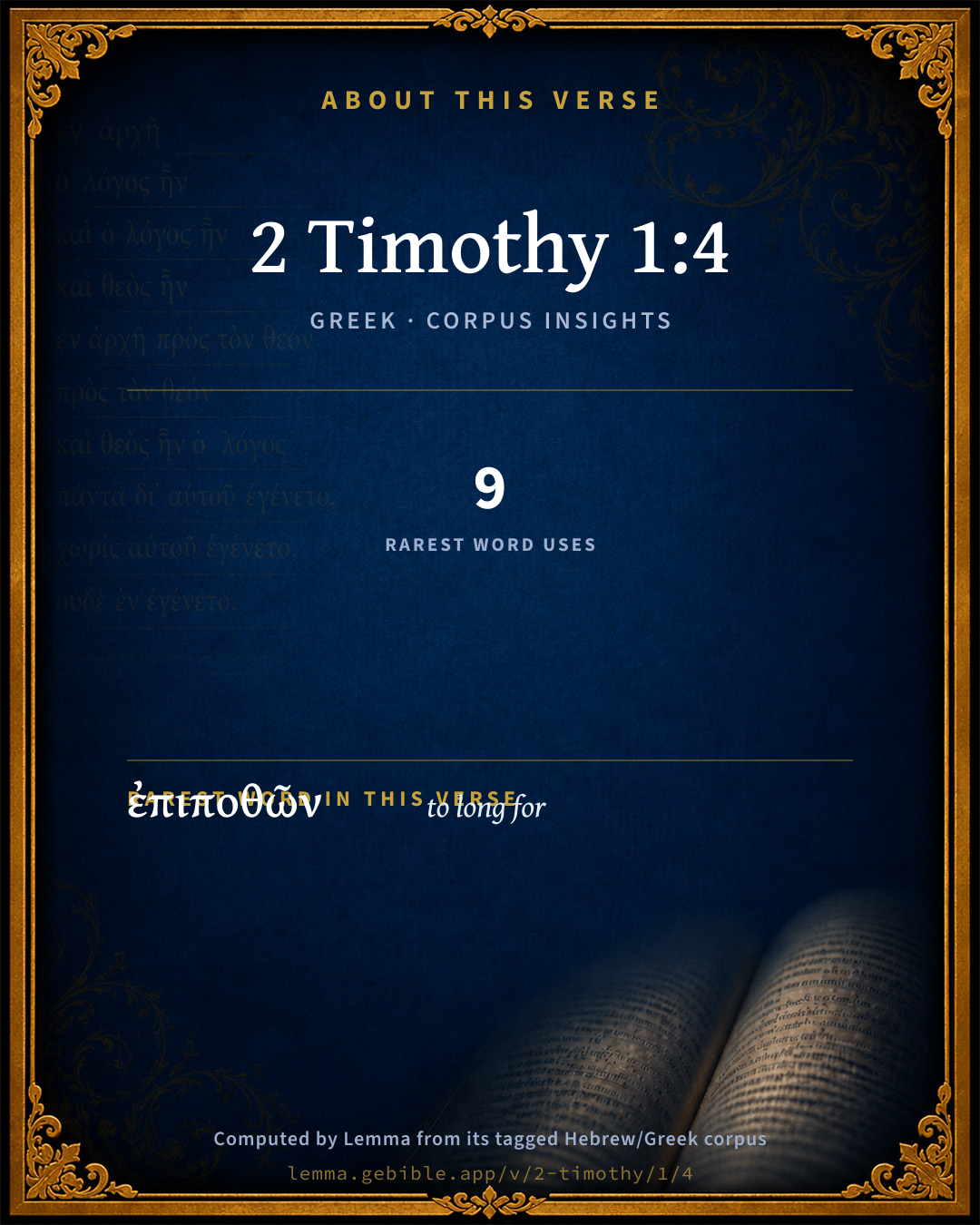
The rarest word here is ἐπιποθῶν to long for G1971 — appearing just 9 times in the whole Greek New Testament.

Shared distinctive vocabulary

ἐπιποθῶν to long for G1971 occurs in 9 verses of the Greek New Testament. Also found in:

Repetition

A word recurs within this verse:

Cross-references

18

Topical passages linked to 2 Timothy 1:4 in the Treasury of Scripture Knowledge — connected by theme and wording, ordered by reader-vote popularity; previews shown in the World English Bible.

  • 2 Timothy 4:9 Be diligent to come to me soon,
  • Philippians 1:8 For God is my witness, how I long after all of you in the tender mercies of Christ Jesus.
  • 1 Thessalonians 2:17–3:1 But we, brothers, being bereaved of you for a short season, in presence, not in heart, tried even harder to see your face with great desire,
  • 2 Timothy 4:21 Be diligent to come before winter. Eubulus salutes you, as do Pudens, Linus, Claudia, and all the brothers.
  • Psalms 126:5 Those who sow in tears will reap in joy.
  • Isaiah 61:3 to appoint to those who mourn in Zion, to give to them a garland for ashes, the oil of joy for mourning, the garment of praise for the spirit of heaviness; that they may be called trees of righteousness, the planting of Yahweh, that he may be glorified.
  • Jeremiah 31:13 Then shall the virgin rejoice in the dance, and the young men and the old together; for I will turn their mourning into joy, and will comfort them, and make them rejoice from their sorrow.
  • John 16:22 Therefore you now have sorrow, but I will see you again, and your heart will rejoice, and no one will take your joy away from you.
  • John 16:24 Until now, you have asked nothing in my name. Ask, and you will receive, that your joy may be made full.
  • Acts 20:19 serving the Lord with all humility, with many tears, and with trials which happened to me by the plots of the Jews;
  • Acts 20:31 Therefore watch, remembering that for a period of three years I didn't cease to admonish everyone night and day with tears.
  • Acts 20:37–38 They all wept a lot, and fell on Paul's neck and kissed him,
  • Romans 1:11 For I long to see you, that I may impart to you some spiritual gift, to the end that you may be established;
  • Romans 15:30–32 Now I beg you, brothers, by our Lord Jesus Christ, and by the love of the Spirit, that you strive together with me in your prayers to God for me,
  • Philippians 2:26 since he longed for you all, and was very troubled, because you had heard that he was sick.
  • 1 John 1:4 And we write these things to you, that our joy may be fulfilled.
  • Revelation 7:17 for the Lamb who is in the midst of the throne shepherds them, and leads them to springs of waters of life. And God will wipe away every tear from their eyes."
  • Revelation 21:4 He will wipe away from them every tear from their eyes. Death will be no more; neither will there be mourning, nor crying, nor pain, any more. The first things have passed away."

Cross-references courtesy of OpenBible.info (CC BY 4.0).

Commentary

Notes on 2 Timothy 1:4 from classic Christian and Jewish commentators (each source and its license shown beneath its notes). The classic Christian expositions comment on the surrounding passage and are grouped to its opening verse, so a note may address several verses; the Jewish commentaries on the Tanakh (Rashi and others) are per-verse, so they appear only where the commentator wrote on this verse.

Lemma curates 59 commentaries, every one of them public domain or Creative Commons licensed, each selected and text-cleaned for this edition rather than reprinted as found. About our sources →

The Cambridge Bible for Schools and Colleges

gen. ed. J. J. S. Perowne

4. being mindful of thy tears] At the close we must suppose of the visit paid him by St Paul in accordance with the intention expressed 1Ti_3:14. It seems very awkward to insert this clause as a subordinate parenthesis ‘with a faint causal force,’ ‘longing to see thee, as I remember thy tears in order that I may be filled with joy’; but this must be the effect of R.V. rendering. And again there is difficulty in either rendering of the participle in 2Ti_1:5 with this construction; (1) A.V. ‘when I call to remembrance’ present, whereas we ought to read the aorist (2) R.V. ‘having been reminded,’ implying that there had been some occasion or messenger to give such news, of which we have at least no other hint. It is better to follow Drs Westcott and Hort in putting a comma after ‘tears’ and joining 2Ti_1:4-5 thus, ‘that I may be filled with joy in being reminded.’ The thought underlying this phrase ‘to be filled with joy,’ ‘to have one’s joy fulfilled,’ is, as Dr Westcott puts it in 1Jn_1:4, that the fulfilment of Christian joy depends upon the realisation of fellowship. This fellowship may be with bodily presence, as 2Jn_1:12; Joh_3:29; or without, as Joh_15:11; Joh_16:24; Joh_17:13; 1Jn_1:4, ‘these things we write that our joy may be fulfilled.’ The joy of the apostle is secured by his ‘little children’ realising full fellowship. Similarly the thought here is an echo of St Paul’s feelings expressed 5 or 6 years before to his Philippian ‘beloved ones,’ and the expressions are an echo too. Through that letter ran the theme ‘gaudeo: gaudete’; in that, with a wonderful tenderness and delicacy St Paul shews them that ‘unity,’ ‘brotherly love,’ is ‘the one thing lacking’ to perfect their joy: the one thing that to hear of or see in them will fulfil his too. Compare Php_1:3-8; Php_2:1-2; Php_4:4. Through this letter runs the theme ‘fidem servavi: serva’; and with the same considerate love St Paul makes the appeal to his timid son to be ‘strong in the faith’ turn first on the fulfilment of his own joy which will result.

The final conjunction ‘in order that’ depends then formally on ‘I give thanks in my supplications,’ really on the whole affectionate yearning and praying spirit of 2Ti_1:3-4.

The Cambridge Bible for Schools and Colleges (gen. ed. J. J. S. Perowne; Cambridge University Press, 1878–1918) — public domain. Text from a community e-Sword module.

The Biblical Illustrator

Joseph S. Exell

2Ti_1:4

Greatly desiring to see thee.

Things of like nature desire union

Two flames will become one, and two rivers, if they meet, willingly make but one stream. And are not all the faithful baptized with fire, and of the like temperature and condition? A faithful man affecteth nothing above the Lord; His image is the only object of his love; and does not every good man in part resemble that, and carry it about with him? Do not the sparkles of grace and wisdom appear in their faces? Is there not a kind of Divine influence in their speeches? They in some measure resemble their father, as dear children; and from the contrary ground the wicked are an abomination to the just. They will build up one another in their holy faith, consult for the good of the Church, and tell one another what the Lord hath done for their soul; yea, the very sight of a good man in the morning, a dream of him in the night, will make one walk with more cheerfulness all the day following. The face of the faithful is like the loadstone, it conveyeth strength to many, and yet is never the weaker, poorer; and as the one is reputed a great wonder in nature, so is the other as great a wonder in grace. (J. Barlow, D. D.)

The coming of an absent friend

The chilling cold of winter makes the summers sun more pleasant; so doth long absence a friends personal presence. (J. Barlow, D. D.)

The faithful found in companies

And here may the profane learn a lesson or two, if they please, for this is the true cause why the faithful, like pigeons, flock to the house of God, and are to be found there in troops and companies. Is not that the congregation of the saints, and the royal exchange, where they all meet together? Again, they may see why some sigh in soul and desire to be loosed. For their best friends be gone to heaven before them, and Christ is absent from them (Php_3:20). (J. Barlow, D. D.)

Mindful of thy tears.

Tears

He seems not merely to speak of the former tears of Timothy shed at bidding Paul farewell (for tears are usually elicited at parting, comp. Act_20:37), but of his habitual tears under the influence of pious feeling. In this respect also he had him like-minded (Php_2:20) with himself. Tears, the flower of the heart, indicate either the greatest hypocrisy or the utmost sincerity. (J. A. Bengel.)

The power of tears

There is no power that man can wield so mighty as that of genuine tears. The eloquence of words is powerful, but the eloquence of tears is far more so. What manly heart has not been often arrested by the genuine sobs of even some poor child in the streets. A childs tear in the crowded thoroughfare has often arrested the busy merchant in his hurried career Coriolanus, who defied all the swords in Italy and her confederate states, fell prostrate before the tears of his mother: Oh, my mother, thou hast saved Rome, but lost thy son. (D. Thomas, D. D.)

Tears described

Tears have been described as the blood of the wounds of the soul, the leaves of the plant of sorrow, the hail and rain of lifes winter, the safety-valves of the heart when too much pressure is laid on, the vent of anguish-showers blown up by the tempests of the soul.

The Biblical Illustrator, edited by Joseph S. Exell (c. 1880s–1900s) — public domain. Text from a community e-Sword module.

Tyndale Open Study Notes

Tyndale Open Resources

1:4 Paul begins urging Timothy to come to him (see study note on 1:5-14). • your tears: The two may have last parted when Paul was transferred to Rome under arrest (cp. Acts 20:37-38; 21:12-14).

Tyndale Open Study Notes — © Tyndale Open Resources, licensed CC BY-SA 4.0. Text via the HelloAO Bible API.

Bengel's Gnomon

Johann Albrecht Bengel

2Ti 1:4. Ἐπιποθῶν σε ἰδεῖν, earnestly desiring to see thee) He begins his invitation to Timothy at first gradually.—μεμνημένος σου τῶν δακρύων, remembering thy tears) He seems not merely to speak of the former tears of Timothy shed at bidding Paul farewell (for tears are usually elicited at parting, comp. Act 20:37), but of his habitual tears under the influence of pious feeling. In this respect also he had him like-minded [Php 2:20] with himself: Act 20:19, note. Tears, the flower of the heart, indicate either the greatest hypocrisy or the utmost sincerity. Turning tears into ridicule is a proof of the depravity of our age.—ἵνα, in order that) Construe with ἰδεῖν, to see thee [not with μεμνημένος—δακρύων].

Bengel's Gnomon of the New Testament — English translation (T&T Clark, Edinburgh, 1860) — public domain. Text from a community e-Sword module.

Meyer's Critical & Exegetical Commentary

Heinrich August Wilhelm Meyer

2Ti_1:4. As in Rom_1:11, Php_1:8, and other passages, Paul also expresses here his longing to see the person to whom the epistle is addressed. The participle ἐπιποθῶν is subordinate to the previous ἔχω; to it, in turn, the next participle μεμνημένος is subordinated. The longing for Timothy causes him to be continually remembered in the apostles prayers, and the remembrance is nourished by thinking of his tears.

σου τῶν δακρύων] By these are meantas the verb μεμνημένος showsnot tears which Timothy shed when at a distance from the apostle (Wiesinger), and of which he knew only through a letter (which Timothy therefore shed by letter, Hofmann); but the tears of which he himself had been witness, the tears which Timothy shed probably on his departure from him (van Oosterzee, Plitt). These were, to the apostle, a proof of Timothys love to him, and produced in him the desire of seeing Timothy again, that he might thereby be filled with joy. In this connection of the clauses with one another, the apostle has not yet given the object of thanks appropriate to the χάριν ἔχω; he does not do so till 2Ti_1:5.[4]

According to Hofmann, the reason of the thanks is already given in the participial clause μεμνημένος. But the idea that Paul thanks God for Timothys tears, is out of all analogy with the other epistles of the apostle. Even the ἵνα χαρᾶς πληρωθῶ is against this view, for the apostle could not possibly say that he remembers Timothys tears in order that he may be filled with joy.

[4] Against this view it cannot be maintained that it makes a subordinate participle μεμνημένος depend on the subordinate participle ἐπιποθῶν, for that is not in itself impossible; nor can it be said that the insertion of a clause μεμνημένος between ἰδεῖν σε and ἵνα is intolerable, since the chief stress is not on μεμνημένος, but on ἐπιποθῶν κ.τ.λ. Further, it cannot provoke objection that Timothys tears nourished in the apostle the longing to see him again, since these were a proof of his loveand of his faith.

Meyer — Critical and Exegetical Commentary on the New Testament — English translation by Peter Christie, edited by Frederick Crombie (T&T Clark, 1880) — public domain. Text from a community e-Sword module.

Expositor's Greek Testament

ed. W. Robertson Nicoll

2Ti 1:4 . μεμνημένος δακρύων : Parenthetical. St. Paul’s longing was made keener by his recollection of the tears Timothy had shed at their last parting. So Chrys. fixes the occasion. We are reminded of the scene at Miletus, Act 20:37 . Bengel, comparing Act 20:19 , thinks that reference is rather made to an habitual manifestation of strong emotion. At that time, and in that society, tears were allowed as a manifestation of emotion more freely than amongst modern men of the West.

χαρᾶς πληρωθῶ : For πληρόω with a genitive, cf. Rom 15:13-14 . It takes a dat., Rom 1:29 , 2Co 7:4 , cf. Eph 5:18 ; an acc., Phi 1:11 , Col 1:9 .

The Expositor's Greek Testament, edited by W. Robertson Nicoll (1897–1910) — public domain. Text from a community e-Sword module.

International Critical Commentary

4. τῶν δακρύων] cf. Act 20:37, though this can scarcely be an allusion to that scene. “Lacrimæ flos cordis” (Bengel).

πληρωθῶ] perhaps to be joined closely with following: “that I may be filled with joy by the receipt of the reminder which your coming would give” (so R.V. margin, W.-H); or ὑπόμν. λαβών is loosely constructed with χάριν ἔχω. “I thank God on the recent receipt of a reminder of your faith.” This implies that he had lately heard news about Timothy, cf. Col 1:4, or perhaps had received an affectionate letter from him.

International Critical Commentary — older volumes (1896–1929), various authors — public domain. Text from a community e-Sword module.

Jamieson, Fausset & Brown

Robert Jamieson, A. R. Fausset & David Brown

desiring--Greek, "with yearning as for one much missed."

mindful of thy tears--not only at our parting (Act 20:37), but also often when under pious feelings.

that I may be filled with joy--to be joined with "desiring to see thee" (Rom 1:11-12; Rom 15:32).

Jamieson, Fausset & Brown — Commentary Critical and Explanatory on the Whole Bible (1871) — public domain (CC PDM 1.0). Text via the HelloAO Bible API.

Adam Clarke's Commentary

Verse 4. Being mindful of thy tears] Whether the apostle refers to the affecting parting with the Ephesian Church, mentioned Ac 20:37, or to the deep impressions made on Timothy's heart when he instructed him in the doctrine of Christ crucified, or to some interview between themselves, it is not certainly known. The mention of this by the apostle is no small proof of his most affectionate regards for Timothy, whom he appears to have loved as a father loves his only son.

Adam Clarke's Commentary on the Bible (1810–1826) — public domain. Text from a community e-Sword/MySword module.

Ellicott's Commentary for English Readers

(4) Greatly desiring to see thee.—In view of that violent death which, at this time a close prisoner, he saw was imminent, the memory, too, of the tears of his friend made him long yet more earnestly to see him once again on earth.

Being mindful of thy tears.—Shed probably by Timothy when his aged master had last taken leave of him. It is likely that the clouds of danger which were gathering thickly round St. Paul towards the close of his career had oppressed the brave-hearted Apostle with a foreboding of coming evil, and had invested the last parting with Timothy with circumstances of unusual solemnity. St. Paul had affected others besides Timothy with the same great love, so that tears were shed by strong men when he bade them farewell. (See the account of the leave-taking of the Ephesian elders at Miletus, Act_20:37-38—“And they all wept sore, and fell on Paul’s neck, and kissed him, sorrowing most of all for the words which he spake, that they should see his face no more.”)

There is no necessity for Hofmann’s singular, but rather far-fetched, theory here that the tears were simply an expression for Timothy’s intense sorrow at hearing of the Apostle’s arrest and close imprisonment, which sorrow St. Paul was made acquainted with in a letter. The tears, according to Hofmann, were those “welche Timotheus brieflich geweint hat.”

That I may be filled with joy.—When he meets Timothy again.

A Bible Commentary for English Readers, edited by Charles John Ellicott (1878–1897) — public domain. Text from a community e-Sword module.

John Gill's Exposition

Greatly desiring to see thee,.... In his former epistle he had desired him to stay at Ephesus, there being some work for him to do, which made it necessary he should continue; but now having answered the apostle's purpose, and he standing in need of him at Rome, being without any assistant there, some having left him, and others were left by him in other places, and others were sent by him elsewhere; and it having been some time since he saw Timothy, he longed for a sight of him:

being mindful of thy tears; shed either at the afflictions and sufferings of the apostle, of which Timothy, being his companion, was an eyewitness, and he being of a truly Christian sympathizing spirit, wept with those that wept; or at their parting from each other, as in Act 20:37

that I may be filled with joy; at the sight of him, and not at the remembrance of his tears; for the last clause is to be read in a parenthesis, and these words stand not connected with that, but with the preceding part of the text. The apostle intimates, that a sight of his dearly beloved son Timothy would fill him with joy amidst all his troubles and afflictions he endured for the Gospel: this is an instance of hearty, sincere, and strong affection.

John Gill's Exposition of the Whole Bible (1746–1763) — public domain (CC PDM 1.0). Text via the HelloAO Bible API.

Trapp's Complete Commentary

John Trapp

4 Greatly desiring to see thee, being mindful of thy tears, that I may be filled with joy;

Ver. 4. Being mindful of thy tears] Timothy was a man of many tears, so was David, Paul, Luther, Bradford, of whom it is said, that he did seldom eat but be bedewed his trencher with tears, and that few days passed him without plenty of tears shed before he went to bed:-Αγαθοι δ αριδακρυες ανδρες.

John Trapp, A Commentary or Exposition upon All the Books of the Old and New Testament (1647–1656) — public domain. Text from a community e-Sword module.

Albert Barnes' Notes on the Bible

Greatly desiring to see thee; - see 2Ti 4:9, 2Ti 4:21. It was probably on, account of this earnest desire that this Epistle was written. He wished to see him, not only on account of the warm friendship which he had for him, but because he would be useful to him in his present circumstances; see the introduction, Section 3.

Being mindful of thy tears - Alluding probably to the tears which he shed at parting from him. The occasion to which he refers is not mentioned; but nothing is more probable than that Timothy would weep when separated from such a father and friend. It is not wrong thus to weep, for religion is not intended to make us stoics or savages.

That I may be filled with joy - By seeing you again. It is easy to imagine what joy it would give Paul, then a prisoner, and forsaken by nearly all his friends, and about to die, to see a friend whom he loved as he did this young man. Learn hence, that there may be very pure and warm friendship between an old and young man, and that the warmth of true friendship is not diminished by the near prospect of death.

Albert Barnes' Notes on the Bible (1834–1885) — public domain. Text from a community e-Sword/MySword module.

Matthew Poole's English Annotations

There was a great brotherly love amongst primitive Christians, so as the apostle often expresseth his desire to see such Christians as were at a distance from him, Rom 1:11; 1Th 2:17; but he expresseth aparticular reason of his desire to see Timothy, remembering the

tears he shed at his parting from him and the rest, Act 20:37,38; besides the desire he had by his presence to satisfy him, and give him occasion of joy, with which he also should be filled; unless he speaketh of the joy he promised himself when he saw Timothy, upon his seeing the improvement he had made both of his graces and gifts in the ministerial office.

Matthew Poole's English Annotations on the Holy Bible (1683–1685) — public domain. Text from a community e-Sword/MySword module.

Whedon's Commentary on the Bible

Daniel D. Whedon

4. Mindful of—That is, recollecting thy tears, shed some time since, probably when Paul first left him at Ephesus to depart to Macedonia. 1Ti_1:3. That I refers back to see thee.

Daniel D. Whedon (gen. ed.), Commentary on the Old and New Testaments (1874–1909) — public domain. Text from a community e-Sword module.

The Pulpit Commentary

Longing for greatly desiring, A.V; remembering for being mindful of, A.V

The Pulpit Commentary (1880–1919), ed. H.D.M. Spence-Jones & Joseph S. Exell — public domain. Text from a community e-Sword module.

John Wesley's Explanatory Notes

Being mindful of thy tears - Perhaps frequently shed, as well as at the apostle's last parting with him.

John Wesley, Explanatory Notes Upon the Whole Bible (1754–1765) — public domain. Text via the GEBible commentary corpus.

Burkitt's Expository Notes on the New Testament

William Burkitt

Observe here, The vehemency of affection which our apostle expresses towards Timothy; he desired, greatly desired, to see him, and with the sight of him to be filled with joy.

Note, That though we must love all Christians, with a sincere love, yet we may love some Christians with a more fervent love than others; choice and useful Christians, endearing and endeared friends, may and must be beloved above others: I desire greatly to see thee, &c.

Observe farther, St. Paul declares how mindful he was of Timothy’s tears; perhaps a flood of tears were shed at their last parting one from another. The best of men have a propension to weeping, and upon occasion, have shed tears; so had Jacob, Joseph, David, and Christ himself. True goodness promotes compassion; good men ever have been, and are men of tender and compassionate dispositions.

William Burkitt's Expository Notes on the New Testament (1700–1703) — public domain. Text from a community e-Sword module.

The People's New Testament

B. W. Johnson

4. Greatly desiring to see thee. There is something pathetic in this language. The lonely prisoner calls to him the tears of Timothy at their last parting, and feels a yearning desire to see and counsel him face to face once more.

B. W. Johnson's The People's New Testament with Notes (1889–1891) — public domain. Electronic text from the Christian Classics Ethereal Library (CCEL) ThML edition.

Cambridge Greek Testament for Schools and Colleges

4. ἐπιποθῶν σε ἰδεῖν, desiring to see thee, here the natural longing of personal affection. Cp. Rom 1:9; 1Th 3:6.

μεμνημένος σου τῶν δακρύων, remembering thy tears, probably those shed at the last parting of the two friends. Cp. Act 20:37.

ἵνα χαρᾶς πληρωθῶ, the desired consequence of the preceding σε ἰδεῖν.

Cambridge Greek Testament for Schools and Colleges (Cambridge University Press, 1896; 21 vols, various authors incl. Carr, Maclear, Plummer, Farrar, Lumby, Moule, M. R. James, Simcox) — public domain. Text from a community e-Sword module.

Vincent's Word Studies in the New Testament

Marvin R. Vincent

Greatly desiring [επιποθων] . Better, longing. Pastorals only here. Quite frequent in Paul. See Rom 1:11; 2Co 5:2; 2Co 9:14; Phi 1:8, etc. The compounded preposition ejpi does not denote intensity, as A. verse greatly, but direction. Comp. chapter 2Ti 4:9, 21. Being mindful of thy tears [μεμνημενος σου των δακρυων] . The verb, mimnhskesqai in Paul, only 1Co 11:2. In Pastorals only here. The words give the reason for the longing to see Timothy. The allusion is probably to the tears shed by Timothy at his parting from Paul. 133 One is naturally reminded of the parting of Paul with the Ephesians elders at Miletus (Act 20:17 ff., see especially verse 37). Holtzmann remarks that Paul 's discourse on that occasion is related to this passage as program to performance. Bonds await the apostle (Act 20:23), and Paul appears as a prisoner (2Ti 1:8). He must fulfill his course Act 20:24); here he has fulfilled it (2Ti 4:7). He bids the overseers take heed to the flock, for false teachers will arise in the bosom of the church (Act 20:29, 30); these letters contain directions for the guidance of the flock, and denunciations of heretical teachers.

That I may be filled with joy. Const. with longing to see you.

Marvin R. Vincent, Word Studies in the New Testament (1887–1900) — public domain. Text from a community e-Sword/MySword module.

Lesson kit

Teaching starters — assembled from the data on this page, not authored interpretation. Every prompt links to the verse data it draws on. Edit before teaching.

2 Timothy, in the Pauline Epistles, opens this verse with 10 words (9 distinct Greek lemmas). Its most distinctive word is epipothéō (“to long for”). A historical commentator’s framing appears above. Read the whole chapter for the surrounding context.

Discussion questions

  1. How does “to long for” (epipothéō) shape what this verse is saying?
  2. How does Romans 1:11, which shares the word «to long for», read alongside this verse?
  3. What does the repetition of “you” (2× in this one verse) do in this verse?
  4. The translations on this page render this verse differently — a whole-verse word diff, not a word-by-word alignment. What might account for the different wordings?
  5. Compare how The Cambridge Bible for Schools and Colleges and The Biblical Illustrator read this verse. Where do they agree or differ?

Things to notice

  • These translations choose different wording for 7 words in this verse.
  • “you” occurs 2× in this single verse.
  • 9 distinct Greek lemmas span 10 words in this verse.

Reading settings

Reading text

Shown beneath each verse's original-language words.

Old Testament
Old Testament edition

Read the OT as the Masoretic Hebrew (MT) or the Greek Septuagint (LXX).

English shown for the Greek Septuagint (in the Hebrew ↔ Greek comparison).

Comparing translations? Open the Compare panel on any verse page to stack up to four side by side.