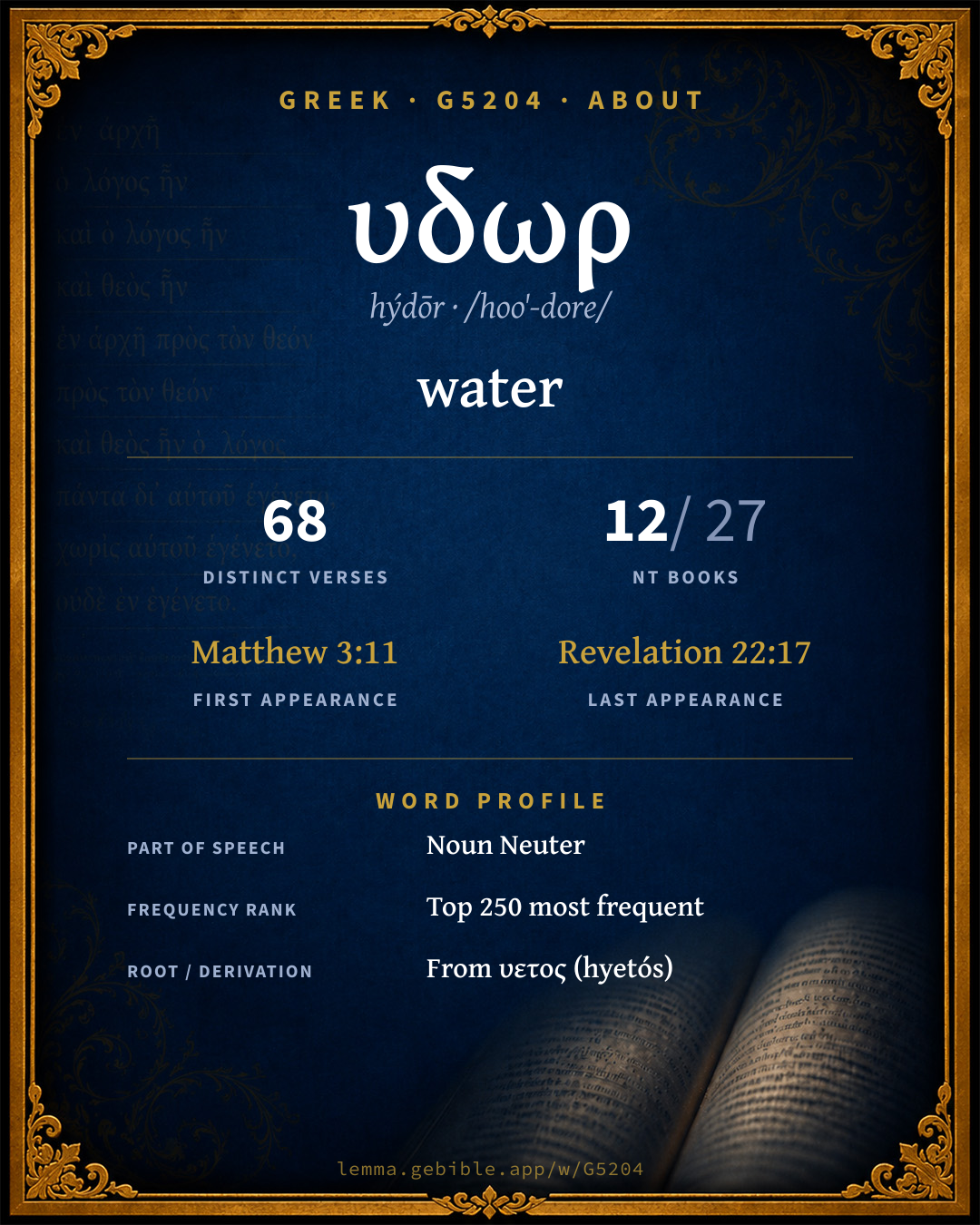
υδωρ
water
Full lexicon entry — Thayer's Greek Lexicon
From Thayer's Greek Lexicon
Where this word appears
See every Dative-case word in the Greek New Testament →
Grammar key — what these labels mean
Part of speech
- Noun
- A naming word — a person, place, thing, or idea.
Case
- Genitive
- The case of source, possession, or “of” — answers “whose / from what.”
- Accusative
- The case of the direct object and of extent.
- Dative
- The case of the indirect object, means, or location — “to / for / with / in.”
- Nominative
- The case of the subject (and the predicate nominative).
Gender
- Neuter
- Grammatically neuter.
Number
- Singular
- One.
- Plural
- More than one.
1 verse where G5204 appears in the Genitive case in the Book of 1 John. Filtered view — show all forms. Click any verse to open its interlinear word-by-word view. Verse text shown in the World English Bible for context — . Each verse’s Greek form is shown with its reference; the English is not keyword-highlighted, since the data carries no word-level English alignment. Use “Compare translations” on any verse to read it across multiple English versions. This concordance covers the Greek New Testament; Septuagint (Greek Old Testament) occurrences of this word are not indexed here.
1 John
About this entry
At a glance — auto-summarized from this page’s data, not written by a person. Every figure links to its source below. This summary describes the numbers; it doesn’t interpret them.
υδωρ (hýdōr) is a Greek noun most often rendered “water.” Debuting at Matthew 3:11, it then recurs through the corpus. The Greek New Testament uses it across 68 verses — moderately common. John dominates its distribution — 18 of 68 verses. Related forms include υετος, υαλος and υγρος. For the data behind this summary, explore the sense tree and the renderings breakdown below.
Gloss history
Strong's 1890 vs modern scholarship
About this word
Strong's G5204 catalogs a Greek word from the Greek New Testament.
These counts are not copied from any lexicon or concordance. They are computed here, from the morphology-tagged Greek New Testament. What Lemma adds →
- 68
- distinct verses
- The word appears in 68 distinct verses.
- 12 / 27
- NT books
- The word appears in 12 of 27 New Testament books.
- #225
- by frequency
- Top 250 most frequent Greek words (rank 225 of 5,347 Greek words by occurrence).
View all 68 occurrences in the concordance →
Most concentrated in
- John 18 verses 26%
- Revelation 17 verses 25%
- Matthew 7 verses 10%
By section of the New Testament
By traditional corpus
Conventional, traditional groupings — biblical authorship is debated, so this is a traditional corpus grouping, not an authorship claim. Some books belong to more than one corpus (Luke is in both the Gospels and the Lukan corpus, and so on), so these shares overlap and need not total 100%. Each figure is a share of the word’s 68 distinct verses.
- Johannine 37 verses · 54%
- Gospels 36 verses · 53%
- Revelation 17 verses · 25%
- Lukan (Luke–Acts) 12 verses · 18%
- General (Catholic) Epistles 6 verses · 9%
- Hebrews 2 verses · 3%
- Pauline corpus 1 verse · 1%
How translations render this word
Counts come from each version’s own published word-to-Strong’s tagging or interlinear alignment — an approximate guide to how each version renders this word, not a word-level alignment the data otherwise carries. Because each total is that version’s own tagged count, the per-version totals vary from one another and need not match the appearance or distinct-verse counts above. These counts may also differ from a printed concordance because Lemma counts each distinctly tagged rendering and does not collapse phrase taggings into a single head-word total. This is a fixed set of word-tagged versions (KJV, ASV, BSB, ULT) and does not change with the reading translation you choose elsewhere. Each version’s license is shown beside its name below (and on Sources).
- King James Version: Water 63×, Waters 15×
- American Standard Version: Water 55×, Waters 16×
- Berean Standard Bible: Water 63×, Waters 12×
- unfoldingWord Literal Text: Water 66×, Waters 12×, Of 4×
King James Version Public Domain
Renders G5204 across 79 tagged occurrences — most commonly:
Plus 1 rendering that appears only once — usually multi-word phrases or single function words the recovered tagging swept in, not distinct renderings.
American Standard Version Public Domain
Renders G5204 across 77 tagged occurrences — most commonly:
Plus 6 renderings that appear only once — usually multi-word phrases or single function words the recovered tagging swept in, not distinct renderings.
Berean Standard Bible Public Domain
Renders G5204 across 75 tagged occurrences — most commonly:
Not rendered by a distinct English word in 1 further occurrence.
unfoldingWord Literal Text CC BY-SA 4.0
Renders G5204 across 83 tagged occurrences — most commonly:
Plus 1 rendering that appears only once — usually multi-word phrases or single function words the recovered tagging swept in, not distinct renderings.
Senses in Thayer's
The 1 sense Thayer's distinguishes for this word, in lexicon order (not ranked by frequency or importance). The full entry — with sub-senses — is in the Lexicon Entry tab.
- water
Word origin
Derived from υετος (hyetós) (G5205) — rain.
From the base of G5205 ; water (as if rainy ) literally or figuratively : - water.
— Strong’s Exhaustive Concordance (1890), public domain.
Forms in the corpus
The 6 distinct written forms G5204 takes in the Greek New Testament, most frequent first — each parse links to that case’s occurrences in the concordance.
| Form | Parsing | Example | Uses |
|---|---|---|---|
| ὕδωρ hýdōr | Noun, Accusative, Singular, Neuter | Matthew 17:15 | 23 |
| ὕδατος hýdatos | Noun, Genitive, Singular, Neuter | Matthew 3:16 | 22 |
| ὕδατι hýdati | Noun, Dative, Singular, Neuter | Matthew 3:11 | 13 |
| ὑδάτων hydátōn | Noun, Genitive, Plural, Neuter | Revelation 1:15 | 12 |
| ὕδατα hýdata | Noun, Accusative, Plural, Neuter | Matthew 14:28 | 5 |
| ὕδασιν hýdasin | Noun, Dative, Plural, Neuter | Matthew 8:32 | 1 |
Same root — word family
Other Thayer's entries built from the same root as G5204, grouped by Strong’s listed origin. These share a root / origin per the lexicon — not necessarily a shared meaning. Each links to that word’s own entry.
Derives from
Shares the same root
Derived from this word
- υδρια hydría G5201 water jar
- υδροποτεω hydropotéō G5202 to drink water
- υδρωπικος hydrōpikós G5203 dropsical
Compare all same-root words → Showing 4 of 7 — not the complete family. They share a root, not necessarily a meaning.
Septuagint usage
The same Greek word υδωρ appears 582 times in the Greek Old Testament (Septuagint), across 508 verses in 32 books.
- 582
- LXX occurrences
- Tagged occurrences of this Greek word in the Septuagint.
- 508
- verses
- Distinct Septuagint verses containing this word.
- 32 / 39
- OT books
- The word appears in 32 of the 39 Old Testament books.
Sample Septuagint occurrences
- Genesis 1:2 ὕδωρ
- Exodus 2:10 ὕδωρ
- Leviticus 1:9 ὕδωρ
- Numbers 5:17 ὕδωρ
- Deuteronomy 2:6 ὕδωρ
- Joshua 3:8 ὕδωρ
- Judges 1:15 ὕδωρ
- 1 Samuel 7:6 ὕδωρ
- 2 Samuel 5:20 ὕδωρ
- 1 Kings 12:24 ὕδωρ
- 2 Kings 2:8 ὕδωρ
- 1 Chronicles 11:17 ὕδωρ
Septuagint occurrences (same lexeme)
Every verse where the same Strong’s number (G5204) appears in the Greek Septuagint — showing the first 50 of 508. Verse text shown in the World English Bible for context; the Greek form is the matched word — the English is not keyword-highlighted.
- Genesis 1:2 ὕδωρ Now the earth was formless and empty. Darkness was on the surface of the deep. God's Spirit was hovering over the surface of the waters.
- Genesis 1:6 ὕδωρ God said, "Let there be an expanse in the midst of the waters, and let it divide the waters from the waters."
- Genesis 1:7 ὕδωρ God made the expanse, and divided the waters which were under the expanse from the waters which were above the expanse, and it was so.
- Genesis 1:9 ὕδωρ God said, "Let the waters under the sky be gathered together to one place, and let the dry land appear," and it was so.
- Genesis 1:10 ὕδωρ God called the dry land Earth, and the gathering together of the waters he called Seas. God saw that it was good.
- Genesis 1:20 ὕδωρ God said, "Let the waters swarm with swarms of living creatures, and let birds fly above the earth in the open expanse of sky."
- Genesis 1:21 ὕδωρ God created the large sea creatures, and every living creature that moves, with which the waters swarmed, after their kind, and every winged bird after its kind. God saw that it was good.
- Genesis 1:22 ὕδωρ God blessed them, saying, "Be fruitful, and multiply, and fill the waters in the seas, and let birds multiply on the earth."
- Genesis 6:17 ὕδωρ I, even, I do bring the flood of waters on this earth, to destroy all flesh having the breath of life from under the sky. Everything that is in the earth will die.
- Genesis 7:6 ὕδωρ Noah was six hundred years old when the flood of waters came on the earth.
- Genesis 7:7 ὕδωρ Noah went into the ark with his sons, his wife, and his sons' wives, because of the waters of the flood.
- Genesis 7:10 ὕδωρ It happened after the seven days, that the waters of the flood came on the earth.
- Genesis 7:17 ὕδωρ The flood was forty days on the earth. The waters increased, and lifted up the ark, and it was lifted up above the earth.
- Genesis 7:18 ὕδωρ The waters prevailed, and increased greatly on the earth; and the ark floated on the surface of the waters.
- Genesis 7:19 ὕδωρ The waters prevailed exceedingly on the earth. All the high mountains that were under the whole sky were covered.
- Genesis 7:20 ὕδωρ The waters prevailed fifteen cubits upward, and the mountains were covered.
- Genesis 7:24 ὕδωρ The waters prevailed on the earth one hundred fifty days.
- Genesis 8:1 ὕδωρ God remembered Noah, all the animals, and all the cattle that were with him in the ark; and God made a wind to pass over the earth. The waters subsided.
- Genesis 8:3 ὕδωρ The waters receded from off the earth continually. After the end of one hundred fifty days the waters decreased.
- Genesis 8:5 ὕδωρ The waters receded continually until the tenth month. In the tenth month, on the first day of the month, the tops of the mountains were seen.
- Genesis 8:7 ὕδωρ and he sent forth a raven. It went back and forth, until the waters were dried up from off the earth.
- Genesis 8:8 ὕδωρ He sent forth a dove from him, to see if the waters were abated from off the surface of the ground,
- Genesis 8:9 ὕδωρ but the dove found no place to rest her foot, and she returned to him into the ark; for the waters were on the surface of the whole earth. He put forth his hand, and took her, and brought her to him into the ark.
- Genesis 8:11 ὕδωρ The dove came back to him at evening, and, behold, in her mouth was an olive leaf plucked off. So Noah knew that the waters were abated from off the earth.
- Genesis 8:13 ὕδωρ It happened in the six hundred first year, in the first month, the first day of the month, the waters were dried up from off the earth. Noah removed the covering of the ark, and looked. He saw that the surface of the ground was dried.
- Genesis 9:11 ὕδωρ I will establish my covenant with you; neither will all flesh be cut off any more by the waters of the flood; neither will there any more be a flood to destroy the earth."
- Genesis 9:15 ὕδωρ and I will remember my covenant, which is between me and you and every living creature of all flesh, and the waters will no more become a flood to destroy all flesh.
- Genesis 16:7 ὕδωρ The angel of Yahweh found her by a fountain of water in the wilderness, by the fountain in the way to Shur.
- Genesis 18:4 ὕδωρ Now let a little water be fetched, wash your feet, and rest yourselves under the tree.
- Genesis 21:14 ὕδωρ Abraham rose up early in the morning, and took bread and a bottle of water, and gave it to Hagar, putting it on her shoulder, and gave her the child, and sent her away. She departed, and wandered in the wilderness of Beersheba.
- Genesis 21:15 ὕδωρ The water in the bottle was spent, and she cast the child under one of the shrubs.
- Genesis 21:19 ὕδωρ God opened her eyes, and she saw a well of water. She went, filled the bottle with water, and gave the boy drink.
- Genesis 21:25 ὕδωρ Abraham complained to Abimelech because of a water well, which Abimelech's servants had violently taken away.
- Genesis 24:11 ὕδωρ He made the camels kneel down outside the city by the well of water at the time of evening, the time that women go out to draw water.
- Genesis 24:13 ὕδωρ Behold, I am standing by the spring of water. The daughters of the men of the city are coming out to draw water.
- Genesis 24:17 ὕδωρ The servant ran to meet her, and said, "Please give me a drink, a little water from your pitcher."
- Genesis 24:32 ὕδωρ The man came into the house, and he unloaded the camels. He gave straw and provender for the camels, and water to wash his feet and the feet of the men who were with him.
- Genesis 24:43 ὕδωρ Behold, I am standing by the spring of water. Let it happen, that the maiden who comes forth to draw, to whom I will say, Give me, I pray you, a little water from your pitcher to drink.
- Genesis 26:18 ὕδωρ Isaac dug again the wells of water, which they had dug in the days of Abraham his father. For the Philistines had stopped them after the death of Abraham. He called their names after the names by which his father had called them.
- Genesis 26:19 ὕδωρ Isaac's servants dug in the valley, and found there a well of springing water.
- Genesis 26:20 ὕδωρ The herdsmen of Gerar argued with Isaac's herdsmen, saying, "The water is ours." He called the name of the well Esek, because they contended with him.
- Genesis 26:32 ὕδωρ It happened the same day, that Isaac's servants came, and told him concerning the well which they had dug, and said to him, "We have found water."
- Genesis 30:38 ὕδωρ He set the rods which he had peeled opposite the flocks in the gutters in the watering-troughs where the flocks came to drink. They conceived when they came to drink.
- Genesis 37:24 ὕδωρ and they took him, and threw him into the pit. The pit was empty. There was no water in it.
- Genesis 43:24 ὕδωρ The man brought the men into Joseph's house, and gave them water, and they washed their feet. He gave their donkeys fodder.
- Genesis 49:4 ὕδωρ Boiling over as water, you shall not have the pre-eminence; Because you went up to your father's bed; Then defiled it. He went up to my couch.
- Exodus 2:10 ὕδωρ The child grew, and she brought him to Pharaoh's daughter, and he became her son. She named him Moses, and said, "Because I drew him out of the water."
- Exodus 4:9 ὕδωρ It will happen, if they will not believe even these two signs, neither listen to your voice, that you shall take of the water of the river, and pour it on the dry land. The water which you take out of the river will become blood on the dry land."
- Exodus 7:15 ὕδωρ Go to Pharaoh in the morning. Behold, he goes out to the water; and you shall stand by the river's bank to meet him; and the rod which was turned to a serpent you shall take in your hand.
- Exodus 7:17 ὕδωρ Thus says Yahweh, "In this you shall know that I am Yahweh. Behold, I will strike with the rod that is in my hand on the waters which are in the river, and they shall be turned to blood.
These are occurrences of the same Greek lexeme (G5204) in the Septuagint — not a translation of any one Hebrew word. The store carries no word-level Hebrew↔Greek alignment, so no Hebrew original is asserted here. Counts come from the recovered LXX Strong's tagging — high-frequency vocabulary is well covered, while rare or late forms may be untagged — so they reflect tagged occurrences and may slightly undercount.