
Revelation 1:15

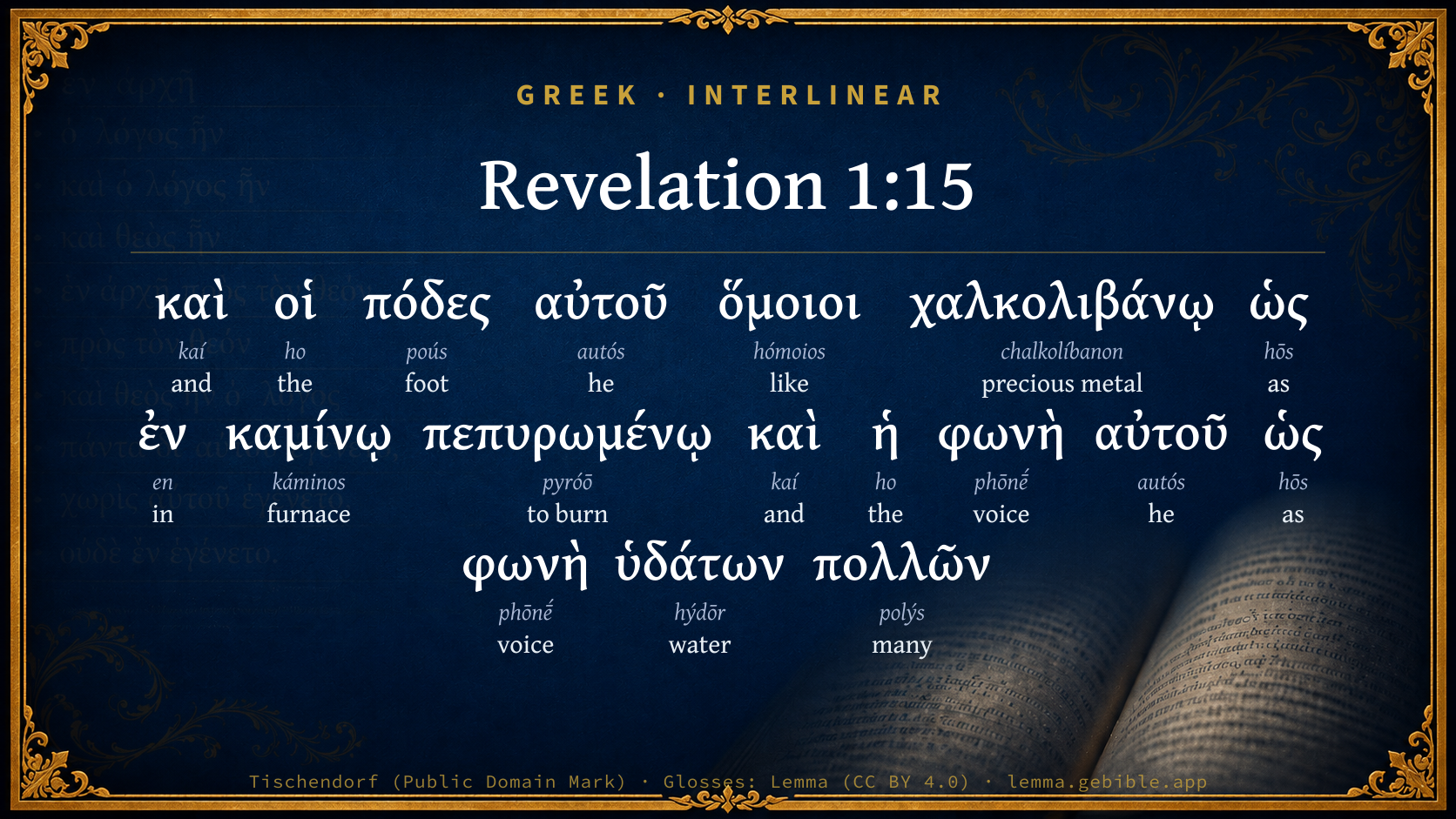
Greek (Tischendorf 8th ed.) Revelation 1:15 appears in the Greek New Testament. The text above is from the Tischendorf 8th edition. Each word links to its Strong’s number and a concise gloss. Click any word for its full Thayer’s Greek Lexicon entry.
Download image
Cite this verse

Revelation 1:15 (World English Bible). Public Domain. Lemma interlinear Bible study tool, https://lemma.gebible.app/v/revelation/1/15.

Show BibTeX & RIS
BibTeX
RIS
English Translation
His feet were like burnished brass, as if it had been refined in a furnace. His voice was like the voice of many waters.
World English Bible · Public Domain
Highlights
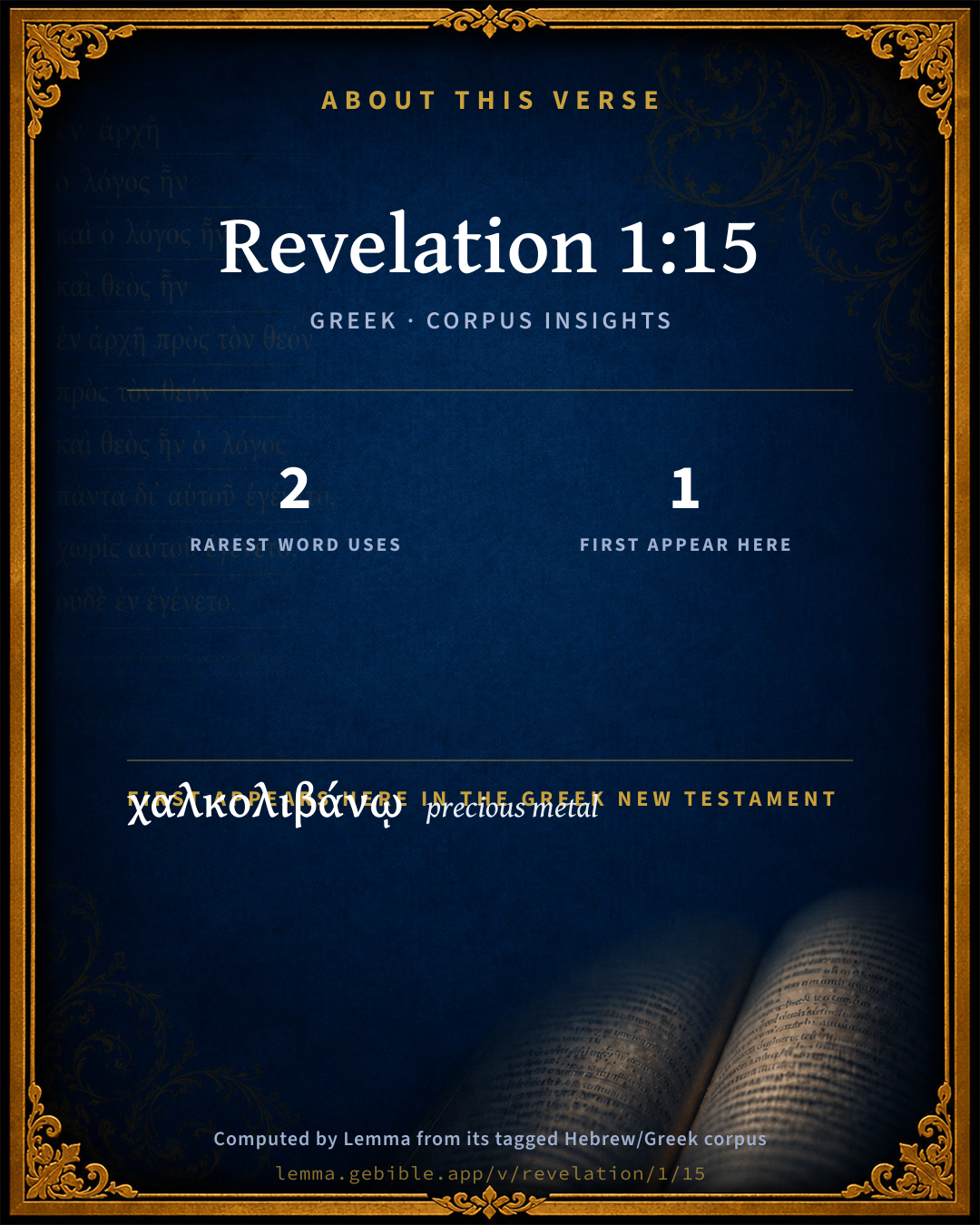
  • 1 first appearance in the Greek New Testament
Full analysis ↓
Download a study sheet

One document with this verse’s original text, its word-by-word gloss line, the meaning frame, cross-references with their text, attributed commentary, and full source and license credits — printable, and it pastes into notes with its structure intact.

This verse Autodidact and up

Study sheet (.html) Plain text (.txt)

A passage Seminary Student

Up to 50 verses in one chapter. A passage sheet keeps up to 6 commentary sources and 12 cross-references per verse, in the order this page ranks them, and says so on the sheet whenever that leaves anything out. Ask for a single verse and you get the Autodidact verse sheet above.

Everything on this page stays free to read, with no account — the sheet is a download of what is already on screen, not access to it.

Want to remove ads? Support Godless Engineer
Compare translations 3

The same verse in 3 English versions, stacked beneath the original-language interlinear above. Click any original word for its lexicon entry.

Each is an independent rendering of the whole verse — the interlinear is not word-aligned to these translations.

Highlighted words mark where these versions differ — a whole-verse word diff, not a word-by-word alignment.

  • World English Bible Public Domain
    His feet were like burnished brass, as if it had been refined in a furnace. His voice was like the voice of many waters.
  • King James Version Public Domain
    And his feet like unto fine brass, as if they burned in a furnace; and his voice as the sound of many waters.
  • unfoldingWord Literal Text CC BY-SA 4.0
    and his feet like bronze as having been refined in a furnace, and his voice like the sound of many waters,

unfoldingWord Literal Text — © unfoldingWord, licensed CC BY-SA 4.0. Word-aligned USFM3 via Door43 (git.door43.org/unfoldingWord/en_ult).

Versions to compare (up to 4)

3 of 4 selected

Show all 19 translations

Every available English version of this verse, each an independent rendering of the whole verse.

  • World English Bible Public Domain
    His feet were like burnished brass, as if it had been refined in a furnace. His voice was like the voice of many waters.
  • Berean Standard Bible Public Domain
    His feet were like polished bronze refined in a furnace, and His voice was like the roar of many waters.
  • Majority Standard Bible Public Domain
    His feet were like polished bronze refined in a furnace, and His voice was like the roar of many waters.
  • King James Version Public Domain
    And his feet like unto fine brass, as if they burned in a furnace; and his voice as the sound of many waters.
  • American Standard Version (1901) Public Domain
    and his feet like unto burnished brass, as if it had been refined in a furnace; and his voice as the voice of many waters.
  • Revised Version (1885) Public Domain
    and his feet like unto burnished brass, as if it had been refined in a furnace; and his voice as the voice of many waters.
  • Geneva Bible (1599) Public Domain
    And his feete like vnto fine brasse, burning as in a fornace: and his voyce as the sounde of many waters.
  • Douay-Rheims (1899) Public Domain
    And his feet like unto fine brass, as in a burning furnace. And his voice as the sound of many waters.
  • Young's Literal Translation Public Domain
    and his feet like to fine brass, as in a furnace having been fired, and his voice as a sound of many waters,
  • Literal Standard Version CC BY-SA 4.0
    and His feet like to frankincense-colored brass, as having been fired in a furnace, and His voice as a sound of many waters;
  • Unlocked Literal Bible CC BY-SA 4.0
    His feet were like polished bronze, like bronze that had been refined in a furnace, and his voice was like the sound of many rushing waters.
  • unfoldingWord Literal Text CC BY-SA 4.0
    and his feet like bronze as having been refined in a furnace, and his voice like the sound of many waters,
  • Darby Bible Public Domain
    and his feet like fine brass, as burning in a furnace; and his voice as the voice of many waters;
  • World Messianic Bible Public Domain
    His feet were like burnished brass, as if it had been refined in a furnace. His voice was like the voice of many waters.
  • Webster's Bible Public Domain
    And his feet like fine brass, as if they burned in a furnace; and his voice as the sound of many waters.
  • Free Bible Version CC BY-SA 4.0
    His feet looked like polished brass that had been refined in a furnace. His voice sounded like a thundering waterfall.
  • Bible in Basic English Public Domain
    And his feet like polished brass, as if it had been burned in a fire; and his voice was as the sound of great waters.
  • Text-Critical English NT CC BY 4.0
    his feet were like burnished bronze refined in a furnace, and his voice was like the roar of many waters.
  • Tyndale New Testament (1534) Public Domain
    and his fete lyke vnto brasse as though they brent in a fornace: and his voyce as the sounde of many waters.

Literal Standard Version (2020), Covenant Press — licensed CC BY-SA 4.0. Text via the HelloAO Bible API (eBible.org). Unlocked Literal Bible (unfoldingWord) — licensed CC BY-SA 4.0. Text via the HelloAO Bible API (eBible.org). unfoldingWord Literal Text — © unfoldingWord, licensed CC BY-SA 4.0. Word-aligned USFM3 via Door43 (git.door43.org/unfoldingWord/en_ult). Free Bible Version, Dr. Jonathan Gallagher — licensed CC BY-SA 4.0. Text via the HelloAO Bible API (eBible.org).

Word by word

More ways to search: Search by grammar → Find every occurrence → Compare this word →

Practice this passage: Drill this verse → Learn its vocabulary →

χαλκολιβάνῳ
chalkolíbanon
G5474
“precious metal”
Noun, Dative, Singular, Neuter
Part of Speech
Noun
Case
Dative
Number
Singular
Gender
Neuter
Full Thayer's Definition

Origin: from a compound of G5475 and G3030 (in the implied mean of whiteness or brilliancy)

TDNT: None

1. some metal like gold if not more precious
  1. καὶ kaí G2532 “and” Conjunction
  2. οἱ ho G3588 “the” Article, Nominative, Plural, Masculine
  3. πόδες poús G4228 “foot” Noun, Nominative, Plural, Masculine
  4. αὐτοῦ autós G846 “he” Personal pronoun, Genitive, Singular, Masculine
  5. ὅμοιοι hómoios G3664 “like” Adjective, Nominative, Plural, Masculine
  6. ὡς hōs G5613 “as” Adverb
  7. ἐν en G1722 “in” Preposition
  8. καμίνῳ káminos G2575 “furnace” Noun, Dative, Singular, Feminine
  9. πεπυρωμένῳ pyróō G4448 “to burn” Verb, Perfect, Passive, Participle, Dative, Singular, Neuter
  10. καὶ kaí G2532 “and” Conjunction
  11. ἡ ho G3588 “the” Article, Nominative, Singular, Feminine
  12. φωνὴ phōnḗ G5456 “voice” Noun, Nominative, Singular, Feminine
  13. αὐτοῦ autós G846 “he” Personal pronoun, Genitive, Singular, Masculine
  14. ὡς hōs G5613 “as” Adverb
  15. φωνὴ phōnḗ G5456 “voice” Noun, Nominative, Singular, Feminine
  16. ὑδάτων hýdōr G5204 “water” Noun, Genitive, Plural, Neuter
  17. πολλῶν polýs G4183 “many” Adjective, Genitive, Plural, Neuter

About this verse

These counts appear in no published source. They are computed here, from the morphology-tagged text and Lemma’s own curated glosses. What Lemma adds →

18
words
13
distinct lemmas
Revelation
section

Notable vocabulary

The rarest word here is χαλκολιβάνῳ precious metal G5474 — appearing just 2 times in the whole Greek New Testament.

First appearance in Scripture

This word makes its first canonical appearance in the Greek New Testament here:

  • χαλκολιβάνῳ precious metal G5474

Shared distinctive vocabulary

χαλκολιβάνῳ precious metal G5474 occurs in 2 verses of the Greek New Testament. Also found in:
Repetition

Words recur within this verse:

Cross-references

9

Topical passages linked to Revelation 1:15 in the Treasury of Scripture Knowledge — connected by theme and wording, ordered by reader-vote popularity; previews shown in the World English Bible.

  • Ezekiel 43:2 Behold, the glory of the God of Israel came from the way of the east: and his voice was like the sound of many waters; and the earth shined with his glory.
  • Daniel 10:6 his body also was like the beryl, and his face as the appearance of lightning, and his eyes as flaming torches, and his arms and his feet like burnished brass, and the voice of his words like the voice of a multitude.
  • Revelation 14:2 I heard a sound from heaven, like the sound of many waters, and like the sound of a great thunder. The sound which I heard was like that of harpists playing on their harps.
  • Revelation 19:6 I heard something like the voice of a great multitude, and like the voice of many waters, and like the voice of mighty thunders, saying, "Hallelujah! For the Lord our God, the Almighty, reigns!
  • Revelation 2:18 "To the angel of the assembly in Thyatira write: "The Son of God, who has his eyes like a flame of fire, and his feet are like burnished brass, says these things:
  • Psalms 93:4 Above the voices of many waters, The mighty breakers of the sea, Yahweh on high is mighty.
  • Ezekiel 1:7 Their feet were straight feet; and the sole of their feet was like the sole of a calf's foot; and they sparkled like burnished brass.
  • Ezekiel 40:3 He brought me there; and, behold, there was a man, whose appearance was like the appearance of brass, with a line of flax in his hand, and a measuring reed; and he stood in the gate.
  • Isaiah 17:13 The nations shall rush like the rushing of many waters: but he shall rebuke them, and they shall flee far off, and shall be chased as the chaff of the mountains before the wind, and like the whirling dust before the storm.

Cross-references courtesy of OpenBible.info (CC BY 4.0).

Commentary

Notes on Revelation 1:15 from classic Christian and Jewish commentators (each source and its license shown beneath its notes). The classic Christian expositions comment on the surrounding passage and are grouped to its opening verse, so a note may address several verses; the Jewish commentaries on the Tanakh (Rashi and others) are per-verse, so they appear only where the commentator wrote on this verse.

Lemma curates 59 commentaries, every one of them public domain or Creative Commons licensed, each selected and text-cleaned for this edition rather than reprinted as found. About our sources →

Tyndale Open Study Notes

Tyndale Open Resources

1:15 Refined or hardened bronze in the feet implies stability, firmness, and security (cp. Dan 10:6). • The thundering voice suggests God’s power—when he speaks, he will be heard (cp. Ezek 43:2).

Tyndale Open Study Notes — © Tyndale Open Resources, licensed CC BY-SA 4.0. Text via the HelloAO Bible API.

Bengel's Gnomon

Johann Albrecht Bengel

Rev 1:15. Πεπυρωμένῳ) So Uffenb. and one or two others, and the ancient versions. Others read πεπυρωμένοι.[20] It is an epithet not of the feet, but of the word χαλκολιβάνου;[21] and therefore it is not repeated, ch. Rev 2:18. Χαλκός brass; λίβανος, incense: χαλκολίβανος, a species of brass, like incense. See Bochart’s Hierozoicon, at the end, where, in a full discussion, he explains it as white brass. Comp. Dan 10:6, on shining brass. Hesychius, ἅπασα χαλκῆ, λαμπρὰ ὅλη, Κρῆτες, “The Cretans express by it what is wholly of brass, shining all over.”

[20] So Rec. Text. “De fornace igneâ,” h. πεπυρωμένῃ, Vulg. But AC have πεπυρωμένης; and so Lachm.—E.

[21] This observation is less supported by the greater Edition than by the margin of Ed. ii.—E. B.

Bengel's Gnomon of the New Testament — English translation (T&T Clark, Edinburgh, 1860) — public domain. Text from a community e-Sword module.

Meyer's Critical & Exegetical Commentary

Heinrich August Wilhelm Meyer

Rev_1:15. To such eyes of flame,[776] belong feet ὅμοιοι χαλκολιβάνῳ ὡς ἐν καμίνῳ πεπυρωμένῃ, which tread down unholy enemies.[777] De Wette is wrong in finding in this feature no other meaning than that of the splendor.

The word χαλκολίβανος,[778] which the Vulg. renders by orichalcum,[779] and Luther by Messing, is of doubtful derivation and meaning. Ewald follows an ancient testimony[780] which says that one of the three kinds of incense is so called.[781] As the entire picture has to do with more than color,[782] and as the type of Dan_10:6[783] leads to the idea of brass,[784] incense can in no way be thought of. This is also, within the comparison itself, highly unnatural. The feet appear like brass, but at the same time, as the second member,[785] Ὢς ἘΝ ΚΑΜ. ΠΕΠΥΡΩΜΈΝῌ, says, as in a furnace glowing with fire, and therefore like the feet of the angel, Rev_10:2, which are Ὡς ΣΤΎΛΟΙ ΠΥΡΌς. But whether the word[786] be a hybrid term composed of χαλκός and לָכָן, and therefore mean glowing white;[787] or brass from Lebanon;[788] or be taken as an intentionally mysterious designation of the ambiguous ἬΛΕΚΤΡΟΝ, which denotes an alloy,[789] and also amber,[790] and therefore corresponds in some degree to the former as well as to the second part of ΧΑΛΚΟΛΊΒΑΝΟς,[791]cannot be certainly decided. The intentional mysteriousness is improbable; even though the idea were possible, thatof course, only in the provincialism of Asia Minorthe word were popularly formed and used in the sense received by Züllig. Wetzel,[792] by recurring to the root λὶβ, i.e., running, flowing, reaches the explanation of molten metal (Erzfluss); perfectly adapted to the meaning, but without sufficient justification in the language.

καὶ ἡ φωνὴ αὐτ., κ.τ.λ. Cf. Dan_10:6; Eze_43:2; Eze_1:24. The force of the voice is represented (cf. Rev_1:10), but the majesty peculiar to the peaceful murmur of the sea[793] is not to be thought of.

[776] Rev_5:14, Rev_2:18.

[777] Psa_60:12; Isa_63:6; cf. Dan_10:6, where, also, arms which cast down are mentioned.

[778] -ον, Suidas.

[779] Cf. Cic., De Off., iii. 23, 12; Horace, Ars Poet., 202.

[780] In Salmas, Ad Solin., p. 810; also in Wetst.

[781] ὁ λίβανος ἔχει τρία εἴδη δένδρων, καὶ ὁ μὲν ἅῤῥην ὀνομάζεται χαλκολίβανος, ἡλιοειδὴς καὶ πυῤῥὸς ἤγουν ξανθός (Lebanon has three kinds of trees, and one that is strong is called χαλκολίβανος, like the sun, and that is to say, the reddish-yellow of fire) Against this, is the notice in Suidas: χαλκολίβανον, εἶδος ἡλέκτρου τιμιώτερον χρυσοῦ, ἔστι δὲ τὸ ἥλεκτρον ἀλλότυπον χρυσίον μεμιγμένον ὑελῷ καὶ λιθείᾳ (χαλκ. of the appearance of ἠλέκτρον, more valuable than gold; and ᾕλεκ. is gold of another kind mingled with glass and stone).

[782] Against Ewald, De Wette.

[783] נְחשֶׁת קָלָל: LXX., χαλκὸς στίλβων. Eze_1:7, LXX., ἐξαστράπτων χαλκ. Cf. Eze_1:4; Eze_1:27; Eze_8:2, חשְמַל: LXX., ἥλεκτρον.

[784] De Wette.

[785] The particle of comparison parallel with the ὅμοιοι renders the reading πεπυρωμένῳ, which is possible in a critical respect, belonging to χαλκολιβ. (cf. Rev_3:18), inadvisable for exegetical reasons.

[786] Very arbitrarily translated by Hitzig (Johannes Marc., p. 68), Ofenerz.

[787] Grotius, Bochart, Hieroz., 3. p. 900; ed. Lips., Vitr., Hengstb.

[788] Syr., Aeth., Areth., Vatabl., Ebr.

[789] Suidas, s. o.

[790] Ew. ii.

[791] Züllig.

[792] Zeitschr. fur die gesammte lutherische Theol. u. Kirche, Leipzig, 1869, i. p. 94.

[793] Ebrard.

Meyer — Critical and Exegetical Commentary on the New Testament — English translation by Peter Christie, edited by Frederick Crombie (T&T Clark, 1880) — public domain. Text from a community e-Sword module.

Jamieson, Fausset & Brown

Robert Jamieson, A. R. Fausset & David Brown

fine brass--Greek, "chalcolibanus," derived by some from two Greek words, "brass" and "frankincense"; derived by BOCHART from Greek, "chalcos," "brass," and Hebrew, "libbeen," "to whiten"; hence, "brass," which in the furnace has reached a white heat. Thus it answers to "burnished (flashing, or glowing) brass," Eze 1:7; Rev 10:1, "His feet as pillars of fire." Translate, "Glowing brass, as if they had been made fiery (red-hot) in a furnace." The feet of the priests were bare in ministering in the sanctuary. So our great High Priest here.

voice as . . . many waters-- (Eze 43:2); in Dan 10:6, it is "like the voice of a multitude." As the Bridegroom's voice, so the bride's, Rev 14:2; Rev 19:6; Eze 1:24, the cherubim, or redeemed creation. His voice, however, is here regarded in its terribleness to His foes. Contrast Sol 2:8; Sol 5:2, with which compare Rev 3:20.

Jamieson, Fausset & Brown — Commentary Critical and Explanatory on the Whole Bible (1871) — public domain (CC PDM 1.0). Text via the HelloAO Bible API.

Adam Clarke's Commentary

Verse 15. His feet like unto fine brass] An emblem of his stability and permanence, brass being considered the most durable of all metallic substances or compounds.

The original word, χαλκολιβανον, means the famous aurichalcum, or factitious metal, which, according to Suidas, was ειδος ηλεκτρου, τιμιωτερον χρυσου, "a kind of amber, more precious than gold." It seems to have been a composition of gold, silver, and brass, and the same with the Corinthian brass, so highly famed and valued; for when Lucius Mummius took and burnt the city of Corinth, many statues of these three metals, being melted, had run together, and formed the composition already mentioned, and which was held in as high estimation as gold. See Pliny, Hist. Nat., lib. 34, c. 2; Florus, lib. 2, c. 16. It may however mean no more than copper melted with lapis calaminaris, which converts it into brass; and the flame that proceeds from the metal during this operation is one of the most intensely and unsufferably vivid that can be imagined. I have often seen several furnaces employed in this operation, and the flames bursting up through the earth (for these furnaces are under ground) always called to remembrance this description given by St. John: His feet of fine brass, as if they burned in a furnace; the propriety and accuracy of which none could doubt, and every one must feel who has viewed this most dazzling operation.

His voice as the sound of many waters.] The same description we find in Eze 43:2: The glory of the God of Israel came from the way of the east; and his voice was like the noise of many waters: and the earth shined with his glory.

Adam Clarke's Commentary on the Bible (1810–1826) — public domain. Text from a community e-Sword/MySword module.

Ellicott's Commentary for English Readers

(15) His feet like unto fine brass.—The feet, like the feet of the ministering priests of Israel, were bare, and appeared like chalcolibanus (fine brass). The exact meaning of this word (used only here) is not certain. The most trustworthy authors incline to take it as a hybrid word, half Greek, half Hebrew—chalcos, brass, and labân, white, to whiten—and understand it to signify brass which has attained in the furnace a white heat. “Such technical words were likely enough to be current in a population like that of Ephesus, consisting largely of workers in metal, some of whom—if we may judge from the case of Alexander the coppersmith (Act_19:34; 2Ti_4:14)—were, without doubt, Jews. I believe the word in question to have belonged to this technical vocabulary. It is at any rate used by St. John as familiar and intelligible to those for whom he wrote” (Prof. Plumptre in the Epistles to Seven Churches, in loco).

His voice as the sound (better, voice, as the same word—phoné—is used twice, and translated first “voice” and then “sound” in our English version) of many waters.—Daniel described the voice of the Ancient of Days as the voice of a multitude (Dan_10:6); but the voice of the multitude was in earlier Hebrew writings compared to the sound of the waves of the sea, which the voice of the Lord alone could subdue (Psa_65:7; Psa_93:4). This image the Evangelist adopts to describe the voice of Christ—strong and majestic, amid the Babel-sounds of earth. That voice, whose word stilled the sea, sounds as the waves of the sea, which St. John heard Him rebuke.

A Bible Commentary for English Readers, edited by Charles John Ellicott (1878–1897) — public domain. Text from a community e-Sword module.

The Cambridge Bible for Schools and Colleges

gen. ed. J. J. S. Perowne

15. fine brass] Decidedly the most probable sense, though the etymology of the word is obscure. It looks like a compound of the Greek words for “brass” (or more accurately bronze) and “incense”—the latter being borrowed from the Hebrew name, which comes from a root meaning “white.” Perhaps the real meaning is “white brass,” i.e. the Latin orichalcum (vid. Verg. Aen. XII. 87), which was like gold (Cic. Off. III. 23:92)—i.e. perhaps was our “brass” as distinct from bronze. In Eze_1:4; Eze_1:27; Eze_8:2 we have a word which probably (comparing ibid. Eze_1:7, Eze_40:3, Dan_10:6) means the same, but which the LXX. translate electrum—meaning perhaps by this not amber, but an alloy of gold with silver or other metal. Some think that sense suitable here, as symbolising the divine and human natures of our Lord.

as if they burned] Read, as if it burned or rather with R. V. as if it had been refined—which seems to prove that “incense” cannot be the sense of the word just discussed, as incense would be burned in a censer not a furnace.

his voice as] Eze_43:2.

The Cambridge Bible for Schools and Colleges (gen. ed. J. J. S. Perowne; Cambridge University Press, 1878–1918) — public domain. Text from a community e-Sword module.

John Gill's Exposition

And his feet like unto fine brass, as if they burned in a furnace,.... By which is meant, not his human nature in a suffering state; or his people, the meaner and lower parts of his mystical body, in a like state; or his apostles and ministers, who are supporters of his church, and run to and fro with spiritual knowledge, for which, though they suffer much, are permanent and glorious; but either the power of Christ in bearing up and supporting his people, in the care and government and defence of them; or his ways, works, and walks in his churches, and all his providential administrations towards them, which are holy, just, and righteous, and will be manifest; or his wrath and vengeance in treading down and trampling upon his enemies:

and his voice as the sound of many waters; meaning his Gospel, as preached by his apostles and ministers, which was heard far and near; see Rom 10:18; and which made a great noise in the world; or his voice of vengeance on his enemies, which will be very terrible and irresistible.

Next: Revelation Chapter 2

John Gill's Exposition of the Whole Bible (1746–1763) — public domain (CC PDM 1.0). Text via the HelloAO Bible API.

Trapp's Complete Commentary

John Trapp

15 And his feet like unto fine brass, as if they burned in a furnace; and his voice as the sound of many waters.

Ver. 15. And his feet] He stood firm then when he was cast into the fire of his Father’s wrath. He trod the winepress alone, and set his feet on the necks of all his and our enemies. He lost no ground, when he grappled with the devil on his own dunghill, Mat 4:1-11 "He will also bruise Satan under our feet shortly," Rom 16:20.

As the sound of many waters] Audible, terrible, forcible. Some Catadupes are deafened by the fall of this Nile. (Som. Scip.) But the spouse cries out, "O thou that dwellest in the gardens, the companions hearken to thy voice; cause me to hear it," Son 8:13.

John Trapp, A Commentary or Exposition upon All the Books of the Old and New Testament (1647–1656) — public domain. Text from a community e-Sword module.

Albert Barnes' Notes on the Bible

And his feet like unto fine brass - Compare Dan 10:6, “And his arms and his feet like in color to polished brass.” See also Eze 1:7, “and they” (the feet of the living creatures) “sparkled like the color of burnished brass.” The word used here - χαλκολιβάνω chalkolibanō - occurs in the New Testament only here and in Rev 2:18. It is not found in the Septuagint. The word properly means “white brass” (probably compounded of χαλκός chalkos, brass, and λίβανος libanos, whiteness, from the Hebrew לבן laban, white). Others regard it as from χαλκός chalkos, brass, and λιπαρόν liparon, clear. The metal referred to was undoubtedly a species of brass distinguished for its clearness or whiteness. Brass is a compound metal, composed of copper and zinc. The color varies much according to the different proportions of the various ingredients. The Vulgate here renders the word “aurichalcum,” a mixture of gold and of brass - perhaps the same as the ἠλεκτρον ēlektron - the electrum of the ancients, composed of gold and of silver, usually in the proportion of four parts gold and one part silver, and distinguished for its brilliancy. See Robinson, Lexicon, and Wetstein, in loco. The kind of metal here referred to, however, would seem to be some compound of brass - of a whitish and brilliant color. The exact proportion of the ingredients in the metal here referred to cannot now be determined.

As if they burned in a furnace - That is, his feet were so bright that they seemed to be like a beautiful metal glowing intensely in the midst of a furnace. Anyone who has looked upon the dazzling and almost insupportable brilliancy of metal in a furnace, can form an idea of the image here presented.

And his voice as the sound of many waters - As the roar of the ocean, or of a cataract. Nothing could be a more sublime description of majesty and authority than to compare the voice of a speaker with the roar of the ocean. This comparison often occurs in the Scriptures. See Eze 43:2, “And behold the glory of the God of Israel came from the east: and his voice was like the sound of many waters: and the earth shined with his glory.” So Rev 14:2; Rev 19:6. Compare Eze 1:24; Dan 10:6.

Albert Barnes' Notes on the Bible (1834–1885) — public domain. Text from a community e-Sword/MySword module.

Haydock's Catholic Bible Commentary

His feet like unto fine brass, to signify the purity and steadfastness of his steps and actions. --- His voice as the sound of many waters, the sound of his preaching by himself, and by his apostles, has been heard throughout all nations of the world. (Witham)

George Leo Haydock (1774–1849), Haydock's Catholic Family Bible and Commentary, 1859 edition — public domain. Excludes Psalms (Douay-Rheims chapter numbering differs from Protestant) and Deuterocanonical books (Catholic canon only).

Matthew Poole's English Annotations

And his feet like unto fine brass: there are nice disquisitions what this chalcolibanum (which we translate, fine brass) was: vid. Poli Synopsin. I understand not of what profit the determination will be to us. By the feet of Christ (probably) are signified his ways, counsels, and methods, in ordering and governing his church, which are compared to fine brass, for the beauty and glory of them, and for their firmness, strength, and steadiness.

As if they burned in a furnace; they appeared like brass filled with fire, as if it were burning, and red-hot in furnace.

And his voice as the sound of many waters; loud and terrible, like the noise of the sea dashing upon a rock, or the shore.

Matthew Poole's English Annotations on the Holy Bible (1683–1685) — public domain. Text from a community e-Sword/MySword module.

Whedon's Commentary on the Bible

Daniel D. Whedon

15. Passing down his priestly-royal robe from his head to his feet, we are again dazzled with the splendour. They are like unto fine brass melted into a white heat in a furnace. How uncouth is Hengstenberg’s quotation from Bengel! “This has respect to his great power, with which he brings all under him, as with a bar of metal burning hot,” etc. But his feet are not said to be brass, but only like brass; and that not in solidity, being melted, but in their intensity of colouring and splendour. The apparent fusion of the brass negatives the “bar;” and may represent that molecular mobility by which the resurrection body is in every element at once indestructible and yet flexible and transformable at will. See note, 1Co_15:44. They once were flesh; they are now transfigured into an immortal nature, of which the blazing furnace can alone suggest the radiance. The Greek compound word for fine brass, used here and at Rev_2:18, χαλκολιβανον, is thought to be a term originated by John. Of what term affixed to brass the compound consists, scholars are doubtful. Salmasius and Ewald find the compound to be furnace brass; Bochart, white brass, alluding to the white heat; but most probable of all seems Lebanon brass or fine brass, first brought from Mount Lebanon, and thence generalized in meaning to mountain brass; an explanation furnished by the old Greek commentator Arethas, and sustained by the Syriac and Ethiopic Versions.

Voice… many waters—Symbol of majesty and power, referring, rather, to the flow of torrents than to the waves of the ocean. The entire imagery suggests superhuman grandeur of size, and requires a correspondent power of voice.

Daniel D. Whedon (gen. ed.), Commentary on the Old and New Testaments (1874–1909) — public domain. Text from a community e-Sword module.

The Pulpit Commentary

Fine brass. This may stand as a translation of calkolibanov , a word which occurs here and in Rev_2:18 only, and the second half of which has never been satisfactorily explained. It may have been a local technical term in use among the metalworkers of Ephesus. (Act_19:24 2Ti_4:14) The Rhemish Version renders it "latten." In what follows, the Revised Version is to be preferred: "as if it had been refined in a furnace; and his voice as the voice of many waters." It is tempting to think that "the roar of the sea is in the ears of the lonely man in Patmos;" but the image seems rather to be that of the sound of many cataracts. (comp. Eze_1:24 Eze_43:2 Dan_10:6) There is singularly little of the scenery of Patmos in the Apocalypse.

The Pulpit Commentary (1880–1919), ed. H.D.M. Spence-Jones & Joseph S. Exell — public domain. Text from a community e-Sword module.

John Wesley's Explanatory Notes

And his feet like fine brass - Denoting his stability and strength. As if they burned in a furnace - As if having been melted and refined, they were still red hot. And his voice - To the comfort of his friends, and the terror of his enemies. As the voice of many waters - Roaring aloud, and bearing down all before them.

John Wesley, Explanatory Notes Upon the Whole Bible (1754–1765) — public domain. Text via the GEBible commentary corpus.

Godbey's Commentary on the New Testament

William B. Godbey

15. “His feet were like unto brass.” This clause describes our Savior’s immutability, revealing the fact that He never changes, but is the same unutterable love, omniscient wisdom, and superabounding grace, yesterday, to-day, and forever. “His voice as the sound of many waters.” This reveals His awful denunciation of sin. The artillery on every battlefield, the roaring thunder, the mighty tread of the hurricane, the sweep of the cyclone, the shock of the earthquake, and the bitter wail of the earth’s suffering millions, articulate our Savior’s warning voices against sin, doom, and damnation.

William B. Godbey, Commentary on the New Testament (1896–1900) — public domain. Text from a community e-Sword module.

The People's New Testament

B. W. Johnson

15. Feet like unto fine brass. Shedding forth splendor like burnished brass heated in a furnace. His voice. His voice was mighty like the sound of surging waters.

B. W. Johnson's The People's New Testament with Notes (1889–1891) — public domain. Electronic text from the Christian Classics Ethereal Library (CCEL) ThML edition.

Cambridge Greek Testament for Schools and Colleges

15. χαλκολιβάνῳ. The ancients were not clear whether this word meant brass (or, strictly speaking, bronze) as clear as a scented gum, or a scented gum that shone like brass; the former sense is decidedly most probable from the context, the various and the parallel passages. Anyway the word seems to be a compound of χαλκὸς and λίβανος, which is borrowed from a Hebrew word meaning white, which is feminine. Possibly this may account for the well-attested reading πεπυρωμένης. Perhaps the real meaning is “white brass,” i. e. the Latin orichalcum (vid. Verg. Aen. XII. 87), which was like gold (Cic. Off. III. xxiii. 92)—i. e. perhaps was our “brass” as distinct from bronze. In Eze 1:4; Eze 1:27; Eze 8:2 we have a word which probably (comparing ibid. Eze 1:7, Eze 40:3, Dan 10:6) means the same, but which the LXX. translate electrum—meaning perhaps by this not amber, but an alloy of gold with silver or other metal. Some think that sense suitable here, as symbolising the divine and human natures of our Lord.

πεπυρωμένης. The genitive absolute is not in the general style of the writer; the construction must be “like unto fine brass as though it [the brass] had been burnt in a furnace.” Anyway incense cannot be meant, which would be burnt in a censer not a furnace and consumed not refined by burning.

ἡ φωνὴ αὐτοῦ.… Cf. Eze 43:2 (Heb.; but LXX. φωυὴ τῆς παρεμβολῆς ὡς φωνὴ διπλασιαζόντων πολλῶν).

Cambridge Greek Testament for Schools and Colleges (Cambridge University Press, 1896; 21 vols, various authors incl. Carr, Maclear, Plummer, Farrar, Lumby, Moule, M. R. James, Simcox) — public domain. Text from a community e-Sword module.

Alford’s Greek Testament

Henry Alford

15.] and his feet were like to chalcolibanus (this word has defeated all the ingenuity of Commentators hitherto. The Vulg. has aurichalcum (or ori- see Cic de Off. iii. 23. 12, Hor. de Art. poet. 202), the Syriac and Arethas, “brass from Lebanon” (1st altern. in catena,—εἴτε τὸν ἐν τῷ Λιβάνῳ τῷ ὄρει μεταλλευόμενον), the Arabic “Greek brass,”—Andreas, and most of the German editions of the Bible, a kind of incense so called (2nd altern. in catena,—εἴτε καὶ τὸν χαλκοειδῆ λιβάνωτον νοητέον, ὃν ἰατρῶν παῖδες ἄῤῥενα καλοῦσιν, εὐώδεις καὶ αὐτὸν πυρὶ ὁμιλοῦντα ἀτμοὺς ἀποπέμποντα: Germ., Erzmeihrauch), on the authority of Antonius of Nebrissa (in Salmasius (Wetst.), ὁ λίβανος ἔχει τρία εἴδη δένδρων, καὶ ὁ μὲν ἄῤῥην ὀνομάζεται χαλκολίβανος, ἡλιοείδης καὶ πυῤῥός, ἤγουν ξανθός), who understands by the word some superior species of frankincense, the so-called ‘thus masculum:’ for in Greek frankincense is called λίβανος, after the Heb. לְבָנָה or לְבוֹנָה, from the root לָבַן, albus fuit. This writer refers to hymns of Orpheus in honour of Apollo and of Artemis, in which χαλκολίβ. occurs in the sense of a costly kind of incense (but all we find in the titles of hymns 7, 19, 21, 65, is λιβανόμαννα, possibly a mixture of frankincense and manna), and to Virg. Ecl. viii. 65,—‘Verbenasque adole pingues et mascula thura.’ Still it appears somewhat strained to refer χαλκολίβανος or -ον to ‘thus masculum:’ for, granted that ‘masculum’ may betoken its purity and clearness, how is χάλκος accounted for, which looks more like a hint at hardness? Besides, incense is not burnt ἐν καμίνῳ, in a smelting furnace, but in a censer or shallow vessel, and its colour while burning is no way observable. The interpretation, “brass from Lebanon,” does not appear to be tenable, as there is no notice of Lebanon ever having produced brass of superior quality, such as this from the context must be. Suidas interprets it thus: χαλκολίβανον, εἶδος, ἠλέκτρου τιμιώτερον χρυσοῦ. ἔστι δὲ τὸ ἤλεκτρον ἀλλότυπον χρυσίον μεμιγμένον ὑελῷ καὶ λιθείᾳ. And this, considering that in the similar and model passage, Dan 10:6 LXX, we have χάλκος ἐξαστράπτων (as also in Eze 1:7), ib. Theod. χάλκος στίλβων (as also in Eze 40:3), and in Eze 1:4, Eze 1:27, and 8:2, ἤλεκτρον,—seems the most likely direction in which to find the meaning. Still, as almost all Commentators confess, it must remain enigmatical, of what the word is compounded, and to what it precisely applies. According to usual analogy, not χάλκος but λίβανος is the central idea, and χάλκος the qualifying one, as in χαλκάνθη, χαλκόλιθος, χαλκοθήκη, &c. But this makes the difficulty greater; for we can assign no meaning to λίβανος which would fit this requirement. If conjecture were admissible (which it is not), I should, in despair of any way out of the difficulty, suggest whether the word might not have been χαλκολιβαδίῳ, a stream of melted brass: ΔΙ having been read ΛΙ or Ν. At all events this may rank with Hitzig’s conjecture, χαλχοκλιβάνῳ), as if they had been burnt in a furnace (and so red-hot and glowing): and his voice as the voice of many waters (Ebrard sees an allusion to the quiet and majestic sound of the sea, appealing to ch. 17:1 and 13:1; but, as Düsterdieck remarks, there seems to be no such allusion here, but only to the power of the voice as resembling the rushing of many waters. So Dan 10:6 Theod., ἡ φωνὴ αὐτοῦ ὡς φωνὴ ὄχλου: Eze 43:2, where the same expression is found (in the Heb., with which agree Vulg., Syr., &c., but not LXX), 1:24, where the sound of the wings of the creatures is ὡς φωνὴ ὕδατος πολλοῦ).

Henry Alford, The Greek Testament (1849–1861) — public domain. Text from a community e-Sword module.

Lesson kit

Teaching starters — assembled from the data on this page, not authored interpretation. Every prompt links to the verse data it draws on. Edit before teaching.

Revelation, in the Revelation, opens this verse with 18 words (13 distinct Greek lemmas). Its most distinctive word is chalkolíbanon (“precious metal”). A historical commentator’s framing appears above. Read the whole chapter for the surrounding context.

Discussion questions

  1. What does “precious metal” (chalkolíbanon) contribute to the verse as a whole?
  2. The word “precious metal” first appears here in Scripture. What is being introduced at this debut?
  3. Revelation 2:18 shares the word «precious metal» with this verse. How do the two illuminate each other?
  4. “voice” occurs 2× in this one verse. What is the effect of the repetition?
  5. The translations on this page render this verse differently — a whole-verse word diff, not a word-by-word alignment. What might account for the different wordings?
  6. Reading how Tyndale Open Study Notes and Bengel's Gnomon read this verse, where do the two commentators agree and where do they part?

Things to notice

  • 1 word makes its first canonical appearance in Scripture here.
  • These translations choose different wording for 10 words in this verse.
  • “voice” occurs 2× in this single verse.
  • 13 distinct Greek lemmas span 18 words in this verse.

Reading settings

Reading text

Shown beneath each verse's original-language words.

Old Testament
Old Testament edition

Read the OT as the Masoretic Hebrew (MT) or the Greek Septuagint (LXX).

English shown for the Greek Septuagint (in the Hebrew ↔ Greek comparison).

Comparing translations? Open the Compare panel on any verse page to stack up to four side by side.