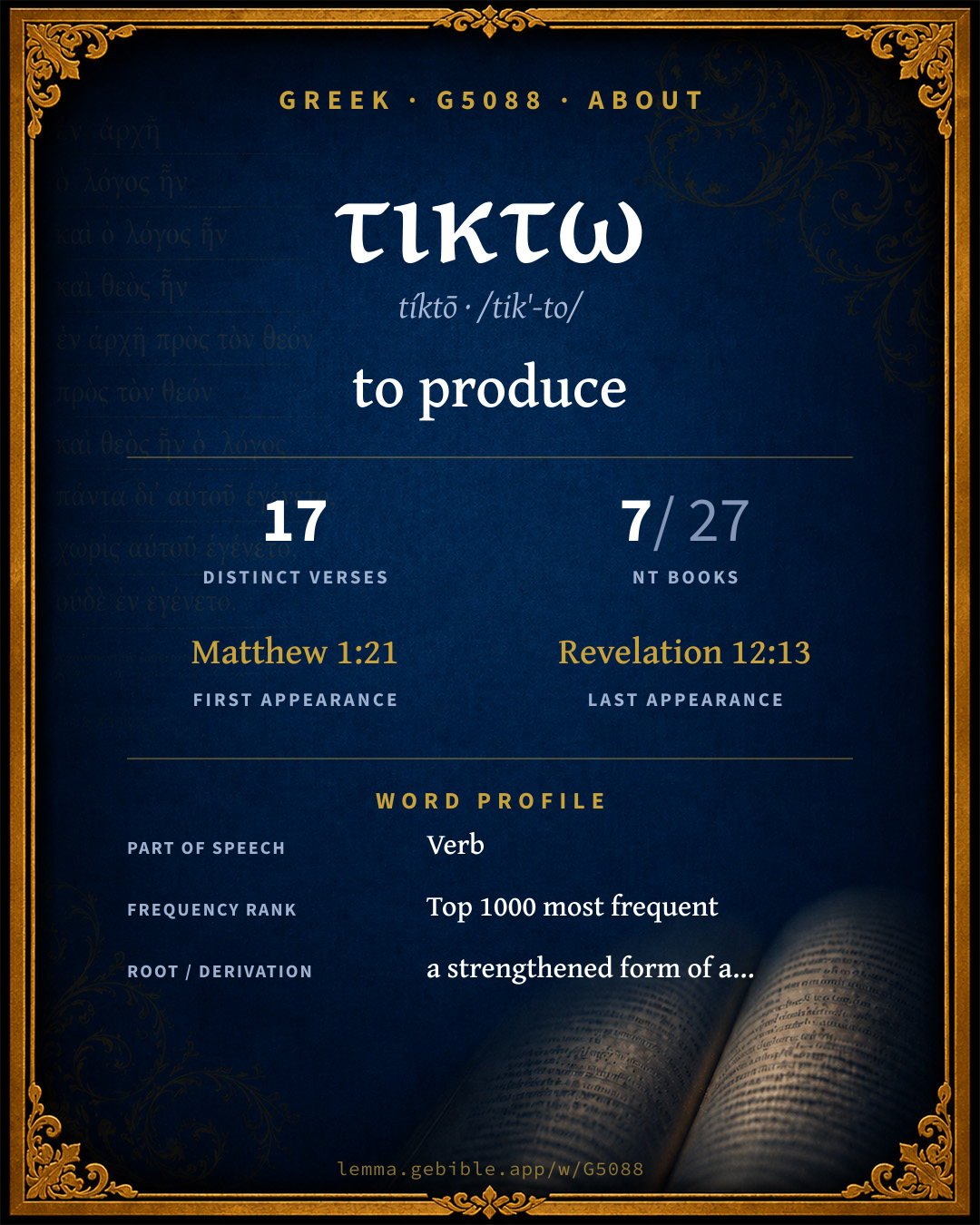
τίκτω
to produce
Full lexicon entry — Thayer's Greek Lexicon
From Thayer's Greek Lexicon
Where this word appears
See every Aorist-tense verb in the Greek New Testament →
Grammar key — what these labels mean
Part of speech
- Verb
- An action or state-of-being word.
Tense
- Aorist
- Action viewed as a simple whole, without regard to duration — often past (perfective aspect).
- Future
- Action expected in future time.
- Present
- Ongoing or general action in present time (imperfective aspect).
Voice
- Active
- The subject performs the action.
- Middle deponent
- Middle in form but active in meaning.
- Passive
- The subject receives the action.
Mood
- Indicative
- States a fact or asks a factual question (the mood of reality).
- Infinitive
- A verbal noun (“to write”), unmarked for person or number.
- Participle
- A verbal adjective (“writing,” “having written”).
- Subjunctive
- Expresses probability, purpose, or possibility (the mood of contingency).
Case
- Nominative
- The case of the subject (and the predicate nominative).
Person
- 3rd person
- The one spoken about (“he / she / it / they”).
- 2nd person
- The one addressed (“you”).
Gender
- Feminine
- Grammatically feminine.
- Masculine
- Grammatically masculine.
Number
- Singular
- One.
3 distinct verses where G5088 appears in the Future tense, across 2 books. Filtered view — show all forms. Click any verse to open its interlinear word-by-word view. Verse text shown in the World English Bible for context — . Each verse’s Greek form is shown with its reference; the English is not keyword-highlighted, since the data carries no word-level English alignment. Use “Compare translations” on any verse to read it across multiple English versions. This concordance covers the Greek New Testament; Septuagint (Greek Old Testament) occurrences of this word are not indexed here.
Matthew 2 verses
- Matthew 1:21 τέξεται fut mid.dep ind 3sg She shall bring forth a son. You shall call his name Jesus, for it is he who shall save his people from their sins."
- Matthew 1:23 τέξεται fut mid.dep ind 3sg "Behold, the virgin shall be with child, And shall bring forth a son. They shall call his name Immanuel;" Which is, being interpreted, "God with us."
Luke 1 verse
About this entry
At a glance — auto-summarized from this page’s data, not written by a person. Every figure links to its source below. This summary describes the numbers; it doesn’t interpret them.
τικτω (tíktō) is a Greek verb most often rendered “to produce.” It first appears in Matthew 1:21. With 17 verses in 7 books, it is an uncommon word in the Greek New Testament. It concentrates in Luke, which alone accounts for 29% of its uses. It clusters with τειχος, τεχνη and τοκος under a shared root. For the data behind this summary, explore the sense tree and the renderings breakdown below.
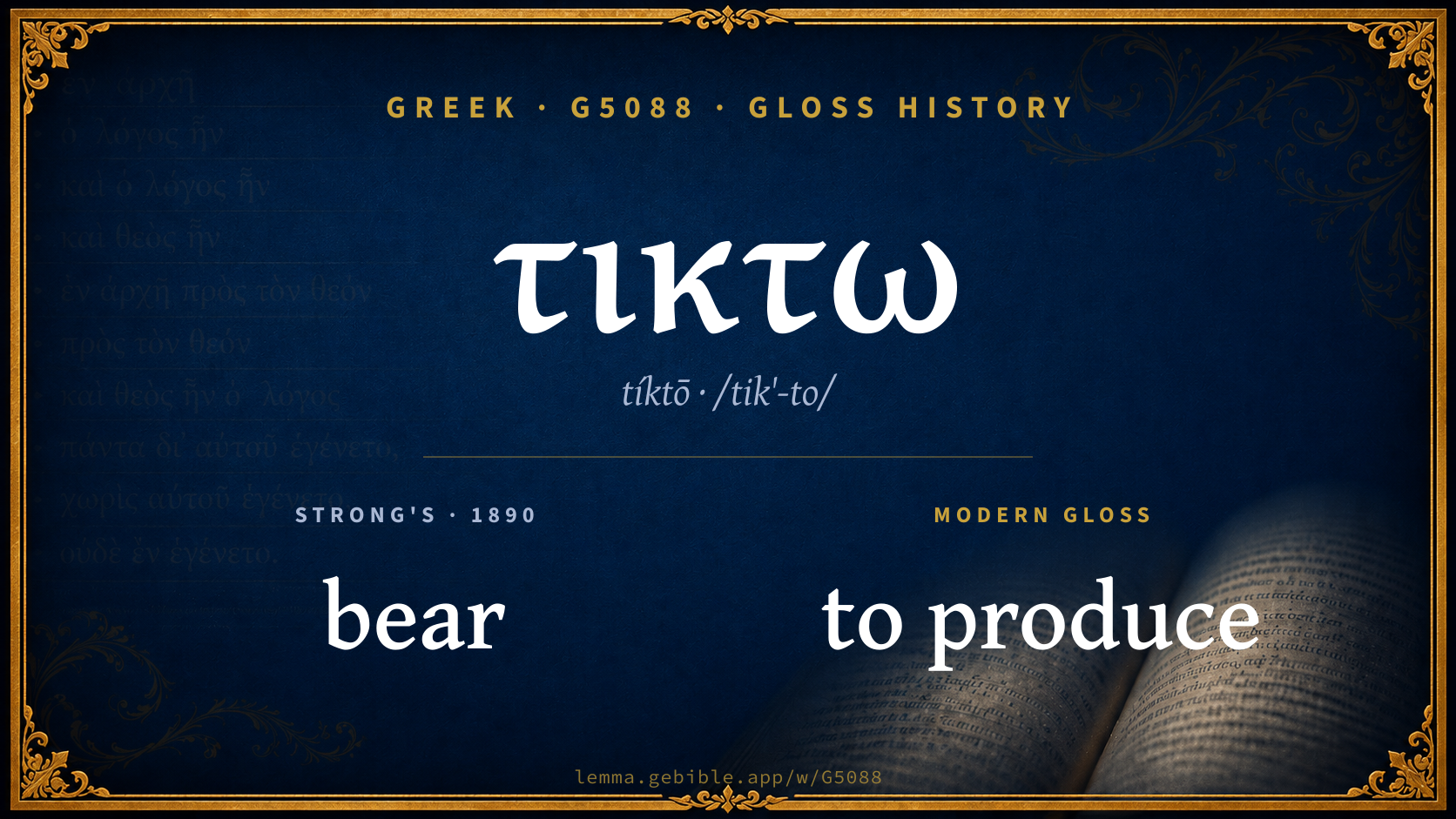
Gloss history
Strong's 1890 vs modern scholarship
About this word
Strong's G5088 catalogs a Greek word from the Greek New Testament.
These counts are not copied from any lexicon or concordance. They are computed here, from the morphology-tagged Greek New Testament. What Lemma adds →
- 17
- distinct verses
- The word appears in 17 distinct verses.
- 7 / 27
- NT books
- The word appears in 7 of 27 New Testament books.
- #664
- by frequency
- Top 1000 most frequent Greek words (rank 664 of 5,347 Greek words by occurrence).
View all 17 occurrences in the concordance →
Most concentrated in
- Luke 5 verses 29%
- Matthew 4 verses 24%
- Revelation 4 verses 24%
By section of the New Testament
By traditional corpus
Conventional, traditional groupings — biblical authorship is debated, so this is a traditional corpus grouping, not an authorship claim. Some books belong to more than one corpus (Luke is in both the Gospels and the Lukan corpus, and so on), so these shares overlap and need not total 100%. Each figure is a share of the word’s 17 distinct verses.
- Gospels 10 verses · 59%
- Lukan (Luke–Acts) 5 verses · 29%
- Johannine 5 verses · 29%
- Revelation 4 verses · 24%
- Pauline corpus 1 verse · 6%
- Hebrews 1 verse · 6%
- General (Catholic) Epistles 1 verse · 6%
How translations render this word
Counts come from each version’s own published word-to-Strong’s tagging or interlinear alignment — an approximate guide to how each version renders this word, not a word-level alignment the data otherwise carries. Because each total is that version’s own tagged count, the per-version totals vary from one another and need not match the appearance or distinct-verse counts above. These counts may also differ from a printed concordance because Lemma counts each distinctly tagged rendering and does not collapse phrase taggings into a single head-word total. This is a fixed set of word-tagged versions (KJV, ASV, BSB, ULT) and does not change with the reading translation you choose elsewhere. Each version’s license is shown beside its name below (and on Sources).
- King James Version: Be delivered 2×, Bringeth forth 2×, She brought forth 2×
- American Standard Version: Be delivered 2×, Should be delivered 2×
- Berean Standard Bible: Has been born 2×, She gave birth 2×, She gave birth to 2×
- unfoldingWord Literal Text: Bear 2×, Deliver 2×, Give birth 2×
King James Version Public Domain
Renders G5088 across 19 tagged occurrences — most commonly:
Plus 11 renderings that appear only once — usually multi-word phrases or single function words the recovered tagging swept in, not distinct renderings.
American Standard Version Public Domain
Renders G5088 across 17 tagged occurrences — most commonly:
Plus 13 renderings that appear only once — usually multi-word phrases or single function words the recovered tagging swept in, not distinct renderings.
Berean Standard Bible Public Domain
Renders G5088 across 18 tagged occurrences — most commonly:
Plus 12 renderings that appear only once — usually multi-word phrases or single function words the recovered tagging swept in, not distinct renderings.
unfoldingWord Literal Text CC BY-SA 4.0
Renders G5088 across 19 tagged occurrences — most commonly:
Plus 13 renderings that appear only once — usually multi-word phrases or single function words the recovered tagging swept in, not distinct renderings.
Senses in Thayer's
The 1 sense Thayer's distinguishes for this word, in lexicon order (not ranked by frequency or importance). The full entry — with sub-senses — is in the Lexicon Entry tab.
- to bring forth, bear, produce (fruit from the seed)
Word origin
Origin: a strengthened form of a primary teko tek'-o (which is used only as alternate in certain tenses)
A strengthened from of a primary word τέκω tekō (which is used only as an alternate in certain tenses); to produce (from seed as a mother a plant the earth etc.) literal or figurative : - bear be born bring forth be delivered be in travail.
— Strong’s Exhaustive Concordance (1890), public domain.
Forms in the corpus
The 10 distinct written forms G5088 takes in the Greek New Testament, most frequent first — each parse links to that tense’s occurrences in the concordance.
| Form | Parsing | Example | Uses |
|---|---|---|---|
| τεκεῖν tekeîn | Verb, Aorist, Active, Infinitive | Luke 1:57 | 4 |
| ἔτεκεν éteken | Verb, Aorist, Active, Indicative, 3rd person, Singular | Matthew 1:25 | 4 |
| τέξεται téxetai | Verb, Future, Middle deponent, Indicative, 3rd person, Singular | Matthew 1:21 | 2 |
| τίκτουσα tíktousa | Verb, Present, Active, Participle, Nominative, Singular, Feminine | Galatians 4:27 | 2 |
| τέκῃ tékē | Verb, Aorist, Active, Subjunctive, 3rd person, Singular | Revelation 12:4 | 1 |
| τέξῃ téxē | Verb, Future, Middle deponent, Indicative, 2nd person, Singular | Luke 1:31 | 1 |
| τίκτει tíktei | Verb, Present, Active, Indicative, 3rd person, Singular | James 1:15 | 1 |
| τίκτῃ tíktē | Verb, Present, Active, Subjunctive, 3rd person, Singular | John 16:21 | 1 |
| τεχθεὶς techtheìs | Verb, Aorist, Passive, Participle, Nominative, Singular, Masculine | Matthew 2:2 | 1 |
| ἐτέχθη etéchthē | Verb, Aorist, Passive, Indicative, 3rd person, Singular | Luke 2:11 | 1 |
Same root — word family
Other Thayer's entries built from the same root as G5088, grouped by Strong’s listed origin. These share a root / origin per the lexicon — not necessarily a shared meaning. Each links to that word’s own entry.
Derived from this word
- τειχος teîchos G5038 city wall
- τεχνη téchnē G5078 craft
- τοκος tókos G5110 usury
- τοξον tóxon G5115 bow
- τυγχανω tynchánō G5177 to happen
Compare all same-root words → Showing 4 of 6 — not the complete family. They share a root, not necessarily a meaning.
Septuagint usage
The same Greek word τικτω appears 227 times in the Greek Old Testament (Septuagint), across 207 verses in 23 books.
- 227
- LXX occurrences
- Tagged occurrences of this Greek word in the Septuagint.
- 207
- verses
- Distinct Septuagint verses containing this word.
- 23 / 39
- OT books
- The word appears in 23 of the 39 Old Testament books.
Sample Septuagint occurrences
- Genesis 3:16 τίκτω
- Exodus 1:16 τίκτω
- Leviticus 12:2 τίκτω
- Numbers 11:12 τίκτω
- Deuteronomy 15:19 τίκτω
- Judges 8:31 τίκτω
- Ruth 1:12 τίκτω
- 1 Samuel 1:20 τίκτω
- 2 Samuel 3:2 τίκτω
- 1 Kings 1:6 τίκτω
- 2 Kings 4:17 τίκτω
- 1 Chronicles 1:20 τίκτω
Septuagint occurrences (same lexeme)
Every verse where the same Strong’s number (G5088) appears in the Greek Septuagint — showing the first 50 of 207. Verse text shown in the World English Bible for context; the Greek form is the matched word — the English is not keyword-highlighted.
- Genesis 3:16 τίκτω To the woman he said, "I will greatly multiply your pain in childbirth. In pain you will bring forth children. Your desire will be for your husband, and he will rule over you."
- Genesis 4:1 τίκτω The man knew Eve his wife. She conceived, and gave birth to Cain, and said, "I have gotten a man with Yahweh's help."
- Genesis 4:2 τίκτω Again she gave birth, to Cain's brother Abel. Abel was a keeper of sheep, but Cain was a tiller of the ground.
- Genesis 4:17 τίκτω Cain knew his wife. She conceived, and gave birth to Enoch. He built a city, and called the name of the city, after the name of his son, Enoch.
- Genesis 4:20 τίκτω Adah gave birth to Jabal, who was the father of those who dwell in tents and have cattle.
- Genesis 4:22 τίκτω Zillah also gave birth to Tubal Cain, the forger of every cutting instrument of brass and iron. Tubal Cain's sister was Naamah.
- Genesis 4:25 τίκτω Adam knew his wife again. She gave birth to a son, and named him Seth. For, she said, "God has appointed me another child instead of Abel, for Cain killed him."
- Genesis 16:1 τίκτω Now Sarai, Abram's wife, bore him no children. She had a handmaid, an Egyptian, whose name was Hagar.
- Genesis 16:2 τίκτω Sarai said to Abram," See now, Yahweh has restrained me from bearing. Please go in to my handmaid. It may be that I will obtain children by her." Abram listened to the voice of Sarai.
- Genesis 16:11 τίκτω The angel of Yahweh said to her, "Behold, you are with child, and will bear a son. You shall call his name Ishmael, because Yahweh has heard your affliction.
- Genesis 16:15 τίκτω Hagar bore a son for Abram. Abram called the name of his son, whom Hagar bore, Ishmael.
- Genesis 16:16 τίκτω Abram was eighty-six years old, when Hagar bore Ishmael to Abram.
- Genesis 17:17 τίκτω Then Abraham fell on his face, and laughed, and said in his heart, "Will a child be born to him who is one hundred years old? Will Sarah, who is ninety years old, give birth?"
- Genesis 17:19 τίκτω God said, "No, but Sarah, your wife, will bear you a son. You shall call his name Isaac. I will establish my covenant with him for an everlasting covenant for his seed after him.
- Genesis 17:21 τίκτω But my covenant I establish with Isaac, whom Sarah will bear to you at this set time in the next year."
- Genesis 18:13 τίκτω Yahweh said to Abraham, "Why did Sarah laugh, saying, 'Will I really bear a child, yet I am old?'
- Genesis 19:37 τίκτω The firstborn bore a son, and named him Moab. The same is the father of the Moabites to this day.
- Genesis 19:38 τίκτω The younger also bore a son, and called his name Ben Ammi. The same is the father of the children of Ammon to this day.
- Genesis 20:17 τίκτω Abraham prayed to God. God healed Abimelech, and his wife, and his maid-servants, and they bore children.
- Genesis 21:2 τίκτω Sarah conceived, and bore Abraham a son in his old age, at the set time of which God had spoken to him.
- Genesis 21:3 τίκτω Abraham called his son who was born to him, whom Sarah bare to him, Isaac.
- Genesis 21:7 τίκτω She said, "Who would have said to Abraham, that Sarah would nurse children? For I have borne him a son in his old age."
- Genesis 22:20 τίκτω It happened after these things, that it was told Abraham, saying, "Behold, Milcah, she also has borne children to your brother Nahor:
- Genesis 22:23 τίκτω Bethuel became the father of Rebekah. These eight Milcah bore to Nahor, Abraham's brother.
- Genesis 22:24 τίκτω His concubine, whose name was Reumah, also bare Tebah, Gaham, Tahash, and Maacah.
- Genesis 24:15 τίκτω It happened, before he had done speaking, that behold, Rebekah came out, who was born to Bethuel the son of Milcah, the wife of Nahor, Abraham's brother, with her pitcher on her shoulder.
- Genesis 24:24 τίκτω She said to him, "I am the daughter of Bethuel the son of Milcah, whom she bore to Nahor."
- Genesis 24:36 τίκτω Sarah, my master's wife, bore a son to my master when she was old. He has given all that he has to him.
- Genesis 24:47 τίκτω I asked her, and said, 'Whose daughter are you?' She said, 'The daughter of Bethuel, Nahor's son, whom Milcah bare to him.' I put the ring on her nose, and the bracelets on her hands.
- Genesis 25:2 τίκτω She bore him Zimran, Jokshan, Medan, Midian, Ishbak, and Shuah.
- Genesis 25:12 τίκτω Now this is the history of the generations of Ishmael, Abraham's son, whom Hagar the Egyptian, Sarah's handmaid, bore to Abraham.
- Genesis 25:24 τίκτω When her days to be delivered were fulfilled, behold, there were twins in her womb.
- Genesis 25:26 τίκτω After that, his brother came out, and his hand had hold on Esau's heel. He was named Jacob. Isaac was sixty years old when she bore them.
- Genesis 29:32 τίκτω Leah conceived, and bore a son, and she named him Reuben. For she said, "Because Yahweh has looked at my affliction. For now my husband will love me."
- Genesis 29:33 τίκτω She conceived again, and bare a son, and said, "Because Yahweh has heard that I am hated, he has therefore given me this son also." She named him Simeon.
- Genesis 29:34 τίκτω She conceived again, and bare a son. Said, "Now this time will my husband be joined to me, because I have borne him three sons." Therefore was his name called Levi.
- Genesis 29:35 τίκτω She conceived again, and bare a son. She said, "This time will I praise Yahweh." Therefore she named him Judah. Then she stopped bearing.
- Genesis 30:1 τίκτω When Rachel saw that she bore Jacob no children, Rachel envied her sister. She said to Jacob, "Give me children, or else I will die."
- Genesis 30:3 τίκτω She said, "Behold, my maid Bilhah. Go in to her, that she may bear on my knees, and I also may obtain children by her."
- Genesis 30:5 τίκτω Bilhah conceived, and bore Jacob a son.
- Genesis 30:7 τίκτω Bilhah, Rachel's handmaid, conceived again, and bore Jacob a second son.
- Genesis 30:9 τίκτω When Leah saw that she had finished bearing, she took Zilpah, her handmaid, and gave her to Jacob as a wife.
- Genesis 30:10 τίκτω Zilpah, Leah's handmaid, bore Jacob a son.
- Genesis 30:12 τίκτω Zilpah, Leah's handmaid, bore Jacob a second son.
- Genesis 30:17 τίκτω God listened to Leah, and she conceived, and bore Jacob a fifth son.
- Genesis 30:19 τίκτω Leah conceived again, and bore a sixth son to Jacob.
- Genesis 30:20 τίκτω Leah said, "God has endowed me with a good dowry. Now my husband will live with me, because I have borne him six sons." She named him Zebulun.
- Genesis 30:21 τίκτω Afterwards, she bore a daughter, and named her Dinah.
- Genesis 30:23 τίκτω She conceived, bore a son, and said, "God has taken away my reproach."
- Genesis 30:25 τίκτω It happened, when Rachel had borne Joseph, that Jacob said to Laban, "Send me away, that I may go to my own place, and to my country.
These are occurrences of the same Greek lexeme (G5088) in the Septuagint — not a translation of any one Hebrew word. The store carries no word-level Hebrew↔Greek alignment, so no Hebrew original is asserted here. Counts come from the recovered LXX Strong's tagging — high-frequency vocabulary is well covered, while rare or late forms may be untagged — so they reflect tagged occurrences and may slightly undercount.