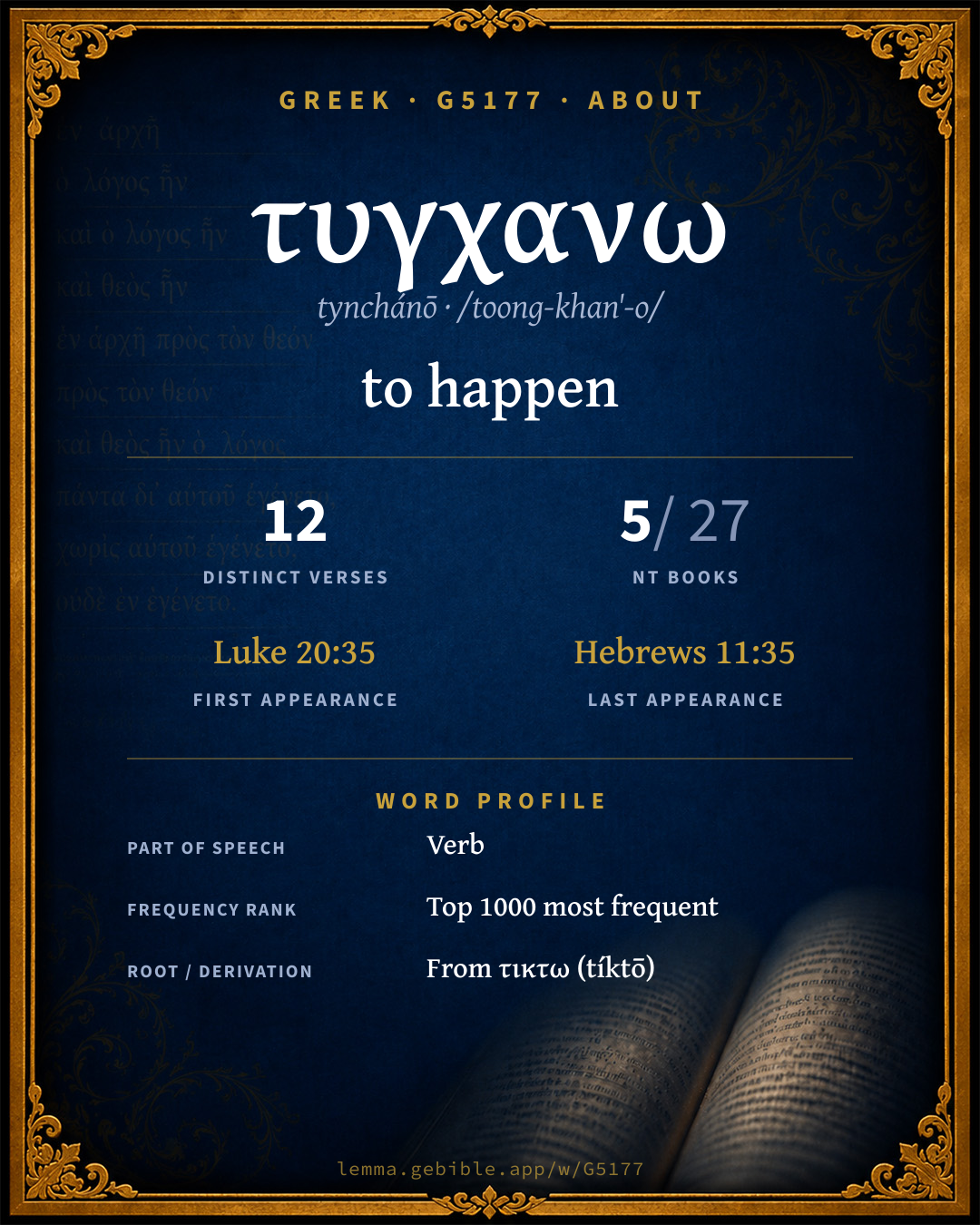
τυγχάνω
to happen
‘to happen’ is one of 6 main senses fuller range ↓
Full lexicon entry — Thayer's Greek Lexicon
From Thayer's Greek Lexicon
Where this word appears
See every Aorist-tense verb in the Greek New Testament →
Grammar key — what these labels mean
Part of speech
- Verb
- An action or state-of-being word.
Tense
- Aorist
- Action viewed as a simple whole, without regard to duration — often past (perfective aspect).
- Perfect
- A completed past action with continuing present results.
- Present
- Ongoing or general action in present time (imperfective aspect).
Voice
- Active
- The subject performs the action.
Mood
- Infinitive
- A verbal noun (“to write”), unmarked for person or number.
- Optative
- Expresses a wish or a remote possibility.
- Subjunctive
- Expresses probability, purpose, or possibility (the mood of contingency).
- Participle
- A verbal adjective (“writing,” “having written”).
- Indicative
- States a fact or asks a factual question (the mood of reality).
Case
- Accusative
- The case of the direct object and of extent.
- Nominative
- The case of the subject (and the predicate nominative).
Person
- 3rd person
- The one spoken about (“he / she / it / they”).
Gender
- Feminine
- Grammatically feminine.
- Neuter
- Grammatically neuter.
- Masculine
- Grammatically masculine.
Number
- Singular
- One.
- Plural
- More than one.
Grammatical forms 9 distinct
- Verb, Aorist, Active, Infinitive 2 times (17%)
- Verb, Aorist, Active, Optative, 3rd person, Singular 2 times (17%)
- Verb, Aorist, Active, Subjunctive, 3rd person, Plural 2 times (17%)
- Verb, Aorist, Active, Participle, Accusative, Plural, Feminine 1 time (8%)
- Verb, Aorist, Active, Participle, Accusative, Singular, Feminine 1 time (8%)
- Verb, Aorist, Active, Participle, Accusative, Singular, Neuter 1 time (8%)
- Verb, Aorist, Active, Participle, Nominative, Singular, Masculine 1 time (8%)
- Verb, Perfect, Active, Indicative, 3rd person, Singular 1 time (8%)
+1 more form (1 occurrence)
Parsed forms decoded from the imported morphology (Robinson–Tischendorf, public domain), counted across 12 parsed occurrences — not distinct verses.
Every verse where G5177 appears — 12 distinct verses across 5 books. Click any verse to open its interlinear word-by-word view. Verse text shown in the World English Bible for context — . Each verse’s Greek form is shown with its reference; the English is not keyword-highlighted, since the data carries no word-level English alignment. Use “Compare translations” on any verse to read it across multiple English versions. This concordance covers the Greek New Testament; Septuagint (Greek Old Testament) occurrences of this word are not indexed here.
Luke 1 verse
Acts 5 verses
- Acts 19:11 τυχούσας aor act ptcp acc pl fem God worked special miracles by the hands of Paul,
- Acts 24:3 τυγχάνοντες pres act ptcp nom pl masc we accept it in all ways and in all places, most excellent Felix, with all thankfulness.
- Acts 26:22 τυχὼν aor act ptcp nom sg masc Having therefore obtained the help that is from God, I stand to this day testifying both to small and great, saying nothing but what the prophets and Moses said would happen,
- Acts 27:3 τυχεῖν aor act inf The next day, we touched at Sidon. Julius treated Paul kindly, and gave him permission to go to his friends and refresh himself.
- Acts 28:2 τυχοῦσαν aor act ptcp acc sg fem The natives showed us uncommon kindness; for they kindled a fire, and received us all, because of the present rain, and because of the cold.
1 Corinthians 3 verses
- 1 Corinthians 14:10 τύχοι aor act opt 3sg There are, it may be, so many kinds of sounds in the world, and none of them is without meaning.
- 1 Corinthians 15:37 τύχοι aor act opt 3sg That which you sow, you don't sow the body that will be, but a bare grain, maybe of wheat, or of some other kind.
- 1 Corinthians 16:6 τυχὸν aor act ptcp acc sg neut But with you it may be that I will stay, or even winter, that you may send me on my journey wherever I go.
2 Timothy 1 verse
Hebrews 2 verses
- Hebrews 8:6 τέτυχεν perf act ind 3sg But now he has obtained a more excellent ministry, by so much as he is also the mediator of a better covenant, which has been enacted on better promises.
- Hebrews 11:35 τύχωσιν aor act subj 3pl Women received their dead by resurrection. Others were tortured, not accepting their deliverance, that they might obtain a better resurrection.
About this entry
At a glance — auto-summarized from this page’s data, not written by a person. Every figure links to its source below. This summary describes the numbers; it doesn’t interpret them.
“to happen” is the headline sense of the Greek verb τυγχανω (tynchánō). Catalogued under 6 senses, its meaning is not single-sense. It turns up in 12 verses across 5 books, an uncommon footprint. It concentrates in Acts, which alone accounts for 42% of its uses. First canonically at Luke 20:35, it enters the text early. The sections below give every sense, occurrence, and version rendering.
Gloss history
Strong's 1890 vs modern scholarship

About this word
Strong's G5177 catalogs a Greek word from the Greek New Testament.
These counts are not copied from any lexicon or concordance. They are computed here, from the morphology-tagged Greek New Testament. What Lemma adds →
- 12
- distinct verses
- The word appears in 12 distinct verses.
- 5 / 27
- NT books
- The word appears in 5 of 27 New Testament books.
- #904
- by frequency
- Top 1000 most frequent Greek words (rank 904 of 5,347 Greek words by occurrence).
View all 12 occurrences in the concordance →
Most concentrated in
- Acts 5 verses 42%
- 1 Corinthians 3 verses 25%
- Hebrews 2 verses 17%
By section of the New Testament
By traditional corpus
Conventional, traditional groupings — biblical authorship is debated, so this is a traditional corpus grouping, not an authorship claim. Some books belong to more than one corpus (Luke is in both the Gospels and the Lukan corpus, and so on), so these shares overlap and need not total 100%. Each figure is a share of the word’s 12 distinct verses.
- Lukan (Luke–Acts) 6 verses · 50%
- Pauline corpus 4 verses · 33%
- Hebrews 2 verses · 17%
- Gospels 1 verse · 8%
How translations render this word
Counts come from each version’s own published word-to-Strong’s tagging or interlinear alignment — an approximate guide to how each version renders this word, not a word-level alignment the data otherwise carries. Because each total is that version’s own tagged count, the per-version totals vary from one another and need not match the appearance or distinct-verse counts above. These counts may also differ from a printed concordance because Lemma counts each distinctly tagged rendering and does not collapse phrase taggings into a single head-word total. This is a fixed set of word-tagged versions (KJV, ASV, BSB, ULT) and does not change with the reading translation you choose elsewhere. Each version’s license is shown beside its name below (and on Sources).
- King James Version: May be 2×, Obtain 2×
- American Standard Version: Attain 1×, Be 1×, Be that 1×
- Berean Standard Bible: Extraordinary 2×
- unfoldingWord Literal Text: Ordinary 2×, Perhaps 2×
King James Version Public Domain
Renders G5177 across 12 tagged occurrences — most commonly:
Plus 8 renderings that appear only once — usually multi-word phrases or single function words the recovered tagging swept in, not distinct renderings. Not rendered by a distinct English word in 3 further occurrences.
American Standard Version Public Domain
Renders G5177 across 14 tagged occurrences — most commonly:
Plus other, less common renderings.
Berean Standard Bible Public Domain
Renders G5177 across 11 tagged occurrences — most commonly:
Plus 9 renderings that appear only once — usually multi-word phrases or single function words the recovered tagging swept in, not distinct renderings. Not rendered by a distinct English word in 1 further occurrence.
unfoldingWord Literal Text CC BY-SA 4.0
Renders G5177 across 12 tagged occurrences — most commonly:
Plus 8 renderings that appear only once — usually multi-word phrases or single function words the recovered tagging swept in, not distinct renderings.
Senses in Thayer's
The 6 senses Thayer's distinguishes for this word, in lexicon order (not ranked by frequency or importance). The full entry — with sub-senses — is in the Lexicon Entry tab.
- of one discharging a javelin or arrow
- to reach, attain, obtain, get, become master of
- to happen, chance, fall out
- to meet one
- of he who meets one or presents himself unsought, any chance, ordinary, common person
- to chance to be
Word origin
Derived from τικτω (tíktō) (G5088) — to produce.
Probably for an obsolete τύχω tuchō (for which the middle voice of another alternate τεύχω teuchō [to make ready or bring to pass ] is used in certain tenses; akin to the base of G5088 through the idea of effecting ; properly to affect ; or (specifically) to hit or light upon (as a mark to be reached) that is (transitively) to attain or secure an object or end or (intransitively) to happen (as if meeting with); but in the latter application only impersonally (with G1487 ) that is perchance ; or (present participle) as adjective usual (as if commonly met with with G3756 extraordinary ) neuter (as adverb) perhaps ; or (with another verb) as adverb by accident ( as it were ): - be chance enjoy little obtain X refresh... self + special. Compare G5180 .
— Strong’s Exhaustive Concordance (1890), public domain.
Forms in the corpus
The 9 distinct written forms G5177 takes in the Greek New Testament, most frequent first — each parse links to that tense’s occurrences in the concordance.
| Form | Parsing | Example | Uses |
|---|---|---|---|
| τυχεῖν tycheîn | Verb, Aorist, Active, Infinitive | Luke 20:35 | 2 |
| τύχοι týchoi | Verb, Aorist, Active, Optative, 3rd person, Singular | 1 Corinthians 14:10 | 2 |
| τύχωσιν týchōsin | Verb, Aorist, Active, Subjunctive, 3rd person, Plural | 2 Timothy 2:10 | 2 |
| τέτυχεν tétychen | Verb, Perfect, Active, Indicative, 3rd person, Singular | Hebrews 8:6 | 1 |
| τυγχάνοντες tynchánontes | Verb, Present, Active, Participle, Nominative, Plural, Masculine | Acts 24:3 | 1 |
| τυχούσας tychoúsas | Verb, Aorist, Active, Participle, Accusative, Plural, Feminine | Acts 19:11 | 1 |
| τυχοῦσαν tychoûsan | Verb, Aorist, Active, Participle, Accusative, Singular, Feminine | Acts 28:2 | 1 |
| τυχὸν tychòn | Verb, Aorist, Active, Participle, Accusative, Singular, Neuter | 1 Corinthians 16:6 | 1 |
| τυχὼν tychṑn | Verb, Aorist, Active, Participle, Nominative, Singular, Masculine | Acts 26:22 | 1 |
Same root — word family
Other Thayer's entries built from the same root as G5177, grouped by Strong’s listed origin. These share a root / origin per the lexicon — not necessarily a shared meaning. Each links to that word’s own entry.
Derives from
Shares the same root
- τειχος teîchos G5038 city wall
- τεχνη téchnē G5078 craft
- τοκος tókos G5110 usury
- τοξον tóxon G5115 bow
Proper names from this root
People and places named from this root — a name, not an additional meaning of the word.
Compare all same-root words → Showing 4 of 7 — not the complete family. 1 of the same-root words is a proper name (a person or place). They share a root, not necessarily a meaning.
Septuagint usage
The same Greek word τυγχανω appears 4 times in the Greek Old Testament (Septuagint), across 4 verses in 2 books.
- 4
- LXX occurrences
- Tagged occurrences of this Greek word in the Septuagint.
- 4
- verses
- Distinct Septuagint verses containing this word.
- 2 / 39
- OT books
- The word appears in 2 of the 39 Old Testament books.
Sample Septuagint occurrences
- Job 3:21 τυγχάνω
- Proverbs 30:23 τυγχάνω
Septuagint occurrences (same lexeme)
Every verse where the same Strong’s number (G5177) appears in the Greek Septuagint. Verse text shown in the World English Bible for context; the Greek form is the matched word — the English is not keyword-highlighted.
- Job 3:21 τυγχάνω Who long for death, but it doesn't come; Dig for it more than for hidden treasures,
- Job 7:2 τυγχάνω As a servant who earnestly desires the shadow, As a hireling who looks for his wages,
- Job 17:1 τυγχάνω "My spirit is consumed, my days are extinct, And the grave is ready for me.
- Proverbs 30:23 τυγχάνω For an unloved woman when she is married; And a handmaid who is heir to her mistress.
These are occurrences of the same Greek lexeme (G5177) in the Septuagint — not a translation of any one Hebrew word. The store carries no word-level Hebrew↔Greek alignment, so no Hebrew original is asserted here. Counts come from the recovered LXX Strong's tagging — high-frequency vocabulary is well covered, while rare or late forms may be untagged — so they reflect tagged occurrences and may slightly undercount.