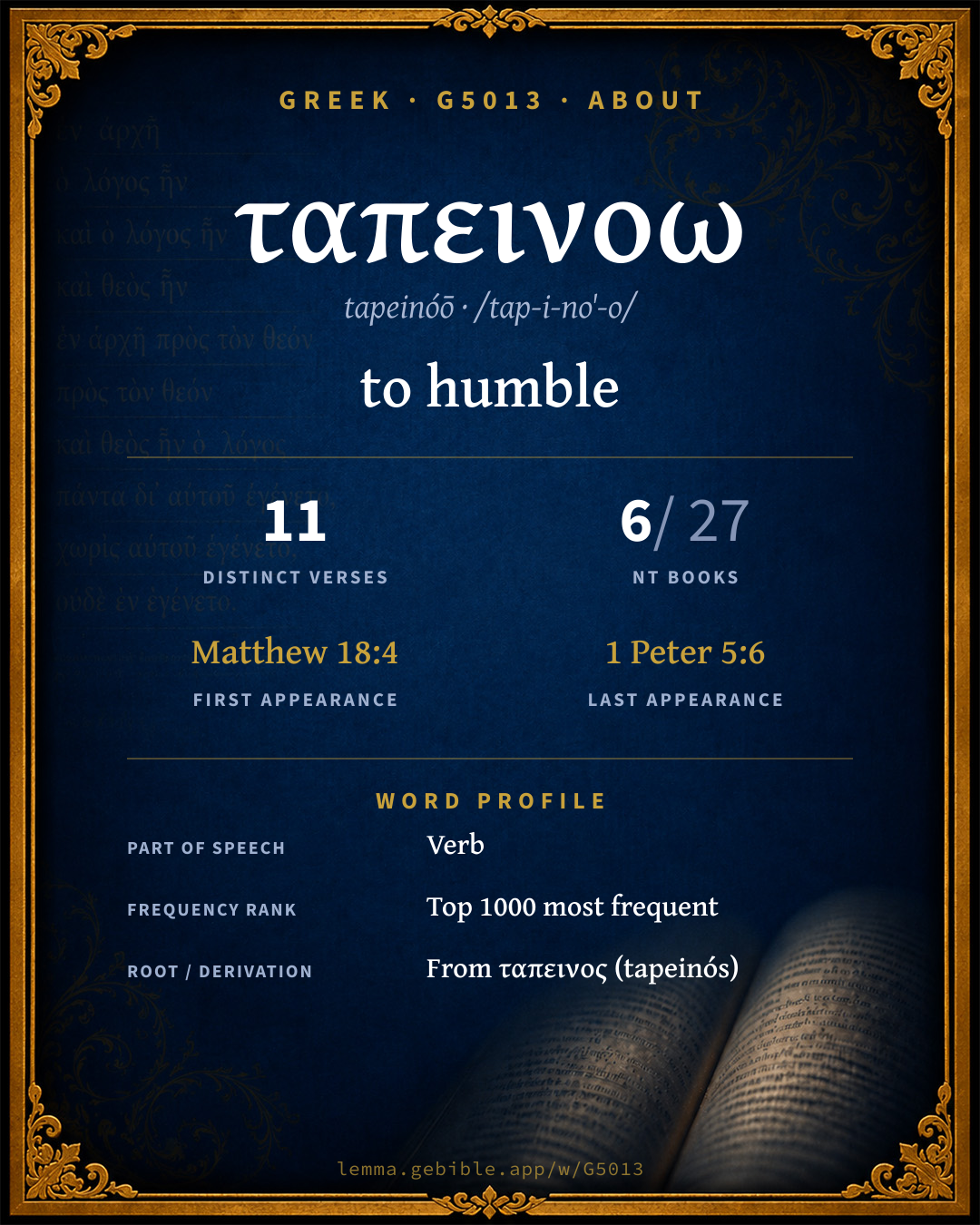
ταπεινόω
to humble
‘to humble’ is one of 3 main senses fuller range ↓
Full lexicon entry — Thayer's Greek Lexicon
From Thayer's Greek Lexicon
Where this word appears
See every Future-tense verb in the Greek New Testament →
Grammar key — what these labels mean
Part of speech
- Verb
- An action or state-of-being word.
Tense
- Future
- Action expected in future time.
- Present
- Ongoing or general action in present time (imperfective aspect).
- Aorist
- Action viewed as a simple whole, without regard to duration — often past (perfective aspect).
Voice
- Passive
- The subject receives the action.
- Active
- The subject performs the action.
Mood
- Indicative
- States a fact or asks a factual question (the mood of reality).
- Participle
- A verbal adjective (“writing,” “having written”).
- Imperative
- Expresses a command or request.
- Infinitive
- A verbal noun (“to write”), unmarked for person or number.
Case
- Nominative
- The case of the subject (and the predicate nominative).
Person
- 3rd person
- The one spoken about (“he / she / it / they”).
- 2nd person
- The one addressed (“you”).
Gender
- Masculine
- Grammatically masculine.
Number
- Singular
- One.
- Plural
- More than one.
Grammatical forms
- Verb, Future, Passive, Indicative, 3rd person, Singular 4 times (29%)
- Verb, Future, Active, Indicative, 3rd person, Singular 3 times (21%)
- Verb, Present, Active, Participle, Nominative, Singular, Masculine 3 times (21%)
- Verb, Aorist, Passive, Imperative, 2nd person, Plural 2 times (14%)
- Verb, Aorist, Active, Indicative, 3rd person, Singular 1 time (7%)
- Verb, Present, Passive, Infinitive 1 time (7%)
Parsed forms decoded from the imported morphology (Robinson–Tischendorf, public domain), counted across 14 parsed occurrences — not distinct verses.
Every verse where G5013 appears — 11 distinct verses across 6 books. Click any verse to open its interlinear word-by-word view. Verse text shown in the World English Bible for context — . Each verse’s Greek form is shown with its reference; the English is not keyword-highlighted, since the data carries no word-level English alignment. Use “Compare translations” on any verse to read it across multiple English versions. This concordance covers the Greek New Testament; Septuagint (Greek Old Testament) occurrences of this word are not indexed here.
Matthew 2 verses
- Matthew 18:4 ταπεινώσει fut act ind 3sg Whoever therefore humbles himself as this little child, the same is the greatest in the Kingdom of Heaven.
- Matthew 23:12 ταπεινωθήσεται ταπεινώσει fut pass ind 3sg fut act ind 3sg Whoever exalts himself will be humbled, and whoever humbles himself will be exalted.
Luke 3 verses
- Luke 3:5 ταπεινωθήσεται fut pass ind 3sg Every valley will be filled. Every mountain and hill will be brought low. The crooked will become straight, And the rough ways smooth.
- Luke 14:11 ταπεινωθήσεται ταπεινῶν fut pass ind 3sg pres act ptcp nom sg masc For everyone who exalts himself will be humbled, and whoever humbles himself will be exalted."
- Luke 18:14 ταπεινωθήσεται ταπεινῶν fut pass ind 3sg pres act ptcp nom sg masc I tell you, this man went down to his house justified rather than the other; for everyone who exalts himself will be humbled, but he who humbles himself will be exalted."
2 Corinthians 2 verses
- 2 Corinthians 11:7 ταπεινῶν pres act ptcp nom sg masc Or did I commit a sin in humbling myself that you might be exalted, because I preached to you God's Gospel free of charge?
- 2 Corinthians 12:21 ταπεινώσει fut act ind 3sg that again when I come my God would humble me before you, and I would mourn for many of those who have sinned before now, and not repented of the uncleanness and sexual immorality and lustfulness which they committed.
Philippians 2 verses
- Philippians 2:8 ἐταπείνωσεν aor act ind 3sg And being found in human form, he humbled himself, becoming obedient to death, yes, the death of the cross.
- Philippians 4:12 ταπεινοῦσθαι pres pass inf I know how to be humbled, and I know also how to abound. In everything and in all things I have learned the secret both to be filled and to be hungry, both to abound and to be in need.
James 1 verse
1 Peter 1 verse
About this entry
At a glance — auto-summarized from this page’s data, not written by a person. Every figure links to its source below. This summary describes the numbers; it doesn’t interpret them.
The Greek verb ταπεινοω centers on the idea of “to humble.” First canonically at Matthew 18:4, it enters the text early. The Greek New Testament uses it across 11 verses — uncommon. Luke dominates its distribution — 3 of 11 verses. Lexicons map it across 3 senses. For the data behind this summary, explore the sense tree and the renderings breakdown below.
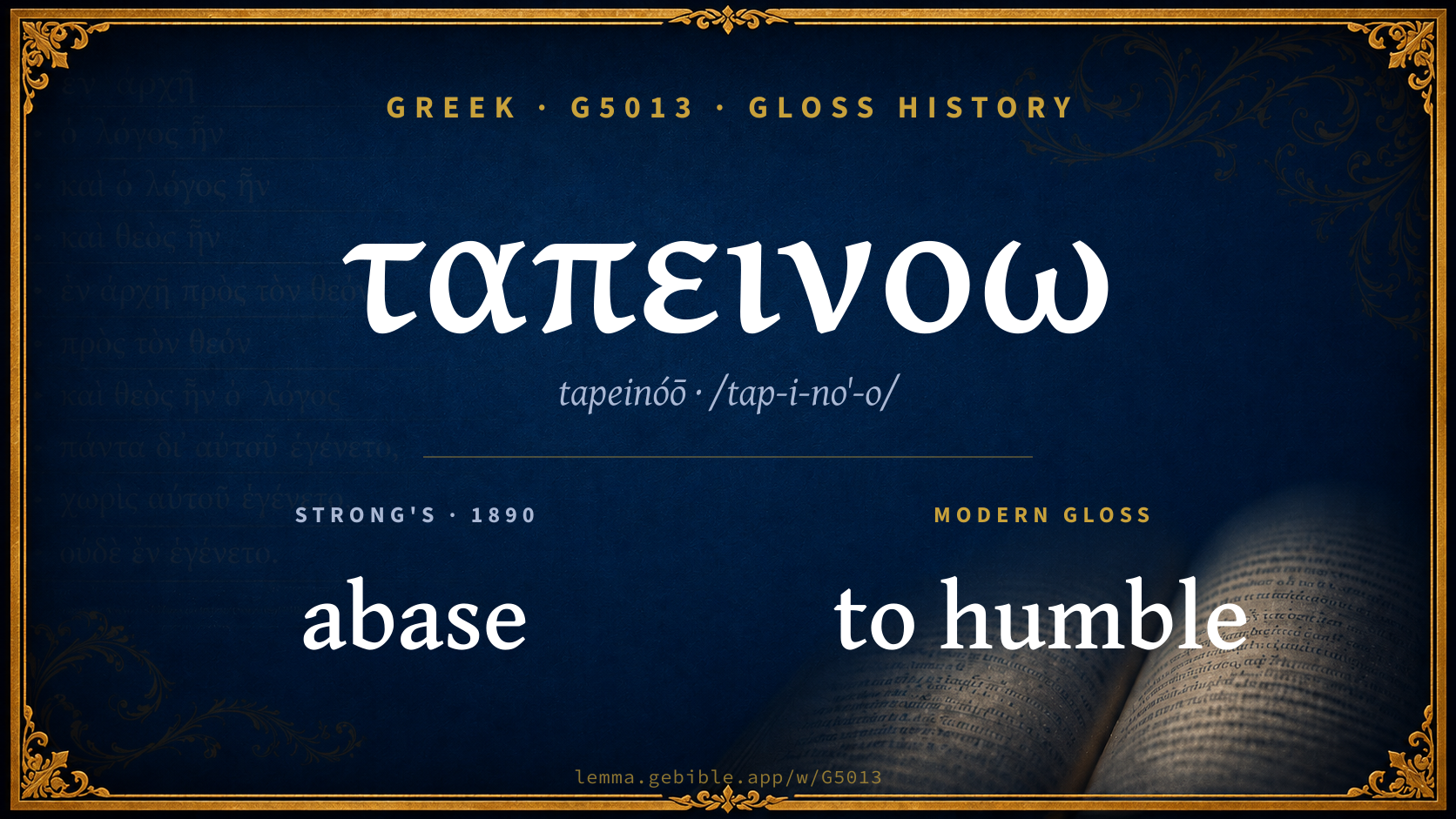
Gloss history
Strong's 1890 vs modern scholarship
About this word
Strong's G5013 catalogs a Greek word from the Greek New Testament.
These counts are not copied from any lexicon or concordance. They are computed here, from the morphology-tagged Greek New Testament. What Lemma adds →
- 11
- distinct verses
- The word appears in 11 distinct verses.
- 6 / 27
- NT books
- The word appears in 6 of 27 New Testament books.
- #814
- by frequency
- Top 1000 most frequent Greek words (rank 814 of 5,347 Greek words by occurrence).
View all 11 occurrences in the concordance →
Most concentrated in
- Luke 3 verses 27%
- Matthew 2 verses 18%
- 2 Corinthians 2 verses 18%
By section of the New Testament
By traditional corpus
Conventional, traditional groupings — biblical authorship is debated, so this is a traditional corpus grouping, not an authorship claim. Some books belong to more than one corpus (Luke is in both the Gospels and the Lukan corpus, and so on), so these shares overlap and need not total 100%. Each figure is a share of the word’s 11 distinct verses.
- Gospels 5 verses · 45%
- Pauline corpus 4 verses · 36%
- Lukan (Luke–Acts) 3 verses · 27%
- General (Catholic) Epistles 2 verses · 18%
How translations render this word
Counts come from each version’s own published word-to-Strong’s tagging or interlinear alignment — an approximate guide to how each version renders this word, not a word-level alignment the data otherwise carries. Because each total is that version’s own tagged count, the per-version totals vary from one another and need not match the appearance or distinct-verse counts above. These counts may also differ from a printed concordance because Lemma counts each distinctly tagged rendering and does not collapse phrase taggings into a single head-word total. This is a fixed set of word-tagged versions (KJV, ASV, BSB, ULT) and does not change with the reading translation you choose elsewhere. Each version’s license is shown beside its name below (and on Sources).
- King James Version: Shall be abased 3×, He that humbleth 2×, Humble yourselves 2×
- American Standard Version: Shall be humbled 3×, Humble yourselves 2×, Humbleth 2×
- Berean Standard Bible: Humbles 4×, Will be humbled 3×, Humble yourselves 2×
- unfoldingWord Literal Text: Humbling 3×, Will be humbled 3×, Will humble 2×
King James Version Public Domain
Renders G5013 across 14 tagged occurrences — most commonly:
Plus 5 renderings that appear only once — usually multi-word phrases or single function words the recovered tagging swept in, not distinct renderings.
American Standard Version Public Domain
Renders G5013 across 14 tagged occurrences — most commonly:
Plus 7 renderings that appear only once — usually multi-word phrases or single function words the recovered tagging swept in, not distinct renderings.
Berean Standard Bible Public Domain
Renders G5013 across 14 tagged occurrences — most commonly:
Plus 5 renderings that appear only once — usually multi-word phrases or single function words the recovered tagging swept in, not distinct renderings.
unfoldingWord Literal Text CC BY-SA 4.0
Renders G5013 across 14 tagged occurrences — most commonly:
Plus 6 renderings that appear only once — usually multi-word phrases or single function words the recovered tagging swept in, not distinct renderings.
Senses in Thayer's
The 3 senses Thayer's distinguishes for this word, in lexicon order (not ranked by frequency or importance). The full entry — with sub-senses — is in the Lexicon Entry tab.
- to level, reduce to a plain
- metaph. to bring into a humble condition, reduce to meaner circumstances
- to lower, depress
Word origin
Derived from ταπεινος (tapeinós) (G5011) — low.
From G5011 ; to depress ; figuratively to humiliate (in condition or heart): - abase bring low humble (self).
— Strong’s Exhaustive Concordance (1890), public domain.
Forms in the corpus
The 6 distinct written forms G5013 takes in the Greek New Testament, most frequent first — each parse links to that tense’s occurrences in the concordance.
| Form | Parsing | Example | Uses |
|---|---|---|---|
| ταπεινωθήσεται tapeinōthḗsetai | Verb, Future, Passive, Indicative, 3rd person, Singular | Matthew 23:12 | 4 |
| ταπεινώσει tapeinṓsei | Verb, Future, Active, Indicative, 3rd person, Singular | Matthew 18:4 | 3 |
| ταπεινῶν tapeinō̂n | Verb, Present, Active, Participle, Nominative, Singular, Masculine | Luke 14:11 | 3 |
| ταπεινώθητε tapeinṓthēte | Verb, Aorist, Passive, Imperative, 2nd person, Plural | James 4:10 | 2 |
| ταπεινοῦσθαι tapeinoûsthai | Verb, Present, Passive, Infinitive | Philippians 4:12 | 1 |
| ἐταπείνωσεν etapeínōsen | Verb, Aorist, Active, Indicative, 3rd person, Singular | Philippians 2:8 | 1 |
Same root — word family
Other Thayer's entries built from the same root as G5013, grouped by Strong’s listed origin. These share a root / origin per the lexicon — not necessarily a shared meaning. Each links to that word’s own entry.
Derives from
Shares the same root
Derived from this word
Compare all same-root words → They share a root, not necessarily a meaning.
Septuagint usage
The same Greek word ταπεινοω appears 140 times in the Greek Old Testament (Septuagint), across 135 verses in 24 books.
- 140
- LXX occurrences
- Tagged occurrences of this Greek word in the Septuagint.
- 135
- verses
- Distinct Septuagint verses containing this word.
- 24 / 39
- OT books
- The word appears in 24 of the 39 Old Testament books.
Sample Septuagint occurrences
- Genesis 15:13 ταπεινόω
- Exodus 1:12 ταπεινόω
- Leviticus 16:29 ταπεινόω
- Deuteronomy 21:14 ταπεινόω
- Judges 16:5 ταπεινόω
- Ruth 1:21 ταπεινόω
- 1 Samuel 2:7 ταπεινόω
- 2 Samuel 7:10 ταπεινόω
- 1 Kings 8:35 ταπεινόω
- 1 Chronicles 4:10 ταπεινόω
- 2 Chronicles 6:26 ταπεινόω
- Ezra 8:21 ταπεινόω
Septuagint occurrences (same lexeme)
Every verse where the same Strong’s number (G5013) appears in the Greek Septuagint — showing the first 50 of 135. Verse text shown in the World English Bible for context; the Greek form is the matched word — the English is not keyword-highlighted.
- Genesis 15:13 ταπεινόω He said to Abram, "Know for sure that your seed will live as foreigners in a land that is not theirs, and will serve them. They will afflict them four hundred years.
- Genesis 16:9 ταπεινόω The angel of Yahweh said to her, "Return to your mistress, and submit yourself under her hands."
- Genesis 31:50 ταπεινόω If you will afflict my daughters, and if you will take wives besides my daughters, no man is with us; behold, God is witness between me and you."
- Genesis 34:2 ταπεινόω Shechem the son of Hamor the Hivite, the prince of the land, saw her. He took her, lay with her, and humbled her.
- Exodus 1:12 ταπεινόω But the more they afflicted them, the more they multiplied and the more they spread out. They were grieved because of the children of Israel.
- Leviticus 16:29 ταπεινόω "It shall be a statute to you forever: in the seventh month, on the tenth day of the month, you shall afflict your souls, and shall do no manner of work, the native-born, or the stranger who lives as a foreigner among you:
- Leviticus 16:31 ταπεινόω It is a Sabbath of solemn rest to you, and you shall afflict your souls; it is a statute forever.
- Leviticus 23:27 ταπεινόω "However on the tenth day of this seventh month is the day of atonement: it shall be a holy convocation to you, and you shall afflict yourselves; and you shall offer an offering made by fire to Yahweh.
- Leviticus 23:29 ταπεινόω For whoever it is who shall not deny himself in that same day; shall be cut off from his people.
- Leviticus 23:32 ταπεινόω It shall be a Sabbath of solemn rest for you, and you shall deny yourselves. In the ninth day of the month at evening, from evening to evening, you shall keep your Sabbath."
- Leviticus 25:39 ταπεινόω "'If your brother has grown poor among you, and sells himself to you; you shall not make him to serve as a slave.
- Deuteronomy 21:14 ταπεινόω It shall be, if you have no delight in her, then you shall let her go where she will; but you shall not sell her at all for money, you shall not deal with her as a slave, because you have humbled her.
- Deuteronomy 22:24 ταπεινόω then you shall bring them both out to the gate of that city, and you shall stone them to death with stones; the lady, because she didn't cry, being in the city; and the man, because he has humbled his neighbor's wife: so you shall put away the evil from the midst of you.
- Deuteronomy 22:29 ταπεινόω then the man who lay with her shall give to the lady's father fifty [shekels] of silver, and she shall be his wife, because he has humbled her; he may not put her away all his days.
- Deuteronomy 26:6 ταπεινόω The Egyptians dealt ill with us, and afflicted us, and laid on us hard bondage:
- Judges 16:5 ταπεινόω The lords of the Philistines came up to her, and said to her, Entice him, and see in which his great strength lies, and by what means we may prevail against him, that we may bind him to afflict him: and we will each give you of us eleven hundred [pieces] of silver.
- Judges 16:6 ταπεινόω Delilah said to Samson, Tell me, Please, in which your great strength lies, and with which you might be bound to afflict you.
- Judges 16:19 ταπεινόω She made him sleep on her knees; and she called for a man, and shaved off the seven locks of his head; and she began to afflict him, and his strength went from him.
- Judges 19:24 ταπεινόω Behold, here is my daughter a virgin, and his concubine; them I will bring out now, and humble you them, and do with them what seems good to you: but to this man don't do any such folly.
- Judges 20:5 ταπεινόω The men of Gibeah rose against me, and beset the house round about me by night; me they thought to have slain, and my concubine they forced, and she is dead.
- Ruth 1:21 ταπεινόω I went out full, and Yahweh has brought me home again empty; why do you call me Naomi, seeing Yahweh has testified against me, and the Almighty has afflicted me?"
- 1 Samuel 2:7 ταπεινόω Yahweh makes poor, and makes rich: He brings low, he also lifts up.
- 1 Samuel 7:13 ταπεινόω So the Philistines were subdued, and they came no more within the border of Israel: and the hand of Yahweh was against the Philistines all the days of Samuel.
- 1 Samuel 12:8 ταπεινόω When Jacob was come into Egypt, and your fathers cried to Yahweh, then Yahweh sent Moses and Aaron, who brought forth your fathers out of Egypt, and made them to dwell in this place.
- 1 Samuel 26:9 ταπεινόω David said to Abishai, Don't destroy him; for who can put forth his hand against Yahweh's anointed, and be guiltless?
- 2 Samuel 7:10 ταπεινόω I will appoint a place for my people Israel, and will plant them, that they may dwell in their own place, and be moved no more; neither shall the children of wickedness afflict them any more, as at the first,
- 2 Samuel 13:12 ταπεινόω She answered him, No, my brother, do not force me; for no such thing ought to be done in Israel. Don't you do this folly.
- 2 Samuel 13:14 ταπεινόω However he would not listen to her voice; but being stronger than she, he forced her, and lay with her.
- 2 Samuel 13:22 ταπεινόω Absalom spoke to Amnon neither good nor bad; for Absalom hated Amnon, because he had forced his sister Tamar.
- 2 Samuel 13:32 ταπεινόω Jonadab, the son of Shimeah, David's brother, answered, Don't let my lord suppose that they have killed all the young men the king's sons; for Amnon only is dead; for by the appointment of Absalom this has been determined from the day that he forced his sister Tamar.
- 2 Samuel 22:28 ταπεινόω The afflicted people you will save; But your eyes are on the haughty, that you may bring them down.
- 1 Kings 8:35 ταπεινόω When the sky is shut up, and there is no rain, because they have sinned against you; if they pray toward this place, and confess your name, and turn from their sin, when you do afflict them:
- 1 Chronicles 4:10 ταπεινόω Jabez called on the God of Israel, saying, Oh that you would bless me indeed, and enlarge my border, and that your hand might be with me, and that you would keep me from evil, that it not be to my sorrow! God granted him that which he requested.
- 1 Chronicles 17:9 ταπεινόω I will appoint a place for my people Israel, and will plant them, that they may dwell in their own place, and be moved no more; neither shall the children of wickedness waste them any more, as at the first,
- 1 Chronicles 17:10 ταπεινόω and [as] from the day that I commanded judges to be over my people Israel; and I will subdue all your enemies. Moreover I tell you that Yahweh will build you a house.
- 1 Chronicles 20:4 ταπεινόω It happened after this, that there arose war at Gezer with the Philistines: then Sibbecai the Hushathite killed Sippai, of the sons of the giant; and they were subdued.
- 2 Chronicles 6:26 ταπεινόω When the sky is shut up, and there is no rain, because they have sinned against you; if they pray toward this place, and confess your name, and turn from their sin, when you do afflict them:
- 2 Chronicles 13:18 ταπεινόω Thus the children of Israel were brought under at that time, and the children of Judah prevailed, because they relied on Yahweh, the God of their fathers.
- 2 Chronicles 28:19 ταπεινόω For Yahweh brought Judah low because of Ahaz king of Israel; for he had dealt wantonly in Judah, and trespassed severely against Yahweh.
- 2 Chronicles 32:26 ταπεινόω Notwithstanding Hezekiah humbled himself for the pride of his heart, both he and the inhabitants of Jerusalem, so that the wrath of Yahweh didn't come on them in the days of Hezekiah.
- 2 Chronicles 33:12 ταπεινόω When he was in distress, he begged Yahweh his God, and humbled himself greatly before the God of his fathers.
- 2 Chronicles 33:23 ταπεινόω He didn't humble himself before Yahweh, as Manasseh his father had humbled himself; but this same Amon trespassed more and more.
- 2 Chronicles 34:27 ταπεινόω because your heart was tender, and you did humble yourself before God, when you heard his words against this place, and against the inhabitants of it, and have humbled yourself before me, and have torn your clothes, and wept before me; I also have heard you, says Yahweh.
- Ezra 8:21 ταπεινόω Then I proclaimed a fast there, at the river Ahava, that we might humble ourselves before our God, to seek of him a straight way for us, and for our little ones, and for all our substance.
- Esther 6:13 ταπεινόω Haman recounted to Zeresh his wife and all his friends everything that had happened to him. Then his wise men and Zeresh his wife said to him, If Mordecai, before whom you have begun to fall, be of the seed of the Jews, you shall not prevail against him, but shall surely fall before him.
- Job 22:12 ταπεινόω "Isn't God in the heights of heaven? See the height of the stars, how high they are!
- Job 22:23 ταπεινόω If you return to the Almighty, you shall be built up, If you put away unrighteousness far from your tents.
- Job 22:29 ταπεινόω When they cast down, you shall say, 'be lifted up.' He will save the humble person.
- Job 24:9 ταπεινόω There are those who pluck the fatherless from the breast, And take a pledge of the poor,
- Job 31:10 ταπεινόω Then let my wife grind for another, And let others sleep with her.
These are occurrences of the same Greek lexeme (G5013) in the Septuagint — not a translation of any one Hebrew word. The store carries no word-level Hebrew↔Greek alignment, so no Hebrew original is asserted here. Counts come from the recovered LXX Strong's tagging — high-frequency vocabulary is well covered, while rare or late forms may be untagged — so they reflect tagged occurrences and may slightly undercount.