James 4:10

Greek (Tischendorf 8th ed.) James 4:10 appears in the Greek New Testament. The text above is from the Tischendorf 8th edition. Each word links to its Strong’s number and a concise gloss. Click any word for its full Thayer’s Greek Lexicon entry.
Download image
Cite this verse

James 4:10 (World English Bible). Public Domain. Lemma interlinear Bible study tool, https://lemma.gebible.app/v/james/4/10.

Show BibTeX & RIS
BibTeX
RIS
English Translation
Humble yourselves in the sight of the Lord, and he will exalt you.
World English Bible · Public Domain
Download a study sheet

One document with this verse’s original text, its word-by-word gloss line, the meaning frame, cross-references with their text, attributed commentary, and full source and license credits — printable, and it pastes into notes with its structure intact.

This verse Autodidact and up

Study sheet (.html) Plain text (.txt)

A passage Seminary Student

Up to 50 verses in one chapter. A passage sheet keeps up to 6 commentary sources and 12 cross-references per verse, in the order this page ranks them, and says so on the sheet whenever that leaves anything out. Ask for a single verse and you get the Autodidact verse sheet above.

Everything on this page stays free to read, with no account — the sheet is a download of what is already on screen, not access to it.

Want to remove ads? Support Godless Engineer
Compare translations 3

The same verse in 3 English versions, stacked beneath the original-language interlinear above. Click any original word for its lexicon entry.

Each is an independent rendering of the whole verse — the interlinear is not word-aligned to these translations.

Highlighted words mark where these versions differ — a whole-verse word diff, not a word-by-word alignment.

  • World English Bible Public Domain
    Humble yourselves in the sight of the Lord, and he will exalt you.
  • King James Version Public Domain
    Humble yourselves in the sight of the Lord, and he shall lift you up.
  • unfoldingWord Literal Text CC BY-SA 4.0
    Be humbled before the Lord, and he will lift you up.

unfoldingWord Literal Text — © unfoldingWord, licensed CC BY-SA 4.0. Word-aligned USFM3 via Door43 (git.door43.org/unfoldingWord/en_ult).

Versions to compare (up to 4)

3 of 4 selected

Show all 19 translations

Every available English version of this verse, each an independent rendering of the whole verse.

  • World English Bible Public Domain
    Humble yourselves in the sight of the Lord, and he will exalt you.
  • Berean Standard Bible Public Domain
    Humble yourselves before the Lord, and He will exalt you.
  • Majority Standard Bible Public Domain
    Humble yourselves before the Lord, and He will exalt you.
  • King James Version Public Domain
    Humble yourselves in the sight of the Lord, and he shall lift you up.
  • American Standard Version (1901) Public Domain
    Humble yourselves in the sight of the Lord, and he shall exalt you.
  • Revised Version (1885) Public Domain
    Humble yourselves in the sight of the Lord, and he shall exalt you.
  • Geneva Bible (1599) Public Domain
    Cast downe your selues before the Lord, and he will lift you vp.
  • Douay-Rheims (1899) Public Domain
    Be humbled in the sight of the Lord, and he will exalt you.
  • Young's Literal Translation Public Domain
    be made low before the Lord, and He shall exalt you.
  • Literal Standard Version CC BY-SA 4.0
    be made low before the LORD, and He will exalt you.
  • Unlocked Literal Bible CC BY-SA 4.0
    Humble yourselves before the Lord, and he will lift you up.
  • unfoldingWord Literal Text CC BY-SA 4.0
    Be humbled before the Lord, and he will lift you up.
  • Darby Bible Public Domain
    Humble yourselves before [the] Lord, and he shall exalt you.
  • World Messianic Bible Public Domain
    Humble yourselves in the sight of the Lord, and he will exalt you.
  • Webster's Bible Public Domain
    Humble yourselves in the sight of the Lord, and he will lift you up.
  • Free Bible Version CC BY-SA 4.0
    Be humble before the Lord and he will lift you up.
  • Bible in Basic English Public Domain
    Make yourselves low in the eyes of the Lord and you will be lifted up by him.
  • Text-Critical English NT CC BY 4.0
    Humble yourselves before the Lord, and he will exalt you.
  • Tyndale New Testament (1534) Public Domain
    Cast doune youre selves before the lorde and he shall lift you vp.

Literal Standard Version (2020), Covenant Press — licensed CC BY-SA 4.0. Text via the HelloAO Bible API (eBible.org). Unlocked Literal Bible (unfoldingWord) — licensed CC BY-SA 4.0. Text via the HelloAO Bible API (eBible.org). unfoldingWord Literal Text — © unfoldingWord, licensed CC BY-SA 4.0. Word-aligned USFM3 via Door43 (git.door43.org/unfoldingWord/en_ult). Free Bible Version, Dr. Jonathan Gallagher — licensed CC BY-SA 4.0. Text via the HelloAO Bible API (eBible.org).

Word by word

More ways to search: Search by grammar → Find every occurrence → Compare this word →

Practice this passage: Drill this verse → Learn its vocabulary →

ταπεινώθητε
tapeinóō
G5013
“to humble”
Verb, Aorist, Passive, Imperative, 2nd person, Plural
Part of Speech
Verb
Tense
Aorist
Voice
Passive
Mood
Imperative
Person
2nd person
Number
Plural
Full Thayer's Definition

Origin: from G5011

TDNT: 08:01,1

1. to make low, bring low a. to level, reduce to a plain b. metaph. to bring into a humble condition, reduce to meaner circumstances 1. to assign a lower rank or place to 2. to abase 3. to be ranked below others who are honoured or rewarded 4. to humble or abase myself by humble living c. to lower, depress 1. of one's soul bring down one's pride 2. to have a modest opinion of one's self 3. to behave in an unassuming manner 4. devoid of all haughtiness
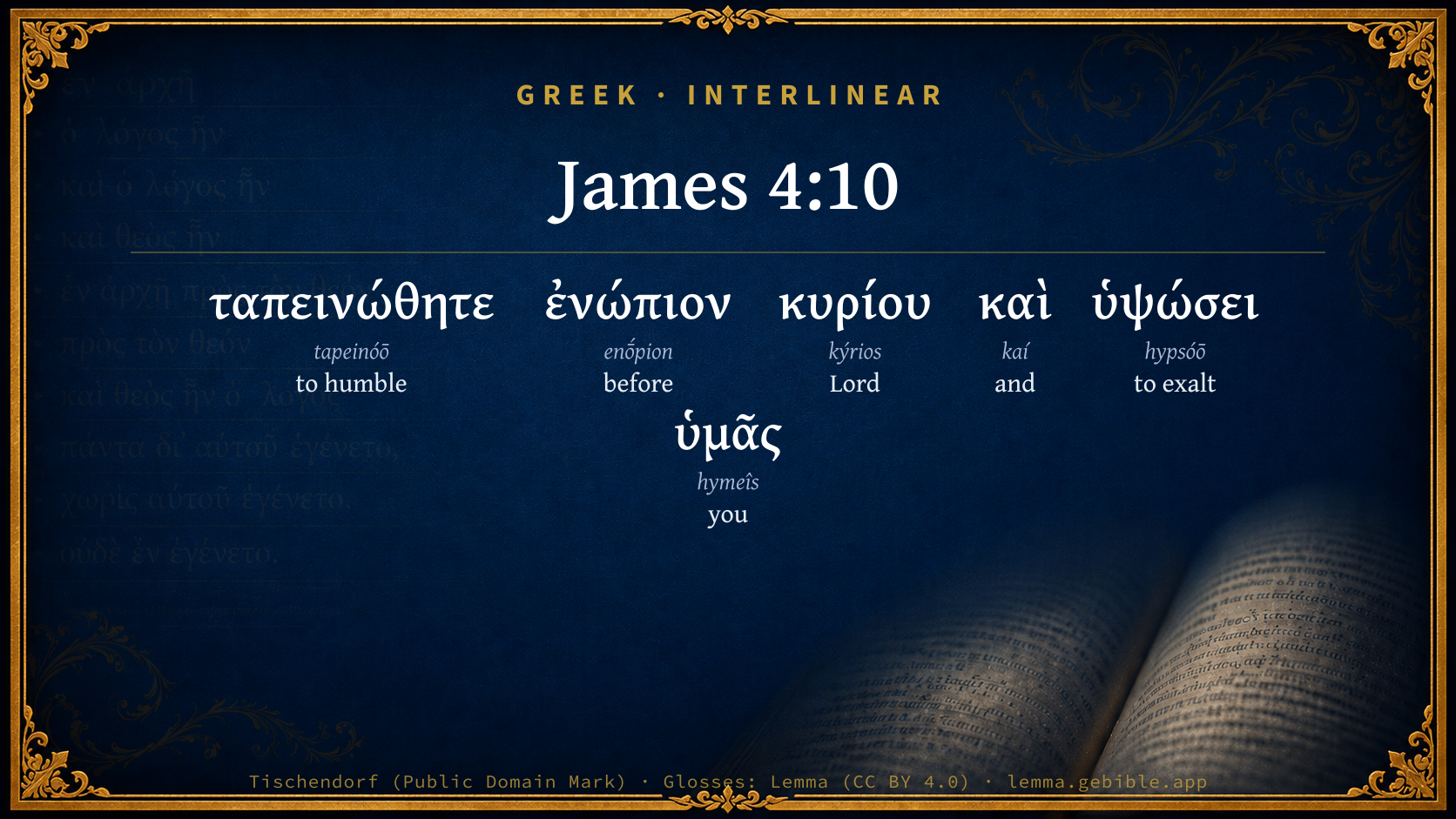
  1. ἐνώπιον enṓpion G1799 “before” Adverb
  2. κυρίου kýrios G2962 “Lord” Noun, Genitive, Singular, Masculine
  3. καὶ kaí G2532 “and” Conjunction
  4. ὑψώσει hypsóō G5312 “to exalt” Verb, Future, Active, Indicative, 3rd person, Singular
  5. ὑμᾶς hymeîs G5210 “you” Personal pronoun, 2nd person, Accusative, Plural

About this verse

These counts appear in no published source. They are computed here, from the morphology-tagged text and Lemma’s own curated glosses. What Lemma adds →

6
words
6
distinct lemmas
General Epistles
section

Notable vocabulary

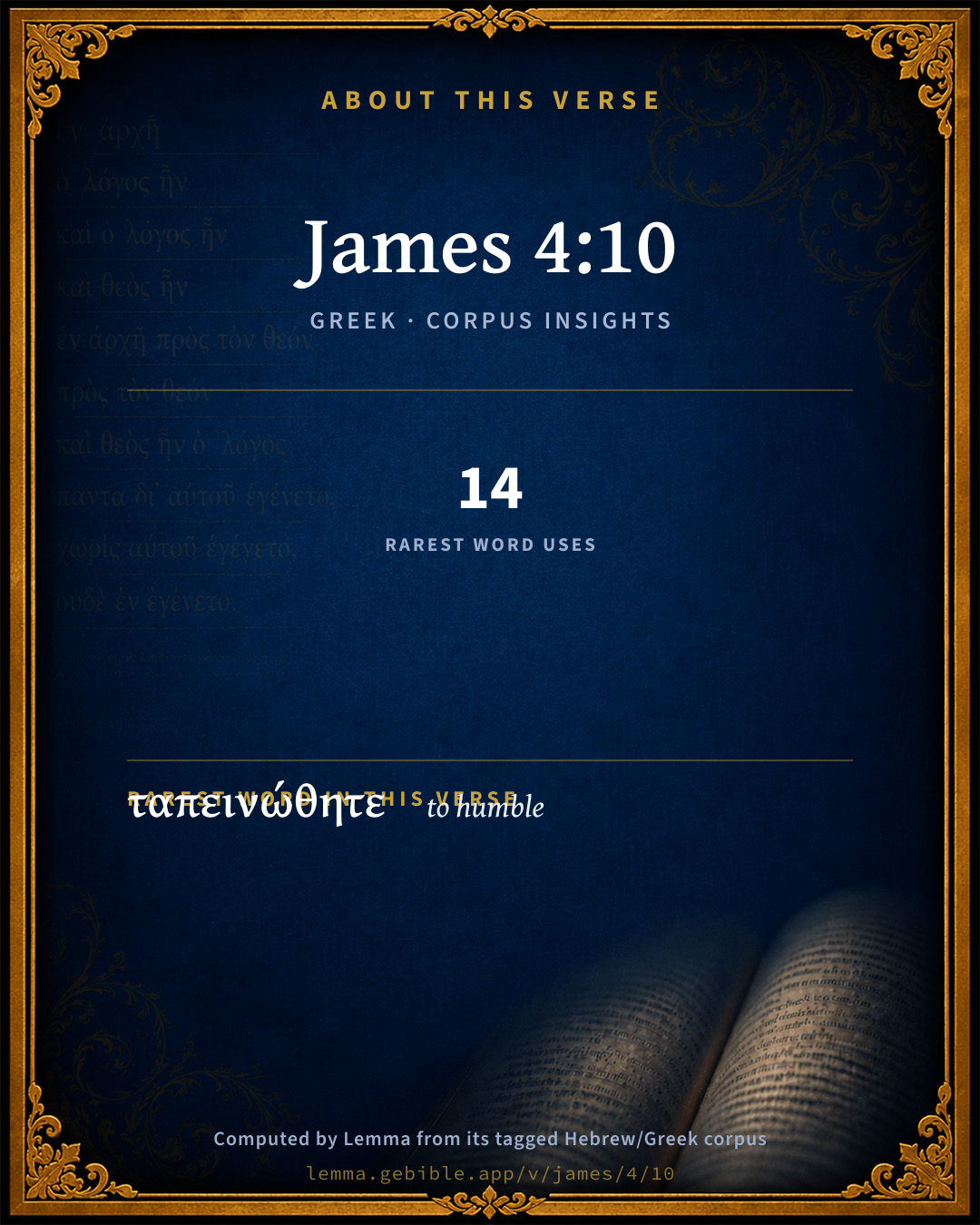
The rarest word here is ταπεινώθητε to humble G5013 — appearing just 14 times in the whole Greek New Testament.

Shared distinctive vocabulary

ταπεινώθητε to humble G5013 occurs in 11 verses of the Greek New Testament. Also found in:

Cross-references

13

Topical passages linked to James 4:10 in the Treasury of Scripture Knowledge — connected by theme and wording, ordered by reader-vote popularity; previews shown in the World English Bible.

  • Psalms 147:6 Yahweh upholds the humble. He brings the wicked down to the ground.
  • Matthew 23:12 Whoever exalts himself will be humbled, and whoever humbles himself will be exalted.
  • 1 Peter 5:6 Humble yourselves therefore under the mighty hand of God, that he may exalt you in due time;
  • Luke 14:11 For everyone who exalts himself will be humbled, and whoever humbles himself will be exalted."
  • James 4:6–7 But he gives more grace. Therefore it says, "God resists the proud, but gives grace to the humble."
  • Job 22:29 When they cast down, you shall say, 'be lifted up.' He will save the humble person.
  • Psalms 113:7 He raises up the poor out of the dust. Lifts up the needy from the ash heap;
  • Luke 1:52 He has put down princes from their thrones. And has exalted the lowly.
  • 1 Samuel 2:9 He will keep the feet of his holy ones; But the wicked shall be put to silence in darkness; For by strength shall no man prevail.
  • Luke 18:14 I tell you, this man went down to his house justified rather than the other; for everyone who exalts himself will be humbled, but he who humbles himself will be exalted."
  • Psalms 30:1 I will extol you, Yahweh, for you have raised me up, And have not made my foes to rejoice over me.
  • Psalms 27:6 Now my head will be lifted up above my enemies around me. I will offer sacrifices of joy in his tent. I will sing, yes, I will sing praises to Yahweh.
  • Psalms 28:9 Save your people, And bless your inheritance. Be their shepherd also, And bear them up forever.

Cross-references courtesy of OpenBible.info (CC BY 4.0).

Commentary

Notes on James 4:10 from classic Christian and Jewish commentators (each source and its license shown beneath its notes). The classic Christian expositions comment on the surrounding passage and are grouped to its opening verse, so a note may address several verses; the Jewish commentaries on the Tanakh (Rashi and others) are per-verse, so they appear only where the commentator wrote on this verse.

Lemma curates 59 commentaries, every one of them public domain or Creative Commons licensed, each selected and text-cleaned for this edition rather than reprinted as found. About our sources →

Tyndale Open Study Notes

Tyndale Open Resources

4:10 To those who humble themselves before him, God gives honor in place of the shame of their persecution and oppression (Jas 2:6-7).

Tyndale Open Study Notes — © Tyndale Open Resources, licensed CC BY-SA 4.0. Text via the HelloAO Bible API.

Meyer's Critical & Exegetical Commentary

Heinrich August Wilhelm Meyer

Jam_4:10. Conclusioncarrying with it an O. T. colouringof the exhortation, in which what has hitherto been said is summed up.

ταπεινώθητε ἐνώπιον κυρίου] ταπεινώθητε in reference to ταπεινοῖς κ.τ.λ., Jam_4:6.

κυρίου] i.e. Θεοῦ (comp. Jam_4:7), not Χριστοῦ (Grotius).

ἐνώπιον] not = ὑπό, 1Pe_5:6 : ταπεινώθητε ὑπὸ τὴν … χεῖρα τοῦ Θεοῦ, but expresses that the self-abasement is to take place in consciousness of the presence of God, who gives grace only to the humble; comp. Sir_2:17 : οἳ φοβούμενοι κύριον … ἐνώπιον αὐτοῦ ταπεινώσουσι τὰς ψυχὰς αὐτῶν.

καὶ ὑψώσει ὑμᾶς] is to be referred both to the present concealed and to the future manifested glory of the humble Christian (comp. chap. Jam_1:9). The contrasted ideas ταπεινοῦν and ὑψοῦν often occur; see in the O. T. Job_5:11; Eze_21:26; in the N. T. Mat_23:12; Luk_14:11; 1Pe_5:6, and other places.

Meyer — Critical and Exegetical Commentary on the New Testament — English translation by Peter Christie, edited by Frederick Crombie (T&T Clark, 1880) — public domain. Text from a community e-Sword module.

Jamieson, Fausset & Brown

Robert Jamieson, A. R. Fausset & David Brown

in the sight of the Lord--as continually in the presence of Him who alone is worthy to be exalted: recognizing His presence in all your ways, the truest incentive to humility. The tree, to grow upwards, must strike its roots deep downwards; so man, to be exalted, must have his mind deep-rooted in humility. In Pe1 5:6, it is, Humble yourselves under the mighty hand of God, namely, in His dealings of Providence: a distinct thought from that here.

lift you up--in part in this world, fully in the world to come.

Jamieson, Fausset & Brown — Commentary Critical and Explanatory on the Whole Bible (1871) — public domain (CC PDM 1.0). Text via the HelloAO Bible API.

Adam Clarke's Commentary

Verse 10. Humble yourselves in the sight of the Lord] In Jas 4:7 they were exhorted to submit to God; here they are exhorted to humble themselves in his sight. Submission to God's authority will precede humiliation of soul, and genuine repentance is performed as in the sight of God; for when a sinner is truly awakened to a sense of his guilt and danger, he seems to see, whithersoever he turns, the face of a justly incensed God turned against him.

He shall lift you up.] Mourners and penitents lay on the ground, and rolled themselves in the dust. When comforted and pardoned, they arose from the earth, shook themselves from the dust, and clothed themselves in their better garments. God promises to raise these from the dust, when sufficiently humbled.

Adam Clarke's Commentary on the Bible (1810–1826) — public domain. Text from a community e-Sword/MySword module.

John Calvin's Commentaries

10 Humble yourselves, or, be ye humbled. The conclusion of what is gone before is, that the grace of God then be ready to raise us up when he sees that our proud spirits are laid aside. We emulate and envy, because we desire to be eminent. This is a way wholly unreasonable, for it is God’s peculiar work to raise up the lowly, and especially those who willingly humble themselves. Whosoever, then, seeks a firm elevation, let him be cast down under a sense of his own infirmity, and think humbly of himself. Augustine well observes somewhere, As a tree must strike deep roots downwards, that it may grow upwards, so every one who has not his soul fixed deep in humility, exalts himself to his own ruin.

John Calvin's Commentaries (1540-1563) — public domain. Text from the Calvin Translation Society English edition (1840s-50s) via the Christian Classics Ethereal Library (ccel.org). Calvin's coverage is partial (roughly two-thirds of the Bible); uncommented books and verses are honest gaps, never fabricated. The 19th-century editor's footnotes and remarks are omitted so the notes are faithfully Calvin's own voice.

Ellicott's Commentary for English Readers

(10) Humble yourselves . . .—Read, Humble yourselves therefore before the Lord, and He shall lift you up. “For thus saith the high and lofty One” (Isa_57:15), “I dwell in the high and holy place, with him also that is of a contrite and humble spirit, to revive the spirit of the humble, and to revive the heart of the contrite.” (Comp. 1Pe_5:6.) “God,” says Thomas à Kempis, “protects the humble and delivers him; He loves and consoles him; He inclines Himself towards the humble man, He bestows on him exceeding grace, and after his humiliation He lifts him up to glory; He reveals his secrets to the humble, and sweetly draws and leads him to Himself.”

A Bible Commentary for English Readers, edited by Charles John Ellicott (1878–1897) — public domain. Text from a community e-Sword module.

The Cambridge Bible for Schools and Colleges

gen. ed. J. J. S. Perowne

10. Humble yourselves in the sight of the Lord, and he shall lift you up] Better, he shall exalt, so as to preserve the manifest allusion to our Lord’s words as recorded in Mat_23:12; Luk_14:12; Luk_18:14. Here again we have another striking parallel with St Peter’s language (1Pe_5:6). There is, however, a difference as well as an agreement to be noticed. While the other passages speak mainly of humility in its relation to man, this dwells emphatically on its being manifested in relation to God.

The Cambridge Bible for Schools and Colleges (gen. ed. J. J. S. Perowne; Cambridge University Press, 1878–1918) — public domain. Text from a community e-Sword module.

John Gill's Exposition

Humble yourselves in the sight of the Lord,.... Which is done, when men, before the Lord, and from their hearts, and in the sincerity of their souls, acknowledge their meanness and unworthiness, their vileness, sinfulness, and wretchedness, and implore the grace and mercy of God in Christ, as did Abraham, Jacob, Job, Isaiah, Paul, and the publican; and when they walk humbly with God, acknowledging they can do nothing without him; owning their dependence on his grace, and ascribing all they have, and are, unto it:

and he shall lift you up; this is God's usual way to lift up the meek, and exalt those that humble themselves; he lifts them from the dunghill, to set them among princes; he gives them a place, and a name in his house, better than sons and daughters; he adorns them with his grace; he clothes them with the righteousness of his Son, he grants them nearness to himself; and at last will introduce them into his kingdom and glory.

John Gill's Exposition of the Whole Bible (1746–1763) — public domain (CC PDM 1.0). Text via the HelloAO Bible API.

Trapp's Complete Commentary

John Trapp

10 Humble yourselves in the sight of the Lord, and he shall lift you up.

Ver. 10. Humble yourselves] He beats often upon this most needful but much neglected duty of humiliation, and all is little enough; there being nothing that more goes against the heart and the hair with us, than to go downward; and yet it must be done, or we are undone.

And he shall lift you up] The Lion of Judah rends not the prostrate prey. But as William the Conqueror ever held submission satisfactory for the greatest offences, and often received rebels into grace (Daniel’s Chron.), so doth Christ much more. The sun in the morning gathereth clouds, but then it soon scattereth them again; so doth the Sun of righteousness cast men down, that he may raise them up again.

" Deiecit ut relevet, premit ut solatia praestet,

Enecat ut possit vivificare Deus."

John Trapp, A Commentary or Exposition upon All the Books of the Old and New Testament (1647–1656) — public domain. Text from a community e-Sword module.

Albert Barnes' Notes on the Bible

Humble yourselves in the sight of the Lord - Compare Mat 23:12. See the notes at Jam 4:6. That is, be willing to take your appropriate place in the dust on account of your transgressions. This is to be “in the sight of the Lord,” or before him. Our sins have been committed against him; and their principal aggravation, whoever may have been wronged by them, and great as is their criminality in other respects, arises from that consideration. Psa 51:4, “against thee, thee only, have I sinned, and done this evil in thy sight.” Luk 15:18, “I will arise and go to my father, and will say to him, Father, I have sinned against heaven, and before thee.” As the Being against whom we have sinned is the only one who can pardon, it is proper that we should humble ourselves before him with penitent confession.

And he shall lift you up - He will exalt you from the condition of a broken-hearted penitent to that of a forgiven child; will wipe away your tears, remove the sadness of your heart, fill you with joy, and clothe you with the garments of salvation. This declaration is in accordance with all the promises in the Bible, and with all the facts which occur on the earth, that God is willing to show mercy to the humble and contrite, and to receive those who are truly penitent into his favor. Compare Luk 15:22.

Albert Barnes' Notes on the Bible (1834–1885) — public domain. Text from a community e-Sword/MySword module.

Matthew Poole's English Annotations

Humble yourselves: the same duty pressed again, only with respect to the more internal part of it, the debasement of the heart, lest they should rest too much in the outward exercises before mentioned. They did lift up themselves through pride and emulation, and he shows them the best way to the truest exaltation, viz. humility, Mat 23:12; Pro 15:33; 18:12.

In the sight of the Lord; sincerely, as in the presence of the Searcher of hearts.

And he shall lift you up; as to your outward state and enjoyments, so far as God sees good for you; but, however, in grace here, and glory hereafter, Luk 14:11.

Matthew Poole's English Annotations on the Holy Bible (1683–1685) — public domain. Text from a community e-Sword/MySword module.

Whedon's Commentary on the Bible

Daniel D. Whedon

10. Humble yourselves… lift you up—To pardon, holiness, and heaven.

Daniel D. Whedon (gen. ed.), Commentary on the Old and New Testaments (1874–1909) — public domain. Text from a community e-Sword module.

The Pulpit Commentary

Humble yourselves, etc. A further parallel with our Lord"s teaching, St. James"s words being perhaps suggested by the saying recorded in Mat_23:12, "Whosoever shall humble himself shall be exalted" (uJywqhsetai, as here, "He shall lift you up," uJywsei). In the sight of the Lord (ejnwpion). The article (tou) in the Received Text is certainly wrong. It is wanting in a, A, B, K. The anarthrous Kuriov is used by St. James here and in Jam_5:4, 10 (with which contrast ver. 14), and 1 l, as equivalent to the "Jehovah" of the Old Testament, which is represented in the LXX by Kuriov without the article.

Humble yourselves in the sight of God, and he shall lift you up.

"As a tree must strike root deep downwards that it may grow upwards, so a man"s spirit must be rooted in humility, or he is only lifted up to his own hurt" (Augustine).

The Pulpit Commentary (1880–1919), ed. H.D.M. Spence-Jones & Joseph S. Exell — public domain. Text from a community e-Sword module.

The People's New Testament

B. W. Johnson

10. Humble yourselves. “He that humbleth himself shall be exalted” (Matt. 23:12).

B. W. Johnson's The People's New Testament with Notes (1889–1891) — public domain. Electronic text from the Christian Classics Ethereal Library (CCEL) ThML edition.

Cambridge Greek Testament for Schools and Colleges

10. ταπεινώθητε, passive form with middle sense. See Monro, Hom. Grammar, § 44, where it is shewn that aorists in -ην and -θην had originally an intransitive sense of which the passive sense was a growth or adaptation. Comp. ἐχάρην, ἐδυνάσθην, ἀπεκρίθην.

Cambridge Greek Testament for Schools and Colleges (Cambridge University Press, 1896; 21 vols, various authors incl. Carr, Maclear, Plummer, Farrar, Lumby, Moule, M. R. James, Simcox) — public domain. Text from a community e-Sword module.

Alford’s Greek Testament

Henry Alford

10.] Conclusion of the exhortation: the true way to exaltation, through humility. Calvin quotes from Augustine, “Sicuti arborem, ut sursum crescat, profundas subtus radices agere oportet, ita quisquis in humilitatis radice fixum animum non habet, in ruinam suam extollitur.” Be humbled before the Lord (ref. Matt. and 1Pe 5:6: but ὑπὸ τὴν χεῖρα τοῦ θεοῦ there is not = ἐνώπιον κυρίου here. This latter gives more the realization in the soul of the presence of God, as drawing near to Him in humility: that, the subjection to Him in recognition of His providence and His judgments. κυρίου, not Christ, but the Father: see on ch. 1:7), and He shall exalt you (both here and hereafter: by His grace and counsel here (not exactly as Grot., who is too external throughout this passage, “Sublimes facie donis suis”) to the hidden glory of His waiting children, and by His fruition and presence hereafter (ἐν καιρῷ as 1Pe 5:6) to the ineffable glory of His manifested children. Cf. besides reff. Luk 1:52: Job 5:11: Eze 21:26).

11,

Henry Alford, The Greek Testament (1849–1861) — public domain. Text from a community e-Sword module.

International Critical Commentary

10. ταπεινώθητε “humble yourselves.” James here returns to the starting-point of his exhortation (v. 6 ταπεινοῖς), and sums up in ταπεινώθητε the several acts directed in vv. 7-9. This act implies single-hearted faith, and such a soul has a sure reward from God, cf. 1:9. See references in Lex.. s. v. ταπεινοφροσύνη, and cf. Ecclus. 2:17 οἱ φοβούμενοι κύριον … ἐνώπιον αὐτοῦ ταπεινώσουσιν τὰς ψυχὰς αὐτῶν, 3:18, 7:17. ταπεινόω means “to confess and deplore one’s spiritual littleness and unworthiness” (Lex.).

On the use of the passive aorist, cf. note on ὑποτάγητε, v. 7.

ἐνώπιον κυρίου. κυρίου here means God; cf. vv. 6, 7, 8.

ὑψώσει, i. e. morally and spiritually, by his presence (vv. 6, 7, 8 and 1:9); and in the glory of eternal life (1:12, 5:8); cf. Luk 1:52, Mat 23:12, Luk 14:11, Luk 14:18:14, 2Co 11:7 ἐμαυτὸν ταπεινῶν ἵνα ὑμεῖς ὑψωθῆτε.

1Pe 5:6 bears close resemblance in form, and is noticeable because of the complicated resemblance of the context in Jam_4 and 1Pe_5. But the meaning is different. Here in James it is a humbling of the soul before God, with repentance, and is in contrast to ὑπερηφανία. 1 Peter is exhorting to a spirit of submissiveness to God (τὴν κραταιὰν χεῖρα τοῦ θεοῦ), even when his providence appears in the hardships of persecution (v. 7 τὴν μέριμναν ὑμῶν ἐπιρίψαντες ἐπʼ αὐτόν), cf. also 1Pe 1:10, 1Pe 3:17, 1Pe 4:12 ff.

International Critical Commentary — older volumes (1896–1929), various authors — public domain. Text from a community e-Sword module.

Lesson kit

Teaching starters — assembled from the data on this page, not authored interpretation. Every prompt links to the verse data it draws on. Edit before teaching.

James, in the General Epistles, opens this verse with 6 words (6 distinct Greek lemmas). Its most distinctive word is tapeinóō (“to humble”). A historical commentator’s framing appears above. Read the whole chapter for the surrounding context.

Discussion questions

  1. What does “to humble” (tapeinóō) contribute to the verse as a whole?
  2. How does Matthew 18:4, which shares the word «to humble», read alongside this verse?
  3. The translations on this page render this verse differently — a whole-verse word diff, not a word-by-word alignment. What might account for the different wordings?
  4. Compare how Tyndale Open Study Notes and Meyer's Critical & Exegetical Commentary read this verse. Where do they agree or differ?

Things to notice

Reading settings

Reading text

Shown beneath each verse's original-language words.

Old Testament
Old Testament edition

Read the OT as the Masoretic Hebrew (MT) or the Greek Septuagint (LXX).

English shown for the Greek Septuagint (in the Hebrew ↔ Greek comparison).

Comparing translations? Open the Compare panel on any verse page to stack up to four side by side.