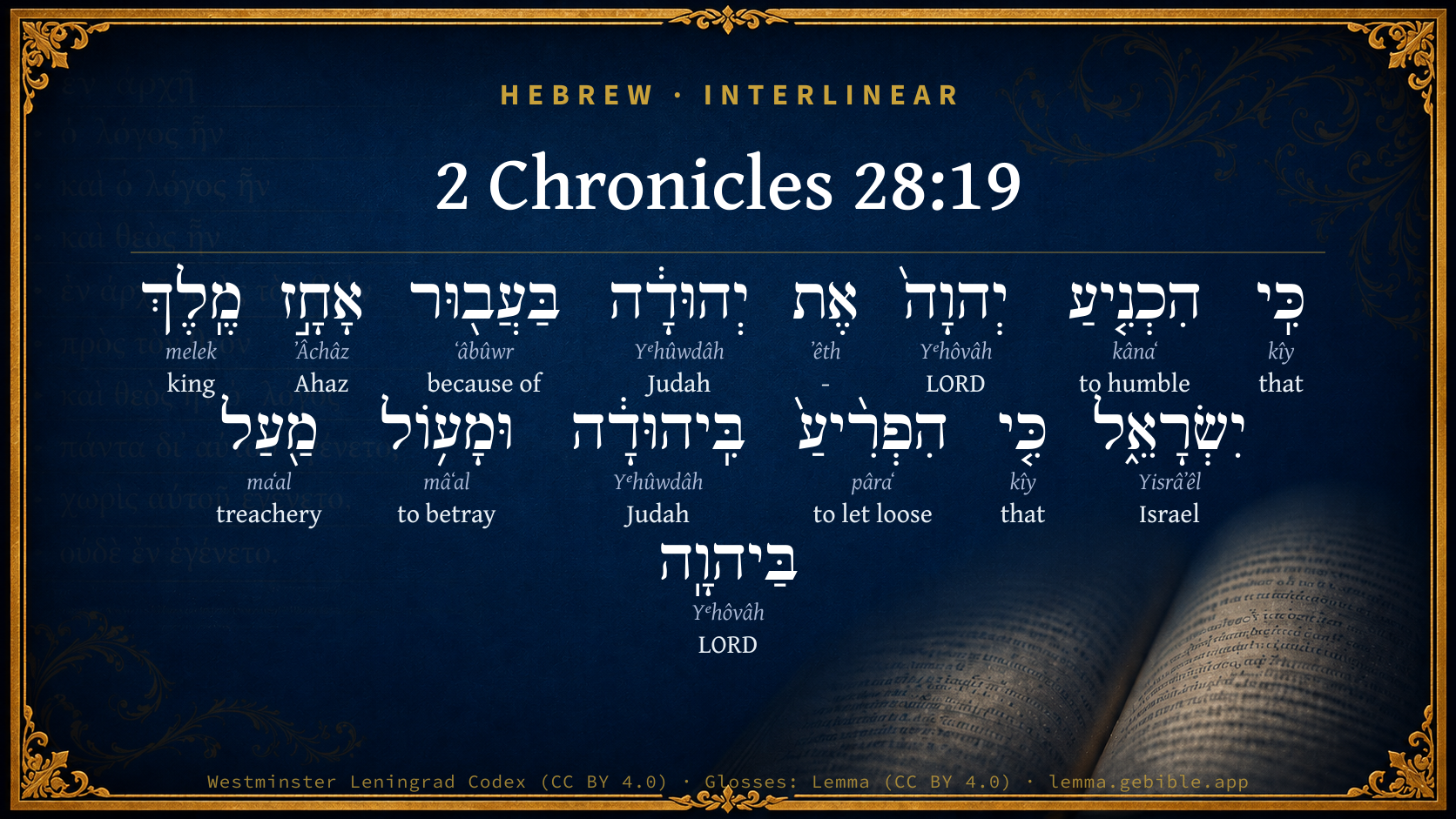
2 Chronicles 28:19

Hebrew (Westminster Leningrad Codex) 2 Chronicles 28:19 appears in the Hebrew Old Testament. The text above is from the Westminster Leningrad Codex. Each word links to its Strong’s number, a concise gloss, and parsing drawn from the Open Scriptures Hebrew Bible morphology. Click any word for its full Brown-Driver-Briggs (BDB) entry.
Download image
Cite this verse

2 Chronicles 28:19 (World English Bible). Public Domain. Lemma interlinear Bible study tool, https://lemma.gebible.app/v/2-chronicles/28/19.

Show BibTeX & RIS
BibTeX
RIS
English Translation
For Yahweh brought Judah low because of Ahaz king of Israel; for he had dealt wantonly in Judah, and trespassed severely against Yahweh.
World English Bible · Public Domain
Download a study sheet

One document with this verse’s original text, its word-by-word gloss line, the meaning frame, cross-references with their text, attributed commentary, and full source and license credits — printable, and it pastes into notes with its structure intact.

This verse Autodidact and up

Study sheet (.html) Plain text (.txt)

A passage Seminary Student

Up to 50 verses in one chapter. A passage sheet keeps up to 6 commentary sources and 12 cross-references per verse, in the order this page ranks them, and says so on the sheet whenever that leaves anything out. Ask for a single verse and you get the Autodidact verse sheet above.

Everything on this page stays free to read, with no account — the sheet is a download of what is already on screen, not access to it.

Want to remove ads? Support Godless Engineer
Compare translations 3

The same verse in 3 English versions, stacked beneath the original-language interlinear above. Click any original word for its lexicon entry.

Each is an independent rendering of the whole verse — the interlinear is not word-aligned to these translations.

Highlighted words mark where these versions differ — a whole-verse word diff, not a word-by-word alignment.

  • World English Bible Public Domain
    For Yahweh brought Judah low because of Ahaz king of Israel; for he had dealt wantonly in Judah, and trespassed severely against Yahweh.
  • King James Version Public Domain
    For the LORD brought Judah low because of Ahaz king of Israel; for he made Judah naked, and transgressed sore against the LORD.
  • unfoldingWord Literal Text CC BY-SA 4.0
    For Yahweh humbled Judah because of Ahaz, the king of Israel; for he caused to break loose in Judah and to act faithlessly in faithlessness against Yahweh.

unfoldingWord Literal Text — © unfoldingWord, licensed CC BY-SA 4.0. Word-aligned USFM3 via Door43 (git.door43.org/unfoldingWord/en_ult).

Versions to compare (up to 4)

3 of 4 selected

Show all 18 translations

Every available English version of this verse, each an independent rendering of the whole verse.

  • World English Bible Public Domain
    For Yahweh brought Judah low because of Ahaz king of Israel; for he had dealt wantonly in Judah, and trespassed severely against Yahweh.
  • Berean Standard Bible Public Domain
    For the LORD humbled Judah because Ahaz king of Israel had thrown off restraint in Judah and had been most unfaithful to the LORD.
  • Majority Standard Bible Public Domain
    For the LORD humbled Judah because Ahaz king of Israel had thrown off restraint in Judah and had been most unfaithful to the LORD.
  • King James Version Public Domain
    For the LORD brought Judah low because of Ahaz king of Israel; for he made Judah naked, and transgressed sore against the LORD.
  • American Standard Version (1901) Public Domain
    For Jehovah brought Judah low because of Ahaz king of Israel; for he had dealt wantonly in Judah, and trespassed sore against Jehovah.
  • Revised Version (1885) Public Domain
    For the LORD brought Judah low because of Ahaz king of Israel; for he had dealt wantonly in Judah, and trespassed sore against the LORD.
  • Geneva Bible (1599) Public Domain
    For the Lord had humbled Iudah, because of Ahaz King of Israel: for he had brought vengeance vpon Iudah, and had grieuously transgressed against the Lord)
  • Douay-Rheims (1899) Public Domain
    For the Lord had humbled Juda because of Achaz the king of Juda, for he had stripped it of help, and had contemned the Lord.
  • Young's Literal Translation Public Domain
    for Jehovah hath humbled Judah because of Ahaz king of Israel, for he made free with Judah, even to commit a trespass against Jehovah.
  • Literal Standard Version CC BY-SA 4.0
    for YHWH has humbled Judah because of Ahaz king of Israel, for he made free with Judah, even to commit a trespass against YHWH.
  • Unlocked Literal Bible CC BY-SA 4.0
    For Yahweh brought Judah low because of Ahaz, king of Israel; for he had acted wickedly in Judah and had sinned against Yahweh very heavily.
  • unfoldingWord Literal Text CC BY-SA 4.0
    For Yahweh humbled Judah because of Ahaz, the king of Israel; for he caused to break loose in Judah and to act faithlessly in faithlessness against Yahweh.
  • Darby Bible Public Domain
    For Jehovah humbled Judah because of Ahaz king of Israel, for he had made Judah lawless, and transgressed much against Jehovah.
  • World Messianic Bible Public Domain
    For the LORD brought Judah low because of Ahaz king of Israel, because he acted without restraint in Judah and trespassed severely against the LORD.
  • Webster's Bible Public Domain
    For the LORD brought Judah low because of Ahaz king of Israel: for he made Judah naked, and greatly transgressed against the LORD.
  • Free Bible Version CC BY-SA 4.0
    The Lord had brought Judah down because Ahaz, king of Israel, was out of control in Judah, sinning terribly against the Lord.
  • Bible in Basic English Public Domain
    For the Lord made Judah low, because of Ahaz, king of Israel; for he had given up all self-control in Judah, sinning greatly against the Lord.
  • JPS Tanakh (1917) Public Domain
    For the LORD brought Judah low because of Ahaz king of Israel; for he had cast away restraint in Judah, and acted treacherously against the LORD.

Literal Standard Version (2020), Covenant Press — licensed CC BY-SA 4.0. Text via the HelloAO Bible API (eBible.org). Unlocked Literal Bible (unfoldingWord) — licensed CC BY-SA 4.0. Text via the HelloAO Bible API (eBible.org). unfoldingWord Literal Text — © unfoldingWord, licensed CC BY-SA 4.0. Word-aligned USFM3 via Door43 (git.door43.org/unfoldingWord/en_ult). Free Bible Version, Dr. Jonathan Gallagher — licensed CC BY-SA 4.0. Text via the HelloAO Bible API (eBible.org).

Word by word

More ways to search: Search by grammar → Find every occurrence → Compare this word →

Practice this passage: Drill this verse → Learn its vocabulary →

הִפְרִ֨יעַ֙
pâraʻ
H6544
“to let loose”
Verb, Hiphil, Perfect, 3rd Person, Masculine, Singular
Part of Speech
Verb
Stem
Hiphil
Form
Perfect
Person
3rd Person
Gender
Masculine
Number
Singular
Full BDB Definition

Origin: a primitive root

TWOT: 1822 , 1823 , 1824

to lead, act as leader - to let go, let loose, ignore, let alone - (Qal) - to let go, let loose - to let alone, avoid, neglect - to loosen - (Niphal) to be let loose, be loosened of restraint - (Hiphil) - to cause to refrain - to show lack of restraint - to let loose restraints
  1. כִּֽי kîy H3588 “that” Conjunction
  2. הִכְנִ֤יעַ kânaʻ H3665 “to humble” Verb, Hiphil, Perfect, 3rd Person, Masculine, Singular
  3. יְהוָה֙ Yᵉhôvâh H3068 “LORD” Noun, Proper
  4. אֶת ʼêth H853 “-” Particle, Direct Object
  5. יְהוּדָ֔ה Yᵉhûwdâh H3063 “Judah” Noun, Proper
  6. בַּעֲב֖וּר ʻâbûwr H5668 “in/at · because of of” Preposition + Noun, Common, Masculine, Singular, Construct
  7. אָחָ֣ז ʼÂchâz H271 “Ahaz” Noun, Proper
  8. מֶֽלֶךְ melek H4428 “king of” Noun, Common, Masculine, Singular, Construct
  9. יִשְׂרָאֵ֑ל Yisrâʼêl H3478 “Israel” Noun, Proper
  10. כִּ֤י kîy H3588 “that” Conjunction
  11. בִּֽיהוּדָ֔ה Yᵉhûwdâh H3063 “in/at · Judah” Preposition + Noun, Proper
  12. וּמָע֥וֹל mâʻal H4603 “and · to betray” Conjunction + Verb, Qal, Infinitive Absolute
  13. מַ֖עַל maʻal H4604 “treachery” Noun, Common, Masculine, Singular, Absolute
  14. בַּיהוָֽה Yᵉhôvâh H3068 “in/at · LORD” Preposition + Noun, Proper

About this verse

These counts appear in no published source. They are computed here, from the morphology-tagged text and Lemma’s own curated glosses. What Lemma adds →

15
words
12
distinct lemmas
Historical
section

Notable vocabulary

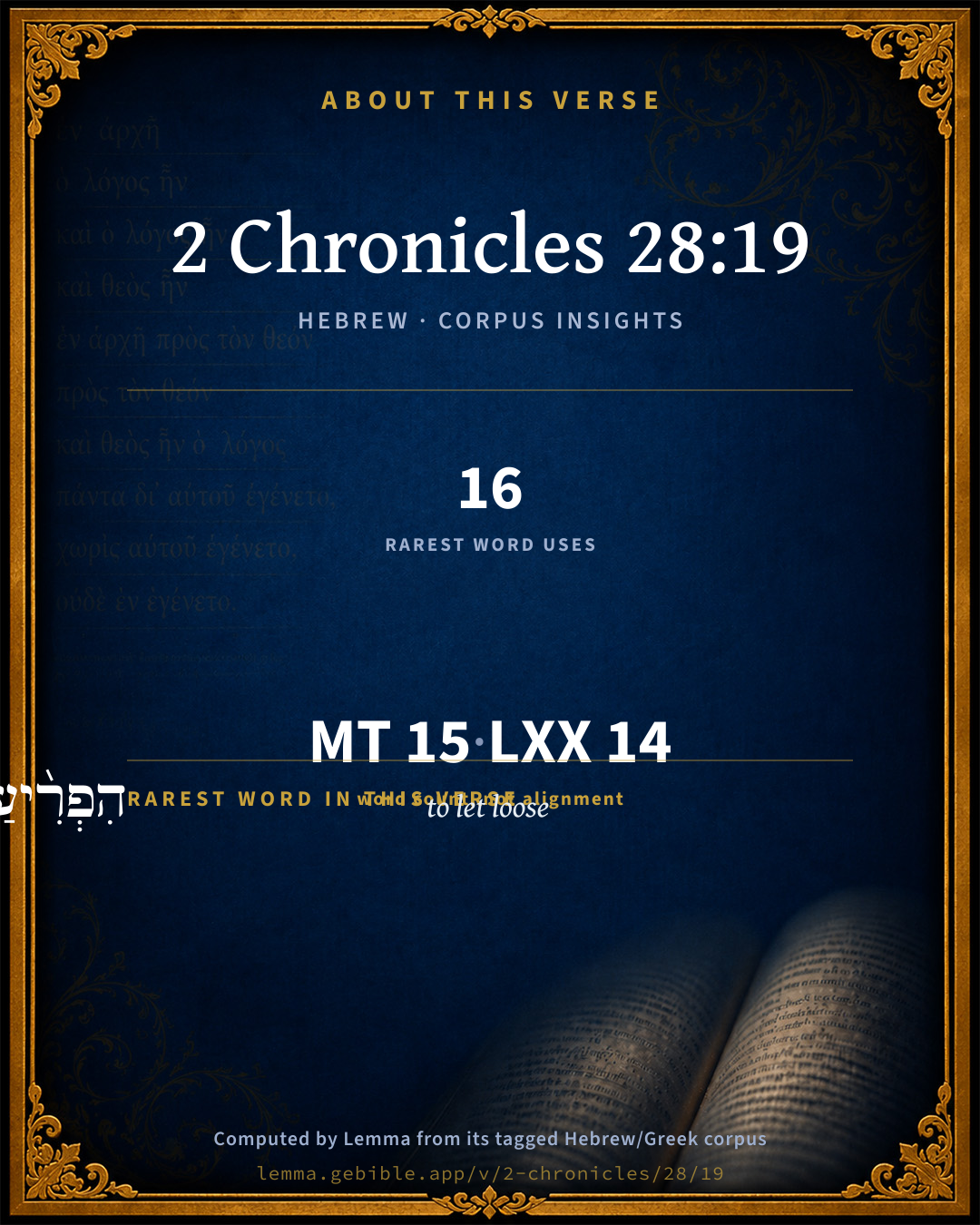
The rarest word here is הִפְרִ֨יעַ֙ to let loose H6544 — appearing just 16 times in the whole Hebrew Bible.

Shared distinctive vocabulary

הִפְרִ֨יעַ֙ to let loose H6544 occurs in 15 verses of the Hebrew Bible. Also found in:

Grammatical profile

  • 3 verbs
  • 9 nouns
  • 2 conjunctions
  • 1 particle

Verb forms

  • הִכְנִ֤יעַ Hiphil · Perfect
  • הִפְרִ֨יעַ֙ Hiphil · Perfect
  • וּמָע֥וֹל Qal · Infinitive Absolute

Repetition

Words recur within this verse — often emphatic in Hebrew:

  • יְהוָה֙ LORD H3068 ×2
  • יְהוּדָ֔ה Judah H3063 ×2
  • כִּֽי that H3588 ×2

Hebrew & Septuagint length

In English translation the verse runs 23 words from the Hebrew and 18 from the Septuagint (LXX English) — closely comparable.

A rough comparison of the two English renderings, which tokenize alike — not a word-level alignment.

Word counts can differ between the Hebrew and the Greek without any difference in meaning — e.g. the Hebrew direct-object marker אֵת has no separate Greek word, and Greek often adds the article ὁ.

In the original languages it is 15 Hebrew tokens and 14 Greek tokens — but the two are counted differently (Hebrew bundles its prefixes and suffixes into one token; the Greek is in lemma form), so that isn’t a like-for-like length.

Cross-references

13

Topical passages linked to 2 Chronicles 28:19 in the Treasury of Scripture Knowledge — connected by theme and wording, ordered by reader-vote popularity; previews shown in the World English Bible.

  • 2 Chronicles 21:2 He had brothers, the sons of Jehoshaphat: Azariah, and Jehiel, and Zechariah, and Azariah, and Michael, and Shephatiah; all these were the sons of Jehoshaphat king of Israel.
  • Job 40:12 Look on everyone who is proud, and humble him. Crush the wicked in their place.
  • Genesis 3:7 Both of their eyes were opened, and they knew that they were naked. They sewed fig leaves together, and made themselves aprons.
  • Genesis 3:11 God said, "Who told you that you were naked? Have you eaten from the tree that I commanded you not to eat from?"
  • Exodus 32:25 When Moses saw that the people had broken loose, (for Aaron had let them loose for a derision among their enemies),
  • Deuteronomy 28:43 The foreigner who is in the midst of you shall mount up above you higher and higher; and you shall come down lower and lower.
  • 1 Samuel 2:7 Yahweh makes poor, and makes rich: He brings low, he also lifts up.
  • Psalms 106:41–43 He gave them into the hand of the nations. Those who hated them ruled over them.
  • Proverbs 29:23 A man's pride brings him low, But one of lowly spirit gains honor.
  • Hosea 5:11 Ephraim is oppressed, He is crushed in judgment; Because he is intent in his pursuit of idols.
  • Micah 6:16 For the statutes of Omri are kept, And all the works of the house of Ahab. You walk in their counsels, That I may make you a ruin, And her inhabitants a hissing; And you will bear the reproach of my people."
  • Revelation 3:17–18 Because you say, 'I am rich, and have gotten riches, and have need of nothing;' and don't know that you are the wretched one, miserable, poor, blind, and naked;
  • Revelation 16:15 "Behold, I come like a thief. Blessed is he who watches, and keeps his clothes, so that he doesn't walk naked, and they see his shame."

Cross-references courtesy of OpenBible.info (CC BY 4.0).

Hebrew and Greek witnesses Masoretic Hebrew ↔ Greek Septuagint

The same verse in the two great witnesses to the Old Testament, shown verse-for-verse.

These are two independent witnesses, not word-aligned to each other, and the Septuagint is shown in lemma (dictionary) form.

Hebrew 2 Chronicles 28:19 Masoretic · Westminster Leningrad Codex

כִּֽי הִכְנִ֤יעַ יְהוָה֙ אֶת יְהוּדָ֔ה בַּעֲב֖וּר אָחָ֣ז מֶֽלֶךְ יִשְׂרָאֵ֑ל כִּ֤י הִפְרִ֨יעַ֙ בִּֽיהוּדָ֔ה וּמָע֥וֹל מַ֖עַל בַּיהוָֽה

For Yahweh brought Judah low because of Ahaz king of Israel; for he had dealt wantonly in Judah, and trespassed severely against Yahweh.

World English Bible · Public Domain

Greek LXX 2 Chronicles 28:19 Septuagint · lemma form

ὅτι ταπεινόω κύριος ὁ ἰούδας διά αχαζ βασιλεύς ἰουδά ὅτι ἀποἵστημι ἀπόστασις ἀπό κύριος

For the Lord humbled Juda because of Achaz king of Juda, because he grievously departed from the Lord.

LXX2012 (modern English Septuagint) · Public Domain

On this verse, Ellicott's Commentary for English Readers discusses the Septuagint’s reading. Read the note in Commentary ↓

Hebrew: Westminster Leningrad Codex (CC BY 4.0). Greek: Septuagint (public domain); English from LXX2012 (modern English Septuagint) (Public Domain). How the Septuagint differs from the Hebrew →

Commentary

Notes on 2 Chronicles 28:19 from classic Christian and Jewish commentators (each source and its license shown beneath its notes). The classic Christian expositions comment on the surrounding passage and are grouped to its opening verse, so a note may address several verses; the Jewish commentaries on the Tanakh (Rashi and others) are per-verse, so they appear only where the commentator wrote on this verse.

Lemma curates 59 commentaries, every one of them public domain or Creative Commons licensed, each selected and text-cleaned for this edition rather than reprinted as found. About our sources →

Trapp's Complete Commentary

John Trapp

2Ch 28:19 For the LORD brought Judah low because of Ahaz king of Israel; for he made Judah naked, and transgressed sore against the LORD.

Ver. 19. For he made Judah naked.] He stripped them of the sincere service of God - which is the beauty and bulwark of a nation - and might have been called, as our Henry III was, regni dilapidator, the kingdom’s bane and break-neck.

John Trapp, A Commentary or Exposition upon All the Books of the Old and New Testament (1647–1656) — public domain. Text from a community e-Sword module.

The Biblical Illustrator

Joseph S. Exell

2Ch_28:19

For the Lord brought Judah low because of Ahaz king of Israel.

The sin of Ahaz

I. I would draw attention to some special points in the history of ahaz.

1. The king himself was peculiarly the transgressor.

2. The people also were transgressors.

3. Mark the special sins enumerated in the history.

(1) There was idolatry.

(2) He substituted an altar of a strange pattern for the altar of the Lord God of hosts.

(3) He trusted in an arm of flesh (verses 16 and 21).

(4) He attempted to gain his object by conciliating the false gods and disparaging the true God.

4. Mark the consequences of all this: national desolation and ruin.

II. Let us see how far our present circumstances as a nation are parallel to those here presented.

III. Two practical questions.

1. What can be done with our rulers?

2. What can be done with our people? (J. C. Goodhart, M.A.)

The Biblical Illustrator, edited by Joseph S. Exell (c. 1880s–1900s) — public domain. Text from a community e-Sword module.

Geneva Bible (1599)

Geneva Bible translators

He meaneth Judah, because Ahaz forsook the Lord and sought help of the infidels. Read of Israel taken for Judah, 2 Chron. 15:17.

Geneva Bible (1599) marginal notes — public domain. Text via Bolls.life.

Ellicott's Commentary for English Readers

(19) Ahaz king of Israel.—Most commentators see an irony in this expression. But, as has been stated before, the southern kingdom was Israel in the chronicler’s idea; although that of the Ten Tribes was, politically speaking, as much more important, as the cedar of Lebanon was in comparison with the blackthorn growing beside it (2Ch_25:18. See Note on 2Ch_12:6; 2Ch_21:2). (Some Hebrew MSS., and all ancient versions, read “Judah.” Other Hebrew MSS. remark that in seven places “king of Judah” should be read instead of “king of Israel.”)

He made Judah naked.—Rather, he behaved loosely, dealt licentiously in Judah (hiphri’a). The verb is so used here only. (Comp. Exo_5:4, where it is transitive: “Why loose ye the people from their works?”) (LXX. omits, Authorised version follows the Vulg.)

Transgressed sore.—Done unfaithfulness (1Ch_10:13).

A Bible Commentary for English Readers, edited by Charles John Ellicott (1878–1897) — public domain. Text from a community e-Sword module.

The Cambridge Bible for Schools and Colleges

gen. ed. J. J. S. Perowne

19. king of Israel] Cp. 2Ch_11:3 (note).

he made Judah naked] R.V. he had dealt wantonly in Judah (mg. “cast away restraint”). Cp. Exo_32:25 (A.V. and R.V.) where the same Heb. verb is twice used.

The Cambridge Bible for Schools and Colleges (gen. ed. J. J. S. Perowne; Cambridge University Press, 1878–1918) — public domain. Text from a community e-Sword module.

John Gill's Exposition

For Ahaz took away a portion out of the house of the Lord, and out of the house of the king, and of the princes,.... A part out of the treasures of the temple, and a part out of his own treasures, and another which he levied upon his nobles:

and gave it unto the king of Assyria; sent it to him as a present, to engage him on his side, and assist him against his enemies, Kg2 16:10.

but he helped him not; See Gill on Ch2 28:20.

John Gill's Exposition of the Whole Bible (1746–1763) — public domain (CC PDM 1.0). Text via the HelloAO Bible API.

Albert Barnes' Notes on the Bible

Ahaz king of Israel - An instance of the lax use of the word “Israel” 2Ch 12:6; 2Ch 21:2. It is simply equivalent to “king of Judah.”

He made Judah naked - literally, “he had caused licentiousness in Judah” - i. e. he had allowed Judah to break loose from all restraints of true religion, and to turn to any idolatry that they preferred 2Ch 28:2-4. In this and in the following expression there is implied an apostasy resembling the unfaithfulness of a wife.

Albert Barnes' Notes on the Bible (1834–1885) — public domain. Text from a community e-Sword/MySword module.

Haydock's Catholic Bible Commentary

Of Juda. Heb. "Israel." But the Sept. have "Juda." H. --- The names are often used promiscuously. C. --- For he. Sept. "because he or it had apostatised from the Lord." --- Script. Prot. "he made Judah naked, and transgressed sore," &c. Thus were the idolatrous Israelites exposed to shame and misery, after they had adored the golden calf, Ex. xxxii. 25. H. --- In the Bacchanalian riots, the pagans threw off their garments, to shew that they trusted entirely in their false gods. T. --- Achaz had plunged his country in distress, (C.) both of soul and body, (H.) by his scandalous deportment. C. --- Of all help, is added by way of explanation; (T.) as God would no longer rescue his rebellious people from the hands of the enemy. H.

George Leo Haydock (1774–1849), Haydock's Catholic Family Bible and Commentary, 1859 edition — public domain. Excludes Psalms (Douay-Rheims chapter numbering differs from Protestant) and Deuterocanonical books (Catholic canon only).

Matthew Poole's English Annotations

He made Judah naked; taking away their ornament and their defence and strength, to wit, their treasures, which he sent to the Assyrian to no purpose; their frontier towns, and other strong holds, which by his folly and wickedness were lost; their religion, and the Divine protection, which was their great and only firm security, which by his sins he forfeited. See Poole "Exo 32:25".

Matthew Poole's English Annotations on the Holy Bible (1683–1685) — public domain. Text from a community e-Sword/MySword module.

The Pulpit Commentary

Ahaz King of Israel. So Jehoshaphat was called inriphi. 2Ch_21:2 "King of Israel. " If these two occasions are not merely cases of the writer"s or of a copyist"s easily imaginable mistake, they must be regarded as naming the king of the chief divided kingdom by the title of the whole kingdom or people. He made Judah naked; Revised Version, had dealt wantonly in Judah; or margin, Revised Version, had cast away restraint in Judah; Hebrew, y.

The Pulpit Commentary (1880–1919), ed. H.D.M. Spence-Jones & Joseph S. Exell — public domain. Text from a community e-Sword module.

John Wesley's Explanatory Notes

Low - As high as they were before in wealth and power. They that will not humble themselves under the word of God will be humbled by his judgments. Naked - Taking away their ornament and their defense and strength, namely their treasures, which he sent to the Assyrian to no purpose; their frontier towns, and other strong holds, which by his folly and wickedness were lost; their religion, and the Divine protection, which was their great and only firm security.

John Wesley, Explanatory Notes Upon the Whole Bible (1754–1765) — public domain. Text via the GEBible commentary corpus.

unfoldingWord translationNotes

Door43 World Missions Community

Yahweh brought Judah low because of Ahaz

The metonym "Judah" represents the people of Judah. Yahweh humiliating the people is spoken of as if he physically brought Judah low to the ground. AT: "Yahweh humiliated the people of Judah because of Ahaz" (See: Metonymy and Metaphor)

sinned against Yahweh very heavily

Ahaz sinning very much is spoken of as if sin were a very heavy object. AT: "sinned very greatly against Yahweh" (See: Metaphor)

Tiglath-Pileser

This is Tiglath-Pileser III, also known as Pul. (See: How to Translate Names)

troubled him instead of strengthening him

Helping Ahaz against his enemies is spoken of as if it were strengthening Ahaz. AT: "caused him trouble instead of helping him" (See: Metaphor)

translationWords

Yahweh

kingdom of Judah

Ahaz

kingdom of Israel

evil

sin

trouble

house of God

unfoldingWord translationNotes — © Distant Shores Media and the Door43 World Missions Community, licensed CC BY-SA 4.0. Source: git.door43.org/Door43/en_tn.

Rashi

Rabbi Shlomo Yitzchaki (Rashi)

for he exposed Judah - Heb. הִפְרִיעַ, similar to (Exod. 32:25): “for Aaron had exposed them (פְּרָעֹה) (Jud. 5:2): “When breaches are made (בִּפְרֹעַ פְּרָעוֹת).”

Rashi on the Tanakh — English translations: “The Judaica Press complete Tanach with Rashi, translated by A. J. Rosenberg” (CC BY 4.0); “Pentateuch with Rashi's commentary by M. Rosenbaum and A.M. Silbermann, 1929-1934” (public domain); “The Metsudah Tanach series, Lakewood, N.J” (CC BY 4.0); and “The Book of Joshua, Metsudah Publications, 1997” (CC BY 4.0). Text via Sefaria.

Lesson kit

Teaching starters — assembled from the data on this page, not authored interpretation. Every prompt links to the verse data it draws on. Edit before teaching.

2 Chronicles, in the Historical, opens this verse with 15 words (12 distinct Hebrew lemmas). Its most distinctive word is pâraʻ (“to let loose”). A historical commentator’s framing appears above. Read the whole chapter for the surrounding context.

Discussion questions

  1. The word pâraʻ carries the sense “to let loose.” How does it shape the verse?
  2. Exodus 5:4 shares the word «to let loose» with this verse. How do the two illuminate each other?
  3. “LORD” occurs 2× in this one verse. What is the effect of the repetition?
  4. These translations render this verse differently; the difference is in the English rendering, not the original. What questions does that raise?
  5. The verb «הִכְנִ֤יעַ» is Hiphil Perfect. How does its form color the action?
  6. Reading how Trapp's Complete Commentary and The Biblical Illustrator read this verse, where do the two commentators agree and where do they part?

Things to notice

Reading settings

Reading text

Shown beneath each verse's original-language words.

Old Testament
Old Testament edition

Read the OT as the Masoretic Hebrew (MT) or the Greek Septuagint (LXX).

English shown for the Greek Septuagint (in the Hebrew ↔ Greek comparison).

Comparing translations? Open the Compare panel on any verse page to stack up to four side by side.