
Job 24:9

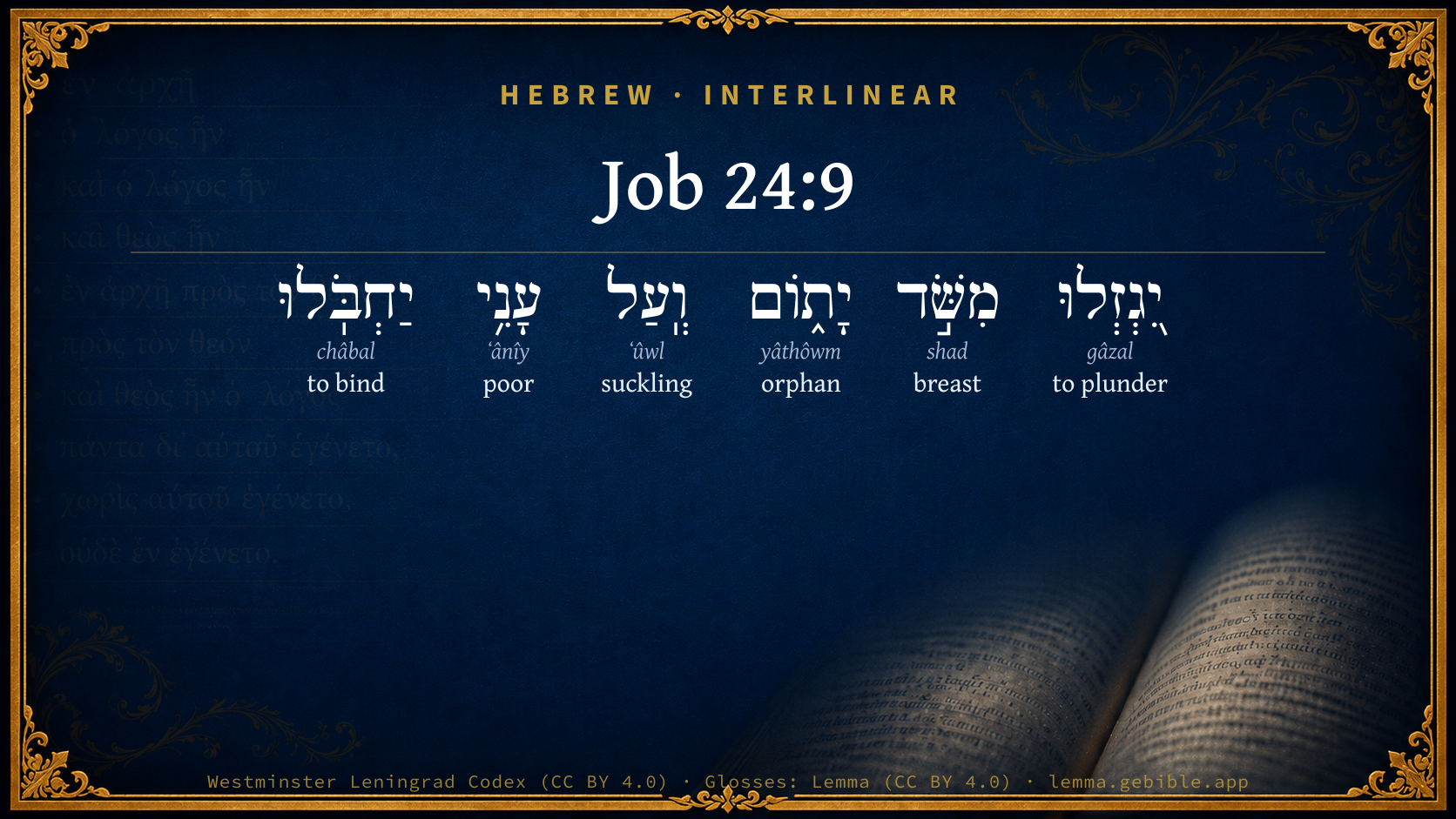
Hebrew (Westminster Leningrad Codex) Job 24:9 appears in the Hebrew Old Testament. The text above is from the Westminster Leningrad Codex. Each word links to its Strong’s number, a concise gloss, and parsing drawn from the Open Scriptures Hebrew Bible morphology. Click any word for its full Brown-Driver-Briggs (BDB) entry.
Download image
Cite this verse

Job 24:9 (World English Bible). Public Domain. Lemma interlinear Bible study tool, https://lemma.gebible.app/v/job/24/9.

Show BibTeX & RIS
BibTeX
RIS
English Translation
There are those who pluck the fatherless from the breast, And take a pledge of the poor,
World English Bible · Public Domain
Highlights
  • 1 first appearance in the Hebrew Bible
Full analysis ↓
Download a study sheet

One document with this verse’s original text, its word-by-word gloss line, the meaning frame, cross-references with their text, attributed commentary, and full source and license credits — printable, and it pastes into notes with its structure intact.

This verse Autodidact and up

Study sheet (.html) Plain text (.txt)

A passage Seminary Student

Up to 50 verses in one chapter. A passage sheet keeps up to 6 commentary sources and 12 cross-references per verse, in the order this page ranks them, and says so on the sheet whenever that leaves anything out. Ask for a single verse and you get the Autodidact verse sheet above.

Everything on this page stays free to read, with no account — the sheet is a download of what is already on screen, not access to it.

Want to remove ads? Support Godless Engineer
Compare translations 3

The same verse in 3 English versions, stacked beneath the original-language interlinear above. Click any original word for its lexicon entry.

Each is an independent rendering of the whole verse — the interlinear is not word-aligned to these translations.

Highlighted words mark where these versions differ — a whole-verse word diff, not a word-by-word alignment.

  • World English Bible Public Domain
    There are those who pluck the fatherless from the breast, And take a pledge of the poor,
  • King James Version Public Domain
    They pluck the fatherless from the breast, and take a pledge of the poor.
  • unfoldingWord Literal Text CC BY-SA 4.0
    They snatch the fatherless from the breast, and upon the poor they bind.

unfoldingWord Literal Text — © unfoldingWord, licensed CC BY-SA 4.0. Word-aligned USFM3 via Door43 (git.door43.org/unfoldingWord/en_ult).

Versions to compare (up to 4)

3 of 4 selected

Show all 18 translations

Every available English version of this verse, each an independent rendering of the whole verse.

  • World English Bible Public Domain
    There are those who pluck the fatherless from the breast, And take a pledge of the poor,
  • Berean Standard Bible Public Domain
    The fatherless infant is snatched from the breast; the nursing child of the poor is seized for a debt.
  • Majority Standard Bible Public Domain
    The fatherless infant is snatched from the breast; the nursing child of the poor is seized for a debt.
  • King James Version Public Domain
    They pluck the fatherless from the breast, and take a pledge of the poor.
  • American Standard Version (1901) Public Domain
    There are that pluck the fatherless from the breast, And take a pledge of the poor;
  • Revised Version (1885) Public Domain
    There are that pluck the fatherless from the breast, and take a pledge of the poor:
  • Geneva Bible (1599) Public Domain
    They plucke the fatherles from the breast, and take the pledge of the poore.
  • Douay-Rheims (1899) Public Domain
    They have violently robbed the fatherless, and stripped the poor common people.
  • Young's Literal Translation Public Domain
    They take violently away From the breast the orphan, And on the poor they lay a pledge.
  • Literal Standard Version CC BY-SA 4.0
    They take away violently || The orphan from the breast, || And they lay a pledge on the poor.
  • Unlocked Literal Bible CC BY-SA 4.0
    There are wicked people who pluck orphans from their mothers' breast, and wicked people who take children as security from poor people.
  • unfoldingWord Literal Text CC BY-SA 4.0
    They snatch the fatherless from the breast, and upon the poor they bind.
  • Darby Bible Public Domain
    They pluck the fatherless from the breast, and take a pledge of the poor:
  • World Messianic Bible Public Domain
    There are those who pluck the fatherless from the breast, and take a pledge of the poor,
  • Webster's Bible Public Domain
    They pluck the fatherless from the breast, and take a pledge of the poor.
  • Free Bible Version CC BY-SA 4.0
    Fatherless children are snatched from their mother's breasts, taking the babies of the poor as security for a debt.
  • Bible in Basic English Public Domain
    The child without a father is forced from its mother's breast, and they take the young children of the poor for debt.
  • JPS Tanakh (1917) Public Domain
    There are that pluck the fatherless from the breast, and take a pledge of the poor;

Literal Standard Version (2020), Covenant Press — licensed CC BY-SA 4.0. Text via the HelloAO Bible API (eBible.org). Unlocked Literal Bible (unfoldingWord) — licensed CC BY-SA 4.0. Text via the HelloAO Bible API (eBible.org). unfoldingWord Literal Text — © unfoldingWord, licensed CC BY-SA 4.0. Word-aligned USFM3 via Door43 (git.door43.org/unfoldingWord/en_ult). Free Bible Version, Dr. Jonathan Gallagher — licensed CC BY-SA 4.0. Text via the HelloAO Bible API (eBible.org).

Word by word

More ways to search: Search by grammar → Find every occurrence → Compare this word →

Practice this passage: Drill this verse → Learn its vocabulary →

About this verse

These counts appear in no published source. They are computed here, from the morphology-tagged text and Lemma’s own curated glosses. What Lemma adds →

6
words
6
distinct lemmas
Wisdom
section

Notable vocabulary

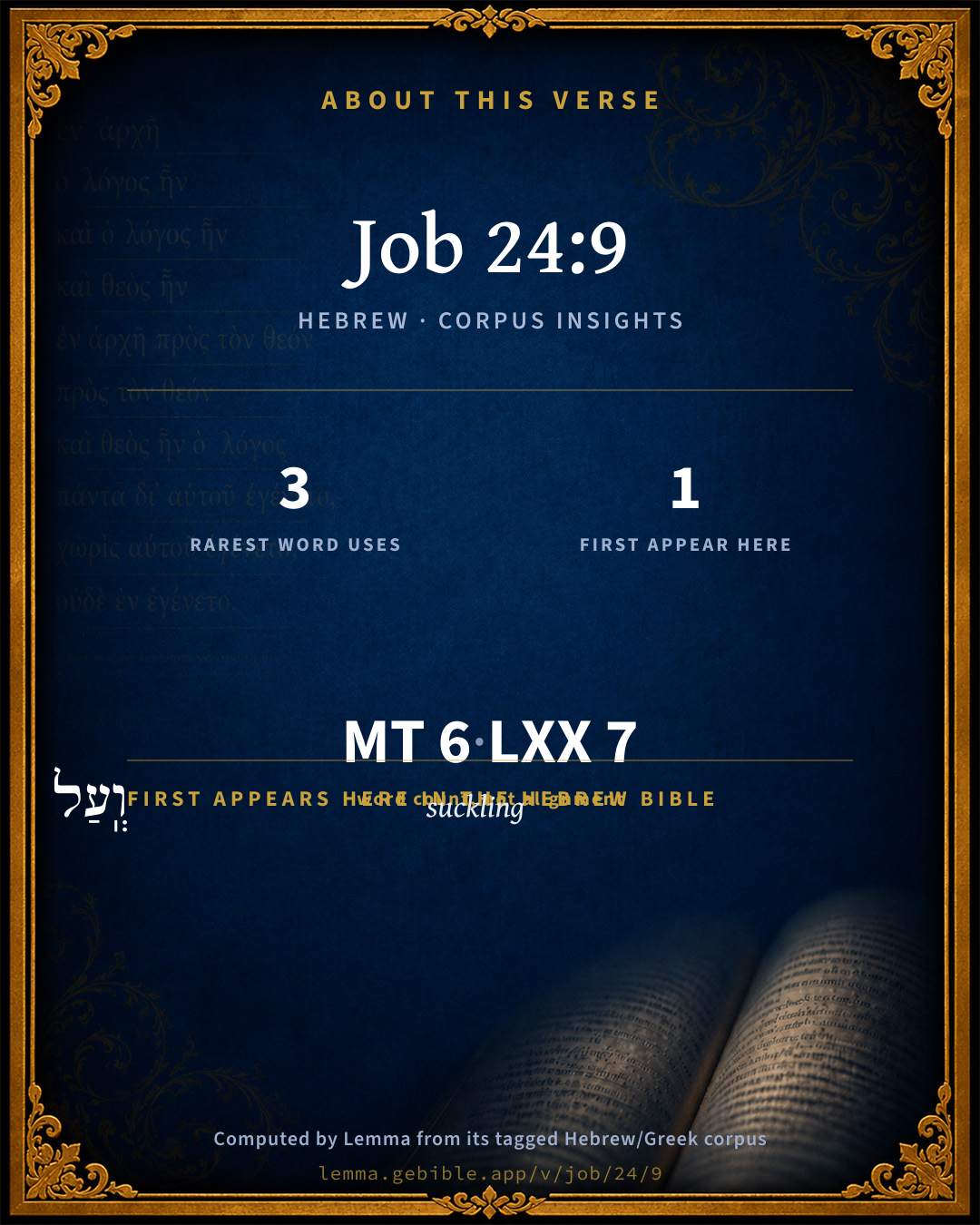
The rarest word here is וְֽעַל suckling H5764 — appearing just 3 times in the whole Hebrew Bible.

First appearance in Scripture

This word makes its first canonical appearance in the Hebrew Bible here:

  • וְֽעַל suckling H5764

Shared distinctive vocabulary

וְֽעַל suckling H5764 occurs in 3 verses of the Hebrew Bible. Also found in:

Grammatical profile

  • 2 verbs
  • 2 nouns
  • 1 adjective
  • 1 preposition

Verb forms

  • יִ֭גְזְלוּ Qal · Imperfect
  • יַחְבֹּֽלוּ Qal · Imperfect

Hebrew & Septuagint length

In English translation the verse runs 17 words from the Hebrew and 13 from the Septuagint (LXX English) — closely comparable.

A rough comparison of the two English renderings, which tokenize alike — not a word-level alignment.

Word counts can differ between the Hebrew and the Greek without any difference in meaning — e.g. the Hebrew direct-object marker אֵת has no separate Greek word, and Greek often adds the article ὁ.

In the original languages it is 6 Hebrew tokens and 7 Greek tokens — but the two are counted differently (Hebrew bundles its prefixes and suffixes into one token; the Greek is in lemma form), so that isn’t a like-for-like length.

Cross-references

2

Topical passages linked to Job 24:9 in the Treasury of Scripture Knowledge — connected by theme and wording, ordered by reader-vote popularity; previews shown in the World English Bible.

  • Nehemiah 5:5 Yet now our flesh is as the flesh of our brothers, our children as their children: and, behold, we bring into bondage our sons and our daughters to be servants, and some of our daughters are brought into bondage [already]: neither is it in our power to help it; for other men have our fields and our vineyards.
  • 2 Kings 4:1 Now there cried a certain woman of the wives of the sons of the prophets to Elisha, saying, Your servant my husband is dead; and you know that your servant did fear Yahweh: and the creditor is come to take to him my two children to be bondservants.

Cross-references courtesy of OpenBible.info (CC BY 4.0).

Hebrew and Greek witnesses Masoretic Hebrew ↔ Greek Septuagint

The same verse in the two great witnesses to the Old Testament, shown verse-for-verse.

These are two independent witnesses, not word-aligned to each other, and the Septuagint is shown in lemma (dictionary) form.

Hebrew Job 24:9 Masoretic · Westminster Leningrad Codex

יִ֭גְזְלוּ מִשֹּׁ֣ד יָת֑וֹם וְֽעַל עָנִ֥י יַחְבֹּֽלוּ

There are those who pluck the fatherless from the breast, And take a pledge of the poor,

World English Bible · Public Domain

Greek LXX Job 24:9 Septuagint · lemma form

ἁρπάζω ὀρφανός ἀπό μαστός ἐκπίπτω δέ ταπεινόω

They have snatched the fatherless from the breast, and have afflicted the outcast.

LXX2012 (modern English Septuagint) · Public Domain

On this verse, Keil & Delitzsch discusses the Septuagint’s reading. Read the note in Commentary ↓

Hebrew: Westminster Leningrad Codex (CC BY 4.0). Greek: Septuagint (public domain); English from LXX2012 (modern English Septuagint) (Public Domain). How the Septuagint differs from the Hebrew →

Commentary

Notes on Job 24:9 from classic Christian and Jewish commentators (each source and its license shown beneath its notes). The classic Christian expositions comment on the surrounding passage and are grouped to its opening verse, so a note may address several verses; the Jewish commentaries on the Tanakh (Rashi and others) are per-verse, so they appear only where the commentator wrote on this verse.

Lemma curates 59 commentaries, every one of them public domain or Creative Commons licensed, each selected and text-cleaned for this edition rather than reprinted as found. About our sources →

Trapp's Complete Commentary

John Trapp

Job 24:9 They pluck the fatherless from the breast, and take a pledge of the poor.

Ver. 9. They pluck the fatherless from the breast] What can be more to be pitied than a fatherless suckling? Who less to be molested or violenced than the mother doing that office to her babe? In the Parisian Massacre one of the murderers took a little one in his arms, who smiled upon him and played with his beard; yet this barbarous wretch was so far from compassion, that he wounded it with his dagger, and so cast it all gore blood into the river (Acts and Mon.). The story of the infant of the isle of Guernsey, thrown back into the fire, out of which it had sprawled, is well known. So is the savage inhumanity of that merciless Minerius, the pope’s champion, who at Merindola, in France, cut off the paps of many which gave suck to their children; which, looking for suck at their mother’s breasts, being dead before, died also for hunger. Well, therefore, might our Saviour say, "Beware of men," Mat 10:17. It had been better the Indies had been given to the devils of hell, said those poor natives, than to those bloody Spaniards, who dashed the mothers in pieces upon their children, as once at Betharbel, Hos 10:14.

And take a pledge from the poor] Misery, which should beget pity in them, begetteth but audacity, and inviteth them to ruin the poor, and fill their houses with their spoils. Some render it thus, They take the poor for a pledge; sc. putting them to their ransom, and meanwhile enslaving them.

John Trapp, A Commentary or Exposition upon All the Books of the Old and New Testament (1647–1656) — public domain. Text from a community e-Sword module.

Joseph Benson's Commentary

Job 24:9-10. They — The wicked oppressors; pluck the fatherless from the breast — Either out of cruelty, not sparing poor infants, or out of covetousness, not allowing the mother time for the suckling of her infant. They take away the sheaf from the hungry — That single sheaf, which the poor man had got with the sweat of his brow, to satisfy his hunger.

Joseph Benson's Commentary on the Old and New Testaments (1811–1818) — public domain. Text from a community e-Sword module.

Whedon's Commentary on the Bible

Daniel D. Whedon

Third strophe — The wretched poor are treated worse than the brute, and in the cities even, the blood of the innocent cries to God in vain, Job_24:9-12.

9. They — The high-handed oppressors of whom he had spoken in Job_24:4. “Inhuman creditors take the fatherless and still tender orphan away from its mother, in order to bring it up as a slave, and so to obtain payment.” — Delitzsch.

Take a pledge — What the poor has on they take as a pledge.— GESENIUS. Mosaical legislation protected the outer garment of the poor, as it served for a covering by night. Exo_22:26.

Daniel D. Whedon (gen. ed.), Commentary on the Old and New Testaments (1874–1909) — public domain. Text from a community e-Sword module.

Keil & Delitzsch

C. F. Keil & F. Delitzsch

9 They tear the fatherless from the breast,

And defraud the poor.

10 Naked, they slink away without clothes,

And hungering they bear the sheaves.

11 Between their walls they squeeze out the oil;

They tread the wine-presses, and suffer thirst.

12 In the city vassals groan, And the soul of the oppressed crieth out -

And Eloah heedeth not the anomaly.

The accentuation of Job 24:9 (יגזלו with Dech, משׁד with Munach) makes the relation of שׁד יתום genitival. Heidenheim (in a MS annotation to Kimchi's Lex.) accordingly badly interprets: they plunder from the spoil of the orphan; Ramban better: from the ruin, i.e., the shattered patrimony; both appeal to the Targum, which translates מביזת יתום, like the Syriac version, men bezto de-jatme (comp. Jerome: vim fecerunt depraedantes pupillos). The original reading, however, is perhaps (vid., Buxtorf, Lex. col. 295) מבּיזא, ἀπὸ βυζίου, from the mother's breast, as it is also, the lxx (ἀπὸ μαστοῦ), to be translated contrary to the accentuation. Inhuman creditors take the fatherless and still tender orphan away from its mother, in order to bring it up as a slave, and so to obtain payment. If this is the meaning of the passage, it is natural to understand יחבּלוּ, Job 24:9, of distraining; but (1) the poet would then repeat himself tautologically, vid., Job 24:3, where the same thing is far more evidently said; (2) חבל, to distrain, would be construed with על, contrary to the logic of the word. Certainly the phrase חבל על may be in some degree explained by the interpretation, "to impose a fine" (Ew., Hahn), or "to distrain" (Hirz., Welte), or "to oppress with fines" (Schlottm.); but violence is thus done to the usage of the language, which is better satisfied by the explanation of Ralbag (among modern expositors, Ges., Arnh., Vaih., Stick., Hlgst.): and what the unfortunate one possesses they seize; but this על = אשׁר על directly as object is impossible. The passage, Deu 7:25, cited by Schultens in its favour, is of a totally different kind.

But throughout the Semitic dialects the verb חבל also signifies "to destroy, to treat injuriously" (e.g., Arab. el-châbil, a by-name of Satan); it occurs in this signification in Job 34:31, and according to the analogy of הרע על, Kg1 17:20, can be construed with על as well as with ל. The poet, therefore, by this construction will have intended to distinguish the one חבל from the other, Job 22:6; Job 24:3; and it is with Umbreit to be translated: they bring destruction upon the poor; or better: they take undue advantage of those who otherwise are placed in trying circumstances.

The subjects of Job 24:10 are these עניים, who are made serfs, and become objects of merciless oppression, and the poet here in Job 24:10 indeed repeats what he has already said almost word for word in Job 24:7 (comp. Job 31:19); but there the nakedness was the general calamity of a race oppressed by subjugation, here it is the consequence of the sin of merces retenta laborum, which cries aloud to heaven, practised on those of their own race: they slink away (הלּך, as Job 30:28) naked (nude), without (בּלי = מבּלי, as perhaps sine = absque) clothing, and while suffering hunger they carry the sheaves (since their masters deny them what, according to Deu 25:4, shall not be withheld even from the beasts). Between their walls (שׁוּרת like שׁרות, Jer 5:10, Chaldee שׁוּריּא), i.e., the walls of their masters who have made them slaves, therefore under strict oversight, they press out the oil (יצהירוּ, ἅπ. γεγρ.), they tread the wine-vats (יקבים, lacus), and suffer thirst withal (fut. consec. according to Ew. 342, a), without being allowed to quench their thirst from the must which runs out of the presses (נּתּות, torcularia, from which the verb דּרך is here transferred to the vats). Bttch. translates: between their rows of trees, without being able to reach out right or left; but that is least of all suitable with the olives. Carey correctly explains: "the factories or the garden enclosures of these cruel slaveholders." This reference of the word to the wall of the enclosure is more suitable than to walls of the press-house in particular. From tyrannical oppression in the country,

(Note: Brentius here remarks: Quantum igitur judicium in eos futurum est, qui in homines ejusdem carnis, ejusdem patriae, ejusdem fidei, ejusdem Christi committunt quod nec in bruta animalia committendum est, quod malum in Germania frequentissimum est. Vae igitur Germaniae!)

Job now passes over to the abominations of discord and was in the cities.

Job 24:12

It is natural, with Umbr., Ew., Hirz., and others, to read מתים like the Peschito; but as mı̂te in Syriac, so also מתים in Hebrew as a noun everywhere signifies the dead (Arab. mauta), not the dying, mortals (Arab. matna); wherefore Ephrem interprets the praes. "they groan" by the perf. "they have groaned." The pointing מתים, therefore, is quite correct; but the accentuation which, by giving Mehupach Zinnorith to מעיר, and Asla legarmeh to מתים, places the two words in a genitival relation, is hardly correct: in the city of men, i.e., the inhabited, thickly-populated city, they groan; not: men (as Rosenm. explains, according to Gen 9:6; Pro 11:6) groan; for just because מתים appeared to be too inexpressive as a subject, this accentuation seems to have been preferred. It is also possible that the signification fierce anger (Hos 11:9), or anguish (Jer 15:8), was combined with עיר, comp. Arab. gayrt, jealousy, fury (= קנאה), of which, however, no trace is anywhere visible.

(Note: Wetzstein translates Hos 11:9 : I will not come as a raging foe, with ב of the attribute = Arab. b-ṣifat 'l-‛ayyûr (comp. Jer 15:8, עיר, parall. שׁדד) after the form קים, to which, if not this עיר, certainly the עיר, ἐγρήγορος, occurring in Dan 4:10, and freq., corresponds. What we remarked above, p. 483, on the form קים, is cleared up by the following observation of Wetzstein: "The form קים belongs to the numerous class of segolate forms of the form פעל, which, as belonging to the earliest period of the formation of the Semitic languages, take neither plural nor feminine terminations; they have often a collective meaning, and are not originally abstracta, but concreta in the sense of the Arabic part. act. mufâ‛l. This inflexible primitive formation is frequently found in the present day in the idiom of the steppe, which shows that the Hebrew is essentially of primeval antiquity (uralt). Thus the Beduin says: hû qitlı̂ (הוּא קטלי), he is my opponent in a hand-to-hand combat; nithı̂ (נטחי), my opponent in the tournament with lances; chı̂lfı̂ (חלפי) and diddı̂ (צדּי), my adversary; thus a step-mother is called dı̂r (ציר), as the oppressor of the step-children, and a concubine dirr (צרר), as the oppressor of her rival. The Kamus also furnishes several words which belong here, as tilb (טלב), a persecutor." Accordingly, קים is derived from קום, as also עיר, a city, from עור (whence, according to a prevalent law of the change of letters, we have עיר first of all, plur. עירים, Jdg 10:4), and signifies the rebelling one, i.e., the enemy (who is now in the idiom of the steppe called qômâni, from qôm, a state of war, a feud), as עיר, a keeper and ציר, a messenger; עיר (קיר) is also originally concrete, a wall (enclosure).)

With Jer., Symm., and Theod., we take מתים as the sighing ones themselves; the feebleness of the subject disappears if we explain the passage according to such passages as Deu 2:34; Deu 3:6, comp. Jdg 20:48 : it is the male inhabitants that are intended, whom any conqueror would put to the sword; we have therefore translated men (men of war), although "people" (Job 11:3) also would not have been unsuitable according to the ancient use of the word. נאק is intended of the groans of the dying, as Jer 51:52; Eze 30:24, as Job 24:12 also shows: the soul of those that are mortally wounded cries out. חללים signifies not merely the slain and already dead, but, according to its etymon, those who are pierced through those who have received their death-blow; their soul cries out, since it does not leave the body without a struggle. Such things happen without God preventing them. לא־ישׂים תּפלה, He observeth not the abomination, either = לא ישׂים בלבו, Job 22:22 (He layeth it not to heart), or, since the phrase occurs nowhere elliptically, = לא ישׂים לבו על, Job 1:8; Job 34:23) He does not direct His heart, His attention to it), here as elliptical, as in Job 4:20; Isa 41:20. True, the latter phrase is never joined with the acc. of the object; but if we translate after שׂים בּ, Job 4:18 : non imputat, He does not reckon such תפלה, i.e., does not punish it, בּם (בּהם) ought to be supplied, which is still somewhat liable to misconstruction, since the preceding subject is not the oppressors, but those who suffer oppression. תּפלה is properly insipidity (comp. Arab. tafila, to stink), absurdity, self-contradiction, here the immorality which sets at nought the moral order of the world, and remains nevertheless unpunished. The Syriac version reads תּפלּה, and translates, like Louis Bridel (1818): et Dieu ne fait aucune attention leur prire.

Keil & Delitzsch — Biblical Commentary on the Old Testament (1861–1891) — public domain (CC PDM 1.0). Text via the HelloAO Bible API. (Old Testament only.)

Tyndale Open Study Notes

Tyndale Open Resources

24:9 widow’s child . . . security for a loan: See 2 Kgs 4:1; Neh 5:1-5; Matt 18:25.

Tyndale Open Study Notes — © Tyndale Open Resources, licensed CC BY-SA 4.0. Text via the HelloAO Bible API.

Geneva Bible (1599)

Geneva Bible translators

That is, his garment, wherewith he should be covered or clad.

That is, they so powle and pill the poor widow, that she cannot have to sustain herself that she may be able to give her child suck.

Geneva Bible (1599) marginal notes — public domain. Text via Bolls.life.

Jamieson, Fausset & Brown

Robert Jamieson, A. R. Fausset & David Brown

from the breast--of the widowed mother. Kidnapping children for slaves. Here Job passes from wrongs in the desert to those done among the habitations of men.

pledge--namely, the garment of the poor debtor, as Job 24:10 shows.

Jamieson, Fausset & Brown — Commentary Critical and Explanatory on the Whole Bible (1871) — public domain (CC PDM 1.0). Text via the HelloAO Bible API.

Adam Clarke's Commentary

Verse 9. They pluck the fatherless from the breast] They forcibly take young children in order that they may bring them up in a state of slavery. This verse is the commencement of a new paragraph, and points out the arbitrary dealings of oppressors, under despotic governors.

Take a pledge of the poor.] Oppressive landlords who let out their grounds at an exorbitant rent, which the poor labourers, though using the utmost diligence, are unable at all times to pay; and then the unfeeling wretch sells then up, as the phrase here is, or takes their cow, their horse, their cart, or their bed, in pledge, that the money shall be paid in such a time. This is one of the crying sins of some countries of Europe.

Adam Clarke's Commentary on the Bible (1810–1826) — public domain. Text from a community e-Sword/MySword module.

The Cambridge Bible for Schools and Colleges

gen. ed. J. J. S. Perowne

9. They pluck] Or, there are who pluck. The reference is to the ruling class who, for some debt perhaps of the dependent, seize the infant of the debtor, in order by selling it or bringing it up as a slave to repay themselves.

take a pledge of the poor] The words might mean “take in pledge that which is on the poor,” i. e. their scanty clothing. Others refer the words to the preceding inhuman act of plucking the child from the breast and render: “and take this pledge of the poor” (Ew.).

9–12. These verses describe the miseries of another class, those who have allowed themselves to be subjected, and become serfs and bondmen attached to the estates of the rich. Probably they are but a portion of the same aboriginal tribes mentioned in Job_24:5-7.

The Cambridge Bible for Schools and Colleges (gen. ed. J. J. S. Perowne; Cambridge University Press, 1878–1918) — public domain. Text from a community e-Sword module.

John Gill's Exposition

They pluck the fatherless from the breast,.... Either on purpose to starve it, which must be extremely barbarous; or to sell it to be brought up a slave; or by obliging the mother to wean it before the due time, that she might be the better able to do work for them they obliged her to. Mr. Broughton renders the words, "of mischievousness they rob the fatherless"; that is, through the greatness of the mischief they do, as Ben Gersom interprets it; or through the exceeding mischievous disposition they are of; of which this is a flagrant instance; or

"they rob the fatherless of what remains for him after spoiling (n),''

or devastation, through the plunder of his father's substance now dead, which was exceeding cruel:

and take a pledge of the poor; either the poor himself, or his poor fatherless children, see Kg2 4:1; or what is "upon the poor" (o), as it may be rendered; that is, his raiment, which was commonly taken for a pledge; and, by a law afterwards established in Israel, was obliged to be restored before sunset, that he might have a covering to sleep in, Exo 22:26; See Gill on Job 22:6.

(n) "per devastationem", some in Munster; "post vastationem", Tigurine version; so Nachmanides & Bar Tzemach. (o) "super inopem", Cocceius, Schultens; so Ben Gersom.

John Gill's Exposition of the Whole Bible (1746–1763) — public domain (CC PDM 1.0). Text via the HelloAO Bible API.

Albert Barnes' Notes on the Bible

They pluck the fatherless from the breast - That is, they steal away unprotected children, and sell them, or make slaves of them for their own use. If this is the correct interpretation, then there existed at that time, what has existed since, so much to the disgrace of mankind, the custom of kidnapping children, and bearing them away to be sold as slaves. Slavery existed in early ages; and it must have been in some such way that slaves were procured. The wonder of Job is, that such people were permitted to live - that God did not come forth and punish them. The fact still exists, and the ground of wonder is not diminished. Africa bleeds under wrongs of this kind; and the vengeance of heaven seems to sleep, though the child is torn away from its mother, and conveyed, amid many horrors, to a distant land, to wear out life in hopeless servitude.

And take a pledge of the poor - Take that, therefore, which is necessary for the comfort of the poor, and retain it, so that they cannot enjoy its use; see the notes at Job 22:6.

Albert Barnes' Notes on the Bible (1834–1885) — public domain. Text from a community e-Sword/MySword module.

Haydock's Catholic Bible Commentary

Robbed. Hebrew and Septuagint, "snatched from the breast." --- Stript. Septuagint, "knocked down." Hebrew, "taken a pledge of, or seized the poor." (Calmet)

George Leo Haydock (1774–1849), Haydock's Catholic Family Bible and Commentary, 1859 edition — public domain. Excludes Psalms (Douay-Rheims chapter numbering differs from Protestant) and Deuterocanonical books (Catholic canon only).

Matthew Poole's English Annotations

They; the wicked oppressors, as is manifest from the following words.

From the breast; either out of cruelty, not sparing poor infants, but killing them; or out of covetousness, and with design either to sell the mother, or to employ her in their work, to which they so strictly confine her, that they will not allow any of her time or strength for the suckling of her infant.

Take a pledge of the poor; of which See Poole "Job 22:6".

Matthew Poole's English Annotations on the Holy Bible (1683–1685) — public domain. Text from a community e-Sword/MySword module.

The Pulpit Commentary

They pluck the fatherless from the breast. Other oppressors, not of the marauding class, but dwellers in towns (ver. 12), are so cruel that they tear the unweaned child of the debtor from the mother"s breast, as satisfaction for a debt, and carry him off into slavery. (comp. 2Ki_22:2-7 Neh_5:5) And take a pledge of the poor; literally, take in pledge that which is on the poor in other words, their clothing. They will not lend to them on any other terms, and so force them to part with their garments, and go about naked. Even Hebrew creditors seem to have done this; (Exo_22:26 Deu_24:12, Deu_24:13) and the Mosaic Law did not forbid the practice, but only required the creditor to let the debtor have his garment at night, that he might sleep in it. (Exo_4:1 Deu_24:13)

The Pulpit Commentary (1880–1919), ed. H.D.M. Spence-Jones & Joseph S. Exell — public domain. Text from a community e-Sword module.

John Wesley's Explanatory Notes

They - The oppressors. Pluck - Out of covetousness; they will not allow the mother time for the suckling of her infant.

John Wesley, Explanatory Notes Upon the Whole Bible (1754–1765) — public domain. Text via the GEBible commentary corpus.

Rashi

Rabbi Shlomo Yitzchaki (Rashi)

from the breast of the orphan The sucking of the orphan, the source of his food and sustenance, as in (Isa. 60:16), “and the breast of kings you shall suck.”

they take a pledge Heb. יחבלו, an expression of (Exod. 22:25), “If you take a pledge (חבל תחבל)”; (Ezek.18:16), “he did not take a pledge (חבל לא חבל).”

Rashi on the Tanakh — English translations: “The Judaica Press complete Tanach with Rashi, translated by A. J. Rosenberg” (CC BY 4.0); “Pentateuch with Rashi's commentary by M. Rosenbaum and A.M. Silbermann, 1929-1934” (public domain); “The Metsudah Tanach series, Lakewood, N.J” (CC BY 4.0); and “The Book of Joshua, Metsudah Publications, 1997” (CC BY 4.0). Text via Sefaria.

Lesson kit

Teaching starters — assembled from the data on this page, not authored interpretation. Every prompt links to the verse data it draws on. Edit before teaching.

Job, in the Wisdom, opens this verse with 6 words (6 distinct Hebrew lemmas). Its most distinctive word is ʻûwl (“suckling”). A historical commentator’s framing appears above. Read the whole chapter for the surrounding context.

Discussion questions

  1. The word ʻûwl carries the sense “suckling.” How does it shape the verse?
  2. The word “suckling” first appears here in Scripture. What is being introduced at this debut?
  3. Isaiah 49:15 shares the word «suckling» with this verse. How do the two illuminate each other?
  4. These translations render this verse differently; the difference is in the English rendering, not the original. What questions does that raise?
  5. The verb «יִ֭גְזְלוּ» is Qal Imperfect. How does its form color the action?
  6. Reading how Trapp's Complete Commentary and Joseph Benson's Commentary read this verse, where do the two commentators agree and where do they part?

Things to notice

Reading settings

Reading text

Shown beneath each verse's original-language words.

Old Testament
Old Testament edition

Read the OT as the Masoretic Hebrew (MT) or the Greek Septuagint (LXX).

English shown for the Greek Septuagint (in the Hebrew ↔ Greek comparison).

Comparing translations? Open the Compare panel on any verse page to stack up to four side by side.