
Philippians 4:12

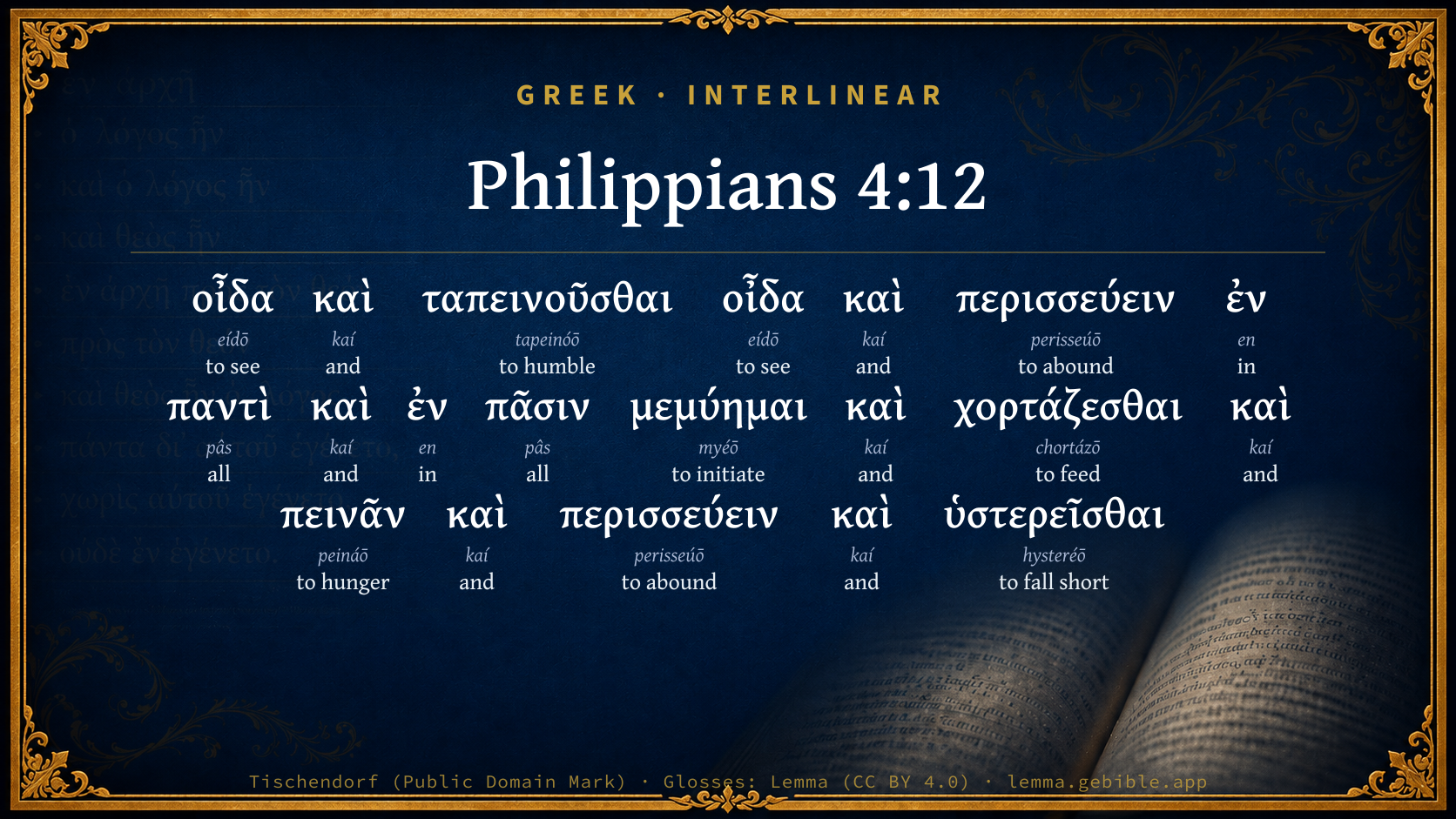
Greek (Tischendorf 8th ed.) Philippians 4:12 appears in the Greek New Testament. The text above is from the Tischendorf 8th edition. Each word links to its Strong’s number and a concise gloss. Click any word for its full Thayer’s Greek Lexicon entry.
Download image
Cite this verse

Philippians 4:12 (World English Bible). Public Domain. Lemma interlinear Bible study tool, https://lemma.gebible.app/v/philippians/4/12.

Show BibTeX & RIS
BibTeX
RIS
English Translation
I know how to be humbled, and I know also how to abound. In everything and in all things I have learned the secret both to be filled and to be hungry, both to abound and to be in need.
World English Bible · Public Domain
Highlights
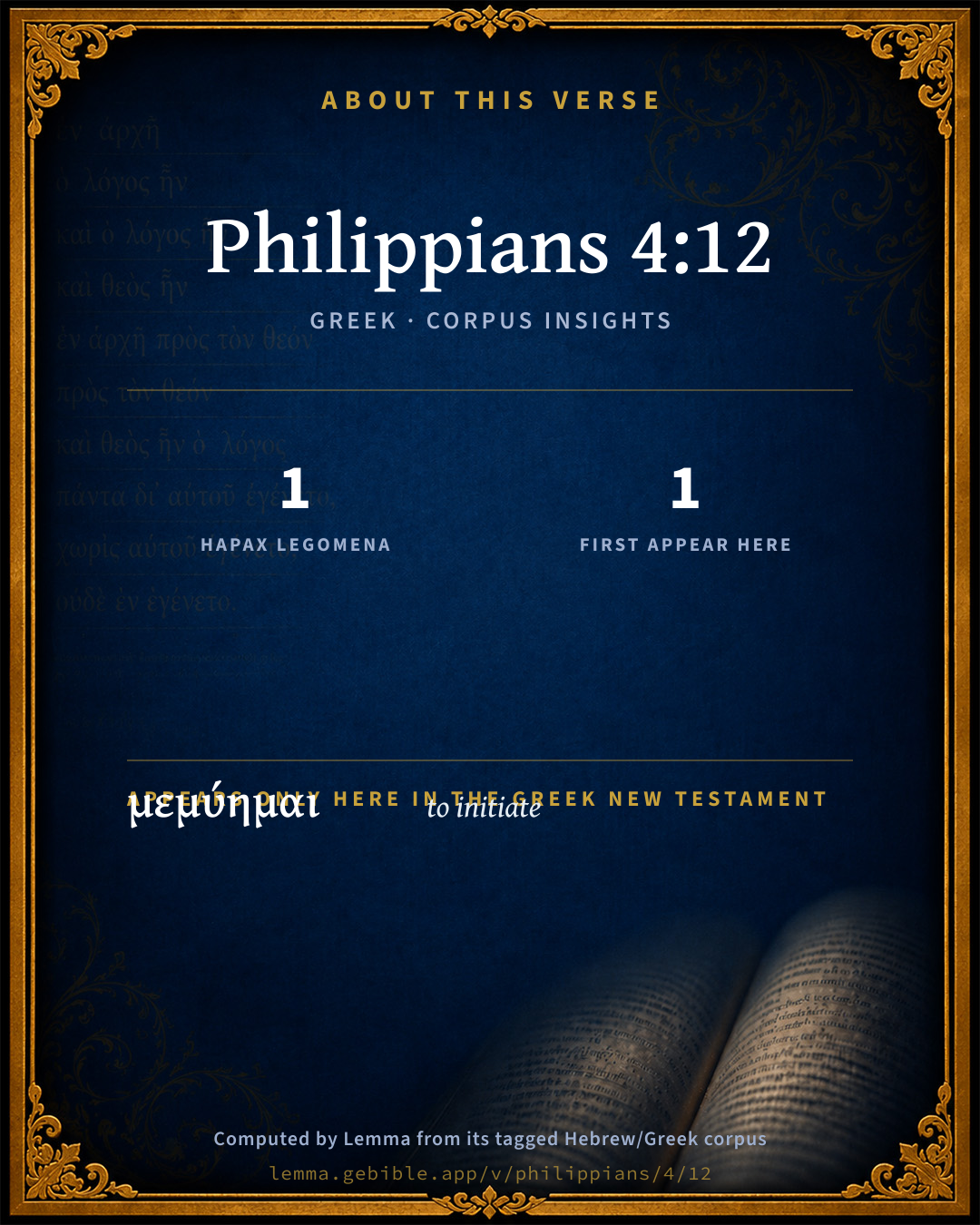
  • 1 hapax legomenon — only here in the Greek New Testament
  • 1 first appearance in the Greek New Testament
Full analysis ↓
Download a study sheet

One document with this verse’s original text, its word-by-word gloss line, the meaning frame, cross-references with their text, attributed commentary, and full source and license credits — printable, and it pastes into notes with its structure intact.

This verse Autodidact and up

Study sheet (.html) Plain text (.txt)

A passage Seminary Student

Up to 50 verses in one chapter. A passage sheet keeps up to 6 commentary sources and 12 cross-references per verse, in the order this page ranks them, and says so on the sheet whenever that leaves anything out. Ask for a single verse and you get the Autodidact verse sheet above.

Everything on this page stays free to read, with no account — the sheet is a download of what is already on screen, not access to it.

Want to remove ads? Support Godless Engineer
Compare translations 3

The same verse in 3 English versions, stacked beneath the original-language interlinear above. Click any original word for its lexicon entry.

Each is an independent rendering of the whole verse — the interlinear is not word-aligned to these translations.

Highlighted words mark where these versions differ — a whole-verse word diff, not a word-by-word alignment.

  • World English Bible Public Domain
    I know how to be humbled, and I know also how to abound. In everything and in all things I have learned the secret both to be filled and to be hungry, both to abound and to be in need.
  • King James Version Public Domain
    I know both how to be abased, and I know how to abound: every where and in all things I am instructed both to be full and to be hungry, both to abound and to suffer need.
  • unfoldingWord Literal Text CC BY-SA 4.0
    I know both to be brought low, and I know to abound. In each and in all, I have learned both to be filled and to be hungry, and to abound and to be in need.

unfoldingWord Literal Text — © unfoldingWord, licensed CC BY-SA 4.0. Word-aligned USFM3 via Door43 (git.door43.org/unfoldingWord/en_ult).

Versions to compare (up to 4)

3 of 4 selected

Show all 19 translations

Every available English version of this verse, each an independent rendering of the whole verse.

  • World English Bible Public Domain
    I know how to be humbled, and I know also how to abound. In everything and in all things I have learned the secret both to be filled and to be hungry, both to abound and to be in need.
  • Berean Standard Bible Public Domain
    I know how to live humbly, and I know how to abound. I am accustomed to any and every situation—to being filled and being hungry, to having plenty and having need.
  • Majority Standard Bible Public Domain
    I know how to live humbly, and I know how to abound. In any and every situation I have learned the secret of being filled and being hungry, of having plenty and having need.
  • King James Version Public Domain
    I know both how to be abased, and I know how to abound: every where and in all things I am instructed both to be full and to be hungry, both to abound and to suffer need.
  • American Standard Version (1901) Public Domain
    I know how to be abased, and I know also how to abound: in everything and in all things have I learned the secret both to be filled and to be hungry, both to abound and to be in want.
  • Revised Version (1885) Public Domain
    I know how to be abased, and I know also how to abound: in everything and in all things have I learned the secret both to be filled and to be hungry, both to abound and to be in want.
  • Geneva Bible (1599) Public Domain
    And I can be abased, and I can abounde: euery where in all things I am instructed, both to be full, and to be hungrie, and to abounde, and to haue want.
  • Douay-Rheims (1899) Public Domain
    I know both how to be brought low, and I know how to abound: (everywhere, and in all things I am instructed) both to be full, and to be hungry; both to abound, and to suffer need.
  • Young's Literal Translation Public Domain
    I have known both to be abased, and I have known to abound; in everything and in all things I have been initiated, both to be full and to be hungry, both to abound and to be in want.
  • Literal Standard Version CC BY-SA 4.0
    I have known both to be abased, and I have known to abound; in everything and in all things I have been initiated, both to be full and to be hungry, both to abound and to be in want.
  • Unlocked Literal Bible CC BY-SA 4.0
    I know what it is to be poor, and I also know what it is to have plenty. In every way and in all things I have learned the secret of how to be well-fed or to be hungry, and how to have an abundance or to be in need.
  • unfoldingWord Literal Text CC BY-SA 4.0
    I know both to be brought low, and I know to abound. In each and in all, I have learned both to be filled and to be hungry, and to abound and to be in need.
  • Darby Bible Public Domain
    I know both how to be abased and I know how to abound. In everything and in all things I am initiated both to be full and to be hungry, both to abound and to suffer privation.
  • World Messianic Bible Public Domain
    I know how to be humbled, and I also know how to abound. In any and all circumstances I have learned the secret both to be filled and to be hungry, both to abound and to be in need.
  • Webster's Bible Public Domain
    I know both how to be abased, and I know how to abound: every where and in all things I am instructed both to be full and to be hungry, both to abound and to suffer need.
  • Free Bible Version CC BY-SA 4.0
    I'm used to having nothing, and I've experienced having plenty too. In every possible situation I've learned the secret of dealing with having plenty and going hungry, of being rich and of living in poverty:
  • Bible in Basic English Public Domain
    It is the same to me if I am looked down on or honoured; everywhere and in all things I have the secret of how to be full and how to go without food; how to have wealth and how to be in need.
  • Text-Critical English NT CC BY 4.0
    I know how to be brought low, and I know how to abound. I have learned the secret of being content in any and every situation, whether well fed or hungry, whether having plenty or being in need.
  • Tyndale New Testament (1534) Public Domain
    I can both cast doune my silfe I can also excede. Every where and in all thynges I am instructed both to be full and to be hongry: to have plenty and to suffre nede.

Literal Standard Version (2020), Covenant Press — licensed CC BY-SA 4.0. Text via the HelloAO Bible API (eBible.org). Unlocked Literal Bible (unfoldingWord) — licensed CC BY-SA 4.0. Text via the HelloAO Bible API (eBible.org). unfoldingWord Literal Text — © unfoldingWord, licensed CC BY-SA 4.0. Word-aligned USFM3 via Door43 (git.door43.org/unfoldingWord/en_ult). Free Bible Version, Dr. Jonathan Gallagher — licensed CC BY-SA 4.0. Text via the HelloAO Bible API (eBible.org).

Word by word

More ways to search: Search by grammar → Find every occurrence → Compare this word →

Practice this passage: Drill this verse → Learn its vocabulary →

μεμύημαι
myéō
G3453
“to initiate”
Verb, Perfect, Passive, Indicative, 1st person, Singular
Part of Speech
Verb
Tense
Perfect
Voice
Passive
Mood
Indicative
Person
1st person
Number
Singular
Full Thayer's Definition

Origin: from the base of G3466

TDNT: 17:48,6

1. to initiate into the mysteries 2. to teach fully, instruct a. to accustom one to a thing b. to give one an intimate acquaintance with a thing
  1. οἶδα eídō G1492 “to see” Verb, Perfect, Active, Indicative, 1st person, Singular
  2. καὶ kaí G2532 “and” Conjunction
  3. ταπεινοῦσθαι tapeinóō G5013 “to humble” Verb, Present, Passive, Infinitive
  4. οἶδα eídō G1492 “to see” Verb, Perfect, Active, Indicative, 1st person, Singular
  5. καὶ kaí G2532 “and” Conjunction
  6. περισσεύειν perisseúō G4052 “to abound” Verb, Present, Active, Infinitive
  7. ἐν en G1722 “in” Preposition
  8. παντὶ pâs G3956 “all” Adjective, Dative, Singular, Masculine
  9. καὶ kaí G2532 “and” Conjunction
  10. ἐν en G1722 “in” Preposition
  11. πᾶσιν pâs G3956 “all” Adjective, Dative, Plural, Masculine
  12. καὶ kaí G2532 “and” Conjunction
  13. χορτάζεσθαι chortázō G5526 “to feed” Verb, Present, Passive, Infinitive
  14. καὶ kaí G2532 “and” Conjunction
  15. πεινᾶν peináō G3983 “to hunger” Verb, Present, Active, Infinitive
  16. καὶ kaí G2532 “and” Conjunction
  17. περισσεύειν perisseúō G4052 “to abound” Verb, Present, Active, Infinitive
  18. καὶ kaí G2532 “and” Conjunction
  19. ὑστερεῖσθαι hysteréō G5302 “to fall short” Verb, Present, Passive, Infinitive

About this verse

These counts appear in no published source. They are computed here, from the morphology-tagged text and Lemma’s own curated glosses. What Lemma adds →

20
words
10
distinct lemmas
Pauline Epistles
section

Notable vocabulary

1 hapax legomenon — a word that appears only here in the entire Greek New Testament:

  • μεμύημαι to initiate G3453

First appearance in Scripture

This word makes its first canonical appearance in the Greek New Testament here:

  • μεμύημαι to initiate G3453

Shared distinctive vocabulary

ταπεινοῦσθαι to humble G5013 occurs in 11 verses of the Greek New Testament. Also found in:
Repetition

Words recur within this verse:

  • οἶδα to see G1492 ×2
  • περισσεύειν to abound G4052 ×2
  • παντὶ all G3956 ×2
  • καὶ and G2532 ×7
  • ἐν in G1722 ×2

Cross-references

15

Topical passages linked to Philippians 4:12 in the Treasury of Scripture Knowledge — connected by theme and wording, ordered by reader-vote popularity; previews shown in the World English Bible.

  • Matthew 11:29 Take my yoke upon you, and learn from me, for I am gentle and lowly in heart; and you will find rest for your souls.
  • 2 Corinthians 12:7–10 By reason of the exceeding greatness of the revelations, that I should not be exalted excessively, there was given to me a thorn in the flesh, a messenger of Satan to buffet me, that I should not be exalted excessively.
  • 2 Corinthians 11:27 in labor and travail, in watchings often, in hunger and thirst, in fastings often, and in cold and nakedness.
  • 2 Corinthians 11:9 When I was present with you and was in need, I wasn't a burden on anyone, for the brothers, when they came from Macedonia, supplied the measure of my need. In everything I kept myself from being burdensome to you, and I will continue to do so.
  • 2 Corinthians 6:4–10 but in everything commending ourselves, as servants of God, in great endurance, in afflictions, in hardships, in distresses,
  • Deuteronomy 32:10 He found him in a desert land, In the waste howling wilderness; He compassed him about, he cared for him, He kept him as the apple of his eye.
  • Isaiah 8:11 For Yahweh spoke thus to me with a strong hand, and instructed me not to walk in the way of this people, saying,
  • 1 Corinthians 4:9–13 For, I think that God has displayed us, the apostles, last of all, like men sentenced to death. For we are made a spectacle to the world, both to angels and men.
  • 2 Corinthians 10:1 Now I Paul, myself, entreat you by the humility and gentleness of Christ; I who in your presence am lowly among you, but being absent am of good courage toward you.
  • Nehemiah 9:20 You gave also your good Spirit to instruct them, and didn't withhold your manna from their mouth, and gave them water for their thirst.
  • Jeremiah 31:19 Surely after that I was turned, I repented; and after that I was instructed, I struck on my thigh: I was ashamed, yes, even confounded, because I did bear the reproach of my youth.
  • Matthew 13:52 He said to them, "Therefore, every scribe who has been made a disciple in the Kingdom of Heaven is like a man who is a householder, who brings out of his treasure new and old things."
  • 2 Corinthians 10:10 For, "His letters," they say, "are weighty and strong, but his bodily presence is weak, and his speech is despised."
  • 2 Corinthians 11:7 Or did I commit a sin in humbling myself that you might be exalted, because I preached to you God's Gospel free of charge?
  • Ephesians 4:20–21 But you did not learn Christ that way;

Cross-references courtesy of OpenBible.info (CC BY 4.0).

Commentary

Notes on Philippians 4:12 from classic Christian and Jewish commentators (each source and its license shown beneath its notes). The classic Christian expositions comment on the surrounding passage and are grouped to its opening verse, so a note may address several verses; the Jewish commentaries on the Tanakh (Rashi and others) are per-verse, so they appear only where the commentator wrote on this verse.

Lemma curates 59 commentaries, every one of them public domain or Creative Commons licensed, each selected and text-cleaned for this edition rather than reprinted as found. About our sources →

The Biblical Illustrator

Joseph S. Exell

Php_4:12

I know both how to be abased, and I know how to abound

The Christian

I.

Expects vicissitude.

II. Knows how to adapt himself to all circumstances.

III. Is instructed by the spirit of God. (J. Lyth, D. D.)

How to be abased

During the periods between the paroxysms of the fever, Cromwell occupied the time with listening to passages from the sacred volume, or by a resigned or despairing reference to the death of his daughter. Read to me, he said to his wife, in one of these intervals, the Epistle to the Philippians. She read these words: I know both how to be abased, and--the reader paused. That verse, said the Protector, once saved my life when the death of my eldest born, the infant Oliver, pierced my heart like the sharp blade of a poignard. (Lamartine.)

The knowledge of properly using abundance

Paul had the double knowledge, How to be abased and how to abound. The two are not distinctly separable--each in some way conditions the other. There is far too little of the knowledge how to abound. Few men who abound come asking how to abound. Men think it hard enough to get rich, but a very easy thing to be rich. No man has a right to be anything unless he has the knowledge of how to be that thing. When Paul says, I know how to abound, he is thinking of anything which makes life pleasant and ample--of money, of scholarship, of friendship, of great spiritual hopes and experiences. Paul did not have all these, and yet he had the knowledge of how to use them. The power by which he could rob abundance of its dangers was the knowledge of the true perfection of a soul in serving Christ. All men do not know how to be rich. The generous, sympathetic, active, kind, rich man knows how to be rich. What is more pitiable than the blunderer who holds wealth and knows not how to use it? There is also needed a knowledge of how to know truth. Here is a scholar who can give you any information, and yet you feel no enrichment. He has no deep convictions, no faith. He has grown less human. He values his knowledge as a botanist his specimens, and not as a gardener his plants. The highest knowledge comes by reverence and devotedness to God. (Phillips Brooks, D. D.)

The difficulty of managing prosperity

Manton says: A garment which is too long trails in the mire and soon becomes a dirty rag; and it is easy for large estates to become much the same. It is a hard lesson to learn to abound (Php_4:12). We say such a one would do well to be a lord or a lady; but it is a harder thing than we think it to be. It is hard to carry a full cup with a steady hand. High places are dizzy places, and full many have fallen to their eternal ruin through climbing aloft without having grace to look up. The simile of the trailing garment used by Manton is simple, but instructive. (C. H. Spurgeon.)

I am instructed.

Initiation into the mysteries

Formerly rendered: I have been instructed, it is given in the Revised Version, I have been taught the secret; while Lightfoot still more adequately brings out the meaning: I have been initiated, I possess the secret. That is what the Greek word means. And here we have one of many examples where a word of strong heathen association is baptized afresh, and consecrated to signify a new and loftier range of thoughts. What these words meant for a serious and good man, from the heathen point of view, was that he had been admitted to communicate in the mysteries, as the great sacramental services of Paganism were called. He had taken part in solemn baptisms, expressing the need of the purification of the soul. He had listened to an awful proclamation from an officiating minister, warning off all murderers and all barbarians, and, in later times, perhaps, all atheists, and Epicureans, and Christians. For these secret sacred rites were intended only for men of Greek blood; and it was thought neither pleasing to the gods nor good for the State that strangers should intrude upon these solemnities. And then, in these ceremonies themselves, he had been made to pass through experiences which could never be forgotten as long as he lived. His imagination was appealed to both through eye and through ear. He saw the representation of wanderings through the darkness, as amidst some maze; shapes of horror were revealed, and his soul was filled with trembling and terror. He was made to pass through a kind of mental proof or purgatory. Then all was changed. There was a sudden illumination; the scenery of beautiful pastures was disclosed; there was music, and dancing, and joy; and he walked in sweet converse with the pious and the good. At the crowning point of the service he was rapt away in an ecstasy of beholding, a species of beatific vision. He seemed to see the meaning of life, its beginning and its end; he beheld the wicked wallowing in filth and the righteous in Paradise--a blessed climate, where all the conditions of spiritual and physical good were realized. On the whole, these sacramental services exerted a very wholesome effect upon the con sciences of the people. They learned to meditate on death and eternity, on the need of the soul being prepared for its future, on the punishment of the wicked and the blessedness of the just. One of the Athenian orators, in boasting to his fellow citizens of the glories of their native land, refers to the great mysteries as imparting good hopes for eternity. If we ask the question how it was that these institutions died away in course of time, the simple answer seems to be that, in part, they were overcome by the superior spirituality and energy of our own religion; partly that they had themselves waxed corrupt, and had become sources of corruption, though originally good. However, the rites of which we have been speaking went on for a long time, for several centuries after Paul. When this letter was read in the Church of Philippi many, possibly all, of the Gentile members were initiated persons. And when this solemn word: I have been initiated, fell upon their ear, it must have vibrated in all its power through their imagination. They must have felt that their beloved teacher was giving a quite new turn to the word. The old sacramental and pictorial associations had vanished; and in place of them there was a deep, central, spiritual truth spoken of as the secret of Paul. What was this secret? It is expressed again by a single word, content. (Professor E. Johnson.)

The secret of contentment

It was the beautiful expression of a Christian, who had been rich, when he was asked how he could bear his reduced state so happily, When I was rich, I had God in everything, and now I am poor I have everything in God.

The value of contentment

Contentment is the best food to preserve a sound man, and the best medicine to restore a sick man. It resembles the gilt on nauseous pills, which makes a man take them without tasting their bitterness. Contentment will make a cottage look as fair as a palace. He is not a poor man that hath but little, but he is a poor man that wants much. (William Seeker.)

The secret explained

Making a days excursion from Botzen, in the Tyrol, we went along the very narrowest of roads, mere alleys, to which our country lanes would be turnpike roads. Well, you may be sure that we did not engage an ordinary broad carriage, for that would have found the passage as difficult as the needles eye to the camel; but our landlord had a very narrow chaise for us--just the very thing for threading those four-feet passages. Now, I must make you hear the moral of it, you fretful little gentlemen. When you have a small estate, you must have small wants, and by contentment suit your carriage to your road. Not so easy, say you? Very necessary to a Christian, say I. (C. H. Spurgeon.)

The Biblical Illustrator, edited by Joseph S. Exell (c. 1880s–1900s) — public domain. Text from a community e-Sword module.

Bengel's Gnomon

Johann Albrecht Bengel

Php 4:12. Ταπεινοῦσθαι, to be abased) in dress and food.—περισσεύειν, to abound) even in relieving others. The order of the words is presently inverted, so that the transition from few to many, and from many to few, may be marked.—ἐν παντὶ, in everything [Engl. Ver. everywhere]) A Symperasma,[56] as all things, Php 4:13.—ἐν πᾶσι, in the case of all) in respect of all men [Engl. Ver. In all things].—μεμύημαι) I am trained (initiated) in a secret discipline unknown to the world.—καὶ χορτάζεσθαι, both to be full) construed with I am initiated.—χορτάζεσθαι καὶ πεινᾷν, to be full and to be hungry) for one day.—περισσεύειν καὶ ὑστερεῖσθαι, to abound and to suffer need) for a longer time. The repeated mention of the abounding is consonant with the condition of Paul, who then abounded in consequence of the liberality of the Philippians. Abasement had preceded, and need would perhaps follow. He who can relieve others has ample means and high position (amplitudinem), to which abasement is opposed.

[56] See App. It is the comprehending in a brief summary what has been previously stated.

Bengel's Gnomon of the New Testament — English translation (T&T Clark, Edinburgh, 1860) — public domain. Text from a community e-Sword module.

Meyer's Critical & Exegetical Commentary

Heinrich August Wilhelm Meyer

Php_4:12. Paul now specifies this his αὐτάρκεια (in Plat. Def. p. 412 B, termed τελειότης κτήσεως ἀγαθῶν).

οἶδα] I understand how (1Th_4:4; Col_4:6; 1Ti_3:5; Mat_7:11; Soph. Aj. 666 f.; Anth. Pal. vii. 440. 5 ff.);[190] result of the ἔμαθον.

καὶ ταπειν]. also to be abased, namely, by want, distress, and other allotted circumstances which place the person affected by them in the condition of abasement. Paul understands this, inasmuch as he knows how to bear himself in the right attitude to such allotted circumstances, namely, in such a way that, independently thereof, he finds his sufficiency in himself, and does not seek it in that which he lacks. We find a commentary on this in 2Co_4:8; 2Co_6:9-10. οἶδα καὶ περισσεύειν is to be understood analogously, of the right attitude to the matter, so that one is not led away by abundance to find his satisfaction in the latter instead of in himself. Pelagius well says: ut nec abundantia extollar, nec frangar inopia.

The first καί adds to the general ἘΝ ΟἿς ΕἸΜΙ the special statement on the one side, to which thereupon the second also adds the counterpart. The contrast, however, is less adequate here than subsequently in περισσεύειν καὶ ὑστερεῖσθαι, for ΤΑΠΕΙΝΟῦΣΘΑΙ is a more comprehensive idea than the counterpart of περισσεύειν, and also contains a figurative conception. Some such expression as ὑψοῦσθαι would have been adequate as the contrast of ΤΑΠΕΙΝ. (Mat_23:12; 2Co_11:7; Php_2:8-9; Polyb. v. 26. 12). There is a lively versatility of conception, from not perceiving which some have given to this ΠΕΡΙΣΣΕΎΕΙΝ (to have a superfluity) the explanation excellere (Erasmus, Vatablus, Calvin), or to ταπειν. the meaning to be poor, to be in pitiful plight, ὀλίγοις κεχρῆσθαι, Theophylact (Estius and others; comp. also Cornelius a Lapide, Grotius, Rheinwald, Matthies, Baumgarten-Crusius, de Wette, Hofmann), which even the LXX., Lev_25:39, does not justify.

In what follows, ἘΝ ΠΑΝΤῚ Κ. ἘΝ ΠᾶΣΙ is not to be regarded as belonging to ΤΑΠΕΙΝΟῦΣΘΑΙ and ΠΕΡΙΣΣΕΎΕΙΝ (Hofmann), but is to be joined with ΜΕΜΎΗΜΑΙ. We are dissuaded from the former connection by the very repetition of the ΟἾΔΑ; and the latter is recommended by the great emphasis, which rests upon ἘΝ ΠΑΝΤῚ Κ. ἘΝ ΠᾶΣΙ heading the last clause, as also by the correlative ΠΆΝΤΑ at the head of Php_4:13. Further, no comma is to be placed after μεμυήμαι, nor is ἘΝ ΠΑΝΤῚ … ΜΕΜΥΉΜΑΙ to be explained as meaning: into everything I am initiated, and then καὶ χορτάζεσθαι κ.τ.λ. as elucidating the notion of everything: cum re qualicunque omnibusque, tam saturitate et fame, quam abundantia et penuria, tantam contraxi familiaritatem, ut rationem teneam iis bene utendi, van Hengel; comp. de Wette, Rilliet, Wiesinger; so also, on the whole, Chrysostom, Erasmus, Estius, and many others, but with different interpretations of παντί and ΠᾶΣΙΝ. This view is at variance with the fact, that ΜΥΕῖΣΘΑΙ has that into which one is initiated expressed not by means of ἐν, butand that most usuallyin the accusative (Herod, ii. 51; Plat. Gorg. p. 497 C, Symp. p. 209 E; Aristoph. Plut. 845 (ἐμμυεῖσθαι); Lucian, Philop. 14), or in the dative (Lucian, Demon. 11), or genitive (Heliod. i. 17; Herodian, i. 13. 16); hence πᾶν κ. πάντα, or ΠΑΝΤῚ Κ. ΠᾶΣΙΝ, or ΠΑΝΤῸς Κ. ΠΆΝΤΩΝ must have been written (in 3Ma_2:30 it has ΚΑΤΆ with the accusative). No; Paul says that in everything and in all, that is, under every relation that may occur and in all circumstances, he is initiated into, that is, made completely familiar with, as well the being satisfied as the being hungry, as well the having superfluity as want; in all situations, without exception, he quite understands how to assume and maintain the right attitude to these different experiences, which in Php_4:11 he characterizes by the words αὐτάρκης εἶναι. Ἐν παντὶ κ. ἐν πᾶσι is accordingly to be taken after the analogy of ἘΝ ΟἿς ΕἸΜΙ, Php_4:11, and therefore as neuter. It was purely arbitrary to render ἐν παντί: ubique (Vulgate, Castalio, Beza, Calvin, and many others), or to refer it to time (Chrysostom, Grotius), or to time and place (Theophylact, Erasmus, and others, also Matthies). Luther and Bengel explain παντί correctly as neuter, but make ΠᾶΣΙΝ (as in 2Co_11:6) masculine (Bengel: respectu omnium hominum). It is not necessary to supply anything to either of the two words; and as to the alternation of the singular and plural, which only indicates the total absence of any exception (comp. analogous expressions in Lobeck, Paral, p. 56 ff.), there is no occasion for artificial explanation.

In German we say: in Allem und Jedem [in all and each], Comp. on ἐν πᾶσι on Col_1:18. With strange arbitrariness Hofmann makes ἘΝ ΠΑΝΤῚ Κ. ἘΝ ΠᾶΣΙ denote everything that is a necessary of life (in detail and in whole). In that case certainly the contrast of χορτάζ. and ΠΕΙΝᾶΝ is unsuitable!

ΜΕΜΎΗΜΑΙ] the proper word for the various grades of initiation into the mysteries (Casaubon, Exerc. Baron, p. 390 ff.; Lobeck, Aglaoph. I. p. 38 ff.) is here used in a figurative sense, like initiatum esse, of a special, unusual, not by every one attainable, familiar acquaintance with something. See Munthe, Obss. p. 383; Jacobs, ad Anthol. III. p. 488. The opposite is ἀμύητος.

The climax should here be noticed, ἜΜΑΘΟΝ … ΟἾΔΑ … ΜΕΜΎΗΜΑΙ. Php_4:13 places beyond doubt to whom the apostle owes this lofty spiritual superiority over all outward circumstances. As to the later form ΠΕΙΝᾶΝ instead of ΠΕΙΝῆΝ, see Lobeck, ad Phryn. p. 61; Jacobs, ad Ael. II. p. 261.

[190] It is the moral understanding, having its seat in the character. Comp. Ameis, Anh. z. Hom. Od. ix. 189.

Meyer — Critical and Exegetical Commentary on the New Testament — English translation by Peter Christie, edited by Frederick Crombie (T&T Clark, 1880) — public domain. Text from a community e-Sword module.

Expositor's Greek Testament

ed. W. Robertson Nicoll

Phi 4:12 . οἶδα κ . τ . λ . καί must be read with all good authorities. The one καί must be correlative to the other, unless he intended to continue the sentence without the second οἶδα (see an excellent note on καί in N.T. in Ell [56] . ad loc. He defines somewhat too minutely). Examples of the infinitive after οἶδα are to be found in classical Greek. ταπειν . The best comment on this is 2Co 11:7 , ἐμαυτὸν ταπεινῶν ἵνα ὑμεῖς ὑψωθῆτε . There it means, “keeping myself low” (in respect of the needs of daily life). Moule aptly quotes Diod., i., 36 (speaking of the Nile), καθʼ ἡμέραν … ταπεινοῦται = “runs low”. ἐν παντ . κ . ἐν π . A vague, general phrase = “in all circumstances of life”. It has no immediate connexion with μεμύημαι ( Cf. a similar expression τῷ παντί in Xen., Hell. , 7, 5, 12, and τοῖς or πᾶσιν in Thucyd., Soph., etc.). μεμύημαι . The verb was originally used of one initiated into the Mysteries. It came (like our own “initiated”) to lose its technical sense. But the word probably implies a difficult process to be gone through. Cf. Psa 25:14 : “The secret of the Lord is with them that fear Him, and He will show them His covenant” (Vaughan), and Wis 8:4 , μύστις γάρ ἐστιν τῆς τοῦ Θεοῦ ἐπιστήμης . In later ecclesiastical usage ὁ μεμυημένος = a baptised Christian (an instructive hint as to the growth of dogma). See Anrich, Das Antike Mysterienwesen , p. 158. μεμύ . goes closely with the infinitives following. Cf. Alciphron, 2, 4 ad fin. , κυβερνᾶν μυηθήσομαι . χορτάζεσθαι is a strong word, used originally of the feeding of animals, which gradually became colourless in the colloquial language (see Sources of N.T. Greek , p. 82). πεινᾶν should be written without iota subscript . It is contracted here with α as usually in later Greek. See Phrynichus (ed. Lobeck), 61, 204. So always in LXX. ὑστερεῖσθαι has the rare meaning “to be in want” (absol.), or rather (in middle), “to feel want”. Cf. 2Co 11:9 , and esp [57] . Sir 11:11 , ἔστιν κοπῶν καὶ πονῶν καὶ σπεύδων , καὶ τόσῳ μᾶλλον ὑστερεῖται .

[56] Ellicott.

[57] especially.

The Expositor's Greek Testament, edited by W. Robertson Nicoll (1897–1910) — public domain. Text from a community e-Sword module.

Geneva Bible (1599)

Geneva Bible translators

This is a metaphor taken from holy things or sacrifices, for our life is like a sacrifice.

He useth a general word, and yet he speaketh but of one kind of cross, which is poverty, for commonly poverty bringeth all kinds of discommodity with it.

Geneva Bible (1599) marginal notes — public domain. Text via Bolls.life.

Jamieson, Fausset & Brown

Robert Jamieson, A. R. Fausset & David Brown

abased--in low circumstances (Co2 4:8; Co2 6:9-10).

everywhere--rather, "in each, and in all things" [ALFORD].

instructed--in the secret. Literally, "initiated" in a secret teaching, which is a mystery unknown to the world.

Jamieson, Fausset & Brown — Commentary Critical and Explanatory on the Whole Bible (1871) — public domain (CC PDM 1.0). Text via the HelloAO Bible API.

Adam Clarke's Commentary

Verse 12. I know - how to be abased] I have passed through all these states; I know how to conduct myself in each, and how to extract good from all. And he had passed through these things, especially the hardships, so that he had learned the lesson perfectly, as the word μεμυημαι implies; he was thoroughly instructed; fully initiated into all the mysteries of poverty and want, and of the supporting hand of God in the whole. See here the state to which God permitted his chief apostle to be reduced! And see how powerfully the grace of Christ supported him under the whole! How few of those who are called Christian ministers or Christian men have learned this important lesson! When want or affliction comes, their complaints are loud and frequent; and they are soon at the end of their patience.

Adam Clarke's Commentary on the Bible (1810–1826) — public domain. Text from a community e-Sword/MySword module.

John Calvin's Commentaries

12 I know both how to be abased There follows here a distinction, with the view of intimating that he has a mind adapted to bear any kind of condition. Prosperity is wont to puff up the mind beyond measure, and adversity, on the other hand, to depress. From both faults he declares himself to be free. I know, says he, to be abased — that is, to endure abasement with patience. Περισσεύειν is made use of twice, but in the former instance it is employed as meaning, to excel; in the second instance as meaning, to abound, so as to correspond with the things to which they are exposed. If a man knows to make use of present abundance in a sober and temperate manner, with thanksgiving, prepared to part with everything whenever it may be the good pleasure of the Lord, giving also a share to his brother, according to the measure of his ability, and is also not puffed up, that man has learned to excel, and to abound. This is a peculiarly excellent and rare virtue, and much superior to the endurance of poverty. Let all who wish to be Christ’s disciples exercise themselves in acquiring this knowledge which was possessed by Paul, but in the mean time let them accustom themselves to the endurance of poverty in such a manner that it will not be grievous and burdensome to them when they come to be deprived of their riches.

John Calvin's Commentaries (1540-1563) — public domain. Text from the Calvin Translation Society English edition (1840s-50s) via the Christian Classics Ethereal Library (ccel.org). Calvin's coverage is partial (roughly two-thirds of the Bible); uncommented books and verses are honest gaps, never fabricated. The 19th-century editor's footnotes and remarks are omitted so the notes are faithfully Calvin's own voice.

Ellicott's Commentary for English Readers

(12) Every where and in all things.—The original has no such distinction of the two words. It is, in all and everything; in life as a whole, and in all its separate incidents.

I am instructed.—The word again is a peculiar and almost technical word. It is, I have been instructed; I have learnt the secret—a phrase properly applied to men admitted into such mysteries as the Eleusinian, enshrining a secret unknown except to the initiated; secondarily, as the context would seem to suggest, to those who entered the inner circle of an exclusive philosophy, learning there what the common herd could neither understand nor care for. A Stoic might well have used these words. There is even a touch of the Stoical contempt in the word “to be full,” which properly applies to cattle, though frequently used of men in the New Testament. Perhaps, like all ascetics, they mostly knew how “to suffer need,” better than how “to abound.” But a Marcus Aurelius might have boldly claimed the knowledge of both.

A Bible Commentary for English Readers, edited by Charles John Ellicott (1878–1897) — public domain. Text from a community e-Sword module.

The Cambridge Bible for Schools and Colleges

gen. ed. J. J. S. Perowne

12. to be abased] “To be low,” in resources and comforts. The word is used in classical Greek of a river running low.

to abound] as now, in the plenty the Philippians had provided. This experience, as well as the opposite, called for the skill of grace.

every where and in all things] Lit., in everything and in all things; in the details and total of experience.

I am instructed] I have been initiated; “I have learned the secret” (R.V.). The Greek verb is akin to the words, mystês, mystêrion, and means to initiate a candidate into the hidden tenets and worship of the “Mysteries”; systems of religion in the Hellenic world derived perhaps from prehistoric times, and jealously guarded by their votaries. Admission to their arcana, as into Freemasonry now, was sought even by the most cultured; with the special hope, apparently, of a peculiar immunity from evil in this life and the next. See Smith’s Dict. of Greek and Roman Antiquities. It is evident that St Paul’s adoption of such a word for the discovery of the “open secrets” of the Gospel is beautifully suggestive. Lightfoot remarks that we have the same sort of adoption in his frequent use (and our Lord’s, Mat_13:11; Mar_4:11; Luk_8:10; and see Rev_1:20; Rev_10:7; Rev_17:5; Rev_17:7) of the word “mystery” for a revealed secret of doctrine or prophecy.

to be full] R.V., to be filled. The Greek verb is the same as e.g. Mat_5:6; Mat_14:20. St Paul uses it only here. Its first meaning was “to give fodder to cattle,” but it lost this lower reference in later Greek (Lightfoot).

hungry] No doubt often in stern reality. Cp. 1Co_4:11.

The Cambridge Bible for Schools and Colleges (gen. ed. J. J. S. Perowne; Cambridge University Press, 1878–1918) — public domain. Text from a community e-Sword module.

John Gill's Exposition

I know both how to be abased,.... Or "humbled"; to be treated with indignity and contempt, to be trampled upon by man, to suffer hardships and distress, to be in a very mean and low condition, to work with his own hands, and minister to his own and the necessities of others in that way; yea, to be in hunger and thirst, in cold and nakedness, and have no certain dwelling place; and he knew how to behave under all this; not to be depressed and cast down, or to fret, repine, and murmur:

and I know how to abound; or "to excel"; to be in the esteem of men, and to have an affluence of the things of this world, and how to behave in the midst of plenty; so as not to be lifted up, to be proud and haughty, and injurious to fellow creatures; so as not to abuse the good things of life; and so as to use them to the honour of God, the interest of religion, and the good of fellow creatures, and fellow Christians:

every where; whether among Jews or Gentiles, at Jerusalem or at Rome, or at whatsoever place; or as the Arabic version renders it, "every time": always, in every season, whether of adversity or prosperity:

and in all things; in all circumstances of life:

I am instructed; or "initiated", as he was by the Gospel; and, ever since he embraced it, was taught this lesson of contentment, and inured to the exercise of it, and was trained up and instructed how to behave himself in the different changes and vicissitudes he came into:

both to be full, and to be hungry; to know what it was to have plenty and want, to have a full meal and to want one, and be almost starved and famished, and how to conduct under such different circumstances:

both to abound and to suffer need; which the apostle repeats for confirmation sake; and the whole of what he here says is an explanation of the lesson of contentment he had learned; and the knowledge he speaks of was not speculative but experimental, and lay not merely in theory, but in practice; and now lest he should be thought guilty of arrogance, and to ascribe too much to himself, he in Phi 4:13 attributes all to the power and grace of Christ.

John Gill's Exposition of the Whole Bible (1746–1763) — public domain (CC PDM 1.0). Text via the HelloAO Bible API.

Trapp's Complete Commentary

John Trapp

12 I know both how to be abased, and I know how to abound: every where and in all things I am instructed both to be full and to be hungry, both to abound and to suffer need.

Ver. 12. I know both how, &c.] Sound bodies can bear sudden alternations of heat and cold: so cannot distempered bodies.

Both how to be abased] So Chilo (one of the seven wise men of Greece) said to his brother, who took it ill that he was not chosen to be one of the judges, I know how to be injuriously dealt with; but I hardly believe him. {a} Socrates also could tell Archelaus, that offered him large revenues, My mind and mine estate are matches. {b} But flesh and blood could never carry him so far, for all his saying so. It is God alone that fashioneth a man’s heart to his estate, Psa 33:15, as a suit of clothes is fitted to the body.

I am instructed] μεμυημαι, I am initiated; I am a young scholar, newly entered in this high point of heavenly learning of Christian practice. I have entered into religion, as it were, I have consecrated myself (the word is wondrous significant) and am religiously taught it; I see it is a mystery, but I have got the mastery of it.

To suffer want] Either patiently to wait for what I desire, or contentedly to lack what God denieth.

{a} Εγω μεν επισταμαι αδικεισθαι. Laert.

{b} Arrian. apud Stobaeum.

John Trapp, A Commentary or Exposition upon All the Books of the Old and New Testament (1647–1656) — public domain. Text from a community e-Sword module.

Albert Barnes' Notes on the Bible

I know both how to be abased - To be in circumstances of want.

And I know how to abound - To have an abundance. lie had been in circumstances where he had an ample supply for all his needs, and knew what it was to have enough. It requires as much grace to keep the heart right in prosperity, as it does in adversity, and perhaps more. Adversity, of itself, does something to keep the mind in a right state; prosperity does nothing.

Everywhere and in all things - In all my travels and imprisonments, and in reference to everything that occurs, I learn important lessons on these points.

I am instructed - The word used here - μεμύημαι memuēmai - is one that is commonly used in relation to mysteries, and denoted being instructed in the secret doctrines that were taught in the ancient “mysteries” - Passow. In those mysteries, it was only the “initiated” who were made acquainted with the lessons that were taught there. Paul says that he had been initiated into the lessons taught by trials and by prosperity. The secret and important lessons which these schools of adversity are fitted to teach, he had had an ample opportunity of learning; and he had faithfully embraced the doctrines thus taught.

Both to be full - That is, he had learned to have an ample supply of his needs, and yet to observe the laws of temperance and soberness, and to cherish gratitude for the mercies which he had enjoyed.

And to be hungry - That is, to be in circumstances of want, and yet not to murmur or complain. He had learned to bear all this without discontent. This was then, as it is now, no easy lesson to learn; and it is not improper to suppose that, when Paul says that he had “been instructed” in this, even he means to say that it was only by degrees that he had acquired it. It is a lesson which we slowly learn, not to complain at the allotments of Providence; not to be envious at the prosperity of others; not to repine when our comforts are removed. There may be another idea suggested here. The condition of Paul was not always the same. He passed through great reverses. At one time he had abundance; then he was reduced to want; now he was in a state which might be regarded as affluent; then he was brought down to extreme poverty. Yesterday, he was poor and hungry; today, all his necessities are supplied.

Now, it is in these sudden reverses that grace is most needed, and in these rapid changes of life that it is most difficult to learn the lessons of calm contentment. People get accustomed to an even tenor of life, no matter what it is, and learn to shape their temper and their calculations according to it. But these lessons of philosophy vanish when they pass suddenly from one extreme to another, and find their condition in life suddenly changed. The garment that was adapted to weather of an uniform temperature, whether of heat or cold, fails to be suited to our needs when these transitions rapidly succeed each other. Such changes are constantly occurring in life. God tries his people, not by a steady course of prosperity, or by long-continued and uniform adversity, but by transition from the one to the other; and it often happens that the grace which would have been sufficient for either continued prosperity or adversity, would fail in the transition from the one to the other.

Hence, new grace is imparted for this new form of trial, and new traits of Christian character are developed in these rapid transitions in life, as some of the most beautiful exhibitions of the laws of matter are brought out in the transitions produced in chemistry. The rapid changes from heat to cold, or from a solid to a gaseous state, develop properties before unknown, and acquaint us much more intimately with the wonderful works of God. The gold or the diamond, unsubjected to the action of intense heat, and to the changes produced by the powerful agents brought to bear on them, might have continued to shine with steady beauty and brilliancy; but we should never have witnessed the special beauty and brilliancy which may be produced in rapid chemical changes. And so there is many a beautiful trait of character which would never have been known by either continued prosperity or adversity. There might have been always a beautiful exhibition of virtue and piety, but not tidal special manifestation which is produced in the transitions from the one to the other.

Albert Barnes' Notes on the Bible (1834–1885) — public domain. Text from a community e-Sword/MySword module.

Matthew Poole's English Annotations

He explains the equality of his mind he had through grace attained to, in a free submission to God, either in the absence or affluence of external good things.

I know both how to be abased; in a mean and ignominious state, he had spiritual skill to exercise suitable graces without murmuring, or repining when trampled on, 1Co 4:11; 2Co 11:27; having entirely resigned his will to the will of God.

And I know how to abound; in a higher state, had in much esteem, and well accommodated.

Every where and in all things I am instructed; yea, in all circumstances religiously initiated and taught, fortified against temptations on all hands.

Both to be full and to be hungry, both to abound and to suffer need; when faring well, and having a large revenue, to be temperate, 1Co 9:25, humble, and communicative, 1Ti 6:18. When hungry and poor, not to be distressed, but confident our heavenly Father will provide enough in his season, Mat 6:32; 7:11; 2Co 4:8, giving an elixir at present that will turn all into gold.

Matthew Poole's English Annotations on the Holy Bible (1683–1685) — public domain. Text from a community e-Sword/MySword module.

Whedon's Commentary on the Bible

Daniel D. Whedon

12. I know—As the result of having learned. He had been in poverty and want, and again in sufficiency and more, without murmuring in the one, or elation in the other. He knew the two extremes of fulness and hunger, of superfluity and necessity, and was fully initiated into both.

Daniel D. Whedon (gen. ed.), Commentary on the Old and New Testaments (1874–1909) — public domain. Text from a community e-Sword module.

The Pulpit Commentary

I know both how to be abased, and I know how to abound. St. Paul had experience both of sorrow and of joy, both of distress and of comfort; he knew how to bear himself in both, because his chiefest joy was "in the Lord." This abiding joy raised him above the vicissitudes of this mortal state, and gave him an autarekia , a Christian independence, which enabled him to act becomingly both in adversity and in prosperity. Everywhere and in all things I am instructed; literally, as R.V, in everything and in all things; as we say, "in each and all," in every condition separately and in all collectively. The R.V translates more accurately, "have I learned the secret." The Greek memuhmai means properly, "I have been" initiated." It is a word adapted from the old Greek mysteries; comp. Bcngel, "Disciplina arcana imbutus sum, ignota mundo." St. Paul represents the advanced Christian life as a mystery, the secrets of which are taught by God. the Holy Ghost to the soul that longs to prove in its own personal experience "what is that good and acceptable and perfect will of God." St. Paul frequently uses the word musthrion , mystery, for the truths once hidden but now brought to light by the gospel. Both to be full and to be hungry, both to abound and to suffer need. The word rendered "to be full" (cortazesyai) is strictly used of animals, and means "to be foddered;" in the New Testament and later Greek it is used also of men, without any depreciatory significance, as in Mat_5:6, They shall be filled (cortasyhsontai).

Vers. 12, 13. The difficulties of prosperity.

1. Contentment needs to be cultivated, not only when we possess little, but likewise when we possess much. It may be thought that to be contented with plenty is an easy task. But this is not so. It is often easier to know how to be abased than to know how to abound. We may be in greater danger when our prayers are answered than when the answer is withheld.

2. St. Paul, having learned many things, can teach us many things. Not only does he know theoretically how difficult it is to abound, but he knows it experimentally, and experimentally he has overcome the difficulty. He has been initiated in the experience of both need and abundance, and has known how to bear either tot with safety.

3. This he had been able to do, not through any Stoical superiority to the things of this life, nor yet through any force of natural character, but in the power in which his whole life was now being lived, the strength given by union with Jesus Christ. VW.H.

The Pulpit Commentary (1880–1919), ed. H.D.M. Spence-Jones & Joseph S. Exell — public domain. Text from a community e-Sword module.

John Wesley's Explanatory Notes

I know how to be abased - Having scarce what is needful for my body. And to abound - Having wherewith to relieve others also. Presently after, the order of the words is inverted, to intimate his frequent transition from scarcity to plenty, and from plenty to scarcity. I am instructed - Literally, I am initiated in that mystery, unknown to all but Christians. Both to be full and to be hungry - For one day. Both to abound and to want - For a longer season.

John Wesley, Explanatory Notes Upon the Whole Bible (1754–1765) — public domain. Text via the GEBible commentary corpus.

The People's New Testament

B. W. Johnson

12. I know both how to be abased, etc. He had experienced all things; want as well as plenty, hunger and food in abundance; every variety of condition.

B. W. Johnson's The People's New Testament with Notes (1889–1891) — public domain. Electronic text from the Christian Classics Ethereal Library (CCEL) ThML edition.

Cambridge Greek Testament for Schools and Colleges

12. οἶδα καὶ ταπεινοῦσθαι. Apparently he would have written οἶδα καὶ τ. καὶ περισσεύειν: but a second οἶδα is thrown in for emphasis. See Lightfoot’s note.—“I know both how to be abased.” For this use of εἰδέναι, callere, “to know how,” cp. e.g. Mat 7:11, οἴδατε δόματα ἀγαθὰ διδόναι: 1Th 4:4, εἰδέναι ἕκαστον ὑμῶν τὸ ἑαυτοῦ σκεῦος κτᾶσθαι. For ταπεινοῦσθαι in the sense of “running low,” cp. Diodorus I. 36, of the fall of the Nile: καθʼ ἡμέραν … ταπεινοῦται. The same word is used of other rivers in the context.

οἶδα καὶ περισσεύειν. As I do now, thanks to the Philippians.—“I know how to abound”; for plenty as well as want needs grace if it is to be borne aright.

ἐν παντὶ καὶ ἐν πᾶσιν. In the detail and in the aggregate of experience. Lightfoot compares 2Co 11:6, ἐν παντὶ φανερώσαντες ἐν πᾶσιν εἰς ὑμᾶς.

μεμύημαι. “I have been initiated.” R.V., “I have learned the secret.” The word is the perf. pass. of μυέω, “to initiate”; connected with μύω, “to shut the eyes.” Hence μύστης, μυστικός, μυστήριον, κτλ.—The μυστήρια, or secret religious rites, were a great phenomenon in classical paganism, frequently mentioned from Herodotus downwards. The most famous were those of Demeter, at Eleusis in Attica; but every considerable Greek city had its “mysteries.” The secrecy of these rites perhaps originated in the desire of the votaries of pre-Hellenic religion to protect their belief and worship by concealment. “The mysteries probably were … scenic representations of mythical legends” (Liddell and Scott, s.v.). The celebration was always secret; but initiation was granted to even slaves, while it was sought by the most cultured and dignified, including Roman Emperors; with the hope apparently of a special immunity from evil in this life and the next. See Smith, Dict. of Gr. and R. Ant., s.v. Mysteries.—Freemasonry familiarly illustrates such a system of concealment; and we now often borrow its name, somewhat as St Paul here borrows μυεῖν (and μυστήριον itself, e.g. Rom 11:25; Rom 16:25, and about twenty times altogether; and cp. e.g. Mat 13:11; Rev 1:20; Rev 10:7; Rev 17:5; Rev 17:7), when we speak of “the freemasonry of the Gospel,” meaning the intimate sympathy of hearts in Christ.

χορτάζεσθαι. “To be filled,” “full fed.” St Paul uses the word here only. Its first meaning was to give fodder to cattle; but it lost this lower (as a distinctive) meaning in later and Biblical Greek. Cp. Psalms 106 (Heb., 107):9, ἐχόρτασε ψυχὴν κενήν: Mat 5:6, οἱ πεινῶντες … τὴν δικαιοσύνην … χορτασθήσονται.

πεινᾶν. No doubt often in stern literality; cp. 1Co 4:11, πεινῶμεν καὶ διψῶμεν καὶ γυμνητεύομεν: 2Co 11:27 ἐν λιμῷ καὶ δίψει.

Cambridge Greek Testament for Schools and Colleges (Cambridge University Press, 1896; 21 vols, various authors incl. Carr, Maclear, Plummer, Farrar, Lumby, Moule, M. R. James, Simcox) — public domain. Text from a community e-Sword module.

Alford’s Greek Testament

Henry Alford

12.] See above. I know (by this teaching) also (the first καί expresses that, besides the general finding of competence in all circumstances, he specially has been taught to suffer humiliation and to bear abundance. See Ellic.’s note) how to be brought low (generally: but here especially by need, in humiliation of circumstances.

Meyer remarks that 2Co 4:8; 2Co 6:9, 2Co 6:10, are a commentary on this), I know also (καί as before, or as an addition to οἶδα καὶ ταπεινοῦσθαι) how to abound (ὑψοῦσθαι, as Wies. remarks, would be the proper general opposite: but he chooses the special one, which fits the matter of which he is treating): in every thing (not as vulg., E. V., all., ‘every where,’ nor ‘at every time,’ as Chrys., Grot.,—nor both, as Thl., &c.:—but as usually in St. Paul: see ref. and note) and in all things (not, as Luth., Beng., ‘respectu omnium hominum:’ ἐν παντὶ πράγματί, φησι, κ. ἐν πᾶσι τοῖς παρεμπίπτουσι, Œc.: the expression conveys universality, as ‘in each and all,’ with us) I have been taught the lesson (‘initiated:’ but no stress to be laid, as by Beng., ‘disciplina arcana imbutus sum, ignota mundo:’ see the last example below. Beware (against Wiesinger) of joining μεμύημαι with ἐν παντὶ κ. ἐν πᾶσιν, initiated in, &c.; the verb is (against Ellicott) not constructed with ἐν, but with an accusative of the person and the thing (μυεῖν τινά τι), which last accusative remains with the passive: so μʼ ἀνὴρ ἐμύησʼ Ἑλικωνίδα, Anthol. ix. 162,—οἱ τὰς τελετὰς μεμυημένοι, Plato, Symp. p. 209. The present construction, with an infinitive, occurs, Alciphr. ii. 4, κυβερνᾷν μυηθήσομαι) both to be satiated and to hunger (the forms πεινᾷν, διψᾷν, for -ῇν, seem to have come in with Macedonian influence: being found first in Aristotle; see Lobeck in Phryn. p. 61), both to abound and to be in need.

Henry Alford, The Greek Testament (1849–1861) — public domain. Text from a community e-Sword module.

International Critical Commentary

12. οἶδα: ‘I know,’ as the result of having learned. (See on 1:19, 25.)

καὶ ταπεινοῦσθαι: ‘also how to be abased.’ Καὶ connects ταπ. with the preceding more general statement, ἐμ … αὐτάρ. εἶν. Ταπεινοῦσθαι: ‘to be brought low,’ with special reference to the abasement caused by want. Not in the spiritual sense, which is all but universal in N.T. The usual antithesis of ταπινοῦν is ὑψοῦν. (See 2Co 11:7; Php 2:8, Php 2:9; 1Pe 5:6.) Here the antithesis is περισσεύειν, contrasting abundance with the want implied in ταπ.

οἶδα καὶ περισσεύειν: ‘and I know how to abound.’ Οἶδα is repeated for emphasis. Περις., ‘to be abundantly furnished.’ Not ‘to have superfluity,’ as Calv. Paul says, ‘I know how to be abased and not crushed; to be in abundance and not exalted.’ (Comp. 2Co 4:8, 2Co 4:9.)

ἐν παντὶ καὶ ἐν πᾶσιν: ‘in everything and in all things.’ In all relations and circumstances. In every particular circumstance, and in all circumstances generally. “In Allem und Jedem.” (Comp. 2Co 11:6.) For ἐν πᾶσιν, comp. Col 1:18, Col 1:3:11; 1Ti 3:11; Heb 13:18. Paul more commonly uses ἐν παντὶ. Both adjectives are neuter, after the analogy of οἷς (vs. 11).

Such interpretations of ἐν παντὶ as ‘ubique’ (Vulg., Calv., Beza); or reference to time (Chr.); or, taking παντὶ as neuter, and πᾶσιν as masculine (Luth., Beng.), are fanciful.

μεμύημαι: ‘I have been initiated.’ R.V., ‘I have learned the secret.’ In class., mostly in the passive, of initiation into the Greek mysteries, as the Eleusinian. (See Hdt. ii. 51; Plat. Gorg. 497 C; Aristoph. Plut. 846; Ran. 158.) In a similar sense, LXX; 3 Macc. 2:30. The kindred word μυστήριον is common in Paul of the great truths hidden from eternity in the divine counsels, and revealed to believers (Eph 3:3, Eph 3:4, Eph 3:9; Col 1:26, Col 2:2, etc.). Comp. Ign. Eph. xii., Παύλου συμμύσται τοῦ ἡγιασμένου: “associates in the mysteries with Paul who has been sanctified.” Connect ἐν παν. κ. ἐν πᾶς. adverbially with μεμύ., while the infinitives depend on μεμύ. Thus: ‘In everything and in all things I have been instructed to be full,’ etc.

Others, as De W., Lips., Ellic., while connecting ἐν παν. κ. ἐν πᾶς. with μεμύ. as above, make the following infinitives simply explicative; while that in which Paul has been instructed is represented by ἐν παντὶ, etc. The objection urged against this is that μυεῖσθαι appears to be habitually construed, either with the accusative of the thing, the dative, or, rarely, with the infinitive; though there is one instance of its construction with a preposition, κατὰ (3 Macc. 2:30). This objection is not formidable, and is relieved by our rendering.

χορτάζεσθαι: ‘to be full.’ The verb, primarily, of the feeding and fattening of animals in a stall. Comp. Apoc. xix. 21, of feeding birds of prey with the flesh of God’s enemies. In Synop., of satisfying the hunger of the multitude (Mat 14:20 and paralls.). In Mat 5:6; Luk 6:21, of satisfying spiritual hunger.

ὑστερεῖσθαι: ‘to suffer need.’ From ὕστερος, ‘behind.’ The phrase ‘to fall behind’ is popularly used of one in straitened circumstances, or in debt. It is applied in N.T. to material deficiency (Luk 15:14; Joh 2:3); and to moral and spiritual short -coming (Rom 3:23; 1Co 8:8; Heb 12:15). The middle voice (not pass. as Thay.) indicates the feeling of the pressure of want, as Luk 15:14; Rom 3:23; 2Co 11:8. The mere fact of want is expressed by the active voice, as Mat 19:20; Joh 2:3. In 2Co 12:11, Paul says that he was in no respect behind the ‘extra super’ apostles; οὐδὲν ὑστέρησα, expressing the fact of his equality, not his sense of it.

See some good remarks of Canon T.S. Evans on 1Co 1:7 (Expositor, 2d Ser. iii. p. 6); also Gifford, in Speaker’s Comm., on Rom 3:23.

International Critical Commentary — older volumes (1896–1929), various authors — public domain. Text from a community e-Sword module.

Vincent's Word Studies in the New Testament

Marvin R. Vincent

I am instructed [μεμυημαι] . Rev., have I learned the secret. The metaphor is from the initiatory rites of the pagan mysteries. I have been initiated. See on Col 1:26.

To be full [χορταζεσθαι] . See on Mt 5:6.

Marvin R. Vincent, Word Studies in the New Testament (1887–1900) — public domain. Text from a community e-Sword/MySword module.

Lesson kit

Teaching starters — assembled from the data on this page, not authored interpretation. Every prompt links to the verse data it draws on. Edit before teaching.

Philippians, in the Pauline Epistles, opens this verse with 20 words (10 distinct Greek lemmas). Its most distinctive word is myéō (“to initiate”). A historical commentator’s framing appears above. Read the whole chapter for the surrounding context.

Discussion questions

  1. How does “to initiate” (myéō) shape what this verse is saying?
  2. This verse holds 1 word here found nowhere else in the Greek New Testament. What might the rare word draw attention to?
  3. The word “to initiate” first appears here in Scripture. What is being introduced at this debut?
  4. Matthew 18:4 shares the word «to humble» with this verse. How do the two illuminate each other?
  5. “to see” occurs 2× in this one verse. What is the effect of the repetition?
  6. The translations on this page render this verse differently — a whole-verse word diff, not a word-by-word alignment. What might account for the different wordings?
  7. Reading how The Biblical Illustrator and Bengel's Gnomon read this verse, where do the two commentators agree and where do they part?

Things to notice

  • 1 word in this verse appears nowhere else in the Greek New Testament.
  • 1 word makes its first canonical appearance in Scripture here.
  • These translations choose different wording for 19 words in this verse.
  • “to see” occurs 2× in this single verse.
  • 10 distinct Greek lemmas span 20 words in this verse.

Reading settings

Reading text

Shown beneath each verse's original-language words.

Old Testament
Old Testament edition

Read the OT as the Masoretic Hebrew (MT) or the Greek Septuagint (LXX).

English shown for the Greek Septuagint (in the Hebrew ↔ Greek comparison).

Comparing translations? Open the Compare panel on any verse page to stack up to four side by side.