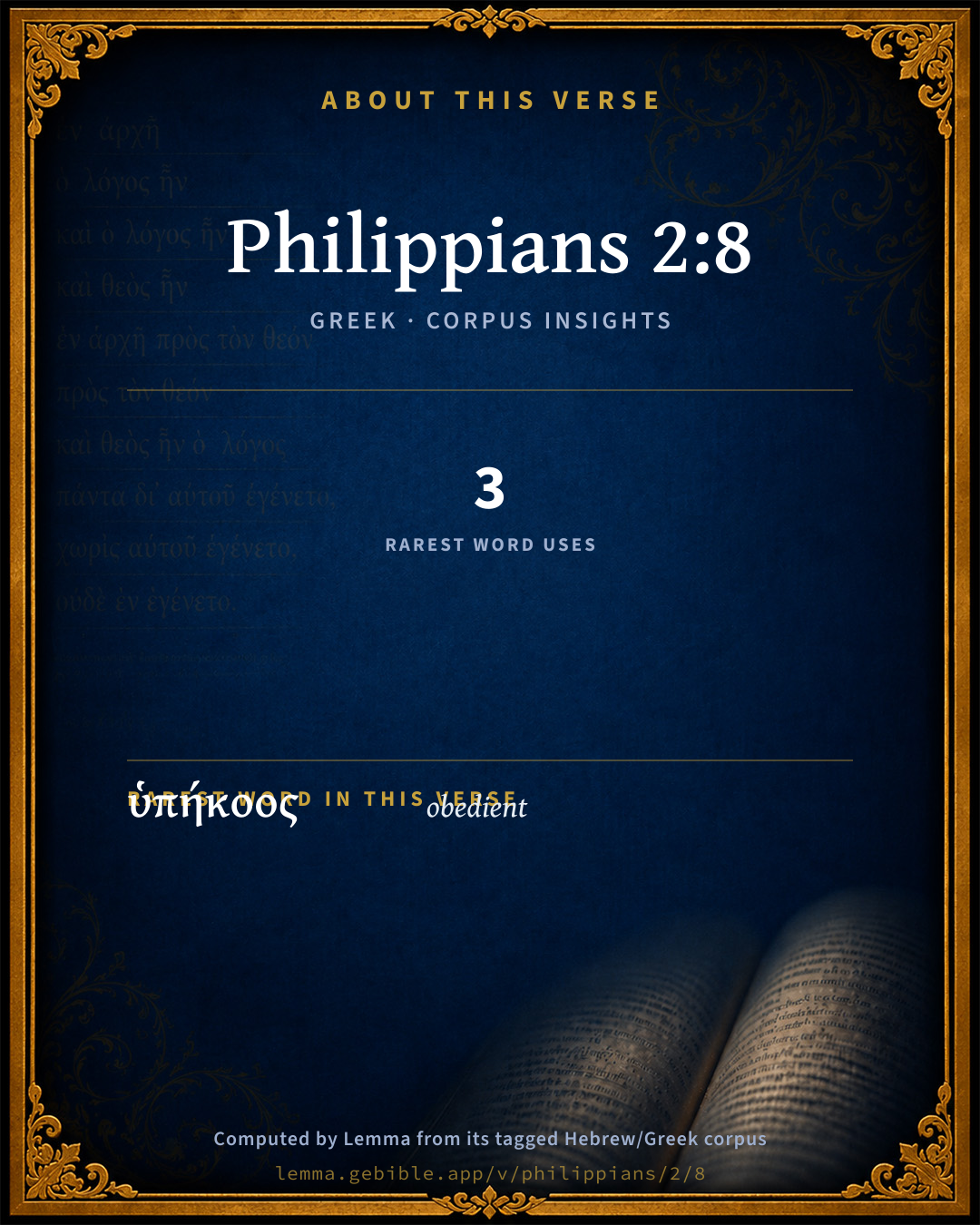
Philippians 2:8

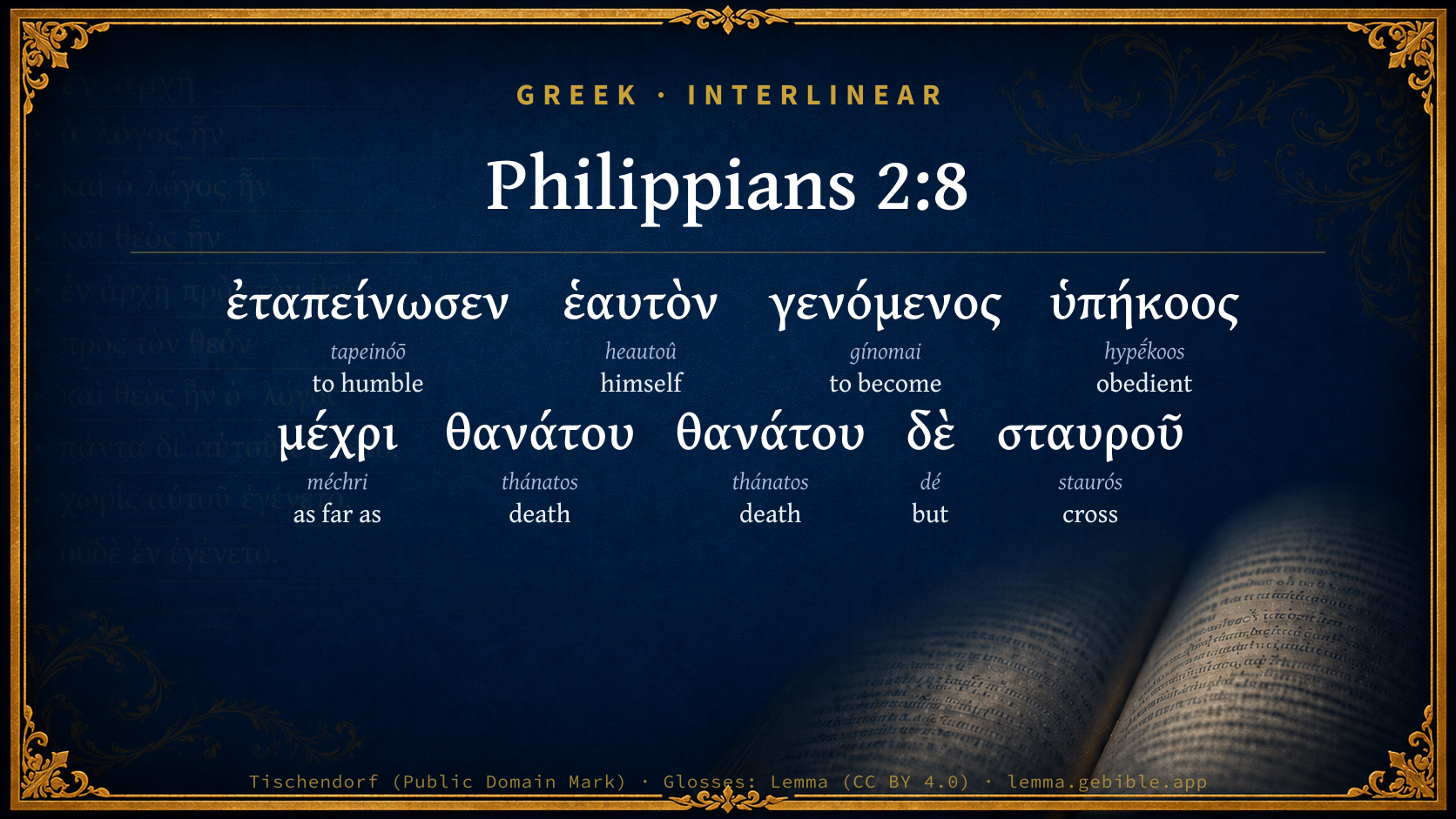
Greek (Tischendorf 8th ed.) Philippians 2:8 appears in the Greek New Testament. The text above is from the Tischendorf 8th edition. Each word links to its Strong’s number and a concise gloss. Click any word for its full Thayer’s Greek Lexicon entry.
Download image
Cite this verse

Philippians 2:8 (World English Bible). Public Domain. Lemma interlinear Bible study tool, https://lemma.gebible.app/v/philippians/2/8.

Show BibTeX & RIS
BibTeX
RIS
English Translation
And being found in human form, he humbled himself, becoming obedient to death, yes, the death of the cross.
World English Bible · Public Domain
Download a study sheet

One document with this verse’s original text, its word-by-word gloss line, the meaning frame, cross-references with their text, attributed commentary, and full source and license credits — printable, and it pastes into notes with its structure intact.

This verse Autodidact and up

Study sheet (.html) Plain text (.txt)

A passage Seminary Student

Up to 50 verses in one chapter. A passage sheet keeps up to 6 commentary sources and 12 cross-references per verse, in the order this page ranks them, and says so on the sheet whenever that leaves anything out. Ask for a single verse and you get the Autodidact verse sheet above.

Everything on this page stays free to read, with no account — the sheet is a download of what is already on screen, not access to it.

Want to remove ads? Support Godless Engineer
Compare translations 3

The same verse in 3 English versions, stacked beneath the original-language interlinear above. Click any original word for its lexicon entry.

Each is an independent rendering of the whole verse — the interlinear is not word-aligned to these translations.

Highlighted words mark where these versions differ — a whole-verse word diff, not a word-by-word alignment.

  • World English Bible Public Domain
    And being found in human form, he humbled himself, becoming obedient to death, yes, the death of the cross.
  • King James Version Public Domain
    And being found in fashion as a man, he humbled himself, and became obedient unto death, even the death of the cross.
  • unfoldingWord Literal Text CC BY-SA 4.0
    he humbled himself, having become obedient to the point of death, even death on a cross!

unfoldingWord Literal Text — © unfoldingWord, licensed CC BY-SA 4.0. Word-aligned USFM3 via Door43 (git.door43.org/unfoldingWord/en_ult).

Versions to compare (up to 4)

3 of 4 selected

Show all 19 translations

Every available English version of this verse, each an independent rendering of the whole verse.

  • World English Bible Public Domain
    And being found in human form, he humbled himself, becoming obedient to death, yes, the death of the cross.
  • Berean Standard Bible Public Domain
    And being found in appearance as a man, He humbled Himself and became obedient to death—even death on a cross.
  • Majority Standard Bible Public Domain
    And being found in appearance as a man, He humbled Himself and became obedient to death—even death on a cross.
  • King James Version Public Domain
    And being found in fashion as a man, he humbled himself, and became obedient unto death, even the death of the cross.
  • American Standard Version (1901) Public Domain
    and being found in fashion as a man, he humbled himself, becoming obedient `even' unto death, yea, the death of the cross.
  • Revised Version (1885) Public Domain
    and being found in fashion as a man, he humbled himself, becoming obedient even unto death, yea, the death of the cross.
  • Geneva Bible (1599) Public Domain
    He humbled himselfe, and became obedient vnto the death, euen the death of the Crosse.
  • Douay-Rheims (1899) Public Domain
    He humbled himself, becoming obedient unto death, even to the death of the cross.
  • Young's Literal Translation Public Domain
    and in fashion having been found as a man, he humbled himself, having become obedient unto death -- death even of a cross,
  • Literal Standard Version CC BY-SA 4.0
    and having been found in appearance as a man, He humbled Himself, having become obedient to death—even death of a cross,
  • Unlocked Literal Bible CC BY-SA 4.0
    He humbled himself and became obedient to the point of death, even death of a cross!
  • unfoldingWord Literal Text CC BY-SA 4.0
    he humbled himself, having become obedient to the point of death, even death on a cross!
  • Darby Bible Public Domain
    and having been found in figure as a man, humbled himself, becoming obedient even unto death, and [that the] death of [the] cross.
  • World Messianic Bible Public Domain
    And being found in human form, he humbled himself, becoming obedient to the point of death, yes, the death of the cross.
  • Webster's Bible Public Domain
    And being found in fashion as a man, he humbled himself, and became obedient to death, even the death of the cross.
  • Free Bible Version CC BY-SA 4.0
    Coming in human form, humbling himself, he submitted himself to death—even death on a cross.
  • Bible in Basic English Public Domain
    And being seen in form as a man, he took the lowest place, and let himself be put to death, even the death of the cross.
  • Text-Critical English NT CC BY 4.0
    And being found in appearance as a man, he humbled himself by becoming obedient to the point of death, even death on a cross.
  • Tyndale New Testament (1534) Public Domain
    and was founde in his aparell as a man. He humbled him silfe and became obediet vnto the deeth even the deeth of the crosse.

Literal Standard Version (2020), Covenant Press — licensed CC BY-SA 4.0. Text via the HelloAO Bible API (eBible.org). Unlocked Literal Bible (unfoldingWord) — licensed CC BY-SA 4.0. Text via the HelloAO Bible API (eBible.org). unfoldingWord Literal Text — © unfoldingWord, licensed CC BY-SA 4.0. Word-aligned USFM3 via Door43 (git.door43.org/unfoldingWord/en_ult). Free Bible Version, Dr. Jonathan Gallagher — licensed CC BY-SA 4.0. Text via the HelloAO Bible API (eBible.org).

Word by word

More ways to search: Search by grammar → Find every occurrence → Compare this word →

Practice this passage: Drill this verse → Learn its vocabulary →

About this verse

These counts appear in no published source. They are computed here, from the morphology-tagged text and Lemma’s own curated glosses. What Lemma adds →

9
words
8
distinct lemmas
Pauline Epistles
section

Notable vocabulary

The rarest word here is ὑπήκοος obedient G5255 — appearing just 3 times in the whole Greek New Testament.

Shared distinctive vocabulary

ὑπήκοος obedient G5255 occurs in 3 verses of the Greek New Testament. Also found in:

Repetition

A word recurs within this verse:

  • θανάτου death G2288 ×2

Cross-references

25

Topical passages linked to Philippians 2:8 in the Treasury of Scripture Knowledge — connected by theme and wording, ordered by reader-vote popularity; previews shown in the World English Bible.

  • John 10:18 No one takes it away from me, but I lay it down by myself. I have power to lay it down, and I have power to take it again. I received this commandment from my Father."
  • Hebrews 12:2 looking to Jesus, the author and perfecter of faith, who for the joy that was set before him endured the cross, despising shame, and has sat down at the right hand of the throne of God.
  • Romans 5:19 For as through the one man's disobedience many were made sinners, even so through the obedience of the one will many be made righteous.
  • 1 Peter 2:24 who his own self bore our sins in his body on the tree, that we, having died to sins, might live to righteousness; by whose stripes you were healed.
  • 1 Peter 3:18 Because Christ also suffered for sins once, the righteous for the unrighteous, that he might bring you to God; being put to death in the flesh, but made alive in the spirit;
  • 2 Corinthians 8:9 For you know the grace of our Lord Jesus Christ, that, though he was rich, yet for your sakes he became poor, that you through his poverty might become rich.
  • Matthew 26:39 He went forward a little, fell on his face, and prayed, saying, "My Father, if it is possible, let this cup pass away from me; nevertheless, not what I desire, but what you desire."
  • Acts 8:33 In his humiliation, his judgment was taken away. Who will declare His generation? For his life is taken from the earth."
  • Galatians 3:13 Christ redeemed us from the curse of the law, having become a curse for us. For it is written, "Cursed is everyone who hangs on a tree,"
  • Titus 2:14 who gave himself for us, that he might redeem us from all iniquity, and purify for himself a people for his own possession, zealous for good works.
  • Isaiah 50:5–6 The Lord Yahweh has opened my ear, and I was not rebellious, neither turned away backward.
  • Hebrews 5:5–9 So also Christ didn't glorify himself to be made a high priest, but it was he who said to him, "You are my Son. Today I have become your father."
  • John 14:31 But that the world may know that I love the Father, and as the Father commanded me, even so I do. Arise, let us go from here.
  • Psalms 40:6–8 Sacrifice and offering you didn't desire. You have opened my ears: Burnt offering and sin offering you have not required.
  • Proverbs 15:33 The fear of Yahweh teaches wisdom. Before honor is humility.
  • John 12:28–32 Father, glorify your name!" Then there came a voice out of the sky, saying, "I have both glorified it, and will glorify it again."
  • John 15:10 If you keep my commandments, you will remain in my love; even as I have kept my Father's commandments, and remain in his love.
  • Matthew 26:42 Again, a second time he went away, and prayed, saying, "My Father, if this cup can't pass away from me unless I drink it, your desire be done."
  • Psalms 22:16 For dogs have surrounded me. A company of evil-doers have enclosed me. They pierced my hands and my feet.
  • Hebrews 10:7–9 Then I said, 'Behold, I have come (In the scroll of the book it is written of me) To do your will, God.'"
  • Deuteronomy 21:23 his body shall not remain all night on the tree, but you shall surely bury him the same day; for he who is hanged is accursed of God; that you don't defile your land which Yahweh your God gives you for an inheritance.
  • Matthew 17:2 He was transfigured before them. His face shone like the sun, and his garments became as white as the light.
  • Mark 9:2–3 After six days Jesus took with him Peter, James, and John, and brought them up onto a high mountain privately by themselves, and he was changed into another form in front of them.
  • John 4:34 Jesus said to them, "My food is to do the will of him who sent me, and to accomplish his work.
  • Luke 9:29 As he was praying, the appearance of his face was altered, and his clothing became white and dazzling.

Cross-references courtesy of OpenBible.info (CC BY 4.0).

Commentary

Notes on Philippians 2:8 from classic Christian and Jewish commentators (each source and its license shown beneath its notes). The classic Christian expositions comment on the surrounding passage and are grouped to its opening verse, so a note may address several verses; the Jewish commentaries on the Tanakh (Rashi and others) are per-verse, so they appear only where the commentator wrote on this verse.

Lemma curates 59 commentaries, every one of them public domain or Creative Commons licensed, each selected and text-cleaned for this edition rather than reprinted as found. About our sources →

Jamieson, Fausset & Brown

Robert Jamieson, A. R. Fausset & David Brown

being found in fashion as a man--being already, by His "emptying Himself," in the form of a servant, or likeness of man (Rom 8:3), "He humbled Himself (still further by) becoming obedient even unto death (not as English Version, 'He humbled Himself and became,'&c.; the Greek has no 'and,' and has the participle, not the verb), and that the death of the cross." "Fashion" expresses that He had the outward guise, speech, and look. In Phi 2:7, in the Greek, the emphasis is on Himself (which stands before the Greek verb), "He emptied Himself," His divine self, viewed in respect to what He had heretofore been; in Phi 2:8 the emphasis is on "humbled" (which stands before the Greek "Himself"); He not only "emptied Himself" of His previous "form of God," but submitted to positive HUMILIATION. He "became obedient," namely, to God, as His "servant" (Rom 5:19; Heb 5:8). Therefore "God" is said to "exalt" Him (Phi 2:9), even as it was God to whom He became voluntarily "obedient." "Even unto death" expresses the climax of His obedience (Joh 10:18).

Jamieson, Fausset & Brown — Commentary Critical and Explanatory on the Whole Bible (1871) — public domain (CC PDM 1.0). Text via the HelloAO Bible API.

Joseph Benson's Commentary

Php 2:8. And being found in fashion as a man — A common man, without any peculiar excellence or comeliness. The word σχημα, rendered fashion, includes all the particulars of a person’s outward appearance; such as his figure, air, looks, clothing, and gait. The word is also applied to things inanimate, as, (1Co 7:31,) the fashion of this world passeth away. He humbled himself — To a still greater depth: for his condescension to the rank of low life among sinful mortals, wonderful as it was, did not content him; but he became obedient — To his Father; even unto death — The greatest instance both of humiliation and obedience: and to no common form of dissolution, but to the ignominious, as well as painful death of the cross, inflicted on few but slaves, or the vilest malefactors. “The reasoning in this passage is beautiful. The Son of God did not proudly continue in his high station, but descended from it for a while, and placed himself in the lowest condition among men, serving every one with the humility and assiduity of a servant, or bondman, as δουλος signifies. Then, in obedience to his Father, (Joh 6:38,) he finished his services by suffering the painful and ignominious death of the cross as a malefactor, for the salvation of the world. Having this great example of humility and benevolence set before them by their Master, his disciples, who are above their brethren in station, should not on every occasion behave as their superiors; but, laying aside their dignity, they should cheerfully perform in person to their inferiors those offices of kindness and humanity which their distress requires; especially when the assistance wanted by their inferiors is of such an urgent nature that it admits of no delay.” — Macknight.

Joseph Benson's Commentary on the Old and New Testaments (1811–1818) — public domain. Text from a community e-Sword module.

Tyndale Open Study Notes

Tyndale Open Resources

2:8 in obedience to God: It was God’s will that Jesus die for the sins of humanity (see Isa 53:7; Matt 26:39; John 3:16; 10:17-18; Rom 5:8, 19; 8:3; Heb 5:8; 1 Jn 4:9-10, 14). • a criminal’s death on a cross: In the Roman Empire, crucifixion was a cruel and humiliating punishment for criminals.

Tyndale Open Study Notes — © Tyndale Open Resources, licensed CC BY-SA 4.0. Text via the HelloAO Bible API.

Bengel's Gnomon

Johann Albrecht Bengel

Php 2:8. Καὶ σχήματι, and in fashion) a distinct and lower degree of emptying. The antitheses are, the form of God, and the form of a servant. Yet such a division of the parts of the sentence remains as joins the two words, emptied, humbled, by and, without an asyndeton.[20] ἈΛΛᾺ, but, Php 2:7, divides into its two distinct parts the whole antithesis, which, after the ὃς, who, in the former part, has two clauses; more clauses in the second.—σχήματι εὑρεθεὶς ὡς ἄνθρωπος, being found in fashion as a man) σχῆμα, fashion, dress, clothing, food, gesture, words and actions.—εὑρεθεὶς, being found) showing Himself such, and bearing Himself so in reality.—ὡς ἄνθρωπος) as a man, a common man, as if He were nothing else besides, and as if He did not excel other men; He assumed to Himself nothing extraordinary.—ἐταπείνωσεν ἑαυτὸν, He humbled Himself [Engl. Vers. made Himself of no reputation]) The state of emptying gradually becomes deeper.—γενόμενος ὑπήκοος) became obedient, Heb 5:8, viz. to God. This ellipsis expresses εὐλάβειαν, the dutiful condescension of Jesus Christ; obedience becomes a slave.—μέχρι, even to [as far as to]) construed with humbled, also with obedient. There is the greatest humiliation in death; ch. Php 3:21; Act 8:33; Psa 90:3, LXX.; and the greatest obedience, Joh 10:18.—σταυροῦ, of the cross) which was the usual punishment of slaves [servants, whose form He took upon Him].

[20] So Lachm. rightly punctuates with comma after ἀνθρώπων γενόμενος, and καὶ σχήματι—ἐταπείνωσεν ἑαυτόν, without asyndeton. But Tisch. joins γενόμενος and εὑρεθεὶς by καὶ, putting the comma after ἄνθρωπος, so that here is an asyndeton between ἐκένωσεν and ἐταπείνωσεν.—ED.

Bengel's Gnomon of the New Testament — English translation (T&T Clark, Edinburgh, 1860) — public domain. Text from a community e-Sword module.

Meyer's Critical & Exegetical Commentary

Heinrich August Wilhelm Meyer

Php_2:8. Ἐταπείνωσεν] is placed with great emphasis at the head of a new sentence (see on Php_2:7), and without any connecting particle: He has humbled Himself. Ἑαυτόν is not prefixed as in Php_2:7; for in Php_2:7 the stress, according to the object in view, was laid on the reflexive reference of the action, but here on the reflexive action itself. The relation to ἐκένωσε is climactic, not, however, as if Paul did not regard the self-renunciation (Php_2:7) as being also self-humiliation, but in so far as the former manifested in the most extreme way the character of ταπείνωσις in the shameful death of Jesus. It is a climactic parallelism (comp. on Php_4:9) in which the two predicates, although the former in the nature of the case already includes the latter (in opposition to Hofmann), are kept apart as respects the essential points of their appearance in historical development. Bengel well remarks: Status exinanitionis gradatim profundior. Hoelemann, mistaking this, says: He humbled Himself even below His dignity as man.

γενόμ. ὑπήκοος] The aorist participle is quite, like the participles in Php_2:7, simultaneous with the governing verb: so that He became obedient. This ὑπήκοος is, however, not to be defined by capientibus se, damnantibus et interficientibus (Grotius); nor is it to be referred to the law, Gal_4:4 (Olshausen), but to God (Rom_5:19; Heb_5:8 f.), whose will and counsel (comp. e.g. Mat_26:42) formed the ground determining the obedience. Comp. Php_2:9 : διὸ καὶ ὁ Θεός κ.τ.λ. The expression itself glances back to μορφ. δούλου; obedientia servum decet, Bengel.

μέχρι θανάτου] belongs to ὑπήκ. γενόμ., not to ἐταπ. ἑαυτ. (Bengel, Hoelemann)which latter connection is arbitrarily assumed, dismembers the discourse, and would leave a too vague and feeble definition for ἐταπ. ἑαυτ. in the mere ὑπήκ. γενόμ. By μέχρι death is pointed out as the culminating point, as the highest degree, up to which He obeyed, not merely as the temporal goal (van Hengel). Comp. 2Ti_2:9; Heb_12:4; Act_22:4; Mat_26:38. This extreme height reached by His obedience was, however, just the extreme depth of the humiliation, and thereby at the same time its end; comp. Act_8:33; Isa_53:8. Hofmann groundlessly takes ὑπήκ. γίνεσθαι in the sense of showing obedience (comp. on Gal_4:12). The obedience of Christ was an ethical becoming (Heb_5:8).

θανάτου δὲ σταυρ.] τουτέστι τοῦ ἐπικαταράτου (comp. Gal_3:13; Heb_12:2), τοῦ τοῖς ἁνόμοις ἀφωρισμένου, Theophylact. The δέ, with the repetition of the same word (comp. Rom_3:22; Rom_9:30), presents, just like the German aber, the more precisely defined idea in contradistinction to the idea which is previously left without this special definition: unto death, but what kind of death? unto the most shameful and most painful, unto the death of the cross; see Klotz, ad Devar. p. 361, and Baeumlein, Partik. p. 97; and the examples in Hartung, Partikell. I. p. 168 f.; Ellendt, Lex. Soph. I. p. 388.

REMARK 1.

According to our explanation, Php_2:6-8 may be thus paraphrased: Jesus Christ, when He found Himself in the heavenly mode of existence of divine glory, did not permit Himself the thought of using His equality with God for the purpose of seizing possessions and honour for Himself on earth: No, He emptied Himself of the divine glory, inasmuch as, notwithstanding His God-equal nature, He took upon Him the mode of existence of a slave of God, so that He entered into the likeness of men, and in His outward bearing and appearance manifested Himself not otherwise than as a man. He humbled Himself, so that He became obedient unto God, etc. According to the explanation of our dogmatic writers, who refer Php_2:6-8 to the earthly life of Christ, the sense comes to this: Christum jam inde a primo conceptionis momento divinam gloriam et majestatem sibi secundum humanam naturam communicatam plena usurpatione exserere et tanquam Deum se gerere potuisse, sed abdicasse se plenario ejus usu et humilem se exhibuisse, patrique suo coelesti obedientem factum esse usque ad mortem crucis (Quenstedt). The most thorough exposition of the passage and demonstration in this sense, though mixed with much polemical matter against the Reformed and the Socinians, are given by Calovius. The point of the orthodox view, in the interest of the full Deity of the God-man, lies in the fact that Paul is discoursing, not de humiliatione INCARNATIONIS, but de humiliatione INCARNATI. Among the Reformed theologians, Calvin and Piscator substantially agreed with our [Lutheran] orthodox expositors.

REMARK 2.

On a difference in the dogmatic understanding of Php_2:6-8, when men sought to explain more precisely the doctrine of the Church (Form. Conc. 8), was based the well-known controversy carried on since 1616 between the theologians of Tübingen and those of Giessen. The latter (Feuerborn and Menzer) assigned to Jesus Christ in His state of humiliation the κτῆσις of the divine attributes, but denied to Him their χρῆσις, thus making the κένωσις a renunciation of the χρῆσις. The Tübingen school, on the other hand (Thummius, Luc. Osiander, and Nicolai), not separating the κτῆσις and χρῆσις, arrived at the conclusion of a hidden and imperceptible use of the divine attributes, and consequently made the κένωσις a κρύψις τῆς χρήσεως. See the account of all the points of controversy in Dorner, II. 2, p. 661 ff., and especially Thomasius, Christi Pers. u. Werk, II. p. 429 ff. The Saxon Decisio, 1624, taking part with the Giessen divines, rejected the κρύψις, without thoroughly refuting it, and even without avoiding unnecessary concessions to it according to the Formula Concordiae (pp. 608, 767), so that the disputed questions remained open and the controversy itself only came to a close through final weariness. Among the dogmatic writers of the present day, Philippi is decidedly on the side of the Giessen school. See his Glaubensl. IV. 1, p. 279 ff. ed. 2. It is certain that, according to our passage, the idea of the κένωσις is clearly and decidedly to be maintained, and the reducing of it to a κρύψις rejected. But, since Paul expressly refers the ἑαυτὸν ἐκένωσε to the μορφὴ Θεοῦ, and consequently to the divine mode of appearance, while he makes the εἶναι ἴσα Θεῷ to subsist with the assumption of the μορφὴ δουλοῦ, just as subsequently the Incarnate One appears only as ἐν ὁμοιώματι ἀνθρ. and as σχήματι ὡς ἀνθρ.; and since, further, in the case of the κτήσις of the divine attributes thus laid down, the non-use of thembecause as divine they necessarily cannot remain dormant (Joh_5:17; Joh_9:4)is in itself inconceivable and incompatible with the Gospel history; the κτῆσις and the χρῆσις must therefore be inseparably kept together. But, setting aside the conception of the κρύψις as foreign to the N. T., this possession and use of the divine attributes are to be conceived as having, by the renunciation of the μορφὴ Θεοῦ in virtue of the incarnation, entered upon a human development, consequently as conditioned, not as absolute, but as theanthropic. At the same time, the self-consciousness of Jesus Christ necessarily remained the self-consciousness of the Son of God developing Himself humanly, or (according to the Johannine phrase) of the Logos that had become flesh, who was the μονογενὴς παρὰ πατρός; see the numerous testimonies in Johns Gospel, as Joh_3:13, Joh_8:58, Joh_17:5, Joh_5:26. Considered from a purely exegetical point of view, there is no clearer and more certain result of the interpretation of Scripture than the proposition, that the Ego of Jesus on earth was identical with the Ego which was previously in glory with the Father; any division of the Son speaking on earth into two Egos, one of whom was the eternally glorious Logos, the other the humanly humble Jesus, is rejected by clear testimonies of Scripture, however intimate we may seek to conceive the marriage of the two during the earthly life of Jesus; Liebner in the Jahrb. f. Deutsche Theol. 1858, p. 362. That which the divine Logos laid aside in the incarnation was, according to our passage, the μορφὴ Θεοῦ, that is, the divine δόξα as a form of existence, and not the εἶναι ἴσα Θεῷ essentially and necessarily constituting His nature, which He retained,[115] and to which belonged, just as essentially and necessarily, the divineand consequently in Him who had become man the divine-humanself-consciousness.[116] But as this cannot find its adequate explanation either in the absolute consciousness of God, or in the archetypal character which Schleiermacher assigned to Christ, or in the idea of the religious genius (Al. Schweizer), or in that of the second Adam created free from original sin, whose personal development proceeds as a gradual incarnation of God and deification of man (Rothe), so we must by no means say, with Gess, v. d. Pers. Chr. p. 304 f., that in becoming incarnate the Logos had laid aside His self-consciousness, in order to get it back again only in the gradual course of development of a human soul, and that merely in the form of a human self-consciousness. See, in opposition to this, Thomasius, Christi Pers. u. Werk, II. p. 198 f.; Schoeberlein in the Jahrb. f. D. Th. 1871, p. 471 ff., comp. the latters Geheimnisse des Glaubens, 1872, 3. The various views which have been adopted on the part of the more recent Lutheran Christologists,[117] diverging from the doctrine of the Formula Concordiae in setting forth Christs humiliation (Dorner: a gradual ethical blending into one another of the divine and human life in immanent development; Thomasius: self-limitation, i.e. partial self-renunciation of the divine Logos; Liebner: the entrance of the Logos into a process of becoming, that is, into a divine-human development), do not fall to be examined here in detail; they belong to the province of Dogmatics. See the discussions on the subject by Dorner, in the Jahrb. f. Deutsche Theol. 1856, 2, 1857, 2, 1858, 3; Broemel, in the Kirchl. Zeitschr. of Kliefoth and Mejer, 1857, p. 144 ff.; Liebner, in the Jahrb. f. Deutsche Theol. 1858, p. 349 ff.; Hasse, ibid. p. 336 ff.; Schoeberlein, l.c. p. 459 ff.; Thomasius, Chr. Pers. u. Werk, II. pp. 192 ff., 542 ff.; Philippi, Dogmat. IV. 1, p. 364 ff.

According to Schoeberlein, the Son of God, when He became man, did not give up His operation in governing the world in conjunction with the Father and the Holy Spirit, but continued to exercise it with divine consciousness in heaven. Thus the dilemma cannot be avoided, either of supposing a dual personality of Christ, or of assuming, with Schoeberlein, that heaven is not local. Not only the former, however, but the latter view also, would be opposed to the entire N. T.

[115] Comp. Düsterdieck, Apolog. Abh. III. p. 67 ff.

[116] Paul agrees in substance with the Logos doctrine of John, but has not adopted the form of Alexandrine speculation. That the latter was known to him in its application to the Christology, may at least be regarded as probable from his frequent and long intercourse with Asia, and also from his relation to Apollos. His conception, however, is just as little Apollinarian as that of John; comp. on Rom_1:3 f.; Col_1:15.

[117] Schenkels ideal transference of Christs pre-existence simply into the self-consciousness of God, which in the person of Christ found a perfect self-manifestation like to humanity, boldly renounces all the results of historical exegesis during a whole generation, and goes back to the standpoint of Löffler and others, and also further, to that of the Socinians. Comp. on Joh_17:5. Yet even Beyschlags Christology leads no further than to an ideal pre-existence of Christ as archetype of humanity, and that not as a person, but merely as the principle of a person;while Keerl (d. Gottmensch. das Ebenbild Gottes, 1866), in unperceived direct opposition to our passage and to the entire N. T., puts the Son of God already as Son of man in absolute (not earthly) corporeality as pre-existent into the glory of heaven. From 1Co_15:47 the conception of the pre-existence of Christ as a heavenly, pneumatic man and archetype of humanity (Holsten, Biedermann, and others) can only be obtained through misapprehension of the meaning. See on 1 Cor. l.c., and Grimm, p. 51 ff.

Meyer — Critical and Exegetical Commentary on the New Testament — English translation by Peter Christie, edited by Frederick Crombie (T&T Clark, 1880) — public domain. Text from a community e-Sword module.

Expositor's Greek Testament

ed. W. Robertson Nicoll

Phi 2:8 . καὶ seems to introduce a break. The Apostle goes on to describe the depth of the self-renunciation. No doubt there is here especially before Paul’s mind the contrast between what Christ “ is in Himself and what He appeared in the eyes of men” (Lft [1] ). σχήμ . = Lat. habitus , the external bearing or fashion, “the transitory quality of our materiality” (Gore). εὑρεθείς . Each word in the description emphasises the outward semblance. “Being found, discovered to be.” The verdict of his fellow-creatures upon Him. They classed Him as an ἄνθρωπος . His outward guise was altogether human. ἐταπ . Even as man He endured great humiliation, for He suffered the shameful death of the Cross. For surely ἐταπ . is more than a vivid, lively way of expressing ἐκέν . (as Weiffenb., op. cit. , p. 42). The rest of the verse depicts His humiliation. That consists in His obedience and the terrible issue to which it led. As obedient, He gave Himself wholly up to His Father’s will. And the course of following that will led as far as ( μέχρι ) death itself, no ordinary death ( δέ bringing into prominence the special nature of it, cf. Rom 3:22 ; Rom 9:30 ), but a death of shame and suffering. Cf. Cic., pro Rabir. , v., 10 (quoted by Moule): Mors si proponitur, in libertate moriamur … nomen ipsum crucis absit non modo a corpore civium Romanorum sed etiam a cogitatione, oculis, auribus . This would come home with force to the minds of the Philippians who enjoyed the jus Italicum .

[1] Lightfoot.

The Expositor's Greek Testament, edited by W. Robertson Nicoll (1897–1910) — public domain. Text from a community e-Sword module.

Adam Clarke's Commentary

Verse 8. And being found in fashion as a man] Και σχηματι εὑρεθεις ὡς ανθρωπος. This clause should be joined to the preceding, and thus translated: Being made in the likeness of man, and was found in fashion as a man.

He humbled himself] Laid himself as low as possible:

1. In emptying himself-laying aside the effulgence of his glory.

2. In being incarnate-taking upon him the human form.

3. In becoming a servant-assuming the lowest innocent character, that of being the servant of all.

4. In condescending to die, to which he was not naturally liable, as having never sinned, and therefore had a right in his human nature to immortality, without passing under the empire of death.

5. In condescending, not only to death, but to the lowest and most ignominious kind of death, the death of the cross; the punishment of the meanest of slaves and worst of felons.

What must sin have been in the sight of God, when it required such abasement in Jesus Christ to make an atonement for it, and undo its influence and malignity!

Adam Clarke's Commentary on the Bible (1810–1826) — public domain. Text from a community e-Sword/MySword module.

John Calvin's Commentaries

8 He became obedient. Even this was great humility — that from being Lord he became a servant; but he says that he went farther than this, because, while he was not only immortal, but the Lord of life and death, he nevertheless became obedient to his Father, even so far as to endure death. This was extreme abasement, especially when we take into view the kind of death, which he immediately adds, with the view of enhancing it. For by dying in this manner he was not only covered with ignominy in the sight of God, but was also accursed in the sight of God. It is assuredly such a pattern of humility as ought to absorb the attention of all mankind; so far is it from being possible to unfold it in words in a manner suitable to its dignity.

John Calvin's Commentaries (1540-1563) — public domain. Text from the Calvin Translation Society English edition (1840s-50s) via the Christian Classics Ethereal Library (ccel.org). Calvin's coverage is partial (roughly two-thirds of the Bible); uncommented books and verses are honest gaps, never fabricated. The 19th-century editor's footnotes and remarks are omitted so the notes are faithfully Calvin's own voice.

Ellicott's Commentary for English Readers

(8) And being found . . .—This should be, And after having been found (or, recognised) in fashion as a man, He [then] humbled Himself, having become obedient even to death. “After having been found,” &c., clearly refers to the manifestation of Himself to the world in all the weakness of humanity: the “outward fashion” was all that men could see; and in it they found “no form or comeliness,” or “beauty, that they should desire Him” (Isa_53:2-3). From this St. Paul proceeds to the last act of His self-humiliation in death: “He became obedient,” that is, to God’s will, “even up to death.” His death is not here regarded as an atonement, for in that light it could be no pattern to us; but as the completion of the obedience of His life. (See Rom_5:19.) Of that life as a whole He said, “I came down from heaven, not to do My own will, but the will of Him that sent Me” (Joh_6:38); and the doing that will (see Heb_10:9-10) ended in “the offering of the body of Jesus Christ once for all.” In this light His death is the perfection of the suffering which, in consequence of the power of sin in the world, must be faced in doing the will of God (see 2Ti_3:12); in this light we can follow it, and even “fill up what is lacking of the sufferings of Christ” (Col_1:24).

Even the death of the cross.—Properly, and that too, the death of the cross; emphasising its peculiar shame and humiliation as an “accursed” death. (See Gal_3:13.)

A Bible Commentary for English Readers, edited by Charles John Ellicott (1878–1897) — public domain. Text from a community e-Sword module.

The Cambridge Bible for Schools and Colleges

gen. ed. J. J. S. Perowne

8. found] as one who presented Himself for inspection and test. See Appendix F.

fashion] See third note on Php_2:6 above. The Greek word schêma denotes appearance with or without underlying reality. It does not negative such reality any more than it asserts it; it emphasizes appearance. In the context, we have the reality of the Lord’s Manhood abundantly given; and in this word accordingly we read, as in the word “likeness” just above, an emphatic statement that (a) He was Man in guise, not in disguise; presenting Himself to all the conditions of concrete life as Man with man; and that (b) all the while the schêma had more beneath it than its own corresponding reality: it was the veil of Deity.

as a man] Better, perhaps, as man, though R.V. retains “as a man.” As the Second Man, our Lord is rather Man, the Man of men, than a Man, one among men.—Yet the assertion here is rather as to what He was pleased to be in relation to those who “found” Him, came into contact with Him, in His earthly walk; and to such He certainly was “a man.” And so, with wonderful condescension, He speaks of Himself as “a man that hath told you the truth” (Joh_8:40).

he humbled himself] in “the acts of condescension and humiliation in that human nature which He emptied Himself to assume” (Ellicott). More particularly the reference is to the specially submissive, bearing, life, under the afflictive will of His Father, which He undertook to lead for our sakes; see the next words. The Greek verb is in the aorist, and sums up the holy course of submission either into one idea, or into one initial crisis of will.

and became] Lit. and better, becoming; an aorist participle coincident in reference with the previous aorist verb.

obedient] to the Father’s will that He should suffer. The utterance of Gethsemane was but the amazing summary and crown of His whole sacred course as the Man of Sorrows. His “Passion,” standing in some vital respects quite alone in His work, was in other respects only the apex of His “Patience.”

unto death] R.V. rightly supplies even before these words. “Unto” means (by the Greek) “to the length of.” He did not “obey” but “abolish” death (2Ti_1:10); He obeyed His Father, “even to the extent of” dying, as the sinner’s Sacrifice, at the demand of the holy Law, and “by the determinate foreknowledge” (Act_2:23) of the Lawgiver.

of the cross] “Far be the very name of a cross not only from the bodies of Roman citizens, but from their imagination, eyes, and ears” (Cicero, pro Rabirio, c. 5. Cp. Gibbon, Decline and Fall, ch. xx.). Every thought of pain and shame was in the word, and was realized in the terrific thing. Combining, as we should do in the case of our Redeemer’s Crucifixion, the significance to the Jew of any death by suspension, with the significance to the Roman of execution on the cross, we must think of this supreme “obedience” as expressing the holy Sufferer’s submission both to “become a curse for us” (Gal_3:13, with Deu_21:23) as before God the Lawgiver, and meanwhile to be “despised and rejected of men” (Isa_53:3) in the most extreme degree.

On the history of thought and usage in connexion with the Cross, and Crucifixion, see Zöckler’s Cross of Christ.

The Cambridge Bible for Schools and Colleges (gen. ed. J. J. S. Perowne; Cambridge University Press, 1878–1918) — public domain. Text from a community e-Sword module.

John Gill's Exposition

And being found in fashion as a man,.... Not that he had only the show and appearance of a man, but he was really a man; for "as" here, denotes not merely the likeness of a thing, but the thing itself, as in Mat 14:5, here, answers to the Hebrew f2, which is sometimes by the Jews (k) said to be , and signifies likeness, and sometimes , and designs truth and reality; which is the sense in which the particle is to be taken here: though he was seen and looked upon as a mere man, and therefore charged with blasphemy when he asserted himself to be the Son of God, he was more than a man; and yet found and known by men in common to be no more than a man, than just such a man as other men are; and so far is true, that his scheme, his habit, his fashion, his form, were like that of other men; though he was not begotten as man, but conceived in an extraordinary manner by the power of the Holy Ghost, yet he lay nine months in his mother's womb, as the human foetus ordinarily does; he was born as children are, was wrapped in swaddling bands when born, as an infant is; grew in stature by degrees, as men do; the shape and size of his body were like other men's, and he was subject to the same infirmities, as hunger, thirst, weariness, pain, grief, sorrow, and death itself, as follows:

he humbled himself: by becoming man, and by various outward actions in his life; as subjection to his parents, working at the trade of a carpenter, conversing with the meanest of men, washing his disciples' feet, &c. and the whole of his deportment both to God and man, his compliance with his Father's will, though disagreeable to flesh and blood, his behaviour towards his enemies, and his forbearance of his disciples, showed him to be of a meek and humble spirit; he humbled himself both to God and man:

and became obedient unto death, or "until death"; for he was obedient from the cradle to the cross, to God, to men, to his earthly parents, and to magistrates; he was obedient to the ceremonial law, to circumcision, the passover, &c. to the moral law, to all the precepts of it, which he punctually fulfilled; and to the penalty of it, death, which he voluntarily and cheerfully bore, in the room and stead of his people:

even the death of the cross; which was both painful and shameful; it was an accursed one, and showed that he bore the curse of the law, and was made a curse for us: this was a punishment usually inflicted on servants, and is called a servile punishment (l); and such was the form which he took, when he was found in fashion as a man: this is now the great instance of humility the apostle gives, as a pattern of it to the saints, and it is a matchless and unparalleled one,

(k) Vid. Kimchi in Josh. iii. 4. (l) Lipsins de Cruce, l. 1. c. 12.

John Gill's Exposition of the Whole Bible (1746–1763) — public domain (CC PDM 1.0). Text via the HelloAO Bible API.

Trapp's Complete Commentary

John Trapp

8 And being found in fashion as a man, he humbled himself, and became obedient unto death, even the death of the cross.

Ver. 8. He humbled himself] The Sun of righteousness went 10 degrees back in the dial of his Father, that he might come to us with health in his wings, that is, in his beams.

Became obedient unto death] That is, to his dying day, saith Beza. He went through many a little death all his life long, and at length underwent that cursed and painful death of the cross, his soul also being heavy to the death, Mat 26:38, he suffered the insufferable wrath of God for a season. Ne perderet obedientiam, perdidit vitam, he lost his life lest he lose his submission to authority, saith Bernard.

John Trapp, A Commentary or Exposition upon All the Books of the Old and New Testament (1647–1656) — public domain. Text from a community e-Sword module.

Albert Barnes' Notes on the Bible

And being found - That is, being such, or existing as a man, he humbled himself.

In fashion as a man - The word rendered “fashion” - σχῆμα schēma - means figure, mien, deportment. Here it is the same as state, or condition. The sense is, that when he was reduced to this condition he humbled himself, and obeyed even unto death. He took upon himself all the attributes of a man. He assumed all the innocent infirmities of our nature. He appeared as other people do, was subjected to the necessity of food and clothing, like others, and was made liable to suffering, as other men are. It was still he who had been in the “form of God” who thus appeared; and, though his divine glory had been for a time laid aside, yet it was not extinguished or lost. It is important to remember, in all our meditations on the Saviour, that it was the same Being who had been invested with so much glory in heaven, that appeared on earth in the form of a man.

He humbled himself - Even then, when he appeared as a man. He had not only laid aside the symbols of his glory Phi 2:7, and become a man; but when he was a man, he humbled himself. Humiliation was a constant characteristic of him as a man. He did not aspire to high honors; he did not affect pomp and parade; he did not demand the service of a train of menials; but he condescended to the lowest conditions of life; Luk 22:27. The words here are very carefully chosen. In the former case Phi 2:7, when he became a man, he “emptied himself,” or laid aside the symbols of his glory; now, when a man, he humbled himself. That is, though he was God appearing in the form of man - a divine person on earth - yet he did not assume and assert the dignity and prerogatives appropriate to a divine being, but put himself in a condition of obedience. For such a being to obey law, implied voluntary humiliation; and the greatness of his humiliation was shown by his becoming entirely obedient, even until he died on the cross.

And became obedient - He subjected himself to the law of God, and wholly obeyed it; Heb 10:7, Heb 10:9. It was a characteristic of the Redeemer that he yielded perfect obedience to the will of God. Should it be said that, if he was God himself, he must have been himself the lawgiver, we may reply that this rendered his obedience all the more wonderful and all the more meritorious. If a monarch should for an important purpose place himself in a position to obey his own laws, nothing could show in a more striking manner their importance in his view. The highest honor that has been shown to the Law of God on earth was, that it was perfectly observed by him who made the Law - the great Mediator.

Unto death - He obeyed even when obedience terminated in death. The point of this expression is this: One may readily and cheerfully obey another where there is no particular peril. But the case is different where obedience is attended with danger. The child shows a spirit of true obedience when he yields to the commands of a father, though it should expose him to hazard; the servant who obeys his master, when obedience is attended with risk of life; the soldier, when he is morally certain that to obey will be followed by death. Thus, many a company or platoon has been ordered into the “deadly breach,” or directed to storm a redoubt, or to scale a wall, or to face a cannon, when it was morally certain that death would be the consequence. No profounder spirit of obedience can be evinced than this. It should be said, however, that the obedience of the soldier is in many cases scarcely voluntary, since, if he did not obey, death would be the penalty. But, in the case of the Redeemer, it was wholly voluntary. He placed himself in the condition of a servant to do the will of God, and then never shrank from what that condition involved.

Even the death of the cross - It was not such a death as a servant might incur by crossing a stream, or by failing among robbers, or by being worn out by toil; it was not such as the soldier meets when he is suddenly cut down, covered with glory as he falls; it was the long lingering, painful, humiliating death of the cross. Many a one might be willing to obey if the death that was suffered was regarded as glorious; but when it is ignominious, and of the most degrading character, and the most torturing that human ingenuity can invent, then the whole character of the obedience is changed. Yet this was the obedience the Lord Jesus evinced; and it was in this way that his remarkable readiness to suffer was shown.

Albert Barnes' Notes on the Bible (1834–1885) — public domain. Text from a community e-Sword/MySword module.

Matthew Poole's English Annotations

To be found is a mere Hebraism, not unusual in the New Testament, not importing auy question of the thing, but only the thing certainly happening beyond expectation. It notes here, not his being apprehended of the soldiers when betrayed by Judas, being before his humble obedience, but his being, and really appearing to be, (as the Greek word is elsewhere used, Phi 3:9; Gen 5:24; 2Co 5:3; Gal 2:17; Heb 11:5, with 1Pe 1:7), as a man, simply considered, among men, which was before his being scourged, &c. consequent upon his apprehension. Now being made man, not reserved for a time, like the angels, for heaven itself and the view of angels; neither, from the privilege of the first man, (which Adam could not keep), did he reserve himself for the inhabiting of Paradise only: but, after the manner of men, he stayed in this earth amongst and conversed with them, and therefore is said to be in the fashion of men, or as a man; whereby his habit and deportment is more especially expressed, as his essence in the foregoing phrase.

Man, here, is considered according to what is proper unto human nature, not having the article prefixed, as if it connoted the first man, Adam, only man as man; the particle as, here, not intimating only likeness, without reality of nature, (as the Marcionites conceited), but as a confirming and assuring particle, noting certainty, Joh 1:14. Some indeed take fashion more strictly, as noting only the external figure of Christ’s body; others, more largely and commodiously, for the whole outward species of human nature: whence the truth of the human nature shined out, not only in the figure and matter of the body, with true flesh and bones, the habit of his members, mouth, eyes, &c., that he might be seen and touched, 1Jo 1:1, as he himself allegeth, Luk 24:39; Joh 20:20,27, growing in wisdom and stature, Luk 2:52; but his labouring with hunger, thirst, and weariness, eating, drinking, sleeping, watching, speaking, gestures, being moved with pity, sorrow, joy, weeping, in all which his human nature was evidenced of God, and easily found of men who conversed with him, Joh 4:29; 9:11; 18:22. What the Socinians urge, that this gainsays his being incarnate, from Samson’s saying, I shall be weak, and be as another man, Jdg 16:7,11; there is no strength in the allegation, that Samson, of Dan’s tribe, Jdg 13:2, should be compared with Christ coming from heaven, (as they themselves do not deny), found in fashion as a man: because Samson, being stronger than a hundred men, if he were dealt so and so withal would become as other men, (for that is the import of the words), no stronger than any other man, Jdg 16:17; whereas here, it is not said as one, any, or every, but simply as a man: and from those in power dying as other men, Psa 82:7. When they scoffingly ask: Doth it evidence these to be incarnate? It is answered: Though he who was strong as many became weak as any one man; they who live in power die in weakness, as other men do, and are not said to be incarnate: yet he who, being equal with God, took on him the form of a servant, and was in this world a very man, may very well be said to be incarnate, 1Ti 3:16.

He humbled himself; he doth not say he was humbled or depressed by the just judgment of God, but of himself, voluntarily, on his own accord, without any constraint. He did really submit himself to the will of his Father, unto whom he was a servant, both in regard of the Divine nature, which he veiled, and also the human in his whole life, Luk 1:48, both outwardly and inwardly, Phi 2:5, in thoughts and affections, as well as actions and passions: wholly yielding his own will and appetite to God, by a patient subjection to affliction, not in showing humility only, but really undergoing it. For we find this low degree of his humiliation opposed to his superexaltation, in the following verse, and agreeing with what Isaiah prophesied of him, Isa 53:7, expounded by Philip, Act 8:32.

And became obedient unto death; without the copulative in the Greek, and expressing the manner of his humiliation, being of his own free will, and not by any force; made obedient, i.e. to God, (Not my will, but thine be done), to others, parents and magistrates, for God, according to the prescript of his law and will, in his life-time

unto death, and in death; unto being taken here, not exclusively, but inclusively, for the further amplification of the obedience, Mat 26:42; Joh 4:34; 8:29,46; Heb 10:9. Had he staid in his life for degrees of obedience, his condescension had been admirable, but that he should submit to a penal and painful death, (taking in his burial, and abiding in a separate state till the third day), this is stupendous: aggravated by the shame of dying on the cross, willingly and meekly yielding himself, though a Son, to that ignominious, cursed death, Deu 21:23; Act 5:30; Gal 3:10,13; Heb 12:2; far more reproachful than beheading, hanging, or burning; out of unspeakable love, to bring us nigh unto God, Rom 5:19; Col 2:14; 1Pe 2:24; 3:18. Upon these considerations, how should Christians in mutual love condescend to each other!

Matthew Poole's English Annotations on the Holy Bible (1683–1685) — public domain. Text from a community e-Sword/MySword module.

The Pulpit Commentary

And being found in fashion as a man. He humbled himself in the Incarnation; but this was not all. The apostle has hitherto spoken of our Lord"s Godhead which he had from the beginning, and of his assumption of our human nature. He now speaks of him as he appeared in the sight of men. The aorist participle, "being found (eureYeiv)," refers to the time of his earthly life when he appeared as a man among men. Fashion (schma), as opposed to form ( morfh), implies the outward and transitory. In outward appearance he was as a man; he was more, for he was God. He humbled himself, and became obedient unto death; translate, as R.V, obedient. The participle implies that the supreme act of self-humiliation consisted in the Lord"s voluntary submission to death. the obedience of his perfect life extended even unto death. "He taketh away literally, "beareth," airei the sin of the world;" "The wages of sin is death;" therefore he suffered death for the sin which, himself sinless, he vouchsafed to bear. Here we may remark in passing that this connection of death with sin must have made death all the more awful to our sinless Lord. Even the death of the cross. No ordinary death, but of all forms of death the most torturing, the most full of shame a death reserved by the Romans for slaves, a death accursed in the eyes of the Jews. (Deu_21:23)

The Pulpit Commentary (1880–1919), ed. H.D.M. Spence-Jones & Joseph S. Exell — public domain. Text from a community e-Sword module.

John Wesley's Explanatory Notes

And being found in fashion as a man - A common man, without any peculiar excellence or comeliness. He humbled himself - To a still greater depth. Becoming obedient - To God, though equal with him. Even unto death - The greatest instance both of humiliation and obedience. Yea, the death of the cross - Inflicted on few but servants or slaves.

John Wesley, Explanatory Notes Upon the Whole Bible (1754–1765) — public domain. Text via the GEBible commentary corpus.

The People's New Testament

B. W. Johnson

8. He humbled himself. Note the infinite condescension: (1) The form of God and sharing the divine glory. (2) He divests himself of this. (3) Nor does he then take the divine form, or even the form of an angel, but of lowly, sinful man. (4) But this is not all. He not only takes the form of man, but the mortality of the flesh, and dies. (5) Nay, more; he dies the most shameful and painful of all deaths, even the death of the cross.

B. W. Johnson's The People's New Testament with Notes (1889–1891) — public domain. Electronic text from the Christian Classics Ethereal Library (CCEL) ThML edition.

Cambridge Greek Testament for Schools and Colleges

8. καὶ. Here another movement of thought begins. We have seen the κένωσις of simple Incarnation. We now pass to the Sacrifice to which, in Manhood, He descended.

σχήματι. Habitu, Lat. Versions. Σχῆμα indicates appearance, with or without underlying reality; and thus is a partial antithesis to μορφή (see first note on Php 2:6 above, and cp. Rom 12:1). In itself it neither affirms nor denies reality; it emphasizes appearance. Thus here it carries out the suggestion just given by ὁμοίωμα. The Lord was (a) man not only in nature but in look, patent to all; and He was (b) more than met the eye: the true and manifest Manhood was the veil of Godhead.

The dative (σχήματι) is the not infrequent dative of relation, connexion; cp. 1Co 7:34, ἁγία σώματι καὶ πνεύματι, and in the classics such phrases as φύσει κακός (see Eph 2:3), γένει Ἕλλην.

εὑρεθεὶς. He was “found,” as one who presented Himself for scrutiny. Εὑρίσκω in Biblical Greek somewhat tends to less distinctive meanings; e.g. Luk 9:36, εὑρέθη Ἰησοῦς μόνος, where in effect we have Him simply “seen alone.” But the thought of inspection, examination, is suggested by association here.

ὡς ἄνθρωπος. Either, “as man,” or (A.V., R.V.) “as a man.” As the Second Man, Head of redeemed Manhood, He is rather Man than a man. Yet we may remember that the point of thought here is not on His difference from His brethren but on His likeness to them; He moved among them, in fact, as “a man.” So, with wonderful condescension, He calls Himself (the rendering must obviously be thus there) “a man that hath told you the truth” (Joh 8:40).

ἐταπείνωσεν ἑαυτὸν, “under the mighty hand (cp. 1Pe 5:6) of” His Father, in the life of surrender which led to the supreme surrender of the Cross. The following context seems to point the reference in this direction.

γενόμενος ὑπήκοος. The aorist participle, in close contact with the aorist verb (ἐταπείνωσεν), brings together the thoughts of self-humbling and of obedience; the “humiliation” coincided with, was expressed in, the “becoming obedient” to the Father’s will that He should suffer.

μέχρι θανάτου. “To the length of death.” “Even unto death,” R.V. Usque ad mortem, Lat. Versions. The A.V., “obedient, unto death,” might seem to mean that He “obeyed death.” This He never did; He obeyed His Father in dying, in order to “abolish death” (2Ti 1:10); dying as our Sacrifice, to meet the κατάρα τοῦ νόμου (Gal 3:13), by the holy will (Act 2:23) of the Lawgiver. Thus He carried His life-long “Patience” “to the length of” His “Passion,” seeking not His own will, but the will of the Father in our salvation.

θανάτου δὲ σταυροῦ. The δὲ carries a slight connective force; “nor only death, but death of cross.”—The Cross (infelix arbor) was the death not only of extreme agony but of the utmost degradation; to the Roman, certainly in all but the earliest ages of Rome, it was reserved for the slave and for the basest ruffian. Mors si proponitur, in libertate moriamur … nomen ipsum crucis absit non modo a corpore civium Romanorum, sed etiam a cogitatione, oculis, auribus (Cicero, pro C. Rabirio, v. § 10). In the case of our Redeemer’s Crucifixion, we see combined the Hebrew’s dread of any death-penalty by suspension (Deu 21:23) with the Roman’s horror of the servile cross. Thus the supreme Obedience expressed the Sufferer’s willingness both to “become a curse for us” (Gal 3:13) as before God the Lawgiver, and to be “despised and rejected of men” (Isa 53:3) as “the outcast of the people.” “Who shall fathom the abyss Where Thou plungedst for our love?”

Cambridge Greek Testament for Schools and Colleges (Cambridge University Press, 1896; 21 vols, various authors incl. Carr, Maclear, Plummer, Farrar, Lumby, Moule, M. R. James, Simcox) — public domain. Text from a community e-Sword module.

Alford’s Greek Testament

Henry Alford

8.] My interpretation has hitherto come very near to that of Meyer. But here I am compelled to differ from him. He would join καὶ σχ. εὑρ. ὡς ἄνθρ. to the foregoing, put a period at ἄνθρ., and begin the next sentence by ἐταπείνωσεν without a copula. The main objection to this with me, is, the word εὑρεθείς. It seems to denote the taking up afresh of the subject, and introducing a new portion of the history. Hitherto of the act of laying aside the form of God, specified to have consisted in μορφὴν δούλου λαβεῖν, and ἐν ὁμ. ἀνθρώπων γενέσθαι. But now we take Him up again, this having past; we find Him in his human appearance—and what then? we have further acts of self-humiliation to relate. So Van Hengel: “duo enim, ut puto, diversa hic tradit Paulus, et quamnam vivendi rationem Christus inierit, … et quomodo hanc vivendi rationem ad mortem usque persecutus sit.” And when He was (having been) found in having (guise, outward semblance; e.g. of look, and dress, and speech. σχήματι is a more specific repetition of ὁμοιώμ. above: and is here emphatic: ‘being found in habit, &c. He did not stop with this outward semblance, but …’) as a man (for He was not a man, but God (in Person), with the humanity taken on Him: ὡς ἄνθρωπος—ἡ γὰρ ἀναληφθεῖσα φύσις τοῦτο ἦν· αὐτὸς δὲ τοῦτο οὐκ ἦν, τοῦτο δὲ περιέκειτο, Thdrt.) He humbled himself (in His humanity: a further act of self-denial. This time, ἑαυτόν does not precede, because, as Meyer well says,—in ver. 7 the pragmatic weight rested on the reflexive reference of the act, but here on the reflexive act itself) by becoming (see on the aorist participle above. It specifies, wherein the ταπείνωσις consisted) obedient (to God; as before in the δούλου: not ‘capientibus se, damnantibus et interficientibus,’ as Grot. See Rom 5:19, Heb 5:8 f., and ver. 9,—διὸ καὶ ὁ θεός,—referring to the τῷ θεῷ here understood) even unto (as far as) death (the climax of His obedience, μέχρι θανάτου must not be taken with ἐταπείνωσεν, as Beng., al., which breaks the sentence awkwardly), and that the death of the cross (on this sense of δέ, see ref., and note there:—τουτέστι, τοῦ ἐπικαταράτου, τοῦ τοῖς ἀνόμοις ἀφωρισμένου, Thl.).

Henry Alford, The Greek Testament (1849–1861) — public domain. Text from a community e-Sword module.

International Critical Commentary

8. ἐταπείνωσεν ἑαυτὸν: ‘he humbled himself.’ The emphasis is on the act, not on the subject. Not synonymous with ἐκένωσεν. (Comp. 2Co 11:7; Php 4:12.)

The more general ἐταπείνωσεν is now specifically defined. γενόμενος ὑπήκοος: ‘becoming obedient or subject.’ He became as a man; in that condition he humbled himself; his humiliation appeared in his subjection. Γενόμ., with an explanatory force, ‘by becoming.’ Understand θεῷ. (Comp. Mat 26:39; Rom 5:19; Heb 5:8.)

μέχρι θανάτου: ‘even unto death.’ To the extent of death. (Comp. Heb 12:4; 2Ti 2:9.)

θανάτου δὲ σταυροῦ: ‘yea, death of the cross.’

Δὲ introduces another and more striking detail of the humiliation, and leads on to a climax: ‘death, yea, the most ignominious of deaths.’ For this force of δὲ, comp. Rom 3:22, Rom 9:20.

σταυροῦ: א adds του. The close of the description leaves the reader at the very lowest point of Christ’s humiliation, death as a malefactor; the mode of death to which a curse was attached in the Mosaic law. (See Deu 21:23; Gal 3:13; Heb 12:2.) Paul, as a Roman citizen, was exempt from this disgrace.

The result of this humiliation was the highest exaltation.

International Critical Commentary — older volumes (1896–1929), various authors — public domain. Text from a community e-Sword module.

Vincent's Word Studies in the New Testament

Marvin R. Vincent

Being found in fashion as a man [σχηματι ευρεθεις ως ανθρωπος] . Some expositors connect these words with the preceding clause, thus : being made in the likeness of men and being found in fashion as a man; a new sentence beginning with He humbled Himself. The general sense is not altered by this change, and there is great force in Meyer's remark that the preceding thought, in the likeness of men, is thus "emphatically exhausted." On the other hand, it breaks the connection with the following sentence, which thus enters very abruptly. Notice being found. After He had assumed the conditions of humanity, and men's attention was drawn to Him, they found Him like a man. Compare Isa 53:2. "If we looked at Him, there was no sightliness that we should delight in Him."

Fashion [σχηματι] . That which is purely outward and appeals to the senses. The form of a servant is concerned with the fact that the manifestation as a servant corresponded with the real fact that Christ came as the servant of mankind. In the phrase in the likeness of men the thought is still linked with that of His essential nature which rendered possible a likeness to men, but not an absolute identity with men. In being found in fashion as a man the thought is confined to the outward guise as it appealed to the sense of mankind. Likeness states the fact of real resemblance to men in mode of existence : fashion defines the outward mode and form. As a man. Not being found a man not what He was recognized to be, but as a man, keeping up the idea of semblance expressed in likeness.

He humbled Himself [εταπεινωσεν εαυτον] . Not the same as emptied Himself, ver. 7. It defines that word, showing how the self - emptying manifests itself.

Became obedient unto death [γενομενος - μεχρι] . Became, compare Rev 1:18. Unto. The Rev. very judiciously inserts even; for the A. V. is open to the interpretation that Christ rendered obedience to death. Unto is up to the point of. Christ 's obedience to God was rendered to the extent of laying down His life.

Of the cross. Forming a climax of humiliation. He submitted not only to death, but to the death of a malefactor. The Mosaic law had uttered a curse against it, Deu 21:23, and the Gentiles reserved it for malefactors and slaves. Hence the shame associated with the cross, Heb 12:2. This was the offense or stumbling - block of the cross, which was so often urged by the Jews against the Christians. See on Gal 3:13. To a Greek, accustomed to clothe his divinities with every outward attribute of grace and beauty, the summons to worship a crucified malefactor appealed as foolishness, 1Co 1:23.

Marvin R. Vincent, Word Studies in the New Testament (1887–1900) — public domain. Text from a community e-Sword/MySword module.

Lesson kit

Teaching starters — assembled from the data on this page, not authored interpretation. Every prompt links to the verse data it draws on. Edit before teaching.

Philippians, in the Pauline Epistles, opens this verse with 9 words (8 distinct Greek lemmas). Its most distinctive word is hypḗkoos (“obedient”). A historical commentator’s framing appears above. Read the whole chapter for the surrounding context.

Discussion questions

  1. The word hypḗkoos carries the sense “obedient.” How does it shape the verse?
  2. How does Acts 7:39, which shares the word «obedient», read alongside this verse?
  3. What does the repetition of “death” (2× in this one verse) do in this verse?
  4. These translations render this verse differently; the difference is in the English rendering, not the original. What questions does that raise?
  5. Compare how Jamieson, Fausset & Brown and Joseph Benson's Commentary read this verse. Where do they agree or differ?

Things to notice

  • These translations choose different wording for 13 words in this verse.
  • “death” occurs 2× in this single verse.
  • 8 distinct Greek lemmas span 9 words in this verse.

Reading settings

Reading text

Shown beneath each verse's original-language words.

Old Testament
Old Testament edition

Read the OT as the Masoretic Hebrew (MT) or the Greek Septuagint (LXX).

English shown for the Greek Septuagint (in the Hebrew ↔ Greek comparison).

Comparing translations? Open the Compare panel on any verse page to stack up to four side by side.