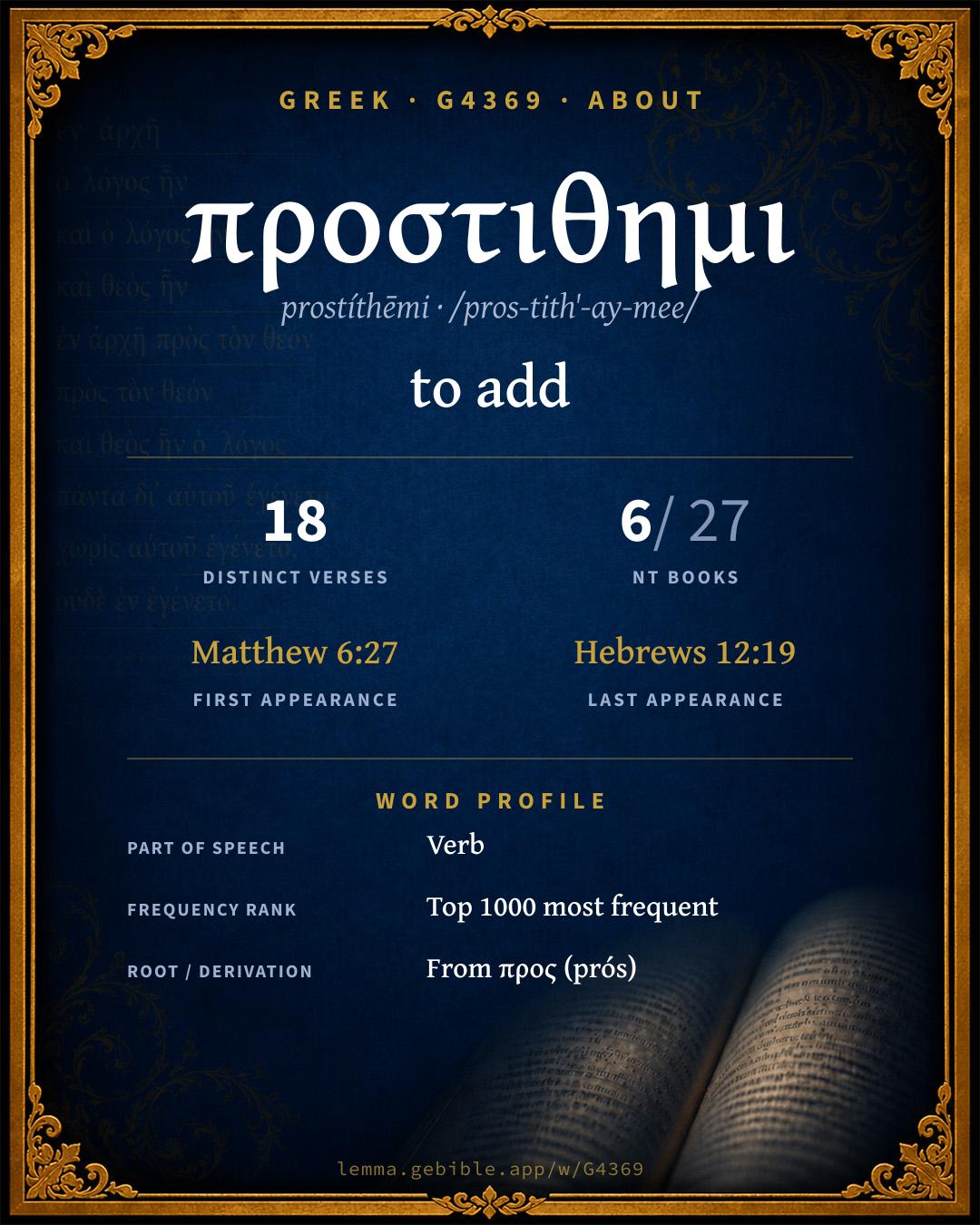
προστίθημι
to add
‘to add’ is one of 2 main senses fuller range ↓
Full lexicon entry — Thayer's Greek Lexicon
From Thayer's Greek Lexicon
Where this word appears
See every Aorist-tense verb in the Greek New Testament →
Grammar key — what these labels mean
Part of speech
- Verb
- An action or state-of-being word.
Tense
- Aorist
- Action viewed as a simple whole, without regard to duration — often past (perfective aspect).
- Future
- Action expected in future time.
- Imperfect
- Continuous or repeated action in past time (“was writing”).
Voice
- Middle
- The subject acts on or for itself, or with special interest in the action.
- Passive
- The subject receives the action.
- Active
- The subject performs the action.
Mood
- Indicative
- States a fact or asks a factual question (the mood of reality).
- Infinitive
- A verbal noun (“to write”), unmarked for person or number.
- Imperative
- Expresses a command or request.
- Participle
- A verbal adjective (“writing,” “having written”).
Case
- Nominative
- The case of the subject (and the predicate nominative).
Person
- 3rd person
- The one spoken about (“he / she / it / they”).
- 2nd person
- The one addressed (“you”).
Gender
- Masculine
- Grammatically masculine.
Number
- Singular
- One.
- Plural
- More than one.
Grammatical forms 11 distinct
- Verb, Aorist, Middle, Indicative, 3rd person, Singular 3 times (17%)
- Verb, Aorist, Passive, Indicative, 3rd person, Singular 3 times (17%)
- Verb, Future, Passive, Indicative, 3rd person, Singular 3 times (17%)
- Verb, Aorist, Active, Infinitive 2 times (11%)
- Verb, Aorist, Active, Imperative, 2nd person, Singular 1 time (6%)
- Verb, Aorist, Active, Participle, Nominative, Singular, Masculine 1 time (6%)
- Verb, Aorist, Active, Indicative, 3rd person, Singular 1 time (6%)
- Verb, Aorist, Passive, Indicative, 3rd person, Plural 1 time (6%)
+3 more forms (3 occurrences)
Parsed forms decoded from the imported morphology (Robinson–Tischendorf, public domain), counted across 18 parsed occurrences — not distinct verses.
Every verse where G4369 appears — 18 distinct verses across 6 books. Click any verse to open its interlinear word-by-word view. Verse text shown in the World English Bible for context — . Each verse’s Greek form is shown with its reference; the English is not keyword-highlighted, since the data carries no word-level English alignment. Use “Compare translations” on any verse to read it across multiple English versions. This concordance covers the Greek New Testament; Septuagint (Greek Old Testament) occurrences of this word are not indexed here.
Matthew 2 verses
Mark 1 verse
Luke 7 verses
- Luke 3:20 προσέθηκεν aor act ind 3sg added this also to them all, that he shut up John in prison.
- Luke 12:25 προσθεῖναι aor act inf Which of you by being anxious can add a cubit to his height?
- Luke 12:31 προστεθήσεται fut pass ind 3sg But seek God's Kingdom, and all these things will be added to you.
- Luke 17:5 πρόσθες aor act impv 2sg The apostles said to the Lord, "Increase our faith."
- Luke 19:11 προσθεὶς aor act ptcp nom sg masc As they heard these things, he went on and told a parable, because he was near Jerusalem, and they supposed that the Kingdom of God would be revealed immediately.
- Luke 20:11 προσέθετο aor mid ind 3sg He sent yet another servant, and they also beat him, and treated him shamefully, and sent him away empty.
- Luke 20:12 προσέθετο aor mid ind 3sg He sent yet a third, and they also wounded him, and threw him out.
Acts 6 verses
- Acts 2:41 προσετέθησαν aor pass ind 3pl Then those who gladly received his word were baptized. There were added that day about three thousand souls.
- Acts 2:47 προσετίθει impf act ind 3sg praising God, and having favor with all the people. The Lord added to the assembly day by day those who were being saved.
- Acts 5:14 προσετίθεντο impf pass ind 3pl More believers were added to the Lord, multitudes of both men and women.
- Acts 11:24 προσετέθη aor pass ind 3sg For he was a good man, and full of the Holy Spirit and of faith, and many people were added to the Lord.
- Acts 12:3 προσέθετο aor mid ind 3sg When he saw that it pleased the Jews, he proceeded to seize Peter also. This was during the days of unleavened bread.
- Acts 13:36 προσετέθη aor pass ind 3sg For David, after he had in his own generation served the counsel of God, fell asleep, and was laid with his fathers, and saw decay.
Galatians 1 verse
Hebrews 1 verse
About this entry
At a glance — auto-summarized from this page’s data, not written by a person. Every figure links to its source below. This summary describes the numbers; it doesn’t interpret them.
The Greek verb προστιθημι centers on the idea of “to add.” Its earliest occurrence is Matthew 6:27. It appears 18 verses across 6 books of the Greek New Testament, among its uncommon vocabulary. The word gravitates to Luke (39%), then Acts and Matthew. Lexicons map it across 2 senses. The sections below give every sense, occurrence, and version rendering.
Gloss history
Strong's 1890 vs modern scholarship
About this word
Strong's G4369 catalogs a Greek word from the Greek New Testament.
These counts are not copied from any lexicon or concordance. They are computed here, from the morphology-tagged Greek New Testament. What Lemma adds →
- 18
- distinct verses
- The word appears in 18 distinct verses.
- 6 / 27
- NT books
- The word appears in 6 of 27 New Testament books.
- #664
- by frequency
- Top 1000 most frequent Greek words (rank 664 of 5,347 Greek words by occurrence).
View all 18 occurrences in the concordance →
By section of the New Testament
By traditional corpus
Conventional, traditional groupings — biblical authorship is debated, so this is a traditional corpus grouping, not an authorship claim. Some books belong to more than one corpus (Luke is in both the Gospels and the Lukan corpus, and so on), so these shares overlap and need not total 100%. Each figure is a share of the word’s 18 distinct verses.
- Lukan (Luke–Acts) 13 verses · 72%
- Gospels 10 verses · 56%
- Pauline corpus 1 verse · 6%
- Hebrews 1 verse · 6%
How translations render this word
Counts come from each version’s own published word-to-Strong’s tagging or interlinear alignment — an approximate guide to how each version renders this word, not a word-level alignment the data otherwise carries. Because each total is that version’s own tagged count, the per-version totals vary from one another and need not match the appearance or distinct-verse counts above. These counts may also differ from a printed concordance because Lemma counts each distinctly tagged rendering and does not collapse phrase taggings into a single head-word total. This is a fixed set of word-tagged versions (KJV, ASV, BSB, ULT) and does not change with the reading translation you choose elsewhere. Each version’s license is shown beside its name below (and on Sources).
- King James Version: Added 3×, Add 2×, Again 2×
- American Standard Version: Added 3×, Add 2×, Shall be added 2×
- Berean Standard Bible: Add 2×, Added 2×, Proceeded 2×
- unfoldingWord Literal Text: He proceeded 4×, Will be added 3×, Add 2×
King James Version Public Domain
Renders G4369 across 20 tagged occurrences — most commonly:
Plus 9 renderings that appear only once — usually multi-word phrases or single function words the recovered tagging swept in, not distinct renderings.
American Standard Version Public Domain
Renders G4369 across 19 tagged occurrences — most commonly:
Plus 10 renderings that appear only once — usually multi-word phrases or single function words the recovered tagging swept in, not distinct renderings.
Berean Standard Bible Public Domain
Renders G4369 across 16 tagged occurrences — most commonly:
Plus 6 renderings that appear only once — usually multi-word phrases or single function words the recovered tagging swept in, not distinct renderings.
unfoldingWord Literal Text CC BY-SA 4.0
Renders G4369 across 18 tagged occurrences — most commonly:
Plus 7 renderings that appear only once — usually multi-word phrases or single function words the recovered tagging swept in, not distinct renderings.
Senses in Thayer's
The 2 senses Thayer's distinguishes for this word, in lexicon order (not ranked by frequency or importance). The full entry — with sub-senses — is in the Lexicon Entry tab.
- to put to
- i.e. to join to, gather with any company, the number of one's followers or companions
Word origin
Derived from προς (prós) (G4314).
Forms in the corpus
The 11 distinct written forms G4369 takes in the Greek New Testament, most frequent first — each parse links to that tense’s occurrences in the concordance.
Same root — word family
Other Thayer's entries built from the same root as G4369, grouped by Strong’s listed origin. These share a root / origin per the lexicon — not necessarily a shared meaning. Each links to that word’s own entry.
Derives from
Shares the same root
- προσαγορευω prosagoreúō G4316 to address
- προσαγω proságō G4317 to bring
- προσαιτεω prosaitéō G4319 to ask alms
- προσαναβαινω prosanabaínō G4320 to go up higher
- προσαναλισκω prosanalískō G4321 to spend additionally
- προσαναπληροω prosanaplēróō G4322 to fill up
- προσανατιθημι prosanatíthēmi G4323 to lay upon
- προσαπειλεω prosapeiléō G4324 to threaten further
- προσδαπαναω prosdapanáō G4325 to spend besides
- προσδεομαι prosdéomai G4326 to need additionally
- προσδεχομαι prosdéchomai G4327 to receive to oneself
- προσδοκαω prosdokáō G4328 to expect
- προσεαω proseáō G4330 to permit approach
- προσεγγιζω prosengízō G4331 to approach
- προσεδρευω prosedreúō G4332 to sit near
- προσεργαζομαι prosergázomai G4333 to work besides
- προσερχομαι prosérchomai G4334 to draw near
- προσευχομαι proseúchomai G4336 to pray
- προσεχω proséchō G4337 to attend to
- προσηλοω prosēlóō G4338 to nail to
- προσκαιρος próskairos G4340 temporary
- προσκαλεομαι proskaléomai G4341 to call to
- προσκαρτερεω proskarteréō G4342 to adhere to
- προσκεφαλαιον proskephálaion G4344 pillow
+27 more words share this root (not shown).
Compare all same-root words → Showing 4 of 53 — not the complete family. They share a root, not necessarily a meaning.
Septuagint usage
The same Greek word προστιθημι appears 242 times in the Greek Old Testament (Septuagint), across 234 verses in 32 books.
- 242
- LXX occurrences
- Tagged occurrences of this Greek word in the Septuagint.
- 234
- verses
- Distinct Septuagint verses containing this word.
- 32 / 39
- OT books
- The word appears in 32 of the 39 Old Testament books.
Sample Septuagint occurrences
- Genesis 4:2 προςτίθημι
- Exodus 1:10 προςτίθημι
- Leviticus 5:16 προςτίθημι
- Numbers 5:7 προςτίθημι
- Deuteronomy 1:11 προςτίθημι
- Joshua 7:12 προςτίθημι
- Judges 2:10 προςτίθημι
- Ruth 1:17 προςτίθημι
- 1 Samuel 3:6 προςτίθημι
- 2 Samuel 2:22 προςτίθημι
- 1 Kings 2:23 προςτίθημι
- 2 Kings 1:11 προςτίθημι
Septuagint occurrences (same lexeme)
Every verse where the same Strong’s number (G4369) appears in the Greek Septuagint — showing the first 50 of 234. Verse text shown in the World English Bible for context; the Greek form is the matched word — the English is not keyword-highlighted.
- Genesis 4:2 προςτίθημι Again she gave birth, to Cain's brother Abel. Abel was a keeper of sheep, but Cain was a tiller of the ground.
- Genesis 4:12 προςτίθημι From now on, when you till the ground, it won't yield its strength to you. You shall be a fugitive and a wanderer in the earth."
- Genesis 8:12 προςτίθημι He stayed yet another seven days, and sent forth the dove; and she didn't return to him any more.
- Genesis 8:21 προςτίθημι Yahweh smelled the sweet savor. Yahweh said in his heart, "I will not again curse the ground any more for man's sake, because the imagination of man's heart is evil from his youth; neither will I ever again strike everything living, as I have done.
- Genesis 18:29 προςτίθημι He spoke to him yet again, and said, "What if there are forty found there?" He said, "I will not do it for the forty's sake."
- Genesis 25:1 προςτίθημι Abraham took another wife, and her name was Keturah.
- Genesis 25:8 προςτίθημι Abraham gave up the spirit, and died in a good old age, an old man, and full of years, and was gathered to his people.
- Genesis 25:17 προςτίθημι These are the years of the life of Ishmael: one hundred thirty-seven years. He gave up the spirit and died, and was gathered to his people.
- Genesis 30:24 προςτίθημι She named him Joseph, saying, "May Yahweh add another son to me."
- Genesis 35:29 προςτίθημι Isaac gave up the spirit, and died, and was gathered to his people, old and full of days. Esau and Jacob, his sons, buried him.
- Genesis 37:8 προςτίθημι His brothers said to him, "Will you indeed reign over us? Or will you indeed have dominion over us?" They hated him all the more for his dreams and for his words.
- Genesis 38:5 προςτίθημι She yet again bore a son, and named him Shelah: and he was at Chezib, when she bore him.
- Genesis 38:26 προςτίθημι Judah acknowledged them, and said, "She is more righteous than I, because I didn't give her to Shelah, my son." He knew her again no more.
- Genesis 44:23 προςτίθημι You said to your servants, 'Unless your youngest brother comes down with you, you will see my face no more.'
- Genesis 49:29 προςτίθημι He charged them, and said to them, "I am to be gathered to my people. Bury me with my fathers in the cave that is in the field of Ephron the Hittite,
- Genesis 49:33 προςτίθημι When Jacob made an end of charging his sons, he gathered up his feet into the bed, and yielded up the spirit, and was gathered to his people.
- Exodus 1:10 προςτίθημι Come, let us deal wisely with them, lest they multiply, and it happen that when any war breaks out, they also join themselves to our enemies, and fight against us, and escape out of the land."
- Exodus 5:7 προςτίθημι "You shall no longer give the people straw to make brick, as before. Let them go and gather straw for themselves.
- Exodus 8:25 προςτίθημι Pharaoh called for Moses and for Aaron, and said, "Go, sacrifice to your God in the land!"
- Exodus 9:28 προςτίθημι Pray to Yahweh; for there has been enough of mighty thunderings and hail. I will let you go, and you shall stay no longer."
- Exodus 9:34 προςτίθημι When Pharaoh saw that the rain and the hail and the thunders were ceased, he sinned yet more, and hardened his heart, he and his servants.
- Exodus 10:28 προςτίθημι Pharaoh said to him, "Get away from me! Be careful to see my face no more; for in the day you see my face you shall die!"
- Exodus 11:6 προςτίθημι There shall be a great cry throughout all the land of Egypt, such as there has not been, nor shall be any more.
- Exodus 14:13 προςτίθημι Moses said to the people, "Don't be afraid. Stand still, and see the salvation of Yahweh, which he will work for you today: for the Egyptians whom you have seen today, you shall never see them again.
- Exodus 23:2 προςτίθημι You shall not follow a crowd to do evil; neither shall you testify in court to side with a multitude to pervert justice;
- Exodus 30:15 προςτίθημι The rich shall not give more, and the poor shall not give less, than the half shekel, when they give the offering of Yahweh, to make atonement for your souls.
- Leviticus 5:16 προςτίθημι He shall make restitution for that which he has done wrong in the holy thing, and shall add a fifth part to it, and give it to the priest; and the priest shall make atonement for him with the ram of the trespass offering, and he will be forgiven.
- Leviticus 5:24 προςτίθημι
- Leviticus 19:14 προςτίθημι "'You shall not curse the deaf, nor put a stumbling block before the blind; but you shall fear your God. I am Yahweh.
- Leviticus 22:14 προςτίθημι "'If a man eats something holy unwittingly, then he shall add the fifth part of its value to it, and shall give the holy thing to the priest.
- Leviticus 26:18 προςτίθημι "'If you in spite of these things will not listen to me, then I will chastise you seven times more for your sins.
- Leviticus 26:21 προςτίθημι "'If you walk contrary to me, and won't listen to me, then I will bring seven times more plagues on you according to your sins.
- Leviticus 27:13 προςτίθημι But if he will indeed redeem it, then he shall add the fifth part of it to its valuation.
- Leviticus 27:15 προςτίθημι If he who dedicates it will redeem his house, then he shall add the fifth part of the money of your valuation to it, and it shall be his.
- Leviticus 27:19 προςτίθημι If he who dedicated the field will indeed redeem it, then he shall add the fifth part of the money of your valuation to it, and it shall remain his.
- Leviticus 27:27 προςτίθημι If it is an unclean animal, then he shall buy it back according to your valuation, and shall add to it the fifth part of it: or if it isn't redeemed, then it shall be sold according to your valuation.
- Leviticus 27:31 προςτίθημι If a man redeems anything of his tithe, he shall add a fifth part to it.
- Numbers 5:7 προςτίθημι then he shall confess his sin which he has done, and he shall make restitution for his guilt in full, and add to it the fifth part of it, and give it to him in respect of whom he has been guilty.
- Numbers 11:25 προςτίθημι Yahweh came down in the cloud, and spoke to him, and took of the Spirit that was on him, and put it on the seventy elders: and it happened that when the Spirit rested on them, they prophesied, but they did so no more.
- Numbers 17:4 προςτίθημι You shall lay them up in the tent of meeting before the testimony, where I meet with you.
- Numbers 18:2 προςτίθημι Your brothers also, the tribe of Levi, the tribe of your father, bring you near with you, that they may be joined to you, and minister to you: but you and your sons with you shall be before the tent of the testimony.
- Numbers 18:4 προςτίθημι They shall be joined to you, and keep the charge of the tent of meeting, for all the service of the Tent: and a stranger shall not come near to you.
- Numbers 20:24 προςτίθημι Aaron shall be gathered to his people; for he shall not enter into the land which I have given to the children of Israel, because you rebelled against my word at the waters of Meribah.
- Numbers 20:26 προςτίθημι and strip Aaron of his garments, and put them on Eleazar his son: and Aaron shall be gathered [to his people], and shall die there.
- Numbers 22:15 προςτίθημι Balak sent yet again princes, more, and more honorable than they.
- Numbers 22:19 προςτίθημι Now therefore, please wait also here this night, that I may know what Yahweh will speak to me more.
- Numbers 22:25 προςτίθημι The donkey saw the angel of Yahweh, and she thrust herself to the wall, and crushed Balaam's foot against the wall: and he struck her again.
- Numbers 22:26 προςτίθημι The angel of Yahweh went further, and stood in a narrow place, where was no way to turn either to the right hand or to the left.
- Numbers 27:13 προςτίθημι When you have seen it, you also shall be gathered to your people, as Aaron your brother was gathered;
- Numbers 31:2 προςτίθημι Avenge the children of Israel of the Midianites: afterward you shall be gathered to your people.
These are occurrences of the same Greek lexeme (G4369) in the Septuagint — not a translation of any one Hebrew word. The store carries no word-level Hebrew↔Greek alignment, so no Hebrew original is asserted here. Counts come from the recovered LXX Strong's tagging — high-frequency vocabulary is well covered, while rare or late forms may be untagged — so they reflect tagged occurrences and may slightly undercount.