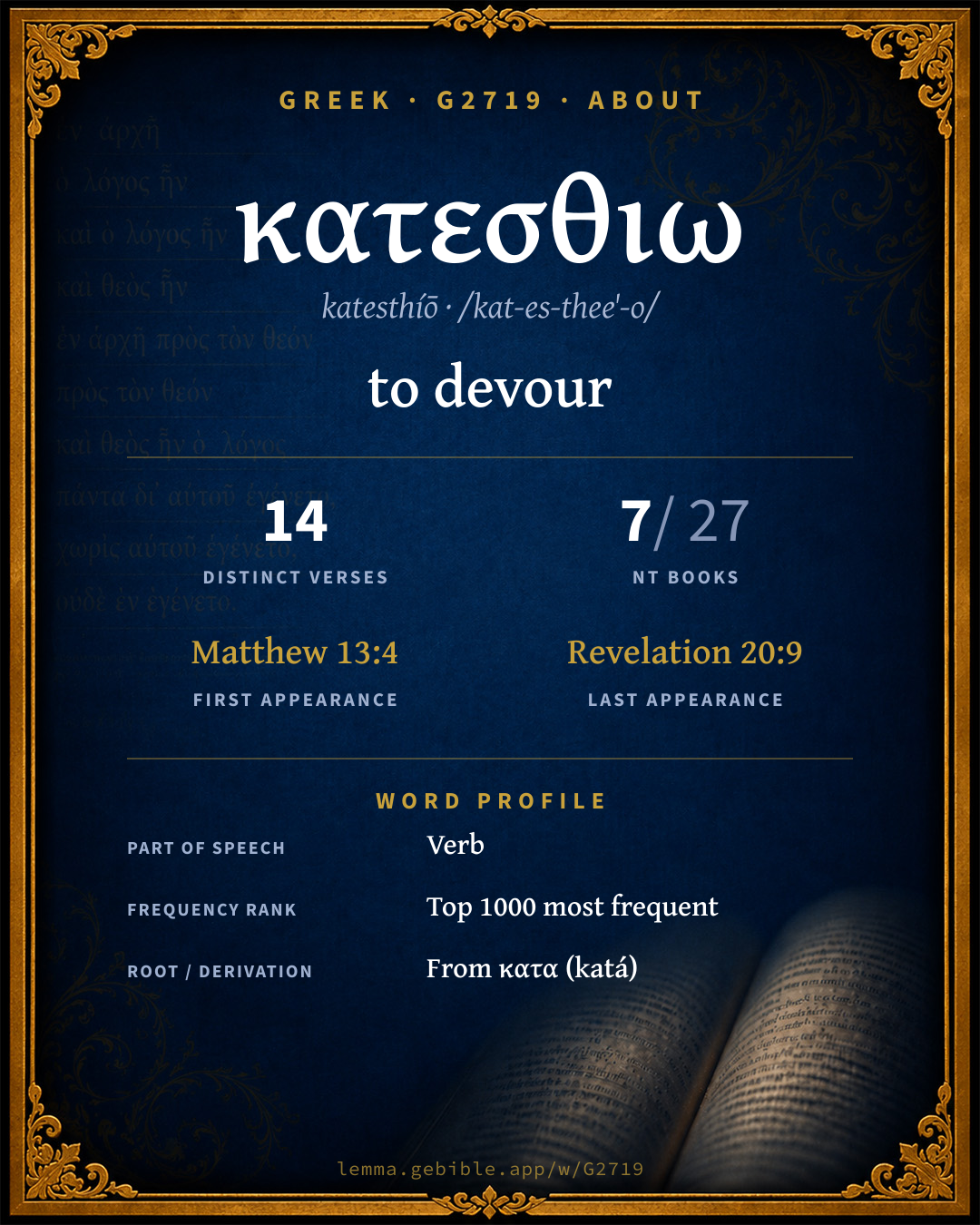
κατεσθίω
to devour
‘to devour’ is one of 2 main senses fuller range ↓
Full lexicon entry — Thayer's Greek Lexicon
From Thayer's Greek Lexicon
Where this word appears
See every Aorist-tense verb in the Greek New Testament →
Grammar key — what these labels mean
Part of speech
- Verb
- An action or state-of-being word.
Tense
- Aorist
- Action viewed as a simple whole, without regard to duration — often past (perfective aspect).
- Present
- Ongoing or general action in present time (imperfective aspect).
- Future
- Action expected in future time.
Voice
- Active
- The subject performs the action.
- Middle deponent
- Middle in form but active in meaning.
Mood
- Indicative
- States a fact or asks a factual question (the mood of reality).
- Imperative
- Expresses a command or request.
- Participle
- A verbal adjective (“writing,” “having written”).
- Subjunctive
- Expresses probability, purpose, or possibility (the mood of contingency).
Case
- Nominative
- The case of the subject (and the predicate nominative).
Person
- 3rd person
- The one spoken about (“he / she / it / they”).
- 1st person
- The speaker (“I / we”).
- 2nd person
- The one addressed (“you”).
Gender
- Masculine
- Grammatically masculine.
Number
- Singular
- One.
- Plural
- More than one.
1 verse where G2719 appears in the Present tense in the Book of Mark. Filtered view — show all forms. Click any verse to open its interlinear word-by-word view. Verse text shown in the World English Bible for context — . Each verse’s Greek form is shown with its reference; the English is not keyword-highlighted, since the data carries no word-level English alignment. Use “Compare translations” on any verse to read it across multiple English versions. This concordance covers the Greek New Testament; Septuagint (Greek Old Testament) occurrences of this word are not indexed here.
Mark
About this entry
At a glance — auto-summarized from this page’s data, not written by a person. Every figure links to its source below. This summary describes the numbers; it doesn’t interpret them.
The Greek verb κατεσθιω centers on the idea of “to devour.” Its earliest occurrence is Matthew 13:4. The Greek New Testament uses it across 14 verses — uncommon. Revelation dominates its distribution — 5 of 14 verses. Thayer's distinguishes 2 senses for it. For the data behind this summary, explore the sense tree and the renderings breakdown below.
Gloss history
Strong's 1890 vs modern scholarship

About this word
Strong's G2719 catalogs a Greek word from the Greek New Testament.
These counts are not copied from any lexicon or concordance. They are computed here, from the morphology-tagged Greek New Testament. What Lemma adds →
- 14
- distinct verses
- The word appears in 14 distinct verses.
- 7 / 27
- NT books
- The word appears in 7 of 27 New Testament books.
- #814
- by frequency
- Top 1000 most frequent Greek words (rank 814 of 5,347 Greek words by occurrence).
View all 14 occurrences in the concordance →
Most concentrated in
- Revelation 5 verses 36%
- Luke 3 verses 21%
- Mark 2 verses 14%
By section of the New Testament
By traditional corpus
Conventional, traditional groupings — biblical authorship is debated, so this is a traditional corpus grouping, not an authorship claim. Some books belong to more than one corpus (Luke is in both the Gospels and the Lukan corpus, and so on), so these shares overlap and need not total 100%. Each figure is a share of the word’s 14 distinct verses.
- Gospels 7 verses · 50%
- Johannine 6 verses · 43%
- Revelation 5 verses · 36%
- Lukan (Luke–Acts) 3 verses · 21%
- Pauline corpus 2 verses · 14%
How translations render this word
Counts come from each version’s own published word-to-Strong’s tagging or interlinear alignment — an approximate guide to how each version renders this word, not a word-level alignment the data otherwise carries. Because each total is that version’s own tagged count, the per-version totals vary from one another and need not match the appearance or distinct-verse counts above. These counts may also differ from a printed concordance because Lemma counts each distinctly tagged rendering and does not collapse phrase taggings into a single head-word total. This is a fixed set of word-tagged versions (KJV, ASV, BSB, ULT) and does not change with the reading translation you choose elsewhere. Each version’s license is shown beside its name below (and on Sources).
- King James Version: Devour 5×, Up 5×, Devoured 4×
- American Standard Version: Devoured 4×, Devour 3×, Up 3×
- Berean Standard Bible: Devoured 3×, Defraud 2×
- unfoldingWord Literal Text: Devoured 4×, Devouring 2×, Devours 2×
King James Version Public Domain
Renders G2719 across 20 tagged occurrences — most commonly:
Plus 6 renderings that appear only once — usually multi-word phrases or single function words the recovered tagging swept in, not distinct renderings.
American Standard Version Public Domain
Renders G2719 across 17 tagged occurrences — most commonly:
Plus 5 renderings that appear only once — usually multi-word phrases or single function words the recovered tagging swept in, not distinct renderings.
Berean Standard Bible Public Domain
Renders G2719 across 14 tagged occurrences — most commonly:
Plus 9 renderings that appear only once — usually multi-word phrases or single function words the recovered tagging swept in, not distinct renderings.
unfoldingWord Literal Text CC BY-SA 4.0
Renders G2719 across 16 tagged occurrences — most commonly:
Plus 8 renderings that appear only once — usually multi-word phrases or single function words the recovered tagging swept in, not distinct renderings.
Senses in Thayer's
The 2 senses Thayer's distinguishes for this word, in lexicon order (not ranked by frequency or importance). The full entry — with sub-senses — is in the Lexicon Entry tab.
- to consume by eating, to eat up, devour
- metaph.
Word origin
Derived from κατα (katá) (G2596) — down.
Forms in the corpus
The 10 distinct written forms G2719 takes in the Greek New Testament, most frequent first — each parse links to that tense’s occurrences in the concordance.
| Form | Parsing | Example | Uses |
|---|---|---|---|
| κατέφαγεν katéphagen | Verb, Aorist, Active, Indicative, 3rd person, Singular | Matthew 13:4 | 4 |
| κατεσθίει katesthíei | Verb, Present, Active, Indicative, 3rd person, Singular | 2 Corinthians 11:20 | 2 |
| κατάφαγε katáphage | Verb, Aorist, Active, Imperative, 2nd person, Singular | Revelation 10:9 | 1 |
| κατέφαγον katéphagon | Verb, Aorist, Active, Indicative, 1st person, Singular | Revelation 10:10 | 1 |
| καταφάγεταί kataphágetaí | Verb, Future, Middle deponent, Indicative, 3rd person, Singular | John 2:17 | 1 |
| καταφάγῃ kataphágē | Verb, Aorist, Active, Subjunctive, 3rd person, Singular | Revelation 12:4 | 1 |
| καταφαγών kataphagṓn | Verb, Aorist, Active, Participle, Nominative, Singular, Masculine | Luke 15:30 | 1 |
| κατεσθίετε katesthíete | Verb, Present, Active, Indicative, 2nd person, Plural | Galatians 5:15 | 1 |
| κατεσθίοντες katesthíontes | Verb, Present, Active, Participle, Nominative, Plural, Masculine | Mark 12:40 | 1 |
| κατεσθίουσιν katesthíousin | Verb, Present, Active, Indicative, 3rd person, Plural | Luke 20:47 | 1 |
Same root — word family
Other Thayer's entries built from the same root as G2719, grouped by Strong’s listed origin. These share a root / origin per the lexicon — not necessarily a shared meaning. Each links to that word’s own entry.
Derives from
Shares the same root
- καθα kathá G2505 according as
- καθαιρεω kathairéō G2507 to tear down
- καθαπτω katháptō G2510 to fasten down
- καθεδρα kathédra G2515 seat
- καθεζομαι kathézomai G2516 to sit down
- καθεξης kathexēs G2517 in order
- καθευδω katheúdō G2518 to fall asleep
- καθηγητης kathēgētḗs G2519 guide
- καθηκω kathḗkō G2520 to come down
- καθημαι káthēmai G2521 to sit down
- καθημερινος kathēmerinós G2522 daily
- καθιημι kathíēmi G2524 to send down
- καθιστημι kathístēmi G2525 to place
- καθο kathó G2526 according to what
- καθολου kathólou G2527 wholly
- καθοπλιζω kathoplízō G2528 to arm
- καθοραω kathoráō G2529 to see clearly
- καθοτι kathóti G2530 according to what
- καθως kathṓs G2531 according as
- καμμυω kammýō G2576 to close eyes
- καταβαινω katabaínō G2597 to descend
- καταβαλλω katabállō G2598 to cast down
- καταβαρεω katabaréō G2599 to weigh down
- καταβιβαζω katabibázō G2601 to bring down
+103 more words share this root (not shown).
Compare all same-root words → Showing 4 of 129 — not the complete family. They share a root, not necessarily a meaning.
Septuagint usage
The same Greek word κατεσθιω appears 141 times in the Greek Old Testament (Septuagint), across 127 verses in 25 books.
- 141
- LXX occurrences
- Tagged occurrences of this Greek word in the Septuagint.
- 127
- verses
- Distinct Septuagint verses containing this word.
- 25 / 39
- OT books
- The word appears in 25 of the 39 Old Testament books.
Sample Septuagint occurrences
- Genesis 31:15 καταἐσθίω
- Exodus 10:5 καταἐσθίω
- Leviticus 9:24 καταἐσθίω
- Numbers 11:1 καταἐσθίω
- Deuteronomy 28:38 καταἐσθίω
- Judges 6:21 καταἐσθίω
- 2 Samuel 2:26 καταἐσθίω
- 1 Kings 12:24 καταἐσθίω
- 2 Kings 1:10 καταἐσθίω
- 2 Chronicles 7:1 καταἐσθίω
- Job 1:16 καταἐσθίω
- Psalms 13:4 καταἐσθίω
Septuagint occurrences (same lexeme)
Every verse where the same Strong’s number (G2719) appears in the Greek Septuagint — showing the first 50 of 127. Verse text shown in the World English Bible for context; the Greek form is the matched word — the English is not keyword-highlighted.
- Genesis 31:15 καταἐσθίω Aren't we accounted by him as foreigners? For he has sold us, and has also quite devoured our money.
- Genesis 31:38 καταἐσθίω These twenty years have I been with you. Your ewes and your female goats have not cast their young, and I haven't eaten the rams of your flocks.
- Genesis 37:20 καταἐσθίω Come now therefore, and let's kill him, and cast him into one of the pits, and we will say, 'An evil animal has devoured him.' We will see what will become of his dreams."
- Genesis 37:33 καταἐσθίω He recognized it, and said, "It is my son's coat. An evil animal has devoured him. Joseph is without doubt torn in pieces."
- Genesis 40:17 καταἐσθίω In the uppermost basket there was all kinds of baked food for Pharaoh, and the birds ate them out of the basket on my head."
- Genesis 41:4 καταἐσθίω The ill-favored and lean-fleshed cattle ate up the seven well-favored and fat cattle. So Pharaoh awoke.
- Genesis 41:20 καταἐσθίω The lean and ill-favored cattle ate up the first seven fat cattle,
- Genesis 43:2 καταἐσθίω It happened, when they had eaten up the grain which they had brought out of Egypt, their father said to them, "Go again, buy us a little more food."
- Exodus 10:5 καταἐσθίω and they shall cover the surface of the earth, so that one won't be able to see the earth. They shall eat the residue of that which has escaped, which remains to you from the hail, and shall eat every tree which grows for you out of the field.
- Exodus 10:12 καταἐσθίω Yahweh said to Moses, "Stretch out your hand over the land of Egypt for the locusts, that they may come up on the land of Egypt, and eat every herb of the land, even all that the hail has left."
- Exodus 10:15 καταἐσθίω For they covered the surface of the whole earth, so that the land was darkened, and they ate every herb of the land, and all the fruit of the trees which the hail had left. There remained nothing green, either tree or herb of the field, through all the land of Egypt.
- Exodus 15:7 καταἐσθίω In the greatness of your excellency, you overthrow those who rise up against you: You send forth your wrath. It consumes them as stubble.
- Leviticus 9:24 καταἐσθίω There came forth fire from before Yahweh, and consumed the burnt offering and the fat upon the altar: and when all the people saw it, they shouted, and fell on their faces.
- Leviticus 10:2 καταἐσθίω And fire came forth from before Yahweh, and devoured them, and they died before Yahweh.
- Leviticus 26:22 καταἐσθίω I will send the wild animals among you, which will rob you of your children, destroy your cattle, and make you few in number; and your roads will become desolate.
- Leviticus 26:38 καταἐσθίω You will perish among the nations, and the land of your enemies will eat you up.
- Numbers 11:1 καταἐσθίω The people were as murmurers, [speaking] evil in the ears of Yahweh: and when Yahweh heard it, his anger was kindled; and the fire of Yahweh burnt among them, and devoured in the uttermost part of the camp.
- Numbers 12:12 καταἔσθιω Let her not, I pray, be as one dead, of whom the flesh is half consumed when he comes out of his mother's womb.
- Numbers 13:32 καταἐσθίω They brought up an evil report of the land which they had spied out to the children of Israel, saying, The land, through which we have gone to spy it out, is a land that eats up the inhabitants of it; and all the people who we saw in it are men of great stature.
- Numbers 16:35 καταἐσθίω Fire came forth from Yahweh, and devoured the two hundred fifty men who offered the incense.
- Numbers 21:28 καταἐσθίω For a fire is gone out of Heshbon, A flame from the city of Sihon: It has devoured Ar of Moab, The lords of the high places of the Arnon.
- Numbers 26:10 καταἐσθίω and the earth opened its mouth, and swallowed them up together with Korah, when that company died; what time the fire devoured two hundred fifty men, and they became a sign.
- Deuteronomy 28:38 καταἐσθίω You shall carry much seed out into the field, and shall gather little in; for the locust shall consume it.
- Deuteronomy 28:39 καταἐσθίω You shall plant vineyards and dress them, but you shall neither drink of the wine, nor gather [the grapes]; for the worm shall eat them.
- Deuteronomy 28:51 καταἐσθίω and shall eat the fruit of your cattle, and the fruit of your ground, until you are destroyed; that also shall not leave you grain, new wine, or oil, the increase of your cattle, or the young of your flock, until they have caused you to perish.
- Deuteronomy 28:55 καταἐσθίω so that he will not give to any of them of the flesh of his children whom he shall eat, because he has nothing left him, in the siege and in the distress with which your enemy shall distress you in all your gates.
- Deuteronomy 28:57 καταἐσθίω and toward her young one who comes out from between her feet, and toward her children whom she shall bear; for she shall eat them for want of all things secretly, in the siege and in the distress with which your enemy shall distress you in your gates.
- Deuteronomy 32:22 καταἐσθίω For a fire is kindled in my anger, Burns to the lowest Sheol, Devours the earth with its increase, Sets on fire the foundations of the mountains.
- Deuteronomy 32:42 καταἐσθίω I will make my arrows drunk with blood, My sword shall devour flesh; With the blood of the slain and the captives, From the head of the leaders of the enemy.
- Judges 6:21 καταἐσθίω Then the angel of Yahweh put forth the end of the staff that was in his hand, and touched the flesh and the unleavened cakes; and there went up fire out of the rock, and consumed the flesh and the unleavened cakes; and the angel of Yahweh departed out of his sight.
- Judges 9:15 καταἐσθίω The bramble said to the trees, If in truth you anoint me king over you, then come and take refuge in my shade; and if not, let fire come out of the bramble, and devour the cedars of Lebanon.
- Judges 9:20 καταἐσθίω but if not, let fire come out from Abimelech, and devour the men of Shechem, and the house of Millo; and let fire come out from the men of Shechem, and from the house of Millo, and devour Abimelech.
- 2 Samuel 2:26 καταἐσθίω Then Abner called to Joab, and said, "Shall the sword devour forever? Don't you know that it will be bitterness in the latter end? How long shall it be then, before you bid the people return from following their brothers?"
- 2 Samuel 18:8 καταἐσθίω For the battle was there spread over the surface of all the country; and the forest devoured more people that day than the sword devoured.
- 2 Samuel 22:9 καταἐσθίω There went up a smoke out of his nostrils, Fire out of his mouth devoured: Coals were kindled by it.
- 1 Kings 12:24 καταἐσθίω Thus says Yahweh, You shall not go up, nor fight against your brothers the children of Israel: return every man to his house; for this thing is of me. So they listened to the word of Yahweh, and returned and went their way, according to the word of Yahweh.
- 1 Kings 16:4 καταἐσθίω Him who dies of Baasha in the city shall the dogs eat; and him who dies of his in the field shall the birds of the sky eat.
- 1 Kings 18:38 καταἐσθίω Then the fire of Yahweh fell, and consumed the burnt offering, and the wood, and the stones, and the dust, and licked up the water that was in the trench.
- 1 Kings 20:23 καταἐσθίω The servants of the king of Syria said to him, Their god is a god of the hills; therefore they were stronger than we: but let us fight against them in the plain, and surely we shall be stronger than they.
- 2 Kings 1:10 καταἐσθίω Elijah answered to the captain of fifty, If I be a man of God, let fire come down from the sky, and consume you and your fifty. Fire came down from the sky, and consumed him and his fifty.
- 2 Kings 1:12 καταἐσθίω Elijah answered them, If I be a man of God, let fire come down from the sky, and consume you and your fifty. The fire of God came down from the sky, and consumed him and his fifty.
- 2 Kings 1:14 καταἐσθίω Behold, fire came down from the sky, and consumed the two former captains of fifty with their fifties; but now let my life be precious in your sight.
- 2 Kings 9:10 καταἐσθίω The dogs shall eat Jezebel in the portion of Jezreel, and there shall be none to bury her. He opened the door, and fled.
- 2 Kings 9:36 καταἐσθίω Therefore they came back, and told him. He said, This is the word of Yahweh, which he spoke by his servant Elijah the Tishbite, saying, In the portion of Jezreel shall the dogs eat the flesh of Jezebel;
- 2 Chronicles 7:1 καταἐσθίω Now when Solomon had made an end of praying, the fire came down from heaven, and consumed the burnt offering and the sacrifices; and the glory of Yahweh filled the house.
- 2 Chronicles 7:13 καταἐσθίω If I shut up the sky so that there is no rain, or if I command the locust to devour the land, or if I send pestilence among my people;
- Job 1:16 καταἐσθίω While he was still speaking, there also came another, and said, "The fire of God has fallen from the sky, and has burned up the sheep and the servants, and consumed them, and I alone have escaped to tell you."
- Job 18:13 καταἐσθίω The members of his body shall be devoured, The firstborn of death shall devour his members.
- Job 20:26 καταἐσθίω All darkness is laid up for his treasures. An unfanned fire shall devour him. It shall consume that which is left in his tent.
- Job 22:20 καταἐσθίω Saying, 'Surely those who rose up against us are cut off, The fire has consumed the remnant of them.'
These are occurrences of the same Greek lexeme (G2719) in the Septuagint — not a translation of any one Hebrew word. The store carries no word-level Hebrew↔Greek alignment, so no Hebrew original is asserted here. Counts come from the recovered LXX Strong's tagging — high-frequency vocabulary is well covered, while rare or late forms may be untagged — so they reflect tagged occurrences and may slightly undercount.