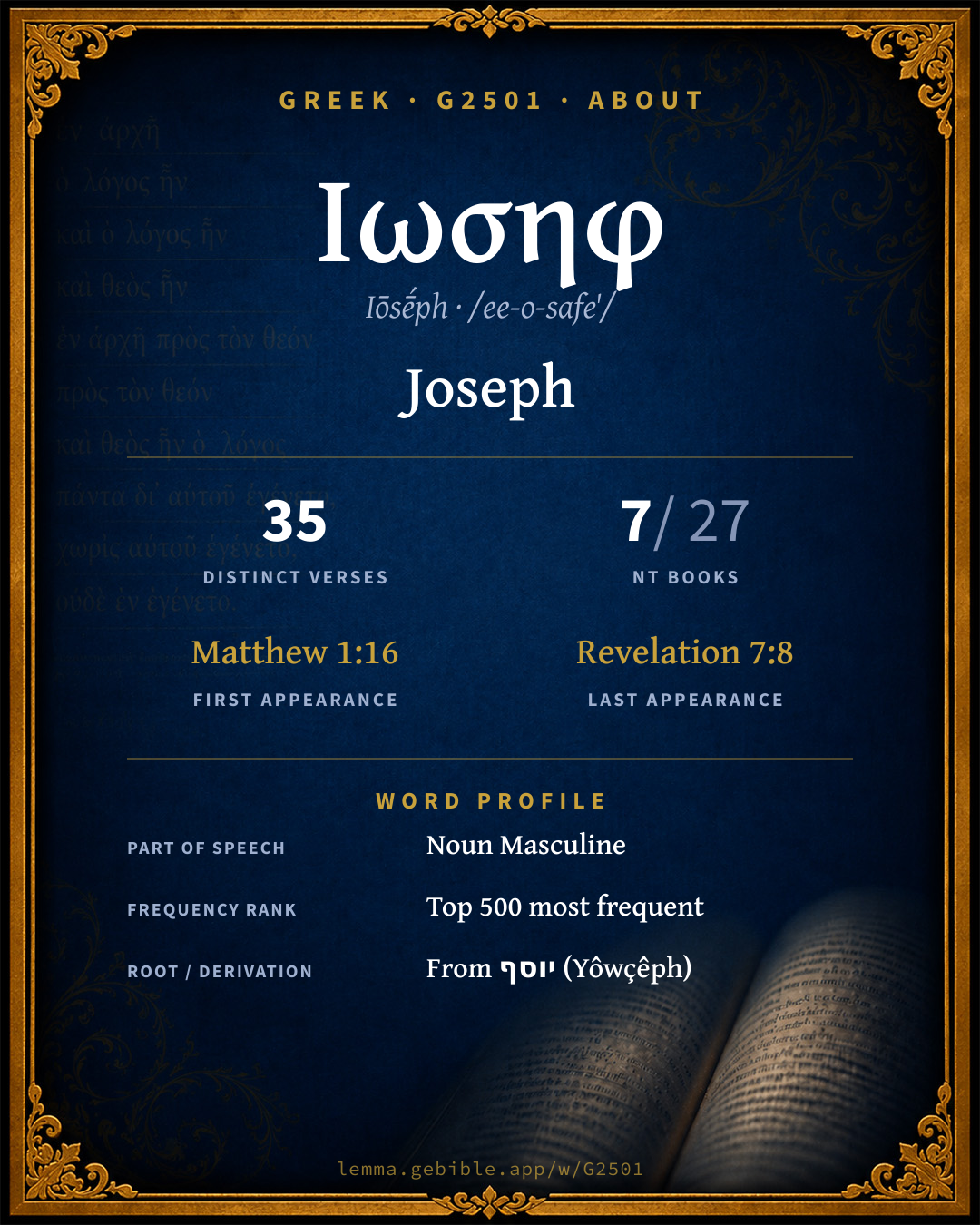
Ἰωσήφ
Joseph
Thayer's lists 10 entries for ‘Joseph’ fuller range ↓
Full lexicon entry — Thayer's Greek Lexicon
From Thayer's Greek Lexicon
Where this word appears
Every verse where G2501 appears in the Book of Luke — 9 distinct verses. Click any verse to open its interlinear word-by-word view. Verse text shown in the World English Bible for context — . Each verse’s Greek form is shown with its reference; the English is not keyword-highlighted, since the data carries no word-level English alignment. Use “Compare translations” on any verse to read it across multiple English versions. This concordance covers the Greek New Testament; Septuagint (Greek Old Testament) occurrences of this word are not indexed here.
Luke
- Luke 1:27 Ἰωσὴφ n proper indecl to a virgin pledged to be married to a man whose name was Joseph, of the house of David. The virgin's name was Mary.
- Luke 2:4 Ἰωσὴφ n proper indecl Joseph also went up from Galilee, out of the city of Nazareth, into Judea, to the city of David, which is called Bethlehem, because he was of the house and family of David;
- Luke 2:16 Ἰωσὴφ n proper indecl They came with haste, and found both Mary and Joseph, and the baby was lying in the feeding trough.
- Luke 3:23 Ἰωσὴφ n proper indecl Jesus himself, when he began to teach, was about thirty years old, being the son (as was supposed) of Joseph, the son of Heli,
- Luke 3:24 Ἰωσὴφ n proper indecl the son of Matthat, the son of Levi, the son of Melchi, the son of Jannai, the son of Joseph,
- Luke 3:26 Ἰωσὴχ n proper indecl the son of Maath, the son of Mattathias, the son of Semein, the son of Joseph, the son of Judah,
- Luke 3:30 Ἰωσὴφ n proper indecl the son of Simeon, the son of Judah, the son of Joseph, the son of Jonan, the son of Eliakim,
- Luke 4:22 Ἰωσὴφ n proper indecl All testified about him, and wondered at the gracious words which proceeded out of his mouth, and they said, "Isn't this Joseph's son?"
- Luke 23:50 Ἰωσὴφ n proper indecl Behold, a man named Joseph, who was a member of the council, a good and righteous man
About this entry
At a glance — auto-summarized from this page’s data, not written by a person. Every figure links to its source below. This summary describes the numbers; it doesn’t interpret them.
At its core, Ιωσηφ (Iōsḗph) means “Joseph.” Scripture first uses it in Matthew 1:16. It appears 35 verses across 7 books of the Greek New Testament, among its moderately common vocabulary. The word gravitates to Matthew (31%), then Luke and Acts. Each statement above links to its evidence; the full detail follows below.
Gloss history
Strong's 1890 vs modern scholarship
About this word
Strong's G2501 catalogs a Greek word from the Greek New Testament.
These counts are not copied from any lexicon or concordance. They are computed here, from the morphology-tagged Greek New Testament. What Lemma adds →
- 35
- distinct verses
- The word appears in 35 distinct verses.
- 7 / 27
- NT books
- The word appears in 7 of 27 New Testament books.
- #419
- by frequency
- Top 500 most frequent Greek words (rank 419 of 5,347 Greek words by occurrence).
View all 35 occurrences in the concordance →
By section of the New Testament
By traditional corpus
Conventional, traditional groupings — biblical authorship is debated, so this is a traditional corpus grouping, not an authorship claim. Some books belong to more than one corpus (Luke is in both the Gospels and the Lukan corpus, and so on), so these shares overlap and need not total 100%. Each figure is a share of the word’s 35 distinct verses.
- Gospels 26 verses · 74%
- Lukan (Luke–Acts) 15 verses · 43%
- Johannine 5 verses · 14%
- Hebrews 2 verses · 6%
- Revelation 1 verse · 3%
How translations render this word
Counts come from each version’s own published word-to-Strong’s tagging or interlinear alignment — an approximate guide to how each version renders this word, not a word-level alignment the data otherwise carries. Because each total is that version’s own tagged count, the per-version totals vary from one another and need not match the appearance or distinct-verse counts above. These counts may also differ from a printed concordance because Lemma counts each distinctly tagged rendering and does not collapse phrase taggings into a single head-word total. This is a fixed set of word-tagged versions (KJV, ASV, BSB, ULT) and does not change with the reading translation you choose elsewhere. Each version’s license is shown beside its name below (and on Sources).
- King James Version: Joseph 28×, Was the son of joseph 3×, Joseph's 2×
- American Standard Version: Joseph 26×, Son of joseph 2×
- Berean Standard Bible: Joseph 33×
- unfoldingWord Literal Text: Joseph 34×
King James Version Public Domain
Renders G2501 across 35 tagged occurrences — most commonly:
Plus 2 renderings that appear only once — usually multi-word phrases or single function words the recovered tagging swept in, not distinct renderings.
American Standard Version Public Domain
Renders G2501 across 33 tagged occurrences — most commonly:
Plus 5 renderings that appear only once — usually multi-word phrases or single function words the recovered tagging swept in, not distinct renderings.
Berean Standard Bible Public Domain
Renders G2501 across 35 tagged occurrences — most commonly:
Plus 2 renderings that appear only once — usually multi-word phrases or single function words the recovered tagging swept in, not distinct renderings. Not rendered by a distinct English word in 1 further occurrence.
unfoldingWord Literal Text CC BY-SA 4.0
Renders G2501 across 37 tagged occurrences — most commonly:
Plus 3 renderings that appear only once — usually multi-word phrases or single function words the recovered tagging swept in, not distinct renderings.
10 senses in Thayer's, in lexicon order
The 10 senses Thayer's distinguishes for this word, in lexicon order (not ranked by frequency or importance). The full entry — with sub-senses — is in the Lexicon Entry tab.
- Joseph = "let him add"
- the patriarch, the eleventh son of Jacob
- the son of Jonan or Jonam, one of the ancestors of Christ, Lk 3:30
- the son of Judah [or Judas; better Joda] another ancestor of Jesus, Lk 3:26
- the son of Mattathias, another ancestor of Christ, Lk 3:24 , 25
- the husband of Mary, the mother of Jesus
- a half-brother of Jesus Mat. 13:55
- Joseph of Arimathaea, a member of the Sanhedrin, who favoured Jesus. Mt. 27:57 , 59 ; Mk 15:43 ,
- Joseph surnamed Barnabas Acts 4:36
- Joseph call Barsabas and surnamed Justus, Acts 1:23
Word origin
Derived from יוסף (Yôwçêph) (H3130) — Joseph.
Of hebrew origin [ H3130 ]; Joseph the name of seven Israelites : - Joseph.
— Strong’s Exhaustive Concordance (1890), public domain.
Forms in the corpus
The 3 distinct written forms G2501 takes in the Greek New Testament, most frequent first — each parse links to that case’s occurrences in the concordance.
| Form | Parsing | Example | Uses |
|---|---|---|---|
| Ἰωσὴφ Iōsḕph | Noun, Proper, indeclinable | Matthew 1:16 | 29 |
| Ἰωσήφ Iōsḗph | Noun, Proper, indeclinable | Matthew 1:18 | 5 |
| Ἰωσὴχ Iōsḕch | Noun, Proper, indeclinable | Luke 3:26 | 1 |
Same root — word family
Other Thayer's entries built from the same root as G2501, grouped by Strong’s listed origin. These share a root / origin per the lexicon — not necessarily a shared meaning. Each links to that word’s own entry.
Derives from
Proper names from this root
People and places named from this root — a name, not an additional meaning of the word.
Compare all same-root words → 3 of the same-root words are proper names (people or places). They share a root, not necessarily a meaning.
Bible dictionary
Public-domain dictionary articles matched to this entry by name (Joseph). A biblical name can be shared by more than one person or place, so an article may treat several.
Easton's Bible Dictionary · M. G. Easton, 1897
Remover or increaser. (1.) The elder of the two sons of Jacob by Rachel (Gen. 30:23, 24), who, on the occasion of his birth, said, "God hath taken away [Heb. asaph] my reproach." "The Lord shall add [Heb. yoseph] to me another son" (Gen. 30:24). He was a child of probably six years of age when his father returned from Haran to Canaan and took up his residence in the old patriarchal town of Hebron. "Now Israel loved Joseph more than all his children, because he was the son of his old age," and he "made him a long garment with sleeves" (Gen. 37:3, R.V. marg.), i.e., a garment long and full, such as was worn by the children of nobles. This seems to be the correct rendering of the words. The phrase, however, may also be rendered, "a coat of many pieces", i.e., a patchwork of many small pieces of divers colours.
When he was about seventeen years old Joseph incurred the jealous hatred of his brothers (Gen. 37:4). They "hated him, and could not speak peaceably unto him." Their anger was increased when he told them his dreams (37:11).
Jacob desiring to hear tidings of his sons, who had gone to Shechem with their flocks, some 60 miles from Hebron, sent Joseph as his messenger to make inquiry regarding them. Joseph found that they had left Shechem for Dothan, whither he followed them. As soon as they saw him coming they began to plot against him, and would have killed him had not Reuben interposed. They ultimately sold him to a company of Ishmaelite merchants for twenty pieces (shekels) of silver (about $2, 10s.), ten pieces less than the current value of a slave, for "they cared little what they had for him, if so be they were rid of him." These merchants were going down with a varied assortment of merchandise to the Egyptian market, and thither they conveyed him, and ultimately sold him as a slave to Potiphar, an "officer of Pharaoh's, and captain of the guard" (Gen. 37:36). "The Lord blessed the Egyptian's house for Joseph's sake," and Potiphar made him overseer over his house. At length a false charge having been brought against him by Potiphar's wife, he was at once cast into the state prison (39; 40), where he remained for at least two years. After a while the "chief of the cupbearers" and the "chief of the bakers" of Pharaoh's household were cast into the same prison (40:2). Each of these new prisoners dreamed a dream in the same night, which Joseph interpreted, the event occurring as he had said.
This led to Joseph's being remembered subsequently by the chief butler when Pharaoh also dreamed. At his suggestion Joseph was brought from prison to interpret the king's dreams. Pharaoh was well pleased with Joseph's wisdom in interpreting his dreams, and with his counsel with reference to the events then predicted; and he set him over all the land of Egypt (Gen. 41:46), and gave him the name of Zaphnath-paaneah. He was married to Asenath, the daughter of the priest of On, and thus became a member of the priestly class. Joseph was now about thirty years of age.
As Joseph had interpreted, seven years of plenty came, during which he stored up great abundance of corn in granaries built for the purpose. These years were followed by seven years of famine "over all the face of the earth," when "all countries came into Egypt to Joseph to buy corn" (Gen. 41:56, 57; 47:13, 14). Thus "Joseph gathered up all the money that was in the land of Egypt, and in the land of Canaan, for the corn which they bought." Afterwards all the cattle and all the land, and at last the Egyptians themselves, became the property of Pharaoh.
During this period of famine Joseph's brethren also came down to Egypt to buy corn. The history of his dealings with them, and of the manner in which he at length made himself known to them, is one of the most interesting narratives that can be read (Gen. 42-45). Joseph directed his brethren to return and bring Jacob and his family to the land of Egypt, saying, "I will give you the good of the land of Egypt, and ye shall eat the fat of the land. Regard not your stuff; for the good of all the land is yours." Accordingly Jacob and his family, to the number of threescore and ten souls, together with "all that they had," went down to Egypt. They were settled in the land of Goshen, where Joseph met his father, and "fell on his neck, and wept on his neck a good while" (Gen. 46:29).
The excavations of Dr. Naville have shown the land of Goshen to be the Wady Tumilat, between Ismailia and Zagazig. In Goshen (Egyptian Qosem) they had pasture for their flocks, were near the Asiatic frontier of Egypt, and were out of the way of the Egyptian people. An inscription speaks of it as a district given up to the wandering shepherds of Asia.
Jacob at length died, and in fulfilment of a promise which he had exacted, Joseph went up to Canaan to bury his father in "the field of Ephron the Hittite" (Gen. 47:29-31; 50:1-14). This was the last recorded act of Joseph, who again returned to Egypt.
"The Story of the Two Brothers,' an Egyptian romance written for the son of the Pharaoh of the Oppression, contains an episode very similar to the Biblical account of Joseph's treatment by Potiphar's wife. Potiphar and Potipherah are the Egyptian Pa-tu-pa-Ra, the gift of the sun-god.' The name given to Joseph, Zaphnath-paaneah, is probably the Egyptian Zaf-nti-pa-ankh, nourisher of the living one,' i.e., of the Pharaoh. There are many instances in the inscriptions of foreigners in Egypt receiving Egyptian names, and rising to the highest offices of state."
By his wife Asenath, Joseph had two sons, Manasseh and Ephraim (Gen. 41:50). Joseph having obtained a promise from his brethren that when the time should come that God would "bring them unto the land which he sware to Abraham, to Isaac, and to Jacob," they would carry up his bones out of Egypt, at length died, at the age of one hundred and ten years; and "they embalmed him, and he was put in a coffin" (Gen. 50:26). This promise was faithfully observed. Their descendants, long after, when the Exodus came, carried the body about with them during their forty years' wanderings, and at length buried it in Shechem, in the parcel of ground which Jacob bought from the sons of Hamor (Josh. 24:32; comp. Gen. 33:19). With the death of Joseph the patriarchal age of the history of Israel came to a close.
The Pharaoh of Joseph's elevation was probably Apepi, or Apopis, the last of the Hyksos kings. Some, however, think that Joseph came to Egypt in the reign of Thothmes III. (see PHARAOH), long after the expulsion of the Hyksos.
The name Joseph denotes the two tribes of Ephraim and Manasseh in Deut. 33:13-17; the kingdom of Israel in Ezek. 37:16, 19, Amos 5:6; and the whole covenant people of Israel in Ps. 81:4.
(2.) One of the sons of Asaph, head of the first division of sacred musicians (1 Chr. 25:2, 9).
(3.) The son of Judah, and father of Semei (Luke 3:26). Other two of the same name in the ancestry of Christ are also mentioned (3:24, 30).
(4.) The foster-father of our Lord (Matt. 1:16; Luke 3:23). He lived at Nazareth in Galilee (Luke 2:4). He is called a "just man." He was by trade a carpenter (Matt. 13:55). He is last mentioned in connection with the journey to Jerusalem, when Jesus was twelve years old. It is probable that he died before Jesus entered on his public ministry. This is concluded from the fact that Mary only was present at the marriage feast in Cana of Galilee. His name does not appear in connection with the scenes of the crucifixion along with that of Mary (q.v.), John 19:25.
(5.) A native of Arimathea, probably the Ramah of the Old Testament (1 Sam. 1:19), a man of wealth, and a member of the Sanhedrim (Matt. 27:57; Luke 23:50), an "honourable counsellor, who waited for the kingdom of God." As soon as he heard the tidings of Christ's death, he "went in boldly" (lit. "having summoned courage, he went") "unto Pilate, and craved the body of Jesus." Pilate having ascertained from the centurion that the death had really taken place, granted Joseph's request, who immediately, having purchased fine linen (Mark 15:46), proceeded to Golgotha to take the body down from the cross. There, assisted by Nicodemus, he took down the body and wrapped it in the fine linen, sprinkling it with the myrrh and aloes which Nicodemus had brought (John 19:39), and then conveyed the body to the new tomb hewn by Joseph himself out of a rock in his garden hard by. There they laid it, in the presence of Mary Magdalene, Mary the mother of Joses, and other women, and rolled a great stone to the entrance, and departed (Luke 23:53, 55). This was done in haste, "for the Sabbath was drawing on" (comp. Isa. 53:9).
(6.) Surnamed Barsabas (Acts 1:23); also called Justus. He was one of those who "companied with the apostles all the time that the Lord Jesus went out and in among them" (Acts 1:21), and was one of the candidates for the place of Judas.
Smith's Bible Dictionary · William Smith, 1863
(increase).
+ The elder of the two sons of Jacob by Rachel. He was born in Padan-aram (Mesopotamia), probably about B.C. 1746. He is first mentioned when a youth, seventeen years old. Joseph brought the evil report of his brethren to his father, and they hated him because his father loved him more than he did them, and had shown his preference by making a dress which appears to have been a long tunic with sleeves, worn by youths and maidens of the richer class. (Genesis 37:2) He dreamed a dream foreshadowing his future power, which increased the hatred of his brethren. (Genesis 37:5-7) He was sent by his father to visit his brothers, who were tending flocks in the fields of Dothan. They resolved to kill him, but he was saved by Reuben, who persuaded the brothers to cast Joseph into a dry pit, to the intent that he might restore him to Jacob. The appearance of the Ishmaelites suggested his sale for "twenty pieces (shekels) of silver." ver. 28. Sold into Egypt to Potiphar, Joseph prospered and was soon set over Potiphar's house, and "all he had he gave into his hand;" but incurring the anger of Potiphar's wife ch. (Genesis 39:7-13) he was falsely accused and thrown into prison, where he remained at least two years, interpreting during this time the dreams of the cupbearer and the baker. Finally Pharaoh himself dreamed two prophetic dreams. Joseph, being sent for, interpreted them in the name of God, foretelling the seven years of plenty and the seven years of famine. Pharaoh at once appointed Joseph not merely governor of Egypt, but second only to the sovereign, and also gave him to wife Asenath, daughter of Potipherah priest of On (Hieropolis), and gave him a name or title, Zaphnath-paaneah (preserver of life). Joseph's first act was to go throughout all the land of Egypt. During the seven plenteous years there was a very abundant produce, and he gathered the fifth part and laid it up. When the seven good years had passed, the famine began. (Genesis 41:54-57) [Famine] After the famine had lasted for a time, apparently two years, Joseph gathered up all the money that was found in the land of Egypt and in the land of Canaan, for the corn which they brought, and brought it into Pharaoh's house, (Genesis 47:13,14) and when the money was exhausted, all the cattle, and finally all the land except that of the priests, and apparently, as a consequence, the Egyptians themselves. He demanded, however, only a fifth part of the produce as Pharaoh's right. Now Jacob, who had suffered also from the effects of the famine, sent Joseph's brother to Egypt for corn. The whole story of Joseph's treatment of his brethren is so graphically told in Genesis42-45 and is so familiar, that it is unnecessary here to repeat it. On the death of Jacob in Egypt Joseph carried him to Canaan, and laid him in the cave of Machpelah, the burying-place of his fathers. Joseph lived "a hundred and ten years," having been more than ninety in Egypt. Dying, he took an oath of his brethren that they should carry up his bones to the land of promise: thus showing in his latest action the faith, (Hebrews 11:22) which had guided his whole life. Like his father he was embalmed, "and he was put in a coffin in Egypt." (Genesis 50:26) His trust Moses kept, and laid the bones of Joseph in his inheritance in Shechem, in the territory of Ephraim his offspring. His tomb is, according to tradition, about a stone's throw from Jacob's well. + Father of Igal, who represented the tribe of Issachar among the spies. (Numbers 13:7) + A lay Israelite who had married a foreign wife. (Ezra 10:42) (B.C. 459.) + A representative of the priestly family of Shebaniah. (Nehemiah 12:14) (B.C. after 536.) + One of the ancestors of Christ, (Luke 3:30) So of Jonan. + Another ancestor of Christ, son of Judah. (Luke 3:26) (B.C. between 536-410.) + Another, son of Mattathias. (Luke 3:24) (B.C. after 400.) + Son of Heli, and reputed father of Jesus Christ. All that is told us of Joseph in the New Testament may be summed up in a few words. He was a just man, and of the house and lineage of David. He lived at Nazareth in Galilee. He espoused Mary, the daughter and heir of his uncle Jacob, and before he took her home as his wife received the angelic communication recorded in (Matthew 1:20) When Jesus was twelve years old Joseph and Mary took him with them to keep the passover at Jerusalem, and when they returned to Nazareth he continued to acct as a father to the child Jesus, and was reputed to be so indeed. But here our knowledge of Joseph ends. That he died before our Lord's crucifixion is indeed tolerably certain, by what is related (John 19:27) and perhaps (Mark 6:3) may imply that he was then dead. But where, when or how he died we know not. + Joseph of Arimathaea, a rich and pious Israelite, probably a member of the Great Council or Sanhedrin. He is further characterized as "a good man and a just." (Luke 23:50) We are expressly told that he did not "consent to the counsel and deed" of his colleagues in conspiring to bring about the death of Jesus; but he seems to have lacked the courage to protest against their judgment. On the very evening of the crucifixion, when the triumph of the chief priests and rulers seemed complete, Joseph "went in boldly unto Pilate and craved the body of Jesus." Pilate consented. Joseph and Nicodemus then, having enfolded the sacred body in the linen shroud which Joseph had bought, consigned it to a tomb hewn in a rock, in a garden belonging to Joseph, and close to the place of crucifixion. There is a tradition that he was one of the seventy disciples. + Joseph, called Barsabas, and surnamed Justus; one of the two person chosen by the assembled church, (Acts 1:23) as worthy to fill the place in the apostolic company from which Judas had fallen.
Hitchcock's Bible Names Dictionary · Roswell D. Hitchcock, 1869
increase; addition
Classic public-domain reference works; full attribution on Sources.
Septuagint usage
The same Greek word Ιωσηφ appears 221 times in the Greek Old Testament (Septuagint), across 198 verses in 15 books.
- 221
- LXX occurrences
- Tagged occurrences of this Greek word in the Septuagint.
- 198
- verses
- Distinct Septuagint verses containing this word.
- 15 / 39
- OT books
- The word appears in 15 of the 39 Old Testament books.
Sample Septuagint occurrences
- Genesis 30:24 ιωσηφ
- Exodus 1:5 ιωσηφ
- Numbers 1:10 ιωσηφ
- Deuteronomy 27:12 ιωσηφ
- Joshua 14:4 ιωσηφ
- Judges 1:22 ιωσηφ
- 2 Samuel 19:21 ιωσηφ
- 1 Kings 11:28 ιωσηφ
- 1 Chronicles 2:2 ιωσηφ
- Ezra 10:42 ιωσηφ
- Psalms 76:16 ιωσηφ
- Ezekiel 37:16 ιωσηφ
Septuagint occurrences (same lexeme)
Every verse where the same Strong’s number (G2501) appears in the Greek Septuagint — showing the first 50 of 198. Verse text shown in the World English Bible for context; the Greek form is the matched word — the English is not keyword-highlighted.
- Genesis 30:24 ιωσηφ She named him Joseph, saying, "May Yahweh add another son to me."
- Genesis 30:25 ιωσηφ It happened, when Rachel had borne Joseph, that Jacob said to Laban, "Send me away, that I may go to my own place, and to my country.
- Genesis 33:2 ιωσηφ He put the handmaids and their children in front, Leah and her children after, and Rachel and Joseph at the rear.
- Genesis 33:7 ιωσηφ Leah also and her children came near, and bowed themselves. After them, Joseph came near with Rachel, and they bowed themselves.
- Genesis 35:24 ιωσηφ The sons of Rachel: Joseph and Benjamin.
- Genesis 37:2 ιωσηφ This is the history of the generations of Jacob. Joseph, being seventeen years old, was feeding the flock with his brothers. He was a boy with the sons of Bilhah and Zilpah, his father's wives. Joseph brought an evil report of them to their father.
- Genesis 37:3 ιωσηφ Now Israel loved Joseph more than all his children, because he was the son of his old age, and he made him a coat of many colors.
- Genesis 37:5 ιωσηφ Joseph dreamed a dream, and he told it to his brothers, and they hated him all the more.
- Genesis 37:13 ιωσηφ Israel said to Joseph, "Aren't your brothers feeding the flock in Shechem? Come, and I will send you to them." He said to him, "Here I am."
- Genesis 37:17 ιωσηφ The man said, "They have left here, for I heard them say, 'Let us go to Dothan.'" Joseph went after his brothers, and found them in Dothan.
- Genesis 37:23 ιωσηφ It happened, when Joseph came to his brothers, that they stripped Joseph of his coat, the coat of many colors that was on him;
- Genesis 37:28 ιωσηφ Midianites who were merchants passed by, and they drew and lifted up Joseph out of the pit, and sold Joseph to the Ishmaelites for twenty pieces of silver. They brought Joseph into Egypt.
- Genesis 37:29 ιωσηφ Reuben returned to the pit; and saw that Joseph wasn't in the pit; and he tore his clothes.
- Genesis 37:31 ιωσηφ They took Joseph's coat, and killed a male goat, and dipped the coat in the blood.
- Genesis 37:33 ιωσηφ He recognized it, and said, "It is my son's coat. An evil animal has devoured him. Joseph is without doubt torn in pieces."
- Genesis 37:36 ιωσηφ The Midianites sold him into Egypt to Potiphar, an officer of Pharaoh's, the captain of the guard.
- Genesis 39:1 ιωσηφ Joseph was brought down to Egypt. Potiphar, an officer of Pharaoh's, the captain of the guard, an Egyptian, bought him from the hand of the Ishmaelites that had brought him down there.
- Genesis 39:2 ιωσηφ Yahweh was with Joseph, and he was a prosperous man. He was in the house of his master the Egyptian.
- Genesis 39:4 ιωσηφ Joseph found favor in his sight. He ministered to him, and he made him overseer over his house, and all that he had he put into his hand.
- Genesis 39:5 ιωσηφ It happened from the time that he made him overseer in his house, and over all that he had, that Yahweh blessed the Egyptian's house for Joseph's sake; and the blessing of Yahweh was on all that he had, in the house and in the field.
- Genesis 39:6 ιωσηφ He left all that he had in Joseph's hand. He didn't concern himself with anything, except for the food which he ate. Joseph was well-built and handsome.
- Genesis 39:7 ιωσηφ It happened after these things, that his master's wife cast her eyes on Joseph; and she said, "Lie with me."
- Genesis 39:10 ιωσηφ It happened that as she spoke to Joseph day by day, that he didn't listen to her, to lie by her, or to be with her.
- Genesis 39:11 ιωσηφ It happened about this time, that he went into the house to do his work, and there were none of the men of the house inside.
- Genesis 39:20 ιωσηφ Joseph's master took him, and put him into the prison, the place where the king's prisoners were bound, and he was there in custody.
- Genesis 39:21 ιωσηφ But Yahweh was with Joseph, and showed kindness to him, and gave him favor in the sight of the keeper of the prison.
- Genesis 39:22 ιωσηφ The keeper of the prison committed to Joseph's hand all the prisoners who were in the prison. Whatever they did there, he was the doer of it.
- Genesis 39:23 ιωσηφ The keeper of the prison didn't look after anything that was under his hand, because Yahweh was with him; and that which he did, Yahweh made it prosper.
- Genesis 40:3 ιωσηφ He put them in custody in the house of the captain of the guard, into the prison, the place where Joseph was bound.
- Genesis 40:4 ιωσηφ The captain of the guard assigned them to Joseph, and he took care of them. They stayed in prison many days.
- Genesis 40:6 ιωσηφ Joseph came in to them in the morning, and saw them, and saw that they were sad.
- Genesis 40:8 ιωσηφ They said to him, "We have dreamed a dream, and there is no one who can interpret it." Joseph said to them, "Don't interpretations belong to God? Please tell it to me."
- Genesis 40:9 ιωσηφ The chief cupbearer told his dream to Joseph, and said to him, "In my dream, behold, a vine was in front of me,
- Genesis 40:12 ιωσηφ Joseph said to him, "This is the interpretation of it: the three branches are three days.
- Genesis 40:16 ιωσηφ When the chief baker saw that the interpretation was good, he said to Joseph, "I also was in my dream, and, behold, three baskets of white bread were on my head.
- Genesis 40:18 ιωσηφ Joseph answered, "This is the interpretation of it. The three baskets are three days.
- Genesis 40:22 ιωσηφ but he hanged the chief baker, as Joseph had interpreted to them.
- Genesis 40:23 ιωσηφ Yet the chief cupbearer didn't remember Joseph, but forgot him.
- Genesis 41:14 ιωσηφ Then Pharaoh sent and called Joseph, and they brought him hastily out of the dungeon. He shaved himself, changed his clothing, and came in to Pharaoh.
- Genesis 41:15 ιωσηφ Pharaoh said to Joseph, "I have dreamed a dream, and there is no one who can interpret it. I have heard it said of you, that when you hear a dream you can interpret it."
- Genesis 41:16 ιωσηφ Joseph answered Pharaoh, saying, "It isn't in me. God will give Pharaoh an answer of peace."
- Genesis 41:17 ιωσηφ Pharaoh spoke to Joseph, "In my dream, behold, I stood on the brink of the river:
- Genesis 41:25 ιωσηφ Joseph said to Pharaoh, "The dream of Pharaoh is one. What God is about to do he has declared to Pharaoh.
- Genesis 41:39 ιωσηφ Pharaoh said to Joseph, "Because God has shown you all of this, there is none so discreet and wise as you.
- Genesis 41:41 ιωσηφ Pharaoh said to Joseph, "Behold, I have set you over all the land of Egypt."
- Genesis 41:42 ιωσηφ Pharaoh took off his signet ring from his hand, and put it on Joseph's hand, and arrayed him in robes of fine linen, and put a gold chain about his neck,
- Genesis 41:44 ιωσηφ Pharaoh said to Joseph, "I am Pharaoh, and without you shall no man lift up his hand or his foot in all the land of Egypt."
- Genesis 41:45 ιωσηφ Pharaoh called Joseph's name Zaphenath-paneah; and he gave him Asenath, the daughter of Potiphera priest of On as a wife. Joseph went out over the land of Egypt.
- Genesis 41:46 ιωσηφ Joseph was thirty years old when he stood before Pharaoh king of Egypt. Joseph went out from the presence of Pharaoh, and went throughout all the land of Egypt.
- Genesis 41:49 ιωσηφ Joseph laid up grain as the sand of the sea, very much, until he stopped counting, for it was without number.
These are occurrences of the same Greek lexeme (G2501) in the Septuagint — not a translation of any one Hebrew word. The store carries no word-level Hebrew↔Greek alignment, so no Hebrew original is asserted here. Counts come from the recovered LXX Strong's tagging — high-frequency vocabulary is well covered, while rare or late forms may be untagged — so they reflect tagged occurrences and may slightly undercount.