Luke 3:24

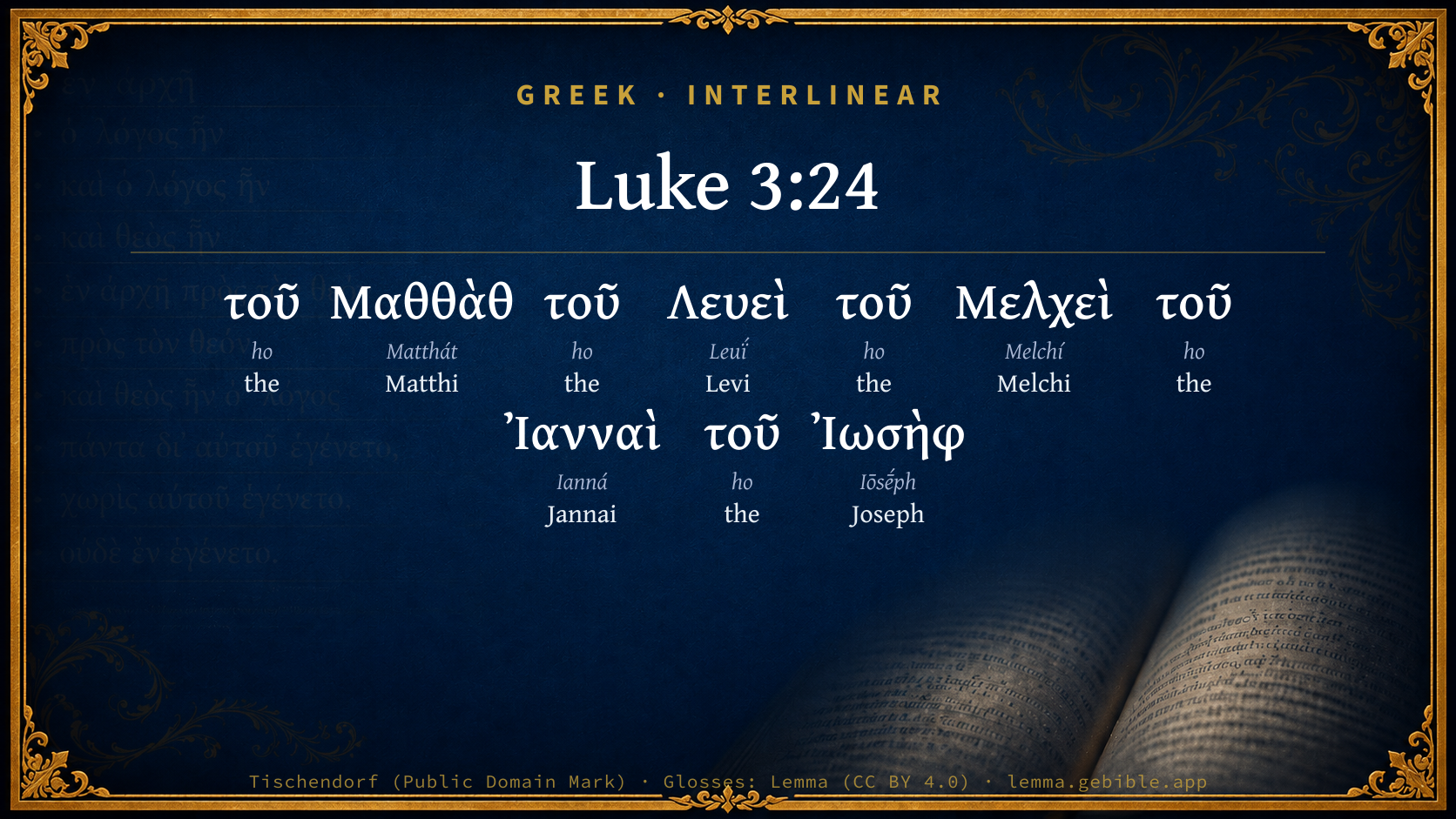
Greek (Tischendorf 8th ed.) Luke 3:24 appears in the Greek New Testament. The text above is from the Tischendorf 8th edition. Each word links to its Strong’s number and a concise gloss. Click any word for its full Thayer’s Greek Lexicon entry.
Download image
Cite this verse

Luke 3:24 (World English Bible). Public Domain. Lemma interlinear Bible study tool, https://lemma.gebible.app/v/luke/3/24.

Show BibTeX & RIS
BibTeX
RIS
English Translation
the son of Matthat, the son of Levi, the son of Melchi, the son of Jannai, the son of Joseph,
World English Bible · Public Domain
Highlights
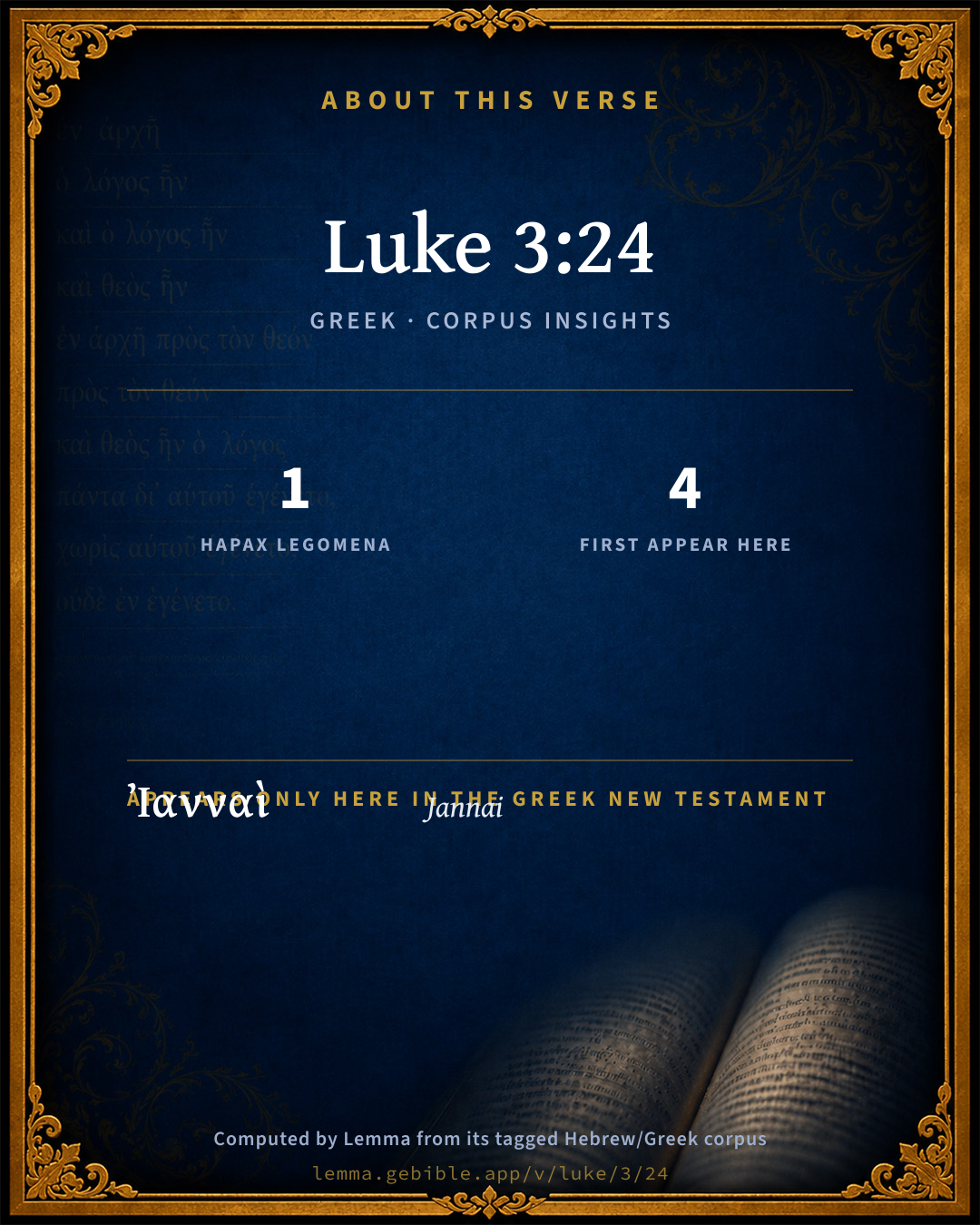
  • 1 hapax legomenon — only here in the Greek New Testament
  • 4 first appearances in the Greek New Testament
Full analysis ↓
Download a study sheet

One document with this verse’s original text, its word-by-word gloss line, the meaning frame, cross-references with their text, attributed commentary, and full source and license credits — printable, and it pastes into notes with its structure intact.

This verse Autodidact and up

Study sheet (.html) Plain text (.txt)

A passage Seminary Student

Up to 50 verses in one chapter. A passage sheet keeps up to 6 commentary sources and 12 cross-references per verse, in the order this page ranks them, and says so on the sheet whenever that leaves anything out. Ask for a single verse and you get the Autodidact verse sheet above.

Everything on this page stays free to read, with no account — the sheet is a download of what is already on screen, not access to it.

Want to remove ads? Support Godless Engineer
Compare translations 3

The same verse in 3 English versions, stacked beneath the original-language interlinear above. Click any original word for its lexicon entry.

Each is an independent rendering of the whole verse — the interlinear is not word-aligned to these translations.

Highlighted words mark where these versions differ — a whole-verse word diff, not a word-by-word alignment.

  • World English Bible Public Domain
    the son of Matthat, the son of Levi, the son of Melchi, the son of Jannai, the son of Joseph,
  • King James Version Public Domain
    Which was the son of Matthat, which was the son of Levi, which was the son of Melchi, which was the son of Janna, which was the son of Joseph,
  • unfoldingWord Literal Text CC BY-SA 4.0
    of Matthat, of Levi, of Melchi, of Jannai, of Joseph,

unfoldingWord Literal Text — © unfoldingWord, licensed CC BY-SA 4.0. Word-aligned USFM3 via Door43 (git.door43.org/unfoldingWord/en_ult).

Versions to compare (up to 4)

3 of 4 selected

Show all 19 translations

Every available English version of this verse, each an independent rendering of the whole verse.

  • World English Bible Public Domain
    the son of Matthat, the son of Levi, the son of Melchi, the son of Jannai, the son of Joseph,
  • Berean Standard Bible Public Domain
    the son of Matthat, the son of Levi, the son of Melchi, the son of Jannai, the son of Joseph,
  • Majority Standard Bible Public Domain
    the son of Matthat, the son of Levi, the son of Melchi, the son of Janna, the son of Joseph,
  • King James Version Public Domain
    Which was the son of Matthat, which was the son of Levi, which was the son of Melchi, which was the son of Janna, which was the son of Joseph,
  • American Standard Version (1901) Public Domain
    the `son' of Matthat, the `son' of Levi, the `son' of Melchi, the `son' of Jannai, the `son' of Joseph,
  • Revised Version (1885) Public Domain
    the son of Matthat, the son of Levi, the son of Melchi, the son of Jannai, the son of Joseph,
  • Geneva Bible (1599) Public Domain
    The sonne of Matthat, the sonne of Leui, the sonne of Melchi, the sonne of Ianna, the sonne of Ioseph,
  • Douay-Rheims (1899) Public Domain
    Who was of Levi, who was of Melchi, who was of Janne, who was of Joseph,
  • Young's Literal Translation Public Domain
    the `son' of Eli, the `son' of Matthat, the `son' of Levi, the `son' of Melchi, the `son' of Janna, the `son' of Joseph,
  • Literal Standard Version CC BY-SA 4.0
    the [son] of Eli, the [son] of Matthat, the [son] of Levi, the [son] of Melchi, the [son] of Janna, the [son] of Joseph,
  • Unlocked Literal Bible CC BY-SA 4.0
    the son of Matthat, the son of Levi, the son of Melchi, the son of Jannai, the son of Joseph.
  • unfoldingWord Literal Text CC BY-SA 4.0
    of Matthat, of Levi, of Melchi, of Jannai, of Joseph,
  • Darby Bible Public Domain
    of Matthat, of Levi, of Melchi, of Janna, of Joseph,
  • World Messianic Bible Public Domain
    the son of Matthat, the son of Levi, the son of Melchi, the son of Jannai, the son of Joseph,
  • Webster's Bible Public Domain
    Who was the son of Matthat, who was the son of Levi, who was the son of Melchi, who was the son of Janna, who was the son of Joseph,
  • Free Bible Version CC BY-SA 4.0
    the son of Matthat, the son of Levi, the son of Melchi, the son of Jannai, the son of Joseph,
  • Bible in Basic English Public Domain
    The son of Matthat, the son of Levi, the son of Melchi, the son of Jannai, the son of Joseph,
  • Text-Critical English NT CC BY 4.0
    the son of Matthat, the son of Levi, the son of Melchi, the son of Janna, the son of Joseph,
  • Tyndale New Testament (1534) Public Domain
    which was the sonne of Mathat: which was the sonne of Levi: which was the sonne of Melchi: which was the sonne of Ianna: which was the sonne of Ioseph:

Literal Standard Version (2020), Covenant Press — licensed CC BY-SA 4.0. Text via the HelloAO Bible API (eBible.org). Unlocked Literal Bible (unfoldingWord) — licensed CC BY-SA 4.0. Text via the HelloAO Bible API (eBible.org). unfoldingWord Literal Text — © unfoldingWord, licensed CC BY-SA 4.0. Word-aligned USFM3 via Door43 (git.door43.org/unfoldingWord/en_ult). Free Bible Version, Dr. Jonathan Gallagher — licensed CC BY-SA 4.0. Text via the HelloAO Bible API (eBible.org).

Word by word

More ways to search: Search by grammar → Find every occurrence → Compare this word →

Practice this passage: Drill this verse → Learn its vocabulary →

About this verse

These counts appear in no published source. They are computed here, from the morphology-tagged text and Lemma’s own curated glosses. What Lemma adds →

10
words
6
distinct lemmas
Gospels
section

Notable vocabulary

1 hapax legomenon — a word that appears only here in the entire Greek New Testament:

  • Ἰανναὶ Jannai G2388

First appearance in Scripture

These words make their first canonical appearance in the Greek New Testament here:

  • Μαθθὰθ Matthi G3158
  • Λευεὶ Levi G3017
  • Μελχεὶ Melchi G3197
  • Ἰανναὶ Jannai G2388

Shared distinctive vocabulary

Μαθθὰθ Matthi G3158 occurs in 2 verses of the Greek New Testament. Also found in:

Repetition

A word recurs within this verse:

Commentary

Notes on Luke 3:24 from classic Christian and Jewish commentators (each source and its license shown beneath its notes). The classic Christian expositions comment on the surrounding passage and are grouped to its opening verse, so a note may address several verses; the Jewish commentaries on the Tanakh (Rashi and others) are per-verse, so they appear only where the commentator wrote on this verse.

Lemma curates 59 commentaries, every one of them public domain or Creative Commons licensed, each selected and text-cleaned for this edition rather than reprinted as found. About our sources →

Expositor's Greek Testament

ed. W. Robertson Nicoll

Luk 3:24-38 . The genealogy . One is surprised to find in Lk. a genealogy at all, until we reflect on his preface with its professed desire for accuracy and thoroughness, and observe the careful manner in which he dates the beginning of John’s ministry. One is further surprised to find here a genealogy so utterly different from that of Mt. Did Lk. not know it, or was he dissatisfied with it? Leaving these questions on one side, we can only suppose that the evangelist in the course of his inquiries came upon this genealogy of the Saviour and resolved to give it as a contribution towards defining the fleshly relationships of Jesus, supplying here and there an editorial touch. Whether this genealogy be of Jewish-Christian, or of Pauline-Christian origin is a question on which opinion differs.

Luk 3:24-31 . From Joseph back to David . Compared with the corresponding section of Mt.’s genealogy these differences are apparent: (1) in both sub-divisions of the section (David to captivity, captivity to Christ) there are considerably more names (Luk 3:20 ; Luk 3:14 ), a fact intelligible enough in genealogies through different lines; (2) they start from different sons of David (Nathan, Solomon); (3) they come together at the captivity in Shealtiel and Zerubbabel ; (4) after running in separate streams from that point onwards they meet again in Joseph, who in the one is the son of Eli, in the other the son of Jacob. The puzzle is to understand how two genealogical streams so distinct in their entire course should meet at these two points. The earlier coincidence is accounted for by harmonists by the hypothesis of adoption (Jeconiah adopts Shealtiel, Shealtiel adopts Zerubbabel), the later by the hypothesis of a Levirate marriage . vide Excursus ii. in Farrar’s work on Luke (C. G. T.). These solutions satisfy some. Others maintain that they do not meet the difficulties, and that we must be content to see in the two catalogues genealogical attempts which cannot be harmonised, or at least have not yet been.

Luk 3:24 . ὢν , being , introducing the genealogical list, which ascends from son to father, instead of, as in Mt., descending from father to son, therefore beginning at the end and going backwards. ὡς ἐνομίζετο : presumably an editorial note to guard the virgin birth. Some regard this expression with Ἰωσήφ following, as a parenthesis, making the genealogy in its original form run being son of Eli, etc., so that the sense, when the parenthesis is inserted, becomes: being son (as was supposed of Joseph but really ) of Eli, etc., Eli being the father of Mary , and the genealogy being that of the mother of Jesus (Godet and others). This is ingenious but not satisfactory. As has been remarked by Hahn, if that had been Lk.’s meaning it would have been very easy for him to have made it clear by inserting ὄντως δὲ before τοῦ Ἠλί . We must therefore rest in the view that this genealogy, like that of Mt., is Joseph’s, not Mary’s, as it could not fail to be if Jews were concerned in its compilation.

The Expositor's Greek Testament, edited by W. Robertson Nicoll (1897–1910) — public domain. Text from a community e-Sword module.

Godet's Commentaries

Frédéric Louis Godet

2 d. Luk 3:24-38.

And first, Luk 3:24-27: from Heli to the captivity. In this period Luke mentions 21 generations (up to Neri); only 19, if the various reading of Africanus be admitted; Matthew , 14. This last number is evidently too small for the length of the period. As Matthew omits in the period of the kings four well-known names of the O. T., it is probable that he takes the same course here, either through an involuntary omission, or for the sake of keeping to the number 14 (Luk 1:17). This comparison should make us appreciate the exactness of Luke’s register.

But how is it that the names Zorobabel and Salathiel occur, connected with each other in the same way, in both the genealogies? And how can Salathiel have Neri for his father in Luke, and in Matthew King Jechonias? Should these names be regarded as standing for different persons, as Wieseler thinks? This is not impossible. The Zorobabel and the Salathiel of Luke might be two unknown persons of the obscurer branch of the royal family descended from Nathan; the Zorobabel and the Salathiel of Matthew, the two well-known persons of the O. T. history, belonging to the reigning branch, the first a son, the second a grandson of King Jechonias (1Ch 3:17; Ezr 3:2; Hag 1:1). This is the view which, after all, appears to Bleek most probable. It is open, however, to a serious objection from the fact that these two names, in the two lists, refer so exactly to the same period, since in both of them they are very nearly halfway between Jesus and David. If the identity of these persons in the two genealogies is admitted, the explanation must be found in 2Ki 24:12, which proves that King Jechonias had no son at the time when he was carried into captivity. It is scarcely probable that he had one while in prison, where he remained shut up for thirty-eight years. He or they whom the passage 1Ch 3:17 assigns to him (which, besides, may be translated in three different ways) must be regarded as adopted sons or as sons-in-law; they would be spoken of as sons, because they would be unwilling to allow the reigning branch of the royal family to become extinct. Salathiel, the first of them, would thus have some other father than Jechonias; and this father would be Neri, of the Nathan branch, indicated by Luke. An alternative hypothesis has been proposed, founded on the Levirate law. Neri, as a relative of Jechonias, might have married one of the wives of the imprisoned king, in order to perpetuate the royal family; and the son of this union, Salathiel, would have been legally a son of Jechonias, but really a son of Neri. In any case, the numerous differences that are found in the statements of our historical books at this period prove that the catastrophe of the captivity brought considerable confusion into the registers or family traditions. Rhesa and Abiud, put down, the one by Luke, the other by Matthew, as sons of Zorobabel, are not mentioned in the O. T., according to which the sons of this restorer of Israel should have been Meshullam and Hananiah (1Ch 3:19). Bleek observes, that if the evangelists had fabricated their lists, they would naturally have made use of these two names that are furnished by the sacred text; therefore they have followed their documents.

Vers. 28-31.

From the captivity to David, 20 names. Matthew for the same period has only 14. But it is proved by the O. T. that he omits four; the number 20, in Luke, is a fresh proof of the accuracy of his document. On Nathan, son of David, comp. 2Sa 5:14, Zec 12:12. The passage in Zechariah proves that this branch was still flourishing after the return from the captivity. If Neri, the descendant of Nathan, was the real father of Salathiel, the adopted son or son-in-law of Jechonias, we should find here once more the characteristic of the two genealogies: in Matthew, the legal, official point of view; in Luke, the real, human point of view.

Vers. 32-34 a.

From David to Abraham. The two genealogies agree with each other, and with the O. T.

Vers. 34-38.

From Abraham to Adam. This part is peculiar to Luke. It is compiled evidently from the O. T., and according to the text of the LXX., with which it exactly coincides. The name Cainan, Luk 3:36, is only found in the LXX., and is wanting in the Heb. text (Gen 10:24; Gen 11:12). This must be a very ancient variation.

The words, of God, with which it ends, are intended to inform us that it is not through ignorance that the genealogist stops at Adam, but because he has reached the end of the chain, perhaps also to remind us of the truth expressed by Paul at Athens: “We are the offspring of God.” The last word of the genealogy is connected with its starting-point (Luk 3:22-23). If man were not the offspring of God, the incarnation (Luk 3:22) would be impossible. God cannot say to a man: “Thou art my beloved son,” save on this ground, that humanity itself is His issue (Luk 3:38).

Frédéric Louis Godet — Commentaries on Luke, John, Romans, and 1 Corinthians — English translation (T&T Clark, Edinburgh, 1870s–1890s) — public domain. Text from a community e-Sword module.

Jamieson, Fausset & Brown

Robert Jamieson, A. R. Fausset & David Brown

son of Matthat, &c.--(See on Mat 1:13-15). In Luk 3:27, Salathiel is called the son, while in Mat 1:12, he is called the father of Zerubbabel. But they are probably different persons.

Jamieson, Fausset & Brown — Commentary Critical and Explanatory on the Whole Bible (1871) — public domain (CC PDM 1.0). Text via the HelloAO Bible API.

John Gill's Exposition

Which was the son of Mattathias,.... Surnamed Siloah, by the same Philo, who governed ten years:

which was the son of Amos; whose surname, according to the same author, was Sirag; or, as some, Syrach, or Shyrach, who governed fourteen years:

which was the son of Naum; who was called Mesalut, or Maslot, who governed seven years:

which was the son of Esli; or Eli, surnamed Haggai, who governed eight years;

which was the son of Nagge: with Philo he is called Nagid Artasat, or Artaxat, and said to govern ten years.

John Gill's Exposition of the Whole Bible (1746–1763) — public domain (CC PDM 1.0). Text via the HelloAO Bible API.

Trapp's Complete Commentary

John Trapp

24 Which was the son of Matthat, which was the son of Levi, which was the son of Melchi, which was the son of Janna, which was the son of Joseph,

Ver. 24. St Luke reckoneth from the last of Christ’s progenitors to the first. And first he mentioneth private men, not read of in the Scriptures. 2. Captains after the Babylonish captivity. 3. Kings and men of great name in and before the captivity. 4. Private persons again before David up to the patriarchs. 5. Lastly, the patriarchs themselves up to Adam the protoplast, the first and common parent.

John Trapp, A Commentary or Exposition upon All the Books of the Old and New Testament (1647–1656) — public domain. Text from a community e-Sword module.

Albert Barnes' Notes on the Bible

See, on this genealogy, the notes at Mat. 1:1-16.

Albert Barnes' Notes on the Bible (1834–1885) — public domain. Text from a community e-Sword/MySword module.

Matthew Poole's English Annotations

There have been great disputes about the genealogy of our Saviour, as recorded both by Matthew and Luke. The adversaries of Christian religion have taken no small advantage from the seeming difference between them, which even many sober writers have thought it no easy matter to reconcile. The apostle hath cautioned us against giving too much heed to endless genealogies, which minister questions rather than godly edifying which is in faith, 1Ti 1:4; yet certainly it is our duty, as well for the stopping the mouths of such as would clamour against the truth of the whole Scripture, (if not of the whole Christian religion), as, so far as we can, to vindicate holy writ from their little cavils, and thereby also to confirm those who are weak in faith. To make these things as clear as we can: It is plain that both the evangelists agree in their design, by setting down the genealogy of our Saviour, to prove him lineally descended both from Abraham and David, the two persons to whom was made the promise of the Messiah, and the stability of his kingdom, and also in the names of the first fourteen generations, mentioned by Matthew, and here by Luke, Luk 3:32,33, and to Abraham, Luk 3:34. Their disagreement lieth in four things.

1. In the form of the pedigree; Matthew beginning with those who were first, Luke with those who were last in order of time. But this is no valuable exception, one evangelist counts forward, another backward.

2. Matthew counts by three periods, each consisting of fourteen generations; Luke doth not: but neither is this of any moment.

3. Matthew sits down our Saviour’s genealogy before he tells us any thing of his conception or birth; Luke, after his relation of his conception, birth, and baptism.

4. Matthew derives our Saviour’s genealogy but from Abraham; Luke, from Adam.

All these differences lay no foundation for any exception. Several accounts are given why Luke carrieth up the genealogy to Adam; the best seemeth to be this: that Matthew intending his history primarily for the Jews, judged it enough to prove Christ the Son of Abraham, and the Son of David; but Luke designing the information of the whole world, derives him from the common father of mankind. By which means he also showeth the antiquity of the gospel, and lets us know that Christ was he who was promised to Adam, before Abraham’s time, and that the grace of the gospel is not limited to the seed of Abraham. Thus also Luke supplieth what was wanting in Matthew, and truly derives both the first and second act from God, the Father of our Lord Jesus Christ, and of us all. But besides these differences (hardly worth the taking notice of under that notion) there are some seeming contradictions in the genealogies, yet not such but I think a fair account may be given of to any who will but first consider:

1. That they all lie in what Luke hath, from Luk 3:23-31, and from the latter end of Luk 3:34 to the end. So that in Luk 3:32,33, and part of Luk 3:34, we have nothing to reconcile.

2. That these words the son is in the Greek only Luk 3:23, where Christ is said to be "the son of Joseph," but ever after it is supplied by the translators. So as the Greek runs thus: The Son of Joseph, which was of Heli, which was of Matthat, which was of Levi, which was of Melchi, &c. Which consideration cuts off the first cavil, how Joseph could be the son of Jacob, as Matthew saith, and the son of Heli, as Luke saith; for indeed Luke saith no more than, And Jesus himself began to be about thirty years of age, being (as was supposed) the son of Joseph, which was the son of Heli, Luk 3:23; that is, Christ was of Heli, the supposed son of Joseph, but truly of Heli, the father of Mary his mother. I know that some think Jacob was also called Heli (as it was ordinary with the Jews to have two names); others think that Joseph is called the son, because he was the son-in-law of Heli, by the marriage of the virgin Mary his daughter. (Naomi calleth those her daughters who were but her legal daughters, Rth 1:11) In this the most agree. But I must confess I think it is Christ, who is here said to be of Heli (though he was reputed, and generally taken, to be the son of Joseph).

3. That Luke is here deriving our Saviour, not from his supposed father Joseph, but from Mary his true mother. It is not to be conceived that Luke, after such a narration of the predictions of his conception as he had given us in the first chapter, should go to derive Christ from Joseph; and this gives us a fair account why the names are so different from David’s time to the birth of Christ. Joseph (whose pedigree Matthew relates) deriving from Solomon, who was the son of David, succeeding him in the kingdom. Mary (whose pedigree Luke relates) descending from Nathan, Luk 3:31; 1Ch 3:5 tells us he was another son of David. So as after David’s time the persons named which before were the same in our Saviour’s pedigree became diverse, some the progenitors of Joseph, whom Matthew reckons, others the progenitors of Mary, whom Luke nameth. This answereth the objection from the differing number of the persons from Joseph to Zorobabel (excluding them both). Matthew reckoneth but nine, Luke here reckoneth eighteen, in Luk 3:23-28. From Zorobabel to David Luke reckons twenty-two progenitors, Matthew but fourteen, (leaving out three kings of the half blood of Ahab, of which we gave an account in our notes: See Poole on "Mat 1:1"), so as the Scripture nameth seventeen, though Matthew leaves out three. In two different lines, it is not impossible that one person in so many years might have so many more progenitors than another, supposing Matthew designed to reckon all, which it is plain from his leaving out three kings named in Scripture that he did not.

4. That ordinarily the Jews had two names, sometimes three. All Josiah’s sons had each of them two at least. Matthew had also the name of Levi, &c. This solves the difference from Luk 3:27, where Rhesa is said to be the son of Zorobabel, whenas Matthew saith, Mat 1:13, Zorobabel begat Abiud. That Abraham was the son of Terah or Thara, and Terah the son of Nachor, appeareth from Gen 11:24,26. That Saruch or Serug was the son of Reu or Ragau, appeareth from Gen 11:20; 1Ch 1:25. That Reu was the son of Peleg, (here called Phalec), and Peleg the son of Eber, and Eber the son of Sala, appears from Gen 11:18; 1Ch 1:25. But in Gen 11:12 we read, that Sala was the son of Arphaxad, whereas he is here said to be the son of Cainan, and Cainan is made the son of Arphaxad. So as Luke maketh Sala grandchild to Arphaxad; Moses makes no mention of Cainan at all, but mentions Salah as begotten by Arphaxad. Those who are curious to know what is said for the resolution of this difficulty, may read it largely both in Spanheim’s Dubia Evangelica, and Mr. Pool’s Synopsis Criticorum. It is a difficulty which hath exercised many very learned men, and I doubt whether ever any yet satisfied himself in the resolution of it. It is not probable that Luke should correct what Moses said; the best account I can give of it is, the Septuagint in Gen 11:12 have it just as Luke here hath it; and it is certain that Luke, in his quotations out of the Old Testament, doth generally follow the Septuagint, being the translation most in use among them. Beza tells us of an ancient copy of the Gospel he had, which mentions no Cainan. The best of it is, that it is a matter of no great moment, for the question is not, whether Sala was the son of Arphaxad, (for so he was, though Arphaxad was his grandfather, in the same sense that Christ is called the Son of Abraham, and the Son of David, and Elisabeth the daughter of Aaron, Luk 1:50) but whether he was the immediate son of Arphaxad or Cainan; whether Moses omitted Cainan, or some transcriber of Luke added Cainan out of the Septuagint (being then the current translation among them): the last is most probable. For the other part of the genealogy, Luk 3:36-38, it plainly agreeth with Gen 5:6; 6:10. So that I must profess I see no great difficulty to reconcile the genealogies, admitting the one to give the genealogy of Joseph, and the other to give the genealogy of Mary. That indeed Mary was the daughter of Heli is not to be proved by Scripture, nor yet contradicted, but it is very probably judged so. And though we cannot prove that Cainan, mentioned Luk 3:36, was added out of some later copies of the Septuagint, yet it is more than probable it was so. Which two things if we admit, I see no great difficulty remaining, but a fair agreement between both the evangelists. For I presume none will stumble at the alteration of some letter, or omission of some letter in a name, or addition to it in the end; there is nothing more ordinary than that, when names are mentioned in several languages.

Matthew Poole's English Annotations on the Holy Bible (1683–1685) — public domain. Text from a community e-Sword/MySword module.

Burkitt's Expository Notes on the New Testament

William Burkitt

We find the genealogy of our blessed Saviour recorded by two evangelists, St. Matthew and St. Luke. His pedigree is set forth by St. Matthew from his father Joseph, by St. Luke from his mother Mary; the design of both is to prove him lineally descended from Abraham and David, and consequently the true and promised Messiah.

St. Matthew, intending his history primarily for the Jews, proves him to be the son of Abraham and David, for their comfort. St. Luke, designing the information and comfort of the Gentiles, derives our Lord’s pedigree from Adam, the common parent of mankind; to assure the Gentiles of their possibility of an interest in Christ, they being the sons of Adam. Neither of these evangelists are strict and accurate in enumerating every individual person; which should teach us not to be over-curious in scanning the parts of this genealogy, much less captiously to object against it, because of some seeming contradictions to it; for if the evangelists were not nice and critical in composing this genealogy, why should we be so in examining of it? Let us rather attend to the design of the Holy Ghost in writing of it, which was twofold.

1. For the honour of our Saviour as man, showing who were his noble and royal progenitors according to the flesh.

2. For the confirmation of our faith, touching the reality of our Saviour’s incarnation. The scripture making mention of all his progenitors from the first man Adam, to his reputed father Joseph, we cannot reasonably doubt either of the truth of his human nature, or of the certainty of his being the promised Messiah.

Hence we may learn that the wisdom of God has taken all necessary care, and used all needful means, for satisfying the minds of all unprejudiced persons, touching the reality of Christ’s human nature, and the certainty of his being the promised Messiah; for both these ends is our Saviour’s genealogy, descent, and pedigree, recorded in holy scripture.

William Burkitt's Expository Notes on the New Testament (1700–1703) — public domain. Text from a community e-Sword module.

Lesson kit

Teaching starters — assembled from the data on this page, not authored interpretation. Every prompt links to the verse data it draws on. Edit before teaching.

Luke, in the Gospels, opens this verse with 10 words (6 distinct Greek lemmas). Its most distinctive word is Ianná (“Jannai”). A historical commentator’s framing appears above. Read the whole chapter for the surrounding context.

Discussion questions

  1. The word Ianná carries the sense “Jannai.” How does it shape the verse?
  2. This verse holds 1 word here found nowhere else in the Greek New Testament. What might the rare word draw attention to?
  3. 4 words here appear for the first time in Scripture. What is being introduced at this debut?
  4. Luke 3:29 shares the word «Matthi» with this verse. How do the two illuminate each other?
  5. “the” occurs 5× in this one verse. What is the effect of the repetition?
  6. The translations on this page render this verse differently — a whole-verse word diff, not a word-by-word alignment. What might account for the different wordings?
  7. Reading how Expositor's Greek Testament and Godet's Commentaries read this verse, where do the two commentators agree and where do they part?

Things to notice

  • 1 word in this verse appears nowhere else in the Greek New Testament.
  • 4 words make their first canonical appearance in Scripture here.
  • These translations choose different wording for 4 words in this verse.
  • “the” occurs 5× in this single verse.
  • 6 distinct Greek lemmas span 10 words in this verse.

Reading settings

Reading text

Shown beneath each verse's original-language words.

Old Testament
Old Testament edition

Read the OT as the Masoretic Hebrew (MT) or the Greek Septuagint (LXX).

English shown for the Greek Septuagint (in the Hebrew ↔ Greek comparison).

Comparing translations? Open the Compare panel on any verse page to stack up to four side by side.