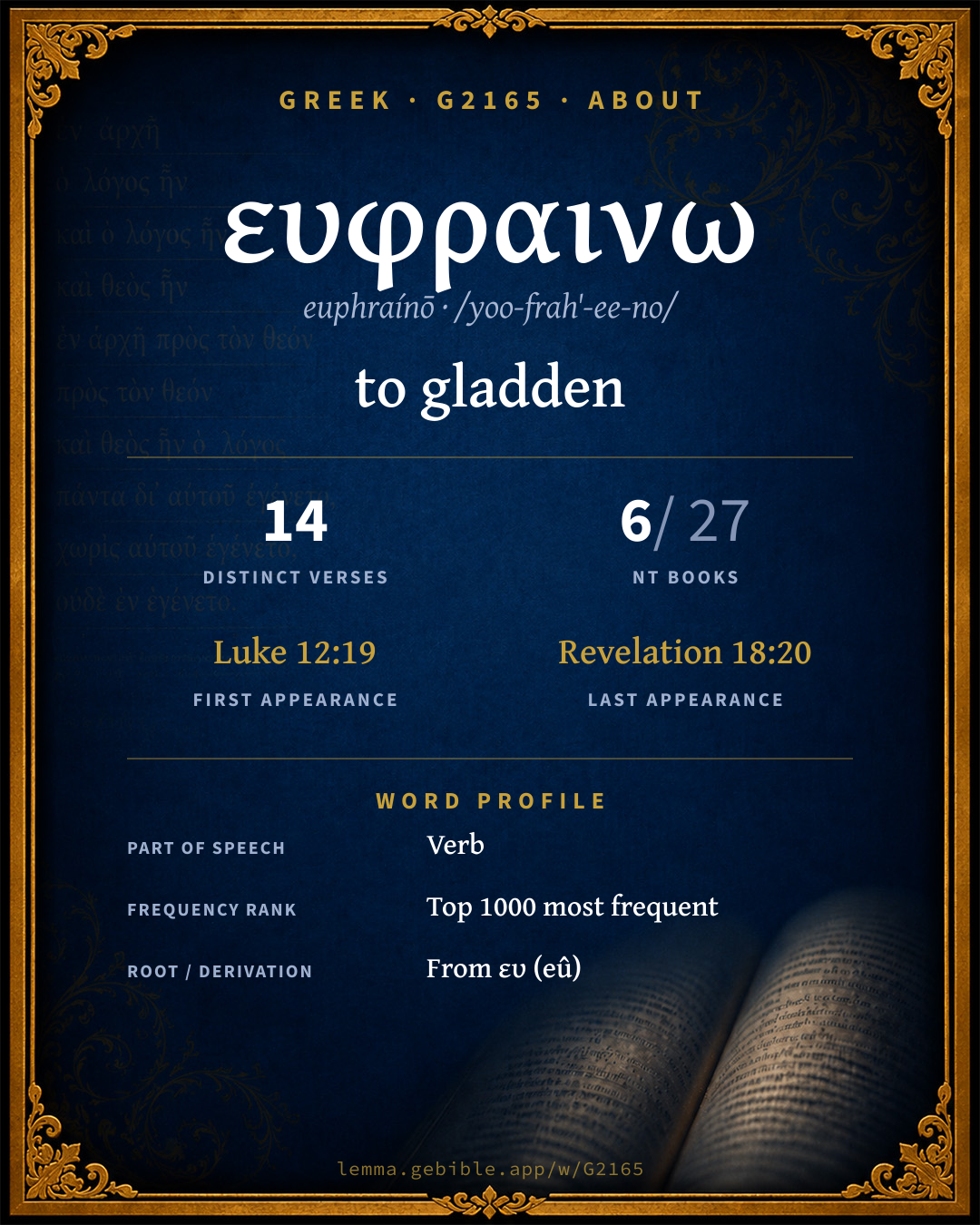
εὐφραίνω
to gladden
‘to gladden’ is one of 2 main senses fuller range ↓
Full lexicon entry — Thayer's Greek Lexicon
From Thayer's Greek Lexicon
Where this word appears
See every Present-tense verb in the Greek New Testament →
Grammar key — what these labels mean
Part of speech
- Verb
- An action or state-of-being word.
Tense
- Present
- Ongoing or general action in present time (imperfective aspect).
- Aorist
- Action viewed as a simple whole, without regard to duration — often past (perfective aspect).
- Imperfect
- Continuous or repeated action in past time (“was writing”).
Voice
- Passive
- The subject receives the action.
- Active
- The subject performs the action.
Mood
- Imperative
- Expresses a command or request.
- Indicative
- States a fact or asks a factual question (the mood of reality).
- Infinitive
- A verbal noun (“to write”), unmarked for person or number.
- Subjunctive
- Expresses probability, purpose, or possibility (the mood of contingency).
- Participle
- A verbal adjective (“writing,” “having written”).
Case
- Nominative
- The case of the subject (and the predicate nominative).
Person
- 2nd person
- The one addressed (“you”).
- 3rd person
- The one spoken about (“he / she / it / they”).
- 1st person
- The speaker (“I / we”).
Gender
- Masculine
- Grammatically masculine.
Number
- Singular
- One.
- Plural
- More than one.
Grammatical forms 13 distinct
- Verb, Present, Passive, Imperative, 2nd person, Singular 2 times (14%)
- Verb, Aorist, Passive, Indicative, 3rd person, Singular 1 time (7%)
- Verb, Aorist, Passive, Imperative, 2nd person, Plural 1 time (7%)
- Verb, Aorist, Passive, Imperative, 2nd person, Singular 1 time (7%)
- Verb, Aorist, Passive, Infinitive 1 time (7%)
- Verb, Aorist, Passive, Subjunctive, 1st person, Plural 1 time (7%)
- Verb, Aorist, Passive, Subjunctive, 1st person, Singular 1 time (7%)
- Verb, Imperfect, Passive, Indicative, 3rd person, Plural 1 time (7%)
+5 more forms (5 occurrences)
Parsed forms decoded from the imported morphology (Robinson–Tischendorf, public domain), counted across 14 parsed occurrences — not distinct verses.
Every verse where G2165 appears — 14 distinct verses across 6 books. Click any verse to open its interlinear word-by-word view. Verse text shown in the World English Bible for context — . Each verse’s Greek form is shown with its reference; the English is not keyword-highlighted, since the data carries no word-level English alignment. Use “Compare translations” on any verse to read it across multiple English versions. This concordance covers the Greek New Testament; Septuagint (Greek Old Testament) occurrences of this word are not indexed here.
Luke 6 verses
- Luke 12:19 εὐφραίνου pres pass impv 2sg I will tell my soul, "Soul, you have many goods laid up for many years. Take your ease, eat, drink, be merry."'
- Luke 15:23 εὐφρανθῶμεν aor pass subj 1pl Bring the fattened calf, kill it, and let us eat, and celebrate;
- Luke 15:24 εὐφραίνεσθαι pres pass inf for this, my son, was dead, and is alive again. He was lost, and is found.' They began to celebrate.
- Luke 15:29 εὐφρανθῶ aor pass subj 1sg But he answered his father, 'Behold, these many years I have served you, and I never disobeyed a commandment of yours, but you never gave me a goat, that I might celebrate with my friends.
- Luke 15:32 εὐφρανθῆναι aor pass inf But it was appropriate to celebrate and be glad, for this, your brother, was dead, and is alive again. He was lost, and is found.'"
- Luke 16:19 εὐφραινόμενος pres pass ptcp nom sg masc "Now there was a certain rich man, and he was clothed in purple and fine linen, living in luxury every day.
Acts 2 verses
Romans 1 verse
2 Corinthians 1 verse
Galatians 1 verse
Revelation 3 verses
- Revelation 11:10 εὐφραίνονται pres pass ind 3pl Those who dwell on the earth rejoice over them, and they will be glad. They will give gifts to one another, because these two prophets tormented those who dwell on the earth.
- Revelation 12:12 εὐφραίνεσθε pres pass impv 2pl Therefore rejoice, heavens, and you who dwell in them. Woe to the earth and to the sea, because the devil has gone down to you, having great wrath, knowing that he has but a short time."
- Revelation 18:20 εὐφραίνου pres pass impv 2sg Rejoice over her, O heaven, you saints, apostles, and prophets; for God has judged your judgment on her."
About this entry
At a glance — auto-summarized from this page’s data, not written by a person. Every figure links to its source below. This summary describes the numbers; it doesn’t interpret them.
ευφραινω (euphraínō) is a Greek verb most often rendered “to gladden.” Scripture first uses it in Luke 12:19. Spanning 14 verses in 6 books, it ranks among the uncommon words of the Greek New Testament. Luke dominates its distribution — 6 of 14 verses. Ranging over 2 senses, it is not a single-sense word. For the data behind this summary, explore the sense tree and the renderings breakdown below.
Gloss history
Strong's 1890 vs modern scholarship

About this word
Strong's G2165 catalogs a Greek word from the Greek New Testament.
These counts are not copied from any lexicon or concordance. They are computed here, from the morphology-tagged Greek New Testament. What Lemma adds →
- 14
- distinct verses
- The word appears in 14 distinct verses.
- 6 / 27
- NT books
- The word appears in 6 of 27 New Testament books.
- #814
- by frequency
- Top 1000 most frequent Greek words (rank 814 of 5,347 Greek words by occurrence).
View all 14 occurrences in the concordance →
Most concentrated in
- Luke 6 verses 43%
- Revelation 3 verses 21%
- Acts 2 verses 14%
By section of the New Testament
By traditional corpus
Conventional, traditional groupings — biblical authorship is debated, so this is a traditional corpus grouping, not an authorship claim. Some books belong to more than one corpus (Luke is in both the Gospels and the Lukan corpus, and so on), so these shares overlap and need not total 100%. Each figure is a share of the word’s 14 distinct verses.
- Lukan (Luke–Acts) 8 verses · 57%
- Gospels 6 verses · 43%
- Johannine 3 verses · 21%
- Pauline corpus 3 verses · 21%
- Revelation 3 verses · 21%
How translations render this word
Counts come from each version’s own published word-to-Strong’s tagging or interlinear alignment — an approximate guide to how each version renders this word, not a word-level alignment the data otherwise carries. Because each total is that version’s own tagged count, the per-version totals vary from one another and need not match the appearance or distinct-verse counts above. These counts may also differ from a printed concordance because Lemma counts each distinctly tagged rendering and does not collapse phrase taggings into a single head-word total. This is a fixed set of word-tagged versions (KJV, ASV, BSB, ULT) and does not change with the reading translation you choose elsewhere. Each version’s license is shown beside its name below (and on Sources).
- King James Version: Rejoice 4×, Be merry 3×
- American Standard Version: Make merry 3×, Rejoice 3×, Be merry 2×
- Berean Standard Bible: Celebrate 4×, Rejoice 4×
- unfoldingWord Literal Text: Celebrate 4×, Rejoice 4×
King James Version Public Domain
Renders G2165 across 16 tagged occurrences — most commonly:
Plus 9 renderings that appear only once — usually multi-word phrases or single function words the recovered tagging swept in, not distinct renderings.
American Standard Version Public Domain
Renders G2165 across 15 tagged occurrences — most commonly:
Plus 7 renderings that appear only once — usually multi-word phrases or single function words the recovered tagging swept in, not distinct renderings.
Berean Standard Bible Public Domain
Renders G2165 across 14 tagged occurrences — most commonly:
Plus 6 renderings that appear only once — usually multi-word phrases or single function words the recovered tagging swept in, not distinct renderings.
unfoldingWord Literal Text CC BY-SA 4.0
Renders G2165 across 15 tagged occurrences — most commonly:
Plus 7 renderings that appear only once — usually multi-word phrases or single function words the recovered tagging swept in, not distinct renderings.
Senses in Thayer's
The 2 senses Thayer's distinguishes for this word, in lexicon order (not ranked by frequency or importance). The full entry — with sub-senses — is in the Lexicon Entry tab.
- to be glad, to be merry, to rejoice
- to rejoice in, be delighted with a thing
Word origin
Derived from ευ (eû) (G2095) — to prosper.
Forms in the corpus
The 13 distinct written forms G2165 takes in the Greek New Testament, most frequent first — each parse links to that tense’s occurrences in the concordance.
Same root — word family
Other Thayer's entries built from the same root as G2165, grouped by Strong’s listed origin. These share a root / origin per the lexicon — not necessarily a shared meaning. Each links to that word’s own entry.
Derives from
Shares the same root
- ευαγγελιζω euangelízō G2097 to evangelize
- ευαρεστος euárestos G2101 pleasing
- ευγενης eugenḗs G2104 noble
- ευδια eudía G2105 fair weather
- ευδοκεω eudokéō G2106 to be pleased
- ευδοκια eudokía G2107 pleasure
- ευεργετης euergétēs G2110 benefactor
- ευθετος eúthetos G2111 well situated
- ευθυμος eúthymos G2115 courageous
- ευθυς euthýs G2117 straight
- ευκαιρος eúkairos G2121 opportune
- ευκοπωτερος eukopṓteros G2123 easy
- ευλαβης eulabḗs G2126 devout
- ευλογεω eulogéō G2127 to praise
- ευμεταδοτος eumetádotos G2130 generous
- ευνοεω eunoéō G2132 to wish well
- ευοδοω euodóō G2137 to prosper
- ευπειθης eupeithḗs G2138 obedient
- ευπεριστατος euperístatos G2139 besetting
- ευποιΐα eupoiḯa G2140 doing good
- ευπρεπεια euprépeia G2143 beauty
- ευπροσδεκτος euprósdektos G2144 acceptable
- ευπροσεδρος euprósedros G2145 devoted
- ευπροσωπεω euprosōpéō G2146 to please
+13 more words share this root (not shown).
Derived from this word
Proper names from this root
People and places named from this root — a name, not an additional meaning of the word.
Compare all same-root words → Showing 4 of 43 — not the complete family. 3 of the same-root words are proper names (people or places). They share a root, not necessarily a meaning.
Septuagint usage
The same Greek word ευφραινω appears 199 times in the Greek Old Testament (Septuagint), across 186 verses in 26 books.
- 199
- LXX occurrences
- Tagged occurrences of this Greek word in the Septuagint.
- 186
- verses
- Distinct Septuagint verses containing this word.
- 26 / 39
- OT books
- The word appears in 26 of the 39 Old Testament books.
Sample Septuagint occurrences
- Leviticus 23:40 εὐφραίνω
- Deuteronomy 12:7 εὐφραίνω
- Judges 9:13 εὐφραίνω
- 1 Samuel 2:1 εὐφραίνω
- 2 Samuel 1:20 εὐφραίνω
- 1 Kings 1:40 εὐφραίνω
- 1 Chronicles 16:10 εὐφραίνω
- 2 Chronicles 6:41 εὐφραίνω
- Ezra 6:22 εὐφραίνω
- Esther 5:7 εὐφραίνω
- Job 21:12 εὐφραίνω
- Psalms 5:12 εὐφραίνω
Septuagint occurrences (same lexeme)
Every verse where the same Strong’s number (G2165) appears in the Greek Septuagint — showing the first 50 of 186. Verse text shown in the World English Bible for context; the Greek form is the matched word — the English is not keyword-highlighted.
- Leviticus 23:40 εὐφραίνω You shall take on the first day the fruit of goodly trees, branches of palm trees, and boughs of thick trees, and willows of the brook; and you shall rejoice before Yahweh your God seven days.
- Deuteronomy 12:7 εὐφραίνω and there you shall eat before Yahweh your God, and you shall rejoice in all that you put your hand to, you and your households, in which Yahweh your God has blessed you.
- Deuteronomy 12:12 εὐφραίνω You shall rejoice before Yahweh your God, you, and your sons, and your daughters, and your men-servants, and your maid-servants, and the Levite who is within your gates, because he has no portion nor inheritance with you.
- Deuteronomy 12:18 εὐφραίνω but you shall eat them before Yahweh your God in the place which Yahweh your God shall choose, you, and your son, and your daughter, and your man-servant, and your maid-servant, and the Levite who is within your gates: and you shall rejoice before Yahweh your God in all that you put your hand to.
- Deuteronomy 14:26 εὐφραίνω and you shall bestow the money for whatever your soul desires, for oxen, or for sheep, or for wine, or for strong drink, or for whatever your soul asks of you; and you shall eat there before Yahweh your God, and you shall rejoice, you and your household.
- Deuteronomy 16:11 εὐφραίνω and you shall rejoice before Yahweh your God, you, and your son, and your daughter, and your man-servant, and your maid-servant, and the Levite who is within your gates, and the foreigner, and the fatherless, and the widow, who are in the midst of you, in the place which Yahweh your God shall choose, to cause his name to dwell there.
- Deuteronomy 16:14 εὐφραίνω and you shall rejoice in your feast, you, and your son, and your daughter, and your man-servant, and your maid-servant, and the Levite, and the foreigner, and the fatherless, and the widow, who are within your gates.
- Deuteronomy 16:15 εὐφραίνω Seven days shall you keep a feast to Yahweh your God in the place which Yahweh shall choose; because Yahweh your God will bless you in all your increase, and in all the work of your hands, and you shall be altogether joyful.
- Deuteronomy 20:6 εὐφραίνω What man is there who has planted a vineyard, and has not used the fruit of it? let him go and return to his house, lest he die in the battle, and another man use the fruit of it.
- Deuteronomy 24:5 εὐφραίνω When a man takes a new wife, he shall not go out in the host, neither shall he be charged with any business: he shall be free at home one year, and shall cheer his wife whom he has taken.
- Deuteronomy 26:11 εὐφραίνω and you shall rejoice in all the good which Yahweh your God has given to you, and to your house, you, and the Levite, and the foreigner who is in the midst of you.
- Deuteronomy 27:7 εὐφραίνω and you shall sacrifice peace-offerings, and shall eat there; and you shall rejoice before Yahweh your God.
- Deuteronomy 28:39 εὐφραίνω You shall plant vineyards and dress them, but you shall neither drink of the wine, nor gather [the grapes]; for the worm shall eat them.
- Deuteronomy 28:63 εὐφραίνω It shall happen that as Yahweh rejoiced over you to do you good, and to multiply you, so Yahweh will rejoice over you to cause you to perish, and to destroy you; and you shall be plucked from off the land where you go in to possess it.
- Deuteronomy 30:9 εὐφραίνω Yahweh your God will make you plenteous in all the work of your hand, in the fruit of your body, and in the fruit of your cattle, and in the fruit of your ground, for good: for Yahweh will again rejoice over you for good, as he rejoiced over your fathers;
- Deuteronomy 32:43 εὐφραίνω Rejoice, you nations, [with] his people: For he will avenge the blood of his servants, Will render vengeance to his adversaries, Will make expiation for his land, for his people.
- Deuteronomy 33:18 εὐφραίνω Of Zebulun he said, Rejoice, Zebulun, in your going out; Issachar, in your tents.
- Judges 9:13 εὐφραίνω The vine said to them, Should I leave my new wine, which cheers God and man, and go to wave back and forth over the trees?
- Judges 9:19 εὐφραίνω if you then have dealt truly and righteously with Jerubbaal and with his house this day, then rejoice you in Abimelech, and let him also rejoice in you:
- Judges 16:23 εὐφραίνω The lords of the Philistines gathered them together to offer a great sacrifice to Dagon their god, and to rejoice; for they said, Our god has delivered Samson our enemy into our hand.
- Judges 19:3 εὐφραίνω Her husband arose, and went after her, to speak kindly to her, to bring her again, having his servant with him, and a couple of donkeys: and she brought him into her father's house; and when the father of the young lady saw him, he rejoiced to meet him.
- 1 Samuel 2:1 εὐφραίνω Hannah prayed, and said: My heart exults in Yahweh; My horn is exalted in Yahweh; My mouth is enlarged over my enemies; Because I rejoice in your salvation.
- 1 Samuel 6:13 εὐφραίνω They of Beth-shemesh were reaping their wheat harvest in the valley; and they lifted up their eyes, and saw the ark, and rejoiced to see it.
- 1 Samuel 11:9 εὐφραίνω They said to the messengers who came, Thus shall you tell the men of Jabesh Gilead, Tomorrow, by the time the sun is hot, you shall have deliverance. The messengers came and told the men of Jabesh; and they were glad.
- 1 Samuel 11:15 εὐφραίνω All the people went to Gilgal; and there they made Saul king before Yahweh in Gilgal; and there they offered sacrifices of peace-offerings before Yahweh; and there Saul and all the men of Israel rejoiced greatly.
- 1 Samuel 16:5 εὐφραίνω He said, Peaceably; I am come to sacrifice to Yahweh: sanctify yourselves, and come with me to the sacrifice. He sanctified Jesse and his sons, and called them to the sacrifice.
- 2 Samuel 1:20 εὐφραίνω Don't tell it in Gath, Don't publish it in the streets of Ashkelon; Lest the daughters of the Philistines rejoice, Lest the daughters of the uncircumcised triumph.
- 1 Kings 1:40 εὐφραίνω All the people came up after him, and the people piped with pipes, and rejoiced with great joy, so that the earth shook with the sound of them.
- 1 Kings 1:45 εὐφραίνω and Zadok the priest and Nathan the prophet have anointed him king in Gihon; and they are come up from there rejoicing, so that the city rang again. This is the noise that you have heard.
- 1 Kings 8:65 εὐφραίνω So Solomon held the feast at that time, and all Israel with him, a great assembly, from the entrance of Hamath to the brook of Egypt, before Yahweh our God, seven days and seven days, even fourteen days.
- 1 Chronicles 16:10 εὐφραίνω Glory you in his holy name; Let the heart of them rejoice who seek Yahweh.
- 1 Chronicles 16:31 εὐφραίνω Let the heavens be glad, and let the earth rejoice; Let them say among the nations, Yahweh reigns.
- 1 Chronicles 16:33 εὐφραίνω Then shall the trees of the wood sing for joy before Yahweh; For he comes to judge the earth.
- 1 Chronicles 29:9 εὐφραίνω Then the people rejoiced, because they offered willingly, because with a perfect heart they offered willingly to Yahweh: and David the king also rejoiced with great joy.
- 2 Chronicles 6:41 εὐφραίνω Now therefore arise, Yahweh God, into your resting-place, you, and the ark of your strength: let your priests, Yahweh God, be clothed with salvation, and let your saints rejoice in goodness.
- 2 Chronicles 7:10 εὐφραίνω On the three and twentieth day of the seventh month he sent the people away to their tents, joyful and glad of heart for the goodness that Yahweh had shown to David, and to Solomon, and to Israel his people.
- 2 Chronicles 15:15 εὐφραίνω All Judah rejoiced at the oath; for they had sworn with all their heart, and sought him with their whole desire; and he was found of them: and Yahweh gave them rest round about.
- 2 Chronicles 20:27 εὐφραίνω Then they returned, every man of Judah and Jerusalem, and Jehoshaphat in the forefront of them, to go again to Jerusalem with joy; for Yahweh had made them to rejoice over their enemies.
- 2 Chronicles 23:13 εὐφραίνω and she looked, and, behold, the king stood by his pillar at the entrance, and the captains and the trumpets by the king; and all the people of the land rejoiced, and blew trumpets; the singers also [played] on instruments of music, and led the singing of praise. Then Athaliah tore her clothes, and said, Treason! treason!
- 2 Chronicles 23:21 εὐφραίνω So all the people of the land rejoiced, and the city was quiet. Athaliah they had slain with the sword.
- 2 Chronicles 29:36 εὐφραίνω Hezekiah rejoiced, and all the people, because of that which God had prepared for the people: for the thing was done suddenly.
- 2 Chronicles 30:25 εὐφραίνω All the assembly of Judah, with the priests and the Levites, and all the assembly who came out of Israel, and the foreigners who came out of the land of Israel, and who lived in Judah, rejoiced.
- Ezra 6:22 εὐφραίνω and kept the feast of unleavened bread seven days with joy: for Yahweh had made them joyful, and had turned the heart of the king of Assyria to them, to strengthen their hands in the work of the house of God, the God of Israel.
- Ezra 22:43 εὐφραίνω
- Esther 5:7 εὐφραίνω Then answered Esther, and said, My petition and my request is:
- Esther 5:12 εὐφραίνω Haman said moreover, Yes, Esther the queen did let no man come in with the king to the banquet that she had prepared but myself; and tomorrow also am I invited by her together with the king.
- Job 21:12 εὐφραίνω They sing to the tambourine and harp, And rejoice at the sound of the pipe.
- Job 31:25 εὐφραίνω If I have rejoiced because my wealth was great, And because my hand had gotten much;
- Psalms 5:12 εὐφραίνω For you will bless the righteous. Yahweh, you will surround him with favor as with a shield.
- Psalms 9:3 εὐφραίνω When my enemies turn back, They stumble and perish in your presence.
These are occurrences of the same Greek lexeme (G2165) in the Septuagint — not a translation of any one Hebrew word. The store carries no word-level Hebrew↔Greek alignment, so no Hebrew original is asserted here. Counts come from the recovered LXX Strong's tagging — high-frequency vocabulary is well covered, while rare or late forms may be untagged — so they reflect tagged occurrences and may slightly undercount.