
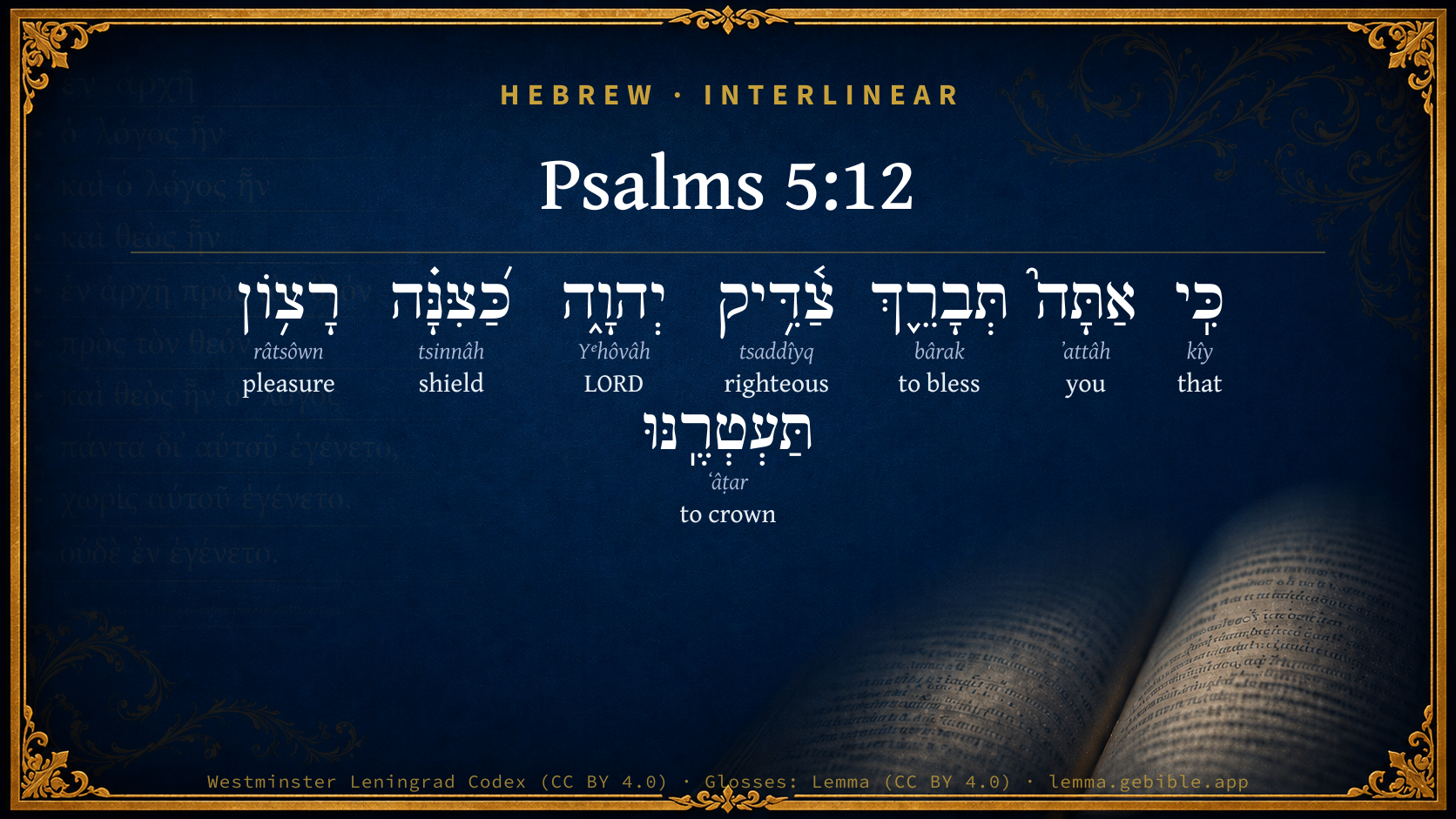
Psalms 5:12

Hebrew (Westminster Leningrad Codex) Psalms 5:12 appears in the Hebrew Old Testament. The text above is from the Westminster Leningrad Codex. Each word links to its Strong’s number, a concise gloss, and parsing drawn from the Open Scriptures Hebrew Bible morphology. Click any word for its full Brown-Driver-Briggs (BDB) entry.
Download image
Cite this verse

Psalms 5:12 (World English Bible). Public Domain. Lemma interlinear Bible study tool, https://lemma.gebible.app/v/psalms/5/12.

Show BibTeX & RIS
BibTeX
RIS
English Translation
For you will bless the righteous. Yahweh, you will surround him with favor as with a shield.
World English Bible · Public Domain
Download a study sheet

One document with this verse’s original text, its word-by-word gloss line, the meaning frame, cross-references with their text, attributed commentary, and full source and license credits — printable, and it pastes into notes with its structure intact.

This verse Autodidact and up

Study sheet (.html) Plain text (.txt)

A passage Seminary Student

Up to 50 verses in one chapter. A passage sheet keeps up to 6 commentary sources and 12 cross-references per verse, in the order this page ranks them, and says so on the sheet whenever that leaves anything out. Ask for a single verse and you get the Autodidact verse sheet above.

Everything on this page stays free to read, with no account — the sheet is a download of what is already on screen, not access to it.

Want to remove ads? Support Godless Engineer
Compare translations 3

The same verse in 3 English versions, stacked beneath the original-language interlinear above. Click any original word for its lexicon entry.

Each is an independent rendering of the whole verse — the interlinear is not word-aligned to these translations.

Highlighted words mark where these versions differ — a whole-verse word diff, not a word-by-word alignment.

  • World English Bible Public Domain
    For you will bless the righteous. Yahweh, you will surround him with favor as with a shield.
  • King James Version Public Domain
    For thou, LORD, wilt bless the righteous; with favour wilt thou compass him as with a shield.
  • unfoldingWord Literal Text CC BY-SA 4.0
    For you, Yahweh, you bless the righteous, you surround him favor as a shield.

unfoldingWord Literal Text — © unfoldingWord, licensed CC BY-SA 4.0. Word-aligned USFM3 via Door43 (git.door43.org/unfoldingWord/en_ult).

Versions to compare (up to 4)

3 of 4 selected

Show all 18 translations

Every available English version of this verse, each an independent rendering of the whole verse.

  • World English Bible Public Domain
    For you will bless the righteous. Yahweh, you will surround him with favor as with a shield.
  • Berean Standard Bible Public Domain
    For surely You, O LORD, bless the righteous; You surround them with the shield of Your favor.
  • Majority Standard Bible Public Domain
    For surely You, O LORD, bless the righteous; You surround them with the shield of Your favor.
  • King James Version Public Domain
    For thou, LORD, wilt bless the righteous; with favour wilt thou compass him as with a shield.
  • American Standard Version (1901) Public Domain
    For thou wilt bless the righteous; O Jehovah, thou wilt compass him with favor as with a shield. Psalm 6 For the Chief Musician; on stringed instruments, set to the Sheminith. A Psalm of David.
  • Revised Version (1885) Public Domain
    For thou wilt bless the righteous; O LORD, thou wilt compass him with favour as with a shield.
  • Geneva Bible (1599) Public Domain
    For thou Lord wilt blesse the righteous, and with fauour wilt compasse him, as with a shielde.
  • Douay-Rheims (1899) Public Domain
    But let all them be glad that hope in thee: they shall rejoice for ever, and thou shalt dwell in them. And all they that love thy name shall glory in thee:
  • Young's Literal Translation Public Domain
    For Thou blessest the righteous, O Jehovah, As a buckler with favour dost compass him!
  • Literal Standard Version CC BY-SA 4.0
    For You bless the righteous, O YHWH, || Surrounding him with favor as a buckler!
  • Unlocked Literal Bible CC BY-SA 4.0
    For you will bless the righteous, Yahweh; you will surround them with favor as with a shield.
  • unfoldingWord Literal Text CC BY-SA 4.0
    For you, Yahweh, you bless the righteous, you surround him favor as a shield.
  • Darby Bible Public Domain
    For thou, Jehovah, wilt bless the righteous [man]; with favour wilt thou surround him as [with] a shield.
  • World Messianic Bible Public Domain
    For you will bless the righteous. LORD, you will surround him with favor as with a shield.
  • Webster's Bible Public Domain
    \\5:11\\But let all those that put their trust in thee rejoice: let them ever shout for joy, because thou defendest them: let them also that love thy name be joyful in thee.
  • Free Bible Version CC BY-SA 4.0
    For you, Lord, bless those who live right; you protect them with your shield of love.
  • Bible in Basic English Public Domain
    For you, Lord, will send a blessing on the upright man; your grace will be round him, and you will be his strength.
  • JPS Tanakh (1917) Public Domain
    (5-13) For Thou dost bless the righteous; O LORD, Thou dost encompass him with favour as with a shield.

Literal Standard Version (2020), Covenant Press — licensed CC BY-SA 4.0. Text via the HelloAO Bible API (eBible.org). Unlocked Literal Bible (unfoldingWord) — licensed CC BY-SA 4.0. Text via the HelloAO Bible API (eBible.org). unfoldingWord Literal Text — © unfoldingWord, licensed CC BY-SA 4.0. Word-aligned USFM3 via Door43 (git.door43.org/unfoldingWord/en_ult). Free Bible Version, Dr. Jonathan Gallagher — licensed CC BY-SA 4.0. Text via the HelloAO Bible API (eBible.org).

Word by word

More ways to search: Search by grammar → Find every occurrence → Compare this word →

Practice this passage: Drill this verse → Learn its vocabulary →

About this verse

These counts appear in no published source. They are computed here, from the morphology-tagged text and Lemma’s own curated glosses. What Lemma adds →

8
words
8
distinct lemmas
Wisdom
section

Notable vocabulary

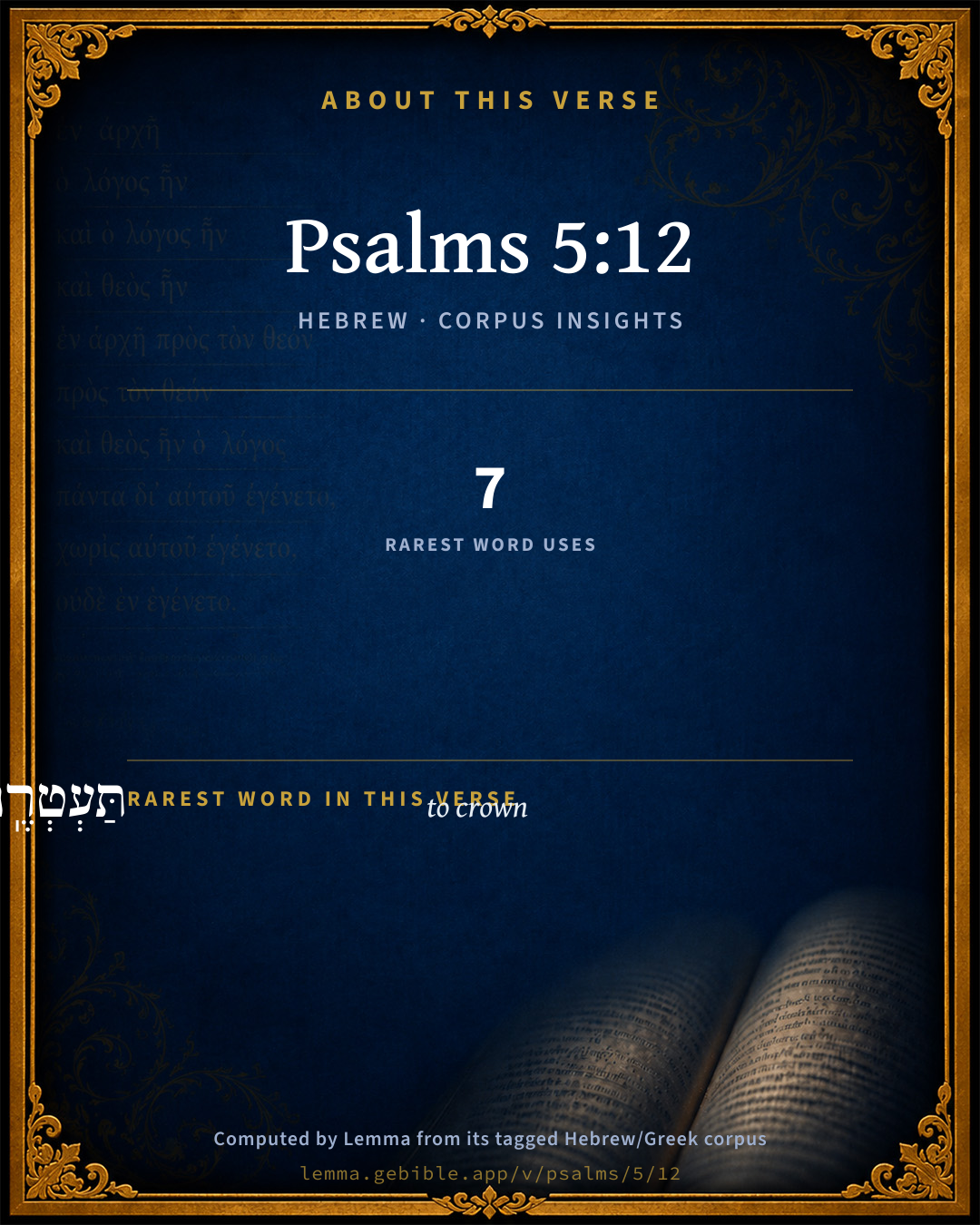
The rarest word here is תַּעְטְרֶֽנּוּ to crown H5849 — appearing just 7 times in the whole Hebrew Bible.

Shared distinctive vocabulary

תַּעְטְרֶֽנּוּ to crown H5849 occurs in 7 verses of the Hebrew Bible. Also found in:

Grammatical profile

  • 2 verbs
  • 3 nouns
  • 1 adjective
  • 1 pronoun
  • 1 conjunction

Verb forms

  • תְּבָרֵ֪ךְ Piel · Imperfect
  • תַּעְטְרֶֽנּוּ Qal · Imperfect

Hebrew & Septuagint length

In English translation the verse runs 17 words from the Hebrew and 17 from the Septuagint (LXX English) — the same length.

A rough comparison of the two English renderings, which tokenize alike — not a word-level alignment.

Word counts can differ between the Hebrew and the Greek without any difference in meaning — e.g. the Hebrew direct-object marker אֵת has no separate Greek word, and Greek often adds the article ὁ.

Cross-references

9

Topical passages linked to Psalms 5:12 in the Treasury of Scripture Knowledge — connected by theme and wording, ordered by reader-vote popularity; previews shown in the World English Bible.

  • Psalms 84:11 For Yahweh God is a sun and a shield. Yahweh will give grace and glory. He withholds no good thing from those who walk blamelessly.
  • Psalms 32:10 Many sorrows shall be to the wicked, But he who trusts in Yahweh, loving kindness shall surround him.
  • Psalms 115:13 He will bless those who fear Yahweh, Both small and great.
  • Psalms 1:1–3 Blessed is the man who doesn't walk in the counsel of the wicked, Nor stand in the way of sinners, Nor sit in the seat of scoffers;
  • Psalms 112:1 Praise Yah! Blessed is the man who fears Yahweh, Who delights greatly in his commandments.
  • Psalms 32:7 You are my hiding place. You will preserve me from trouble. You will surround me with songs of deliverance. Selah.
  • Psalms 29:11 Yahweh will give strength to his people. Yahweh will bless his people with peace.
  • Psalms 3:3 But you, Yahweh, are a shield around me, My glory, and the one who lifts up my head.
  • Psalms 3:8 Salvation belongs to Yahweh. Your blessing be on your people. Selah.

Cross-references courtesy of OpenBible.info (CC BY 4.0).

Hebrew and Greek witnesses Masoretic Hebrew ↔ Greek Septuagint

The same verse in the two great witnesses to the Old Testament, shown verse-for-verse.

You’re reading Greek Psalm 5 (Hebrew Psalm 5). The Septuagint counts the superscription, so verse numbers can differ from the Hebrew — chapter-level alignment, not verse-by-verse. Numbering follows Rahlfs.

These are two independent witnesses, not word-aligned to each other, and the Septuagint is shown in lemma (dictionary) form.

Hebrew Psalms 5:12 Masoretic · Westminster Leningrad Codex

כִּֽי אַתָּה֮ תְּבָרֵ֪ךְ צַ֫דִּ֥יק יְהוָ֑ה כַּ֝צִּנָּ֗ה רָצ֥וֹן תַּעְטְרֶֽנּוּ

For you will bless the righteous. Yahweh, you will surround him with favor as with a shield.

World English Bible · Public Domain

Greek LXX Greek Psalm 5:12 Septuagint · lemma form

καί εὐφραίνω πᾶς ὁ ἐλπίζω ἐπί σύ εἰς αἰών ἀγαλλιάομαι καί κατασκηνόω ἐν αὐτός καί καυχάομαι ἐν σύ πᾶς ὁ ἀγαπάω ὁ ὄνομα σύ

For you, Lord, shall bless the righteous: you have compassed us as with a shield of favor.

LXX2012 (modern English Septuagint) · Public Domain

On this verse, John Calvin's Commentaries discusses the Septuagint’s reading. Read the note in Commentary ↓

Hebrew: Westminster Leningrad Codex (CC BY 4.0). Greek: Septuagint (public domain); English from LXX2012 (modern English Septuagint) (Public Domain). How the Septuagint differs from the Hebrew →

Commentary

Notes on Psalms 5:12 from classic Christian and Jewish commentators (each source and its license shown beneath its notes). The classic Christian expositions comment on the surrounding passage and are grouped to its opening verse, so a note may address several verses; the Jewish commentaries on the Tanakh (Rashi and others) are per-verse, so they appear only where the commentator wrote on this verse.

Lemma curates 59 commentaries, every one of them public domain or Creative Commons licensed, each selected and text-cleaned for this edition rather than reprinted as found. About our sources →

Trapp's Complete Commentary

John Trapp

Psa 5:12 For thou, LORD, wilt bless the righteous; with favour wilt thou compass him as [with] a shield.

Ver. 12. For thou, Lord, wilt bless the righteous] Yea, the righteous man shall abound with blessings, Pro 28:20; yea, God will bless all them that bless him, Gen 12:3, or that but give him a cup of cold water, Mat 10:42

With favour] Or, goodwill; Quae praecedit nostram bonam voluntatem, saith Augustine.

Wilt thou compass him] Or, encircle him as with a crown, and so make them "higher than the kings of the earth," Psa 89:27, whose crowns cannot keep their heads from aching, but fill them with cares; which made one king cry out, O vilis pannus, &c. (Val. Max.), and another spake this of his crown,

Nobilis es fateor, rutilisque onerata lapillis,

Innumeris curis sed comitata venis.

Quod bene si nossent omnes expendere, nemo

Nemo foret qui te tollere vellet humo.

As with a shield] A piked shield, such as doth circuire tres partes hominis, compass about three parts of a man, saith R. Solomon on this text. Shields and bucklers, besides other bosses for ornament, had one great boss in the middle with a sharp pike in it for use, to pierce and wound the adversary. See Job 15:26. God will be all in all to his people, crown, shield, &c.: they may therefore well enough rejoice, shout, leap, as in the former verse.

John Trapp, A Commentary or Exposition upon All the Books of the Old and New Testament (1647–1656) — public domain. Text from a community e-Sword module.

Tyndale Open Study Notes

Tyndale Open Resources

5:12 The psalmist extends his concern beyond himself to all the godly. • A shield, here an image of God’s protection, deflects spears and arrows from its bearer.

Tyndale Open Study Notes — © Tyndale Open Resources, licensed CC BY-SA 4.0. Text via the HelloAO Bible API.

Geneva Bible (1599)

Geneva Bible translators

Or, give good success.

So that he shall be safe from all dangers.

Geneva Bible (1599) marginal notes — public domain. Text via Bolls.life.

Jamieson, Fausset & Brown

Robert Jamieson, A. R. Fausset & David Brown

with favour--or, "acceptance," alluding to the favor shown to an acceptable offering and worshipper (Lev 7:18; Lev 19:7).

shield--(compare Psa 3:3).

Next: Psalms Chapter 6

Jamieson, Fausset & Brown — Commentary Critical and Explanatory on the Whole Bible (1871) — public domain (CC PDM 1.0). Text via the HelloAO Bible API.

Adam Clarke's Commentary

Verse 12. For thou, Lord, wilt bless the righteous] A righteous soul is a peculiar object of God's affectionate regards; and therefore will be a subject of continual blessing.

With favour] Literally, Like a shield, thy favour will crown him. God loves such; and this love is their defence. In all places, times and circumstances, it will preserve them. "Keep yourselves," says the apostle, "in the love of God." He who abides in this love need not fear the face of any adversary. Thus ended the morning's devotion of this excellent man: a model by which every Christian may frame his own.

ANALYSIS OF THE FIFTH PSALM

This Psalm consists of FIVE parts: -

I. An introduction, in which he petitions to be heard; professes his earnestness about it, Ps 5:1-3; and his confidence of audience.

II. He delivers his petition, Ps 5:8; and the reason of it-his enemies.

III. These enemies he circumstantially describes, Ps 5:9.

IV. He prophesies that God will destroy them, Ps 5:10.

V. He prays for the Church, that God would preserve it, Ps 5:11-12.

I.

1. In the entrance he prays very earnestly for audience; he shows that he meant to be serious and fervent in it; and he chooses a variety of words to express the same thing, which rise by degrees in the description: 1. He rises from meditation; 2. To words; 3. From words to a voice; 4. From a voice to a cry. Then he desires God, 1. To consider. 2, To give ear. 3. To hearken. 1. He considers, who weighs the justice of the cause. 2. He gives ear, who would understand what the suppliant means. 3. He attends and hearkens, who intends to satisfy the petitioner.

2. The reasons he uses here to beget audience are very considerable: -

1. The relation that was between him and his God: "Thou art my King and my God."

2. That he would sue to none other: "To thee will I pray;" which he illustrates, 1. From the time. It is a morning petition. 2. It was a well composed and ordered prayer. 3. He would lift up his eyes with it; that is, have all his hope and expectation exercised in it. "My voice shalt thou hear in the morning; I will direct my prayer unto thee, and look up."

3. The third reason is taken from the nature of God: whom he will and whom he will not hear. 1. Persevering sinners God will not regard. 2. To the upright he is ready to look. The sinners whom God will not hear he thus describes: 1. Men who delighted in wickedness, evil, foolish workers of iniquity - liars - blood-thirsty and deceitful. Now it was not likely that God should hear such: "For thou art not a God who hast pleasure in wickedness, neither shall evil dwell with thee." These it is said he hated; these he would destroy; these he did abhor. 2. But on the contrary, he who was faithful; who relied on God; who feared the Lord; who attended the ordinances of his house; who worshipped towards his temple; and who came, not trusting to himself, but in the multitude of God's mercies; him he would hear.

II. David, having petitioned for audience, and delivered the grounds of his confidence, brings forth his petition that his life may be holy and innocent: -

1. "Lead me in thy righteousness."

2. "Make thy way straight before me." For which he gives this reason: "Because of mine enemies."

III. These his enemies he circumstantially describes: -

1. By their MOUTH: "There is no faithfulness in their mouth."

2. By their HEART: "Their inward parts are very wickedness."

3. By their THROAT: "Their throat is an open sepulchre."

4. By their TONGUE: "They flatter with their tongue."

IV. Then he proceeds to prophesy against these enemies: -

1. God will destroy them.

2. They shall fall by their own counsels.

3. They shall be cast out in the multitude of their transgressions. For which predictions he gives this reason: They are rebels. For they have rebelled against thee. Rebels, not against David, but against God. They have not rejected me, but they have rejected thee.

V. The conclusion contains his prayer for God's people, whom he here describes: 1. They are righteous. 2. They put their trust in God. 3. They love his name.

And he prays for them, that, 1. They may be happy; that they may shout for joy. 2. They may be joyful in God.

And he expects an answer; because, 1. God defends them. 2. He will continue to bless them. 3. He will with his favour compass them as with a shield.

Adam Clarke's Commentary on the Bible (1810–1826) — public domain. Text from a community e-Sword/MySword module.

John Calvin's Commentaries

12. For thou, Jehovah, wilt bless the righteous. The Psalmist here confirms the concluding sentence of the preceding verse, namely, that all the servants of God in common will take support to their faith from what he had experienced, for he would have us from one example to form our judgment of the immutability and perpetuity of God’s grace towards all the godly. Again, by this he teaches us that there is no true and right joy but that which is derived from the sense of God’s fatherly love. The word, to bless, in Hebrew, (when we speak of this as the act of men,) signifies to wish happiness and prosperity to any one, and to pray for him; “Signifie, souhaitter bien et prosperite a quelquun et prier pour luy.” — Fr.

Bishop Horsley thinks כצנה, katsinah, as with a shield, should be construed with רצונ ratson, favor or good will, and translates the words thus: ”Like a shield of good will, thou wilt stand guard around him.” The reading of the Septuagint is the same: Ως ὁπλω εὐδοκιας, as with a shield of good will. The word צנה tsinah, means that kind of shield, from the middle of which there arose a large boss, surmounted by a dagger and which was highly useful both as a defensive and an offensive weapon in ancient warfare.

John Calvin's Commentaries (1540-1563) — public domain. Text from the Calvin Translation Society English edition (1840s-50s) via the Christian Classics Ethereal Library (ccel.org). Calvin's coverage is partial (roughly two-thirds of the Bible); uncommented books and verses are honest gaps, never fabricated. The 19th-century editor's footnotes and remarks are omitted so the notes are faithfully Calvin's own voice.

The Cambridge Bible for Schools and Colleges

gen. ed. J. J. S. Perowne

12. The R.V. follows the Massoretic punctuation in transferring lord to the second half of the verse:

O lord, thou wilt compass him with favour as with a shield.

a shield] A buckler, or large shield to protect the whole body. Cp. Psa_35:2, Psa_91:4; 1Sa_17:7. From 1Ki_10:16-17 it would seem that the ‘buckler’ (A.V. ‘target’) was about double the size of the ‘shield.’

The Cambridge Bible for Schools and Colleges (gen. ed. J. J. S. Perowne; Cambridge University Press, 1878–1918) — public domain. Text from a community e-Sword module.

John Gill's Exposition

For thou, Lord, wilt bless the righteous. As he has blessed him with a righteousness, even the righteousness of God imputed to him, by which he is denominated righteous, and with the forgiveness of his sins; so he will bless him with peace and prosperity, with all spiritual blessings, with the blessings of grace here, and glory hereafter. Hence he has just reason to rejoice and be glad;

with favour wilt thou compass him as with a shield: by which is meant the free favour, love, and grace of God in Christ, which springs from his sovereign will and pleasure; is his good will to men, and the exceeding riches of his grace, shown in his kindness towards them in Christ Jesus: and the compassing or crowning of the righteous with it, as the word (x) signifies, is expressive of the abundance of it, in the application of it to them in conversion, and in every instance and blessing of grace; for such are crowned with lovingkindness and tender mercies; the grace of the Lord is exceeding abundant towards them, it flows and overflows; it surrounds them on all sides, and covers them all over: it is as a shield unto them from all their enemies, Psa 40:11; and which being held in the hand of faith, quenches the fiery darts of Satan; and is the saints security from every enemy, and from all hurt and danger, here or hereafter; see Zep 3:17; and is a crown of glory upon them, which makes them glorious, lovely, and amiable. Some interpret this of Christ the righteous One; so Nebiensis.

(x) , Sept. "coronasti nos", V. L. Arab. Ethiop. "coronabis cum", Pagninus, Montanus, Cocceius.

Next: Psalms Chapter 6

John Gill's Exposition of the Whole Bible (1746–1763) — public domain (CC PDM 1.0). Text via the HelloAO Bible API.

Albert Barnes' Notes on the Bible

For thou, Lord, wilt bless the righteous - It is one of the characteristics of God that, while he will punish the wicked, he will show favor to the righteous; while he brings deserved punishment upon the one, he will show his favor to the other.

With favor wilt thou compass him as with a shield - That is, as a shield is thrown round or before one in the day of battle to protect him, so wilt thou throw thy protection around the righteous. For a description of a “shield,” see the notes at Eph 6:16. Compare the notes at Psa 3:3. On these accounts, David felt that he might trust in God in the day of trouble and danger; and, on the same account, all who are righteous may put their trust in him now.

Albert Barnes' Notes on the Bible (1834–1885) — public domain. Text from a community e-Sword/MySword module.

Matthew Poole's English Annotations

i.e. Thou art resolved, and hast engaged thyself by promise and covenant, to bless them; and therefore my prayer for them is agreeable to thy will.

With favour; with thy love and gracious providence.

Wilt thou compass him as with a shield, i.e. keep him safe on every side.

Matthew Poole's English Annotations on the Holy Bible (1683–1685) — public domain. Text from a community e-Sword/MySword module.

The Treasury of David

Charles H. Spurgeon

Ver. 12. As with a shield. Luther, when making his way into the presence of Cardinal Cajetan, who had summoned him to answer for his heretical opinions at Augsburg, was asked by one of the Cardinal's minions, where he should find a shelter, if his patron, the Elector of Saxony, should desert him? "Under the shield of heaven!" was the reply. The silenced minion turned round, and went his way.

Ver. 12. With favour wilt thou compass him as with a shield. The shield is not for the defence of any particular part of the body, as almost all the other pieces are: helmet, fitted for the head; plate, designed for the breast; and so others, they have their several parts, which they are fastened to; but the shield is a piece that is intended for the defence of the whole body. It was used therefore to be made very large; for its broadness, called a gate or door, because so long and large, as in a manner to cover the whole body. And if the shield were not large enough at once to cover every part, yet being a movable piece of armour, the skilful soldier might turn it this way or that way, to catch the blow or arrow from lighting on any part they were directed to. And this indeed doth excellently well set forth the universal use that faith is of to the Christian. It defends the whole man: every part of the Christian by it is preserved ... The shield doth not only defend the whole body, but it is a defence to the soldier's armour also; it keeps the arrow from the helmet as well as head, from the breast and breastplate also. Thus faith, it is armour upon armour, a grace that preserves all the other graces. William Gurnall.

Ver. 12. (first clause). The divine blessing upon the righteous. It is ancient, effectual, constant, extensive, irreversible, surpassing, eternal, infinite.

Ver. 12. (second clause). A sense of divine favour a defence to the soul.

Charles H. Spurgeon's The Treasury of David (1869–1885) — public domain. Psalms only. Text from a community e-Sword/MySword module.

The Pulpit Commentary

For thou, Lord, wilt bless the righteous. All the joy of the righteous springs from the fact that God"s blessing is upon them. The sense of his favour fills their hearts with rejoicing. With favour wilt thou compass him as with a shield. Tsinnah (hNxi) is the large, long shield that protected the whole body (see "Ancient Monarchies," vol. 1. p. 445). God"s favour, thus encompassing a man, effectually secured him against all dangers.

The Pulpit Commentary (1880–1919), ed. H.D.M. Spence-Jones & Joseph S. Exell — public domain. Text from a community e-Sword module.

J. A. Alexander on Psalms

Joseph Addison Alexander

12. The transition and contrast are the same as in Psa 5:8 above. While the wicked perish, the righteous shall have cause for everlasting joy. And all (those) trusting in thee, making thee their refuge, shall be glad; forever shall they shout (or sing) for joy, and (not without cause, for) thou wilt cover over (or protect) them; and in thee, in thy presence and thy favour, shall exult, or triumph, (the) lovers of thy name, i. e. of thy manifested excellence, which is the usual sense of this expression in the Old Testament. The believers and lovers of God's name, here spoken of, are not merely friends of the psalmist who rejoice in his deliverance, but the great congregation of God's people, to which he belonged, and of which he was the representative, so that his deliverance was theirs, and a rational occasion of their joy, not only on his account but on their own.

The confident hope expressed in the foregoing verse was not a groundless or capricious one, but founded on the nature of God and the uniform tenor of his dispensations. The psalmist knows what God will do in this case, because he knows what he does and will do still in general. For thou wilt bless, and art wont to bless, the righteous, the opposite of those described in Psa 5:5-7 and Psa 5:10-11, O Lord, Jehovah! Like the shield, as the shield protects the soldier (so with) favour thou wilt surround him, or enclose him, still referring to the righteous; see the same comparison in Psa 3:4. The confident assertion that God will do so, implies that he has done so, and is wont to do so, to the righteous as a class. And this affords a reasonable ground for the belief, expressed in the preceding verse, that he will do so also in the present case.

Joseph Addison Alexander, The Psalms Translated and Explained (1850) — public domain. Text from a community e-Sword module.

Rashi

Rabbi Shlomo Yitzchaki (Rashi)

and You shall shelter them You shall shield and shelter them.

exult in You when they see that You bless the righteous man, Jacob, and his seed.

Rashi on the Tanakh — English translations: “The Judaica Press complete Tanach with Rashi, translated by A. J. Rosenberg” (CC BY 4.0); “Pentateuch with Rashi's commentary by M. Rosenbaum and A.M. Silbermann, 1929-1934” (public domain); “The Metsudah Tanach series, Lakewood, N.J” (CC BY 4.0); and “The Book of Joshua, Metsudah Publications, 1997” (CC BY 4.0). Text via Sefaria.

Radak

Rabbi David Kimhi (Radak)

So shall all those that put their trust in Thee rejoice; They shall ever ring out their joy – just the opposite of the enemies, who do not trust in Thee; and when Thou shalt thrust them out those who trust in Thee shall rejoice. And the sense of

and Thou shalt defend them (is): – that Thou wilt be over them as a tent, so that the enemy shall not harm them.

Yea, let those that love Thy name he joyful in Thee: – The 'ayin (of וְיַעְלְצוּ) and the lamed are pointed with sheva.

Radak on the Tanakh — English translations: “Sefaria Community Translation” (CC0 1.0 (public-domain dedication)); “Eliyahu Munk, HaChut Hameshulash” (CC BY 4.0); “Rabbi Mike Feuer, Jerusalem Anthology” (CC BY 4.0); and “R. David Kimhi on the first book of Psalms, Translated by R.G. Finch, London, 1919” (public domain). Text via Sefaria.

Lesson kit

Teaching starters — assembled from the data on this page, not authored interpretation. Every prompt links to the verse data it draws on. Edit before teaching.

Psalms, in the Wisdom, opens this verse with 8 words (8 distinct Hebrew lemmas). Its most distinctive word is ʻâṭar (“to crown”). A historical commentator’s framing appears above. Read the whole chapter for the surrounding context.

Discussion questions

  1. How does “to crown” (ʻâṭar) shape what this verse is saying?
  2. 1 Samuel 23:26 shares the word «to crown» with this verse. How do the two illuminate each other?
  3. The translations on this page render this verse differently — a whole-verse word diff, not a word-by-word alignment. What might account for the different wordings?
  4. The verb «תְּבָרֵ֪ךְ» is Piel Imperfect. How does its form color the action?
  5. Reading how Trapp's Complete Commentary and Tyndale Open Study Notes read this verse, where do the two commentators agree and where do they part?

Things to notice

Reading settings

Reading text

Shown beneath each verse's original-language words.

Old Testament
Old Testament edition

Read the OT as the Masoretic Hebrew (MT) or the Greek Septuagint (LXX).

English shown for the Greek Septuagint (in the Hebrew ↔ Greek comparison).

Comparing translations? Open the Compare panel on any verse page to stack up to four side by side.