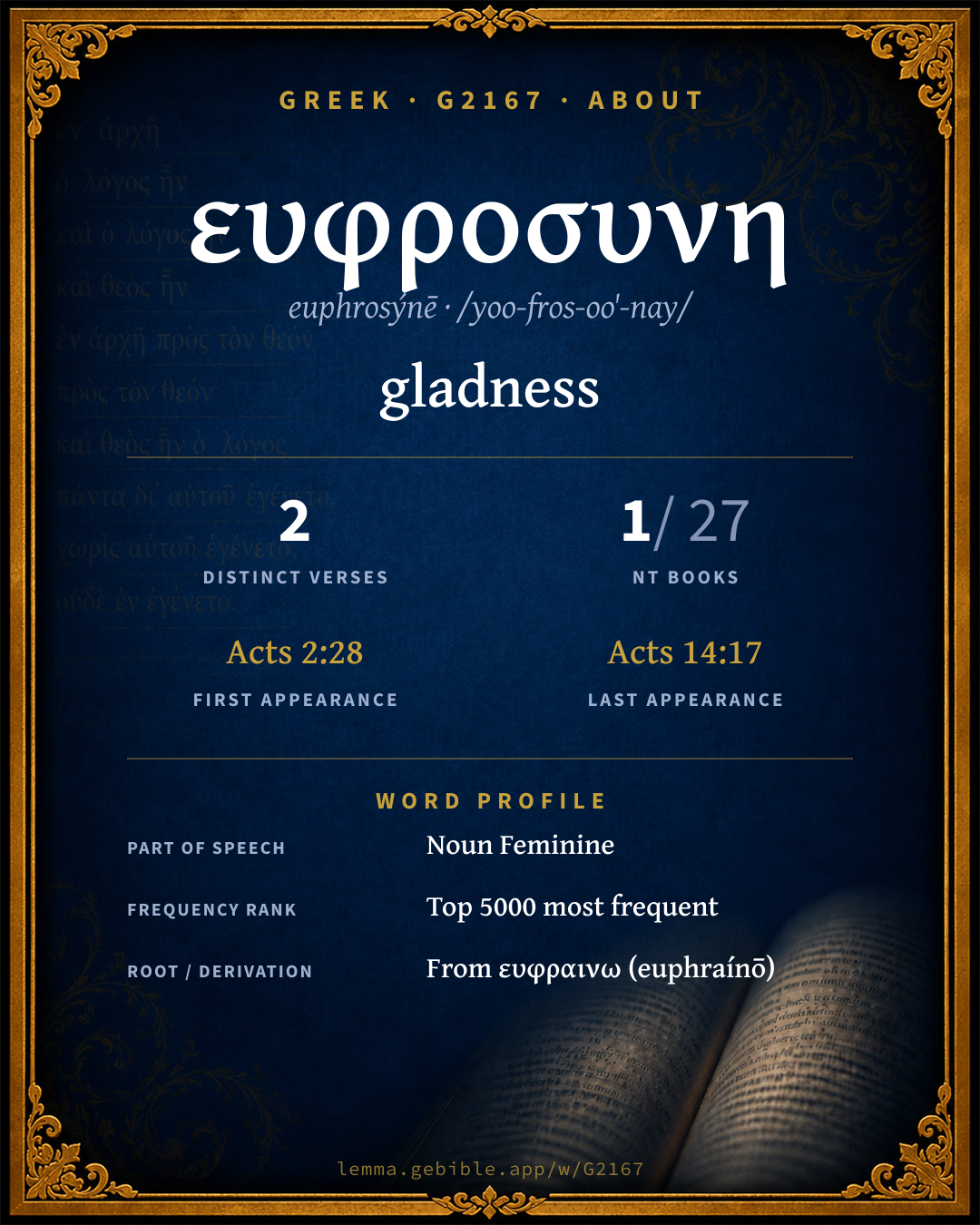
εὐφροσύνη
gladness
Full lexicon entry — Thayer's Greek Lexicon
From Thayer's Greek Lexicon
Where this word appears
Grammar key — what these labels mean
Part of speech
- Noun
- A naming word — a person, place, thing, or idea.
Case
- Genitive
- The case of source, possession, or “of” — answers “whose / from what.”
Gender
- Feminine
- Grammatically feminine.
Number
- Singular
- One.
Every verse where G2167 appears — 2 distinct verses across 1 book. Click any verse to open its interlinear word-by-word view. Verse text shown in the World English Bible for context — . Each verse’s Greek form is shown with its reference; the English is not keyword-highlighted, since the data carries no word-level English alignment. Use “Compare translations” on any verse to read it across multiple English versions. This concordance covers the Greek New Testament; Septuagint (Greek Old Testament) occurrences of this word are not indexed here.
Acts 2 verses
- Acts 2:28 εὐφροσύνης n gen sg fem You made known to me the ways of life. You will make me full of gladness with your presence.'
- Acts 14:17 εὐφροσύνης n gen sg fem Yet he didn't leave himself without witness, in that he did good and gave you rains from the sky and fruitful seasons, filling our hearts with food and gladness."
About this entry
At a glance — auto-summarized from this page’s data, not written by a person. Every figure links to its source below. This summary describes the numbers; it doesn’t interpret them.
At its core, ευφροσυνη (euphrosýnē) means “gladness.” It occurs a mere 2 verses across Scripture. The word gravitates to Acts (100%). First canonically at Acts 2:28, it enters the text early. Dig into 2-verse concordance and the renderings breakdown below.
Gloss history
Strong's 1890 vs modern scholarship
About this word
Strong's G2167 catalogs a Greek word from the Greek New Testament.
These counts are not copied from any lexicon or concordance. They are computed here, from the morphology-tagged Greek New Testament. What Lemma adds →
- 2
- distinct verses
- The word appears in 2 distinct verses.
- 1 / 27
- NT books
- The word appears in 1 of 27 New Testament books.
- #2,678
- by frequency
- Top 5000 most frequent Greek words (rank 2,678 of 5,347 Greek words by occurrence).
View all 2 occurrences in the concordance →
Most concentrated in
- Acts 2 verses 100%
By section of the New Testament
By traditional corpus
Conventional, traditional groupings — biblical authorship is debated, so this is a traditional corpus grouping, not an authorship claim. Some books belong to more than one corpus (Luke is in both the Gospels and the Lukan corpus, and so on), so these shares overlap and need not total 100%. Each figure is a share of the word’s 2 distinct verses.
- Lukan (Luke–Acts) 2 verses · 100%
How translations render this word
Counts come from each version’s own published word-to-Strong’s tagging or interlinear alignment — an approximate guide to how each version renders this word, not a word-level alignment the data otherwise carries. Because each total is that version’s own tagged count, the per-version totals vary from one another and need not match the appearance or distinct-verse counts above. These counts may also differ from a printed concordance because Lemma counts each distinctly tagged rendering and does not collapse phrase taggings into a single head-word total. This is a fixed set of word-tagged versions (KJV, ASV, BSB, ULT) and does not change with the reading translation you choose elsewhere. Each version’s license is shown beside its name below (and on Sources).
- King James Version: Gladness 1×, Joy 1×
- American Standard Version: Gladness 1×
- Berean Standard Bible: Gladness 1×, Joy 1×
- unfoldingWord Literal Text: Gladness 2×
King James Version Public Domain
Renders G2167 across 2 tagged occurrences — most commonly:
American Standard Version Public Domain
Renders G2167 across 1 tagged occurrence — most commonly:
Berean Standard Bible Public Domain
Renders G2167 across 2 tagged occurrences — most commonly:
unfoldingWord Literal Text CC BY-SA 4.0
Renders G2167 across 2 tagged occurrences — most commonly:
Senses in Thayer's
The 1 sense Thayer's distinguishes for this word, in lexicon order (not ranked by frequency or importance). The full entry — with sub-senses — is in the Lexicon Entry tab.
- good cheer, joy, gladness
Word origin
Derived from ευφραινω (euphraínō) (G2165) — to gladden.
From the same as G2165 ; joyfulness : - gladness joy.
— Strong’s Exhaustive Concordance (1890), public domain.
Septuagint usage
The same Greek word ευφροσυνη appears 109 times in the Greek Old Testament (Septuagint), across 101 verses in 22 books.
- 109
- LXX occurrences
- Tagged occurrences of this Greek word in the Septuagint.
- 101
- verses
- Distinct Septuagint verses containing this word.
- 22 / 39
- OT books
- The word appears in 22 of the 39 Old Testament books.
Sample Septuagint occurrences
- Genesis 31:27 εὐφροσύνη
- Numbers 10:10 εὐφροσύνη
- Deuteronomy 28:47 εὐφροσύνη
- 2 Samuel 6:12 εὐφροσύνη
- 1 Kings 1:40 εὐφροσύνη
- 1 Chronicles 12:41 εὐφροσύνη
- 2 Chronicles 20:27 εὐφροσύνη
- Ezra 3:12 εὐφροσύνη
- Esther 1:4 εὐφροσύνη
- Job 3:7 εὐφροσύνη
- Psalms 4:8 εὐφροσύνη
- Proverbs 10:28 εὐφροσύνη
Septuagint occurrences (same lexeme)
Every verse where the same Strong’s number (G2167) appears in the Greek Septuagint — showing the first 50 of 101. Verse text shown in the World English Bible for context; the Greek form is the matched word — the English is not keyword-highlighted.
- Genesis 31:27 εὐφροσύνη Why did you flee secretly, and deceive me, and didn't tell me, that I might have sent you away with mirth and with songs, with tambourine and with harp;
- Numbers 10:10 εὐφροσύνη Also in the day of your gladness, and in your set feasts, and in the beginnings of your months, you shall blow the trumpets over your burnt offerings, and over the sacrifices of your peace-offerings; and they shall be to you for a memorial before your God: I am Yahweh your God.
- Deuteronomy 28:47 εὐφροσύνη Because you didn't serve Yahweh your God with joyfulness, and with gladness of heart, by reason of the abundance of all things;
- 2 Samuel 6:12 εὐφροσύνη It was told king David, saying, Yahweh has blessed the house of Obed-edom, and all that pertains to him, because of the ark of God. David went and brought up the ark of God from the house of Obed-edom into the city of David with joy.
- 1 Kings 1:40 εὐφροσύνη All the people came up after him, and the people piped with pipes, and rejoiced with great joy, so that the earth shook with the sound of them.
- 1 Chronicles 12:41 εὐφροσύνη
- 1 Chronicles 15:16 εὐφροσύνη David spoke to the chief of the Levites to appoint their brothers the singers, with instruments of music, psalteries and harps and cymbals, sounding aloud and lifting up the voice with joy.
- 1 Chronicles 15:25 εὐφροσύνη So David, and the elders of Israel, and the captains over thousands, went to bring up the ark of the covenant of Yahweh out of the house of Obed-edom with joy.
- 1 Chronicles 29:17 εὐφροσύνη I know also, my God, that you try the heart, and have pleasure in uprightness. As for me, in the uprightness of my heart I have willingly offered all these things: and now have I seen with joy your people, that are present here, offer willingly to you.
- 2 Chronicles 20:27 εὐφροσύνη Then they returned, every man of Judah and Jerusalem, and Jehoshaphat in the forefront of them, to go again to Jerusalem with joy; for Yahweh had made them to rejoice over their enemies.
- 2 Chronicles 23:18 εὐφροσύνη Jehoiada appointed the officers of the house of Yahweh under the hand of the priests the Levites, whom David had distributed in the house of Yahweh, to offer the burnt offerings of Yahweh, as it is written in the law of Moses, with rejoicing and with singing, according to the order of David.
- 2 Chronicles 29:30 εὐφροσύνη Moreover Hezekiah the king and the princes commanded the Levites to sing praises to Yahweh with the words of David, and of Asaph the seer. They sang praises with gladness, and they bowed their heads and worshiped.
- 2 Chronicles 30:21 εὐφροσύνη The children of Israel who were present at Jerusalem kept the feast of unleavened bread seven days with great gladness; and the Levites and the priests praised Yahweh day by day, [singing] with loud instruments to Yahweh.
- 2 Chronicles 30:23 εὐφροσύνη The whole assembly took counsel to keep other seven days; and they kept [other] seven days with gladness.
- 2 Chronicles 30:26 εὐφροσύνη So there was great joy in Jerusalem; for since the time of Solomon the son of David king of Israel there was not the like in Jerusalem.
- Ezra 3:12 εὐφροσύνη But many of the priests and Levites and heads of fathers' [houses], the old men who had seen the first house, when the foundation of this house was laid before their eyes, wept with a loud voice; and many shouted aloud for joy:
- Ezra 3:13 εὐφροσύνη so that the people could not discern the noise of the shout of joy from the noise of the weeping of the people; for the people shouted with a loud shout, and the noise was heard afar off.
- Ezra 6:16 εὐφροσύνη The children of Israel, the priests, and the Levites, and the rest of the children of the captivity, kept the dedication of this house of God with joy.
- Ezra 6:22 εὐφροσύνη and kept the feast of unleavened bread seven days with joy: for Yahweh had made them joyful, and had turned the heart of the king of Assyria to them, to strengthen their hands in the work of the house of God, the God of Israel.
- Ezra 18:12 εὐφροσύνη
- Ezra 18:17 εὐφροσύνη
- Ezra 22:27 εὐφροσύνη
- Ezra 22:43 εὐφροσύνη
- Ezra 22:44 εὐφροσύνη
- Esther 1:4 εὐφροσύνη when he shown the riches of his glorious kingdom and the honor of his excellent majesty many days, even one hundred eighty days.
- Esther 8:16 εὐφροσύνη The Jews had light and gladness, and joy and honor.
- Esther 8:17 εὐφροσύνη In every province, and in every city, wherever the king's commandment and his decree came, the Jews had gladness and joy, a feast and a good day. Many from among the peoples of the land became Jews; for the fear of the Jews was fallen on them.
- Esther 9:17 εὐφροσύνη [This was done] on the thirteenth day of the month Adar; and on the fourteenth day of the same they rested, and made it a day of feasting and gladness.
- Esther 9:18 εὐφροσύνη But the Jews who were in Shushan assembled together on the thirteenth [day] of it, and on the fourteenth of it; and on the fifteenth [day] of the same they rested, and made it a day of feasting and gladness.
- Esther 9:19 εὐφροσύνη Therefore do the Jews of the villages, who dwell in the unwalled towns, make the fourteenth day of the month Adar [a day of] gladness and feasting, and a good day, and of sending portions one to another.
- Esther 9:22 εὐφροσύνη as the days in which the Jews had rest from their enemies, and the month which was turned to them from sorrow to gladness, and from mourning into a good day; that they should make them days of feasting and gladness, and of sending portions one to another, and gifts to the needy.
- Job 3:7 εὐφροσύνη Behold, let that night be barren. Let no joyful voice come therein.
- Job 20:5 εὐφροσύνη That the triumphing of the wicked is short, The joy of the godless but for a moment?
- Psalms 4:8 εὐφροσύνη In peace I will both lay myself down and sleep, For you, Yahweh alone, make me live in safety.
- Psalms 15:11 εὐφροσύνη
- Psalms 29:12 εὐφροσύνη
- Psalms 44:16 εὐφροσύνη At the taunt of one who reproaches and verbally abuses, Because of the enemy and the avenger.
- Psalms 50:10 εὐφροσύνη For every animal of the forest is mine, And the cattle on a thousand hills.
- Psalms 67:4 εὐφροσύνη Oh let the nations be glad and sing for joy, For you will judge the peoples with equity, And govern the nations on earth. Selah.
- Psalms 96:11 εὐφροσύνη Let the heavens be glad, and let the earth rejoice. Let the sea roar, and it's fullness!
- Psalms 99:2 εὐφροσύνη Yahweh is great in Zion. He is high above all the peoples.
- Psalms 104:43 εὐφροσύνη
- Psalms 105:5 εὐφροσύνη Remember his marvelous works that he has done; His wonders, and the judgments of his mouth,
- Psalms 136:6 εὐφροσύνη To him who spread out the earth above the waters; For his loving kindness endures forever:
- Proverbs 10:28 εὐφροσύνη The prospect of the righteous is joy, But the hope of the wicked will perish.
- Proverbs 14:13 εὐφροσύνη Even in laughter the heart may be sorrowful, And mirth may end in heaviness.
- Proverbs 21:15 εὐφροσύνη It is joy to the righteous to do justice; But it is a destruction to the workers of iniquity.
- Proverbs 21:17 εὐφροσύνη He who loves pleasure shall be a poor man: He who loves wine and oil shall not be rich.
- Proverbs 29:6 εὐφροσύνη An evil man is snared by his sin, But the righteous can sing and be glad.
- Proverbs 30:32 εὐφροσύνη "If you have done foolishly in lifting up yourself, Or if you have thought evil, Put your hand over your mouth.
These are occurrences of the same Greek lexeme (G2167) in the Septuagint — not a translation of any one Hebrew word. The store carries no word-level Hebrew↔Greek alignment, so no Hebrew original is asserted here. Counts come from the recovered LXX Strong's tagging — high-frequency vocabulary is well covered, while rare or late forms may be untagged — so they reflect tagged occurrences and may slightly undercount.