
Proverbs 19:20

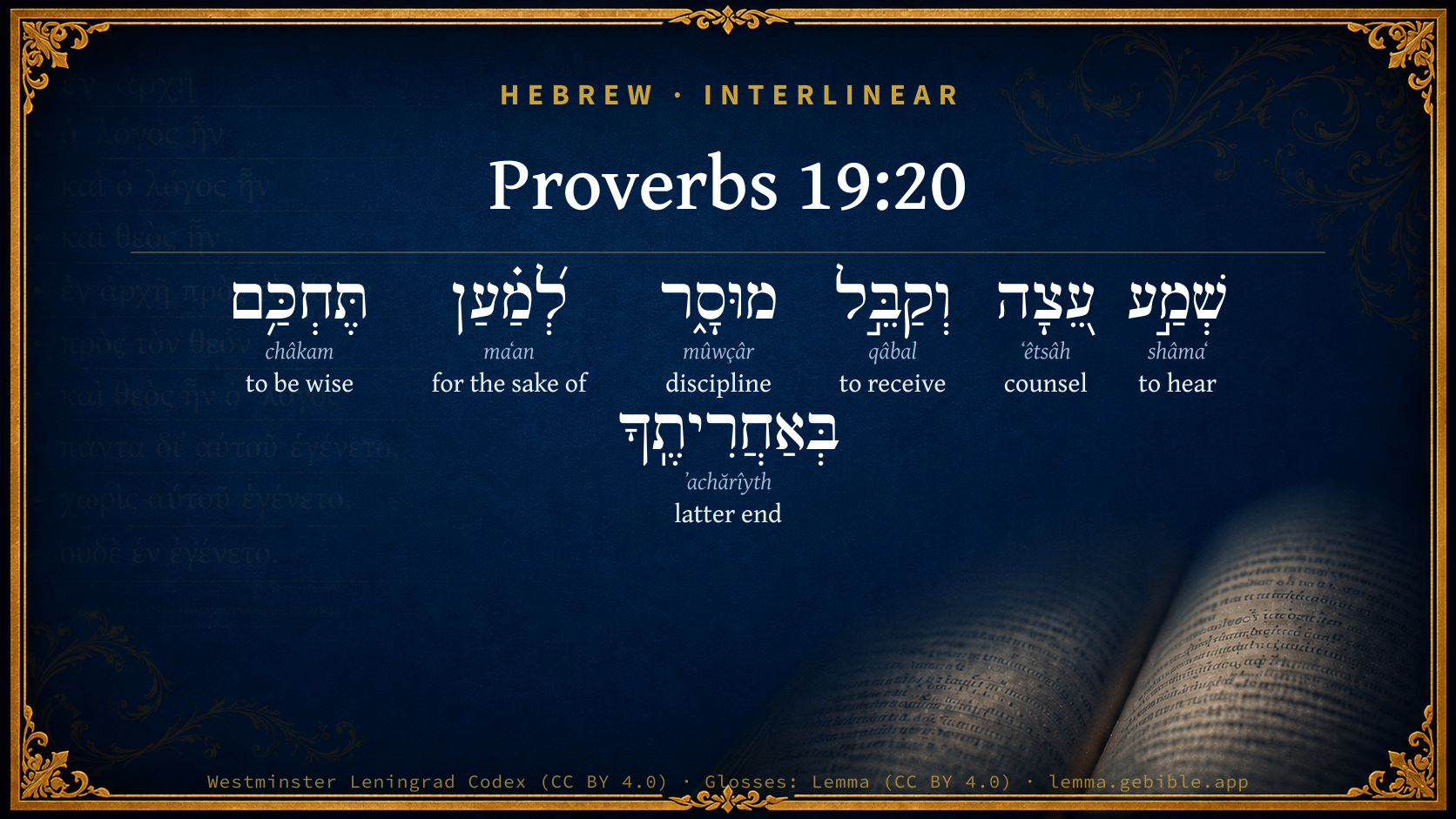
Hebrew (Westminster Leningrad Codex) Proverbs 19:20 appears in the Hebrew Old Testament. The text above is from the Westminster Leningrad Codex. Each word links to its Strong’s number, a concise gloss, and parsing drawn from the Open Scriptures Hebrew Bible morphology. Click any word for its full Brown-Driver-Briggs (BDB) entry.
Download image
Cite this verse

Proverbs 19:20 (World English Bible). Public Domain. Lemma interlinear Bible study tool, https://lemma.gebible.app/v/proverbs/19/20.

Show BibTeX & RIS
BibTeX
RIS
English Translation
Listen to counsel and receive instruction, That you may be wise in your latter end.
World English Bible · Public Domain
Download a study sheet

One document with this verse’s original text, its word-by-word gloss line, the meaning frame, cross-references with their text, attributed commentary, and full source and license credits — printable, and it pastes into notes with its structure intact.

This verse Autodidact and up

Study sheet (.html) Plain text (.txt)

A passage Seminary Student

Up to 50 verses in one chapter. A passage sheet keeps up to 6 commentary sources and 12 cross-references per verse, in the order this page ranks them, and says so on the sheet whenever that leaves anything out. Ask for a single verse and you get the Autodidact verse sheet above.

Everything on this page stays free to read, with no account — the sheet is a download of what is already on screen, not access to it.

Want to remove ads? Support Godless Engineer
Compare translations 3

The same verse in 3 English versions, stacked beneath the original-language interlinear above. Click any original word for its lexicon entry.

Each is an independent rendering of the whole verse — the interlinear is not word-aligned to these translations.

Highlighted words mark where these versions differ — a whole-verse word diff, not a word-by-word alignment.

  • World English Bible Public Domain
    Listen to counsel and receive instruction, That you may be wise in your latter end.
  • King James Version Public Domain
    Hear counsel, and receive instruction, that thou mayest be wise in thy latter end.
  • unfoldingWord Literal Text CC BY-SA 4.0
    Listen to counsel and accept instruction, so that you will become wise in your afterwards.

unfoldingWord Literal Text — © unfoldingWord, licensed CC BY-SA 4.0. Word-aligned USFM3 via Door43 (git.door43.org/unfoldingWord/en_ult).

Versions to compare (up to 4)

3 of 4 selected

Show all 18 translations

Every available English version of this verse, each an independent rendering of the whole verse.

  • World English Bible Public Domain
    Listen to counsel and receive instruction, That you may be wise in your latter end.
  • Berean Standard Bible Public Domain
    Listen to counsel and accept discipline, that you may be wise the rest of your days.
  • Majority Standard Bible Public Domain
    Listen to counsel and accept discipline, that you may be wise the rest of your days.
  • King James Version Public Domain
    Hear counsel, and receive instruction, that thou mayest be wise in thy latter end.
  • American Standard Version (1901) Public Domain
    Hear counsel, and receive instruction, That thou mayest be wise in thy latter end.
  • Revised Version (1885) Public Domain
    Hear counsel, and receive instruction, that thou mayest be wise in thy latter end.
  • Geneva Bible (1599) Public Domain
    Heare counsell and receiue instruction, that thou mayest be wise in thy latter ende.
  • Douay-Rheims (1899) Public Domain
    Hear counsel, and receive instruction, that thou mayst be wise in thy latter end.
  • Young's Literal Translation Public Domain
    Hear counsel and receive instruction, So that thou art wise in thy latter end.
  • Literal Standard Version CC BY-SA 4.0
    Hear counsel and receive instruction, || So that you are wise in your latter end.
  • Unlocked Literal Bible CC BY-SA 4.0
    Listen to advice and accept instruction, so you may become wise by the end of your life.
  • unfoldingWord Literal Text CC BY-SA 4.0
    Listen to counsel and accept instruction, so that you will become wise in your afterwards.
  • Darby Bible Public Domain
    Hear counsel, and receive instruction, that thou mayest be wise in thy latter end.
  • World Messianic Bible Public Domain
    Listen to counsel and receive instruction, that you may be wise in your latter end.
  • Webster's Bible Public Domain
    Hear counsel, and receive instruction, that thou mayest be wise in thy latter end.
  • Free Bible Version CC BY-SA 4.0
    Listen to advice and accept instruction so that you'll eventually become wise.
  • Bible in Basic English Public Domain
    Let your ear be open to suggestion and take teaching, so that at the end you may be wise.
  • JPS Tanakh (1917) Public Domain
    Hear counsel, and receive instruction, that thou mayest be wise in thy latter end.

Literal Standard Version (2020), Covenant Press — licensed CC BY-SA 4.0. Text via the HelloAO Bible API (eBible.org). Unlocked Literal Bible (unfoldingWord) — licensed CC BY-SA 4.0. Text via the HelloAO Bible API (eBible.org). unfoldingWord Literal Text — © unfoldingWord, licensed CC BY-SA 4.0. Word-aligned USFM3 via Door43 (git.door43.org/unfoldingWord/en_ult). Free Bible Version, Dr. Jonathan Gallagher — licensed CC BY-SA 4.0. Text via the HelloAO Bible API (eBible.org).

Word by word

More ways to search: Search by grammar → Find every occurrence → Compare this word →

Practice this passage: Drill this verse → Learn its vocabulary →

About this verse

These counts appear in no published source. They are computed here, from the morphology-tagged text and Lemma’s own curated glosses. What Lemma adds →

7
words
7
distinct lemmas
Wisdom
section

Notable vocabulary

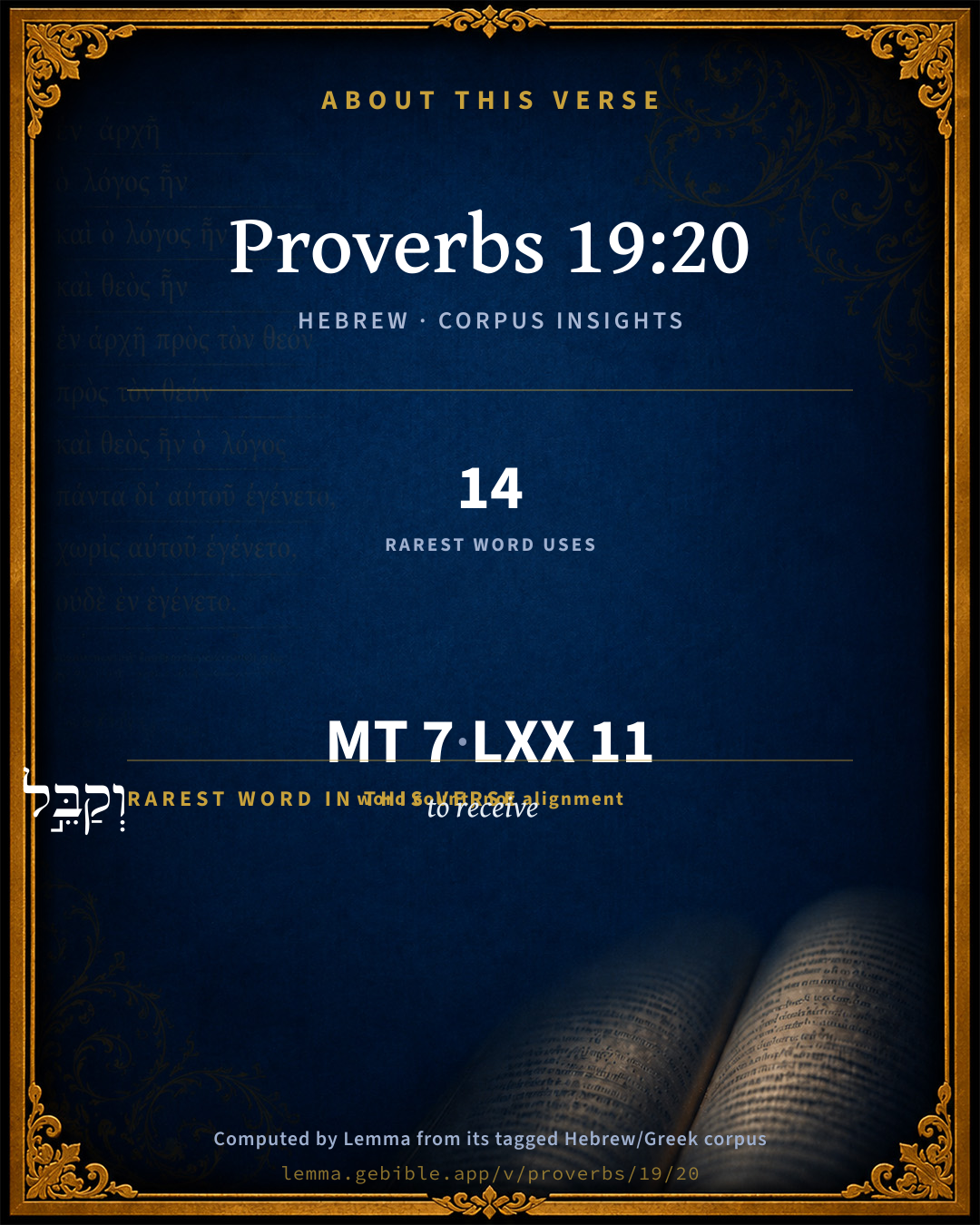
The rarest word here is וְקַבֵּ֣ל to receive H6901 — appearing just 14 times in the whole Hebrew Bible.

Shared distinctive vocabulary

וְקַבֵּ֣ל to receive H6901 occurs in 12 verses of the Hebrew Bible. Also found in:

Grammatical profile

  • 3 verbs
  • 3 nouns
  • 1 preposition

Verb forms

  • שְׁמַ֣ע Qal · Imperative
  • וְקַבֵּ֣ל Piel · Imperative
  • תֶּחְכַּ֥ם Qal · Imperfect

Hebrew & Septuagint length

In English translation the verse runs 15 words from the Hebrew and 16 from the Septuagint (LXX English) — closely comparable.

A rough comparison of the two English renderings, which tokenize alike — not a word-level alignment.

Word counts can differ between the Hebrew and the Greek without any difference in meaning — e.g. the Hebrew direct-object marker אֵת has no separate Greek word, and Greek often adds the article ὁ.

In the original languages it is 7 Hebrew tokens and 11 Greek tokens — but the two are counted differently (Hebrew bundles its prefixes and suffixes into one token; the Greek is in lemma form), so that isn’t a like-for-like length.

Cross-references

12

Topical passages linked to Proverbs 19:20 in the Treasury of Scripture Knowledge — connected by theme and wording, ordered by reader-vote popularity; previews shown in the World English Bible.

  • Proverbs 12:15 The way of a fool is right in his own eyes, But he who is wise listens to counsel.
  • Proverbs 8:34–35 Blessed is the man who hears me, Watching daily at my gates, Waiting at my door posts.
  • Proverbs 2:1–9 My son, if you will receive my words, And store up my commandments within you;
  • Proverbs 1:8 My son, listen to your father's instruction, And don't forsake your mother's teaching:
  • Proverbs 4:1 Listen, sons, to a father's instruction. Pay attention and know understanding;
  • Numbers 23:10 Who can count the dust of Jacob, Or number the fourth part of Israel? Let me die the death of the righteous, Let my last end be like his!
  • Luke 16:19–23 "Now there was a certain rich man, and he was clothed in purple and fine linen, living in luxury every day.
  • Psalms 90:14 Satisfy us in the morning with your loving kindness, That we may rejoice and be glad all our days.
  • Psalms 37:37 Mark the perfect man, and see the upright, For there is a future for the man of peace.
  • Psalms 90:12 So teach us to number our days, That we may gain a heart of wisdom.
  • Deuteronomy 8:16 who fed you in the wilderness with manna, which your fathers didn't know; that he might humble you, and that he might prove you, to do you good at your latter end:
  • Deuteronomy 32:29 Oh that they were wise, that they understood this, That they would consider their latter end!

Cross-references courtesy of OpenBible.info (CC BY 4.0).

Hebrew and Greek witnesses Masoretic Hebrew ↔ Greek Septuagint

The same verse in the two great witnesses to the Old Testament, shown verse-for-verse.

These are two independent witnesses, not word-aligned to each other, and the Septuagint is shown in lemma (dictionary) form.

Hebrew Proverbs 19:20 Masoretic · Westminster Leningrad Codex

שְׁמַ֣ע עֵ֭צָה וְקַבֵּ֣ל מוּסָ֑ר לְ֝מַ֗עַן תֶּחְכַּ֥ם בְּאַחֲרִיתֶֽךָ

Listen to counsel and receive instruction, That you may be wise in your latter end.

World English Bible · Public Domain

Greek LXX Proverbs 19:20 Septuagint · lemma form

ἀκούω υἱός παιδεία πατήρ σύ ἵνα σοφός γίγνομαι ἐπί ἔσχατος σύ

Hear, son, the instruction of your father, that you may be wise at your latter end.

LXX2012 (modern English Septuagint) · Public Domain

On this verse, The Pulpit Commentary discusses the Septuagint’s reading. Read the note in Commentary ↓

Hebrew: Westminster Leningrad Codex (CC BY 4.0). Greek: Septuagint (public domain); English from LXX2012 (modern English Septuagint) (Public Domain). How the Septuagint differs from the Hebrew →

Commentary

Notes on Proverbs 19:20 from classic Christian and Jewish commentators (each source and its license shown beneath its notes). The classic Christian expositions comment on the surrounding passage and are grouped to its opening verse, so a note may address several verses; the Jewish commentaries on the Tanakh (Rashi and others) are per-verse, so they appear only where the commentator wrote on this verse.

Lemma curates 59 commentaries, every one of them public domain or Creative Commons licensed, each selected and text-cleaned for this edition rather than reprinted as found. About our sources →

Trapp's Complete Commentary

John Trapp

Pro 19:20 Hear counsel, and receive instruction, that thou mayest be wise in thy latter end.

Ver. 20. Hear counsel, and receive instruction.] Or, Correction. Here he directs his speech to the younger sort, and exhorts them. (1.) To hear counsel, that is, to keep the commandment, as Pro 19:16 : (2.) To receive correction of parents, as Pro 19:18, as the only way to sound and lasting wisdom: for Vexatio dat intellectum; Piscator ictus sapit; Quae nocent docent. Or Solomon may here bring in the father, thus lessoning his untoward child, whom he hath lashed. For to correct, and not to instruct, is to snuff the lamp, but not pour in oil to feed it.

John Trapp, A Commentary or Exposition upon All the Books of the Old and New Testament (1647–1656) — public domain. Text from a community e-Sword module.

The Biblical Illustrator

Joseph S. Exell

Pro_19:20

Hear counsel and receive instruction, that thou mayest be wise in thy latter end.

Instruction and counsel placed before the young

I. The advice given. These two things in the text will be found to imply all that is valuable in principle and all that is useful in practice. What is here meant is not the history of the world, the instructions of science, or the general field of literature; but the principles and instructions of religion. The Word of God discovers evidences of the fact that there must be such a being as God. It gives instruction concerning the government of God and concerning man. What is the distinction between counsel and instruction? Instruction consists in the communication of right principles; counsel in the advice by which you may apply these principles practically.

II. Look to the end to be obtained by receiving the instruction, and hearing the counsel. The benefit here stated--wisdom in the latter end--is a benefit of the greatest importance; it delivers you from the disgrace of sin, of growing up a foolish old man in the midst of so many opportunities of acquiring the blessings of instruction. (J. Burnet.)

The Biblical Illustrator, edited by Joseph S. Exell (c. 1880s–1900s) — public domain. Text from a community e-Sword module.

Joseph Benson's Commentary

Pro 19:20. Hear counsel, &c. — Be willing to be taught and ruled; to be advised and reproved, when thou art young; that thou mayest be wise in thy latter end — Before thy death come. Which he adds, not exclusively, as if a man ought not to be wise before, but emphatically, to show that how foolishly soever he may have spent his former and younger years, it highly and especially concerns him to be wise before it is too late, or before death comes.

Joseph Benson's Commentary on the Old and New Testaments (1811–1818) — public domain. Text from a community e-Sword module.

The Annotated Bible

Arno C. Gaebelein

III. INSTRUCTIONS GIVEN TO SOLOMON

CHAPTER 19:20-29

Beginning with the twentieth verse of chapter 19 the personal address begins again and we read repeatedly the phrase “My son” up to the twenty-fifth chapter. This section corresponds therefore with the first nine chapters, containing the instructions which Solomon received from the Lord and which he records in these chapters.

Once more there is the call, like in the opening chapters, to hear, to give attention. “Hear counsel, and receive instruction, that thou mayest be wise in thy latter end.” The Lord knew beforehand what “the latter end” of Solomon would be. The wise man who warned against the fool, the backslider, the unjust and the man who forsakes counsel and the Lord, himself illustrates the truths given in these proverbs by turning away from the Lord. Alas! he did not hear counsel, and therefore instead of being wise in his latter days he became a fool. The truth expressed in Pro 19:22 was Solomon’s portion as long as the fear of the Lord governed his conduct. He was satisfied, had peace and prosperity; but when he no longer feared the Lord, evil came upon his kingdom and it was divided. “Wherefore the LORD said unto Solomon, Forasmuch as this is done of thee, and thou has not kept My covenant and My statutes which I have commanded thee, I will surely rend the kingdom from thee, and will give it to thy servant” 1Ki 11:11).

Arno C. Gaebelein, The Annotated Bible (1913–1922) — public domain. Text from a community e-Sword module.

Matthew Henry's Commentary

Note, 1. It is well with those that are wise in their latter end, wise for their latter end, for their future state, wise for another world, that are found wise when their latter end comes, wise virgins, wise builders, wise stewards, that are wise at length, and understand the things that belong to their peace, before they be hidden from their eyes. A carnal worldling at his end shall be a fool (Jer 17:11), but godliness will prove wisdom at last. 2. Those that would be wise in their latter end must hear counsel and receive instruction, in their beginnings must be willing to be taught and ruled, willing to be advised and reproved, when they are young. Those that would be stored in winter must gather in summer.

Matthew Henry's Commentary on the Whole Bible (1708–1710) — public domain (CC PDM 1.0). Text via the HelloAO Bible API.

Jamieson, Fausset & Brown

Robert Jamieson, A. R. Fausset & David Brown

(Compare Pro 13:18-20).

latter end-- (Pro 5:11). In youth prepare for age.

Jamieson, Fausset & Brown — Commentary Critical and Explanatory on the Whole Bible (1871) — public domain (CC PDM 1.0). Text via the HelloAO Bible API.

Ellicott's Commentary for English Readers

(20) That thou mayest be wise in thy latter end.—That “though thy beginning might be small, yet that thy latter end should greatly increase” (Job_8:7)

A Bible Commentary for English Readers, edited by Charles John Ellicott (1878–1897) — public domain. Text from a community e-Sword module.

John Gill's Exposition

Hear counsel, and receive instruction,.... Of parents, masters, and ministers; especially the counsel and instruction of Wisdom, of Jesus Christ, the Wisdom of God, the wonderful Counsellor; and of his Gospel and of the Scriptures, which are able to make a man wise unto salvation;

that thou mayest be wise in thy latter end; in the latter end of life, at death; that then it may appear a man has been so wise as to be concerned for a future state, for the good of his soul in another world; by listening to the counsel and instruction of Christ, in his word; by looking to him, and believing in him, for life and salvation; by leaning and living upon him; and committing the affairs of his soul, and the salvation of it, to him.

John Gill's Exposition of the Whole Bible (1746–1763) — public domain (CC PDM 1.0). Text via the HelloAO Bible API.

Matthew Poole's English Annotations

Before thy death come; which he adds not exclusively, as if he ought not to be wish before, but emphatically, to show that how foolishly soever he had spent his former and younger years, it highly concerned him to be wise before it was too late, or before death came.

Matthew Poole's English Annotations on the Holy Bible (1683–1685) — public domain. Text from a community e-Sword/MySword module.

Whedon's Commentary on the Bible

Daniel D. Whedon

20. In thy latter end — Thy hereafter, which may mean in the after-part of this life, or in the future life. The interpreters generally favour the sense, in thy after years. “Get instruction and counsel when young, that you may be wise when you grow old.” — Stuart. Compare Proverbs 42:12, for same word.

Daniel D. Whedon (gen. ed.), Commentary on the Old and New Testaments (1874–1909) — public domain. Text from a community e-Sword module.

The Pulpit Commentary

Comp. Pro_8:10 Pro_12:15. The Septuagint directs the maxim to children, "Hear, O son, the instruction of thy father." That thou mayest be wise in thy latter end. Wisdom gathered and digested in youth is seen in the prudence and intelligence of manhood and old age. Job_8:7, "Though thy beginning was small, yet thy latter end should greatly increase." Ecc 25:6, "O how comely is the wisdom of old men, and understanding and counsel to men of honour! Much experience is the crown of old men, and the fear of God is their glory." "Wer nicht horen will," say the Germans, "muss fuhlen," "He that will not hear must feel." Among Pythagoras"s golden words we read Bouleuou de pro ergou opwv mh mwra telhtai . "Before thou doest aught, deliberate, Lest folly thee befall.

Ready at the end.

The wise man always shows his wisdom by looking well before him. It is the sure mark of a fool to content himself with the immediate present. We do not wonder that proverbs should deal much with the future. "Passion and Patience" is the picture which is always being exhibited before the eyes of men.

I THE NEED OF READINESS AT THE END. "How shall we enjoy the present time?" asks one; "How shall we make ready for the end?" asks another and a wiser soul. The question presents itself to the youth, as he looks forward to the end of the term and the coming of the examination or the writing of the report; to the young man the apprentice, the articled clerk, the student as he considers how he shall go through his trial hour and be prepared for his business or profession; to the man in middle life, as he foresees the time coming when he can no longer do as he is doing now, and must have something to fall back upon in his declining days; to the man in later life, as he is compelled to feel that his powers are fast failing, and that the hour is not distant when he will stand on the very verge of life and confront the long and solemn future. It should also be present in the mind of those who are soon to go forth into the sterner conflict of life, to meet alone, away from home influences, the serious and strong temptations of an evil world. Whatever the stage through which we are now passing, it moves towards its close an end which is sure to open out into something beyond, and, most likely, something more important, weighted with graver responsibilities and leading to larger issues. Are we so living, the wise will ask, that we shall be ready for that end when it comes?

II THE CONSEQUENT NEED TO LEARN OF GOD. "Hear counsel," etc.

1. There is much need to learn of men from our parents, from our teachers, from every form of instructive literature, from all that the experiences of men, as we watch their life, are saying to us. Whoso would be wise at the end of his career should have an open mind that everyone and everything may teach him. Lessons are to be learnt from every event, however simple and humble it may be. The wide world is the school which the wise will never "leave.

2. There is much more need to learn of God, to learn of Christ. For:

a. He can speak authoritatively, as man cannot.

b. He gives us wisdom unmingled with error, as man does not.

c. He can tell us how to find his Divine favour and how to reach his nearer presence, as no man can.

Let us learn of Christ and be wise. C.

The Pulpit Commentary (1880–1919), ed. H.D.M. Spence-Jones & Joseph S. Exell — public domain. Text from a community e-Sword module.

Bridges on Proverbs

Charles Bridges

We have just had a word for parents, directing their Christian discipline. Here the children are exhorted to humility. Again are they awakened to hear counsel and instruction.†1 And constantly do they need the word. "Childhood and youth are vanity."†2 Present gratification is the main object. Oh! remember that the seed, now sown in the season of youth, will produce either blessed or bitter fruit in the latter end. Rich indeed was the harvest from Timothy’s early attention to instruction.†3 Fearful indeed was the judgment upon the scoffers,†4 the awful death of the profligate,†5 the ruin of the holy nation†6 — all the fruit of despising timely wisdom and instruction. Might not Rehoboam†7 and Amaziah†8 have escaped the ruin of their kingdom, had they heard counsel, and thus obtained wisdom in their latter end? ’I am going to die,’ said a thoughtless King on his death-bed; ’and yet I have not begun to live.’ How does the wisdom of mature age depend upon diligence in hearing counsel and instruction! Hence we value "the yoke" — specially of affliction — "borne in youth" — a "good" thing indeed, fraught with profit. (Lam 3:27 .) In this yoke Joseph heard from his God much counsel and instruction, that eminently qualified him with wisdom for his high responsibility. (Genesis 37. 39.-41.) Daniel, thus early instructed, found wisdom in the latter end of a life protracted beyond the ordinary term, that enabled him to superintend a hundred and twenty provinces with singular honour to his profession. (Dan 1:4-9 ; Dan 6:3-4 .)

And then as regards the latter end — "the end of all things," — the wisdom to meet the great crisis is not to be found in thoughtless disregard. Counsel and instruction are largely given. But alas! of the most the Lord is constrained to complain — "My people doth not consider." (Isa 1:3 .) And who, in the sight of the mass of ungodliness, can refrain from the weeping lamentation of the man of God, — "Oh! that they were wise! that they understood this, that they would consider their latter end!" (Deu 32:29 .)

Footnotes:

†1 Pro 4:1-2; Pro 5:1-2 ; Pro 7:1-2 .

†2 Ecc 11:10.

†3 2Ti 3:14-15 .

†4 Pro 1:26; Pro 29:1 .

†5 Pro 5:9-14.

†6 Mat 23:37-39. Luk 19:41-42 .

†7 1Ki 12:12-19 .

†8 2Ch 25:15-20 .

Charles Bridges, An Exposition of the Book of Proverbs (1846) — public domain. Text from a community e-Sword module.

Kretzmann's Popular Commentary

Paul E. Kretzmann

v. 20. Hear counsel and receive instruction, in effecting the moral training which every person needs for true wisdom, that thou mayest be wise in thy latter end, in the future; for the conduct of the truly wise will grow nearer perfection as they grow in years.

Paul E. Kretzmann, Popular Commentary of the Bible (1921–1924) — public domain. Text from a community e-Sword module.

Lesson kit

Teaching starters — assembled from the data on this page, not authored interpretation. Every prompt links to the verse data it draws on. Edit before teaching.

Proverbs, in the Wisdom, opens this verse with 7 words (7 distinct Hebrew lemmas). Its most distinctive word is qâbal (“to receive”). A historical commentator’s framing appears above. Read the whole chapter for the surrounding context.

Discussion questions

  1. How does “to receive” (qâbal) shape what this verse is saying?
  2. How does Exodus 26:5, which shares the word «to receive», read alongside this verse?
  3. These translations render this verse differently; the difference is in the English rendering, not the original. What questions does that raise?
  4. «שְׁמַ֣ע» is a Qal Imperative verb. How does that grammatical form shape the action described?
  5. Compare how Trapp's Complete Commentary and The Biblical Illustrator read this verse. Where do they agree or differ?

Things to notice

Reading settings

Reading text

Shown beneath each verse's original-language words.

Old Testament
Old Testament edition

Read the OT as the Masoretic Hebrew (MT) or the Greek Septuagint (LXX).

English shown for the Greek Septuagint (in the Hebrew ↔ Greek comparison).

Comparing translations? Open the Compare panel on any verse page to stack up to four side by side.