
Proverbs 29:21

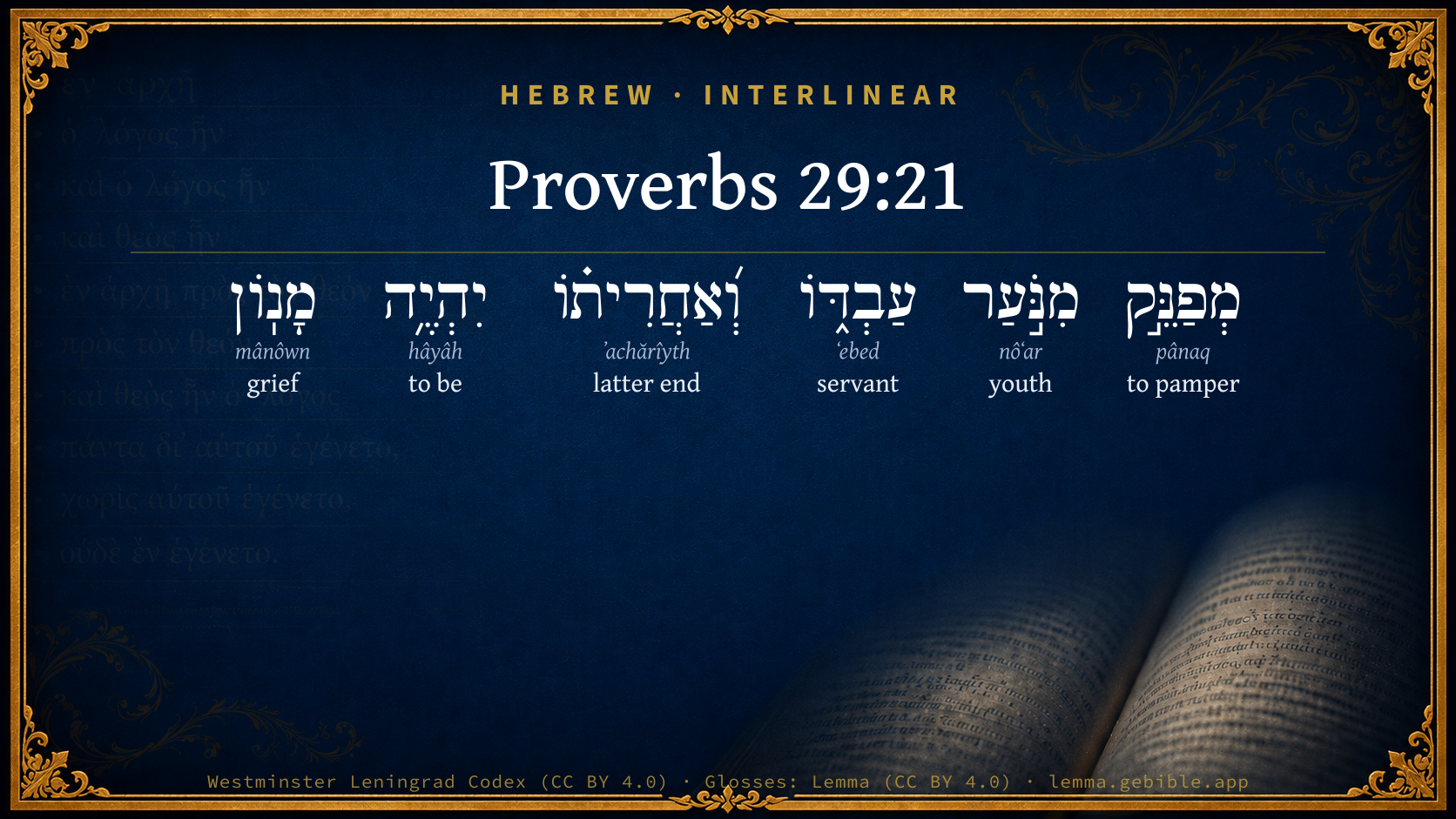
Hebrew (Westminster Leningrad Codex) Proverbs 29:21 appears in the Hebrew Old Testament. The text above is from the Westminster Leningrad Codex. Each word links to its Strong’s number, a concise gloss, and parsing drawn from the Open Scriptures Hebrew Bible morphology. Click any word for its full Brown-Driver-Briggs (BDB) entry.
Download image
Cite this verse

Proverbs 29:21 (World English Bible). Public Domain. Lemma interlinear Bible study tool, https://lemma.gebible.app/v/proverbs/29/21.

Show BibTeX & RIS
BibTeX
RIS
English Translation
He who pampers his servant from youth Will have him become a son in the end.
World English Bible · Public Domain
Highlights
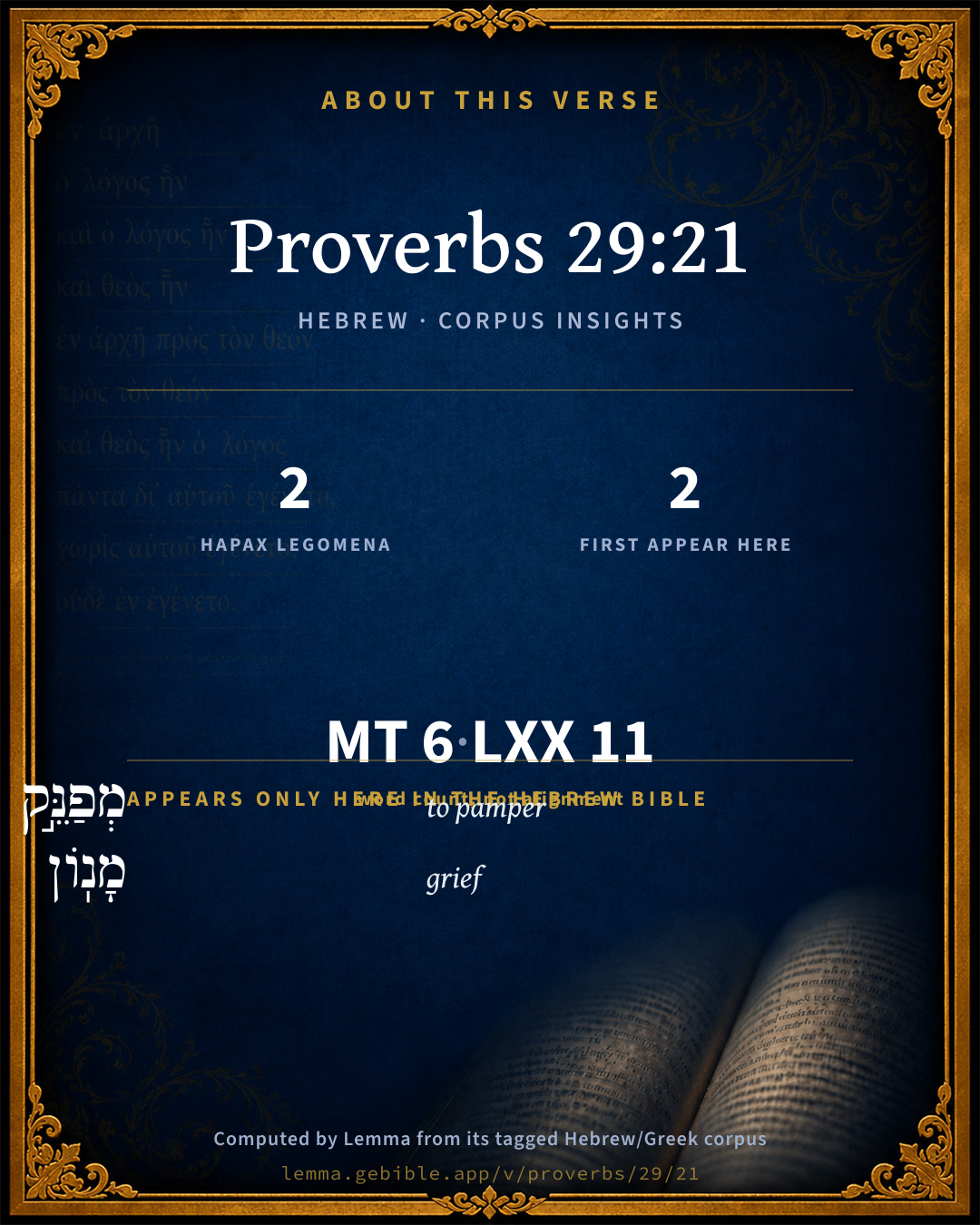
  • 2 hapax legomena — only here in the Hebrew Bible
  • 2 first appearances in the Hebrew Bible
Full analysis ↓
Download a study sheet

One document with this verse’s original text, its word-by-word gloss line, the meaning frame, cross-references with their text, attributed commentary, and full source and license credits — printable, and it pastes into notes with its structure intact.

This verse Autodidact and up

Study sheet (.html) Plain text (.txt)

A passage Seminary Student

Up to 50 verses in one chapter. A passage sheet keeps up to 6 commentary sources and 12 cross-references per verse, in the order this page ranks them, and says so on the sheet whenever that leaves anything out. Ask for a single verse and you get the Autodidact verse sheet above.

Everything on this page stays free to read, with no account — the sheet is a download of what is already on screen, not access to it.

Want to remove ads? Support Godless Engineer
Compare translations 3

The same verse in 3 English versions, stacked beneath the original-language interlinear above. Click any original word for its lexicon entry.

Each is an independent rendering of the whole verse — the interlinear is not word-aligned to these translations.

Highlighted words mark where these versions differ — a whole-verse word diff, not a word-by-word alignment.

  • World English Bible Public Domain
    He who pampers his servant from youth Will have him become a son in the end.
  • King James Version Public Domain
    He that delicately bringeth up his servant from a child shall have him become his son at the length.
  • unfoldingWord Literal Text CC BY-SA 4.0
    Pampering his servant from youth, then his end will be insolence.

unfoldingWord Literal Text — © unfoldingWord, licensed CC BY-SA 4.0. Word-aligned USFM3 via Door43 (git.door43.org/unfoldingWord/en_ult).

Versions to compare (up to 4)

3 of 4 selected

Show all 18 translations

Every available English version of this verse, each an independent rendering of the whole verse.

  • World English Bible Public Domain
    He who pampers his servant from youth Will have him become a son in the end.
  • Berean Standard Bible Public Domain
    A servant pampered from his youth will bring grief in the end.
  • Majority Standard Bible Public Domain
    A servant pampered from his youth will bring grief in the end.
  • King James Version Public Domain
    He that delicately bringeth up his servant from a child shall have him become his son at the length.
  • American Standard Version (1901) Public Domain
    He that delicately bringeth up his servant from a child Shall have him become a son at the last.
  • Revised Version (1885) Public Domain
    He that delicately bringeth up his servant from a child shall have him become a son at the last.
  • Geneva Bible (1599) Public Domain
    He that delicately bringeth vp his seruant from youth, at length he will be euen as his sone.
  • Douay-Rheims (1899) Public Domain
    He that nourisheth his servant delicately from his childhood, afterwards shall find him stubborn.
  • Young's Literal Translation Public Domain
    Whoso is bringing up his servant delicately, from youth, `At' his latter end also he is continuator.
  • Literal Standard Version CC BY-SA 4.0
    Whoever is bringing up his servant delicately, from youth, || [At] his latter end he is also continuator.
  • Unlocked Literal Bible CC BY-SA 4.0
    One who pampers his slave from youth, at the end of it there will be trouble.
  • unfoldingWord Literal Text CC BY-SA 4.0
    Pampering his servant from youth, then his end will be insolence.
  • Darby Bible Public Domain
    He that delicately bringeth up his servant from a child, shall in the end have him as a son.
  • World Messianic Bible Public Domain
    He who pampers his servant from youth will have him become a son in the end.
  • Webster's Bible Public Domain
    He that delicately bringeth up his servant from a child shall have him at length become his son.
  • Free Bible Version CC BY-SA 4.0
    A servant indulged from childhood will in the end become unmanageable.
  • Bible in Basic English Public Domain
    If a servant is gently cared for from his early years, he will become a cause of sorrow in the end.
  • JPS Tanakh (1917) Public Domain
    He that delicately bringeth up his servant from a child shall have him become master at the last.

Literal Standard Version (2020), Covenant Press — licensed CC BY-SA 4.0. Text via the HelloAO Bible API (eBible.org). Unlocked Literal Bible (unfoldingWord) — licensed CC BY-SA 4.0. Text via the HelloAO Bible API (eBible.org). unfoldingWord Literal Text — © unfoldingWord, licensed CC BY-SA 4.0. Word-aligned USFM3 via Door43 (git.door43.org/unfoldingWord/en_ult). Free Bible Version, Dr. Jonathan Gallagher — licensed CC BY-SA 4.0. Text via the HelloAO Bible API (eBible.org).

Word by word

More ways to search: Search by grammar → Find every occurrence → Compare this word →

Practice this passage: Drill this verse → Learn its vocabulary →

About this verse

These counts appear in no published source. They are computed here, from the morphology-tagged text and Lemma’s own curated glosses. What Lemma adds →

6
words
6
distinct lemmas
Wisdom
section

Notable vocabulary

2 hapax legomena — words that appear only here in the entire Hebrew Bible:

  • מְפַנֵּ֣ק to pamper H6445
  • מָנֽוֹן grief H4497

First appearance in Scripture

These words make their first canonical appearance in the Hebrew Bible here:

  • מְפַנֵּ֣ק to pamper H6445
  • מָנֽוֹן grief H4497

Shared distinctive vocabulary

מִנֹּ֣עַר youth H5290 occurs in 4 verses of the Hebrew Bible. Also found in:

Grammatical profile

  • 2 verbs
  • 4 nouns

Verb forms

  • מְפַנֵּ֣ק Piel · Participle Active
  • יִהְיֶ֥ה Qal · Imperfect

Hebrew & Septuagint length

In English translation the verse runs 16 words from the Hebrew and 19 from the Septuagint (LXX English) — closely comparable.

A rough comparison of the two English renderings, which tokenize alike — not a word-level alignment.

Word counts can differ between the Hebrew and the Greek without any difference in meaning — e.g. the Hebrew direct-object marker אֵת has no separate Greek word, and Greek often adds the article ὁ.

In the original languages it is 6 Hebrew tokens and 11 Greek tokens — but the two are counted differently (Hebrew bundles its prefixes and suffixes into one token; the Greek is in lemma form), so that isn’t a like-for-like length.

Hebrew and Greek witnesses Masoretic Hebrew ↔ Greek Septuagint

The same verse in the two great witnesses to the Old Testament, shown verse-for-verse.

These are two independent witnesses, not word-aligned to each other, and the Septuagint is shown in lemma (dictionary) form.

Hebrew Proverbs 29:21 Masoretic · Westminster Leningrad Codex

מְפַנֵּ֣ק מִנֹּ֣עַר עַבְדּ֑וֹ וְ֝אַחֲרִית֗וֹ יִהְיֶ֥ה מָנֽוֹן

He who pampers his servant from youth Will have him become a son in the end.

World English Bible · Public Domain

Greek LXX Proverbs 29:21 Septuagint · lemma form

ὅς κατασπαταλάω ἐκ παῖς οἰκέτης εἰμί ἔσχατος δέ ὀδυνάω ἐπί ἑαυτοῦ

He that lives wantonly from a child, shall be a servant, and in the end shall grieve over himself.

LXX2012 (modern English Septuagint) · Public Domain

On this verse, The Cambridge Bible for Schools and Colleges discusses the Septuagint’s reading. Read the note in Commentary ↓

Hebrew: Westminster Leningrad Codex (CC BY 4.0). Greek: Septuagint (public domain); English from LXX2012 (modern English Septuagint) (Public Domain). How the Septuagint differs from the Hebrew →

Commentary

Notes on Proverbs 29:21 from classic Christian and Jewish commentators (each source and its license shown beneath its notes). The classic Christian expositions comment on the surrounding passage and are grouped to its opening verse, so a note may address several verses; the Jewish commentaries on the Tanakh (Rashi and others) are per-verse, so they appear only where the commentator wrote on this verse.

Lemma curates 59 commentaries, every one of them public domain or Creative Commons licensed, each selected and text-cleaned for this edition rather than reprinted as found. About our sources →

Trapp's Complete Commentary

John Trapp

Pro 29:21 He that delicately bringeth up his servant from a child shall have him become [his] son at the length.

Ver. 21. He that delicately bringeth up his servant.] A master that would be, as he ought, both loved and feared by his servants, must see to two things: - (1.) The well-choosing; and (2.) The well using of them. This Solomon himself, that thus adviseth here, was not so well advised of; for he saw that Jeroboam, who gave occasion, as it is conceived, of uttering this proverb, was meet for the work, and therefore, not examining his religion, entertained him into his service, yea, placed him over the family of Joseph, admitted him into so much familiarity, and so let loose the bridle of domestic discipline to him, that he took estate upon him as a young master in the house, and soon after turned traitor, and would needs be as his son, and more. The like is to be seen in Abner, Ishbosheth’s servant, who grew so haughty and haunty, that he might not be spoken to, {2Sa 3:7-11} and in Zimri, whom his master Elah so favoured and esteemed, that he made him captain over the half part of his chariots. But this beggar, thus set on horseback, rides without reins, to the ruin of his master and his whole house. {1Ki 16:11} So true is that of the poet -

“Aφορητος εστι μαστιγιας ευτυχων.”

“Asperius nihil est humili dum surgit in altum.”

Tobiah the servant is so insolent there is no dealing with him.

John Trapp, A Commentary or Exposition upon All the Books of the Old and New Testament (1647–1656) — public domain. Text from a community e-Sword module.

Joseph Benson's Commentary

Pro 29:21. He that delicately bringeth up his servant, &c. — Allowing him too much freedom and familiarity; shall have him become his son — Will find him, at last, grow insolent, and forgetful of his servile condition.

Joseph Benson's Commentary on the Old and New Testaments (1811–1818) — public domain. Text from a community e-Sword module.

Matthew Henry's Commentary

Note, 1. It is an imprudent thing in a master to be too fond of a servant, to advance him too fast, and admit him to be too familiar with him, to suffer him to be over-nice and curious in his diet, and clothing, and lodging, and so to bring him up delicately, because he is a favourite, and an agreeable servant; it should be remembered that he is a servant, and, by being thus indulged, will be spoiled for any other place. Servants must endure hardness. 2. It is an ungrateful thing in a servant, but what is very common, to behave insolently because he has been used tenderly. The humble prodigal thinks himself unworthy to be called a son, and is content to be a servant; the pampered slave thinks himself too good to be called a servant, and will be a son at the length, will take his ease and liberty, will be on a par with his master, and perhaps pretend to the inheritance. Let masters give their servants that which is equal and fit for them, and neither more nor less. This is very applicable to the body, which is a servant to the soul; those that delicately bring up the body, that humour it, and are over-tender of it, will find that at length it will forget its place, and become a son, a master, a perfect tyrant.

Matthew Henry's Commentary on the Whole Bible (1708–1710) — public domain (CC PDM 1.0). Text via the HelloAO Bible API.

Jamieson, Fausset & Brown

Robert Jamieson, A. R. Fausset & David Brown

become his son--assume the place and privileges of one.

Jamieson, Fausset & Brown — Commentary Critical and Explanatory on the Whole Bible (1871) — public domain (CC PDM 1.0). Text via the HelloAO Bible API.

Adam Clarke's Commentary

Verse 21. He that delicately bringeth up his servant] Such persons are generally forgetful of their obligations, assume the rights and privileges of children, and are seldom good for any thing.

Adam Clarke's Commentary on the Bible (1810–1826) — public domain. Text from a community e-Sword/MySword module.

Ellicott's Commentary for English Readers

(21) Shall have him become his son at the last.—Confidential slaves sometimes rose to be the heirs of their master’s property. (See above on Pro_17:2.) But here the warning seems to be rather against spoiling a slave by over-indulgence, lest he at the last forget his position, just as old and petted servants are apt to become somewhat dictatorial.

A Bible Commentary for English Readers, edited by Charles John Ellicott (1878–1897) — public domain. Text from a community e-Sword module.

The Cambridge Bible for Schools and Colleges

gen. ed. J. J. S. Perowne

21. his son] The meaning of the word which occurs only here is doubtful (see R.V. marg.), but this is the most probable rendering of it. The Vulg., as referred to in R.V. marg., has sentiet eum contumacem, shall have him become refractory. The LXX. give the proverb differently: “He that lives delicately from his youth shall be a servant, and shall be grieved with himself (ὀδυνηθήσεται ἐφʼ ἑαυτῷ) at the last.”

The Cambridge Bible for Schools and Colleges (gen. ed. J. J. S. Perowne; Cambridge University Press, 1878–1918) — public domain. Text from a community e-Sword module.

John Gill's Exposition

He that delicately bringeth up his servant from a child,.... In a very tender and affluent way uses him with great familiarity; makes him sit at table, with him, feeds him with dainties, and clothes him in the most handsome manner, as if he was one of his own children:

shall have him become his son at the length: he will expect to be used as a son; he will not care to do any servile work, or anything, especially that is hard and laborious; he will be for supplanting the son and heir, and think to inherit all himself; or, however, become proud, haughty, and saucy. Jarchi interprets this of the evil imagination, or the corruption of nature, which is in a man from a child; which, if cherished and not subdued, wilt in the issue rule over a man: and some apply it to the body; which, if delicately pampered, and not kept under, will be master of the soul, instead of servant to it, and its members be instruments of unrighteousness.

John Gill's Exposition of the Whole Bible (1746–1763) — public domain (CC PDM 1.0). Text via the HelloAO Bible API.

Albert Barnes' Notes on the Bible

Son - The Hebrew word occurs here only and is therefore of doubtful meaning. The favored slave, petted and pampered from boyhood, will claim at last the privilege, perhaps the inheritance, of sonship.

Albert Barnes' Notes on the Bible (1834–1885) — public domain. Text from a community e-Sword/MySword module.

Matthew Poole's English Annotations

He that delicately bringeth up his servant, allowing him too much freedom, and familiarity, and delicious fare, shall have him become his son; will find him at last grow insolent and presumptuous, and forgetful of his servile condition.

Matthew Poole's English Annotations on the Holy Bible (1683–1685) — public domain. Text from a community e-Sword/MySword module.

Whedon's Commentary on the Bible

Daniel D. Whedon

21. His son at the length — So most translators; but some render, “Contumacious, ungrateful.” The English text is generally followed. Patrick, as usual, combines the different senses thus: “Indulging him in too much ease, liberty, and familiarity, will make him saucy, if not contumacious; nay, to domineer and take upon him, as if he were a son, and perhaps endeavor to disinherit the heir of the family.” Two words in this verse are found nowhere else in the Bible, מפנק, (mephannek,) and מנון, (manon,) rendered son. Oriental servants might become heirs to the master’s property. Compare Gen_15:3.

Daniel D. Whedon (gen. ed.), Commentary on the Old and New Testaments (1874–1909) — public domain. Text from a community e-Sword module.

The Pulpit Commentary

He that delicately bringeth up his servant from a child. The verb panak, which is not found elsewhere in the Old Testament, is rightly here translated as in the Vulgate, qui delicate nutrit. It refers to the spoiling a person by over-refinement, luxury, and pampering a treatment peculiarly unsuitable in the case of a bond servant, and one which makes such forgetful of his dependent position. Septuagint, "He that liveth wantonly (kataspatala ) from childhood shall be a servant." Shall have him become his son at the length; i.e. at length, like "at the last," equivalent to "at last". (Pro_5:11) The word rendered "son" (wOnm, manon) is of doubtful meaning, and has been variously understood or misunderstood by interpreters. Septuagint, "And in the end shall have pain (odunhyhsetai ) over himself;" Symmachus, "shall have murmuring (esta goggusmov );" Vulgate, Postea sentiet eum contumacem. Ewald translates "ungrateful;" Delitzsch, "place of increase," i.e. a household of pampered scapegraces; but one does not see how the disaster can be called a place or a house. It seems safest in this uncertainty to adopt the Jewish interpretation of "progeny:" "he will be as a son." The pampered servant will end by claiming the privileges of a son, and perhaps ousting the legitimate children from their inheritance. (comp. Pro_17:2; and the ease of Ziba and Mephibosheth, 2Sa_16:4) "Fodder, a stick, and burdens are for the ass; and bread, correction, and work for a servant. If thou set thy servant to labour, thou shalt find rest; but if thou let him go idle, he will seek liberty" (Ecc 33:24, etc.). Spiritual writers have applied this proverb to the pampering of the flesh, which ought to be under the control of its master, the spirit, but which, if gratified and unrestrained, gets the upper hand, and, like a spoiled servant, dictates to its lord.

The Pulpit Commentary (1880–1919), ed. H.D.M. Spence-Jones & Joseph S. Exell — public domain. Text from a community e-Sword module.

John Wesley's Explanatory Notes

Delicately - Allowing him too much freedom, and familiarity. A son - Will find him at last grow insolent, and forgetful of his servile condition.

John Wesley, Explanatory Notes Upon the Whole Bible (1754–1765) — public domain. Text via the GEBible commentary corpus.

Keil & Delitzsch

C. F. Keil & F. Delitzsch

21 If one pampers his servant from youth up,

He will finally reach the place of a child.

The lxx had no answer to the question as to the meaning of מנון. On the other hand, for פּנּק, the meaning to fondle; delicatius enutrire, is perfectly warranted by the Aram. and Arab. The Talmud, Succa 52b, resorts to the alphabet בח''אט in order to reach a meaning for מנון. How the Targ. comes to translate the word by מנסּח (outrooted) is not clear; the rendering of Jerome: postea sentiet eum contumacem, is perhaps mediated by the ἔσται γογγυσμός of Symmachus, who combines נון with לון, Niph. γογγύζειν. The ὀθυνηθήσεται of the lxx, with the Syr., von Hofmann has sought to justify (Schriftbew. ii. 2. 404), for he derives מנון = מנהון from נהה. We must then punctuate מנּון; but perhaps the lxx derived the word from אנן = מאנון, whether they pronounced it מנון (cf. מסרת = מאסרת) or מנּון. To follow them is not wise, for the formation of the word is precarious; one does not see with the speaker of this proverb, to whom the language presented a fulness of synonyms for the idea of complaint, meant by using this peculiar word. Linguistically these meanings are impossible: of Jerome, dominus = ממנּה (Ahron b. Josef, Meri, and others); or: the oppressed = מוּנה, from ינה (Johlson); or: one who is sick = מונה (Euchel). and Ewald's "undankbar" [unthankful], derived from the Arabic, is a mere fancy, since (Arab.) manuwan does not mean one who is unthankful, but, on the contrary, one who upbraids good deeds shown.

(Note: In Jahrb. xi. p. 10f. Ewald compares, in an expressive way, the Ethiopic mannána (Piel) to scorn; menûn, a reprobate; and mannânı̂, one who is despised; according to which מנון hcih could certainly designate "a man despising scornfully his own benefactors, or an unthankful man." But this verbal stem is peculiarly Ethiop., and is certainly not once found in Arab. For minnat (which Ewald compares) denotes benefaction, and the duty laid on one thereby, the dependence thereby produced. The verb (Arab.) minn (= מנן) signifies to divide; and particularly, partly to confer benefaction, partly to attribute benefaction, reckon to, enumerate, and thereby to bring out the sense of obligation. Thus nothing is to be derived from this verbal stem for מנון.)

The ancients are in the right track, who explain מנון after the verb נוּן, Psa 72:17 = נין = בּן; the Venet., herein following Kimchi, also adopts the nominal form, for it translates (but without perceptible meaning) γόνωσις. Luther's translation is fortunate:

"If a servant is tenderly treated from youth up,

He will accordingly become a Junker [squire]."

The ideas represented in modern Jewish translations: that of a son (e.g., Solomon: he will at last be the son) and that of a master (Zunz), are here united. But how the idea of a son (from the verb נון), at the same time that of a master, may arise, is not to be perceived in the same way as with Junker and the Spanish infante and hidalgo; rather with מנון, as the ironical naming of the son (little son), the idea of a weakling (de Wette) may be connected. The state of the matter appears as follows: - the Verb נוּן has the meanings of luxuriant growth, numerous propagation; the fish has from this the Aram. name of נוּן, like the Heb. דּג, from דּגה, which also means luxuriant, exuberant increase (vid., at Psa 72:17). From this is derived נין, which designates the offspring as a component part of a kindred, as well as מנון, which, according as the מ is interpreted infin. or local, means either this, that it sprouts up luxuriantly, the abundant growth, or also the place of luxuriant sprouting, wanton growing, abundant and quick multiplication: thus the place of hatching, spawning. The subject in יהיה might be the fondled one; but it lies nearer, however, to take him who fondles as the subject, as in 21a. אחריתו is either adv. accus. for באחריתו, or, as we preferred at Pro 23:32, it is the subj. introducing, after the manner of a substantival clause, the following sentence as its virtual predicate: "one has fondled his servant from his youth up, and his (that of the one who fondles) end is: he will become a place of increase." The master of the house is thought of along with his house; and the servant as one who, having become a man, presents his master with ילידי בּית, who are spoilt scapegraces, as he himself has become by the pampering of his master. There was used in the language of the people, נין for בּן, in the sense on which we name a degenerate son a "Schnes Frchtchen" [pretty little fruit]; and מנון is a place (house) where many נינים are; and a man (master of a house) who has many of them is one whose family has increased over his head. One reaches the same meaning if מנון is rendered more immediately as the place or state of growing, increasing, luxuriating. The sense is in any case: he will not be able, in the end, any more to defend himself against the crowd which grows up to him from this his darling, but will be merely a passive part of it.

Keil & Delitzsch — Biblical Commentary on the Old Testament (1861–1891) — public domain (CC PDM 1.0). Text via the HelloAO Bible API. (Old Testament only.)

Bridges on Proverbs

Charles Bridges

We have another valuable rule for domestic discipline; directing masters to a wise treatment of their servants. It is a grievous error to step ourselves, or to induce another to step out of the path, which a God of order has marked for us. Divine Wisdom has framed the constitution of society, assigning to each their station and their duties. If a servant aspire to be in the house anything but a servant, his character loses its value. A master acts — to say the least — most unseemly, when he forgets his own place and authority, and delicately bringeth up his servant by the allowance of undue freedom. It is a great exercise to preserve the true medium between distance and familiarity. An haughty, menacing demeanor towards our servants forgets the respect justly due to them. (Eph 6:9 .) An inconsiderate fondness takes them out of their place, greatly to their own injury. Our Lord’s distinction shews, that friends — not servants — should be admitted to our familiar intercourse, and entrusted with our confidence. (Joh 15:15 .) To promote a servant therefore to the rank of a confidant, unfits him for his own condition, and defeats our own end by the natural results of this unnatural treatment. True kindness keeps him in his place. ’Good usage does by no means imply that indulgence, that would ruin a child.’†1 A servant delicately brought up — often from a child — if he be not taken down in time, and made to know his place — soon relaxes in respect and attention. Instead of this false kindness stimulating to diligence, and inducing gratitude; he becomes idle, insolent, and ungovernable (Compare Sir 33:25-27 ); assumes the young master — becomes a son at length. This unseemly usurpation is an evil, "that the earth cannot bear — a servant, when he reigneth."†2 Ishbosheth must have allowed Abner undue liberty, when he so far forgot the respect due to his sovereign, as to insult him before his face. (2Sa 3:8 .) David also must have loosened the reins of proper authority, when Joab murdered the commander-in-chief at the head of his army, without being instantly subjected to the penalty of the law. (2Sa 20:10 .) Even the wise man appears to have forgotten his own prudent caution, when he delicately brought up Jeroboam in authority; and promoted him too suddenly. He lived to regret his error, when with the pretension of a son he combined the pride of a rebel. (1Ki 11:26-28 .) The confusion and anarchy of after years in the kingdom originated in the same false step. (1Ki 16:9-12 .) The greatest kindness to servants is to "give to them that which is just and equal" (Col 4:1 ) — but no more. Any defect in this rule will be sure to bring (as in the case referred to) future trouble, as the just chastening for present folly. What need have we of the daily supply of Divine grace to rule our house well in due subjection! The resolution to "behave ourselves wisely in a perfect way" can only be accomplished in the habitual prayer — "O, when wilt thou come unto me?" Then indeed "I will walk within my house with a perfect heart." (Psa 101:2 .)

Footnotes:

†1 Scott.

†2 Pro 30:21-22. Lord bacon suggests for the good ordering of servants - 1. That we promote them by steps, not by leaps. 2. That we occasionally deny their wishes. ’Sudden elevation’ - he adds - ’induces insolence. The constant granting of their wishes makes them only more imperative in demand.’ - Advancement of Learning, Book 12.

Charles Bridges, An Exposition of the Book of Proverbs (1846) — public domain. Text from a community e-Sword module.

unfoldingWord translationNotes

Door43 World Missions Community

who pampers his slave

"who allows his slave to avoid work and who treats his slave better than he treats other slaves"

at the end of it

"at the end of the slave's youth" or "when the slave is grown"

there will be trouble

These words translate a Hebrew word whose meaning no one knows for sure. Some understand it to mean that the slave will be weak, others that the slave will rule the household.

stirs up strife

Causing people to argue more is spoken of as if it were stirring up or awakening arguments. The abstract noun "strife" can be stated as "argue." See how you translated similar words in Proverbs 15:18. AT: "causes people to argue more" or "causes people to argue and fight" (See: Metaphor and Abstract Nouns)

a master of rage

This idiom means "a person who becomes angry easily." (See: Idiom)

translationWords

servant

trouble

anger

strife

lord

rage

sin

unfoldingWord translationNotes — © Distant Shores Media and the Door43 World Missions Community, licensed CC BY-SA 4.0. Source: git.door43.org/Door43/en_tn.

Rashi

Rabbi Shlomo Yitzchaki (Rashi)

If one pampers his slave from childhood [This refers to] the evil inclination.

a ruler Heb. מנון, a ruler, and so is (Ps.72:17): “May His name be magnified (ינון) as long as the sun exists.” Similarly, every instance of נין in the Bible, since the son rises in his father’s stead to rule over his property.

Rashi on the Tanakh — English translations: “The Judaica Press complete Tanach with Rashi, translated by A. J. Rosenberg” (CC BY 4.0); “Pentateuch with Rashi's commentary by M. Rosenbaum and A.M. Silbermann, 1929-1934” (public domain); “The Metsudah Tanach series, Lakewood, N.J” (CC BY 4.0); and “The Book of Joshua, Metsudah Publications, 1997” (CC BY 4.0). Text via Sefaria.

Lesson kit

Teaching starters — assembled from the data on this page, not authored interpretation. Every prompt links to the verse data it draws on. Edit before teaching.

Proverbs, in the Wisdom, opens this verse with 6 words (6 distinct Hebrew lemmas). Its most distinctive word is pânaq (“to pamper”). A historical commentator’s framing appears above. Read the whole chapter for the surrounding context.

Discussion questions

  1. How does “to pamper” (pânaq) shape what this verse is saying?
  2. 2 words here appear nowhere else in the Hebrew Bible. Why might the author reach for such rare wording?
  3. 2 words make their first appearance in Scripture here. What does this debut establish?
  4. How does Job 33:25, which shares the word «youth», read alongside this verse?
  5. These translations render this verse differently. What is at stake in choosing one wording over another?
  6. «מְפַנֵּ֣ק» is a Piel Participle Active verb. How does that grammatical form shape the action described?
  7. Compare how Trapp's Complete Commentary and Joseph Benson's Commentary read this verse. Where do they agree or differ?

Things to notice

Reading settings

Reading text

Shown beneath each verse's original-language words.

Old Testament
Old Testament edition

Read the OT as the Masoretic Hebrew (MT) or the Greek Septuagint (LXX).

English shown for the Greek Septuagint (in the Hebrew ↔ Greek comparison).

Comparing translations? Open the Compare panel on any verse page to stack up to four side by side.