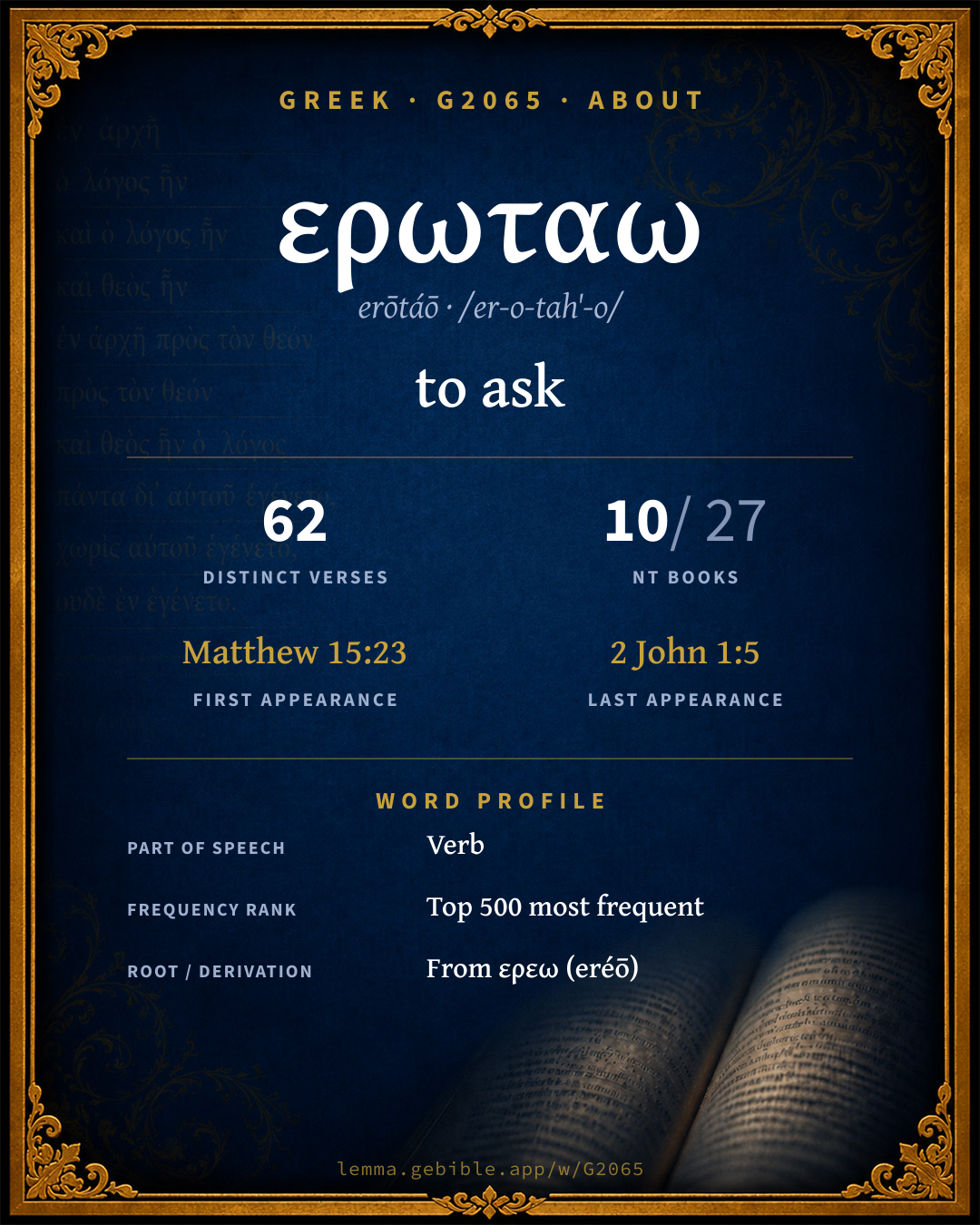
ἐρωτάω
to ask
‘to ask’ is one of 2 main senses fuller range ↓
Full lexicon entry — Thayer's Greek Lexicon
From Thayer's Greek Lexicon
Where this word appears
See every Imperfect-tense verb in the Greek New Testament →
Grammar key — what these labels mean
Part of speech
- Verb
- An action or state-of-being word.
Tense
- Imperfect
- Continuous or repeated action in past time (“was writing”).
- Present
- Ongoing or general action in present time (imperfective aspect).
- Aorist
- Action viewed as a simple whole, without regard to duration — often past (perfective aspect).
- Future
- Action expected in future time.
Voice
- Active
- The subject performs the action.
Mood
- Indicative
- States a fact or asks a factual question (the mood of reality).
- Infinitive
- A verbal noun (“to write”), unmarked for person or number.
- Subjunctive
- Expresses probability, purpose, or possibility (the mood of contingency).
- Imperative
- Expresses a command or request.
- Participle
- A verbal adjective (“writing,” “having written”).
Case
- Genitive
- The case of source, possession, or “of” — answers “whose / from what.”
- Nominative
- The case of the subject (and the predicate nominative).
Person
- 3rd person
- The one spoken about (“he / she / it / they”).
- 1st person
- The speaker (“I / we”).
- 2nd person
- The one addressed (“you”).
Gender
- Masculine
- Grammatically masculine.
Number
- Plural
- More than one.
- Singular
- One.
Every verse where G2065 appears in the Book of Matthew — 4 distinct verses. Click any verse to open its interlinear word-by-word view. Verse text shown in the World English Bible for context — . Each verse’s Greek form is shown with its reference; the English is not keyword-highlighted, since the data carries no word-level English alignment. Use “Compare translations” on any verse to read it across multiple English versions. This concordance covers the Greek New Testament; Septuagint (Greek Old Testament) occurrences of this word are not indexed here.
Matthew
- Matthew 15:23 ἠρώτουν impf act ind 3pl But he answered her not a word. His disciples came and begged him, saying, "Send her away; for she cries after us."
- Matthew 16:13 ἠρώτα impf act ind 3sg Now when Jesus came into the parts of Caesarea Philippi, he asked his disciples, saying, "Who do men say that I, the Son of Man, am?"
- Matthew 19:17 ἐρωτᾷς pres act ind 2sg He said to him, "Why do you call me good? No one is good but one, that is, God. But if you want to enter into life, keep the commandments."
- Matthew 21:24 ἐρωτήσω fut act ind 1sg Jesus answered them, "I also will ask you one question, which if you tell me, I likewise will tell you by what authority I do these things.
About this entry
At a glance — auto-summarized from this page’s data, not written by a person. Every figure links to its source below. This summary describes the numbers; it doesn’t interpret them.
“to ask” is the headline sense of the Greek verb ερωταω (erōtáō). Translators differ — “ask” in the King James Version, then “asked” (Berean Standard Bible), as the renderings breakdown shows. With 62 verses in 10 books, it is a moderately common word in the Greek New Testament. It concentrates in John, which alone accounts for 42% of its uses. Lexicons map it across 2 senses. The sections below give every sense, occurrence, and version rendering.
Gloss history
Strong's 1890 vs modern scholarship
About this word
Strong's G2065 catalogs a Greek word from the Greek New Testament.
These counts are not copied from any lexicon or concordance. They are computed here, from the morphology-tagged Greek New Testament. What Lemma adds →
- 62
- distinct verses
- The word appears in 62 distinct verses.
- 10 / 27
- NT books
- The word appears in 10 of 27 New Testament books.
- #258
- by frequency
- Top 500 most frequent Greek words (rank 258 of 5,347 Greek words by occurrence).
View all 62 occurrences in the concordance →
By section of the New Testament
By traditional corpus
Conventional, traditional groupings — biblical authorship is debated, so this is a traditional corpus grouping, not an authorship claim. Some books belong to more than one corpus (Luke is in both the Gospels and the Lukan corpus, and so on), so these shares overlap and need not total 100%. Each figure is a share of the word’s 62 distinct verses.
- Gospels 49 verses · 79%
- Johannine 28 verses · 45%
- Lukan (Luke–Acts) 23 verses · 37%
- Pauline corpus 4 verses · 6%
- General (Catholic) Epistles 2 verses · 3%
How translations render this word
Counts come from each version’s own published word-to-Strong’s tagging or interlinear alignment — an approximate guide to how each version renders this word, not a word-level alignment the data otherwise carries. Because each total is that version’s own tagged count, the per-version totals vary from one another and need not match the appearance or distinct-verse counts above. These counts may also differ from a printed concordance because Lemma counts each distinctly tagged rendering and does not collapse phrase taggings into a single head-word total. This is a fixed set of word-tagged versions (KJV, ASV, BSB, ULT) and does not change with the reading translation you choose elsewhere. Each version’s license is shown beside its name below (and on Sources).
- King James Version: Ask 9×, Besought 6×, Asked 5×
- American Standard Version: Asked 10×, Ask 8×, I pray 5×
- Berean Standard Bible: Asked 12×, Ask 8×, They asked 5×
- unfoldingWord Literal Text: Asked 10×, Ask 7×, They asked 7×
King James Version Public Domain
Renders G2065 across 59 tagged occurrences — most commonly:
Plus 18 renderings that appear only once — usually multi-word phrases or single function words the recovered tagging swept in, not distinct renderings.
American Standard Version Public Domain
Renders G2065 across 57 tagged occurrences — most commonly:
Plus 16 renderings that appear only once — usually multi-word phrases or single function words the recovered tagging swept in, not distinct renderings.
Berean Standard Bible Public Domain
Renders G2065 across 63 tagged occurrences — most commonly:
Plus 18 renderings that appear only once — usually multi-word phrases or single function words the recovered tagging swept in, not distinct renderings.
unfoldingWord Literal Text CC BY-SA 4.0
Renders G2065 across 68 tagged occurrences — most commonly:
Plus 24 renderings that appear only once — usually multi-word phrases or single function words the recovered tagging swept in, not distinct renderings.
Senses in Thayer's
The 2 senses Thayer's distinguishes for this word, in lexicon order (not ranked by frequency or importance). The full entry — with sub-senses — is in the Lexicon Entry tab.
- to question
- to request, entreat, beg, beseech
Word origin
Derived from ερεω (eréō) (G2046) — to speak.
Forms in the corpus
The 23 distinct written forms G2065 takes in the Greek New Testament, most frequent first — each parse links to that tense’s occurrences in the concordance.
Same root — word family
Other Thayer's entries built from the same root as G2065, grouped by Strong’s listed origin. These share a root / origin per the lexicon — not necessarily a shared meaning. Each links to that word’s own entry.
Derives from
Shares the same root
Proper names from this root
People and places named from this root — a name, not an additional meaning of the word.
Compare all same-root words → Showing 4 of 6 — not the complete family. 1 of the same-root words is a proper name (a person or place). They share a root, not necessarily a meaning.
Septuagint usage
The same Greek word ερωταω appears 61 times in the Greek Old Testament (Septuagint), across 58 verses in 14 books.
- 61
- LXX occurrences
- Tagged occurrences of this Greek word in the Septuagint.
- 58
- verses
- Distinct Septuagint verses containing this word.
- 14 / 39
- OT books
- The word appears in 14 of the 39 Old Testament books.
Sample Septuagint occurrences
- Genesis 24:47 ἐρωτάω
- Exodus 3:13 ἐρωτάω
- Deuteronomy 6:20 ἐρωτάω
- Joshua 4:6 ἐρωτάω
- Judges 4:20 ἐρωτάω
- 1 Samuel 10:4 ἐρωτάω
- 2 Samuel 5:19 ἐρωτάω
- 1 Chronicles 14:10 ἐρωτάω
- Ezra 5:9 ἐρωτάω
- Job 21:29 ἐρωτάω
- Psalms 121:6 ἐρωτάω
- Isaiah 41:28 ἐρωτάω
Septuagint occurrences (same lexeme)
Every verse where the same Strong’s number (G2065) appears in the Greek Septuagint — showing the first 50 of 58. Verse text shown in the World English Bible for context; the Greek form is the matched word — the English is not keyword-highlighted.
- Genesis 24:47 ἐρωτάω I asked her, and said, 'Whose daughter are you?' She said, 'The daughter of Bethuel, Nahor's son, whom Milcah bare to him.' I put the ring on her nose, and the bracelets on her hands.
- Genesis 24:57 ἐρωτάω They said, "We will call the young lady, and ask her."
- Genesis 32:18 ἐρωτάω Then you shall say, 'They are your servant, Jacob's. It is a present sent to my lord, Esau. Behold, he also is behind us.'"
- Genesis 32:30 ἐρωτάω Jacob called the name of the place Peniel: for, he said, "I have seen God face to face, and my life is preserved."
- Genesis 37:15 ἐρωτάω A certain man found him, and behold, he was wandering in the field: and the man asked him, saying, "What are you looking for?"
- Genesis 40:7 ἐρωτάω He asked Pharaoh's officers who were with him in custody in his master's house, saying, "Why do you look so sad today?"
- Genesis 43:7 ἐρωτάω They said, "The man asked directly concerning ourselves, and concerning our relatives, saying, 'Is your father still alive? Have you another brother?' We just answered his questions. Is there any way we could know that he would say, 'Bring your brother down?'"
- Genesis 43:27 ἐρωτάω He asked them of their welfare, and said, "Is your father well, the old man of whom you spoke? Is he yet alive?"
- Genesis 44:19 ἐρωτάω My lord asked his servants, saying, 'Have you a father, or a brother?'
- Exodus 3:13 ἐρωτάω Moses said to God, "Behold, when I come to the children of Israel, and tell them, 'The God of your fathers has sent me to you;' and they ask me, 'What is his name?' What should I tell them?"
- Exodus 13:14 ἐρωτάω It shall be, when your son asks you in time to come, saying, 'What is this?' that you shall tell him, 'By strength of hand Yahweh brought us out from Egypt, from the house of bondage;
- Deuteronomy 6:20 ἐρωτάω When your son asks you in time to come, saying, What mean the testimonies, and the statutes, and the ordinances, which Yahweh our God has commanded you?
- Deuteronomy 13:15 ἐρωτάω you shall surely strike the inhabitants of that city with the edge of the sword, destroying it utterly, and all that is therein and the cattle of it, with the edge of the sword.
- Joshua 4:6 ἐρωτάω that this may be a sign among you, that when your children ask in time to come, saying, What do you mean by these stones?
- Joshua 4:21 ἐρωτάω He spoke to the children of Israel, saying, When your children shall ask their fathers in time to come, saying, What mean these stones?
- Judges 4:20 ἐρωτάω He said to her, Stand in the door of the tent, and it shall be, when any man does come and inquire of you, and say, Is there any man here? that you shall say, No.
- Judges 13:6 ἐρωτάω Then the woman came and told her husband, saying, A man of God came to me, and his face was like the face of the angel of God, very awesome; and I didn't ask him whence he was, neither did he tell me his name:
- Judges 13:18 ἐρωτάω The angel of Yahweh said to him, Why do you ask after my name, seeing it is wonderful?
- Judges 18:5 ἐρωτάω They said to him, Ask counsel, we pray you, of God, that we may know whether our way which we go shall be prosperous.
- Judges 18:15 ἐρωτάω They turned aside there, and came to the house of the young man the Levite, even to the house of Micah, and asked him of his welfare.
- Judges 20:18 ἐρωτάω The children of Israel arose, and went up to Bethel, and asked counsel of God; and they said, Who shall go up for us first to battle against the children of Benjamin? Yahweh said, Judah [shall go up] first.
- Judges 20:23 ἐρωτάω The children of Israel went up and wept before Yahweh until even; and they asked of Yahweh, saying, Shall I again draw near to battle against the children of Benjamin my brother? Yahweh said, Go up against him.
- 1 Samuel 10:4 ἐρωτάω and they will greet you, and give you two loaves of bread, which you shall receive of their hand.
- 1 Samuel 19:22 ἐρωτάω Then went he also to Ramah, and came to the great well that is in Secu: and he asked and said, Where are Samuel and David? One said, Behold, they are at Naioth in Ramah.
- 1 Samuel 22:10 ἐρωτάω He inquired of Yahweh for him, and gave him food, and gave him the sword of Goliath the Philistine.
- 1 Samuel 22:13 ἐρωτάω Saul said to him, Why have you conspired against me, you and the son of Jesse, in that you have given him bread, and a sword, and have inquired of God for him, that he should rise against me, to lie in wait, as at this day?
- 1 Samuel 22:15 ἐρωτάω Have I today begun to inquire of God for him? be it far from me: don't let the king impute anything to his servant, nor to all the house of my father; for your servant knows nothing of all this, less or more.
- 1 Samuel 23:4 ἐρωτάω Then David inquired of Yahweh yet again. Yahweh answered him, and said, Arise, go down to Keilah; for I will deliver the Philistines into your hand.
- 1 Samuel 25:5 ἐρωτάω David sent ten young men, and David said to the young men, Go up to Carmel, and go to Nabal, and greet him in my name:
- 1 Samuel 25:8 ἐρωτάω Ask your young men, and they will tell you: therefore let the young men find favor in your eyes; for we come in a good day. Please give whatever comes to your hand, to your servants, and to your son David.
- 1 Samuel 30:21 ἐρωτάω David came to the two hundred men, who were so faint that they could not follow David, whom also they had made to abide at the brook Besor; and they went forth to meet David, and to meet the people who were with him: and when David came near to the people, he greeted them.
- 2 Samuel 5:19 ἐρωτάω David inquired of Yahweh, saying, Shall I go up against the Philistines? will you deliver them into my hand? Yahweh said to David, Go up; for I will certainly deliver the Philistines into your hand.
- 2 Samuel 8:10 ἐρωτάω then Toi sent Joram his son to king David, to Greet him, and to bless him, because he had fought against Hadadezer and struck him: for Hadadezer had wars with Toi. [Joram] brought with him vessels of silver, and vessels of gold, and vessels of brass:
- 2 Samuel 20:18 ἐρωτάω Then she spoke, saying, They were wont to speak in old time, saying, They shall surely ask [counsel] at Abel: and so they ended [the matter].
- 1 Chronicles 14:10 ἐρωτάω David inquired of God, saying, Shall I go up against the Philistines? and will you deliver them into my hand? Yahweh said to him, Go up; for I will deliver them into your hand.
- 1 Chronicles 14:14 ἐρωτάω David inquired again of God; and God said to him, You shall not go up after them: turn away from them, and come on them over against the mulberry trees.
- 1 Chronicles 18:10 ἐρωτάω he sent Hadoram his son to king David, to Greet him, and to bless him, because he had fought against Hadarezer and struck him; (for Hadarezer had wars with Tou;) and [he had with him] all manner of vessels of gold and silver and brass.
- Ezra 5:9 ἐρωτάω Then asked we those elders, and said to them thus, Who gave you a decree to build this house, and to finish this wall?
- Ezra 5:10 ἐρωτάω We asked them their names also, to inform you that we might write the names of the men who were at the head of them.
- Ezra 11:2 ἐρωτάω
- Job 21:29 ἐρωτάω Haven't you asked wayfaring men? Don't you know their evidences,
- Job 38:3 ἐρωτάω Brace yourself like a man, For I will question you, then you answer me!
- Job 40:7 ἐρωτάω "Now brace yourself like a man. I will question you, and you will answer me.
- Job 42:4 ἐρωτάω You said, 'Listen, now, and I will speak; I will question you, and you will answer me.'
- Psalms 121:6 ἐρωτάω The sun will not harm you by day, Nor the moon by night.
- Isaiah 41:28 ἐρωτάω When I look, there is no man: even among them there is no counselor who, when I ask of them, can answer a word.
- Isaiah 45:11 ἐρωτάω Thus says Yahweh, the Holy One of Israel, and his Maker: Ask me of the things that are to come; concerning my sons, and concerning the work of my hands, command you me.
- Jeremiah 6:16 ἐρωτάω Thus says Yahweh, Stand you in the ways and see, and ask for the old paths, where is the good way; and walk therein, and you shall find rest for your souls: but they said, We will not walk [therein].
- Jeremiah 18:13 ἐρωτάω Therefore thus says Yahweh: Ask you now among the nations, who has heard such things; the virgin of Israel has done a very horrible thing.
- Jeremiah 23:33 ἐρωτάω When this people, or the prophet, or a priest, shall ask you, saying, What is the burden of Yahweh? then shall you tell them, What burden! I will cast you off, says Yahweh.
These are occurrences of the same Greek lexeme (G2065) in the Septuagint — not a translation of any one Hebrew word. The store carries no word-level Hebrew↔Greek alignment, so no Hebrew original is asserted here. Counts come from the recovered LXX Strong's tagging — high-frequency vocabulary is well covered, while rare or late forms may be untagged — so they reflect tagged occurrences and may slightly undercount.