Ezra 5:9

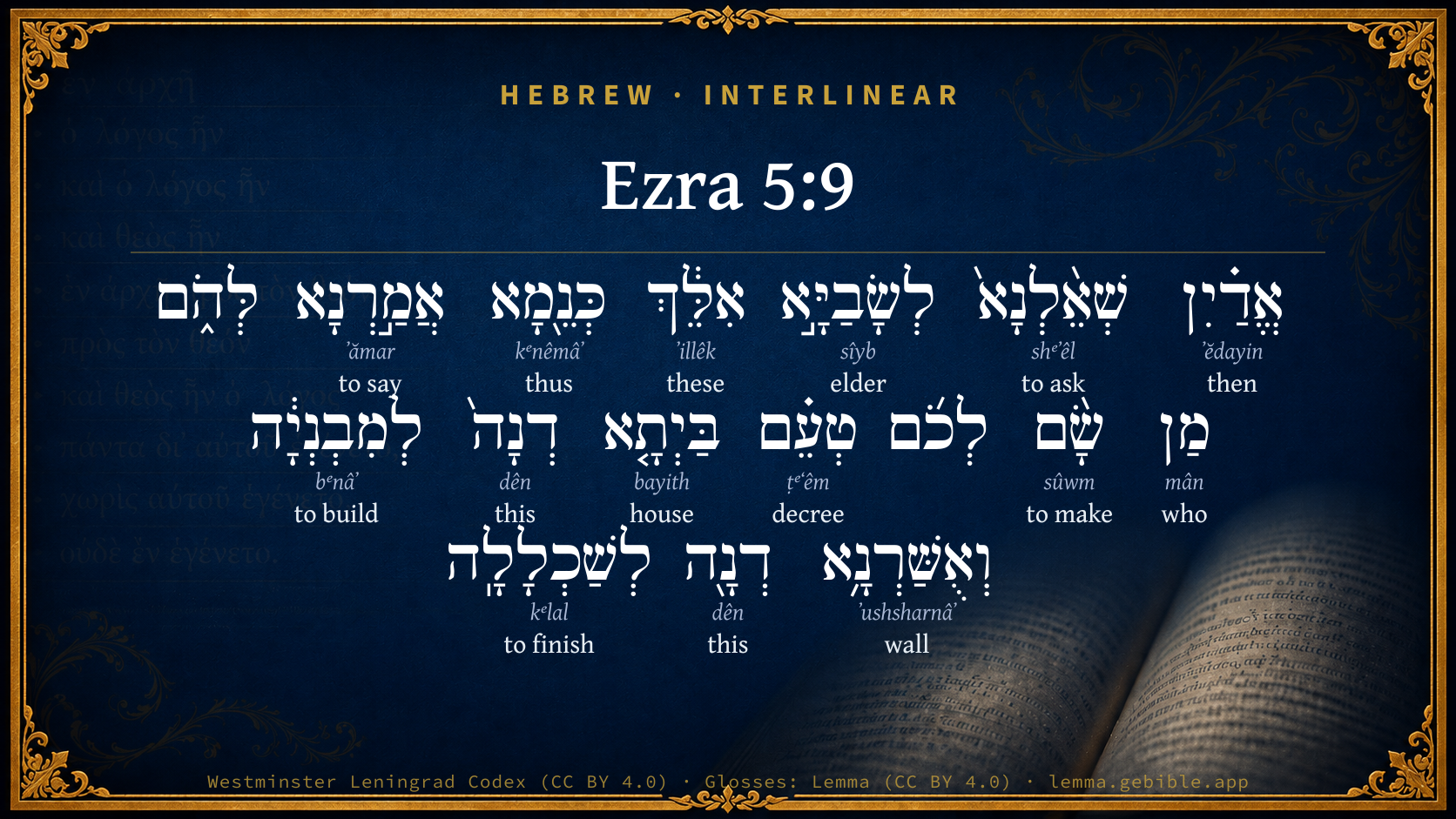
Hebrew (Westminster Leningrad Codex) Ezra 5:9 appears in the Hebrew Old Testament. The text above is from the Westminster Leningrad Codex. Each word links to its Strong’s number, a concise gloss, and parsing drawn from the Open Scriptures Hebrew Bible morphology. Click any word for its full Brown-Driver-Briggs (BDB) entry.
Download image
Cite this verse

Ezra 5:9 (World English Bible). Public Domain. Lemma interlinear Bible study tool, https://lemma.gebible.app/v/ezra/5/9.

Show BibTeX & RIS
BibTeX
RIS
English Translation
Then asked we those elders, and said to them thus, Who gave you a decree to build this house, and to finish this wall?
World English Bible · Public Domain
Highlights
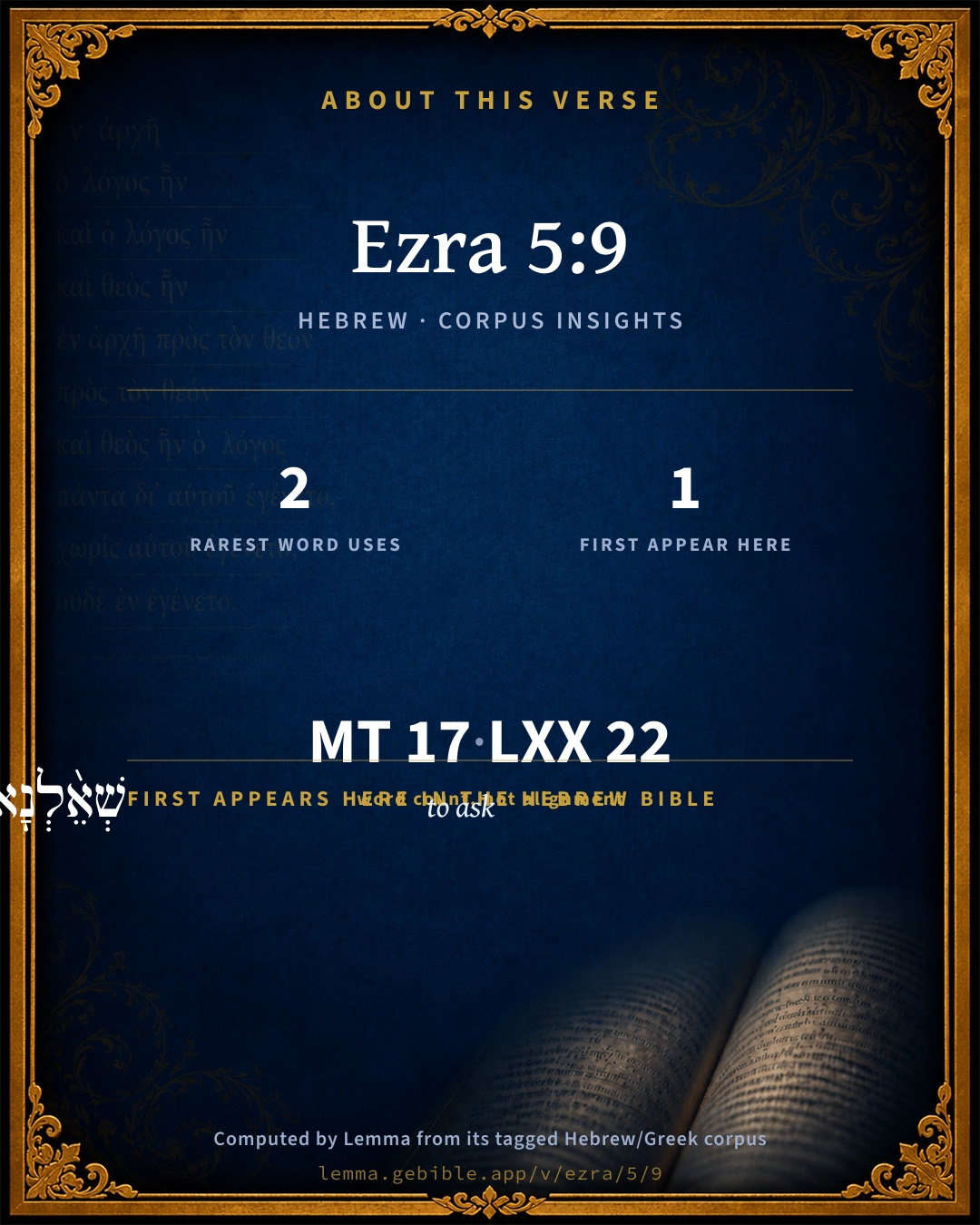
  • 1 first appearance in the Hebrew Bible
Full analysis ↓
Download a study sheet

One document with this verse’s original text, its word-by-word gloss line, the meaning frame, cross-references with their text, attributed commentary, and full source and license credits — printable, and it pastes into notes with its structure intact.

This verse Autodidact and up

Study sheet (.html) Plain text (.txt)

A passage Seminary Student

Up to 50 verses in one chapter. A passage sheet keeps up to 6 commentary sources and 12 cross-references per verse, in the order this page ranks them, and says so on the sheet whenever that leaves anything out. Ask for a single verse and you get the Autodidact verse sheet above.

Everything on this page stays free to read, with no account — the sheet is a download of what is already on screen, not access to it.

Want to remove ads? Support Godless Engineer
Compare translations 3

The same verse in 3 English versions, stacked beneath the original-language interlinear above. Click any original word for its lexicon entry.

Each is an independent rendering of the whole verse — the interlinear is not word-aligned to these translations.

Highlighted words mark where these versions differ — a whole-verse word diff, not a word-by-word alignment.

  • World English Bible Public Domain
    Then asked we those elders, and said to them thus, Who gave you a decree to build this house, and to finish this wall?
  • King James Version Public Domain
    Then asked we those elders, and said unto them thus, Who commanded you to build this house, and to make up these walls?
  • unfoldingWord Literal Text CC BY-SA 4.0
    Then we asked these elders, we said thus to them, ‘Who set a decree for you to build this house and to complete this structure?’

unfoldingWord Literal Text — © unfoldingWord, licensed CC BY-SA 4.0. Word-aligned USFM3 via Door43 (git.door43.org/unfoldingWord/en_ult).

Versions to compare (up to 4)

3 of 4 selected

Show all 18 translations

Every available English version of this verse, each an independent rendering of the whole verse.

  • World English Bible Public Domain
    Then asked we those elders, and said to them thus, Who gave you a decree to build this house, and to finish this wall?
  • Berean Standard Bible Public Domain
    So we questioned the elders and asked, “Who authorized you to rebuild this temple and restore this structure?”
  • Majority Standard Bible Public Domain
    So we questioned the elders and asked, “Who authorized you to rebuild this temple and restore this structure?”
  • King James Version Public Domain
    Then asked we those elders, and said unto them thus, Who commanded you to build this house, and to make up these walls?
  • American Standard Version (1901) Public Domain
    Then asked we those elders, and said unto them thus, Who gave you a decree to build this house, and to finish this wall?
  • Revised Version (1885) Public Domain
    Then asked we those elders, and said unto them thus, Who gave you a decree to build this house, and to finish this wall?
  • Geneva Bible (1599) Public Domain
    Then asked we those Elders, and sayd vnto them thus, Who hath giuen you commandement to buylde this house, and to lay the foundation of these walles?
  • Douay-Rheims (1899) Public Domain
    And we asked those ancients, and said to them thus: Who hath given you authority to build this house, and to repair these walls?
  • Young's Literal Translation Public Domain
    Then we have asked of these elders, thus we have said to them, Who hath made for you a decree this house to build, and this wall to finish?
  • Literal Standard Version CC BY-SA 4.0
    Then we have asked of these elders, thus we have said to them, Who has made for you a decree to build this house, and to finish this wall?
  • Unlocked Literal Bible CC BY-SA 4.0
    We asked the elders, 'Who gave you a decree to build this house and these walls?'
  • unfoldingWord Literal Text CC BY-SA 4.0
    Then we asked these elders, we said thus to them, ‘Who set a decree for you to build this house and to complete this structure?’
  • Darby Bible Public Domain
    Then asked we those elders: thus we said to them, Who gave you orders to build this house and to complete this wall?
  • World Messianic Bible Public Domain
    Then we asked those elders, and said to them thus, “Who gave you a decree to build this house, and to finish this wall?”
  • Webster's Bible Public Domain
    Then we asked those elders, and said to them thus, Who commanded you to build this house, and to erect these walls?
  • Free Bible Version CC BY-SA 4.0
    We questioned the leaders, asking them, ‘Who gave you permission to rebuild this Temple and finish it?’
  • Bible in Basic English Public Domain
    Then we said to the men responsible, who gave you authority for the building of this house and these walls?
  • JPS Tanakh (1917) Public Domain
    Then asked we those elders, and said unto them thus: Who gave you a decree to build this house, and to finish this wall?

Literal Standard Version (2020), Covenant Press — licensed CC BY-SA 4.0. Text via the HelloAO Bible API (eBible.org). Unlocked Literal Bible (unfoldingWord) — licensed CC BY-SA 4.0. Text via the HelloAO Bible API (eBible.org). unfoldingWord Literal Text — © unfoldingWord, licensed CC BY-SA 4.0. Word-aligned USFM3 via Door43 (git.door43.org/unfoldingWord/en_ult). Free Bible Version, Dr. Jonathan Gallagher — licensed CC BY-SA 4.0. Text via the HelloAO Bible API (eBible.org).

Word by word

More ways to search: Search by grammar → Find every occurrence → Compare this word →

Practice this passage: Drill this verse → Learn its vocabulary →

וְאֻשַּׁרְנָ֥א
ʼushsharnâʼ
H846
“and · wall · the”
Adjective, C + Noun, Common, Masculine, Singular, Determined + Particle, Definite Article
Part of Speech
Adjective + Noun + Particle
Type
Definite Article
Full BDB Definition

Origin: from a root corresponding to H833

TWOT: 2616

wall, panelling, beams, structure (precise meaning and derivation uncertain)
  1. אֱדַ֗יִן ʼĕdayin H116 “then” Adjective, D
  2. שְׁאֵ֨לְנָא֙ shᵉʼêl H7593 “to ask” Adjective, V, Plural
  3. לְשָׂבַיָּ֣א sîyb H7868 “to/for · elders · the” Adjective, R + Noun, Common, Masculine, Plural, Determined + Particle, Definite Article
  4. אִלֵּ֔ךְ ʼillêk H479 “these” Adjective, P
  5. כְּנֵ֖מָא kᵉnêmâʼ H3660 “thus” Adjective, D
  6. אֲמַ֣רְנָא ʼămar H560 “to say” Adjective, V, Plural
  7. מַן mân H4479 “who” Adjective, P
  8. שָׂ֨ם sûwm H7761 “to make” Adjective, V, Plural
  9. טְעֵ֗ם ṭᵉʻêm H2942 “decree” Adjective, N, Common
  10. בַּיְתָ֤א bayith H1005 “house · the” Adjective, N, Common + Particle, Definite Article
  11. דְנָה֙ dên H1836 “this” Adjective, P
  12. לְמִבְנְיָ֔ה bᵉnâʼ H1124 “to build” Adjective, R + Verb, Qal, Infinitive Construct
  13. דְנָ֖ה dên H1836 “this” Adjective, P
  14. לְשַׁכְלָלָֽה kᵉlal H3635 “to finish” Adjective, R + Verb, e, Infinitive Construct

About this verse

These counts appear in no published source. They are computed here, from the morphology-tagged text and Lemma’s own curated glosses. What Lemma adds →

17
words
14
distinct lemmas
Historical
section

Notable vocabulary

The rarest word here is וְאֻשַּׁרְנָ֥א wall H846 — appearing just 2 times in the whole Hebrew Bible.

First appearance in Scripture

This word makes its first canonical appearance in the Hebrew Bible here:

  • שְׁאֵ֨לְנָא֙ to ask H7593

Shared distinctive vocabulary

וְאֻשַּׁרְנָ֥א wall H846 occurs in 2 verses of the Hebrew Bible. Also found in:

Grammatical profile

  • 2 verbs
  • 12 adjectives
  • 3 particles

Verb forms

  • לְמִבְנְיָ֔ה Qal · Infinitive Construct
  • לְשַׁכְלָלָֽה Infinitive Construct

Repetition

A word recurs within this verse — often emphatic in Hebrew:

  • דְנָה֙ this H1836 ×2

Hebrew & Septuagint length

In English translation the verse runs 24 words from the Hebrew and 25 from the Septuagint (LXX English) — closely comparable.

A rough comparison of the two English renderings, which tokenize alike — not a word-level alignment.

Word counts can differ between the Hebrew and the Greek without any difference in meaning — e.g. the Hebrew direct-object marker אֵת has no separate Greek word, and Greek often adds the article ὁ.

In the original languages it is 17 Hebrew tokens and 22 Greek tokens — but the two are counted differently (Hebrew bundles its prefixes and suffixes into one token; the Greek is in lemma form), so that isn’t a like-for-like length.

Cross-references

1

Topical passages linked to Ezra 5:9 in the Treasury of Scripture Knowledge — connected by theme and wording, ordered by reader-vote popularity; previews shown in the World English Bible.

  • Ezra 5:3–4 At the same time came to them Tattenai, the governor beyond the River, and Shetharbozenai, and their companions, and said thus to them, Who gave you a decree to build this house, and to finish this wall?

Cross-references courtesy of OpenBible.info (CC BY 4.0).

Hebrew and Greek witnesses Masoretic Hebrew ↔ Greek Septuagint

The same verse in the two great witnesses to the Old Testament, shown verse-for-verse.

These are two independent witnesses, not word-aligned to each other, and the Septuagint is shown in lemma (dictionary) form.

Hebrew Ezra 5:9 Masoretic · Westminster Leningrad Codex

אֱדַ֗יִן שְׁאֵ֨לְנָא֙ לְשָׂבַיָּ֣א אִלֵּ֔ךְ כְּנֵ֖מָא אֲמַ֣רְנָא לְּהֹ֑ם מַן שָׂ֨ם לְכֹ֜ם טְעֵ֗ם בַּיְתָ֤א דְנָה֙ לְמִבְנְיָ֔ה וְאֻשַּׁרְנָ֥א דְנָ֖ה לְשַׁכְלָלָֽה

Then asked we those elders, and said to them thus, Who gave you a decree to build this house, and to finish this wall?

World English Bible · Public Domain

Greek LXX Ezra 5:9 Septuagint · lemma form

τότε ἐρωτάω ὁ πρεσβύτερος ἐκεῖνος καί οὕτως εἶπον αὐτός τίς τίθημι σύ γνώμη ὁ οἶκος οὗτος οἰκοδομέω καί ὁ χορηγία οὗτος καταἀρτίζω

Then we asked those elders, and thus we said to them, Who gave you the order to build this house, and to provide this preparation?

LXX2012 (modern English Septuagint) · Public Domain

In the Septuagint this is one book — Esdras B (2 Esdras): Ezra is chapters 1–10, Nehemiah 11–23.

Hebrew: Westminster Leningrad Codex (CC BY 4.0). Greek: Septuagint (public domain); English from LXX2012 (modern English Septuagint) (Public Domain). How the Septuagint differs from the Hebrew →

Commentary

Notes on Ezra 5:9 from classic Christian and Jewish commentators (each source and its license shown beneath its notes). The classic Christian expositions comment on the surrounding passage and are grouped to its opening verse, so a note may address several verses; the Jewish commentaries on the Tanakh (Rashi and others) are per-verse, so they appear only where the commentator wrote on this verse.

Lemma curates 59 commentaries, every one of them public domain or Creative Commons licensed, each selected and text-cleaned for this edition rather than reprinted as found. About our sources →

Trapp's Complete Commentary

John Trapp

Ezr 5:9 Then asked we those elders, [and] said unto them thus, Who commanded you to build this house, and to make up these walls?

Ver. 9. Who commanded you?] Chaldee, Who hath made you a decree? {See Trapp on "Ezr 5:3"}

John Trapp, A Commentary or Exposition upon All the Books of the Old and New Testament (1647–1656) — public domain. Text from a community e-Sword module.

The Biblical Illustrator

Joseph S. Exell

Ezr_5:1; Ezr_5:9

Then the prophets, Haggai.

The great work resumed

The best commentary on these verses is the first chapter of Haggai.

I. The inciters to the west.

1. Want of interest in the work is implied.

2. Obligation to perform the work is implied.

3. Exhortations to resume the work were given.

II. The leaders in the work. Then rose up Zerubbabel, etc.

1. They resumed the work readily.

2. They led the work appropriately. Those that are in places of dignity and power, ought with their dignity to put honour upon and with their power to put life into every good work.

3. They led work influentially. The example of those who occupy high stations is--

(1) Most conspicuous.

(2) Most attractive.

III. The helpers in the work. The prophets. They assisted by their--

1. Exhortations to vigorous prosecution of the work.

2. Assurances of the presence of God with them.

3. Promises of future blessings from God to them.

IV. The great first cause of the work. The Lord stirred up the spirit of Zerubbabel, etc. All holy desires, all good counsels, and all just works do proceed from Him. I will build My Church, said our Lord to Peter. All the inspiration, wisdom, etc., of the under-builders come from him. Learn--

1. The insidious nature of worldliness.

2. The value of faithful ministers.

3. The solemn obligation of men in eminent stations. (William Jones.)

Hebrew prophets in unfavourable times

The Hebrew prophets came when the circumstances of society were least favourable. Like painters arising to adorn a dingy city, like poets singing of summer in the winter of discontent, like flowers in the wilderness, like wells in the desert, they brought life and strength and gladness to the helpless and despondent, because they came from God. The literary form of their work reflected the civilisation of their day, but there was on it a light that never shone on sea or shore, and this they knew to be the light of God. We never find a true religious revival springing from the spirit of the age. Such a revival always begins in one or two choice souls--in a Moses, a Samuel, a John the Baptist, a St. Bernard, a Jonathan-Edwards, a Wesley, a Newman. (W. F. Adeney, M. A.)

The Biblical Illustrator, edited by Joseph S. Exell (c. 1880s–1900s) — public domain. Text from a community e-Sword module.

The Cambridge Bible for Schools and Colleges

gen. ed. J. J. S. Perowne

9. Who commanded …, and to make up] R.V. Who gave … a decree, … and to finish. Cf. on Ezr_5:3.

these walls] R.V. ‘this wall’ as in Ezr_5:3.

The Cambridge Bible for Schools and Colleges (gen. ed. J. J. S. Perowne; Cambridge University Press, 1878–1918) — public domain. Text from a community e-Sword module.

John Gill's Exposition

Then asked we those elders,.... The elders of the province of Judea; the chief men of it:

who commanded you to build this house, and to make up these walls? see Ezr 5:3.

John Gill's Exposition of the Whole Bible (1746–1763) — public domain (CC PDM 1.0). Text via the HelloAO Bible API.

Keil & Delitzsch

C. F. Keil & F. Delitzsch

Hereupon the royal officials asked the elders of the Jews who had commanded them to build, and inquired concerning their names, that they might write to the king the names of the leading men (see the remark on 3 and 41). בראשׁהם דּי does not mean, who are at the head of them: but, who act in the capacity of heads.

Keil & Delitzsch — Biblical Commentary on the Old Testament (1861–1891) — public domain (CC PDM 1.0). Text via the HelloAO Bible API. (Old Testament only.)

Rashi

Rabbi Shlomo Yitzchaki (Rashi)

Then When we saw the building, we asked these elders.

as follows we said to them As we will say immediately following, we said to them.

Who issued to you Who issued to you the authorization to build this house and to found these walls?

and...wall the building of a wall of bricks.

Rashi on the Tanakh — English translations: “The Judaica Press complete Tanach with Rashi, translated by A. J. Rosenberg” (CC BY 4.0); “Pentateuch with Rashi's commentary by M. Rosenbaum and A.M. Silbermann, 1929-1934” (public domain); “The Metsudah Tanach series, Lakewood, N.J” (CC BY 4.0); and “The Book of Joshua, Metsudah Publications, 1997” (CC BY 4.0). Text via Sefaria.

Lesson kit

Teaching starters — assembled from the data on this page, not authored interpretation. Every prompt links to the verse data it draws on. Edit before teaching.

Ezra, in the Historical, opens this verse with 17 words (14 distinct Hebrew lemmas). Its most distinctive word is ʼushsharnâʼ (“wall”). A historical commentator’s framing appears above. Read the whole chapter for the surrounding context.

Discussion questions

  1. What does “wall” (ʼushsharnâʼ) contribute to the verse as a whole?
  2. The word “to ask” first appears here in Scripture. What is being introduced at this debut?
  3. Ezra 5:3 shares the word «wall» with this verse. How do the two illuminate each other?
  4. “this” occurs 2× in this one verse. What is the effect of the repetition?
  5. These translations render this verse differently; the difference is in the English rendering, not the original. What questions does that raise?
  6. The verb «לְמִבְנְיָ֔ה» is Qal Infinitive Construct. How does its form color the action?
  7. Reading how Trapp's Complete Commentary and The Biblical Illustrator read this verse, where do the two commentators agree and where do they part?

Things to notice

Reading settings

Reading text

Shown beneath each verse's original-language words.

Old Testament
Old Testament edition

Read the OT as the Masoretic Hebrew (MT) or the Greek Septuagint (LXX).

English shown for the Greek Septuagint (in the Hebrew ↔ Greek comparison).

Comparing translations? Open the Compare panel on any verse page to stack up to four side by side.