
Psalms 121:6

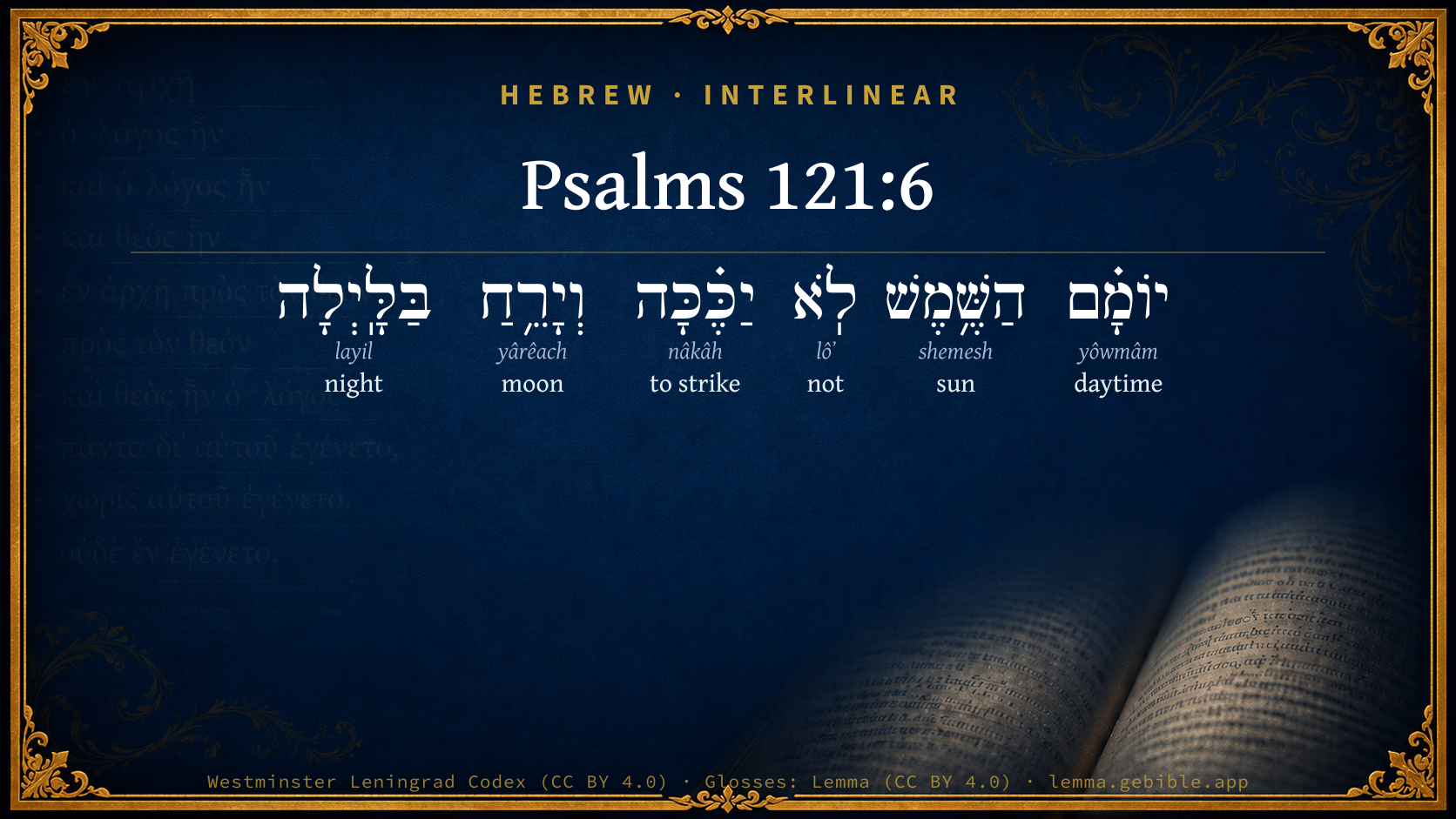
Hebrew (Westminster Leningrad Codex) Psalms 121:6 appears in the Hebrew Old Testament. The text above is from the Westminster Leningrad Codex. Each word links to its Strong’s number, a concise gloss, and parsing drawn from the Open Scriptures Hebrew Bible morphology. Click any word for its full Brown-Driver-Briggs (BDB) entry.
Download image
Cite this verse

Psalms 121:6 (World English Bible). Public Domain. Lemma interlinear Bible study tool, https://lemma.gebible.app/v/psalms/121/6.

Show BibTeX & RIS
BibTeX
RIS
English Translation
The sun will not harm you by day, Nor the moon by night.
World English Bible · Public Domain
Download a study sheet

One document with this verse’s original text, its word-by-word gloss line, the meaning frame, cross-references with their text, attributed commentary, and full source and license credits — printable, and it pastes into notes with its structure intact.

This verse Autodidact and up

Study sheet (.html) Plain text (.txt)

A passage Seminary Student

Up to 50 verses in one chapter. A passage sheet keeps up to 6 commentary sources and 12 cross-references per verse, in the order this page ranks them, and says so on the sheet whenever that leaves anything out. Ask for a single verse and you get the Autodidact verse sheet above.

Everything on this page stays free to read, with no account — the sheet is a download of what is already on screen, not access to it.

Want to remove ads? Support Godless Engineer
Compare translations 3

The same verse in 3 English versions, stacked beneath the original-language interlinear above. Click any original word for its lexicon entry.

Each is an independent rendering of the whole verse — the interlinear is not word-aligned to these translations.

Highlighted words mark where these versions differ — a whole-verse word diff, not a word-by-word alignment.

  • World English Bible Public Domain
    The sun will not harm you by day, Nor the moon by night.
  • King James Version Public Domain
    The sun shall not smite thee by day, nor the moon by night.
  • unfoldingWord Literal Text CC BY-SA 4.0
    By day the sun will not strike you, and the moon by night.

unfoldingWord Literal Text — © unfoldingWord, licensed CC BY-SA 4.0. Word-aligned USFM3 via Door43 (git.door43.org/unfoldingWord/en_ult).

Versions to compare (up to 4)

3 of 4 selected

Show all 18 translations

Every available English version of this verse, each an independent rendering of the whole verse.

  • World English Bible Public Domain
    The sun will not harm you by day, Nor the moon by night.
  • Berean Standard Bible Public Domain
    The sun will not strike you by day, nor the moon by night.
  • Majority Standard Bible Public Domain
    The sun will not strike you by day, nor the moon by night.
  • King James Version Public Domain
    The sun shall not smite thee by day, nor the moon by night.
  • American Standard Version (1901) Public Domain
    The sun shall not smite thee by day, Nor the moon by night.
  • Revised Version (1885) Public Domain
    The sun shall not smite thee by day, nor the moon by night.
  • Geneva Bible (1599) Public Domain
    The sunne shall not smite thee by day, nor the moone by night.
  • Douay-Rheims (1899) Public Domain
    my soul hath been long a sojourner.
  • Young's Literal Translation Public Domain
    By day the sun doth not smite thee, Nor the moon by night.
  • Literal Standard Version CC BY-SA 4.0
    By day the sun does not strike you, || Nor the moon by night.
  • Unlocked Literal Bible CC BY-SA 4.0
    The sun will not harm you by day, nor the moon by night.
  • unfoldingWord Literal Text CC BY-SA 4.0
    By day the sun will not strike you, and the moon by night.
  • Darby Bible Public Domain
    The sun shall not smite thee by day, nor the moon by night.
  • World Messianic Bible Public Domain
    The sun will not harm you by day, nor the moon by night.
  • Webster's Bible Public Domain
    The sun shall not smite thee by day, nor the moon by night.
  • Free Bible Version CC BY-SA 4.0
    The sun won't hurt you during the day, nor the moon at night.
  • Bible in Basic English Public Domain
    You will not be touched by the sun in the day, or by the moon at night.
  • JPS Tanakh (1917) Public Domain
    The sun shall not smite thee by day, nor the moon by night.

Literal Standard Version (2020), Covenant Press — licensed CC BY-SA 4.0. Text via the HelloAO Bible API (eBible.org). Unlocked Literal Bible (unfoldingWord) — licensed CC BY-SA 4.0. Text via the HelloAO Bible API (eBible.org). unfoldingWord Literal Text — © unfoldingWord, licensed CC BY-SA 4.0. Word-aligned USFM3 via Door43 (git.door43.org/unfoldingWord/en_ult). Free Bible Version, Dr. Jonathan Gallagher — licensed CC BY-SA 4.0. Text via the HelloAO Bible API (eBible.org).

Word by word

More ways to search: Search by grammar → Find every occurrence → Compare this word →

Practice this passage: Drill this verse → Learn its vocabulary →

About this verse

These counts appear in no published source. They are computed here, from the morphology-tagged text and Lemma’s own curated glosses. What Lemma adds →

6
words
6
distinct lemmas
Wisdom
section

Shared distinctive vocabulary

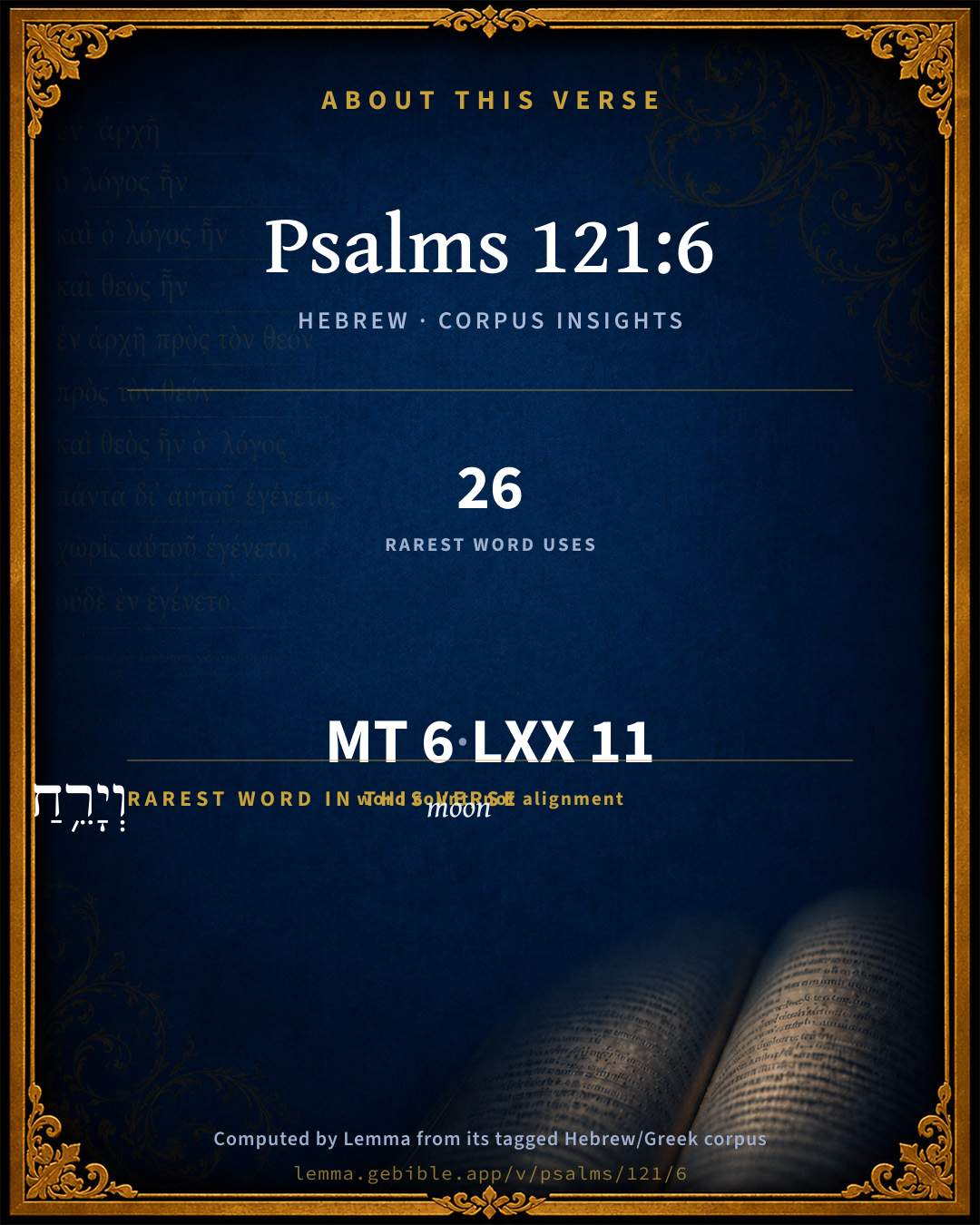
וְיָרֵ֥חַ moon H3394 occurs in 26 verses of the Hebrew Bible. Also found in:

Grammatical profile

  • 1 verb
  • 3 nouns
  • 1 adverb
  • 1 particle

Verb forms

  • יַכֶּ֗כָּה Hiphil · Imperfect

Hebrew & Septuagint length

In English translation the verse runs 13 words from the Hebrew and 13 from the Septuagint (LXX English) — the same length.

A rough comparison of the two English renderings, which tokenize alike — not a word-level alignment.

Word counts can differ between the Hebrew and the Greek without any difference in meaning — e.g. the Hebrew direct-object marker אֵת has no separate Greek word, and Greek often adds the article ὁ.

In the original languages it is 6 Hebrew tokens and 11 Greek tokens — but the two are counted differently (Hebrew bundles its prefixes and suffixes into one token; the Greek is in lemma form), so that isn’t a like-for-like length.

Cross-references

4

Topical passages linked to Psalms 121:6 in the Treasury of Scripture Knowledge — connected by theme and wording, ordered by reader-vote popularity; previews shown in the World English Bible.

  • Revelation 7:16 They will never be hungry, neither thirsty any more; neither will the sun beat on them, nor any heat;
  • Isaiah 49:10 They shall not hunger nor thirst; neither shall the heat nor sun strike them: for he who has mercy on them will lead them, even by springs of water will he guide them.
  • Psalms 91:5–10 You shall not be afraid of the terror by night, Nor of the arrow that flies by day;
  • Jonah 4:8 It happened, when the sun arose, that God prepared a sultry east wind; and the sun beat on Jonah's head, so that he fainted, and requested for himself that he might die, and said, "It is better for me to die than to live."

Cross-references courtesy of OpenBible.info (CC BY 4.0).

Hebrew and Greek witnesses Masoretic Hebrew ↔ Greek Septuagint

The same verse in the two great witnesses to the Old Testament, shown verse-for-verse.

You’re reading Greek Psalm 120 (Hebrew Psalm 121). The Septuagint counts the superscription, so verse numbers can differ from the Hebrew — chapter-level alignment, not verse-by-verse. Numbering follows Rahlfs.

These are two independent witnesses, not word-aligned to each other, and the Septuagint is shown in lemma (dictionary) form.

Hebrew Psalms 121:6 Masoretic · Westminster Leningrad Codex

יוֹמָ֗ם הַשֶּׁ֥מֶשׁ לֹֽא יַכֶּ֗כָּה וְיָרֵ֥חַ בַּלָּֽיְלָה

The sun will not harm you by day, Nor the moon by night.

World English Bible · Public Domain

Greek LXX Greek Psalm 120:6 Septuagint · lemma form

ἡμέρα ὁ ἥλιος οὐ συνκαίω σύ οὐδέ ὁ σελήνη ὁ νύξ

The sun shall not burn you by day, neither the moon by night.

LXX2012 (modern English Septuagint) · Public Domain

On this verse, Albert Barnes' Notes on the Bible discusses the Septuagint’s reading. Read the note in Commentary ↓

Hebrew: Westminster Leningrad Codex (CC BY 4.0). Greek: Septuagint (public domain); English from LXX2012 (modern English Septuagint) (Public Domain). How the Septuagint differs from the Hebrew →

Commentary

Notes on Psalms 121:6 from classic Christian and Jewish commentators (each source and its license shown beneath its notes). The classic Christian expositions comment on the surrounding passage and are grouped to its opening verse, so a note may address several verses; the Jewish commentaries on the Tanakh (Rashi and others) are per-verse, so they appear only where the commentator wrote on this verse.

Lemma curates 59 commentaries, every one of them public domain or Creative Commons licensed, each selected and text-cleaned for this edition rather than reprinted as found. About our sources →

Trapp's Complete Commentary

John Trapp

Psa 121:6 The sun shall not smite thee by day, nor the moon by night.

Ver. 6. The sun shall not smite thee by day] So choice and chary is God of his children, that he will have no creature to hurt them (parching heat by day or pinching cold by night), but both north and south must blow good to them, Son 4:16, and all creatures must cater for them, Hos 2:21-22, yet ever with exception of the cross, if need be, 1Pe 1:6. But let the pope be the sun and the emperor the moon (as the canonists called them), yet the sun shall not smite the Church by day nor the moon by night. Luther was at the same time excommunicated by the pope and proscribed by the emperor; yet died he in his bed.

John Trapp, A Commentary or Exposition upon All the Books of the Old and New Testament (1647–1656) — public domain. Text from a community e-Sword module.

J. A. Alexander on Psalms

Joseph Addison Alexander

6. (Psa 121:6) By day the sun shall not smite thee, and the moon by night. The last clause does not necessarily refer to injurious effects produced directly by the moon, but may be understood as a poetical description of all noxious influences operating in the night, over which the moon was constituted ruler at the time of its creation. See Gen 1:16; Gen 31:40, Jer 36:30.

Joseph Addison Alexander, The Psalms Translated and Explained (1850) — public domain. Text from a community e-Sword module.

Geneva Bible (1599)

Geneva Bible translators

Neither heat nor cold, nor any incommodity shall be able to destroy God’s Church, albeit for a time they may molest it.

Geneva Bible (1599) marginal notes — public domain. Text via Bolls.life.

Adam Clarke's Commentary

Verse 6. The sun shall not smite thee by day] Thus expressed by the Chaldee: "The morning spectres shall not smite thee by day, during the government of the sun; nor the nocturnal spectres by night, during the government of the moon." I believe the psalmist simply means, they shall not be injured by heat nor cold; by a sun-stroke by day, nor a frost-bite by night.

Adam Clarke's Commentary on the Bible (1810–1826) — public domain. Text from a community e-Sword/MySword module.

John Calvin's Commentaries

6. The sun shall not smite thee by day. By these forms of expression the Psalmist magnifies the advantages which result to us from our having God present with us; and, by the figure synecdoche, under one particular, he declares in general that the faithful shall be safe from all adversities, defended as they are by Divine power. The language is metaphorical, the cold of night and the heat of day denoting all kind of inconveniences. The sense then is, that although God’s people may be subject in common with others to the miseries of human life, yet his shadow is always at their side to shield them from thereby receiving any harm. The Prophet does not, however, promise the faithful a condition of such felicity and comfort as implies an exemption from all trouble; he only, for the purpose of assuaging their sorrows, sets before them this consolation — that being interested in the Divine layout, they shall be secure from all deadly harm; a point which he unfolds more distinctly in the following verses, where he tells us that God will so keep his own people from all evils, as to maintain their life in safety. The statement in the text before us is indeed general, but he afterwards specifies the chief parts of human life.

John Calvin's Commentaries (1540-1563) — public domain. Text from the Calvin Translation Society English edition (1840s-50s) via the Christian Classics Ethereal Library (ccel.org). Calvin's coverage is partial (roughly two-thirds of the Bible); uncommented books and verses are honest gaps, never fabricated. The 19th-century editor's footnotes and remarks are omitted so the notes are faithfully Calvin's own voice.

Ellicott's Commentary for English Readers

(6) Smite thee.—The mention of shade leads to the amplification of the figure. The evil effects of sunstroke are too well known to need comment. They are often mentioned in the Bible (2Ki_4:18; 2Ki_4:20; Jonah 4; Jdt_8:3).

Nor the moon by night.—Possibly there is allusion to the belief, so common in old times, of the harmful influence of the moon’s light—a belief still recalled in the word lunacy. It is a fact that temporary blindness is often caused by moonlight. (See authorities referred to by Ewald and Delitzsch.) Others, again, think that the injurious cold of the night is here placed in antithesis to the heat of the noonday sun (comp. Gen_31:40; Jer_36:30), the impression that intense cold burns being common in the East, as indeed everywhere. Tennyson speaks of the moon being “keen with frost.” But it is also possible that the generally harmful effects of night air are intended.

A Bible Commentary for English Readers, edited by Charles John Ellicott (1878–1897) — public domain. Text from a community e-Sword module.

The Cambridge Bible for Schools and Colleges

gen. ed. J. J. S. Perowne

6. The metaphor is naturally suggested by ‘shade’ in Psa_121:5. Sunstroke is of course common and dangerous in the East (2Ki_4:19; Isa_49:10); and the belief in ‘moonstroke’ as and is widely spread.

The Cambridge Bible for Schools and Colleges (gen. ed. J. J. S. Perowne; Cambridge University Press, 1878–1918) — public domain. Text from a community e-Sword module.

John Gill's Exposition

Thee Lord shall preserve them from all evil,.... The Word of the Lord, as the Targum. Not from the evil of affliction, though from that as a penal evil; or as a real one, it being made to work for good: but from the evil of sin; not from the being or commission of it; but from its dominion and damning power, or from a final and total falling away by it: and from the evil of the world; not from tribulation in it, nor from the reproach or persecution of it; but from the wickedness and lusts that are in it, and from the wicked men of it, their power, rage, and fury: and from the evil one, Satan; not from his temptations, but from sinking under them, and perishing by them; see Joh 17:12;

he shall preserve thy soul: he preserves the bodies of his people, oftentimes from diseases and disasters, and from death, till the appointed time comes; and then he preserves their dust in the grave, and raises it up at the last day; but more especially their souls, the redemption and salvation of which he undertook, and has effected; and which are preserved by him safe to his coming, kingdom, and glory.

John Gill's Exposition of the Whole Bible (1746–1763) — public domain (CC PDM 1.0). Text via the HelloAO Bible API.

Albert Barnes' Notes on the Bible

The sun shall not smite thee by day - The Septuagint renders this, “shall not burn thee” - συγκαύσει sungkausei. So the Latin Vulgate. The Hebrew word means to smite, to strike, as with a rod or staff, or with the plague or pestilence; and then, to kill, to slay. The allusion here is to what is now called a “sun-stroke” - the effect of the burning sun on the brain. Such effects of the sun are often fatal now, as doubtless they were in the time of the psalmist.

Nor the moon by night - The psalmist here refers to some prevalent opinion about the influence of the moon, as endangering life or health. Some have supposed that he refers to the sudden cold which follows the intense heat of the day in Oriental countries, and which, because the moon rules the night, as the sun does the day, is either poetically or literally attributed to the moon. Lackmann and Michaelis suppose that there is some allusion to the influence of the moon in producing various kinds of disease, and especially lunacy - an idea which gave origin to that name. Compare the notes at Mat 4:24. See Mat 17:15; Mar 9:17; Luk 9:39. Knapp supposes the idea is, that from the moon’s not giving a clear and full light like the sun, travelers trusting to its guidance may be led into rivers or quagmires. Macrobius refers to a custom among the Orientals of covering the faces of children when asleep, from some imagined effect of the moon on the health of the child. Andersen (Orient. Reise-Beschreib. i. 8) refers to an effect, which he says is common, and which he had often seen, of sleeping in the moon-beams, of making the neck stiff, so that it could not be turned from side to side as before. See Rosenmuller, Morgenland, in loc. Others have supposed that the allusion is to the effect of the moon, and of sleeping under the open air, in producing ophthalmia - a disease very common in the East - an effect guarded against by covering the face. The influence of the moon, in producing madness or disease - the general influence of it on health - is often referred to. Thus Shakespeare says:

“The moon, the governess of floods,

Pale in her anger, washes all the air,

That rheumatic diseases do abound.”

Midsummer Night’s Dream, ii. 2.

“It is the very error of the moon;

She comes more near the earth than she was wont,

And makes men mad.”

Othello, v. 2.

Some of these things are evidently purely imaginary. The true idea seems to be that there were effects to be dreaded from the sudden changes from the heat of day to the cold of night, and that these effects were attributed to the moon. See Gen 31:40. The meaning is, that God would be a Protector alike in the dangers of the day and of the night.

Albert Barnes' Notes on the Bible (1834–1885) — public domain. Text from a community e-Sword/MySword module.

Matthew Poole's English Annotations

The sun shall not smite thee with excessive heat,

nor the moon with that cold and moisture which comes into the air by it and with it. Intemperate heats and colds are the two springs of many diseases. He alludes both to the conditions of soldiers or travellers, who are exposed to the open air by day and by night, and also to the cloudy pillar which defended the Israelites both by day and by night. The sense is, He shall protect thee from all evils both by day and night.

Matthew Poole's English Annotations on the Holy Bible (1683–1685) — public domain. Text from a community e-Sword/MySword module.

The Treasury of David

Charles H. Spurgeon

Ver. 6. The sun shall not smite thee by day, nor the moon by night. None but the Lord could shelter us from these tremendous forces. These two great lights rule the day and the night, and under the lordship of both we shall labour or rest in equal safety. Doubtless there are dangers of the light and of the dark, but in both and from both we shall be preservedliterally from excessive heat and from baneful chills; mystically from any injurious effects which might follow from doctrine bright or dim; spiritually from the evils of prosperity and adversity; eternally from the strain of overpowering glory and from the pressure of terrible events, such as judgment and the burning of the world. Day and night make up all time: thus the ever present protection never ceases. All evil may be ranked as under the sun or the moon, and if neither of these can smite us we are indeed secure. God has not made a new sun or a fresh moon for his chosen, they exist under the same outward circumstances as others, but the power to smite is in their case removed from temporal agencies; saints are enriched, and not injured, by the powers which govern the earth's condition; to them has the Lord given "the precious things brought forth by the sun, and the precious things put forth by the moon, "while at the same moment he has removed from them all glare and curse of heat or damp, of glare or chill.

Ver. 6. The sun shall not smite thee. hrh of the sun signifies to smite injuriously (Isa 49:10), plants, so that they wither (Ps 102:5), and the head (Joh 4:8), so that symptoms of sunstroke (2Ki 4:19; Jud 8:2 seq.) appear. The transferring of the word to the word is not zeugmatic. Even the moon's rays may become insupportable, may affect the eyes injuriously, and (more particularly in the equatorial regions) produce fatal inflammation of the brain. From the hurtful influences of nature that are round about him the promise extends in verses 7,8 in every direction. Jahve, says the poet to himself, will keep (guard) thee against all evil, of whatever kind it may be and whencesoever it may threaten; he will keep thy soul, and therefore thy life both inwardly and outwardly; he will keep thy going out and coming in, i.e., all thy business and intercourse of life... everywhere and at all times; and that from this time forth even for ever. Franz Delitzsch.

Ver. 6. The sun shall not smite thee by day, etc. A promise made with allusion unto, and application of that care which God had over his people, when he brought them out of Egypt through the wilderness, when he guarded them from the heat of the sun by a cloud by day, and from the cold and moistness of the night and moon by a pillar of fire by night. David Dickson.

Ver. 6. Nor the moon by night.

The moon, the governess of floods,

Pale in her anger, washes all the air,

That rheumatic diseases do abound.

William Shakespeare (1564-1616), in "The Midsummer Night's Dream".

Ver. 6. Joseph Hart in one of his hymns speaks of some who "travel much by night". To such this promise is precious. Biblical Treasury.

Ver. 6. Nor the moon by night. The effect of the moonlight on the eyes in tiffs country is singularly injurious... The moon here really strikes and affects the sight, when you sleep exposed to it, much more than the sun, a fact of which I had a very unpleasant proof one night, and took care to guard against it afterwards; indeed, the sight of a person who should sleep with his face exposed at night would soon be utterly impaired or destroyed. John Carne, in "Letters from the East", 1826.

Ver. 6. Nor the moon by night. In the cloudless skies of the East, where the moon shines with such exceeding clearness, its effects upon the human frame have been found most injurious. The inhabitants of these countries are most careful in taking precautionary measures before exposing themselves to its influence. Sleeping much in the open air, they are careful to cover well their heads and faces. It has been proved beyond a doubt that the moon smites as well as the sun, causing blindness for a time, and even distortion of the features. Sailors are well aware of this fact; and a naval officer relates that he has often, when Sailing between the tropics, seen the commanders of vessels waken up young men who have fallen asleep in the moonlight. Indeed, he witnessed more than once the effects of a moonstroke, when the mouth was drawn on one side and the sight injured for a time. He was of opinion that, with long exposure, the mind might become seriously affected. It is supposed that patients suffering under fever and other illnesses are affected by this planet, and the natives of India constantly affirm that they will either get better or worse, according to her changes. C.W., in, "The Biblical Treasury".

Ver. 6. The highest powers, under God, prevented from hurting believers, and even made to serve them.

Ver. 6. Our Horoscope.

1. Superstitious fears removed.

2. Sacred assurances supplied.

Psalms 121:7*

Charles H. Spurgeon's The Treasury of David (1869–1885) — public domain. Psalms only. Text from a community e-Sword/MySword module.

Whedon's Commentary on the Bible

Daniel D. Whedon

6. Sun shall not smite, etc.—It is well known that a sunstroke in the East is a common liability, sometimes producing instant death to man and beast. Probably 2Ki_4:18-20, was an instance. The moonbeams, also, are known to affect the human system injuriously. Hence the word lunatics, applied to those who are supposed to be injured by the influence of the moon. The dangers common to the travellers are kept before the mind throughout the psalm.

Daniel D. Whedon (gen. ed.), Commentary on the Old and New Testaments (1874–1909) — public domain. Text from a community e-Sword module.

The Pulpit Commentary

The sun shall not smite thee by day, nor the moon by night. These were the chief dangers of travelers, whether pilgrims or others. Coup de soleil was feared by day, and the deleterious influence of the moon"s rays by night. This last has sometimes been doubted, but the observation of modern travelers seems to show that bad effects actually fellow on sleeping in the moonlight in hot countries (see Curzon"s "Travels," p. 36; Leopolt, "India Missions," p. 7).

Types of peril by day and by night.

The sun and the moon. To understand these figures, it is necessary to keep in mind, not only what the sun and moon actually are in Eastern countries, but also the sentiments which have gathered about them in those lands.

I THE SUN IS THE TYPE OF THE OPEN PERILS OF THE GODLY LIFE. The sun strikes openly, and is especially perilous when it strikes on the lower part of the back of the head. Men know this, and are duly warned to take all precautions. And so in life there are various temptations and dangers, which we all know about, which every man knows may come into his personal experience, and concerning which we all, in various ways and degrees, take precautions. Yet even in respect of these we need the assurance of an outside and Divine protection. So strange is the frailty of human nature, that men are over-mastered by the very things they know well, are warned against, and even think themselves strong to resist. It needs to be always kept in mind that the power of temptation depends on the physical, mental, or spiritual condition in which we are found when it assails us. And we need the assurance of God"s defense even against open and well-known evils, because he only can know the particular peril which lies in their relativity to us at any given time. Illustrate by the fact that the sunstroke is only an occasional peril. The sun strikes the man who is in a physical condition to receive the stroke. But the man does not know the peril of his physical condition. God knows, and can help him to defend himself from the peril.

II THE MOON IS THE TYPE OF THE SECRET PERILS OF THE GODLY LIFE. In the cloudless skies of the East, where the moon shines with such exceeding clearness, its effects upon the human frame have been found most injurious. It has been proved, beyond a doubt, that the moon smites as well as the sun, causing blindness for a time, and even the distortion of the features. The Arabs universally believe that the beams of the moon are noxious to the human body; and therefore they carefully cover over their heads when they sleep in the open air. Meat, when exposed to the moonbeams, becomes quickly tainted. Mr. Martin says, "Of the effects of the moon on animal life very many instances could be cited. I have seen in Africa the newly littered young perish in a few hours, if exposed to the rays of the full moon. Fish become rapidly putrid, and meat, if left exposed, incurable or unpreservable by salt. The mariner, heedlessly sleeping on deck, becomes afflicted with nyctolopia, or night-blindness; at times the face is hideously swollen, if exposed during sleep to the moon"s rays; the maniac"s paroxysms are renewed with fearful vigor at the full and change, and the cold, damp chill of the ague supervenes on the ascendency of this apparently mild yet powerful luminary. Let her influence over this earth be studied; it is more powerful than is generally known." The moon may very well be taken as the type of the secret, subtle, insidious perils of the godly life; and these are chiefly to be dreaded. As there are poison-germs in the natural atmosphere, which generate disease in us when our vitality and resisting power are low, so there are poison-germs in the moral atmosphere of our everyday associations, which only cultured spiritual life can enable us to resist. There are enervating influences, suggestive examples. Little slips into inexactness or untruthfulness. A thousand things in common life, that seem to have no more Power of mischief in them than have the moonbeams. What, then, would be any man"s hope of preserving moral health and safety, if we might not cherish the assurance of the psalmist, that God understands all secret perils that gather about us, and will not let the moon smite us by night? "The darkness and the light are both alike to him. R.T.

The Pulpit Commentary (1880–1919), ed. H.D.M. Spence-Jones & Joseph S. Exell — public domain. Text from a community e-Sword module.

John Wesley's Explanatory Notes

Smite - With excessive heat. Moon - With that cold and moisture which come into the air by it. Intemperate heats and colds are the springs of many diseases.

John Wesley, Explanatory Notes Upon the Whole Bible (1754–1765) — public domain. Text via the GEBible commentary corpus.

Lesson kit

Teaching starters — assembled from the data on this page, not authored interpretation. Every prompt links to the verse data it draws on. Edit before teaching.

Psalms, in the Wisdom, opens this verse with 6 words (6 distinct Hebrew lemmas). Its most distinctive word is yârêach (“moon”). A historical commentator’s framing appears above. Read the whole chapter for the surrounding context.

Discussion questions

  1. The word yârêach carries the sense “moon.” How does it shape the verse?
  2. Genesis 37:9 shares the word «moon» with this verse. How do the two illuminate each other?
  3. These translations render this verse differently. What is at stake in choosing one wording over another?
  4. The verb «יַכֶּ֗כָּה» is Hiphil Imperfect. How does its form color the action?
  5. Reading how Trapp's Complete Commentary and J. A. Alexander on Psalms read this verse, where do the two commentators agree and where do they part?

Things to notice

Reading settings

Reading text

Shown beneath each verse's original-language words.

Old Testament
Old Testament edition

Read the OT as the Masoretic Hebrew (MT) or the Greek Septuagint (LXX).

English shown for the Greek Septuagint (in the Hebrew ↔ Greek comparison).

Comparing translations? Open the Compare panel on any verse page to stack up to four side by side.