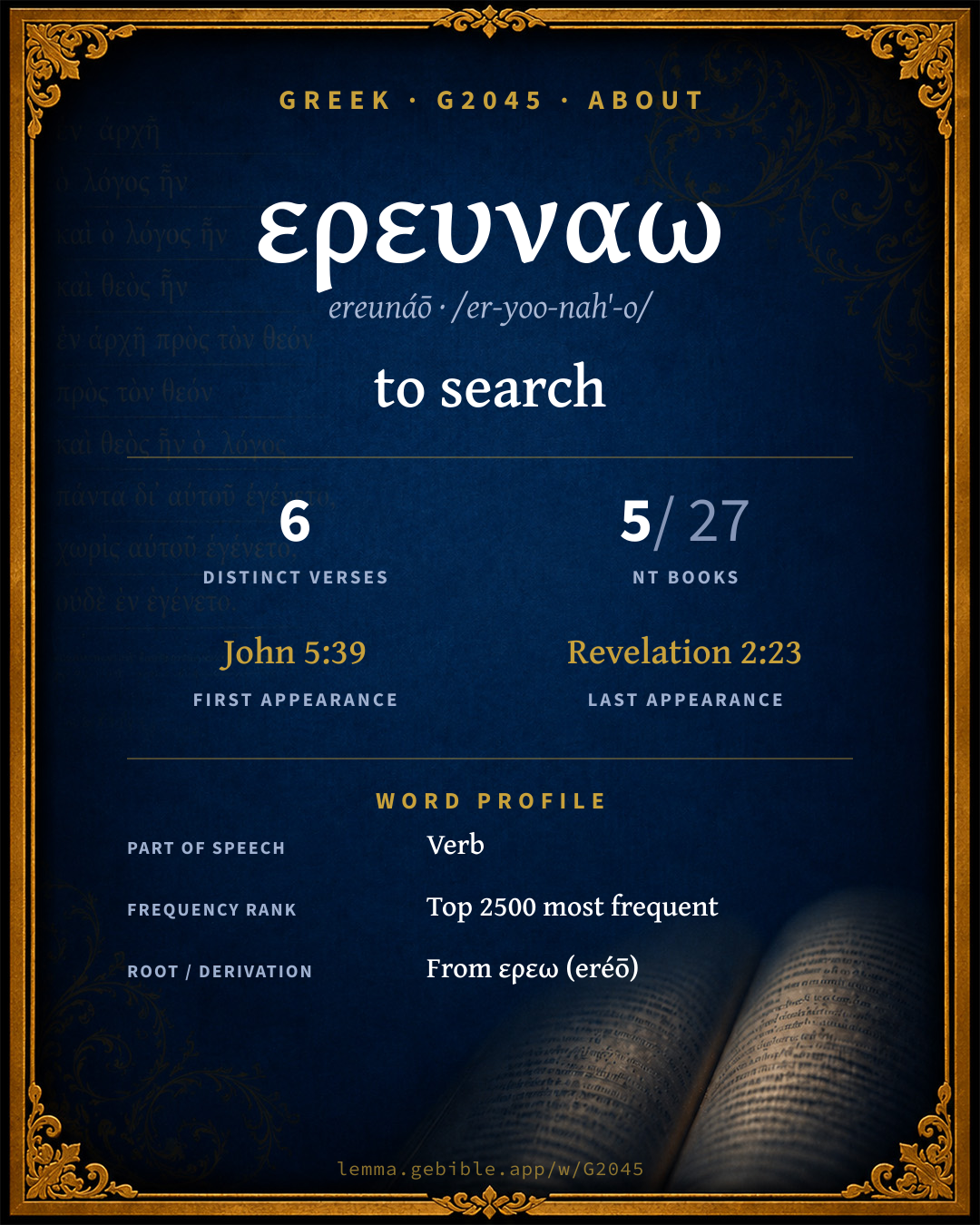
ἐρευνάω
to search
Full lexicon entry — Thayer's Greek Lexicon
From Thayer's Greek Lexicon
Where this word appears
See every Present-tense verb in the Greek New Testament →
Grammar key — what these labels mean
Part of speech
- Verb
- An action or state-of-being word.
Tense
- Present
- Ongoing or general action in present time (imperfective aspect).
- Aorist
- Action viewed as a simple whole, without regard to duration — often past (perfective aspect).
Voice
- Active
- The subject performs the action.
Mood
- Participle
- A verbal adjective (“writing,” “having written”).
- Imperative
- Expresses a command or request.
- Indicative
- States a fact or asks a factual question (the mood of reality).
Case
- Nominative
- The case of the subject (and the predicate nominative).
Person
- 2nd person
- The one addressed (“you”).
- 3rd person
- The one spoken about (“he / she / it / they”).
Gender
- Masculine
- Grammatically masculine.
Number
- Singular
- One.
- Plural
- More than one.
Grammatical forms
- Verb, Present, Active, Participle, Nominative, Singular, Masculine 2 times (33%)
- Verb, Aorist, Active, Imperative, 2nd person, Singular 1 time (17%)
- Verb, Present, Active, Indicative, 2nd person, Plural 1 time (17%)
- Verb, Present, Active, Indicative, 3rd person, Singular 1 time (17%)
- Verb, Present, Active, Participle, Nominative, Plural, Masculine 1 time (17%)
Parsed forms decoded from the imported morphology (Robinson–Tischendorf, public domain), counted across 6 parsed occurrences — not distinct verses.
Every verse where G2045 appears — 6 distinct verses across 5 books. Click any verse to open its interlinear word-by-word view. Verse text shown in the World English Bible for context — . Each verse’s Greek form is shown with its reference; the English is not keyword-highlighted, since the data carries no word-level English alignment. Use “Compare translations” on any verse to read it across multiple English versions. This concordance covers the Greek New Testament; Septuagint (Greek Old Testament) occurrences of this word are not indexed here.
John 2 verses
- John 5:39 ἐραυνᾶτε pres act ind 2pl "You search the Scriptures, because you think that in them you have eternal life; and these are they which testify about me.
- John 7:52 ἐραύνησον aor act impv 2sg They answered him, "Are you also from Galilee? Search, and see that no prophet has arisen out of Galilee."
Romans 1 verse
1 Corinthians 1 verse
1 Peter 1 verse
Revelation 1 verse
About this entry
At a glance — auto-summarized from this page’s data, not written by a person. Every figure links to its source below. This summary describes the numbers; it doesn’t interpret them.
At its core, ερευναω (ereunáō) means “to search.” It first appears in John 5:39. It turns up in 6 verses across 5 books, an uncommon footprint. The word gravitates to John (33%), then Romans and 1 Corinthians. It clusters with ερεω, επω and ερωταω under a shared root. Each statement above links to its evidence; the full detail follows below.
Gloss history
Strong's 1890 vs modern scholarship
About this word
Strong's G2045 catalogs a Greek word from the Greek New Testament.
These counts are not copied from any lexicon or concordance. They are computed here, from the morphology-tagged Greek New Testament. What Lemma adds →
- 6
- distinct verses
- The word appears in 6 distinct verses.
- 5 / 27
- NT books
- The word appears in 5 of 27 New Testament books.
- #1,476
- by frequency
- Top 2500 most frequent Greek words (rank 1,476 of 5,347 Greek words by occurrence).
View all 6 occurrences in the concordance →
Most concentrated in
- John 2 verses 33%
- Romans 1 verse 17%
- 1 Corinthians 1 verse 17%
By section of the New Testament
By traditional corpus
Conventional, traditional groupings — biblical authorship is debated, so this is a traditional corpus grouping, not an authorship claim. Some books belong to more than one corpus (Luke is in both the Gospels and the Lukan corpus, and so on), so these shares overlap and need not total 100%. Each figure is a share of the word’s 6 distinct verses.
- Johannine 3 verses · 50%
- Gospels 2 verses · 33%
- Pauline corpus 2 verses · 33%
- General (Catholic) Epistles 1 verse · 17%
- Revelation 1 verse · 17%
How translations render this word
Counts come from each version’s own published word-to-Strong’s tagging or interlinear alignment — an approximate guide to how each version renders this word, not a word-level alignment the data otherwise carries. Because each total is that version’s own tagged count, the per-version totals vary from one another and need not match the appearance or distinct-verse counts above. These counts may also differ from a printed concordance because Lemma counts each distinctly tagged rendering and does not collapse phrase taggings into a single head-word total. This is a fixed set of word-tagged versions (KJV, ASV, BSB, ULT) and does not change with the reading translation you choose elsewhere. Each version’s license is shown beside its name below (and on Sources).
- King James Version: Search 2×, Searcheth 2×
- American Standard Version: He that searcheth 2×
- Berean Standard Bible: Searches 3×
- unfoldingWord Literal Text: Inquiring 1×, One searching 1×, Search 1×
King James Version Public Domain
Renders G2045 across 6 tagged occurrences — most commonly:
Plus 2 renderings that appear only once — usually multi-word phrases or single function words the recovered tagging swept in, not distinct renderings.
American Standard Version Public Domain
Renders G2045 across 5 tagged occurrences — most commonly:
Plus 3 renderings that appear only once — usually multi-word phrases or single function words the recovered tagging swept in, not distinct renderings.
Berean Standard Bible Public Domain
Renders G2045 across 6 tagged occurrences — most commonly:
Plus 3 renderings that appear only once — usually multi-word phrases or single function words the recovered tagging swept in, not distinct renderings.
unfoldingWord Literal Text CC BY-SA 4.0
Renders G2045 across 6 tagged occurrences — most commonly:
Senses in Thayer's
The 1 sense Thayer's distinguishes for this word, in lexicon order (not ranked by frequency or importance). The full entry — with sub-senses — is in the Lexicon Entry tab.
- to search, examine into
Word origin
Derived from ερεω (eréō) (G2046) — to speak.
Apparently from G2046 (through the idea of inquiry ); to seek that is (figuratively) to investigate : - search.
— Strong’s Exhaustive Concordance (1890), public domain.
Forms in the corpus
The 5 distinct written forms G2045 takes in the Greek New Testament, most frequent first — each parse links to that tense’s occurrences in the concordance.
| Form | Parsing | Example | Uses |
|---|---|---|---|
| ἐραυνῶν eraunō̂n | Verb, Present, Active, Participle, Nominative, Singular, Masculine | Romans 8:27 | 2 |
| ἐραυνᾶτε eraunâte | Verb, Present, Active, Indicative, 2nd person, Plural | John 5:39 | 1 |
| ἐραυνᾷ eraunâ | Verb, Present, Active, Indicative, 3rd person, Singular | 1 Corinthians 2:10 | 1 |
| ἐραυνῶντες eraunō̂ntes | Verb, Present, Active, Participle, Nominative, Plural, Masculine | 1 Peter 1:11 | 1 |
| ἐραύνησον eraúnēson | Verb, Aorist, Active, Imperative, 2nd person, Singular | John 7:52 | 1 |
Same root — word family
Other Thayer's entries built from the same root as G2045, grouped by Strong’s listed origin. These share a root / origin per the lexicon — not necessarily a shared meaning. Each links to that word’s own entry.
Derives from
Shares the same root
Proper names from this root
People and places named from this root — a name, not an additional meaning of the word.
Compare all same-root words → Showing 4 of 6 — not the complete family. 1 of the same-root words is a proper name (a person or place). They share a root, not necessarily a meaning.
Septuagint usage
The same Greek word ερευναω appears 13 times in the Greek Old Testament (Septuagint), across 12 verses in 9 books.
- 13
- LXX occurrences
- Tagged occurrences of this Greek word in the Septuagint.
- 12
- verses
- Distinct Septuagint verses containing this word.
- 9 / 39
- OT books
- The word appears in 9 of the 39 Old Testament books.
Sample Septuagint occurrences
- Genesis 31:33 ἐρευνάω
- Deuteronomy 13:15 ἐρευνάω
- Judges 6:29 ἐρευνάω
- 2 Samuel 10:3 ἐρευνάω
- 1 Kings 21:6 ἐρευνάω
- 2 Kings 10:23 ἐρευνάω
- Proverbs 20:18 ἐρευνάω
- Jeremiah 27:26 ἐρευνάω
- Joel 1:7 ἐρευνάω
Septuagint occurrences (same lexeme)
Every verse where the same Strong’s number (G2045) appears in the Greek Septuagint. Verse text shown in the World English Bible for context; the Greek form is the matched word — the English is not keyword-highlighted.
- Genesis 31:33 ἐρευνάω Laban went into Jacob's tent, into Leah's tent, and into the tent of the two maid-servants; but he didn't find them. He went out of Leah's tent, and entered into Rachel's tent.
- Genesis 31:35 ἐρευνάω She said to her father, "Don't let my lord be angry that I can't rise up before you; for the manner of women is on me." He searched, but didn't find the teraphim.
- Genesis 31:37 ἐρευνάω Now that you have felt around in all my stuff, what have you found of all your household stuff? Set it here before my relatives and your relatives, that they may judge between us two.
- Genesis 44:12 ἐρευνάω He searched, beginning with the eldest, and ending at the youngest. The cup was found in Benjamin's sack.
- Deuteronomy 13:15 ἐρευνάω you shall surely strike the inhabitants of that city with the edge of the sword, destroying it utterly, and all that is therein and the cattle of it, with the edge of the sword.
- Judges 6:29 ἐρευνάω They said one to another, Who has done this thing? When they inquired and asked, they said, Gideon the son of Joash has done this thing.
- 2 Samuel 10:3 ἐρευνάω But the princes of the children of Ammon said to Hanun their lord, Do you think that David honors your father, in that he has sent comforters to you? Hasn't David sent his servants to you to search the city, and to spy it out, and to overthrow it?
- 1 Kings 21:6 ἐρευνάω He said to her, Because I spoke to Naboth the Jezreelite, and said to him, Give me your vineyard for money; or else, if it please you, I will give you [another] vineyard for it: and he answered, I will not give you my vineyard.
- 2 Kings 10:23 ἐρευνάω Jehu went, and Jehonadab the son of Rechab, into the house of Baal; and he said to the worshippers of Baal, Search, and look that there be here with you none of the servants of Yahweh, but the worshippers of Baal only.
- Proverbs 20:18 ἐρευνάω Plans are established by advice; By wise guidance you wage war!
- Jeremiah 27:26 ἐρευνάω
- Joel 1:7 ἐρευνάω He has laid my vine waste, And stripped my fig tree. He has stripped its bark, and thrown it away. Its branches are made white.
These are occurrences of the same Greek lexeme (G2045) in the Septuagint — not a translation of any one Hebrew word. The store carries no word-level Hebrew↔Greek alignment, so no Hebrew original is asserted here. Counts come from the recovered LXX Strong's tagging — high-frequency vocabulary is well covered, while rare or late forms may be untagged — so they reflect tagged occurrences and may slightly undercount.