
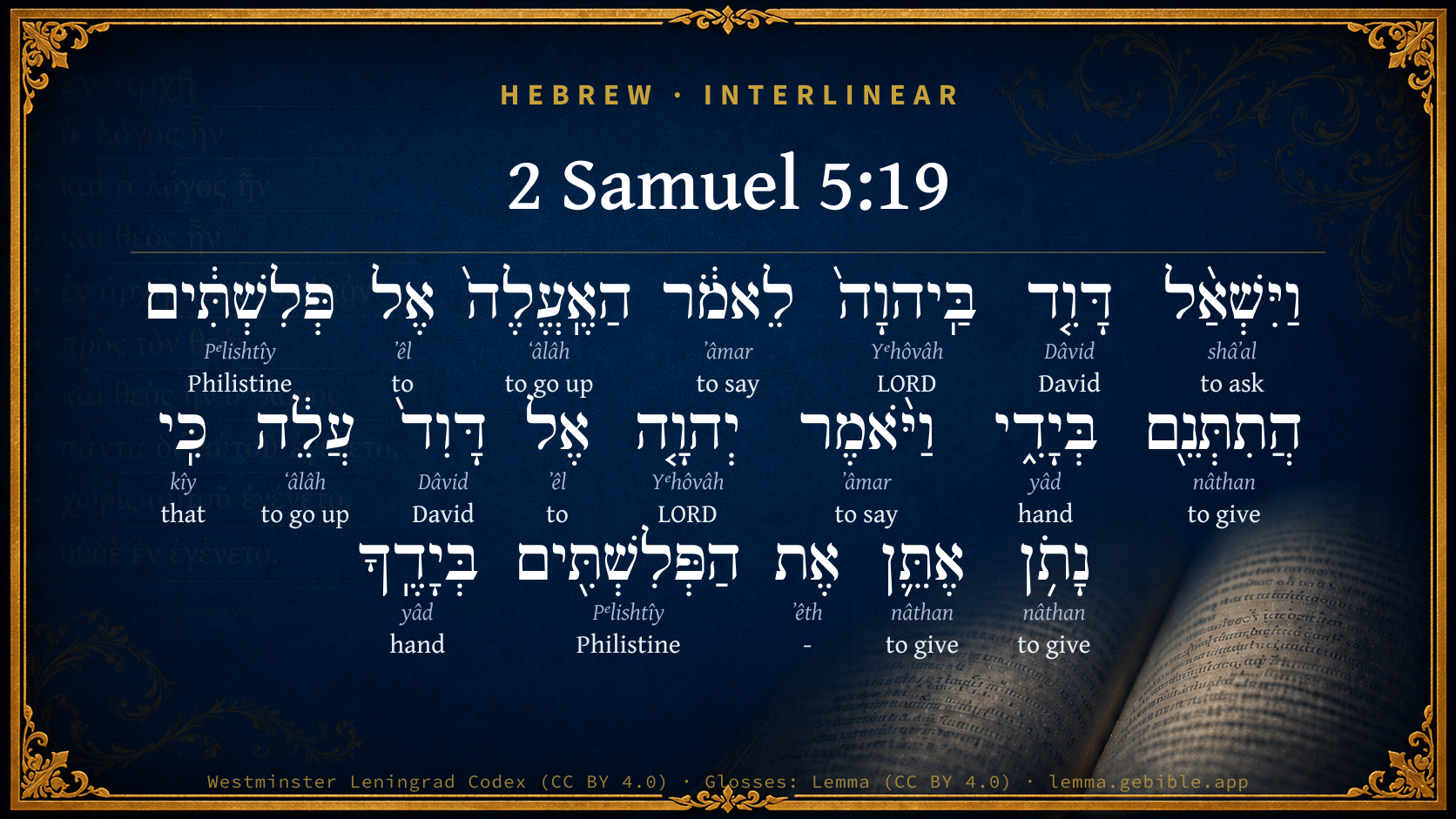
2 Samuel 5:19

Hebrew (Westminster Leningrad Codex) 2 Samuel 5:19 appears in the Hebrew Old Testament. The text above is from the Westminster Leningrad Codex. Each word links to its Strong’s number, a concise gloss, and parsing drawn from the Open Scriptures Hebrew Bible morphology. Click any word for its full Brown-Driver-Briggs (BDB) entry.
Download image
Cite this verse

2 Samuel 5:19 (World English Bible). Public Domain. Lemma interlinear Bible study tool, https://lemma.gebible.app/v/2-samuel/5/19.

Show BibTeX & RIS
BibTeX
RIS
English Translation
David inquired of Yahweh, saying, Shall I go up against the Philistines? will you deliver them into my hand? Yahweh said to David, Go up; for I will certainly deliver the Philistines into your hand.
World English Bible · Public Domain
Download a study sheet

One document with this verse’s original text, its word-by-word gloss line, the meaning frame, cross-references with their text, attributed commentary, and full source and license credits — printable, and it pastes into notes with its structure intact.

This verse Autodidact and up

Study sheet (.html) Plain text (.txt)

A passage Seminary Student

Up to 50 verses in one chapter. A passage sheet keeps up to 6 commentary sources and 12 cross-references per verse, in the order this page ranks them, and says so on the sheet whenever that leaves anything out. Ask for a single verse and you get the Autodidact verse sheet above.

Everything on this page stays free to read, with no account — the sheet is a download of what is already on screen, not access to it.

Want to remove ads? Support Godless Engineer
Compare translations 3

The same verse in 3 English versions, stacked beneath the original-language interlinear above. Click any original word for its lexicon entry.

Each is an independent rendering of the whole verse — the interlinear is not word-aligned to these translations.

Highlighted words mark where these versions differ — a whole-verse word diff, not a word-by-word alignment.

  • World English Bible Public Domain
    David inquired of Yahweh, saying, Shall I go up against the Philistines? will you deliver them into my hand? Yahweh said to David, Go up; for I will certainly deliver the Philistines into your hand.
  • King James Version Public Domain
    And David inquired of the LORD, saying, Shall I go up to the Philistines? wilt thou deliver them into mine hand? And the LORD said unto David, Go up: for I will doubtless deliver the Philistines into thine hand.
  • unfoldingWord Literal Text CC BY-SA 4.0
    And David inquired of Yahweh, saying, “Shall I go up to the Philistines? Will you give them into my hand?” And Yahweh said to David, “Go up, for giving, I will give the Philistines into your hand.”

unfoldingWord Literal Text — © unfoldingWord, licensed CC BY-SA 4.0. Word-aligned USFM3 via Door43 (git.door43.org/unfoldingWord/en_ult).

Versions to compare (up to 4)

3 of 4 selected

Show all 18 translations

Every available English version of this verse, each an independent rendering of the whole verse.

  • World English Bible Public Domain
    David inquired of Yahweh, saying, Shall I go up against the Philistines? will you deliver them into my hand? Yahweh said to David, Go up; for I will certainly deliver the Philistines into your hand.
  • Berean Standard Bible Public Domain
    So David inquired of the LORD, “Should I go up against the Philistines? Will You deliver them into my hand?” “Go,” replied the LORD, “for I will surely deliver the Philistines into your hand.”
  • Majority Standard Bible Public Domain
    So David inquired of the LORD, “Should I go up against the Philistines? Will You deliver them into my hand?” “Go up,” replied the LORD, “for I will surely deliver the Philistines into your hand.”
  • King James Version Public Domain
    And David inquired of the LORD, saying, Shall I go up to the Philistines? wilt thou deliver them into mine hand? And the LORD said unto David, Go up: for I will doubtless deliver the Philistines into thine hand.
  • American Standard Version (1901) Public Domain
    And David inquired of Jehovah, saying, Shall I go up against the Philistines? wilt thou deliver them into my hand? And Jehovah said unto David, Go up; for I will certainly deliver the Philistines into thy hand.
  • Revised Version (1885) Public Domain
    And David inquired of the LORD, saying, Shall I go up against the Philistines? wilt thou deliver them into mine hand? And the LORD said unto David, Go up: for I will certainly deliver the Philistines into thine hand.
  • Geneva Bible (1599) Public Domain
    Then Dauid asked counsel of the Lord, saying, Shall I goe vp to the Philistims? wilt thou deliuer them into mine handes? And the Lord answered Dauid, Goe vp: for I will doubtlesse deliuer the Philistims into thine handes.
  • Douay-Rheims (1899) Public Domain
    And the Philistines coming spread themselves in the valley of Raphaim.
  • Young's Literal Translation Public Domain
    And David asketh of Jehovah, saying, `Do I go up unto the Philistines? dost Thou give them into my hand?' And Jehovah saith unto David, `Go up, for I certainly give the Philistines into thy hand.'
  • Literal Standard Version CC BY-SA 4.0
    And David asks of YHWH, saying, “Do I go up to the Philistines? Do You give them into my hand?” And YHWH says to David, “Go up, for I certainly give the Philistines into your hand.”
  • Unlocked Literal Bible CC BY-SA 4.0
    Then David asked for help from Yahweh. He said, “Should I attack the Philistines? Will you give victory over them?” Yahweh said to David, “Attack, for I will certainly give you victory over the Philistines.”
  • unfoldingWord Literal Text CC BY-SA 4.0
    And David inquired of Yahweh, saying, “Shall I go up to the Philistines? Will you give them into my hand?” And Yahweh said to David, “Go up, for giving, I will give the Philistines into your hand.”
  • Darby Bible Public Domain
    And David inquired of Jehovah, saying, Shall I go up against the Philistines? wilt thou give them into my hand? And Jehovah said to David, Go up; for I will certainly give the Philistines into thy hand.
  • World Messianic Bible Public Domain
    David inquired of the LORD, saying, “Shall I go up against the Philistines? Will you deliver them into my hand?” The LORD said to David, “Go up; for I will certainly deliver the Philistines into your hand.”
  • Webster's Bible Public Domain
    And David inquired of the LORD, saying, Shall I go up to the Philistines? wilt thou deliver them into my hand? And the LORD said to David, Go up: for I will doubtless deliver the Philistines into thy hand.
  • Free Bible Version CC BY-SA 4.0
    David asked the Lord “Should I go and attack the Philistines? Will you hand them over to me?” “Yes, go,” the Lord replied, “for I will definitely hand them over to you.”
  • Bible in Basic English Public Domain
    And David, desiring directions from the Lord, said, Am I to go up against the Philistines? will you give them up into my hands? And the Lord said, Go up, for I will certainly give up the Philistines into your hands.
  • JPS Tanakh (1917) Public Domain
    And David inquired of the LORD, saying: 'Shall I go up against the Philistines? wilt Thou deliver them into my hand?' And the LORD said unto David: 'Go up; for I will certainly deliver the Philistines into thy hand.'

Literal Standard Version (2020), Covenant Press — licensed CC BY-SA 4.0. Text via the HelloAO Bible API (eBible.org). Unlocked Literal Bible (unfoldingWord) — licensed CC BY-SA 4.0. Text via the HelloAO Bible API (eBible.org). unfoldingWord Literal Text — © unfoldingWord, licensed CC BY-SA 4.0. Word-aligned USFM3 via Door43 (git.door43.org/unfoldingWord/en_ult). Free Bible Version, Dr. Jonathan Gallagher — licensed CC BY-SA 4.0. Text via the HelloAO Bible API (eBible.org).

Word by word

More ways to search: Search by grammar → Find every occurrence → Compare this word →

Practice this passage: Drill this verse → Learn its vocabulary →

וַיִּשְׁאַ֨ל
shâʼal
H7592
“and · to ask”
Conjunction + Verb, Qal, Sequential Imperfect, 3rd Person, Masculine, Singular
Part of Speech
Conjunction + Verb
Stem
Qal
Form
Sequential Imperfect
Person
3rd Person
Gender
Masculine
Number
Singular
Full BDB Definition

Origin: a primitive root

TWOT: 2303

to ask, enquire, borrow, beg - (Qal) - to ask, ask for - to ask (as a favour), borrow - to enquire, enquire of - to enquire of, consult (of deity, oracle) - to seek - (Niphal) to ask for oneself, ask leave of absence - (Piel) - to enquire, enquire carefully - to beg, practise beggary - (Hiphil) - to be given on request - to grant, make over to, let (one) ask (successfully) or give or lend on request (then) grant or make over to
  1. דָּוִ֤ד Dâvid H1732 “David” Noun, Proper
  2. בַּֽיהוָה֙ Yᵉhôvâh H3068 “in/at · LORD” Preposition + Noun, Proper
  3. לֵאמֹ֔ר ʼâmar H559 “to say” Preposition + Verb, Qal, Infinitive Construct
  4. הַאֶֽעֱלֶה֙ ʻâlâh H5927 “to go up” Particle, Interrogative + Verb, Qal, Imperfect, 1st Person, Common, Singular
  5. אֶל ʼêl H413 “to” Preposition
  6. פְּלִשְׁתִּ֔ים Pᵉlishtîy H6430 “Philistines” Noun, Gentilic, Masculine, Plural, Absolute
  7. הֲתִתְּנֵ֖ם nâthan H5414 “to give · them” Particle, Interrogative + Verb, Qal, Imperfect, 2nd Person, Masculine, Singular + Suffix, Personal, 3rd Person, Masculine, Plural
  8. בְּיָדִ֑י yâd H3027 “in/at · hand · my” Preposition + Noun, Common, Both, Singular, Construct + Suffix, Personal, 1st Person, Common, Singular
  9. וַיֹּ֨אמֶר ʼâmar H559 “and · to say” Conjunction + Verb, Qal, Sequential Imperfect, 3rd Person, Masculine, Singular
  10. יְהוָ֤ה Yᵉhôvâh H3068 “LORD” Noun, Proper
  11. אֶל ʼêl H413 “to” Preposition
  12. דָּוִד֙ Dâvid H1732 “David” Noun, Proper
  13. עֲלֵ֔ה ʻâlâh H5927 “go up” Verb, Qal, Imperative, 2nd Person, Masculine, Singular
  14. כִּֽי kîy H3588 “that” Conjunction
  15. נָתֹ֥ן nâthan H5414 “to give” Verb, Qal, Infinitive Absolute
  16. אֶתֵּ֛ן nâthan H5414 “to give” Verb, Qal, Imperfect, 1st Person, Common, Singular
  17. אֶת ʼêth H853 “-” Particle, Direct Object
  18. הַפְּלִשְׁתִּ֖ים Pᵉlishtîy H6430 “the · Philistines” Particle, Definite Article + Noun, Gentilic, Masculine, Plural, Absolute
  19. בְּיָדֶֽךָ yâd H3027 “in/at · hand · your” Preposition + Noun, Common, Both, Singular, Construct + Suffix, Personal, 2nd Person, Masculine, Singular

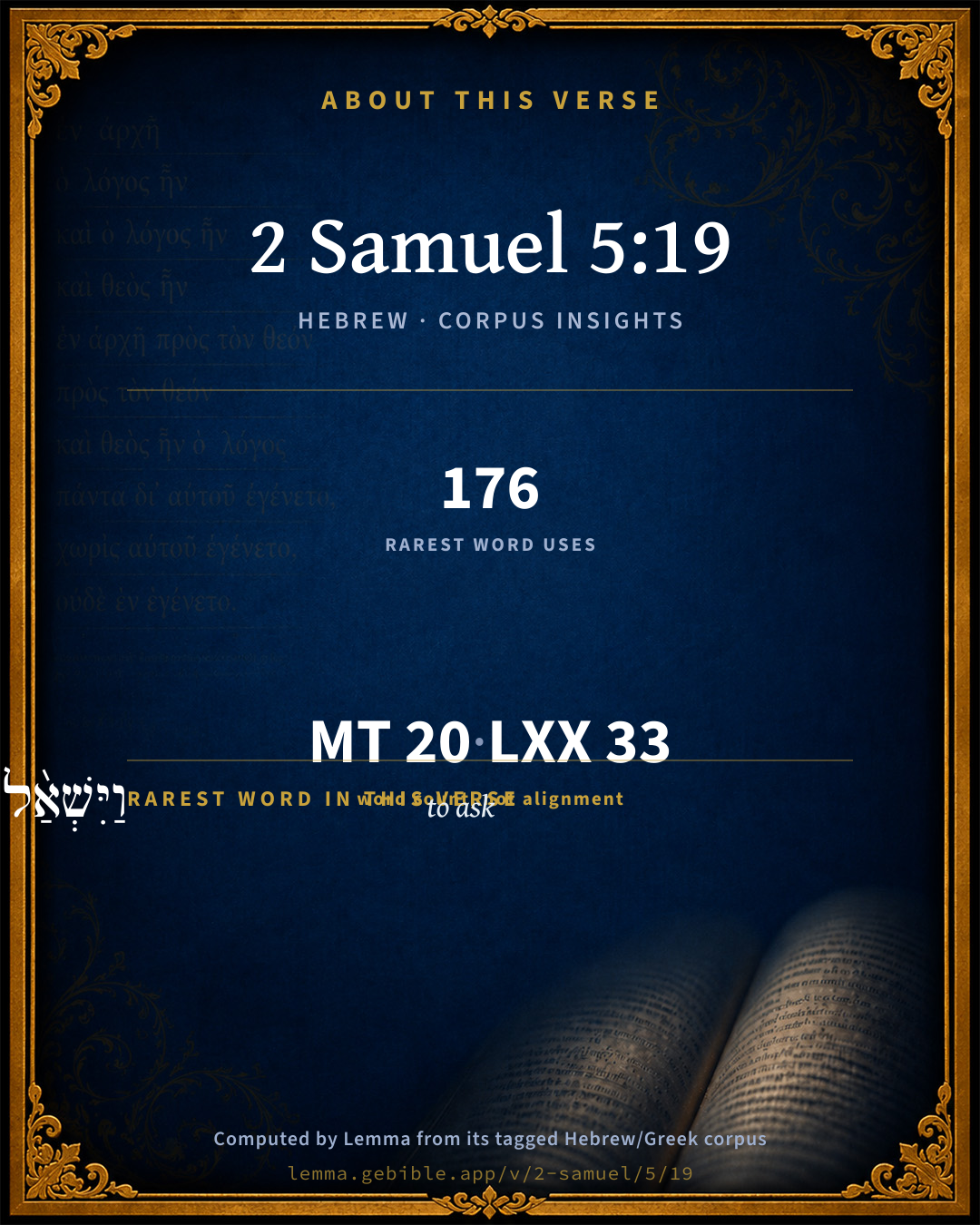
About this verse

These counts appear in no published source. They are computed here, from the morphology-tagged text and Lemma’s own curated glosses. What Lemma adds →

20
words
11
distinct lemmas
Historical
section

Grammatical profile

  • 8 verbs
  • 8 nouns
  • 2 prepositions
  • 1 conjunction
  • 1 particle

Verb forms

  • וַיִּשְׁאַ֨ל Qal · Sequential Imperfect
  • לֵאמֹ֔ר Qal · Infinitive Construct
  • הַאֶֽעֱלֶה֙ Qal · Imperfect
  • הֲתִתְּנֵ֖ם Qal · Imperfect
  • וַיֹּ֨אמֶר Qal · Sequential Imperfect
  • עֲלֵ֔ה Qal · Imperative
  • נָתֹ֥ן Qal · Infinitive Absolute
  • אֶתֵּ֛ן Qal · Imperfect

Repetition

Words recur within this verse — often emphatic in Hebrew:

  • הֲתִתְּנֵ֖ם to give H5414 ×3
  • דָּוִ֤ד David H1732 ×2
  • בַּֽיהוָה֙ LORD H3068 ×2
  • לֵאמֹ֔ר to say H559 ×2
  • הַאֶֽעֱלֶה֙ to go up H5927 ×2
  • פְּלִשְׁתִּ֔ים Philistine H6430 ×2
  • בְּיָדִ֑י hand H3027 ×2
  • אֶל to H413 ×2

Hebrew & Septuagint length

In English translation the verse runs 35 words from the Hebrew and 40 from the Septuagint (LXX English) — closely comparable.

A rough comparison of the two English renderings, which tokenize alike — not a word-level alignment.

Word counts can differ between the Hebrew and the Greek without any difference in meaning — e.g. the Hebrew direct-object marker אֵת has no separate Greek word, and Greek often adds the article ὁ.

In the original languages it is 20 Hebrew tokens and 33 Greek tokens — but the two are counted differently (Hebrew bundles its prefixes and suffixes into one token; the Greek is in lemma form), so that isn’t a like-for-like length.

Cross-references

11

Topical passages linked to 2 Samuel 5:19 in the Treasury of Scripture Knowledge — connected by theme and wording, ordered by reader-vote popularity; previews shown in the World English Bible.

  • 2 Samuel 2:1 It happened after this, that David inquired of Yahweh, saying, Shall I go up into any of the cities of Judah? Yahweh said to him, Go up. David said, Where shall I go up? He said, To Hebron.
  • 1 Samuel 23:2 Therefore David inquired of Yahweh, saying, Shall I go and strike these Philistines? Yahweh said to David, Go, and strike the Philistines, and save Keilah.
  • Judges 20:28 and Phinehas, the son of Eleazar, the son of Aaron, stood before it in those days), saying, Shall I yet again go out to battle against the children of Benjamin my brother, or shall I cease? Yahweh said, Go up; for tomorrow I will deliver him into your hand.
  • 2 Samuel 5:23 When David inquired of Yahweh, he said, You shall not go up: make a circuit behind them, and come on them over against the mulberry trees.
  • Proverbs 3:6 In all your ways acknowledge him, And he will direct your paths.
  • 1 Samuel 23:4 Then David inquired of Yahweh yet again. Yahweh answered him, and said, Arise, go down to Keilah; for I will deliver the Philistines into your hand.
  • 1 Samuel 30:7–8 David said to Abiathar the priest, the son of Ahimelech, Please bring me here the ephod. Abiathar brought there the ephod to David.
  • 1 Kings 22:15–23 When he was come to the king, the king said to him, Micaiah, shall we go to Ramoth-gilead to battle, or shall we forbear? He answered him, Go up and prosper; and Yahweh will deliver it into the hand of the king.
  • 1 Kings 22:6 Then the king of Israel gathered the prophets together, about four hundred men, and said to them, Shall I go against Ramoth-gilead to battle, or shall I forbear? They said, Go up; for the Lord will deliver it into the hand of the king.
  • James 4:15 For you ought to say, "If the Lord wills, we will both live, and do this or that."
  • 1 Samuel 28:6 When Saul inquired of Yahweh, Yahweh didn't answer him, neither by dreams, nor by Urim, nor by prophets.

Cross-references courtesy of OpenBible.info (CC BY 4.0).

Hebrew and Greek witnesses Masoretic Hebrew ↔ Greek Septuagint

The same verse in the two great witnesses to the Old Testament, shown verse-for-verse.

These are two independent witnesses, not word-aligned to each other, and the Septuagint is shown in lemma (dictionary) form.

Hebrew 2 Samuel 5:19 Masoretic · Westminster Leningrad Codex

וַיִּשְׁאַ֨ל דָּוִ֤ד בַּֽיהוָה֙ לֵאמֹ֔ר הַאֶֽעֱלֶה֙ אֶל פְּלִשְׁתִּ֔ים הֲתִתְּנֵ֖ם בְּיָדִ֑י וַיֹּ֨אמֶר יְהוָ֤ה אֶל דָּוִד֙ עֲלֵ֔ה כִּֽי נָתֹ֥ן אֶתֵּ֛ן אֶת הַפְּלִשְׁתִּ֖ים בְּיָדֶֽךָ

David inquired of Yahweh, saying, Shall I go up against the Philistines? will you deliver them into my hand? Yahweh said to David, Go up; for I will certainly deliver the Philistines into your hand.

World English Bible · Public Domain

Greek LXX 2 Samuel 5:19 Septuagint · lemma form

καί ἐρωτάω δαυίδ διά κύριος λέγω εἰ ἀναβαίνω πρός ὁ ἀλλόφυλος καί παραδίδωμι αὐτός εἰς ὁ χείρ ἐγώ καί εἶπον κύριος πρός δαυίδ ἀναβαίνω ὅτι παραδίδωμι παραδίδωμι ὁ ἀλλόφυλος εἰς ὁ χείρ σύ

And David enquired of the Lord, saying, Shall I go up against the Philistines? and will you deliver them into my hands? and the Lord said to David, Go up, for I will surely deliver the Philistines into your hands.

LXX2012 (modern English Septuagint) · Public Domain

On this verse, John Gill's Exposition discusses the Septuagint’s reading. Read the note in Commentary ↓

Hebrew: Westminster Leningrad Codex (CC BY 4.0). Greek: Septuagint (public domain); English from LXX2012 (modern English Septuagint) (Public Domain). How the Septuagint differs from the Hebrew →

Targum (Aramaic paraphrase)

1

The Targum is the ancient Jewish Aramaic paraphrase of the Hebrew Scriptures — an interpretive translation, not the Hebrew text itself. Onkelos (literal) and Pseudo-Jonathan (expansive) render the Torah, and Jonathan the Prophets. Coverage is partial: where no permissively-licensed English translation exists for a verse, only the Aramaic is shown. This is verse-level text, not a word-by-word alignment to the Hebrew.

  1. Targum Jonathan Prophets (Joshua–Malachi)
    וּשְׁאֵיל דָוִד בְּמֵימְרָא דַייָ לְמֵימַר הַאֶסַק עַל פְּלִשְׁתָּאֵי הֲתִמְסְרִינוּן בִּידִי וַאֲמַר יְיָ לְדָוִד סַק אֲרֵי מִמְסַר אֶמְסָר יַת פְּלִשְׁתָּאֵי בִּידָךְ:

    (no public-domain English translation for this verse)

    Targum Jonathan — Aramaic: “Mikraot Gedolot” (public domain). English: “Sefaria Community Translation” (CC0 1.0 (public-domain dedication)); “London "Chaldee Paraphrase," 1871” (public domain). Text via Sefaria.

Commentary

Notes on 2 Samuel 5:19 from classic Christian and Jewish commentators (each source and its license shown beneath its notes). The classic Christian expositions comment on the surrounding passage and are grouped to its opening verse, so a note may address several verses; the Jewish commentaries on the Tanakh (Rashi and others) are per-verse, so they appear only where the commentator wrote on this verse.

Lemma curates 59 commentaries, every one of them public domain or Creative Commons licensed, each selected and text-cleaned for this edition rather than reprinted as found. About our sources →

Trapp's Complete Commentary

John Trapp

2Sa 5:19 And David enquired of the LORD, saying, Shall I go up to the Philistines? wilt thou deliver them into mine hand? And the LORD said unto David, Go up: for I will doubtless deliver the Philistines into thine hand.

Ver. 19. And David enquired of the Lord.] Without whose direction he would not attempt anything; but said in effect, as Jdg 4:8, "If thou wilt go with me, then I will go; but if thou wilt not go with me, I will not go."

John Trapp, A Commentary or Exposition upon All the Books of the Old and New Testament (1647–1656) — public domain. Text from a community e-Sword module.

Joseph Benson's Commentary

2Sa 5:19. David inquired of the Lord — Though David went into a strong hold, he did not trust to that, nor intended merely to stand upon his defence. But yet he would not give them battle till he had asked counsel of God, and was encouraged by him to do it.

Joseph Benson's Commentary on the Old and New Testaments (1811–1818) — public domain. Text from a community e-Sword module.

Geneva Bible (1599)

Geneva Bible translators

By Abiathar the Priest.

Geneva Bible (1599) marginal notes — public domain. Text via Bolls.life.

Adam Clarke's Commentary

Verse 19. David inquired of the Lord] He considered himself only the captain of the Lord's host, and therefore would not strike a stroke without the command of his Superior.

Adam Clarke's Commentary on the Bible (1810–1826) — public domain. Text from a community e-Sword/MySword module.

The Cambridge Bible for Schools and Colleges

gen. ed. J. J. S. Perowne

19. inquired of the Lord] Cp. 1Sa_23:2, and note on ch. 2Sa_2:1.

The Cambridge Bible for Schools and Colleges (gen. ed. J. J. S. Perowne; Cambridge University Press, 1878–1918) — public domain. Text from a community e-Sword module.

John Gill's Exposition

And they left their images,.... Their idol gods, which they brought with them to protect and defend them, and give them success; perhaps in imitation of the Israelites, who formerly brought the ark of God into their camp against the Philistines, Sa1 4:3; and it appears to have been the custom of other countries, in later times, to bring their gods with them to battle (x):

and David and his men burnt them: that is, his men burnt them at his command, Ch1 14:12; agreeably to the law of God, that so no profit might be made of them, Deu 7:5; the Septuagint and Vulgate Latin versions, and others, render it, "and took them", or "carried them away" (y); as they might do, and, after they had exposed them in triumph, then burnt them.

(x) "Omnigenumque Deum", &c. Virgil. Aeneid. l. 8. (y) , Sept. "tulit", V. L. Tigurine version, Montanus; "sustulit", Junius & Tremellius, Piscator.

John Gill's Exposition of the Whole Bible (1746–1763) — public domain (CC PDM 1.0). Text via the HelloAO Bible API.

The Pulpit Commentary

Divine assurance of victory.

The enlargement and establishment of David"s kingdom, while a joy to Israel, was a grief to their old and formidable enemies, the Philistines. These came in great numbers into the territory of Israel, hoping to seize David himself (ver. 17), as the shortest way of putting an end to the newly united state. So formidable was the invasion that the king found it desirable to leave his new city and go "down to the hold," the fortress probably of Adullam, with such forces as he could collect; and when the enemy "spread themselves in the Valley of Rephaim," he sought direction and promise of victory from God before attacking them, and received the answer, "Go up," etc. Christians are called to a warfare with powerful enemies, who are the enemies of Christ and his kingdom; and it is their satisfaction that they have received Divine assurance of victory. They have to fight against the world, the flesh, and the devil, as they assail themselves and endanger their salvation, and as they prevail in the world and even invade the Church. They are powerful foes, with many resources at command, and their onset is at times alarming. As the Philistines with David, they may be expected to make specially violent assaults when special prosperity has been attained, but the results are not yet fully established. But it is the joy of Christ"s warriors that victory is certain. Each faithful soul shall successfully fight his own way to heaven, and the Church shall gain final and complete success in the battle with evil.

I HOW THE ASSURANCE OF VICTORY IS IMPARTED. How does God assure us that we shall be successful in the Christian war?

1. By the intuitions of the soul. When we distinctly place before our minds the combatants, we cannot doubt which.will ultimately be victorious. It is a conflict between good and evil, truth and error, right and wrong, holiness and sin, God and Satan. Evil is mighty, but good is almighty, because the living, true, and holy God is almighty.

2. By the promises and prophecies of his Word. These assure victory to every faithful soul in his own personal contest (see 1Co_10:13; Eph_6:10-13; Jam_4:7; Mat_24:13) and triumph to the Church in the conflict with error and sin in the world, notwithstanding the deep and firm hold they have upon men, their extensive prevalence, their long reign. These assurances abound throughout the Scriptures, culminating in the descriptions of the conflict in the Apocalypse, and of the victories of the great Leader and his forces, and summed up in the triumphant shout of the great voices in heaven: "The kingdoms of this world are become the kingdoms of our Lord and of his Christ, and he shall reign forever and ever". (Rev_11:15)

3. By the mission and work of our Lord Jesus Christ. He came as our "Leader and Commander", (Isa_55:4) and, by his personal conflict, endurance, and conquests, not only led the way for his followers, but secured victory for them. "Be of good cheer," he says, "I have overcome the world". (Joh_16:33; see also Heb_2:9, Heb_2:10, Heb_2:14-18; 1Co_15:24, 1Co_15:25)

4. By the victories already won. The gift of the Holy Spirit and his mighty operations in apostolic times and all through the Christian centuries. The victories over the old paganism; the Reformation; the revivals of religion at various periods; the successes of modern missions. Every true hearted Christian has in his own experience not only a pledge of final victory for himself, but an encouragement to seek the salvation of others.

II THE EFFECT WHICH SUCH ASSURANCE SHOULD HAVE UPON US. "Go up." Engage in the battle with evil; and do so with:

1. Confidence and courage.

2. Resolute zeal and determination.

3. Persistency, notwithstanding all delays, discouragements, and partial failures.

4. Songs of victory. Not only forevery advantage gained, but for the final and complete victory already to faith as good as won. If the hope of victory in other conflicts produces such effects, much more should the absolute certainty which the soldiers of Christ have. An altogether ill effect is that which the Divine assurances produce on some. They say that, as the battle is the Lord"s, and he is sure to conquer, their efforts are needless. As relates to a man"s own salvation, such a persuasion is fatal; for victory is promised only to the earnest combatant, and the assurance of Divine operation is made a reason why we should "work out our own salvation" (Luk_13:24; 1Ti_6:12; Php_2:12, 13) And as respects the spread and triumph of the kingdom of Christ, such a feeling indicates ignorance, indifference, indolence, and unfaithfulness, rather than faith in God. It is quite inconsistent with both Scripture and reason, and will deprive those who cherish it of all share in the joy of final victory, even if they are not utterly cast away as "wicked, slothful, and unprofitable". G.W. (Mat_25:26, Mat_25:30)

The Pulpit Commentary (1880–1919), ed. H.D.M. Spence-Jones & Joseph S. Exell — public domain. Text from a community e-Sword module.

unfoldingWord translationNotes

Door43 World Missions Community

Baal Perazim

This is the name of a place. (See: How to Translate Names)

Yahweh has burst through my enemies before me like a bursting flood of water

Here David speaks of the victory that Yahweh brought as if it were a flood of water that overflowed its banks and covered the land, causing destruction. AT: "Yahweh has overwhelmed my enemies like a flood overwhelms the land" (See: Simile)

translationWords

Yahweh

false god

David

unfoldingWord translationNotes — © Distant Shores Media and the Door43 World Missions Community, licensed CC BY-SA 4.0. Source: git.door43.org/Door43/en_tn.

Lesson kit

Teaching starters — assembled from the data on this page, not authored interpretation. Every prompt links to the verse data it draws on. Edit before teaching.

2 Samuel, in the Historical, opens this verse with 20 words (11 distinct Hebrew lemmas). Its most distinctive word is shâʼal (“to ask”). A historical commentator’s framing appears above. Read the whole chapter for the surrounding context.

Discussion questions

  1. The word shâʼal carries the sense “to ask.” How does it shape the verse?
  2. 2 Samuel 2:1 shares this passage’s theme. How do the two illuminate each other?
  3. “to give” occurs 3× in this one verse. What is the effect of the repetition?
  4. The translations on this page render this verse differently — a whole-verse word diff, not a word-by-word alignment. What might account for the different wordings?
  5. The verb «וַיִּשְׁאַ֨ל» is Qal Sequential Imperfect. How does its form color the action?
  6. Reading how Trapp's Complete Commentary and Joseph Benson's Commentary read this verse, where do the two commentators agree and where do they part?

Things to notice

Reading settings

Reading text

Shown beneath each verse's original-language words.

Old Testament
Old Testament edition

Read the OT as the Masoretic Hebrew (MT) or the Greek Septuagint (LXX).

English shown for the Greek Septuagint (in the Hebrew ↔ Greek comparison).

Comparing translations? Open the Compare panel on any verse page to stack up to four side by side.