
Isaiah 45:11

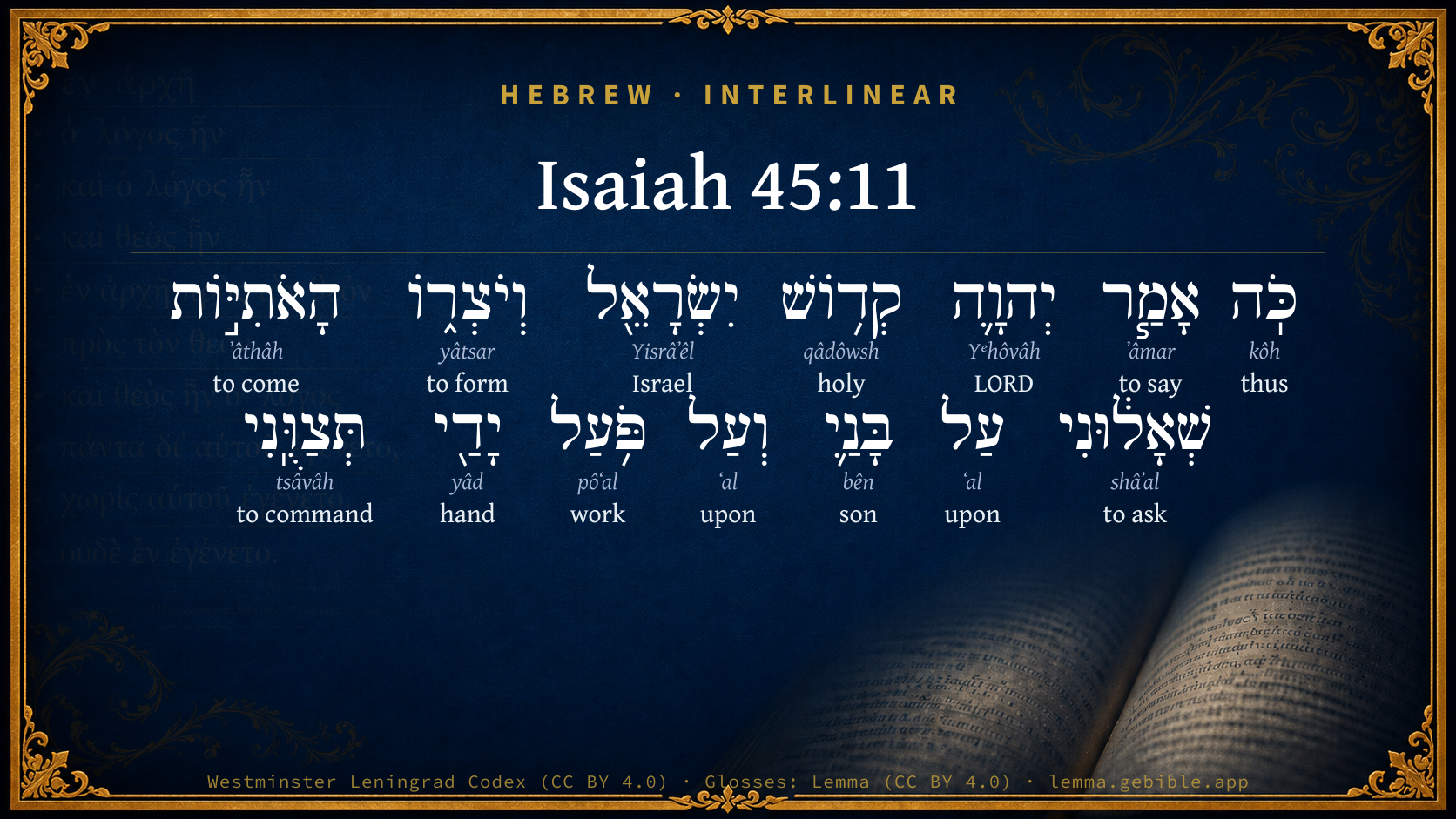
Hebrew (Westminster Leningrad Codex) Isaiah 45:11 appears in the Hebrew Old Testament. The text above is from the Westminster Leningrad Codex. Each word links to its Strong’s number, a concise gloss, and parsing drawn from the Open Scriptures Hebrew Bible morphology. Click any word for its full Brown-Driver-Briggs (BDB) entry.
Download image
Cite this verse

Isaiah 45:11 (World English Bible). Public Domain. Lemma interlinear Bible study tool, https://lemma.gebible.app/v/isaiah/45/11.

Show BibTeX & RIS
BibTeX
RIS
English Translation
Thus says Yahweh, the Holy One of Israel, and his Maker: Ask me of the things that are to come; concerning my sons, and concerning the work of my hands, command you me.
World English Bible · Public Domain
Download a study sheet

One document with this verse’s original text, its word-by-word gloss line, the meaning frame, cross-references with their text, attributed commentary, and full source and license credits — printable, and it pastes into notes with its structure intact.

This verse Autodidact and up

Study sheet (.html) Plain text (.txt)

A passage Seminary Student

Up to 50 verses in one chapter. A passage sheet keeps up to 6 commentary sources and 12 cross-references per verse, in the order this page ranks them, and says so on the sheet whenever that leaves anything out. Ask for a single verse and you get the Autodidact verse sheet above.

Everything on this page stays free to read, with no account — the sheet is a download of what is already on screen, not access to it.

Want to remove ads? Support Godless Engineer
Compare translations 3

The same verse in 3 English versions, stacked beneath the original-language interlinear above. Click any original word for its lexicon entry.

Each is an independent rendering of the whole verse — the interlinear is not word-aligned to these translations.

Highlighted words mark where these versions differ — a whole-verse word diff, not a word-by-word alignment.

  • World English Bible Public Domain
    Thus says Yahweh, the Holy One of Israel, and his Maker: Ask me of the things that are to come; concerning my sons, and concerning the work of my hands, command you me.
  • King James Version Public Domain
    Thus saith the LORD, the Holy One of Israel, and his Maker, Ask me of things to come concerning my sons, and concerning the work of my hands command ye me.
  • unfoldingWord Literal Text CC BY-SA 4.0
    Thus says Yahweh, the Holy One of Israel and his fashioner: “Do you ask me the coming concerning my sons, or command me concerning the work of my hands?

unfoldingWord Literal Text — © unfoldingWord, licensed CC BY-SA 4.0. Word-aligned USFM3 via Door43 (git.door43.org/unfoldingWord/en_ult).

Versions to compare (up to 4)

3 of 4 selected

Show all 18 translations

Every available English version of this verse, each an independent rendering of the whole verse.

  • World English Bible Public Domain
    Thus says Yahweh, the Holy One of Israel, and his Maker: Ask me of the things that are to come; concerning my sons, and concerning the work of my hands, command you me.
  • Berean Standard Bible Public Domain
    Thus says the LORD, the Holy One of Israel, and its Maker: “How dare you question Me about My sons, or instruct Me in the work of My hands?
  • Majority Standard Bible Public Domain
    Thus says the LORD, the Holy One of Israel, and its Maker: “Concerning things to come, do you question Me about My sons, or instruct Me in the work of My hands?
  • King James Version Public Domain
    Thus saith the LORD, the Holy One of Israel, and his Maker, Ask me of things to come concerning my sons, and concerning the work of my hands command ye me.
  • American Standard Version (1901) Public Domain
    Thus saith Jehovah, the Holy One of Israel, and his Maker: Ask me of the things that are to come; concerning my sons, and concerning the work of my hands, command ye me.
  • Revised Version (1885) Public Domain
    Thus saith the LORD, the Holy One of Israel, and his Maker: Ask me of the things that are to come concerning my sons, and concerning the work of my hands, command ye me.
  • Geneva Bible (1599) Public Domain
    Thus saith the Lord, the holy one of Israel, and his maker, Aske me of things to come concerning my sonnes, and concerning the workes of mine hands: commande you me.
  • Douay-Rheims (1899) Public Domain
    Thus saith the Lord the Holy One of Israel, his maker: Ask me of things to come, concerning my children, and concerning the work of my hands give ye charge to me.
  • Young's Literal Translation Public Domain
    Thus said Jehovah, The Holy One of Israel, and his Former: Ask Me of the things coming concerning My sons, Yea, concerning the work of My hands, ye command Me.'
  • Literal Standard Version CC BY-SA 4.0
    Thus said YHWH, The Holy One of Israel, and his Former: “Ask Me of the things coming concerning My sons, || Indeed, concerning the work of My hands, you command Me.
  • Unlocked Literal Bible CC BY-SA 4.0
    This is what Yahweh says, the Holy One of Israel, his Maker: 'Why do you ask questions about what I will do for my children? Do you tell me what to do concerning the work of my hands?'
  • unfoldingWord Literal Text CC BY-SA 4.0
    Thus says Yahweh, the Holy One of Israel and his fashioner: “Do you ask me the coming concerning my sons, or command me concerning the work of my hands?
  • Darby Bible Public Domain
    Thus saith Jehovah, the Holy One of Israel, and his Maker: Ask me of the things to come; concerning my sons, and concerning the work of my hands, command ye me.
  • World Messianic Bible Public Domain
    The LORD, the Holy One of Israel and his Maker says: “You ask me about the things that are to come, concerning my sons, and you command me concerning the work of my hands!
  • Webster's Bible Public Domain
    Thus saith the LORD, the Holy One of Israel, and his Maker, Ask me of things to come concerning my sons, and concerning the work of my hands command ye me.
  • Free Bible Version CC BY-SA 4.0
    This is what the Lord says, the Holy One of Israel, your Creator: You can ask me about things to come. But are you going to lecture me about my children and what I do?
  • Bible in Basic English Public Domain
    The Lord, the Holy One of Israel, and his Maker, says, Will you put a question to me about the things which are to come, or will you give me orders about my sons, and the work of my hands?
  • JPS Tanakh (1917) Public Domain
    Thus saith the LORD, the Holy One of Israel, and his Maker: Ask Me of the things that are to come; concerning My sons, and concerning the work of My hands, command ye Me.

Literal Standard Version (2020), Covenant Press — licensed CC BY-SA 4.0. Text via the HelloAO Bible API (eBible.org). Unlocked Literal Bible (unfoldingWord) — licensed CC BY-SA 4.0. Text via the HelloAO Bible API (eBible.org). unfoldingWord Literal Text — © unfoldingWord, licensed CC BY-SA 4.0. Word-aligned USFM3 via Door43 (git.door43.org/unfoldingWord/en_ult). Free Bible Version, Dr. Jonathan Gallagher — licensed CC BY-SA 4.0. Text via the HelloAO Bible API (eBible.org).

Word by word

More ways to search: Search by grammar → Find every occurrence → Compare this word →

Practice this passage: Drill this verse → Learn its vocabulary →

הָאֹתִיּ֣וֹת
ʼâthâh
H857
“the · coming”
Particle, Definite Article + Verb, Qal, Participle Active, Feminine, Plural, Absolute
Part of Speech
Particle + Verb
Stem
Qal
Form
Participle Active
Gender
Feminine
Number
Plural
State
Absolute
Full BDB Definition

Origin: a primitive root [collateral to H225 contraction]

TWOT: 188

to come, arrive - (Qal) to come (of men, time, beasts, calamity) - (Hiphil) to bring
  1. כֹּֽה kôh H3541 “thus” Adverb
  2. אָמַ֧ר ʼâmar H559 “to say” Verb, Qal, Perfect, 3rd Person, Masculine, Singular
  3. יְהוָ֛ה Yᵉhôvâh H3068 “LORD” Noun, Proper
  4. קְד֥וֹשׁ qâdôwsh H6918 “holy of” Adjective, Adjective, Masculine, Singular, Construct
  5. יִשְׂרָאֵ֖ל Yisrâʼêl H3478 “Israel” Noun, Proper
  6. וְיֹצְר֑וֹ yâtsar H3335 “and · forming · him” Conjunction + Verb, Qal, Participle Active, Masculine, Singular, Construct + Suffix, Personal, 3rd Person, Masculine, Singular
  7. שְׁאָל֔וּנִי shâʼal H7592 “ask · me” Verb, Qal, Imperative, 2nd Person, Masculine, Plural + Suffix, Personal, 1st Person, Common, Singular
  8. עַל ʻal H5921 “upon” Preposition
  9. בָּנַ֛י bên H1121 “sons · my” Noun, Common, Masculine, Plural, Construct + Suffix, Personal, 1st Person, Common, Singular
  10. וְעַל ʻal H5921 “and · upon” Conjunction + Preposition
  11. פֹּ֥עַל pôʻal H6467 “work of” Noun, Common, Masculine, Singular, Construct
  12. יָדַ֖י yâd H3027 “hands · my” Noun, Common, Both, Dual, Construct + Suffix, Personal, 1st Person, Common, Singular
  13. תְּצַוֻּֽנִי tsâvâh H6680 “to command · me” Verb, Piel, Imperfect, 2nd Person, Masculine, Plural + Suffix, Personal, 1st Person, Common, Singular

About this verse

These counts appear in no published source. They are computed here, from the morphology-tagged text and Lemma’s own curated glosses. What Lemma adds →

14
words
13
distinct lemmas
Prophets
section

Notable vocabulary

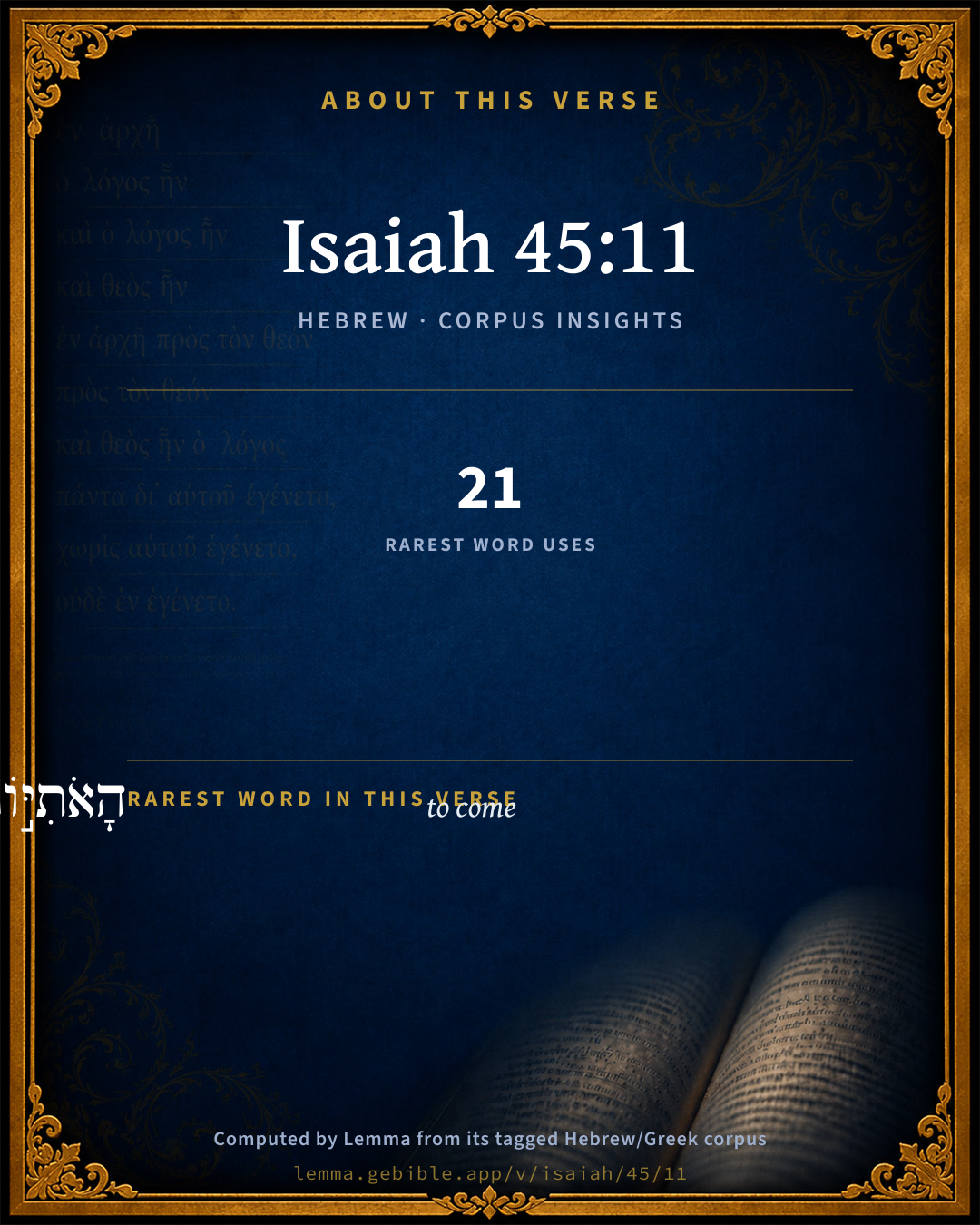
The rarest word here is הָאֹתִיּ֣וֹת to come H857 — appearing just 21 times in the whole Hebrew Bible.

Shared distinctive vocabulary

הָאֹתִיּ֣וֹת to come H857 occurs in 20 verses of the Hebrew Bible. Also found in:

Grammatical profile

  • 5 verbs
  • 5 nouns
  • 1 adjective
  • 2 prepositions
  • 1 adverb

Verb forms

  • אָמַ֧ר Qal · Perfect
  • וְיֹצְר֑וֹ Qal · Participle Active
  • הָאֹתִיּ֣וֹת Qal · Participle Active
  • שְׁאָל֔וּנִי Qal · Imperative
  • תְּצַוֻּֽנִי Piel · Imperfect

Repetition

A word recurs within this verse — often emphatic in Hebrew:

Hebrew & Septuagint length

In English translation the verse runs 33 words from the Hebrew and 35 from the Septuagint (LXX English) — closely comparable.

A rough comparison of the two English renderings, which tokenize alike — not a word-level alignment.

Word counts can differ between the Hebrew and the Greek without any difference in meaning — e.g. the Hebrew direct-object marker אֵת has no separate Greek word, and Greek often adds the article ὁ.

Cross-references

28

Topical passages linked to Isaiah 45:11 in the Treasury of Scripture Knowledge — connected by theme and wording, ordered by reader-vote popularity; previews shown in the World English Bible.

  • Jeremiah 33:3 Call to me, and I will answer you, and will show you great things, and difficult, which you don't know.
  • Isaiah 48:17 Thus says Yahweh, your Redeemer, the Holy One of Israel: I am Yahweh your God, who teaches you to profit, who leads you by the way that you should go.
  • Ezekiel 36:37 Thus says the Lord Yahweh: For this, moreover, will I be inquired of by the house of Israel, to do it for them: I will increase them with men like a flock.
  • Mark 11:24 Therefore I tell you, all things whatever you pray and ask for, believe that you receive them, and you shall have them.
  • Isaiah 29:23 But when he sees his children, the work of my hands, in the midst of him, they shall sanctify my name; yes, they shall sanctify the Holy One of Jacob, and shall stand in awe of the God of Israel.
  • Ephesians 2:10 For we are his workmanship, created in Christ Jesus for good works, which God prepared before that we would walk in them.
  • Joshua 10:12 Then spoke Joshua to Yahweh in the day when Yahweh delivered up the Amorites before the children of Israel; and he said in the sight of Israel, Sun, stand you still on Gibeon; You, Moon, in the valley of Aijalon.
  • Isaiah 43:21 the people which I formed for myself, that they might set forth my praise.
  • Isaiah 60:21 Your people also shall be all righteous; they shall inherit the land forever, the branch of my planting, the work of my hands, that I may be glorified.
  • Hosea 1:10 Yet the number of the children of Israel will be as the sand of the sea, which can't be measured nor numbered; and it will come to pass that, in the place where it was said to them, 'You are not my people,' they will be called 'sons of the living God.'
  • Genesis 32:26 The man said, "Let me go, for the day breaks." Jacob said, "I won't let you go, unless you bless me."
  • Isaiah 43:3 For I am Yahweh your God, the Holy One of Israel, your Savior; I have given Egypt as your ransom, Ethiopia and Seba in your place.
  • Isaiah 43:7 everyone who is called by my name, and whom I have created for my glory, whom I have formed, yes, whom I have made.
  • Isaiah 43:15 I am Yahweh, your Holy One, the Creator of Israel, your King.
  • Isaiah 64:8 But now, Yahweh, you are our Father; we are the clay, and you our potter; and we all are the work of your hand.
  • Jeremiah 31:9 They shall come with weeping; and with petitions will I lead them: I will cause them to walk by rivers of waters, in a straight way in which they shall not stumble; for I am a father to Israel, and Ephraim is my firstborn.
  • Hosea 12:4 Indeed, he had power over the angel, and prevailed; He wept, and made supplication to him. He found him at Bethel, and there he spoke with us,
  • Isaiah 19:25 because Yahweh of Hosts has blessed them, saying, Blessed be Egypt my people, and Assyria the work of my hands, and Israel my inheritance.
  • Jeremiah 3:19 But I said, How I will put you among the children, and give you a pleasant land, a goodly heritage of the hosts of the nations! and I said, You shall call me My Father, and shall not turn away from following me.
  • Ezekiel 39:7 My holy name will I make known in the midst of my people Israel; neither will I allow my holy name to be profaned any more: and the nations shall know that I am Yahweh, the Holy One in Israel.
  • Daniel 2:18 that they would desire mercies of the God of heaven concerning this secret; that Daniel and his companions should nor perish with the rest of the wise men of Babylon.
  • Daniel 9:2–3 in the first year of his reign I, Daniel, understood by the books the number of the years about which the word of Yahweh came to Jeremiah the prophet, for the accomplishing of the desolations of Jerusalem, even seventy years.
  • Romans 9:4–8 who are Israelites; whose is the adoption, the glory, the covenants, the giving of the law, the service, and the promises;
  • 2 Corinthians 6:18 I will be to you a Father. You will be to me sons and daughters,' says the Lord Almighty."
  • Galatians 3:26–29 For you are all children of God, through faith in Christ Jesus.
  • Judges 16:23 The lords of the Philistines gathered them together to offer a great sacrifice to Dagon their god, and to rejoice; for they said, Our god has delivered Samson our enemy into our hand.
  • Jeremiah 31:1 At that time, says Yahweh, will I be the God of all the families of Israel, and they shall be my people.
  • Daniel 9:24–27 Seventy weeks are decreed on your people and on your holy city, to finish disobedience, and to make an end of sins, and to make reconciliation for iniquity, and to bring in everlasting righteousness, and to seal up vision and prophecy, and to anoint the most holy.

Cross-references courtesy of OpenBible.info (CC BY 4.0).

Hebrew and Greek witnesses Masoretic Hebrew ↔ Greek Septuagint

The same verse in the two great witnesses to the Old Testament, shown verse-for-verse.

These are two independent witnesses, not word-aligned to each other, and the Septuagint is shown in lemma (dictionary) form.

Hebrew Isaiah 45:11 Masoretic · Westminster Leningrad Codex

כֹּֽה אָמַ֧ר יְהוָ֛ה קְד֥וֹשׁ יִשְׂרָאֵ֖ל וְיֹצְר֑וֹ הָאֹתִיּ֣וֹת שְׁאָל֔וּנִי עַל בָּנַ֛י וְעַל פֹּ֥עַל יָדַ֖י תְּצַוֻּֽנִי

Thus says Yahweh, the Holy One of Israel, and his Maker: Ask me of the things that are to come; concerning my sons, and concerning the work of my hands, command you me.

World English Bible · Public Domain

Greek LXX Isaiah 45:11 Septuagint · lemma form

ὅτι οὕτως λέγω κύριος ὁ θεός ὁ ἅγιος ἰσραήλ ὁ ποιέω ὁ ἐπιἔρχομαι ἐρωτάω ἐγώ περί ὁ υἱός ἐγώ καί περί ὁ θυγάτηρ ἐγώ καί περί ὁ ἔργον ὁ χείρ ἐγώ ἐντέλλομαι ἐγώ

For thus says the Lord God, the Holy One of Israel, who has formed the things that are to come, Enquire of me concerning my sons, and concerning the works of my hands command me.

LXX2012 (modern English Septuagint) · Public Domain

On this verse, Adam Clarke's Commentary discusses the Septuagint’s reading. Read the note in Commentary ↓

Hebrew: Westminster Leningrad Codex (CC BY 4.0). Greek: Septuagint (public domain); English from LXX2012 (modern English Septuagint) (Public Domain). How the Septuagint differs from the Hebrew →

Targum (Aramaic paraphrase)

1

The Targum is the ancient Jewish Aramaic paraphrase of the Hebrew Scriptures — an interpretive translation, not the Hebrew text itself. Onkelos (literal) and Pseudo-Jonathan (expansive) render the Torah, and Jonathan the Prophets. Coverage is partial: where no permissively-licensed English translation exists for a verse, only the Aramaic is shown. This is verse-level text, not a word-by-word alignment to the Hebrew.

  1. Targum Jonathan Prophets (Joshua–Malachi)
    כִּדְנַן אֲמַר יְיָ קַדִישָׁא דְיִשְׂרָאֵל וּדְאַתְקְנֵהּ אַתְיָא דַעֲתִידִין לְמֵיתֵי אַתּוּן שָׁאֲלִין מִן קֳדָמַי עַל עַמִי וְעַל עוֹבַד גְבוּרְתִּי תְּפַקְדוּנַנִי:

    Thus saith the Lord, the Holy One of Israel, and He that formed him, Ye question me about things concerning my people, which shall come to pass; and will ye command me concerning the work of my power?

    Targum Jonathan — Aramaic: “Mikraot Gedolot” (public domain). English: “Sefaria Community Translation” (CC0 1.0 (public-domain dedication)); “London "Chaldee Paraphrase," 1871” (public domain). Text via Sefaria.

Commentary

Notes on Isaiah 45:11 from classic Christian and Jewish commentators (each source and its license shown beneath its notes). The classic Christian expositions comment on the surrounding passage and are grouped to its opening verse, so a note may address several verses; the Jewish commentaries on the Tanakh (Rashi and others) are per-verse, so they appear only where the commentator wrote on this verse.

Lemma curates 59 commentaries, every one of them public domain or Creative Commons licensed, each selected and text-cleaned for this edition rather than reprinted as found. About our sources →

Matthew Henry's Commentary

The people of God in captivity, who reconciled themselves to the will of God in their affliction and were content to wait his time for their deliverance, are here assured that they should not wait in vain.

I. They are invited to enquire concerning the issue of their troubles, Isa 45:11. The Holy One of Israel, and his Maker, though he does not allow them to strive with him, yet encourages them, 1. To consult his word: "Ask of me things to come; have recourse to the prophets and their prophecies, and see what they say concerning these things. Ask the watchmen, What of the night? Ask them, How long?" Things to come, as far as they are revealed, belong to us and to our children, and we must not be strangers to them. 2. To seek unto him by prayer: "Concerning my sons and concerning the work of my hands, which as becomes them submit to the will of their Father, the will of their potter, command you me, not by way of prescription, but by way of petition. Be earnest in your requests, and confident in your expectations, as far as both are guided by and grounded upon the promise." We may not strive with our Maker by passionate complaints, but we may wrestle with him by faithful and fervent prayer. My sons, and the work of my hands, commend to me (so some read it), bring them to me and leave them with me. See the power of prayer, and its prevalency with God: Thou shalt cry, and he shall say, Here I am; what would you that I should do unto you? Some read it with an interrogation, as carrying on the reproof (Isa 45:9, Isa 45:10): Do you question me concerning things to come? and am I bound to give you an account? And concerning my children, even concerning the work of my hands, will you command me, or prescribe to me? Dare you do so? Shall any teach God knowledge, or give law to him? Those that complain of God do in effect assume an authority over him.

II. They are encouraged to depend upon the power of God when they are brought very low and are utterly incapable of helping themselves, Isa 45:12. Their help stands in the name of the Lord, who made heaven and earth, which he mentions here, not only for his own glory, but for their comfort. The heavens and earth shall contribute, if he please, to the deliverance of the church (Isa 45:8), for he created both, and therefore has both at command. 1. He made the earth, and created man upon it, for it was intended to be a habitation for man, Psa 115:16. He has therefore not only authority, but wisdom and power sufficient to govern man here on this earth and to make what use he pleases of him. 2. His hands have stretched out the heavens, and all their hosts he commanded into being at first, and therefore still governs all their motions and influences. It is good news to God's Israel that their God is the creator and governor of the world.

III. They are particularly told what God would do for them, that they might know what to depend upon; and this shall lead them to expect a more glorious Redeemer and redemption, of whom, and of which, Cyrus and their deliverance by him were types and figures.

1. Liberty shall be proclaimed to them, Isa 45:13. Cyrus is the man that shall proclaim it; and, in order hereunto, God will put power into his hands: I have raised him up in righteousness, that is, in pursuance and performance of my promises and to plead my people's just but injured cause. He will give him success in all his enterprises, particularly that against Babylon: I will direct all his ways; and then it follows that he will prosper him, for those must needs speed well that are under a divine direction. God will make plain the way of those whom he designs to employ for him. Two things Cyrus must do for God: - (1.) Jerusalem is God's city, but it is now in ruins, and he must rebuild it, that is, he must give orders for the rebuilding of it, and give wherewithal to do it. (2.) Israel is God's people, but they are now captives, and he must release them freely and generously, not demanding any ransom, nor compounding with them for price or reward. And Christ is anointed to do that for poor captive souls which Cyrus was to do for the captive Jews, to proclaim the opening of the prison to those that were bound (Isa 61:1), enlargement from a worse bondage than that in Babylon.

2. Provision shall be made for them. They went out poor, and unable to bear the expenses of their return and re-establishment; and therefore it is promised that the labour of Egypt and other nations should come over to them and be theirs, Isa 45:14. Cyrus, having conquered those countries, out of their spoils provided for the returning Jews; and he ordered his subjects to furnish them with necessaries (Ezr 1:4), so that they did not go out empty from Babylon any more than from Egypt. Those that are redeemed by Christ shall be not only provided for, but enriched. Those whose spirits God stirs up to go to the heavenly Zion may depend upon him to bear their charges. The world is theirs as far as is good for them.

3. Proselytes shall be brought over to them: Men of stature shall come after thee in chains; they shall fall down to thee, saying, Surely God is in thee. This was in part fulfilled when many of the people of the land became Jews (Est 8:17), and said, We will go with you, humbly begging leave to do so, for we have heard that God is with you, Zac 8:23. The restoration would be a means of the conviction of many and the conversion of some. Perhaps many of the Chaldeans who were now themselves conquered by Cyrus, when they saw the Jews going back in triumph, came and begged pardon for the affronts and abuses they had given them, owned that God was among them and that he was God alone, and therefore desired to join themselves to them. But this promise was to have its full accomplishment in the gospel church, - when the Gentiles shall become obedient by word and deed to the faith of Christ (Rom 15:18), as willing captives to the church (Psa 110:3), glad to wear her chains, - when an infidel, beholding the public worship of Christians, shall own himself convinced that God is with them of a truth (Co1 14:24, Co1 14:25) and shall assay to join himself to them, - and when those that had been of the synagogue of Satan shall come and worship before the church's feet, and be made to know that God has loved her (Rev 3:9), and the kings of the earth and the nations shall bring their glory into the gospel Jerusalem, Rev 21:24. Note, It is good to be with those, though it be in chains, that have God with them.

IV. They are taught to trust God further than they can see him. The prophet puts this word into their mouths, and goes before them in saying it (Isa 45:15): Verily, thou art a God that hidest thyself. 1. God hid himself when he brought them into the trouble, hid himself and was wroth, Isa 57:17. Note, Though God be his people's God and Saviour, yet sometimes, when they provoke him, he hides himself from them in displeasure, suspends his favours, and lays them under his frowns: but let them wait upon the Lord that hides his face, Isa 8:17. 2. He hid himself when he was bringing them out of the trouble. Note, When God is acting as Israel's God and Saviour commonly his way is in the sea, Psa 77:19. The salvation of the church is carried on in a mysterious way, by the Spirit of the Lord of hosts working on men's spirits (Zac 4:6), by weak and unlikely instruments, small and accidental occurrences, and not wrought till the last extremity; but this is our comfort, though God hide himself, we are sure he is the God of Israel, the Saviour. See Job 35:14.

V. They are instructed to triumph over idolaters and all the worshippers of other gods (Isa 45:16): Those who are makers of idols, not only who frame them, but who make gods of them by praying to them, shall be ashamed and confounded, when they shall be convinced of their mistakes and shall be forced to acknowledged that the God of Israel is the only true God, and when they shall be disappointed in their expectations from their idols, under whose protection they had put themselves. They shall go to confusion when they shall find that they can neither excuse the sin nor escape the punishment of it, Psa 97:7. It is not here and there one more timorous than the rest that shall thus shrink, and give up the cause, but all of them; nay, though they appear in a body, though hand join in hand, and they do all they can to keep one another in countenance, yet they shall go to confusion together. Bind them in bundles, to burn them.

VI. They are assured that those who trust in God shall never be made ashamed of their confidence in him, Isa 45:17. Now that God was about to deliver them out of Babylon he directed them by his prophet, 1. To look up to him as the author of their salvation: Israel shall be saved in the Lord. Not only their salvation shall be wrought out by his power, but it shall be treasured up for them in his grace and promise, and so secured to them. They shall be saved in him; for his name shall be their strong tower, into which they shall run, and in which they shall be safe. 2. To look beyond this temporal deliverance to that which is spiritual and has reference to another world, to think of that salvation by the Messiah which is an everlasting salvation, the salvation of the soul, a rescue from everlasting misery and a restoration to everlasting bliss. "Give diligence to make that sure, for it may be made sure, so sure that you shall not be ashamed nor confounded world with out end. You shall not only be delivered from the everlasting shame and contempt which will be the portion of idolaters (Dan 12:2), but you shall have everlasting honour and glory." [1.] There is a world without end; and it will be well or ill with us according as it will be with us in that world. [2.] Those who are saved with the everlasting salvation shall never be ashamed of what they did or suffered in the hopes of it; for it will so far outdo their expectations as to be a more abundant reimbursement. The returning captives owned that to them did belong confusion of face (Dan 9:7, Dan 9:8); yet God tells them that they shall not be confounded, but shall have assurance for ever. Those who are confounded as penitents for their own sin shall not be confounded as believers in God's promise and power.

VII. They are engaged for ever to cleave to God, and never to desert him, never to distrust him. What had been often inculcated before is here again repeated, for the encouragement of his people to continue faithful to him, and to hope that he would be so to them: I am the Lord, and there is none else. That the Lord we serve and trust in is God alone appears by the two great lights, that of nature and that of revelation.

1. It appears by the light of nature; for he made the world, and therefore may justly demand its homage (Isa 45:18): "Thus saith the Lord, that created the heavens and formed the earth, I am the Lord, the sovereign Lord of all, and there is none else." The gods of the heathen did not do this, nay, they did not pretend to do it. He here mentions the creation of the heavens, but enlarges more upon that of the earth, because that is the part of the creation which we have the nearest view of and are most conversant with. It is here observed, (1.) That he formed it. It is not a rude and indigested chaos, but cast into the most proper shape and size by Infinite Wisdom. (2.) That he fixed it. When he had made it he established it, founded it on the seas, (Psa 24:2), hung it on nothing (Job 26:7) as at first he made it of nothing, and yet made it substantial an hung it fast, ponderibus librata suis - poised by its own weight. (3.) That he fitted it for use, and for the service of man, to whom he designed to give it. He created it not in vain, merely to be a proof of his power; but he formed it to be inhabited by the children of men, and for that end he drew the waters off from it, with which it was at first covered, and made the dry land appear, Psa 104:6, Psa 104:7. Be it observed here, to the honour of God's wisdom, that he made nothing in vain, but intended every thing for some end and fitted it to answer the intention. If any man prove to have been made in vain, it is his own fault. It should also be observed, to the honour of God's goodness and his favour to man, that he reckoned that not made in vain which serves for his use and benefit, to be a habitation and maintenance for him.

2. It appears by the light of revelation. As the works of God abundantly prove that he is God alone, so does his word, and the discovery he has made of himself and of his mind and will by it. His oracles far exceed those of the Pagan deities, as well as his operations, Isa 45:19. The preference is here placed in three things: - All that God has said is plain, satisfactory, and just. (1.) In the manner of the delivery of it it is plain and open: I have not spoken in secret, in a dark place of the earth. The Pagan deities delivered their oracles out of dens and caverns, with a low and hollow voice, and in ambiguous expressions; those that had familiar spirits whispered and muttered (Isa 8:19); but God delivered his law from the top of Mount Sinai before all the thousands of Israel, in distinct, audible, and intelligible sounds. Wisdom cries in the chief places of concourse, Pro 1:20, Pro 1:21; Pro 8:1-3. The vision is written, and made plain, so that he who runs may read it; if he be obscure to any, they may thank themselves. Christ pleaded in his own defence what God says here, In secret have I said nothing, Joh 18:20. (2.) In the use and benefit of it it was highly satisfactory: I said not unto the seed of Jacob, who consulted these oracles and governed themselves by them, Seek you me in vain, as the false gods did to their worshippers, who sought for the living to the dead, Isa 8:19. This includes all the gracious answers that God gave both to those who consulted him (his word is to them a faithful guide) and to those that prayed to him. The seed of Jacob are a praying people; it is the generation of those that seek him, Psa 24:6. And, as he has in his word invited them to seek him, so he never denied their believing prayers nor disappointed their believing expectations. He said not to them, to any of them, Seek you me in vain; for, if he did not think fit to give them the particular thing they prayed for, yet he gave them such a sufficiency of grace and such comfort and satisfaction of soul as were equivalent. What we say of winter is true of prayer, It never rots in the skies. God not only gives a gracious answer to those that diligently seek him, but will be their bountiful rewarder. (3.) In the matter of it it was incontestably just, and there was no iniquity in it: I the Lord speak righteousness, I declare things that are right, and consonant to the eternal rules and reasons of good and evil. The heathen deities dictated those things to their worshippers which were the reproach of human nature and tended to the extirpation of virtue; but God speaks righteousness, dictates that which is right in itself and tends to make men righteous; and therefore he is God, and there is none else.

Matthew Henry's Commentary on the Whole Bible (1708–1710) — public domain (CC PDM 1.0). Text via the HelloAO Bible API.

Trapp's Complete Commentary

John Trapp

Isa 45:11 Thus saith the LORD, the Holy One of Israel, and his Maker, Ask me of things to come concerning my sons, and concerning the work of my hands command ye me.

Ver. 11. Thus saith the Lord, &c., ] q.d., Leave off such insolent and unbecoming language, and learn of me about what ye should rather busy yourselves.

Ask me of things to come.] Me, and not your wizards. Have recourse to "my prophets; believe them, and ye shall prosper." Let your patient mind be known to all men; the Lord is at hand for your deliverance.

Command ye me.] This is a wonderful expression, and doth notably set forth the power of prayer. Luther, it seemeth, well understood the latitude of this royal charter, saith one, {a} when praying for the recovery of a godly useful preacher who was far gone in a consumption, among other passages he let fall this transcendent rapture of a daring faith, "Let my will be done," but then he falls off sweetly, "My will, Lord, because thy will."

{a} Mr Burr.

John Trapp, A Commentary or Exposition upon All the Books of the Old and New Testament (1647–1656) — public domain. Text from a community e-Sword module.

The Biblical Illustrator

Joseph S. Exell

Isa_45:11

Thus saith the Lord . . . Ask Me

Prayer and criticism

Ask Me, but do not criticise Me.

Command Me must mean leave to My care. (Prof. J. Skinner, D. D.)

Encouragement to pray from the names of God

The Lord--that is, God in His everlasting redemptive purpose; the Holy One of Israel--that is, the moral perfections of Israels God, as contrasted with the abominations perpetrated under the sanction of heathen religions; his Maker--suggesting the purpose which from the clay gathered in Abrahams time from the highlands of Mesopotamia, was fashioning a fair vessel meet for His use. This threefold description of God introduces the august command which bade the people seek by prayer the fulfilment of the purpose on which the Divine heart was set. (F. B. Meyer, B. A.)

Putting forth of` Gods power dependent on prayer

In launching an ironclad, the pressure of a babys finger is not infrequently required to put in operation the ponderous machinery by which the iron leviathan glides evenly and majestically on to the ocean wave. So, if we may dare to say it, all the purposes of God, and the providential machinery by which they were to be executed, stood in suspense until the chosen people had asked for the things which He had promised, and had even commanded Him concerning the work on which His heart was set. (F. B. Meyer, B. A.)

Asking and commanding

I. PRAYER IS A NECESSARY LINK IN THE PERFORMANCE OF THE DIVINE PROMISES. Ask Me of things to come. Even to the Son, Jehovah says, Ask of Me, and I will give Thee the heathen, &c. And to the chosen people, at the end of a paragraph beginning with I will, and unfolding the work which He is prepared to do, not for their sakes, but for His own--He says, For this, moreover, will I be inquired of by the house of Israel, to do it for them. Our Lord is unremitting in the stress He lays on prayer, and pledges Himself to do only whatsoever is asked in His name.

1. Prayer is part of the system of co-operation between God and man which pervades nature and life.

2. Prayer, when genuine, indicates the presence of a disposition to which God can entrust His best gifts without injury to the recipient. To bless some men, apart from humility and submission, and weanedness of soul from creature aid, would only injure. And so, in His dear love, God withholds His choicest gifts until the heart is sore broken, and cries to Him. That cry is the blessed symptom of soul-health.

3. Prayer is also in its essence, when inspired by faith, an openness towards God, a receptiveness, a faculty of apprehending with open hand what He would impart. Let us pray--

(1) Unitedly. God would be inquired of by the house of Israel.

(2) Sympathetically. A prayer offered in the presence of others should receive their endorsement.

(3) Earnestly. The Divine gauge of the worth of prayer is its pressure on the heart of God.

(4) In the name of Jesus.

II. THE IMPERATIVE ACCENT IN FAITH. Concerning My sons, and concerning the work of My hands, command ye Me. Our Lord spoke in this tone when He said, Father, I will. Joshua used it when in the supreme moment of triumph he lifted up his spear towards the setting sun, and cried, Sun, stand thou still! Elijah used it when he shut the heavens for three years and six months, and again opened them. Luther used it when, kneeling by the dying Melanchthon, he forbade death to take his prey. It is a marvellous relationship into which God bids us enter. We are accustomed to obey Him. But with the single limitation that our biddings must concern His sons, and the work of His hands, and must be included in His word of promise, Jehovah says to us, His redeemed children in Jesus Christ, Command ye Me! The world is full of mighty forces which are labouring for our weal. How is it that these great natural forces--which are manifestations of the power of God--so absolutely obey man? Is it not because, since the days of Bacon, man has so diligently studied, and so absolutely obeyed, the conditions under which they work? Obey the law of a force, and the force will obey you, is almost an axiom in physics. So God gives the Holy Spirit to them that obey Him. All the resources of God dwell bodily in the risen and glorified Lord. Obey Him, and He pours such mighty energy into and through the spirit that men are amazed at the prodigality of its supply; resist or thwart Him, and He retires from the spirit, leaving it to struggle as best it may with its difficulties and trials. But after our greatest deeds of prayer and faith we shall ever lie low before God; as Elijah did, who, after calling fire from heaven, prostrated himself on the ground, with his face between his knees. (F. B. Meyer, B. A.)

Counsel for Gods people in trouble

(Isa_45:11-15):--

I. THE PEOPLE OF GOD IN CAPTIVITY ARE INVITED TO INQUIRE CONCERNING THE ISSUE OF THEIR TROUBLES (Isa_45:11). The Holy One of Israel, though He doth not allow them to strive with Him, yet encourageth them--

1. To consult His Word. Ask Me of things to come.

2. To seek unto Him by prayer. Command ye Me.

II. THEY ARE ENCOURAGED TO DEPEND ON THE POWER OF GOD WHEN THEY WERE BROUGHT VERY LOW, AND WERE UTTERLY INCAPABLE OF HELPING THEMSELVES (Isa_45:12).

III. THEY ARE PARTICULARLY TOLD WHAT GOD WOULD DO FOR THEM, THAT THEY MIGHT KNOW WHAT TO DEPEND UPON (Isa_45:13-14).

IV. THEY ARE TAUGHT TO TRUST GOD FURTHER THAN THEY CAN SEE HIM (Isa_45:15). (M. Henry.)

Gods abounding liberality

I am told that, in the olden times, on Christmas Day, it was the custom in country villages for the squire always to fill with good things whatever vessels the poor people brought up to the hall, that they might have a Christmas dinner. It was strange how big the basins grew year after year. Whenever the man came round with the crockery cart, every good housewife would look all over his stock to see if there was not a still larger basin. It was a rule that the squires servants should always fill the bowl, whatever size it was, and thus the bowls grew bigger and bigger. God will fill your bowl, however large it is! Get as big a bowl as you can; and when you bring it, if ever there comes a whisper in your ear, Now you have presumed upon Gods benevolence, you have brought too big a bowl, smile at yourself, and say, This is as nothing to His overflowing fulness. If I said, O poor sea, poor sea, now thou wilt be drained dry, for they bring such big bowls to be filled with thy waters; the sea, tossing its mighty billows far and wide, would laugh at my folly. Come, then, and bring your largest conceptions of God, and multiply them ten thousandfold, and believe in Him as this Book would make you believe in Him. Open thy mouth wide, and He will fill it. He bids you even to command Him. He says, Ask Me of things to come concerning My sons, and concerning the work of My hands command ye Me. That is a wonderful expression; rise to the sublimity of faith, and be daring with your God. (C. H. Spurgeon.)

The Biblical Illustrator, edited by Joseph S. Exell (c. 1880s–1900s) — public domain. Text from a community e-Sword module.

Joseph Benson's Commentary

Isa 45:11-13. Thus saith the Holy One of Israel, and his Maker — Israel’s Maker. A preface this which always ushers in some gracious promise: see Isa 43:1; Isa 43:3; Isa 43:14; and Isa 44:6; and Isa 48:17. Ask me of things to come, &c. — The words thus rendered contain a concession, and the sense of them may be this: although the potter doth not give an account to the clay, nor parents to their children, yet I will so far condescend to you as to be at your command in this matter, to give you an account of those great actions of mine for which you quarrel with me. Many interpreters, however, prefer rendering the words interrogatively, thus: Do you, or will you, ask, or question me, of things to come concerning my sons? and concerning the work of my hands will you command me? As if he had said, Will you not allow me the liberty which yourselves take, of disposing of my own children and works as I see fit? Must I give you an account of these matters? Which he does in the words following. I have made the earth, and created man, &c. — The earth and its inhabitants are wholly and solely my creatures, and therefore are absolutely at my disposal. I have raised him up — Namely, Cyrus, named before, Isa 45:1; in righteousness — Not in a way of absolute sovereignty, as I might have done, but most justly to punish the oppressors of my people, to plead the cause of the oppressed, and to manifest my righteousness, truth, and goodness. And I will direct his ways — Will guide and assist him in all his marches, wars, and battles, crowning all his undertakings with success. He shall let go my captives, not for price, &c. — That is, freely, without requiring any ransom for them, as is usual in such cases. Such an exact prediction of events, which depended on the mind and will of Cyrus, is mentioned here as an infallible evidence of the certainty of God’s foreknowledge, and of his being the only true God, because idols could discover no such things.

Joseph Benson's Commentary on the Old and New Testaments (1811–1818) — public domain. Text from a community e-Sword module.

The Preacher's Complete Homiletical Commentary

Joseph S. Exell (gen. ed.)

THE PEOPLE OF A PRAYER-HEARING GOD

Isa_45:11-13. Thus saith the Lord, &c.

A wonderful promise wonderfully fulfilled. The facts and principles involved in it are of perpetual value.

I. God has a people whom He distinguishes as His sons.

II. He is specially concerned for their welfare and happiness, present and future.

III. He is always ready to interpose for them; you may ask, command.

IV. He has ample ability and resources for their help.

V. He has made final provision for their final deliverance out of all trouble.—J. Lyth, D.D., Homiletical Treasury, Isaiah, p. 61.

The Preacher's Complete Homiletical Commentary (gen. ed. Joseph S. Exell; Funk & Wagnalls, c. 1892) — public domain (pre-1929). A full-Bible homiletical/sermon-outline anthology covering 65 of 66 books (2 John is absent from the source module). Text from a community e-Sword module.

Keil & Delitzsch

C. F. Keil & F. Delitzsch

After this double woe, which is expressed in general terms, but the application of which is easily made, the words of Jehovah are directly addressed to the presumptuous criticizers. Isa 45:11 "Thus saith Jehovah, the Holy One of Israel, and its Maker, Ask me what is to come; let my sons and the work of my hands be committed to me!" The names by which He calls Himself express his absolute blamelessness, and His absolute right of supremacy over Israel. שׁאלוּני is an imperative, like שׁמעוּני in Gen 23:8; the third person would be written שׁאלוּני. The meaning is: If ye would have any information or satisfaction concerning the future ("things to come," Isa 41:23; Isa 44:7), about which ye can neither know nor determine anything of yourselves, inquire of me. צוּה with an accusative of the person, and על of the thing, signifies to commit anything to the care of another (Ch1 22:12). The fault-finders in Israel were to leave the people of whom Jehovah was the Maker (a retrospective allusion to Isa 45:10 and Isa 45:9), in the hands of Him who has created everything, and on whom everything depends. Isa 45:12 "I, I have made the earth, and created men upon it; I, my hands have stretched out the heavens, and all their host have I called forth." ידי אני, according to Ges. 121, 3, is equivalent to my hands, and mine alone - a similar arrangement of words to those in Gen 24:27; Ch2 28:10; Ecc 2:15. Hitzig is wrong in his rendering, "all their host do I command." That of Ewald is the correct one, "did I appoint;" for tsivvâsh, followed by an accusative of the person, means to give a definite order or command to any one, the command in this case being the order to come into actual existence (= esse jussi, cf., Psa 33:9).

Keil & Delitzsch — Biblical Commentary on the Old Testament (1861–1891) — public domain (CC PDM 1.0). Text via the HelloAO Bible API. (Old Testament only.)

Geneva Bible (1599)

Geneva Bible translators

Instead of murmuring, humble yourselves, and ask what ye will for the consolation of my children, and you shall be sure of it, as ye are of these things which are at your commandment. Some read it with an interrogation, and make it the application of the similitude.

Geneva Bible (1599) marginal notes — public domain. Text via Bolls.life.

Jamieson, Fausset & Brown

Robert Jamieson, A. R. Fausset & David Brown

Ask . . . command--Instead of striving with Me in regard to My purposes, your wisdom is in prayer to ask, and even command Me, in so far as it is for My glory, and for your real good (Mar 11:24; Joh 16:23, Joh 16:13, latter part of the verse; Jo1 3:22).

sons-- (Isa 54:13; Gal 3:26).

work of my hands--spiritually (Eph 2:10); also literal Israel (Isa 60:21). MAURER translates, instead of "command," Leave it to Me, in My dealings concerning My sons and concerning the work of My hands, to do what I will with My own. LOWTH reads it interrogatively, Do ye presume to question Me and dictate to Me (see Isa 45:9-10)? The same sense is given, if the words be taken in irony. But English Version is best.

Jamieson, Fausset & Brown — Commentary Critical and Explanatory on the Whole Bible (1871) — public domain (CC PDM 1.0). Text via the HelloAO Bible API.

Adam Clarke's Commentary

Verse 11. Ask me of things to come - "And he that formeth the things which are to come"] I read ויוצר veyotser, without the ו vau suffixed; from the Septuagint, who join it in construction with the following word, ὁ ποιησας τα επερχομενα.

"Do ye question me." - תשאלוני tishaluni, Chald. recte; praecedit ת tau; et sic forte legerunt reliqui Intt. - Secker. "The Chaldee has, more properly, תשאלוני tishaluni, with a ת tau preceding; and thus the other interpreters probably read." The learned bishop therefore reads the passage thus: -

"Thus saith Jehovah, the Holy One of Israel;

And he that formeth the things which are to come;

Do ye question me concerning my children?

And do ye give me directions concerning the work

of my hands?"

Adam Clarke's Commentary on the Bible (1810–1826) — public domain. Text from a community e-Sword/MySword module.

Ellicott's Commentary for English Readers

(11) Ask me of things to come . . .—As it stands, the verse calls men to consult the Holy One of Israel, and not the oracles of the heathen, about the future, to leave His works to His own control, and this falls in with Isa_44:25-26. A slight alteration of the text gives a meaning much more coherent with the immediate context: Will ye question me concerning things to come, concerning my sons . . . will ye command me! This was what they were practically doing when they murmured against the providence of God.

A Bible Commentary for English Readers, edited by Charles John Ellicott (1878–1897) — public domain. Text from a community e-Sword module.

The Cambridge Bible for Schools and Colleges

gen. ed. J. J. S. Perowne

11. The last two verses were probably spoken by the prophet in his own name; here Jehovah addresses the same persons, introducing Himself as the Holy One of Israel (Isa_41:14) and his maker (Isa_45:9). If the text be quite accurate, ask me must mean “ask me, but do not criticise me,” and command me must mean “leave to my care” (as 1Sa_13:14; 1Sa_25:30; 2Sa_6:21; 2Sa_7:11). But Cheyne well observes that these parallels are not exact, the verb being used of a charge laid on an inferior by a superior; and it is doubtful if it could be suitably employed of committing anything to the charge of God. He supposes that by an easily explicable omission of a consonant an imperf. has been changed into an imper.; and his translation is perhaps more forcible than any that can be obtained from the received text: concerning things to come (Isa_41:23, Isa_44:7) will ye question (i.e. “interrogate” in a hostile sense) me? and concerning … the work of my hands will ye lay commands upon me?

concerning my sons] should (according to the accents) be taken with what follows (as R.V.); but the phrase is irrelevant and should probably be omitted as a gloss based on Isa_45:10.

The Cambridge Bible for Schools and Colleges (gen. ed. J. J. S. Perowne; Cambridge University Press, 1878–1918) — public domain. Text from a community e-Sword module.

John Gill's Exposition

Thus saith the Lord, the Holy One of Israel, and his Maker,.... He whose name alone is Jehovah, who is glorious in holiness, the Sanctifier of his people, and the Maker of them, both as creatures, and new creatures:

ask me of things to come concerning my sons, and concerning the work of my hands command ye me; these words are not spoken to idolaters, or the idolatrous Jews, or those of them that were inclined to idolatry; directing them to ask of the Lord, and not of their idols, things to come, which they were not able to show, and to seek to him for, and insist upon the performance of his promises to them, his children, and creatures; but to the spiritual Israel of God, as the preface shows, directing them to inquire after things future, concerning his children and people, especially among the Gentiles, whom the carnal Jews despised; and to expect, and believe, and even as it were demand the performance of them, being promised and prophesied of: there are some who are the "sons" of God, not by creation only, or by natural birth, or by desert, or merely by profession, but by adopting grace; which is a very great and excellent privilege, preferable to civil or national adoption, or to the highest rank of sonship among men; a blessing which continues forever, and entitles to eternal life: and these become the work of the Lord's hands in regeneration; they are made new creatures; they are his workmanship, created in Christ Jesus; whatever is wrought in them is of his operation, faith, hope, love, and every grace, which make up that good work which shall be performed until the day of Christ: first, men are the sons of God by adoption, and then they are his workmanship in regeneration; and the latter because of the former, and of which the latter is an evidence: now there were and are "things to come", concerning these persons; there were some things to come, and which were to come to pass, and did, in the first times of the Gospel, as the incarnation of Christ, and redemption by him; his sufferings and death, and the glory that should follow; the effusion of Spirit, and the conversion of the Gentiles; all which were for the sake of these "sons" of God, and respected them: and there are other things yet to come concerning them, and will be accomplished in the latter day; some things sad and sorrowful, as the giving the outward court to the Gentiles, the Protestant churches to the Papists, and the slaying of the witnesses; and others desirable and joyful, as the numerous conversions of the Jews and Gentiles; their extensive knowledge of spiritual things, and their abundant peace and prosperity; the increase of brotherly love, their purity, spirituality, holiness, and righteousness; their power, authority, and dominion, both in the spiritual and personal reign of Christ, and their ultimate glory. And now the Lord allows his people, and encourages them to "ask" of him these things; to inquire of him by prayer, and by searching the Scriptures, what these things are that are to come; what of them have been accomplished, and what of them remain to be accomplished, "and how long it will be to the end of these wonders", Dan 12:6, and so Jarchi interprets the word, rendered "things to come in the text", signs and wonders: and they may and should pray for the accomplishment of them; yea, insist upon and demand them. The Lord not only allows his people to put him in remembrance of his promises and prophecies, but to plead for, and, as it were, require the performance of them; and so the words are an encouragement to the importunate prayer of faith. Faith in prayer has great power with God, a kind of command over him; it holds him to his word; it will not let him go without the blessing; nor let him alone till he has made good his promise; nor give him any rest, day nor night, till he has fulfilled the things to come concerning his sons. Some (r) read the words by way of interrogation, "do ye ask or question me concerning things to come?" what I intend to do hereafter? am I obliged to give you an account of my secret purposes and designs? or make you acquainted with future events? "do ye, or should ye, command me concerning, my sons and the works of my hands?" will you prescribe to me what I shall do in my family? am I a father, and must I be directed what to do with my sons? am I the Maker of all men, and must I be told what to do with the work of my hands? what arrogance and insolence is this! but the former reading and sense are best.

(r) So Gataker, and some in the Dutch annotations, and Vitringa.

John Gill's Exposition of the Whole Bible (1746–1763) — public domain (CC PDM 1.0). Text via the HelloAO Bible API.

Albert Barnes' Notes on the Bible

Thus saith the Lord - This verse is designed still further to illustrate the general subject referred to in this chapter, and especially to show them, that instead of complaining of his designs, or of finding fault with his sovereignty, it was their privilege to inquire respecting his dealings, and even to ‘command’ him. He was willing to be inquired of, and to instruct them in regard to the events which were occurring.

And his Maker - (See the note at Isa 43:1).

Ask me of things to come - I alone can direct and order future events; and it is your duty and privilege to make inquiry respecting those events. Lowth renders this as a question, ‘Do ye question me concerning my children?’ But the more correct rendering is doubtless that in our translations, where it is represented as a duty to make inquiry respecting future events from God. The idea is:

1. That God alone could direct future events, and give information respecting them.

2. That instead of complaining of his allotments, they should humbly inquire of him in regard to their design, and the proper manner of meeting them; and

3. That if they were made the subject of humble, fervent, believing prayer, he would order them so as to promote their welfare, and would furnish them grace to meet them in a proper manner.

Concerning my sons - Those who are my adopted children. It is implied that God loved them as his children, and that they had the privilege of pleading for his favor and regard, with the assurance that he would be propitious to their cry, and would order events so as to promote their welfare.

And concerning the work of my hands - In regard to what I do. This is also read as a question by Lowth; ‘And do ye give me directions concerning the work of my hands?’ According to this interpretation, God would reprove them for presuming to give him direction about what he should do, in accordance with the sentiment in Isa 45:9-10. This interpretation also is adopted by Vitringa, Jarchi, Aben Ezra, and some others. Grotius renders it, ‘Hinder, if you can, my doing what I will with them. Thus you will show what you can do, and what I can do.’ Rosenmuller supposes it to mean, ‘Commit my sons, and the work of my hands to me: suffer me to do with my own what I will.’ It seems to me, however, that the word ‘command’is here to be taken rather as indicating the privilege of his people to present their desires in the language of fervent and respectful petition; and that God here indicates that he would, so to speak, allow them to direct him; that he would hear their prayers, and would conform the events of his administration to their wishes and their welfare. This is the most obvious interpretation; and this will perhaps suit the connection as well as any other. Instead of complaining, and opposing his administration Isa 45:9-10, it was their privilege to come before him and spread out their needs, and even to give direction in regard to future events, so far as the events of his administration would bear on them, and he would meet their desires. Thus interpreted, it accords with the numerous passages of the Bible which command us to pray; and with the promises of God that he will lend a listening ear to our cries.

Albert Barnes' Notes on the Bible (1834–1885) — public domain. Text from a community e-Sword/MySword module.

Haydock's Catholic Bible Commentary

To me. Ask what will come to pass, or direct me how to act.

George Leo Haydock (1774–1849), Haydock's Catholic Family Bible and Commentary, 1859 edition — public domain. Excludes Psalms (Douay-Rheims chapter numbering differs from Protestant) and Deuterocanonical books (Catholic canon only).

Matthew Poole's English Annotations

His Maker; Israel’s Maker, who not only created him, as I did all others, but made him a new creature, and a peculiar people to myself.

Ask me of things to come concerning my sons, and concerning the work of my hands command ye me: the words thus rendered contain a concession or permission; and the sense may be this, Although the potter doth not give an account to the clay, nor parents to their children; yet I will so far condescend to you, as to be at your command in this matter, to give you an account of these great actions of mine, for which you quarrel with me. As for the expression, command ye me, though it seem to be harsh, yet there are instances in Scripture of such wonderful condescensions, as when it is said, that the Lord will make his people in heaven to sit down to meat, and will come forth and serve them, Luk 12:37. But the words seem to be better rendered interrogatively, as they are by some interpreter, Do you, or will you, ask me of things to come concerning my sons, and concerning the work of mine hands will ye command me? Will you not allow me that liberty which yourselves take, of disposing of my own children and works as I see fit? Must I give you an account of. these matters? Will you set bounds to me by your commands, that I shall do this, and not that, according to your good pleasure? This is intolerable boldness in you; and yet I am able to give a good account of my actions. And the account is given in the following verse.

Matthew Poole's English Annotations on the Holy Bible (1683–1685) — public domain. Text from a community e-Sword/MySword module.

Whedon's Commentary on the Bible

Daniel D. Whedon

11-13. Ask me of things concerning my sons — Very differently ought the true Israelite to do. He should ask the Maker of all what is to be the outcome of things in Israel at a time when they seem bordering upon ruin.

I… made the earth, and… man — Is it unsafe to leave desperate affairs in his hands? No human workmanship can say of Him that made it, He has no hands. Much of this kind of rebuke can be detected in Isa_40:12; Isa_40:21; Isa_40:28; Isa_44:24; Isa_45:18; Isa_48:13.

Have raised him up — That is, Cyrus.

In righteousness — “In” is expressive of element in which, hence, causal. Rightness, on the whole, and from all considerations, has determined the choosing of Cyrus as a leader subordinate with God in setting Israel back into Jerusalem and Zion.

Not for price nor reward — Here is God’s word for it, that Cyrus was not moved to co-act with God in relation to Israel from selfish motives. With character like this, Cyrus was worthy to be God’s servant. Add to the reinstating of Israel in Judea, that he restored the treasures and the golden vessels to the temple, which also he helped to rebuild. Shall a true Israelite complain of God?

Daniel D. Whedon (gen. ed.), Commentary on the Old and New Testaments (1874–1909) — public domain. Text from a community e-Sword module.

The Pulpit Commentary

The Holy One of Israel; i.e. he who always does right, and with whom, therefore, it is absurd to find fault. His Maker; i.e. Israel"s Maker, who has, therefore, the right to do with him as he pleases. Ask me of things to come concerning my sons. This sentence is wrongly punctuated. The last three words should be attached to what follows, thus: "Ask me of things to come: concerning my sons and concerning the work of my hands command ye me;" i.e. first learn of me what in my designs is to be the course of human events, and then (if necessary) give me directions concerning my sons (Israel), who are the work of my hands; but do not presume to give me directions while you are still in utter ignorance of my designs. In any case remember who I am the Maker of heaven and earth, the Creator of man, One accustomed to give directions to the angelic host (ver. 12).

The Pulpit Commentary (1880–1919), ed. H.D.M. Spence-Jones & Joseph S. Exell — public domain. Text from a community e-Sword module.

John Wesley's Explanatory Notes

Thus saith - Will you not allow me that liberty which yourselves take, of disposing of my own children and works, as I see fit?

John Wesley, Explanatory Notes Upon the Whole Bible (1754–1765) — public domain. Text via the GEBible commentary corpus.

J. A. Alexander on Isaiah

Joseph Addison Alexander

“Thus saith Jehovah, the Holy One of Israel and his Maker, Ask me (of) the things to come, concerning my sons and concerning the work of my hands ye may command me.” You may ask me concerning things to come, for I am able to inform you; you may trust my children to my own care, for I am abundantly able to protect them. Command is a common expression for giving one authority over any thing or person, or in other words committing it to him, and leaving it at his disposal. For the meaning of work of my hands as an equivalent to my children, or my people.

Joseph Addison Alexander, The Prophecies of Isaiah (1846–1847; New York: Scribner, 1870–1878) — public domain. Text from a community e-Sword module.

unfoldingWord translationNotes

Door43 World Missions Community

Holy One of Israel

See how you translated this phrase in Isaiah 1:4.

Why do you ask questions about what I will do for my children? Do you tell me what to do concerning the work of my hands?

Yahweh uses questions to scold those who argue with him about what he does. AT: "Do not question me about what I do for my children. Do not tell me ... my hands." (See: Rhetorical Question)

my children

This refers to the people of Israel.

the work of my hands

Here the word "hands" represents Yahweh. AT: "the things that I have made" (See: Synecdoche)

translationWords

Yahweh

Holy One

Israel

children

hand

unfoldingWord translationNotes — © Distant Shores Media and the Door43 World Missions Community, licensed CC BY-SA 4.0. Source: git.door43.org/Door43/en_tn.

Rashi

Rabbi Shlomo Yitzchaki (Rashi)

Ask Me about the signs etc. Heb. הָאוֹתִיוֹת. The ‘heh’ is voweled with a ‘kamatz.’ This indicates that it is not the interrogative, but this is its explanation: If you have come to ask Me, you and the prophets, ask Me about the signs of the heavens and the wonders that you see coming about on the earth; about them you may ask Me, what they are, but about My children and about the work of My hands, Israel, for whose sake I formed everything, shall you come to command Me and to complain before Me?

do you command Me? This is the interrogative. Must you command Me concerning My children? I have already created the salvation for them in the thought that has entered My mind [lit. has come before Me]. How so? I aroused him with righteousness. This is stated regarding Cyrus.

Rashi on the Tanakh — English translations: “The Judaica Press complete Tanach with Rashi, translated by A. J. Rosenberg” (CC BY 4.0); “Pentateuch with Rashi's commentary by M. Rosenbaum and A.M. Silbermann, 1929-1934” (public domain); “The Metsudah Tanach series, Lakewood, N.J” (CC BY 4.0); and “The Book of Joshua, Metsudah Publications, 1997” (CC BY 4.0). Text via Sefaria.

Ibn Ezra

Rabbi Abraham ibn Ezra

And his maker. I am he who made Israel.

שְׁאׇלוּגׅי Ask me. It is imperative like שְׁמׇלוּגׅי hear me (Gen. 23:8), the kamez being substituted for zeré because of the guttural letter (א).

,mubhWill ye command me. It is a question.—As the potter knows what to do with the clay, so I know what to do with Israel, who is my son. The other nations, the Non-Israelites are addressed in these words.

Ibn Ezra on the Tanakh — English translations: “Sefaria Community Translation” (CC0 1.0 (public-domain dedication)); “Yalkut, Sifsei Chachomim Chumash, Metsudah Publications, 2009” (CC BY 4.0); and “Commentary of Ibn Ezra on Isaiah - trans. by M. Friedlander, 1873” (public domain). Text via Sefaria.

Lesson kit

Teaching starters — assembled from the data on this page, not authored interpretation. Every prompt links to the verse data it draws on. Edit before teaching.

Isaiah, in the Prophets, opens this verse with 14 words (13 distinct Hebrew lemmas). Its most distinctive word is ʼâthâh (“to come”). A historical commentator’s framing appears above. Read the whole chapter for the surrounding context.

Discussion questions

  1. How does “to come” (ʼâthâh) shape what this verse is saying?
  2. Deuteronomy 33:2 shares the word «to come» with this verse. How do the two illuminate each other?
  3. “upon” occurs 2× in this one verse. What is the effect of the repetition?
  4. The translations on this page render this verse differently — a whole-verse word diff, not a word-by-word alignment. What might account for the different wordings?
  5. The verb «אָמַ֧ר» is Qal Perfect. How does its form color the action?
  6. Reading how Matthew Henry's Commentary and Trapp's Complete Commentary read this verse, where do the two commentators agree and where do they part?

Things to notice

Reading settings

Reading text

Shown beneath each verse's original-language words.

Old Testament
Old Testament edition

Read the OT as the Masoretic Hebrew (MT) or the Greek Septuagint (LXX).

English shown for the Greek Septuagint (in the Hebrew ↔ Greek comparison).

Comparing translations? Open the Compare panel on any verse page to stack up to four side by side.