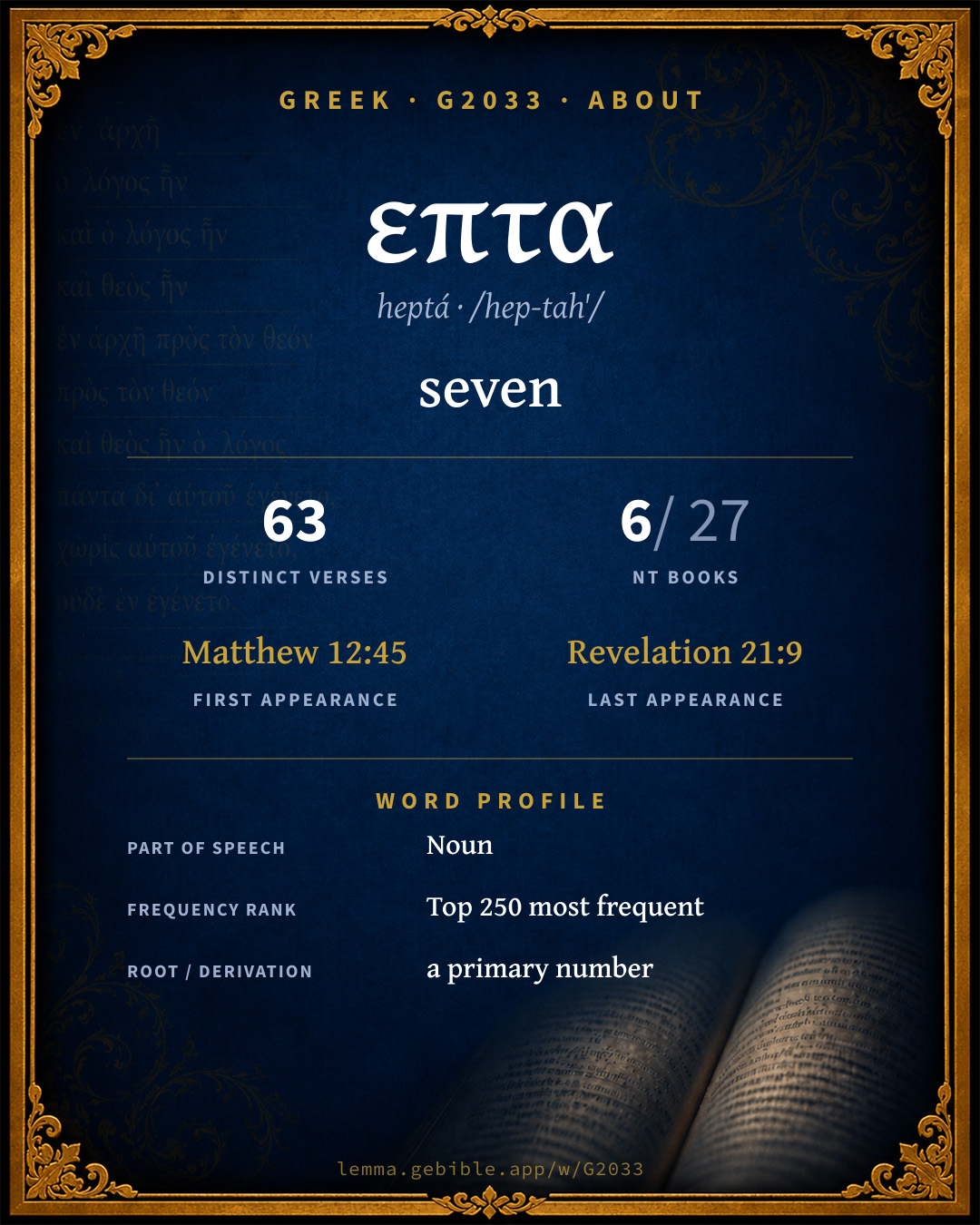
ἑπτά
seven
Full lexicon entry — Thayer's Greek Lexicon
From Thayer's Greek Lexicon
Where this word appears
Every verse where G2033 appears in the Book of Luke — 6 distinct verses. Click any verse to open its interlinear word-by-word view. Verse text shown in the World English Bible for context — . Each verse’s Greek form is shown with its reference; the English is not keyword-highlighted, since the data carries no word-level English alignment. Use “Compare translations” on any verse to read it across multiple English versions. This concordance covers the Greek New Testament; Septuagint (Greek Old Testament) occurrences of this word are not indexed here.
Luke
- Luke 2:36 ἑπτὰ adj num indecl There was one Anna, a prophetess, the daughter of Phanuel, of the tribe of Asher (she was of a great age, having lived with a husband seven years from her virginity,
- Luke 8:2 ἑπτὰ adj num indecl and certain women who had been healed of evil spirits and infirmities: Mary who was called Magdalene, from whom seven demons had gone out;
- Luke 11:26 ἑπτά adj num indecl Then he goes, and takes seven other spirits more evil than himself, and they enter in and dwell there. The last state of that man becomes worse than the first."
- Luke 20:29 ἑπτὰ adj num indecl There were therefore seven brothers. The first took a wife, and died childless.
- Luke 20:31 ἑπτὰ adj num indecl The third took her, and likewise the seven all left no children, and died.
- Luke 20:33 ἑπτὰ adj num indecl Therefore in the resurrection whose wife of them will she be? For the seven had her as a wife."
About this entry
At a glance — auto-summarized from this page’s data, not written by a person. Every figure links to its source below. This summary describes the numbers; it doesn’t interpret them.
“seven” is the headline sense of the Greek noun επτα (heptá). Its earliest occurrence is Matthew 12:45. It turns up in 63 verses across 6 books, a moderately common footprint. It concentrates in Revelation, which alone accounts for 49% of its uses. It clusters with εβδομος and επτακις under a shared root. The sections below give every sense, occurrence, and version rendering.
Gloss history
Strong's 1890 vs modern scholarship
About this word
Strong's G2033 catalogs a Greek word from the Greek New Testament.
These counts are not copied from any lexicon or concordance. They are computed here, from the morphology-tagged Greek New Testament. What Lemma adds →
- 63
- distinct verses
- The word appears in 63 distinct verses.
- 6 / 27
- NT books
- The word appears in 6 of 27 New Testament books.
- #197
- by frequency
- Top 250 most frequent Greek words (rank 197 of 5,347 Greek words by occurrence).
View all 63 occurrences in the concordance →
Most concentrated in
- Revelation 31 verses 49%
- Matthew 9 verses 14%
- Mark 8 verses 13%
By section of the New Testament
By traditional corpus
Conventional, traditional groupings — biblical authorship is debated, so this is a traditional corpus grouping, not an authorship claim. Some books belong to more than one corpus (Luke is in both the Gospels and the Lukan corpus, and so on), so these shares overlap and need not total 100%. Each figure is a share of the word’s 63 distinct verses.
- Johannine 31 verses · 49%
- Revelation 31 verses · 49%
- Gospels 23 verses · 37%
- Lukan (Luke–Acts) 14 verses · 22%
- Hebrews 1 verse · 2%
How translations render this word
Counts come from each version’s own published word-to-Strong’s tagging or interlinear alignment — an approximate guide to how each version renders this word, not a word-level alignment the data otherwise carries. Because each total is that version’s own tagged count, the per-version totals vary from one another and need not match the appearance or distinct-verse counts above. These counts may also differ from a printed concordance because Lemma counts each distinctly tagged rendering and does not collapse phrase taggings into a single head-word total. This is a fixed set of word-tagged versions (KJV, ASV, BSB, ULT) and does not change with the reading translation you choose elsewhere. Each version’s license is shown beside its name below (and on Sources).
- King James Version: Seven 85×
- American Standard Version: Seven 79×
- Berean Standard Bible: Seven 85×
- unfoldingWord Literal Text: Seven 86×
King James Version Public Domain
Renders G2033 across 87 tagged occurrences — most commonly:
Plus 2 renderings that appear only once — usually multi-word phrases or single function words the recovered tagging swept in, not distinct renderings.
American Standard Version Public Domain
Renders G2033 across 87 tagged occurrences — most commonly:
Plus 8 renderings that appear only once — usually multi-word phrases or single function words the recovered tagging swept in, not distinct renderings.
Berean Standard Bible Public Domain
Renders G2033 across 87 tagged occurrences — most commonly:
Plus 2 renderings that appear only once — usually multi-word phrases or single function words the recovered tagging swept in, not distinct renderings. Not rendered by a distinct English word in 1 further occurrence.
unfoldingWord Literal Text CC BY-SA 4.0
Renders G2033 across 87 tagged occurrences — most commonly:
Plus 1 rendering that appears only once — usually multi-word phrases or single function words the recovered tagging swept in, not distinct renderings. Not rendered by a distinct English word in 1 further occurrence.
Senses in Thayer's
The 1 sense Thayer's distinguishes for this word, in lexicon order (not ranked by frequency or importance). The full entry — with sub-senses — is in the Lexicon Entry tab.
- seven
Word origin
Origin: a primary number
A primary number; seven : - seven.
— Strong’s Exhaustive Concordance (1890), public domain.
Forms in the corpus
The 2 distinct written forms G2033 takes in the Greek New Testament, most frequent first — each parse links to that case’s occurrences in the concordance.
| Form | Parsing | Example | Uses |
|---|---|---|---|
| ἑπτὰ heptà | Adjective, Numeral (indeclinable) | Matthew 12:45 | 72 |
| ἑπτά heptá | Adjective, Numeral (indeclinable) | Matthew 15:34 | 16 |
Same root — word family
Other Thayer's entries built from the same root as G2033, grouped by Strong’s listed origin. These share a root / origin per the lexicon — not necessarily a shared meaning. Each links to that word’s own entry.
Derived from this word
Compare all same-root words → They share a root, not necessarily a meaning.
Septuagint usage
The same Greek word επτα appears 293 times in the Greek Old Testament (Septuagint), across 256 verses in 25 books.
- 293
- LXX occurrences
- Tagged occurrences of this Greek word in the Septuagint.
- 256
- verses
- Distinct Septuagint verses containing this word.
- 25 / 39
- OT books
- The word appears in 25 of the 39 Old Testament books.
Sample Septuagint occurrences
- Genesis 4:15 ἑπτά
- Exodus 2:16 ἑπτά
- Leviticus 8:33 ἑπτά
- Numbers 1:29 ἑπτά
- Deuteronomy 7:1 ἑπτά
- Joshua 6:8 ἑπτά
- Judges 6:1 ἑπτά
- Ruth 4:15 ἑπτά
- 1 Samuel 2:5 ἑπτά
- 2 Samuel 2:11 ἑπτά
- 1 Kings 2:11 ἑπτά
- 2 Kings 3:9 ἑπτά
Septuagint occurrences (same lexeme)
Every verse where the same Strong’s number (G2033) appears in the Greek Septuagint — showing the first 50 of 256. Verse text shown in the World English Bible for context; the Greek form is the matched word — the English is not keyword-highlighted.
- Genesis 4:15 ἑπτά Yahweh said to him, "Therefore whoever slays Cain, vengeance will be taken on him sevenfold." Yahweh appointed a sign for Cain, lest any finding him should strike him.
- Genesis 4:24 ἑπτά If Cain will be avenged seven times, Truly Lamech seventy-seven times."
- Genesis 5:7 ἑπτά Seth lived after he became the father of Enosh eight hundred seven years, and became the father of sons and daughters.
- Genesis 5:25 ἑπτά Methuselah lived one hundred eighty-seven years, and became the father of Lamech.
- Genesis 7:2 ἑπτά You shall take seven pairs of every clean animal with you, the male and his female. Of the animals that are not clean, take two, the male and his female.
- Genesis 7:3 ἑπτά Also of the birds of the sky, seven and seven, male and female, to keep seed alive on the surface of all the earth.
- Genesis 7:4 ἑπτά In seven days, I will cause it to rain on the earth for forty days and forty nights. Every living thing that I have made, I will destroy from the surface of the ground."
- Genesis 7:10 ἑπτά It happened after the seven days, that the waters of the flood came on the earth.
- Genesis 8:10 ἑπτά He stayed yet another seven days; and again he sent forth the dove out of the ark.
- Genesis 8:12 ἑπτά He stayed yet another seven days, and sent forth the dove; and she didn't return to him any more.
- Genesis 11:21 ἑπτά Reu lived after he became the father of Serug two hundred seven years, and became the father of sons and daughters.
- Genesis 21:28 ἑπτά Abraham set seven ewe lambs of the flock by themselves.
- Genesis 21:29 ἑπτά Abimelech said to Abraham, "What do these seven ewe lambs which you have set by themselves mean?"
- Genesis 21:30 ἑπτά He said, "You shall take these seven ewe lambs from my hand, that it may be a witness to me, that I have dug this well."
- Genesis 23:1 ἑπτά Sarah lived one hundred twenty-seven years. These were the years of Sarah's life.
- Genesis 25:17 ἑπτά These are the years of the life of Ishmael: one hundred thirty-seven years. He gave up the spirit and died, and was gathered to his people.
- Genesis 29:18 ἑπτά Jacob loved Rachel. He said, "I will serve you seven years for Rachel, your younger daughter."
- Genesis 29:20 ἑπτά Jacob served seven years for Rachel. They seemed to him but a few days, for the love he had for her.
- Genesis 29:27 ἑπτά Fulfill the week of this one, and we will give you the other also for the service which you will serve with me yet seven other years."
- Genesis 29:30 ἑπτά He went in also to Rachel, and he loved also Rachel more than Leah, and served with him yet seven other years.
- Genesis 31:23 ἑπτά He took his relatives with him, and pursued after him seven days' journey. He overtook him in the mountain of Gilead.
- Genesis 37:2 ἑπτά This is the history of the generations of Jacob. Joseph, being seventeen years old, was feeding the flock with his brothers. He was a boy with the sons of Bilhah and Zilpah, his father's wives. Joseph brought an evil report of them to their father.
- Genesis 41:2 ἑπτά Behold, there came up out of the river seven cattle, well-favored and fat-fleshed, and they fed in the reed-grass.
- Genesis 41:3 ἑπτά Behold, seven other cattle came up after them out of the river, ill-favored and lean-fleshed, and stood by the other cattle on the brink of the river.
- Genesis 41:4 ἑπτά The ill-favored and lean-fleshed cattle ate up the seven well-favored and fat cattle. So Pharaoh awoke.
- Genesis 41:5 ἑπτά He slept and dreamed a second time: and, behold, seven heads of grain came up on one stalk, healthy and good.
- Genesis 41:6 ἑπτά Behold, seven heads of grain, thin and blasted with the east wind, sprung up after them.
- Genesis 41:7 ἑπτά The thin heads of grain swallowed up the seven healthy and full ears. Pharaoh awoke, and, behold, it was a dream.
- Genesis 41:18 ἑπτά and, behold, there came up out of the river seven cattle, fat-fleshed and well-favored. They fed in the reed-grass,
- Genesis 41:19 ἑπτά and, behold, seven other cattle came up after them, poor and very ill-favored and lean-fleshed, such as I never saw in all the land of Egypt for ugliness.
- Genesis 41:20 ἑπτά The lean and ill-favored cattle ate up the first seven fat cattle,
- Genesis 41:22 ἑπτά I saw in my dream, and, behold, seven heads of grain came up on one stalk, full and good:
- Genesis 41:23 ἑπτά and, behold, seven heads of grain, withered, thin, and blasted with the east wind, sprung up after them.
- Genesis 41:24 ἑπτά The thin heads of grain swallowed up the seven good heads of grain. I told it to the magicians; but there was no one who could explain it to me."
- Genesis 41:26 ἑπτά The seven good cattle are seven years; and the seven good heads of grain are seven years. The dream is one.
- Genesis 41:27 ἑπτά The seven lean and ill-favored cattle that came up after them are seven years, and also the seven empty heads of grain blasted with the east wind; they will be seven years of famine.
- Genesis 41:29 ἑπτά Behold, there come seven years of great plenty throughout all the land of Egypt.
- Genesis 41:30 ἑπτά There will arise after them seven years of famine, and all the plenty will be forgotten in the land of Egypt. The famine will consume the land,
- Genesis 41:34 ἑπτά Let Pharaoh do this, and let him appoint overseers over the land, and take up the fifth part of the land of Egypt's produce in the seven plenteous years.
- Genesis 41:35 ἑπτά Let them gather all the food of these good years that come, and lay up grain under the hand of Pharaoh for food in the cities, and let them keep it.
- Genesis 41:36 ἑπτά The food will be for a store to the land against the seven years of famine, which will be in the land of Egypt; that the land not perish through the famine."
- Genesis 41:47 ἑπτά In the seven plenteous years the earth brought forth abundantly.
- Genesis 41:48 ἑπτά He gathered up all the food of the seven years which were in the land of Egypt, and laid up the food in the cities: the food of the field, which was round about every city, he laid up in the same.
- Genesis 41:50 ἑπτά To Joseph were born two sons before the year of famine came, whom Asenath, the daughter of Potiphera priest of On, bore to him.
- Genesis 41:53 ἑπτά The seven years of plenty, that was in the land of Egypt, came to an end.
- Genesis 41:54 ἑπτά The seven years of famine began to come, just as Joseph had said. There was famine in all lands, but in all the land of Egypt there was bread.
- Genesis 46:25 ἑπτά These are the sons of Bilhah, whom Laban gave to Rachel, his daughter, and these she bore to Jacob: all the souls were seven.
- Genesis 47:28 ἑπτά Jacob lived in the land of Egypt seventeen years. So the days of Jacob, the years of his life, were one hundred forty-seven years.
- Genesis 50:10 ἑπτά They came to the threshing floor of Atad, which is beyond the Jordan, and there they lamented with a very great and sore lamentation. He mourned for his father seven days.
- Exodus 2:16 ἑπτά Now the priest of Midian had seven daughters. They came and drew water, and filled the troughs to water their father's flock.
These are occurrences of the same Greek lexeme (G2033) in the Septuagint — not a translation of any one Hebrew word. The store carries no word-level Hebrew↔Greek alignment, so no Hebrew original is asserted here. Counts come from the recovered LXX Strong's tagging — high-frequency vocabulary is well covered, while rare or late forms may be untagged — so they reflect tagged occurrences and may slightly undercount.