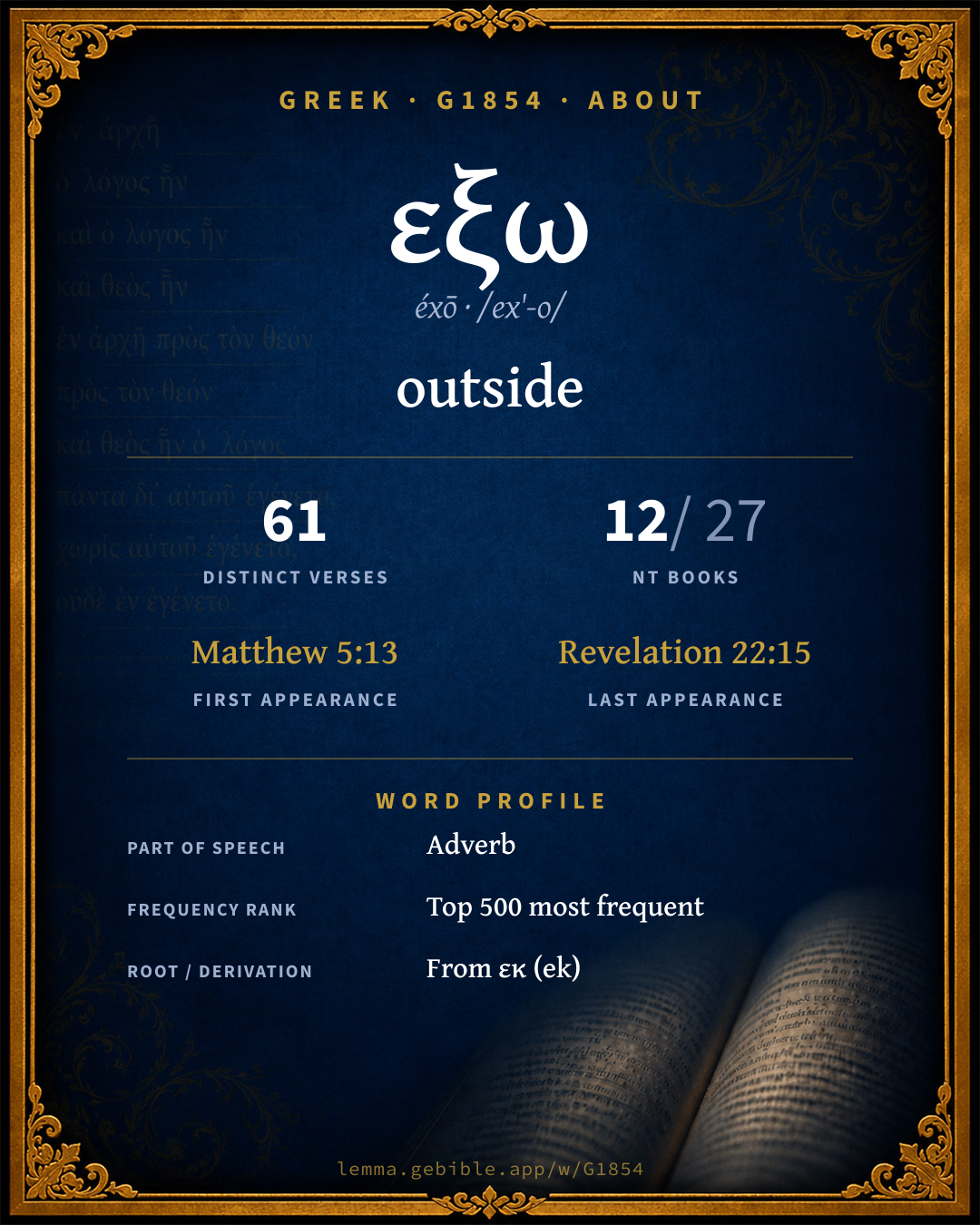
ἔξω
outside
Full lexicon entry — Thayer's Greek Lexicon
From Thayer's Greek Lexicon
Where this word appears
Grammar key — what these labels mean
Part of speech
- Adverb
- A word that modifies a verb, adjective, or other adverb.
Every verse where G1854 appears in the Book of 1 John — 1 distinct verse. Click any verse to open its interlinear word-by-word view. Verse text shown in the World English Bible for context — . Each verse’s Greek form is shown with its reference; the English is not keyword-highlighted, since the data carries no word-level English alignment. Use “Compare translations” on any verse to read it across multiple English versions. This concordance covers the Greek New Testament; Septuagint (Greek Old Testament) occurrences of this word are not indexed here.
1 John
About this entry
At a glance — auto-summarized from this page’s data, not written by a person. Every figure links to its source below. This summary describes the numbers; it doesn’t interpret them.
εξω — transliterated éxō — is a Greek verb carrying the sense “outside.” Where the King James Version says “without,” newer translations reach for “outside” (unfoldingWord Literal Text); the renderings breakdown has the detail. The Greek New Testament uses it across 61 verses — moderately common. Debuting at Matthew 5:13, it then recurs through the corpus. It shares a root with εκ, εκβαλλω and εκβασις. Each statement above links to its evidence; the full detail follows below.
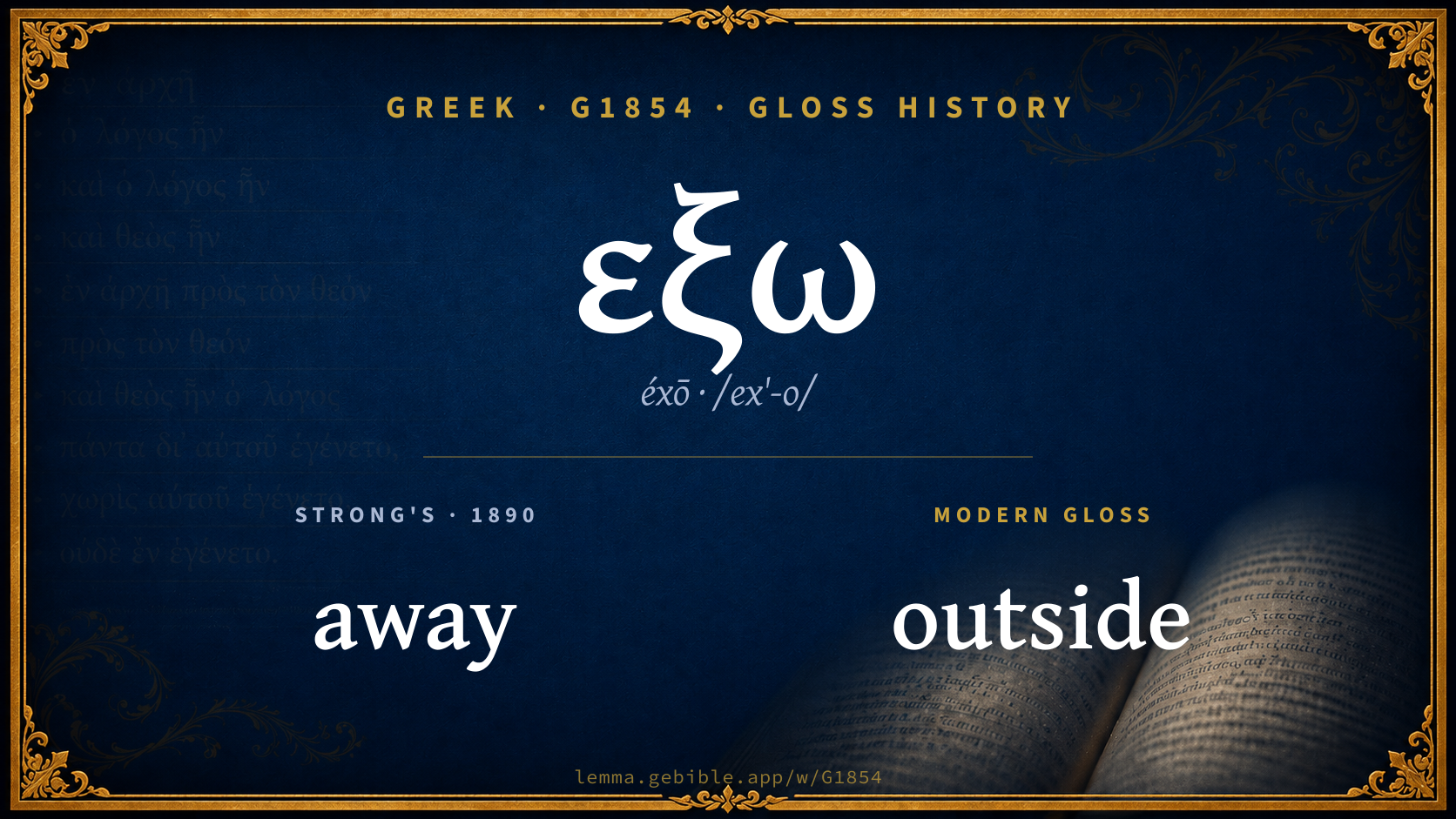
Gloss history
Strong's 1890 vs modern scholarship
About this word
Strong's G1854 catalogs a Greek word from the Greek New Testament.
These counts are not copied from any lexicon or concordance. They are computed here, from the morphology-tagged Greek New Testament. What Lemma adds →
- 61
- distinct verses
- The word appears in 61 distinct verses.
- 12 / 27
- NT books
- The word appears in 12 of 27 New Testament books.
- #262
- by frequency
- Top 500 most frequent Greek words (rank 262 of 5,347 Greek words by occurrence).
View all 61 occurrences in the concordance →
By section of the New Testament
By traditional corpus
Conventional, traditional groupings — biblical authorship is debated, so this is a traditional corpus grouping, not an authorship claim. Some books belong to more than one corpus (Luke is in both the Gospels and the Lukan corpus, and so on), so these shares overlap and need not total 100%. Each figure is a share of the word’s 61 distinct verses.
- Gospels 40 verses · 66%
- Lukan (Luke–Acts) 19 verses · 31%
- Johannine 15 verses · 25%
- Pauline corpus 5 verses · 8%
- Hebrews 3 verses · 5%
- Revelation 2 verses · 3%
- General (Catholic) Epistles 1 verse · 2%
How translations render this word
Counts come from each version’s own published word-to-Strong’s tagging or interlinear alignment — an approximate guide to how each version renders this word, not a word-level alignment the data otherwise carries. Because each total is that version’s own tagged count, the per-version totals vary from one another and need not match the appearance or distinct-verse counts above. These counts may also differ from a printed concordance because Lemma counts each distinctly tagged rendering and does not collapse phrase taggings into a single head-word total. This is a fixed set of word-tagged versions (KJV, ASV, BSB, ULT) and does not change with the reading translation you choose elsewhere. Each version’s license is shown beside its name below (and on Sources).
- King James Version: Without 18×, Out 15×, Of 14×
- American Standard Version: Without 20×, Out 18×, Of 5×
- Berean Standard Bible: Out 21×, Outside 21×, Of 8×
- unfoldingWord Literal Text: Outside 36×, Out 17×, Of 5×
King James Version Public Domain
Renders G1854 across 65 tagged occurrences — most commonly:
Plus 5 renderings that appear only once — usually multi-word phrases or single function words the recovered tagging swept in, not distinct renderings.
American Standard Version Public Domain
Renders G1854 across 61 tagged occurrences — most commonly:
Plus 5 renderings that appear only once — usually multi-word phrases or single function words the recovered tagging swept in, not distinct renderings.
Berean Standard Bible Public Domain
Renders G1854 across 60 tagged occurrences — most commonly:
Plus 5 renderings that appear only once — usually multi-word phrases or single function words the recovered tagging swept in, not distinct renderings. Not rendered by a distinct English word in 3 further occurrences.
unfoldingWord Literal Text CC BY-SA 4.0
Renders G1854 across 64 tagged occurrences — most commonly:
Plus 3 renderings that appear only once — usually multi-word phrases or single function words the recovered tagging swept in, not distinct renderings.
Word origin
Derived from εκ (ek) (G1537) — from.
Adverb from G1537 ; out ( side of doors ) literally or figuratively : - away forth (with-) out (of -ward) strange.
— Strong’s Exhaustive Concordance (1890), public domain.
Same root — word family
Other Thayer's entries built from the same root as G1854, grouped by Strong’s listed origin. These share a root / origin per the lexicon — not necessarily a shared meaning. Each links to that word’s own entry.
Derives from
Shares the same root
- εκβαλλω ekbállō G1544 to cast out
- εκβασις ékbasis G1545 exit
- εκγαμιζω ekgamízō G1547 to give in marriage
- εκγαμισκω ekgamískō G1548 to give in marriage
- εκγονον ékgonon G1549 offspring
- εκδαπαναω ekdapanáō G1550 to spend
- εκδεχομαι ekdéchomai G1551 to receive
- εκδηλος ékdēlos G1552 evident
- εκδημεω ekdēméō G1553 to depart
- εκδιδωμι ekdídōmi G1554 to give out
- εκδιηγεομαι ekdiēgéomai G1555 to relate
- εκδικος ékdikos G1558 without justice
- εκδιωκω ekdiṓkō G1559 to banish
- εκδοτος ékdotos G1560 delivered up
- εκδυω ekdýō G1562 to put off
- εκζητεω ekzētéō G1567 to seek out
- εκθαμβος ékthambos G1569 astonished
- εκθετος ékthetos G1570 exposed
- εκκαθαιρω ekkathaírō G1571 to cleanse
- εκκαιω ekkaíō G1572 to burn
- εκκακεω ekkakéō G1573 to be exhausted
- εκκεντεω ekkentéō G1574 to pierce
- εκκλαω ekkláō G1575 to cut off
- εκκλειω ekkleíō G1576 to shut out
+88 more words share this root (not shown).
Derived from this word
Compare all same-root words → Showing 4 of 116 — not the complete family. They share a root, not necessarily a meaning.
Septuagint usage
The same Greek word εξω appears 95 times in the Greek Old Testament (Septuagint), across 90 verses in 22 books.
- 95
- LXX occurrences
- Tagged occurrences of this Greek word in the Septuagint.
- 90
- verses
- Distinct Septuagint verses containing this word.
- 22 / 39
- OT books
- The word appears in 22 of the 39 Old Testament books.
Sample Septuagint occurrences
- Genesis 9:22 ἔξω
- Exodus 12:46 ἔξω
- Leviticus 4:12 ἔξω
- Numbers 5:3 ἔξω
- Deuteronomy 23:11 ἔξω
- Joshua 2:19 ἔξω
- Judges 12:9 ἔξω
- 1 Samuel 9:26 ἔξω
- 2 Samuel 13:17 ἔξω
- 1 Kings 8:8 ἔξω
- 2 Kings 10:24 ἔξω
- 1 Chronicles 26:29 ἔξω
Septuagint occurrences (same lexeme)
Every verse where the same Strong’s number (G1854) appears in the Greek Septuagint — showing the first 50 of 90. Verse text shown in the World English Bible for context; the Greek form is the matched word — the English is not keyword-highlighted.
- Genesis 9:22 ἔξω Ham, the father of Canaan, saw the nakedness of his father, and told his two brothers outside.
- Genesis 15:5 ἔξω Yahweh brought him outside, and said, "Look now toward the sky, and count the stars, if you are able to count them." He said to Abram, "So shall your seed be."
- Genesis 19:17 ἔξω It came to pass, when they had taken them out, that he said, "Escape for your life! Don't look behind you, neither stay anywhere in the plain. Escape to the mountain, lest you be consumed!"
- Genesis 24:11 ἔξω He made the camels kneel down outside the city by the well of water at the time of evening, the time that women go out to draw water.
- Genesis 24:29 ἔξω Rebekah had a brother, and his name was Laban. Laban ran out to the man, to the spring.
- Genesis 24:31 ἔξω He said, "Come in, you blessed of Yahweh. Why do you stand outside? For I have prepared the house, and room for the camels."
- Genesis 39:12 ἔξω She caught him by his garment, saying, "Lie with me!" He left his garment in her hand, and ran outside.
- Genesis 39:13 ἔξω It happened, when she saw that he had left his garment in her hand, and had run outside,
- Genesis 39:15 ἔξω It happened, when he heard that I lifted up my voice and cried, that he left his garment by me, and ran outside."
- Genesis 39:18 ἔξω and it happened, as I lifted up my voice and cried, that he left his garment by me, and ran outside."
- Exodus 12:46 ἔξω In one house shall it be eaten; you shall not carry forth anything of the flesh abroad out of the house; neither shall you break a bone of it.
- Exodus 21:19 ἔξω if he rises again and walks around with his staff, then he who struck him shall be cleared: only he shall pay for the loss of his time, and shall provide for his healing until he is thoroughly healed.
- Exodus 29:14 ἔξω But the flesh of the bull, and its skin, and its dung, you shall burn with fire outside of the camp: it is a sin-offering.
- Exodus 33:7 ἔξω Now Moses used to take the tent and to pitch it outside the camp, far away from the camp, and he called it "The tent of meeting." It happened that everyone who sought Yahweh went out to the tent of meeting, which was outside the camp.
- Exodus 33:8 ἔξω It happened that when Moses went out to the Tent, that all the people rose up, and stood, everyone at their tent door, and watched Moses, until he had gone into the Tent.
- Leviticus 4:12 ἔξω even the whole bull shall he carry forth outside the camp to a clean place, where the ashes are poured out, and burn it on wood with fire. Where the ashes are poured out it shall be burned.
- Leviticus 4:21 ἔξω He shall carry forth the bull outside the camp, and burn it as he burned the first bull. It is the sin offering for the assembly.
- Leviticus 6:4 ἔξω then it shall be, if he has sinned, and is guilty, he shall restore that which he took by robbery, or the thing which he has gotten by oppression, or the deposit which was committed to him, or the lost thing which he found,
- Leviticus 8:17 ἔξω But the bull, and its skin, and its flesh, and its dung, he burned with fire outside the camp; as Yahweh commanded Moses.
- Leviticus 9:11 ἔξω The flesh and the skin he burned with fire outside the camp.
- Leviticus 10:4 ἔξω Moses called Mishael and Elzaphan, the sons of Uzziel the uncle of Aaron, and said to them, "Draw near, carry your brothers from before the sanctuary out of the camp."
- Leviticus 10:5 ἔξω So they drew near, and carried them in their coats out of the camp, as Moses had said.
- Leviticus 13:46 ἔξω All the days in which the plague is in him he shall be unclean. He is unclean. He shall dwell alone. Outside of the camp shall be his dwelling.
- Leviticus 14:3 ἔξω and the priest shall go forth out of the camp. The priest shall examine him, and, behold, if the plague of leprosy is healed in the leper,
- Leviticus 14:8 ἔξω "He who is to be cleansed shall wash his clothes, and shave off all his hair, and bathe himself in water; and he shall be clean. After that he shall come into the camp, but shall dwell outside his tent seven days.
- Leviticus 14:40 ἔξω then the priest shall command that they take out the stones in which is the plague, and cast them into an unclean place outside of the city:
- Leviticus 14:41 ἔξω and he shall cause the inside of the house to be scraped round about, and they shall pour out the mortar, that they scraped off, outside of the city into an unclean place.
- Leviticus 14:45 ἔξω He shall break down the house, its stones, and its timber, and all the house's mortar. He shall carry them out of the city into an unclean place.
- Leviticus 14:53 ἔξω but he shall let the living bird go out of the city into the open field. So shall he make atonement for the house; and it shall be clean."
- Leviticus 16:27 ἔξω The bull for the sin offering, and the goat for the sin offering, whose blood was brought in to make atonement in the Holy Place, shall be carried forth outside the camp; and they shall burn their skins, their flesh, and their dung with fire.
- Leviticus 17:3 ἔξω Whatever man there is of the house of Israel, who kills an ox, or lamb, or goat, in the camp, or who kills it outside the camp,
- Leviticus 17:4 ἔξω and hasn't brought it to the door of the Tent of Meeting, to offer it as an offering to Yahweh before the tabernacle of Yahweh: blood shall be imputed to that man. He has shed blood; and that man shall be cut off from among his people.
- Leviticus 18:9 ἔξω "'You shall not uncover the nakedness of your sister, the daughter of your father, or the daughter of your mother, whether born at home, or born abroad.
- Leviticus 24:14 ἔξω "Bring out of the camp him who cursed; and let all who heard him lay their hands on his head, and let all the congregation stone him.
- Leviticus 24:23 ἔξω Moses spoke to the children of Israel; and they brought forth him who had cursed out of the camp, and stoned him with stones. The children of Israel did as Yahweh commanded Moses.
- Numbers 5:3 ἔξω Both male and female shall you put out, outside of the camp shall you put them; that they not defile their camp, in the midst of which I dwell."
- Numbers 5:4 ἔξω The children of Israel did so, and put them out outside of the camp; as Yahweh spoke to Moses, so did the children of Israel.
- Numbers 12:14 ἔξω Yahweh said to Moses, If her father had but spit in her face, shouldn't she be ashamed seven days? let her be shut up outside of the camp seven days, and after that she shall be brought in again.
- Numbers 12:15 ἔξω Miriam was shut up outside of the camp seven days: and the people didn't travel until Miriam was brought in again.
- Numbers 15:36 ἔξω All the congregation brought him outside of the camp, and stoned him to death with stones; as Yahweh commanded Moses.
- Numbers 19:3 ἔξω You shall give her to Eleazar the priest, and he shall bring her forth outside of the camp, and one shall kill her before his face:
- Numbers 19:9 ἔξω A man who is clean shall gather up the ashes of the heifer, and lay them up outside of the camp in a clean place; and it shall be kept for the congregation of the children of Israel for a water for impurity: it is a sin-offering.
- Numbers 31:13 ἔξω Moses, and Eleazar the priest, and all the princes of the congregation, went forth to meet them outside of the camp.
- Numbers 31:19 ἔξω Encamp you outside of the camp seven days: whoever has killed any person, and whoever has touched any slain, purify yourselves on the third day and on the seventh day, you and your captives.
- Numbers 35:4 ἔξω The suburbs of the cities, which you shall give to the Levites, shall be from the wall of the city and outward one thousand cubits round about.
- Numbers 35:5 ἔξω You shall measure outside of the city for the east side two thousand cubits, and for the south side two thousand cubits, and for the west side two thousand cubits, and for the north side two thousand cubits, the city being in the midst. This shall be to them the suburbs of the cities.
- Numbers 35:27 ἔξω and the avenger of blood find him outside of the border of his city of refuge, and the avenger of blood kill the manslayer; he shall not be guilty of blood,
- Deuteronomy 23:11 ἔξω but it shall be, when evening comes on, he shall bathe himself in water; and when the sun is down, he shall come within the camp.
- Deuteronomy 23:13 ἔξω and you shall have a paddle among your weapons; and it shall be, when you sit down abroad, you shall dig therewith, and shall turn back and cover that which comes from you:
- Deuteronomy 23:14 ἔξω for Yahweh your God walks in the midst of your camp, to deliver you, and to give up your enemies before you; therefore shall your camp be holy, that he may not see an unclean thing in you, and turn away from you.
These are occurrences of the same Greek lexeme (G1854) in the Septuagint — not a translation of any one Hebrew word. The store carries no word-level Hebrew↔Greek alignment, so no Hebrew original is asserted here. Counts come from the recovered LXX Strong's tagging — high-frequency vocabulary is well covered, while rare or late forms may be untagged — so they reflect tagged occurrences and may slightly undercount.