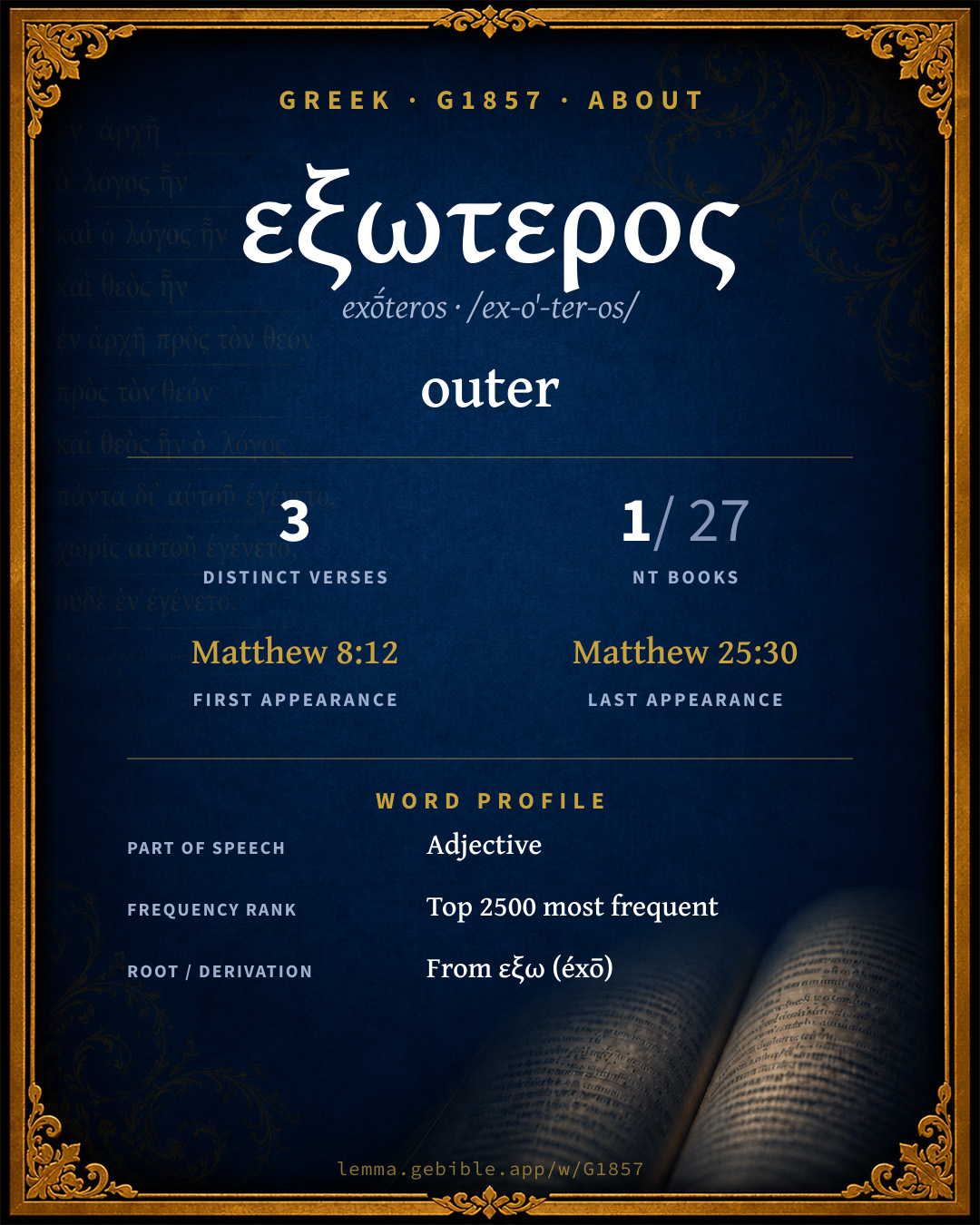
ἐξώτερος
outer
Full lexicon entry — Thayer's Greek Lexicon
From Thayer's Greek Lexicon
Where this word appears
Grammar key — what these labels mean
Part of speech
- Adjective
- A word that describes or qualifies a noun.
Case
- Accusative
- The case of the direct object and of extent.
Gender
- Neuter
- Grammatically neuter.
Number
- Singular
- One.
Degree
- Comparative
- Expresses a greater degree (“greater,” “more”).
Every verse where G1857 appears — 3 distinct verses across 1 book. Click any verse to open its interlinear word-by-word view. Verse text shown in the World English Bible for context — . Each verse’s Greek form is shown with its reference; the English is not keyword-highlighted, since the data carries no word-level English alignment. Use “Compare translations” on any verse to read it across multiple English versions. This concordance covers the Greek New Testament; Septuagint (Greek Old Testament) occurrences of this word are not indexed here.
Matthew 3 verses
- Matthew 8:12 ἐξώτερον adj acc sg neut comp but the children of the Kingdom will be thrown out into the outer darkness. There will be weeping and the gnashing of teeth."
- Matthew 22:13 ἐξώτερον adj acc sg neut comp Then the king said to the servants, 'Bind him hand and foot, take him away, and throw him into the outer darkness; there is where the weeping and grinding of teeth will be.'
- Matthew 25:30 ἐξώτερον adj acc sg neut comp Throw out the unprofitable servant into the outer darkness, where there will be weeping and gnashing of teeth.'
About this entry
At a glance — auto-summarized from this page’s data, not written by a person. Every figure links to its source below. This summary describes the numbers; it doesn’t interpret them.
εξωτερος (exṓteros) is a Greek adjective most often rendered “outer.” It occurs a mere 3 verses across Scripture. It clusters heavily in Matthew, which alone accounts for 100% of its uses. It first appears in Matthew 8:12. It clusters with εξω and εξωθεν under a shared root. For the data behind this summary, explore the sense tree and the renderings breakdown below.
Gloss history
Strong's 1890 vs modern scholarship
About this word
Strong's G1857 catalogs a Greek word from the Greek New Testament.
These counts are not copied from any lexicon or concordance. They are computed here, from the morphology-tagged Greek New Testament. What Lemma adds →
- 3
- distinct verses
- The word appears in 3 distinct verses.
- 1 / 27
- NT books
- The word appears in 1 of 27 New Testament books.
- #2,203
- by frequency
- Top 2500 most frequent Greek words (rank 2,203 of 5,347 Greek words by occurrence).
View all 3 occurrences in the concordance →
Most concentrated in
- Matthew 3 verses 100%
By section of the New Testament
By traditional corpus
Conventional, traditional groupings — biblical authorship is debated, so this is a traditional corpus grouping, not an authorship claim. Some books belong to more than one corpus (Luke is in both the Gospels and the Lukan corpus, and so on), so these shares overlap and need not total 100%. Each figure is a share of the word’s 3 distinct verses.
- Gospels 3 verses · 100%
How translations render this word
Counts come from each version’s own published word-to-Strong’s tagging or interlinear alignment — an approximate guide to how each version renders this word, not a word-level alignment the data otherwise carries. Because each total is that version’s own tagged count, the per-version totals vary from one another and need not match the appearance or distinct-verse counts above. These counts may also differ from a printed concordance because Lemma counts each distinctly tagged rendering and does not collapse phrase taggings into a single head-word total. This is a fixed set of word-tagged versions (KJV, ASV, BSB, ULT) and does not change with the reading translation you choose elsewhere. Each version’s license is shown beside its name below (and on Sources).
- King James Version: Outer 3×
- American Standard Version: Outer 3×
- Berean Standard Bible: Outer 3×
- unfoldingWord Literal Text: Outer 3×
King James Version Public Domain
Renders G1857 across 3 tagged occurrences — most commonly:
American Standard Version Public Domain
Renders G1857 across 3 tagged occurrences — most commonly:
Berean Standard Bible Public Domain
Renders G1857 across 3 tagged occurrences — most commonly:
unfoldingWord Literal Text CC BY-SA 4.0
Renders G1857 across 3 tagged occurrences — most commonly:
Senses in Thayer's
The 1 sense Thayer's distinguishes for this word, in lexicon order (not ranked by frequency or importance). The full entry — with sub-senses — is in the Lexicon Entry tab.
- outer
Word origin
Derived from εξω (éxō) (G1854) — outside.
Compound of G1854 ; exterior : - outer.
— Strong’s Exhaustive Concordance (1890), public domain.
Same root — word family
Other Thayer's entries built from the same root as G1857, grouped by Strong’s listed origin. These share a root / origin per the lexicon — not necessarily a shared meaning. Each links to that word’s own entry.
Derives from
Shares the same root
Compare all same-root words → They share a root, not necessarily a meaning.
Septuagint usage
The same Greek word εξωτερος appears 22 times in the Greek Old Testament (Septuagint), across 22 verses in 4 books.
- 22
- LXX occurrences
- Tagged occurrences of this Greek word in the Septuagint.
- 22
- verses
- Distinct Septuagint verses containing this word.
- 4 / 39
- OT books
- The word appears in 4 of the 39 Old Testament books.
Sample Septuagint occurrences
- Exodus 26:4 ἐξώτερος
- 1 Kings 6:29 ἐξώτερος
- Job 18:17 ἔξωτέρος
- Ezekiel 10:5 ἐξώτερος
Septuagint occurrences (same lexeme)
Every verse where the same Strong’s number (G1857) appears in the Greek Septuagint. Verse text shown in the World English Bible for context; the Greek form is the matched word — the English is not keyword-highlighted.
- Exodus 26:4 ἐξώτερος You shall make loops of blue on the edge of the one curtain from the edge in the coupling; and likewise shall you make in the edge of the curtain that is outmost in the second coupling.
- 1 Kings 6:29 ἐξώτερος He carved all the walls of the house round about with carved figures of cherubim and palm trees and open flowers, inside and outside.
- 1 Kings 6:30 ἐξώτερος The floor of the house he overlaid with gold, inside and outside.
- Job 18:17 ἔξωτέρος His memory shall perish from the earth. He shall have no name in the street.
- Ezekiel 10:5 ἐξώτερος The sound of the wings of the cherubim was heard even to the outer court, as the voice of God Almighty when he speaks.
- Ezekiel 40:19 ἐξώτερος Then he measured the breadth from the forefront of the lower gate to the forefront of the inner court outside, one hundred cubits, [both] on the east and on the north.
- Ezekiel 40:20 ἐξώτερος The gate of the outer court whose prospect is toward the north, he measured the length of it and the breadth of it.
- Ezekiel 40:31 ἐξώτερος The arches of it were toward the outer court; and palm trees were on the posts of it: and the ascent to it had eight steps.
- Ezekiel 40:37 ἐξώτερος The posts of it were toward the outer court; and palm trees were on the posts of it, on this side, and on that side: and the ascent to it had eight steps.
- Ezekiel 41:15 ἐξώτερος He measured the length of the building before the separate place which was at the back of it, and the galleries of it on the one side and on the other side, one hundred cubits; and the inner temple, and the porches of the court;
- Ezekiel 41:17 ἐξώτερος to [the space] above the door, even to the inner house, and outside, and by all the wall round about inside and outside, by measure.
- Ezekiel 42:1 ἐξώτερος Then he brought me forth into the outer court, the way toward the north: and he brought me into the chamber that was over against the separate place, and which was over against the building toward the north.
- Ezekiel 42:3 ἐξώτερος Over against the twenty [cubits] which belonged to the inner court, and over against the pavement which belonged to the outer court, was gallery against gallery in the third story.
- Ezekiel 42:6 ἐξώτερος For they were in three stories, and they didn't have pillars as the pillars of the courts: therefore [the uppermost] was straitened more than the lowest and the middle from the ground.
- Ezekiel 42:7 ἐξώτερος The wall that was outside by the side of the chambers, toward the outer court before the chambers, the length of it was fifty cubits.
- Ezekiel 42:8 ἐξώτερος For the length of the chambers that were in the outer court was fifty cubits: and, behold, before the temple were one hundred cubits.
- Ezekiel 42:9 ἐξώτερος From under these chambers was the entry on the east side, as one goes into them from the outer court.
- Ezekiel 42:14 ἐξώτερος When the priests enter in, then shall they not go out of the holy place into the outer court, but there they shall lay their garments in which they minister; for they are holy: and they shall put on other garments, and shall approach to that which pertains to the people.
- Ezekiel 44:1 ἐξώτερος Then he brought me back by the way of the outer gate of the sanctuary, which looks toward the east; and it was shut.
- Ezekiel 44:19 ἐξώτερος When they go forth into the outer court, even into the outer court to the people, they shall put off their garments in which they minister, and lay them in the holy chambers; and they shall put on other garments, that they not sanctify the people with their garments.
- Ezekiel 46:20 ἐξώτερος He said to me, This is the place where the priests shall boil the trespass-offering and the sin-offering, [and] where they shall bake the meal-offering; that they not bring them forth into the outer court, to sanctify the people.
- Ezekiel 46:21 ἐξώτερος Then he brought me forth into the outer court, and caused me to pass by the four corners of the court; and, behold, in every corner of the court there was a court.
These are occurrences of the same Greek lexeme (G1857) in the Septuagint — not a translation of any one Hebrew word. The store carries no word-level Hebrew↔Greek alignment, so no Hebrew original is asserted here. Counts come from the recovered LXX Strong's tagging — high-frequency vocabulary is well covered, while rare or late forms may be untagged — so they reflect tagged occurrences and may slightly undercount.