Luke 22:7

Greek (Tischendorf 8th ed.) Luke 22:7 appears in the Greek New Testament. The text above is from the Tischendorf 8th edition. Each word links to its Strong’s number and a concise gloss. Click any word for its full Thayer’s Greek Lexicon entry.
Download image
Cite this verse

Luke 22:7 (World English Bible). Public Domain. Lemma interlinear Bible study tool, https://lemma.gebible.app/v/luke/22/7.

Show BibTeX & RIS
BibTeX
RIS
English Translation
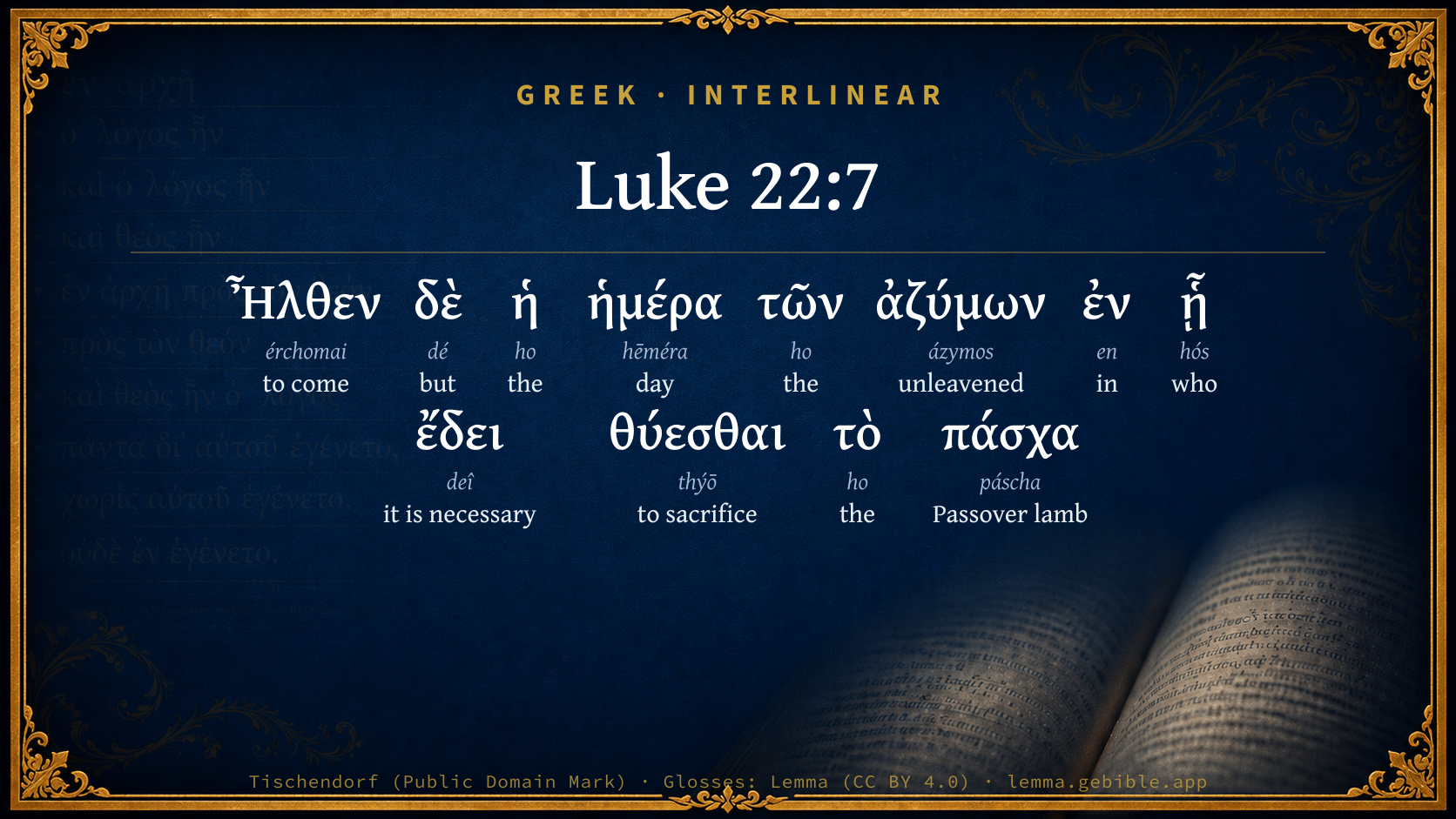
The day of unleavened bread came, on which the Passover must be sacrificed.
World English Bible · Public Domain
Download a study sheet

One document with this verse’s original text, its word-by-word gloss line, the meaning frame, cross-references with their text, attributed commentary, and full source and license credits — printable, and it pastes into notes with its structure intact.

This verse Autodidact and up

Study sheet (.html) Plain text (.txt)

A passage Seminary Student

Up to 50 verses in one chapter. A passage sheet keeps up to 6 commentary sources and 12 cross-references per verse, in the order this page ranks them, and says so on the sheet whenever that leaves anything out. Ask for a single verse and you get the Autodidact verse sheet above.

Everything on this page stays free to read, with no account — the sheet is a download of what is already on screen, not access to it.

Want to remove ads? Support Godless Engineer
Compare translations 3

The same verse in 3 English versions, stacked beneath the original-language interlinear above. Click any original word for its lexicon entry.

Each is an independent rendering of the whole verse — the interlinear is not word-aligned to these translations.

Highlighted words mark where these versions differ — a whole-verse word diff, not a word-by-word alignment.

  • World English Bible Public Domain
    The day of unleavened bread came, on which the Passover must be sacrificed.
  • King James Version Public Domain
    Then came the day of unleavened bread, when the passover must be killed.
  • unfoldingWord Literal Text CC BY-SA 4.0
    Then came the Day of Unleavened Bread, on which it was necessary to sacrifice the Passover.

unfoldingWord Literal Text — © unfoldingWord, licensed CC BY-SA 4.0. Word-aligned USFM3 via Door43 (git.door43.org/unfoldingWord/en_ult).

Versions to compare (up to 4)

3 of 4 selected

Show all 19 translations

Every available English version of this verse, each an independent rendering of the whole verse.

  • World English Bible Public Domain
    The day of unleavened bread came, on which the Passover must be sacrificed.
  • Berean Standard Bible Public Domain
    Then came the day of Unleavened Bread on which the Passover lamb was to be sacrificed.
  • Majority Standard Bible Public Domain
    Then came the day of Unleavened Bread on which the Passover lamb was to be sacrificed.
  • King James Version Public Domain
    Then came the day of unleavened bread, when the passover must be killed.
  • American Standard Version (1901) Public Domain
    And the day of unleavened bread came, on which the passover must be sacrificed.
  • Revised Version (1885) Public Domain
    And the day of unleavened bread came, on which the passover must be sacrificed.
  • Geneva Bible (1599) Public Domain
    Then came the day of vnleauened bread, when the Passeouer must be sacrificed.
  • Douay-Rheims (1899) Public Domain
    And the day of the unleavened bread came, on which it was necessary that the pasch should be killed.
  • Young's Literal Translation Public Domain
    And the day of the unleavened food came, in which it was behoving the passover to be sacrificed,
  • Literal Standard Version CC BY-SA 4.0
    And the day of the Unleavened [Bread] came, in which it was necessary [for] the Passover to be sacrificed,
  • Unlocked Literal Bible CC BY-SA 4.0
    Then came the day of unleavened bread, on which the Passover lamb had to be sacrificed.
  • unfoldingWord Literal Text CC BY-SA 4.0
    Then came the Day of Unleavened Bread, on which it was necessary to sacrifice the Passover.
  • Darby Bible Public Domain
    And the day of unleavened bread came, in which the passover was to be killed.
  • World Messianic Bible Public Domain
    The day of unleavened bread came, on which the Passover must be sacrificed.
  • Webster's Bible Public Domain
    Then came the day of unleavened bread, when the passover must be killed.
  • Free Bible Version CC BY-SA 4.0
    The Day of Unleavened Bread arrived when the Passover animal had to be sacrificed.
  • Bible in Basic English Public Domain
    And the day of unleavened bread came, when the Passover lamb is put to death.
  • Text-Critical English NT CC BY 4.0
    Then came the day for the Feast of Unleavened Bread, when the Passover lamb had to be sacrificed.
  • Tyndale New Testament (1534) Public Domain
    Then came the daye of swete breed when of necessite the esterlambe must be offered.

Literal Standard Version (2020), Covenant Press — licensed CC BY-SA 4.0. Text via the HelloAO Bible API (eBible.org). Unlocked Literal Bible (unfoldingWord) — licensed CC BY-SA 4.0. Text via the HelloAO Bible API (eBible.org). unfoldingWord Literal Text — © unfoldingWord, licensed CC BY-SA 4.0. Word-aligned USFM3 via Door43 (git.door43.org/unfoldingWord/en_ult). Free Bible Version, Dr. Jonathan Gallagher — licensed CC BY-SA 4.0. Text via the HelloAO Bible API (eBible.org).

Word by word

More ways to search: Search by grammar → Find every occurrence → Compare this word →

Practice this passage: Drill this verse → Learn its vocabulary →

About this verse

These counts appear in no published source. They are computed here, from the morphology-tagged text and Lemma’s own curated glosses. What Lemma adds →

12
words
10
distinct lemmas
Gospels
section

Notable vocabulary

The rarest word here is ἀζύμων unleavened G106 — appearing just 9 times in the whole Greek New Testament.

Shared distinctive vocabulary

ἀζύμων unleavened G106 occurs in 9 verses of the Greek New Testament. Also found in:

Repetition

A word recurs within this verse:

Cross-references

6

Topical passages linked to Luke 22:7 in the Treasury of Scripture Knowledge — connected by theme and wording, ordered by reader-vote popularity; previews shown in the World English Bible.

  • Exodus 12:18 In the first month, on the fourteenth day of the month at evening, you shall eat unleavened bread, until the twenty first day of the month at evening.
  • Mark 14:12–16 On the first day of unleavened bread, when they sacrificed the Passover, his disciples asked him, "Where do you want us to go and make ready that you may eat the Passover?"
  • Exodus 12:6 and you shall keep it until the fourteenth day of the same month; and the whole assembly of the congregation of Israel shall kill it at evening.
  • 1 Corinthians 5:7 Purge out the old yeast, that you may be a new lump, even as you are unleavened. For indeed Christ, our Passover, has been sacrificed in our place.
  • Matthew 26:17–19 Now on the first day of unleavened bread, the disciples came to Jesus, saying to him, "Where do you want us to prepare for you to eat the Passover?"
  • Luke 22:1 Now the feast of unleavened bread, which is called the Passover, drew near.

Cross-references courtesy of OpenBible.info (CC BY 4.0).

Commentary

Notes on Luke 22:7 from classic Christian and Jewish commentators (each source and its license shown beneath its notes). The classic Christian expositions comment on the surrounding passage and are grouped to its opening verse, so a note may address several verses; the Jewish commentaries on the Tanakh (Rashi and others) are per-verse, so they appear only where the commentator wrote on this verse.

Lemma curates 59 commentaries, every one of them public domain or Creative Commons licensed, each selected and text-cleaned for this edition rather than reprinted as found. About our sources →

Matthew Henry's Commentary

What a hopeful prospect had we of Christ's doing a great deal of good by his preaching in the temple during the feast of unleavened bread, which continued seven days, when the people were every morning, and early in the morning, so attentive to hear him! But here is a stop put to it. He must enter upon work of another kind; in this, however, he shall do more good than in the other, for neither Christ's nor his church's suffering days are their idle empty days. Now here we have,

I. The preparation that was made for Christ's eating the passover with his disciples, upon the very day of unleavened bread, when the passover must be killed according to the law, Luk 22:7. Christ was made under the law, and observed the ordinances of it, particularly that of the passover, to teach us in like manner to observe his gospel institutions, particularly that of the Lord's supper, and not to neglect them. It is probable that he went to the temple to preach in the morning, when he sent Peter and John another way into the city to prepare the passover. Those who have attendants about them, to do their secular business for them in a great measure, must not think that this allows them to be idle; it engages them to employ themselves more in spiritual business, or service to the public. He directed those whom he employed whither they should go (Luk 22:9, Luk 22:10): they must follow a man bearing a pitcher of water, and he must be their guide to the house. Christ could have described the house to them; probably it was a house they knew, and he might have said no more than, Go to such a one's house, or to a house in such a street, with such a sign, etc. But he directed them thus, to teach them to depend upon the conduct of Providence, and to follow that, step by step. They went, not knowing whither they went, nor whom they followed. Being come to the house, they must desire the master of the house to show them a room (Luk 22:11), and he will readily do it, Luk 22:12. Whether it was a friend's house or a public house does not appear; but the disciples found their guide, and the house, and the room, just as he had said to them (Luk 22:13); for they need not fear a disappointment who go upon Christ's word; according to the orders given them, they got every thing in readiness for the passover, Luk 22:11.

II. The solemnizing of the passover, according to the law. When the hour was come that they should go to supper he sat down, probably at the head-end of the table, and the twelve apostles with him, Judas not excepted; for it is possible that those whose hearts are filled with Satan, and all manner of wickedness, may yet continue a plausible profession of religion, and be found in the performance of its external services; and while it is in the heart, and does not break out into any thing scandalous, such cannot be denied the external privileges of their external profession. Though Judas has already been guilty of an overt act of treason, yet, it not being publicly known, Christ admits him to sit down with the rest at the passover. Now observe,

1. How Christ bids this passover welcome, to teach us in like manner to welcome his passover, the Lord's supper, and to come to it with an appetite (Luk 22:15): "With desire I have desired, I have most earnestly desired, to eat this passover with you before I suffer." He knew it was to be the prologue to his sufferings, and therefore he desired it, because it was in order to his Father's glory and man's redemption. He delighted to do even this part of the will of God concerning him as Mediator. Shall we be backward to any service for him who was so forward in the work of our salvation? See the love he had to his disciples; he desired to eat it with them, that he and they might have a little time together, themselves, and none besides, for private conversation, which they could not have in Jerusalem but upon this occasion. He was now about to leave them, but was very desirous to eat this passover with them before he suffered, as if the comfort of that would carry him the more cheerfully through his sufferings, and make them the easier to him. Note, Our gospel passover, eaten by faith with Jesus Christ, will be an excellent preparation for sufferings, and trials, and death itself.

2. How Christ in it takes his leave of all passovers, thereby signifying his abrogating all the ordinances of the ceremonial law, of which that of the passover was one of the earliest and one of the most eminent (Luk 22:16): "I will not any more eat thereof, nor shall it by any more celebrated by my disciples, until it be fulfilled in the kingdom of God." (1.) It was fulfilled when Christ our Passover was sacrificed for us, Co1 5:7. And therefore that type and shadow was laid aside, because now in the kingdom of God the substance was come, which superseded it. (2.) It was fulfilled in the Lord's supper, an ordinance of the gospel kingdom, in which the passover had its accomplishment, and which the disciples, after the pouring out of the Spirit, did frequently celebrate, as we find Act 2:42, Act 2:46. They ate of it, and Christ might be said to eat with them, because of the spiritual communion they had with him in that ordinance. He is said to sup with them and they with him, Rev 3:20. But, (3.) The complete accomplishment of that commemoration of liberty will be in the kingdom of glory, when all God's spiritual Israel shall be released from the bondage of death and sin, and be put in possession of the land of promise. What he had said of his eating of the paschal lamb, he repeats concerning his drinking of the passover wine, the cup of blessing, or of thanksgiving, in which all the company pledged the Master of the feast, at the close of the passover supper. This cup he took, according to the custom, and gave thanks for the deliverance of Israel out of Egypt, and the preservation of their first-born, and then said, Take this, and divide it among yourselves, Luk 22:17. This is not said afterwards of the sacramental cup, which being probably of much more weight and value, being the New Testament in his blood, he might give into every one's hand, to teach them to make a particular application of it to their own souls; but, as for the paschal cup which is to be abolished, it is enough to say, "Take it, and divide it among yourselves, do what you will with it, for we shall have no more occasion for it, Luk 22:18. I will not drink of the fruit of the vine any more, I will not have it any more drank of, till the kingdom of God shall come, till the Spirit be poured out, and then you shall in the Lord's supper commemorate a much more glorious redemption, of which both the deliverance out of Egypt and the passover commemoration of it were types and figures. The kingdom of God is now so near being set up that you will not need to eat or drink any more till it comes." Christ dying next day opened it. As Christ with a great deal of pleasure took leave of all the legal feasts (which fell of course with the passover) for the evangelical ones, both spiritual and sacramental; so may good Christians, when they are called to remove from the church militant to that which is triumphant, cheerfully exchange even their spiritual repasts, much more their sacramental ones, for the eternal feast.

III. The institution of the Lord's supper, Luk 22:19, Luk 22:20. The passover and the deliverance out of Egypt were typical and prophetic signs of a Christ to come, who should by dying deliver us from sin and death, and the tyranny of Satan; but they shall no more say, The Lord liveth, that brought us up out of the land of Egypt; a much greater deliverance shall eclipse the lustre of that, and therefore the Lord's supper is instituted to be a commemorative sign or memorial of a Christ already come, that has by dying delivered us; and it is his death that is in a special manner set before us in that ordinance.

1. The breaking of Christ's body as a sacrifice for us is here commemorated by the breaking of bread; and the sacrifices under the law were called the bread of our God (Lev 21:6, Lev 21:8, Lev 21:17): This is my body which is given for you. And there is a feast upon that sacrifice instituted, in which we are to apply it to ourselves, and to take the benefit and comfort of it. This bread that was given for us is given to us to be food for our souls, for nothing can be more nourishing and satisfying to our souls than the doctrine of Christ's making atonement for sin, and the assurance of our interest in that atonement; this bread that was broken and given for us, to satisfy for the guilt of our sins, is broken and given to us, to satisfy the desire of our souls. And this we do in remembrance of what he did for us, when he died for us, and for a memorial of what we do, in making ourselves partakers of him, and joining ourselves to him in an everlasting covenant; like the stone Joshua set up for a witness, Jos 24:27.

2. The shedding of Christ's blood, by which the atonement was made (for the blood made atonement for the soul, Lev 17:11), as represented by the wine in the cup; and that cup of wine is a sign and token of the New Testament, or new covenant, made with us. It commemorates the purchase of the covenant by the blood of Christ, and confirms the promises of the covenant, which are all Yea and Amen in him. This will be reviving and refreshing to our souls, as wine that makes glad the heart. In all our commemorations of the shedding of Christ's blood, we must have an eye to it as shed for us; we needed it, we take hold of it, we hope to have benefit by it; who loved me, and gave himself for me. And in all our regards to the New Testament we must have an eye to the blood of Christ, which gave life and being to it, and seals to us all the promises of it. Had it not been for the blood of Christ, we had never had the New Testament; and, had it not been for the New Testament, we had never know the meaning of Christ's blood shed.

Matthew Henry's Commentary on the Whole Bible (1708–1710) — public domain (CC PDM 1.0). Text via the HelloAO Bible API.

Jamieson, Fausset & Brown

Robert Jamieson, A. R. Fausset & David Brown

LAST PASSOVER--INSTITUTION OF THE SUPPER--DISCOURSE AT THE TABLE. (Luke 22:7-38)

the day of unleavened bread--strictly the fifteenth Nisan (part of our March and April) after the paschal lamb was killed; but here, the fourteenth (Thursday). Into the difficult questions raised on this we cannot here enter.

Jamieson, Fausset & Brown — Commentary Critical and Explanatory on the Whole Bible (1871) — public domain (CC PDM 1.0). Text via the HelloAO Bible API.

The Biblical Illustrator

Joseph S. Exell

Luk_22:7-13

Go and prepare us the passover

Preparation for the Last Supper

Passover just at hand.

Day of preparation. The Lamb to be offered is Himself. Go and prepare--get ready--for Me; let it be heart-preparation.

1. This preparation was general. All Old Testament teachings, histories, prophecies, and events were a preparation for the death on the cross. Go, prepare to meet Me around that table of commemoration.

2. When, or at what time, concerned the disciples. Your time to prepare is now.

3. The character of this command. Imperative. Go. Now Grotius, who lived to be fifty before he made this preparation, said, I have passed the whole of my life laboriously doing nothing. Cast away your sins, your prayerlessness. I have lost ten years; I give the rest to Jesus, should be the resolution of youth.

4. You will need to carry nothing in there. The feast is prepared. (S. H.Tyng, D. D.)

Preparation for the Lords Supper

Part of the preparation for the Lords Supper consists in learning about Christ. Unless we know Him we cannot remember Him. If we know little about Him our remembrance of Him will be poor and shallow. Suppose you were asked to do something, to illuminate your house or to plant a tree, in remembrance of some one of whom you had never heard--Bocchoris, for instance--you might do it; but what sense would there be in your doing it? You know nothing about him. What you did would be a mere external and formal observance. If I told you that according to Manetho he was the only monarch belonging to the twenty-fourth dynasty of Egyptian kings, he would still be nothing more than a name to you. Was he a good king or a bad king? Did he build temples, pyramids, great public works, make canals, establish wise and beneficent laws, fight famous battles, contribute to the civilization and happiness of his people, or did he do nothing? Was his reign long and glorious? Was he remembered after his death with love and honour? Or was his memory execrated? You dont know; I believe no one knows. His name stands in a list of ancient kings, that is all we can say, and to do anything in remembrance of him would be an unmeaning ceremony. Remembrance must be based on knowledge, and the richer our knowledge the more vivid is our remembrance. When there is to be any public celebration of a great man, when a statue is to be erected or a building opened in his honour, the newspapers tell us about his life, and about what he did for the country; and speeches are delivered to recall the grounds on which his memory deserves to be perpetuated. And so a large part of the proper preparation for the Lords Supper consists in learning all we can know about the Lord Jesus Christ. The four Gospels are the best preparation for the service. (R. W. Dale.)

The last passover

I. CHRISTS DESIRE TO EAT THE PASSOVER. This in another place is expressed in the strongest terms (Luk_22:15). Now, this he might do for the following reasons:

1. It was the Lords passover, so called in Exo_12:11.

2. Hereby he gave an undeniable proof, that He was made under the ceremonial as well as moral law.

3. This was His last passover, and had an immediate relation to His subsequent sufferings.

4. The company with which He was to eat the passover, and the gospel ordinance He was about to institute in its room, might increase the ardour of His desire. Hence those tender words: I shall eat the passover with My disciples.

II. Notice THE PLACE IN WHICH CHRIST WOULD EAT THIS PASSOVER. Not in Herods, or the High Priests palace; for He who took upon Him the form of a servant, did not affect state and grandeur. Not in the magnificent dwelling of a Roman officer, or Jewish ruler, where He might be attended with a numerous retinue of servants; He came not to be ministered to, but to minister. Now this may be considered as emblematical Ñ

1. Of the gospel Church.

2. It may resemble the renewed and sanctified heart. Commune with your own heart (Psa_4:4). Enter into your own chamber (Hebrews) The furnished room may also resemble a heart endowed with all the gifts, and adorned with all the graces of the Spirit. (B. Beddome, M. A. )

The Biblical Illustrator, edited by Joseph S. Exell (c. 1880s–1900s) — public domain. Text from a community e-Sword module.

Joseph Benson's Commentary

Luk 22:7-13. Then came the day of unleavened bread, when the passover must be killed — They called the day on which the passover was killed, one of the days of unleavened bread, and the first day thereof, because it was preparatory to that feast; though, properly speaking, the first day began with the passover-supper. This appears likewise from Josephus, who, making use of the vulgar computation, tells us, that the feast of unleavened bread lasted eight days; whereas, in the law, it was ordered to be kept only seven days. Thus Exo 12:19 : Seven days shall there be no leaven found in your houses. He sent Peter and John — From the place where he had spent the night before in retirement with them; saying, Go and prepare us the passover — Go, buy a lamb for us, and get it killed and roasted, and make the other preparations, that we may, once more, eat it together. They said, Where wilt thou that we prepare? — See on Mat 26:17, and Mar 14:10-16 : where this paragraph is considered at large.

Joseph Benson's Commentary on the Old and New Testaments (1811–1818) — public domain. Text from a community e-Sword module.

Whedon's Commentary on the Bible

Daniel D. Whedon

PERIOD EIGHTH.

THE SUFFERING, Luk_22:7 to Luk_23:56.

§ 121. JESUS PREPARES TO KEEP THE PASSOVER, Luk_22:7-13.

Compare notes on Mat_26:17-19; Mar_14:12-16.

Daniel D. Whedon (gen. ed.), Commentary on the Old and New Testaments (1874–1909) — public domain. Text from a community e-Sword module.

The Preacher's Complete Homiletical Commentary

Joseph S. Exell (gen. ed.)

CRITICAL NOTES

Luk_22:7. The day of unleavened bread.—Strictly speaking, the first day of unleavened bread was the 15th Nisan (i.e., beginning from the evening of the 14th), when the paschal lamb was killed. But the day here spoken of was evidently the 14th, as the Passover was not yet slain. On this day it was usual, though not necessary, to abstain from leaven; and by including it the feast was sometimes reckoned as lasting eight days (Josephus, Ant., II. Luk_15:1). If, then, we take the 14th day at its legal beginning (i.e., after sunset on the 13th), it is possible that our Lord and His apostles celebrated the Passover a day before the usual time. This would harmonise the narrative of the synoptical Gospels with that of St. John. The former speak most definitely of the Passover being celebrated by our Lord, and the latter as definitely of the Passover as still to be observed by the Jews. The whole question is an extremely difficult and perplexing one, but probably the above is the simplest solution of it. The passover.—I.e., the paschal lamb. Killed.—Rather, “sacrificed” (R.V.).

Luk_22:8. Peter and John.—“It was a solemn message, and for it were chosen the two chief apostles” (Alford).

Luk_22:10. A man.—The secrecy with which the place of celebration was pointed out was probably occasioned by a desire to prevent Judas being acquainted beforehand with it. It would seem that Christ Himself had, without His disciples’ knowledge, made arrangements, perhaps with one friendly to Him, for celebrating the feast in his house. Bearing a pitcher.—Probably the significance of this sign is to be explained by the fact that it was the custom for the head of a family to draw a pitcher of pure water for kneading the unleavened bread. It was a formal piece of ritual

Luk_22:11. Goodman.—I.e., as in Luk_12:39, the paterfamilias. Guest-chamber.—The same word which is translated “inn” (Luk_2:7).

Luk_22:14. The hour.—I.e., appointed for the paschal supper. Sat down.—I.e., reclined the custom of standing at the paschal feast having been long given up by the Jews. Twelve apostles.—Omit “twelve”; omitted in R.V. Probably the word is taken from Mat_26:20; Mar_14:17.

Luk_22:15. With desire, etc.—A Hebraism for “I have earnestly desired.”

Luk_22:16. I will not any more, etc.—“He should hold no more social converse with them on earth up to the period when the work of redemption by His blood (that sacrifice of which the Passover was the type) should be accomplished, and the kingdom of God established” (Bloomfield).

Luk_22:17. And He took.—Rather “and He received a cup” (R.V.)—i.e., the first cup of the Passover-meal, of which Christ evidently drank. Gave thanks.—As was usual before partaking of this cup. The formula of thanksgiving was, “Blessed be Thou, O Lord our God, who hast created the fruit of the vine.” To this Christ evidently alludes in Luk_22:18.

Luk_22:19. Which is given for you.—This clause is not found in the parallel passages in St. Matthew and St. Mark. In some MSS. the phrase that corresponds to it in 1Co_11:24 is “which is broken for you.” In the R.V. this last is relegated to the margin, and the text is, “which is for you”—which seems a mutilated sentence. New Testament.—R.V. “new covenant.” The word means both a will and an agreement. In the new relation between God and man there is both an absolute element (will), and a conditional (covenant).

MAIN HOMILETICS OF THE PARAGRAPH.—Luk_22:7-20

The Lord’s Supper.

I. The preparation.—Peculiar to this Gospel are the names of the disciples sent to make ready the Passover and the representation of the command as preceding the disciples’ question, “Where?” The selection of Peter and John indicates the confidential nature of the task, which comes out still more plainly in the singular directions given to them. How is the designation of the place which Christ gives to be understood? Was it supernatural knowledge, or was it the result of previous arrangement with the “goodman of the house”? Most probably the latter, for he was in so far a disciple that he recognised Jesus as the Master, and was glad to have Him in his house, and the chamber on the roof was ready “furnished” when they came. Why this mystery about the place? Because Judas was listening, too, for the answer to “Where?” thinking that it would give him the “opportunity” which he sought “to betray Him in the absence of the multitude.” Jesus takes precautions to delay the cross. He takes none to escape it, but rather sets Himself in these last days to bring it near. The variety in His action means no change in His mind, but both modes are equally the result of His self-forgetting love to us all.

II. The revelation of Christ’s heart (Luk_22:14-18).—He discloses His earnest desire for that last hour of calm before He went out to face the storm, and His vision of the future feast in the perfect kingdom. That desire touchingly shows His brotherhood in all our shrinking from parting with dear ones, and in our treasuring of the last, sweet, sad moments of being together. But the desire was not for Himself only. He wished to partake of that Passover, and then to transform it for ever, and to leave the new rite to His servants. We shall best conceive the course of events if we suppose that the earlier stages of the paschal ceremonial were duly attended to, and that the Lord’s Supper was instituted in connection with its later parts. There is no need to discuss the exact stage at which our Lord spoke and acted as recorded in Luk_22:15-17. It is sufficient to note that in them He gives what He does not taste, and that, in giving, His thoughts travel beyond all the sorrow and death to reunion and perfected festal joys. The prophetic aspect of the Lord’s Supper should never be left out of view. It is at once a feast of memory and of hope, and is also a symbol for the present, since it represents the conditions of spiritual life as being participation in the body and blood of Christ.

III. The actual institution of the Lord’s Supper (Luk_22:19-20).—Note its connection with the rite which it transforms. The Passover was the memorial of deliverance, the very centre of Jewish ritual. It was a family feast, and our Lord took the place of the head of the household. But this memorial of deliverance He transfigures—He calls upon Jew and Gentile to forget the venerable meaning of the rite, and remember rather His work for all men. He must have been clothed with Divine authority to abrogate a Divinely enjoined ceremony. The separation of the symbols of the body and blood plainly indicates that it is the death of Jesus, and that a violent one, which is being commemorated. Both parts of the symbol teach that all our hopes are rooted in the death of Jesus, and that the only true life of our spirits comes from participation in His death, and thereby in His life. Jesus declares, by this rite, that through His death a new “covenant” comes into force as between God and man, in which all the anticipations of prophets are more than realised, and sins are remembered no more, and the knowledge of God becomes the blessing of all, and a close relationship of mutual possession is established between God and us, and His laws are written on loving hearts and softened wills. St. Luke alone preserves for us the command to “do this,” which at once establishes the rite as meant to be perpetual, and defines the new nature of it. It is a memorial: “in order to My remembrance.” Jesus knew that we should be in constant danger of forgetting Him, and therefore, in this one case, He enlists sense on the side of faith, and trusts to these homely memorials the recalling to our treacherous memories of His dying love. He wished to live in our hearts, and that for the satisfaction of His own love and for the deepening of ours. The Lord’s Supper is a standing evidence of Christ’s own estimate of where the centre of His work lies. We are to remember His death. Surely no view of the significance and purpose of the cross but that which sees in it a propitiation for the world’s sins accounts for this rite. A Christianity which strikes the atoning death of Jesus out of its theology is sorely embarrassed to find a worthy meaning for His dying command, “This do in remembrance of Me.”—Maclaren.

SUGGESTIVE COMMENTS ON Luk_22:7-20

Luk_22:7-38. Outline of The Narrative.—

1. Preparations for the Last Supper (Luk_22:7-13).

2. The Last Supper itself (Luk_22:14-23).

3. The conversation following it (Luk_22:24-38).

Luk_22:7. “When the Passover must be killed.”—The example of Christ in observing the outward ordinances of the Jewish religion should suggest to us the duty of a like scrupulousness in keeping those of our religion.

Luk_22:8. “Sent Peter and John.”—This errand was

(1) an exercise in faith and obedience; and

(2) the result of it was calculated to encourage them to believe in His hidden greatness, in spite of His humiliation.

Luk_22:9-10.—The mystery with which Christ surrounded His procedure on this occasion:

1. By concealing the information of the place from Judas, it was a measure of precaution for Himself.

2. It impressed upon the minds of His disciples the fact of His absolute foreknowledge of all events.

Luk_22:10-12.—A Sign Given to The Disciples:

1. To impress them with the dignity and solemnity of this Passover celebration.

2. To convince them of His own Divine foreknowledge and almighty power—in predicting what was to happen and in making provision for celebrating the feast.

Luk_22:10. The Man Bearing a Pitcher.

I. The Passover was observed in the midst of ordinary life and its familiar surroundings.—This was a specially solemn and significant occasion. And yet, peculiarly holy and full of world-wide, time-long meaning as it was, it took place among the common details of family life. It was not held in a court of the Temple, but in the upper room of an unknown citizen. It was not ushered in by pomp and ceremony and portent, but by a humble servant carrying a pitcher of water for household purposes. Our Passover—the Lord’s Supper—ought not to be dissociated from our ordinary life, and made an unearthly, unnatural experience. Too much superstitious feeling still clings to the ordinance. Many are afraid to partake of it. They practically disobey Christ’s loving command.

II. The Lord’s Supper is, after all, but a household service, a family meal, linked most closely with all the familiar things of our common life.—Bread and wine are common things. The Communion Service is a part of the common worship of the sanctuary. Only here the symbols appeal to the eye, and to the touch and taste. The Communion Table is only the upper chamber of the familiar Church. This is no high mystic service, no exclusive channel of grace. There is no sacramentarianism about it.

III. Let the significant lesson of the man carrying the pitcher of water, pointing the way to the upper room, teach us that so every circumstance of our ordinary life, however homely, should have reference to and prepare for the Holy Supper as often as we are called upon to observe it.—We should so live that no special preparation need be made for our sitting down at the Lord’s Table—that wherever we are, and however engaged, we may always be in a suitable frame of mind to enjoy the Holy Communion. Let our whole life, religious and secular, be of one piece, and so our daily carrying of the pitcher of water for household purposes, the daily business of our life, will lead to and prepare for the perpetual communion feast of heaven.—Macmillan.

Luk_22:11. “The goodman of the house.”—As there was among His friends a secret enemy, so was there among His enemies a secret friend.—Braune.

Luk_22:12. “Upper room.”—The usual place of resort for large gatherings in a Jewish house; probably the very room which also witnessed the appearance of the risen Christ to the twelve, and the descent of the Holy Ghost at Pentecost.—Farrar.

The Best to be Offered to Christ.—The man who is to lend the room knows Jesus, and is, in some measure, a disciple. He had, apparently, already been told by some one that such a room would be required. But the “upper room” was not the “guest chamber” which the Master asked for. It was a quieter place, not on the ground floor, but upstairs. Christ asked merely for the lower room, the common guest-chamber, but was supplied with a better reserved for special purposes and occasions. When Christ makes any demand on us, let as give Him even more and better than He asks for.

I. It was an upper room.—A private room above the hall or guest-chamber. The “best” room in the house. He could have privacy there with His disciples. He wants it all, and all for Himself. Do we offer to Christ the best we have?

II. It was a furnished room.—It was supplied with couches and table, with cups and vessels. Are our hearts furnished and ready with what Christ loves—prayers, hymns, thanksgivings, holy thoughts, good deeds, kind words? There He can rest and abide.

III. It was a large room.—Of ample accommodation. A party of thirteen needed more room than a tiny chamber. Are we niggardly to Christ? Do we put Him in the smallest room? Have we place in our hearts for His disciples? He will come to bless. Give Him room to work.—Plummer.

Luk_22:13. “Found as He had said.”—The directions had been given with great circumstantiality—the entrance of the city, a man, meeting them, carrying a pitcher of water, entering a house. Had any one of these particulars been found wanting, the prophecy would have proved untrue, and the disciples would have failed in their errand.

Luk_22:14 to Luk_23:1. The words of Jesus introductory to the Supper (Luk_22:14-18).

2. The Supper itself, with the institution of the new rite (Luk_22:19-20).

3. The announcement of the treachery of one of the disciples.

Luk_22:14. “The twelve apostles with Him.”—The presence of Judas at this Last Supper in distinctly asserted here, as well as in Luk_22:21. The fact that Christ, who was acquainted with his secret villainy, did not exclude him is very significant. It implies that a man who makes profession of religion, and in whose outward life there is nothing scandalous, cannot reasonably be denied the external privileges of religion. The endeavour to secure, by rigid scrutiny and long probation, that none but the regenerate are in the visible Church finds little to countenance it in the New Testament. It is calculated to discourage the timid and self-distrustful, and as a matter of fact it does not keep out hypocrites.

The First Word at The Supper.—

I. An utterance of human tenderness.—A consecration of all that is purest and loftiest in the brotherhood of men. Christ craves to eat with His brother men. He anticipates the responsive love of those whom He has called to Himself—“With you.” This is beautifully, unselfishly human. The heart of God is human, and longs to find itself welcomed, understood, and responded to.

II. An utterance full of the purpose and travail of the Redeemer.—There is an element in the longing of Christ above and beyond the feeling of the Israelite towards the national festival. It is the last Passover of the true Israel of God. The time of the Re-formation has arrived. The kingdom is coming. The complete ingathering of the redeemed is in view. And, till then, he takes farewell of all earthly rite and ordinance.—Lang.

Luk_22:15-16. “With desire,” etc.

I. For the sake of His disciples to whom, on this occasion of farewell, He was to reveal the intensity of His affection for them.

II. For His own sake, because immediately after this Passover He was to enter into His glory.

Luk_22:15. “I have desired.”—Very vehement desire is on no other occasion attributed to our Lord, either by Himself or by others. So great was this occasion, when, before He left His disciples, He had to give to them the new covenant of His Body and Blood.

“Before I suffer.”—This is the only instance in the Gospels in which the word “suffer” is used in its absolute sense, as in the creed—“He suffered under Pontius Pilate.”

Reasons why Christ Desired so Earnestly to Eat this Last Passover.

I. The Passover had now reached its end, and found its full meaning.

II. He desired it for the support of His own soul in the approaching struggle.—“Before I suffer.”

III. Because His friends needed special support. “To eat this Passover with you.”

IV. Because this Passover looked forward to all the future of His Church and people.—Ker.

Luk_22:16. “Until it be fulfilled.”—Jesus has in view a new banquet, which will be held after the consummation of all things. The Holy Supper is the bond of union between the Jewish Passover, which is now nearing its end, and the heavenly banquet yet to come, just as the salvation of the gospel, of which the Supper is the monument, forms the transition between the external deliverance of Israel and the salvation, at once spiritual and external, of the glorified Church.—Godet.

Luk_22:17-20. The Lord’s Supper is a Monument Sacred to the Memory of Jesus Christ.—

1. It refers to the death of Jesus.

2. Its significance does not depend upon the tragic circumstances of that death, or to its glorious character as an act of martyrdom.

3. Jesus represents His death as a sin-offering; His blood is shed for the remission of sins.

4. The sacrament of the Supper represents Christ, not merely as a Lamb, to be slain for a sin-offering, but as a Paschal Lamb, to be eaten for spiritual nourishment.—Bruce.

The Last Supper.—The Supper brings before us—

I. A Saviour.—Every part of it fixes our gaze, not on it, but on Him.

II. A human Saviour.—He sits, eats, drinks, speaks, has a body and blood, dies.

III. A suffering Saviour.—The bread is broken through and through. The wine is poured out. These acts symbolise and emphasise His sufferings. His death is the central fact.

IV. A willing Saviour.—He gave thanks, though He knew of all that was in “the cup”—Gethsemane, Calvary, and the grave. With more than willingness—with positive joy—He gave Himself for our salvation.

V. A sin-bearing Saviour.—This is Christ’s explanation of His own death. Let us be content with it. He came to “give His life a ransom for many.”—Wells.

Luk_22:17. “He took the cup.”—I.e., the Paschal cup, of which Christ now partook for the last time: in Luk_22:20 it is the eucharistic cup of which He did not partake.

Luk_22:18. “I will not drink.”—As Luk_22:16 means, “This is My last Passover,” so this means, “This is My last meal”—My last day. To the reference here to a future banquet, in which Christ Himself will participate, corresponds the saying of St. Paul, “until He come” (1Co_11:26).

Luk_22:19-20. The Lord’s Supper is

(1) a memorial of Christ;

(2) a standing evidence of the truth of Christianity;

(3) an act by which we profess our faith in His atoning sacrifice;

(4) an act of communion with God, and with our fellow-believers; and

(5) one which is intended to lead us to anticipate our Lord’s second coming.

Divine Object-Lessons.—“This bread.’ “This cup.”

I. “This bread.”—God does not separate sign and thing signified. Nor should we.

1. Take.—Christ is to be taken as we take the bread. He comes to us from without. He is offered to us.

2. Eat.—The bread is ready for eating. It is not grain, but food. Eating is a perfect illustration of appropriation, assimilation, incorporation. Eaten bread makes brain, heart, hand. Christ should thus create and nourish convictions, affections, activities.

3. Divide it.—Pass it round. It is a family meal. A reminder of brotherly love. It is free to all. There is enough for all.

II. “This cup.”—

1. It is filled. You are not offered an empty cup. He gave Himself to fill this cup with His life-blood for you.

2. It is offered to you. Not a far-off, vague uncertainty, like the Holy Grail. It is brought near, it touches your hand, your lip. Not to take it were an outrage.

3. It is to be partaken of. Untouched, it mocks your thirst as the cup of Tantalus did. It cheers you only when you taste its contents.

4. It is passed on. It is a social, not a solitary cup. The Divine order is from Christ through His disciples. A symbol of fraternity. Let all taste of it.—Wells.

Luk_22:19. “Gave thanks.”—

1. For the higher food symbolised by it.

2. As ordaining it to be a means of spiritual nourishment.

Old and New.—

I. An old feast.—The Passover feast.

II. A new feast.—Christ the Passover Lamb.

III. The new command.—Do this.—W. Taylor.

“In remembrance of Me.”—The word used is more emphatic than remembrance (which may be involuntary); it is a deliberate, inward act of the will, showing itself by external signs.

Luk_22:20. “This cup.”—The fact that Jesus took in His hands a portion of bread and a cup of wine forbids that literal identification of the bread and wine with His body and blood upon which both Roman Catholic and Lutherian divines have insisted. The distinction between the two was evident at the time. If such literal identification were intended, the words of institution would virtually mean, “This, in time to come, will be My body, My blood.” Is it possible that such an idea entered into the minds of those who were present at that Supper?

“New Testament.”—A new covenant between God and man, based upon the sacrifice of Christ.

I. The free gift of salvation on the part of God.

II. The acceptance of it, by faith, on the part of man.—This is symbolised by the cup which Jesus hands to His disciples, and which they may freely take and raise to their lips.

The Preacher's Complete Homiletical Commentary (gen. ed. Joseph S. Exell; Funk & Wagnalls, c. 1892) — public domain (pre-1929). A full-Bible homiletical/sermon-outline anthology covering 65 of 66 books (2 John is absent from the source module). Text from a community e-Sword module.

Lange's Commentary on the Holy Scriptures

2. The Preparation of the Passover (Luk_22:7-13)

(Parallel to Mat_26:17-19; Mar_14:12-16.)

7Then came the day of unleavened bread, when the passover must be [had to be] killed. 8And he sent Peter and John, saying, Go and prepare us the passover, that we 9may eat. And they said unto him, Where wilt thou that we prepare? 10And he said unto them, Behold, when ye are entered into the city, there shall a man meet you, bearing a pitcher of water; follow him into the house where he entereth in. 11And ye shall say unto the goodman [master] of the house, The Master [Teacher] saith unto thee, Where is the guestchamber [κατάλυμα], where I shall [may] eat the passover with my disciples? 12And he shall shew you a large upper room furnished: there make ready [prepare the passover]. 13And they went, and found as he had said unto them: and they made ready the passover.

EXEGETICAL AND CRITICAL

Luk_22:7. When the Passover had to be killed, έ̓δει θύεσθαι.—It is really an enigma how one could ever have found in this chronological datum of Luke, and in the words of our Lord, Mat_26:18, a ground for the entirely unprovable conjecture that our Savior ate the Passover a day earlier than other Israelites. Upon every impartial person the beginning of this Pericope makes far more the impression that Luke speaks here of the definite day on which, according to the appointment of the law, the Passover lamb had to be slaughtered. Only on this day was the question of the disciples, Mat_26:17, perfectly natural; moreover, the beginning of the discourse at table, preserved by Luke alone, Luk_22:15, shows that our Lord attributes to this very Passover an especially high significance. As to the rest, it is not here the place to enter into detailed discussion as to the actual day of our Lord’s death. Be it only granted to us to express our conviction—the result of special and repeated investigation—that as well according to the Synoptics as according to John, our Lord, on the 14th Nisan, at the same time with the other Jews, and at the time appointed by the law, ate the Passover, and on the 15th suffered the death on the Cross. We believe that the grounds for this view in Wieseler’s Chronolog. Synopse, p. 339 seq., have been, it is true, controverted by Bleek, Tischendorf, and others, but not refuted; and that, moreover, there is just as little reason for placing the meal, John 13, on Wednesday evening (Wichelhaus), as (Krafft, Chronologie und Harmonie der 4 Evangelien, Erlangen, 1848, p. 125) to speak of two meals, and to transfer this evening to the 12th and 13th Nisan. The objections, which even after the powerful demonstration of Wieseler, may be raised from an entirely different stand-point against the view accepted by us, are not unknown to us; but we believe that these, at all events, are of infinitely less importance than the difficulties in which one involves himself if he assumes in this particular an irreconcilable discrepancy between John and the Synoptics. Respecting the Passover controversy of the ancient church, and its relation to the chronology of the Passion Week, comp. Riggenbach, l.c., p. 635 seq., where at the same time the most recent literature on this question is given. See also: Der Tag des letzten Paschamahles Jesu Christi, ein harmonistischer Versuch, by Serno, Berlin, 1859.

Luk_22:8. And He sent Peter and John.—According to the more detailed account of Matthew and Mark, the disciples themselves first began to speak to our Lord of the Passover meal, apparently on Thursday morning, at Bethany. Perhaps the Master was now more silent than of old; of the feast, without doubt, He did not speak, and this mysterious fact, as well as also the sight of numerous pilgrims to the feast, very naturally occasioned the disciples to ask the question: ποῦ θέλεις, κ.τ.λ. That our Lord would eat the Passover on that day on which it must be slaughtered they tacitly presuppose, and perhaps had not spoken even earlier of it only because the prophecy of death, Mat_26:2, has filled their hearts more than the thoughts of the feast, or because they already have a dark presentiment that this Passover would be something entirely different for them from what any earlier one had ever been; or because they were expecting a direct intimation from Jesus Himself before they betook themselves to the capital, whither He Himself yesterday, for the first time, had no longer gone. If we compare Luke with the other Synoptics, we may then unite the accounts thus: that at a preliminary inquiry of the μαθηταί as to the ποῦ, our Lord gives Peter and John a definite command to go away to prepare the Passover; whereupon then they now repeat with more definiteness the natural inquiry as to the πομ͂, and now receive the mysterious direction in reference to the man with the pitcher of water, which Matthew does not give account of. It is still simpler, if we, with Tischendorf, and others, read εἶπαν, and explain the fact thus: that, Luk_22:9, the question is really brought up afterwards, which, strictly speaking, ought to have been stated before the command, Luk_22:8.

Luk_22:10. There shall a man meet you.—In Mark and Luke we have the more special account of the condition in which they would find the furnished upper room, without however their statement being in conflict with the general one of Matthew. Our Saviour gives His disciples a similar token to that which Samuel once gave Saul, 1Sa_10:2-5.—A man.—Although he is here represented as occupied in a menial service, comp. Deu_29:11; Jos_9:21, we have not necessarily to understand a slave (Sepp even knows that it was a slave of Nicodemus), but in general only a person of the lower classes; the pitcher, the carrying of water, point possibly to domestic preparation for the coming Passover; and would in this case in a certain measure concur as a proof that we have here to do with the ordinary Passover day. Luke has συναντήσει more exactly for the ἀπαντήσει of Mark: He will so meet you, so come together with you, that you will go one way with him.

Luk_22:11. Ye shall say to the master of the house.—Not a prophetic but an imperative future.—Οἰκοδεσπότης τῆς οἰκ. a pleonastic expression not unusual with the Greeks, especially in the more familiar style.—The Teachersaith.—The remarkable words, Mat_26:18 : “My time is at hand,” are omitted in Mark and Luke, while they on the other hand render the address to the master of the house in the form of a question.—Τὸ κατάλυμα, diversorium (Luk_2:7), then also cœnaculum. See the LXX, in 1Sa_9:22. Μον is here, at all events, spurious, and might also be very well dispensed with in the parallel passage in Matthew.

Luk_22:12. And he, ἐκεῖνος, according to Mark αὐτός.—The man with the pitcher of water has now accomplished his service, and the master of the house now comes in his place. The direction which the disciples receive is so precise that it does not leave them one uncertainty remaining. They will find an upper room, ἀνάγαιον (which reading appears to deserve the preference above that of the Recepta, ἀνώγεον, and even above that commended by Tischendorf after B., M., S., ἀνώγαιον)=ὑπερῷον, an upper chamber, used often as a place of prayer and assembling. Comp. Act_1:13. This great hall (μέγα) is moreover ἐστρωμένον, furnished with pillows, stratis tricliniis, and so, according to Mark, already έ̓τοιμον, so that there would need no further loss of time for the purpose of putting the hall in good order.

Luk_22:13.And they went.—We may assume that the way of the apostles led through the water-gate (Neh_8:1), past the Pool of Siloam, which as is known furnished almost the whole city with water, and that they there also met the man with the pitcher of water. Yet there was a spring also in the neighborhood of Cedron; therefore it is remarkable that our Lord does not give them the least specification as to the way which they had to take, but only tells them what should meet them on the way. From Mar_14:17, it seems to be the fact that the two, after having punctually fulfilled the duty enjoined on them, returned back to the Master, and that He entered the Passover hall with all the Twelve.

DOCTRINAL AND ETHICAL

1. It belongs to the Divine decorum of the history of the Passion, that our Lord celebrates the Passover at Jerusalem, at the time appointed by the law. Had not to-day been the legally-appointed evening of the feast, on which every Israelite was under obligation to eat the Passover lamb, there would have been properly no ground for at this particular time entering the capital, in which, as was well known to Him, His enemies were watching for Him. But now literally the way of obedience has led Him to death, and the last Passover celebration of the Old Covenant coalesces with the institution of the Holy Communion. Inasmuch as He celebrates it in this way, He does away forever with the old Passover, as He did away with circumcision, when it was accomplished on Himself on the eighth day, Luk_2:21.

2. As to the question, how we have to understand the prediction concerning the man who should meet them with the water-pitcher, we have the choice between five possible opinions:—Invention, accident, previous concert, revelation, supernatural knowledge. That it is an invention (De Wette, Strauss, Meyer), is wholly unproved. The analogy with Samuel proves nothing. It would, moreover, have been incomprehensible to what purpose a trait apparently so insignificant should have been invented for the history of the Passion. To understand accident is forbidden, as well by the precision of the prediction as by its exact accomplishment. Previous concert (not only Paulus, but also Olshausen, Kern, Krabbe, Neander, Braune, in a certain measure, also Lange) is certainly in itself not impossible. It is unquestionably conceivable that our Lord had already arranged this matter with a secret friend in the city. However, the tone of the command, the analogy with 1Sa_10:2-5, and the similarity to what happened at His public entry with respect to the ass-colt, appear to indicate that we have here rather to understand something supernatural. With the ordinary prophet we should be able here to assume a momentary revelation, by means of which before his enlightened view the limits of time and space vanished; with the Lord, however, we can here see nothing less than the activity of the same Divinely human knowledge by which He was rendered capable of discovering all which He must fathom for the accomplishment of His holy intent. To find even in this case a manifestation of such knowledge can have nothing strange, if we bear in mind the entirely unique importance which just this Passover celebration had for our Lord as well as for His disciples. Without doubt, our Lord made the acquaintance of the designated host in a natural way, but by His Divine knowledge He is assured that this friend will be immediately ready and in a condition to receive Him, and that his servant has just now to-day gone out to the spring before the city in order to bring water. Thus, in the manner in which our Lord, as the Good Shepherd, prepares for His own a table in the presence of their enemies, there is displayed an admirable knowledge of the human heart, of a definite locality, of an apparently casual arrangement.

The view that our Saviour designedly gave this command in so mysterious a form, that the place of the celebration might remain unknown to Judas, and that He might therefore be able to spend the evening entirely unobserved with His own (Theophylact, Neander), cannot indeed be mathematically proved, but yet is by all means probable on internal grounds; the result, moreover, showed that in consequence of this arrangement the traitor was not able to carry out his plan until later in the night. At all events, this embassy was for John and Peter an exercise in faith and in obedience; they had to learn therefrom to follow our Lord even blindly, even when they did not see the purpose of His command, and in the future also to leave the care of their earthly interests unconditionally to Him, under whose high guidance they should never lack for anything, Luk_22:35. At the same time, such revelations of the hidden greatness of our Lord might be for them a counterpoise against the depth of humiliation into which He was soon to sink. Without doubt they, afterwards, in dark hours of life, may sometimes have still thought upon this mysterious errand, and looked back to its satisfactory issue.

3. This whole occurrence is a speaking proof of the greatness of our Lord, even in that which is small and seemingly insignificant. This preparatory measure shows us His immovable composure, which He preserved even in spite of the most certain prospect of death; His holy presence of mind over against the secret plotting of the traitors; but, above all, His wisdom, love, and faithfulness, with which He cares, even to the end, for the training of His disciples, and gives them, even in a slight command, a great lesson for the future. Thus does He remain even to the end in silence, and in speech, in temper, and action, perfectly consistent with Himself, and goes undaunted and quiet as a lamb to the slaughter, at about the same hour in which the Paschal lambs were bought and slaughtered.

4. Allegorical interpretation of this narrative among the ancients: The water-pitcher, an image of the insipid and burdensome law which the Jews bore; the roomy upper chamber, an image of the abundant room for all whom the Saviour has invited to His spiritual supper, Luk_14:21-23; Rev_3:20, &c. Juster is the remark of John Gerhard: Christus hac sua prœdictione fidem discipulorum confirmare et contra crucis scandalum eos munire voluit, ut magis ac magis intelligerent, nihil temere in urbe magistro eventurum. Even because our Lord, like any common Israelite, observes the Passover and voluntarily humbles Himself, does He will that His glory shall shine out in the manner in which He makes ready for this meal.

HOMILETICAL AND PRACTICAL

The worth of trifles in general and in sacred history, particularly in the history of the Passion.—We men are often little in great things, the Saviour is great in little things. Even by His greatness in little things, He shows Himself: 1. The image of the invisible God; 2. the perfect Redeemer of the world; 3. the best Guide of His people; 4. the noblest example for imitation.—Our Lord is, even on His last day of earth, faithful to the high principle which He uttered at His first appearance, Mat_3:15.—Peter and John here also, as often, united. Joh_20:1; Act_3:1; Act_4:19.—In every perplexity the disciple may turn to Jesus.—Even the man with a pitcher of water must have his place in the history of the Passion.—The significance of apparently insignificant and subordinate persons for the carrying out of the counsel of God, for example, 2Ki_5:2; Act_12:13; Act_23:16.—There exists more evil but also more good than shows itself to the superficial view.—Even in the most corrupted city, Jesus finds hidden friends and knows them.—“I will come unto him and sup with him.”—The best in the house of His friends is for the Lord not too good.—The obedience of faith is never put to shame.—The true disciple of Jesus is faithful not only in the great, but also in the small.—He loved His own even to the end, Joh_13:1.

Starke:—Nova Bibl. Tub.:—How shall we prepare and address ourselves to worthy enjoyment of the Paschal lamb of the New Covenant in His feast of love? 1Co_11:28.—Not our will but Thine, O Lord, be done. Act_21:14.—God provides His own with habitation and shelter, even though they have nothing of their own in the world. 1Ki_17:9.—That we find everything in the world as God’s word has said, is an irrefutable proof of the truth and divinity of the Scriptures.—Heubner:—Notwithstanding His high vocation, Jesus thinks also on the little concerns of love.—The disciples obey willingly, without making objections that were very obvious.—Besser:—In wonderfully beautiful simplicity they did as the Lord had commanded them; that was a true communion temper.—Fr. Arndt:—1. The signification of the Paschal lamb; 2. the preparation for the same.

Footnotes:

[1]Luk_22:4.—Revised Version of the American Bible Union.—C. C. S.

[2]Luk_22:4.—Προδίδωμι, which properly means “to betray,” is only used in the Gospels once of Judas, in the form of its derivative προδότης, Luk_6:16. Elsewhere the Evangelists speak of him as “delivering up” the Saviour, leaving the character of the act to speak for itself.—C. C. S.]

Lange's Commentary on the Holy Scriptures (Critical, Doctrinal, and Homiletical), ed. John Peter Lange, English translation edited by Philip Schaff (1864–1880) — public domain. Text from a community e-Sword module.

MacLaren's Expositions of Holy Scripture

Alexander MacLaren

Luke

THE LORD’S SUPPER

Luk 22:7 - Luk 22:20.

Paul had his account of the Last Supper direct from Christ. Luke apparently had his from Paul, so that the variations from Matthew and Mark are invested with singular interest, as probably traceable to the Lord of the feast Himself. Our passage has three sections-the preparation, the revelation of Christ’s heart, and the institution of the rite.

I. The Preparation.-

Peculiar to Luke are the names of the disciples entrusted with it, and the representation of the command, as preceding the disciples’ question ‘Where?’ The selection of Peter and John indicates the confidential nature of the task, which comes out still more plainly in the singular directions given to them. Luke’s order of command and question seems more precise than that of the other Gospels, as making our Lord the originator instead of merely responsive to the disciples’ suggestion.

How is the designation of the place which Christ gives to be understood? Was it supernatural knowledge, or was it the result of previous arrangement with the ‘goodman of the house’? Most probably the latter; for he was in so far a disciple that he recognised Jesus as ‘the Master,’ and was glad to have Him in his house, and the chamber on the roof was ready ‘furnished’ when they came. Why this mystery about the place? The verses before our passage tell the reason.

Judas was listening, too, for the answer to ‘Where?’ thinking that it would give him the ‘opportunity’ which he sought ‘to betray Him in the absence of the multitude.’ Jesus had much to say to His disciples, and needed the quiet hours in the upper room, and therefore sent away the two with directions which revealed nothing to the others. If He had told the group where the house was, the last supper might never have been instituted, nor the precious farewell words, the holy of holies of John’s Gospel, ever been spoken. Jesus takes precautions to delay the Cross. He takes none to escape it, but rather sets Himself in these last days to bring it near. The variety in His action means no change in His mind, but both modes are equally the result of His self-forgetting love to us all. So He sends away Peter and John with sealed orders, as it were, and the greedy ears of the traitor are balked, and none know the appointed place till Jesus leads them to it. The two did not come back, but Christ guided the others to the house, when the hour was come.

II. Luk 22:14 - Luk 22:18 give a glimpse into Christ’s heart as He partook, for the last time, of the Passover.

He discloses His earnest desire for that last hour of calm before He went out to face the storm, and reveals His vision of the future feast in the perfect kingdom. That desire touchingly shows His brotherhood in all our shrinking from parting with dear ones, and in our treasuring of the last sweet, sad moments of being together. That was a true human heart, ‘fashioned alike’ with ours, which longed and planned for one quiet hour before the end, and found some bracing for Gethsemane and Calvary in the sanctities of the Upper Room. But the desire was not for Himself only. He wished to partake of that Passover, and then to transform it for ever, and to leave the new rite to His servants.

Our Lord evidently ate of the Passover; for we cannot suppose that His words in Luk 22:15 relate to an ungratified wish, but, as evidently, that eating was finished before He spoke. We shall best conceive the course of events if we suppose that the earlier stages of the paschal ceremonial were duly attended to, and that the Lord’s Supper was instituted in connection with its later parts. We need not discuss what was the exact stage at which our Lord spoke and acted as in Luk 22:15 - Luk 22:17. It is sufficient to note that in them He gives what He does not taste, and that, in giving, His thoughts travel beyond all the sorrow and death to reunion and perfected festal joys. These anticipations solaced His heart in that supreme hour. ‘For the joy that was set before Him’ He ‘endured the Cross,’ and this was the crown of His joy, that all His friends should share it with Him, and sit at His table in His kingdom.

The prophetic aspect of the Lord’s Supper should never be left out of view. It is at once a feast of memory and of hope, and is also a symbol for the present, inasmuch as it represents the conditions of spiritual life as being participation in the body and blood of Christ. This is where Paul learned his ‘till He come’; and that hope which filled the Saviour’s heart should ever fill ours when we remember His death.

III. Verses 19 and 20 record the actual institution of the Lord’s Supper.

Note its connection with the rite which it transforms. The Passover was the memorial of deliverance, the very centre of Jewish ritual. It was a family feast, and our Lord took the place of the head of the household. That solemnly appointed and long-observed memorial of the deliverance which made a mob of slaves into a nation is transfigured by Jesus, who calls upon Jew and Gentile to forget the venerable meaning of the rite, and remember rather His work for all men. It is strange presumption thus to brush aside the Passover, and in effect to say, ‘I abrogate a divinely enjoined ceremony, and breathe a new meaning into so much of it as I retain.’ Who is He who thus tampers with God’s commandments? Surely He is either One having a co-ordinate authority, or--? But perhaps the alternative is best left unspoken.

The separation of the symbols of the body and blood plainly indicates that it is the death of Jesus, and that a violent one, which is commemorated. The double symbol carries in both its parts the same truth, but with differences. Both teach that all our hopes are rooted in the death of Jesus, and that the only true life of our spirits comes from participation in His death, and thereby in His life. But in addition to this truth common to both, the wine, which represents His blood, is the seal of the ‘new covenant.’ Again we mark the extraordinary freedom with which Christ handles the most sacred parts of the former revelation, putting them aside as He wills, to set Himself in their place. He declares, by this rite, that through His death a new ‘covenant’ comes into force as between God and man, in which all the anticipations of prophets are more than realised, and sins are remembered no more, and the knowledge of God becomes the blessing of all, and a close relationship of mutual possession is established between God and us, and His laws are written on loving hearts and softened wills.

Nor is even this all the meaning of that cup of blessing; for blood is the vehicle of life, and whoso receives Christ’s blood on his conscience, to sprinkle it from dead works, therein receives, not only cleansing for the past, but a real communication of ‘the Spirit of life’ which was ‘in Christ’ to be the life of his life, so as that he can say, ‘I live; yet not I, but Christ liveth in me.’ Nor is even this all; for, as wine is, all the world over, the emblem of festivity, so this cup declares that to partake of Christ is to have a fountain of joy in ourselves, which yet has a better source than ourselves. Nor is this all; for ‘this cup’ is prophecy as well as memorial and symbol, and shadows the new wine of the kingdom and the marriage supper of the Lamb.

‘This is My body’ could not have meant to the hearers, who saw Him sitting there in bodily form, anything but ‘this is a symbol of My body.’ It is but the common use of the word in explaining a figurative speech or act. ‘The field is the world; the tares are the children of the wicked one; the reapers are the angels,’-and so in a hundred cases.

Luke alone preserves for us the command to ‘do this,’ which at once establishes the rite as meant to be perpetual, and defines the true nature of it. It is a memorial, and, if we are to take our Lord’s own explanation, only a memorial. There is nothing here of sacramental efficacy, but simply the loving desire to be remembered and the condescending entrusting of some power to recall him to these outward symbols. Strange that, if the communion were so much more, as the sacramentarian theory makes it, the feast’s own Founder should not have said a word to hint that it was.

And how deep and yet lowly an insight into His hold on our hearts the institution of this ordinance shows Him to have had! The Greek is, literally, ‘In order to My remembrance.’ He knew that-strange and sad as it may seem, and impossible as, no doubt, it did seem to the disciples-we should be in constant danger of forgetting Him; and therefore, in this one case, He enlists sense on the side of faith, and trusts to these homely memorials the recalling, to our treacherous memories, of His dying love. He wished to live in our hearts, and that for the satisfaction of His own love and for the deepening of ours.

The Lord’s Supper is a standing evidence of Christ’s own estimate of where the centre of His work lies. We are to remember His death. Why should it be selected as the chief treasure for memory, unless it was something altogether different from the death of other wise teachers and benefactors? If it were in His case what it is in all others, the end of His activity for blessing, and no part of His message to the world, what need is there for the Lord’s Supper, and what meaning is there in it, if Christ’s death were not the sacrifice for the world’s sin? Surely no view of the significance and purpose of the Cross but that which sees in it the propitiation for the world’s sins accounts for this rite. A Christianity which strikes the atoning death of Jesus out of its theology is sorely embarrassed to find a worthy meaning for His dying command, ‘This do in remembrance of Me.’

But if the breaking of the precious alabaster box of His body was needed in order that ‘the house’ might be ‘filled with the odour of the ointment,’ and if His death was the indispensable condition of pardon and impartation of His life, then ‘wheresoever this gospel shall be preached in the whole world, there,’ as its vital centre, shall His death be proclaimed, and this rite shall speak of it for a memorial of Him, and ‘show the Lord’s death till He come.’

Alexander MacLaren, Expositions of Holy Scripture (1904–1910) — public domain. Text from a community e-Sword module.

Godbey's Commentary on the New Testament

William B. Godbey

PREPARATION FOR THE PASSOVER

Mat 26:17-19; Luk 22:7-13; Mar 14:12-16. It is now Thursday morning, the Passover beginning properly on the following Sabbath; but these two preceding days are occupied in preparation for the great national solemnity. Josephus says it was not uncommon for them to slaughter two hundred and fifty thousand lambs during a single Passover. O what a wonderful symbolization of Calvary’s bleeding Lamb! “On the first day of unleavened bread, when they were accustomed to slay the Passover, His disciples say to Him, Where do You wish that, having gone, we may prepare that You may eat the Passover? And He sends two of His disciples, and says to them [Peter and John — see Luk 22:8], Go ye into the city, and a man carrying a pitcher of water will meet you; follow him. And whithersoever he may go in, say to the landlord that the Teacher says, Where is the guest-chamber, where I may eat the Passover with My disciples? And he will show you a large upper room, furnished, ready; there prepare for us. And His disciples departed, and came into the city, and found as He said to them, and prepared the Passover.” They escorted me, during both of my tours in Jerusalem, to a large upper room in the City of David, on the summit of Mount Zion, which they claim to be identical with the one here mentioned, which received imperishable notoriety for the Last Supper, the winding up and abolishment of the Passover, which had been so prominent since that memorable night when they began their exodus out of Egypt, no longer slaves, but a free and independent nation, Jehovah, the God of Abraham, Isaac, and Jacob, having broken every chain; meanwhile its celebrity was augmented by the imperishable memories of the wonderful Pentecost, when the Holy Ghost and fire fell on the disciples, the full-orbed gospel dispensation, under the auspices of entire sanctification, pouring down from heaven like a deluge, converting three thousand, and in a day or two five thousand more, giving a boom to the Church of the Nazarenes which shook the world with the tread of an earthquake, and, glory to God! It is still heaving and quaking.

William B. Godbey, Commentary on the New Testament (1896–1900) — public domain. Text from a community e-Sword module.

Tyndale Open Study Notes

Tyndale Open Resources

22:7-30 Jesus celebrated the traditional Jewish Passover but transformed it with reference to his own sacrificial death as the Passover lamb. He also prepared his disciples for his coming death and the leadership role they would assume over his church.

22:7 The Passover lamb was sacrificed at twilight, and Passover was celebrated in the evening (see Exod 12:6-8).

Tyndale Open Study Notes — © Tyndale Open Resources, licensed CC BY-SA 4.0. Text via the HelloAO Bible API.

Bengel's Gnomon

Johann Albrecht Bengel

Luk 22:7. Ἦλθε, came) Sosinus Perastianus of Cephalonia explains this of the near approach, not of the actual advent of the day of unleavened bread, and for this object, in order that he may push forward the Passover to the Sabbath. See Cl. Hermann’s Hist. of the Controv. concerning the Passover (de Azymo), p. 489. But this ἦλθε, came, is much more strict in its force than the ἤγγιζεν, draw nigh, in Luk 22:1. Therefore Luke must clearly mean to mark the actual arrival of the day of unleavened bread, just in the same way as Matthew and Mark do. [ἔδει, it was necessary) according to the direction of the law.—V. g.]

Bengel's Gnomon of the New Testament — English translation (T&T Clark, Edinburgh, 1860) — public domain. Text from a community e-Sword module.

Meyer's Critical & Exegetical Commentary

Heinrich August Wilhelm Meyer

Luk_22:7-13. See on Mat_26:17-19; Mar_14:12-16. Luke names the disciples, and makes Jesus take the initiative. The latter is a quite immaterial difference; the former is a more precise statement of the later tradition, in respect of which a special tendency is assumed (Baur supposes that the two are intended to represent the Judaism of the older apostles).

ἦλθε] there came, there appeared the day. Comp. Luk_5:35, Luk_23:29; Act_2:20, and elsewhere.[248]

Ἡ ἩΜΈΡΑ] not Ἡ ἙΟΡΤΉ again, as in Luk_22:1, because the latter denotes the whole festival, not the single day of the feast (in opposition to Wieseler, Synopse, p. 397).

Luk_22:11. ἐρεῖτε] a future with the force of an imperative: and ye shall say.

τῷ οἰκοδεσπότῃ τῆς οἰκ.] See, on such pleonastic combinations, Bornemann in loc.; Lobeck, Paralip. p. 536 f.; also Valckenaer, Schol. p. 264 f.

[248] Paschke is in error when he says, in the Theol. Quartalschr. 1851, p. 410 ff., that ἦλθε means here: he came near; and that at Mat_26:17, Mar_14:12, τῇ πρώτῃ ἡμέρᾳ τῶν ἀζύμων means: on the day before the Passover. Moreover, Ewald (Gesch. Chr. p. 459 f.) decides that, in so far as the words of Luke are concerned (not also of Matthew and Mark), the day before the Passover might be meant. But by ἑν ᾗ ἔδει κ.τ.λ., as well as by the further course of the narrative, the day is definitely enough indicated as the same as in Matthew and Mark.

Meyer — Critical and Exegetical Commentary on the New Testament — English translation by Peter Christie, edited by Frederick Crombie (T&T Clark, 1880) — public domain. Text from a community e-Sword module.

Expositor's Greek Testament

ed. W. Robertson Nicoll

Luk 22:7-13 . Preparation for the paschal feast (Mat 26:17-19 , Mar 14:12-16 ).

Luk 22:7 . ἦλθε , arrived. A considerable number of commentators (Euthy. Zig., Godet, Schanz, J. Weiss (Meyer)) render, approached ( ἐπλησίασε , Euthy.), holding that Lk. with John makes Jesus anticipate the feast by a day, so finding here one of the points in which the third Gospel is in touch with the fourth.

The Expositor's Greek Testament, edited by W. Robertson Nicoll (1897–1910) — public domain. Text from a community e-Sword module.

Cambridge Greek Testament for Schools and Colleges

7–13. PREPARATION FOR THE PASSOVER

7. ἡ ἡμέρα τῶν ἀζύμων. All leaven was most carefully and scrupulously put away on the afternoon of Thursday, Nisan 13.

θύεσθαι. ‘Be sacrificed.’

EXCURSUS V.

ON Luk 22:7

WAS THE LAST SUPPER AN ACTUAL PASSOVER?

The question whether, before the institution of the Lord’s Supper, our Lord and His Disciples ate the usual Jewish Passover—in other words, whether in the year of the Crucifixion the ordinary Jewish passover (Nisan 15) began on the evening of Thursday or on the evening of Friday—is a question which has been ably and voluminously debated, and respecting which eminent authorities have come to opposite conclusions.

Luk 24:1.

1. From the Synoptists alone we should no doubt infer that the ordinary Paschal Feast was eaten by our Lord and His Disciples, as by all the Jews, on the evening of Thursday (Mat 26:2; Mat 26:17-19; Mar 14:14-16; Luk 22:7; Luk 22:11-13; Luk 22:15).

Luk 24:2.

2. On the other hand, St John uses language which seems quite as distinctly to imply that the Passover was not eaten till the next day (Luk 13:1, “before the Feast of the Passover;” 29, “those things that we have need of against the feast;” Luk 18:28, “they themselves went not into the judgment-hall lest they should be defiled; but that they might eat the passover”). He also calls the Sabbath (Saturday) a high day (a name given by the Jews to the first and last days of the octave of a feast) apparently because it was both a Sabbath and the first day of the Passover; and says (Luk 19:14) that Friday was “the preparation of the Passover.” Here the word used is παρασκευή (as in Luk 23:54). Now this word may no doubt merely mean ‘Friday,’ since every Friday was a preparation for the Sabbath; but it seems very difficult to believe that the expression means ‘Passover Friday.’ (See the note on Luk 23:54.)

Luk 24:3.

3. Now since the language of St John seems to be perfectly explicit, and since it is impossible to explain away his expressions by any natural process—though no doubt they can be explained away by a certain amount of learned ingenuity—it seems more simple to accept his express statement, and to interpret thereby the less definite language of the Synoptists.

We may set aside many current explanations of the difficulty, such as that—

α. Two different days may have been observed in consequence of different astronomical calculations about the day.

or β. Some laxity as to the day may have been introduced by different explanations of “between the two evenings.”

or γ. The Jews in their hatred put off their Passover till the next evening.

or δ. St John, by “eating the Passover,” may have meant no more than eating the Chagigah or festive meal.

or ε. The supper described by St John is not the same as that described by the Synoptists.

or ζ. The Last Supper was an ordinary Passover, only it was eaten by anticipation.

Setting aside these and many other untenable views, it seems probable that the Last Supper was not the ordinary Jewish Paschal meal, but was eaten the evening before the ordinary Jewish Passover; and that the language of the Synoptists is perfectly consistent and explicable on the view that our Lord gave to His last Supper a Paschal character (“to eat this Passover,” or “this as a Passover,” Luk 22:15), and spoke of it to His disciples as their Passover. Hence had arisen in the Church the view that it actually was the Paschal meal—which St John silently corrects. The spread of this impression would be hastened by the fact that in any case Thursday was, in one sense, ‘the first day of unleavened bread,’ since on that day all leaven was carefully searched for that it might be removed.

When we adopt this conclusion—that the Last Supper was not the Paschal Feast itself, but intended to supersede and abrogate it—it is supported by a multitude of facts and allusions in the Synoptists themselves; e.g.

i. The occupations of the Friday on which Jesus was crucified shew no sign whatever of its having been a very solemn festival. The Jews kept their chief festival days with a scrupulosity almost as great as that with which they kept their Sabbaths. Yet on this Friday working, buying, selling, holding trials, executing criminals, bearing burdens, &c. is going on as usual. Everything tends to shew that the day was a common Friday, and that the Passover only began at sunset.

ii. The Sanhedrin had distinctly said that it would be both dangerous and impolitic to put Christ to death on the Feast day (Mar 14:2, and comp. Act 12:4).

iii. Not a word is said in any of the Evangelists about the Lamb—the most important and essential element of the Paschal meal; nor of the bitter herbs; nor of the account given by the Chief Person present of the Institution of the Passover, &c.

Further than this, many arguments tend to shew that this Last Supper was not a Paschal meal; e.g.

α. Early Christian tradition—apparently down to the time of Chrysostom—distinguished between the Last Supper and the Passover. Hence the Eastern Church always uses leavened bread at the Eucharist, as did the Western Church down to the 9th century.

β. Jewish tradition—with no object in view—fixes the Death of Christ on the afternoon before the Passover (Erebh Pesach).

γ. The language of St Paul (1Co 5:7; 1Co 11:23) seems to imply that the Lord’s Supper was not the Passover, but a Feast destined to supersede it.

δ. If our Lord had eaten an actual Paschal meal the very evening before His death, the Jews might fairly have argued that He was not Himself the Paschal Lamb; whereas

ε. There was a peculiar symbolic fitness in the fact that He—the True Lamb—was offered at the very time when the Lamb which was but a type was being sacrificed.

For these and other reasons—more fully developed in the Life of Christ, pp. 471–483—I still hold that the Last Supper was not the actual Jewish Passover, but a quasi-Passover, a new and Christian Passover.

Cambridge Greek Testament for Schools and Colleges (Cambridge University Press, 1896; 21 vols, various authors incl. Carr, Maclear, Plummer, Farrar, Lumby, Moule, M. R. James, Simcox) — public domain. Text from a community e-Sword module.

Godet's Commentaries

Frédéric Louis Godet

II. The Last Supper: Luk 22:7-38.

We find ourselves here face to face with a difficulty which, since the second century of the Church, has arrested the attentive readers of the Scriptures. As it was on the 14th Nisan, in the afternoon, that the Paschal lamb was sacrificed, that it might be eaten the evening of the same day, it has been customary to take the time designated by the words, Luk 22:7, Then came the day of unleavened bread when the Passover must be killed (comp. Matthew and Mark), as falling on the morning of that 14th day; from which it would follow that the Supper, related Luk 22:14 et seq., took place the evening between the 14th and 15th. This view seems to be confirmed by the parallels Mat 26:17, Mar 14:12, where the disciples (not Jesus, as in Luke) take the initiative in the steps needed for the Supper. If such was the fact, it appeared that the apostles could not have been occupied with the matter till the morning of the 14th. But thereby the explanation came into conflict with John, who seems to say in a considerable number of passages that Jesus was crucified on the afternoon of the 14th, at the time when they were slaying the lamb in the temple, which necessarily supposes that the last Supper of Jesus with His disciples took place the evening between the 13th and 14th, the eve before that on which Israel celebrated the Paschal Supper, and not the evening between the 14th and 15th. This seeming contradiction does not bear on the day of the week on which Jesus was crucified. According to our four Gospels, this day was indisputably Friday. The difference relates merely to the day of the month, but on that very account, also, to the relation between the last Supper of Jesus at which He instituted the Eucharist, and the Paschal feast of that year. Many commentators

Wieseler, Hofmann, Lichtenstein, Tholuck, Riggenbach—think that they can identify the meaning of John’s passages with the idea which at first sight appears to be that of the synoptical narrative; Jesus, according to John as according to the Syn., celebrated His last Supper on the evening of the 14th, and instituted the Holy Supper while celebrating the Passover conjointly with the whole people. We have explained in our Commentaire sur l’évangile de Jean the reasons which appear to us to render this solution impossible. The arguments advanced since then by the learned Catholic theologian Langen, and by the eminent philologist Bäumlein, have not changed our conviction. The meaning which presents itself first to the mind on reading John’s Gospel, is and remains the only possible one, exegetically speaking. But it may and should be asked in return, What is the true meaning of the synoptical narrative, and its relation to John’s account thus understood? Such is the point which we proceed to examine as we study more closely the text of Luke.

The narrative of Luke embraces: 1. The preparation for the feast (Luk 22:7-13); 2. The feast itself (Luk 22:14-23); 3. The conversations which followed the feast (Luk 22:24-38).

1. The Preparations: Luk 22:7-13. — There is a marked difference between the ἦλθε, came, of Luk 22:7, and the ἤγγιζε, drew nigh, of Luk 22:1. The word drew nigh placed us one or two days before the Passover; the word came denotes the beginning of the day on which the lamb was killed, the 14th. Is this time, as is ordinarily supposed, the morning of the 14th? But after the Jewish mode of reckoning, the 14th began at even, about six o’clock. The whole night between the 13th and 14th, in our language, belonged to the 14th. How, then, could the word came apply to a time when the entire first half of the day was already past? The came of Luk 22:7 seems to us, therefore, to denote what in our language we should call the evening of the 13th (among the Jews the time of transition from the 13th to the 14th, from four to six o’clock). The expressions of Matthew and Mark, without being so precise, do not necessarily lead to a different meaning. Indeed, the expression of Mark, Luk 22:12, does not signify, “at the time when they killed...,” but “the day when they...” But may we place on the 13th, in the evening, the command of Jesus to His two disciples to prepare the feast for the morrow? That is not only possible, but necessary. On the morning of the 14th, it would have been too late to think of procuring an apartment for that very evening. Strauss fully acknowledges this: “In consequence of the flocking of pilgrims from a distance, it was of course difficult, and even impossible, to find on the morning of the first day of the feast (the 14th), for the very evening, a room not yet taken up.” Places were then taken at least a day in advance. Clement of Alexandria, on this account, gives the 13th the name of προετοιμασία, pro-preparation. The 14th was the preparation, because on that day the lamb was killed; the 13th, the pro-preparation, because, as Clement says, on that day they consecrated the unleavened bread, and took all the other steps necessary for the Paschal feast. Hence it follows, that the question put by Matthew and Mark into the mouth of the disciples, “Where wilt Thou that we prepare the Passover?” must likewise be placed on the evening of the 13th, which for the Jews was already passing into the 14th. It matters little, therefore, so far as this question is concerned, whether the initiative be ascribed to Jesus (Luke) or to the disciples (Matthew and Mark). As to the rest, on this point the narrative of Luke is evidently the most precise and exact, for he also, Luk 22:9, relates the question of the disciples, but replacing it in its true position. Luke alone mentions the names of the two apostles chosen. He must have borrowed this detail from a private source—at least if he did not invent it! In any case, the fact would not agree very well with his alleged habitual animosity against St. Peter. Jesus must have had an object in specially choosing those two disciples. We shall see, in fact, that this was a confidential mission, which could be trusted to none but His surest and most intimate friends. — If it was between four and six o’clock in the evening, the apostles had yet time to execute their commission before night, whether they had passed the day in the city, and Jesus left them to do it when He Himself was starting for Bethany with the purpose of returning later to Jerusalem, or whether He had passed the whole of this last day at Bethany, and sent them from the latter place.

Why does Jesus not describe to them more plainly (Luk 22:10-12) the host whom He has in view? There is but one answer: He wishes the house where He reckons on celebrating the feast to remain unknown to those who surround Him at the time when He gives this order. This is why, instead of describing it, He gives the sign indicated. Jesus knew the projects of Judas; the whole narrative of the feast which follows proves this; and He wished, by acting in this way, to escape from the hindrances which the treachery of His disciple might have put in His way in the use which He desired to make of this last evening.

The sign indicated, a man drawing water from a fountain, is not so accidental as it appears. On the evening of the 13th, before the stars appeared in the heavens, every father, according to Jewish custom, had to repair to the fountain to draw pure water with which to knead the unleavened bread. It was, in fact, a rite which was carried through to the words: “This is the water of unleavened bread.” Then a torch was lighted, and during some following part of the night the house was visited, and searched in every corner, to put away the smallest vestige of leaven. There is thus a closer relation than appears between the sign and its meaning.

Here is a new proof of the supernatural knowledge of Jesus. The fact is omitted in Matthew. As usual, this evangelist abridges the narrative of facts. Probably Jesus knew the master of the house mentioned Luk 22:11, and had already asked this service of him conditionally (Luk 22:12). ᾿Ανάγαιον (in the Attic form, ἀνώγεων), the upper room, which sometimes occupies a part of the terrace of the house. All furnished: provided with the necessary divans and tables (the triclinium, in the shape of a horse-shoe).

Matthew (Mat 26:18) has preserved to us, in the message of Jesus to the master of the house, a saying which deserves to be weighed: “My time is at hand; let me keep the Passover at thy house with my disciples.” How does the first of those two propositions form a ground for the request implied in the second? Commentators have seen in the first an appeal to the owner’s sensibilities: I am about to die; grant me this last service. Ewald somewhat differently: Soon I shall be in my glory, and I shall be able to requite thee for this service. These explanations are far-fetched. We can explain the thought of Jesus, if those words express the necessity under which He finds Himself laid, by the nearness of His death, to anticipate the celebration of the Passover: “My death is near; to-morrow it will be too late for me to keep the Passover; let me celebrate it at thy house [this evening] with my disciples.” Ποιῶ is not the att. fut. (Bleek), but the present (Winer): “Let me keep it immediately.” It was a call to the owner instantly to prepare the room, and everything which was necessary for the feast. The two disciples were to make those preparations in conjunction with the host. No doubt the lamb could not be slain in the temple; but could Jesus, being excommunicated with all His adherents, and already even laid under sentence of arrest by the Sanhedrim (Joh 11:53-57), have had His lamb slain on the morrow in the legal form? That is far from probable. Jesus is about to substitute the new Passover for the old. How should He not have the right to free Himself from the letter of the ordinance? all the more that, according to the original institution, every father was required himself to slay the Paschal lamb in his dwelling. He freed Himself in like manner from the law as to the day. He is forced, indeed, to do so, if He wishes Himself to substitute the new feast for the old. The decision of the Sanhedrim to put Him to death before the feast (Mat 26:5), leaves Him no choice. This entire state of things agrees with the expression which John uses: δείπνου γενομένου, a supper having taken place (Luk 13:2).

Frédéric Louis Godet — Commentaries on Luke, John, Romans, and 1 Corinthians — English translation (T&T Clark, Edinburgh, 1870s–1890s) — public domain. Text from a community e-Sword module.

Geneva Bible (1599)

Geneva Bible translators

Christ teacheth his disciples by a manifest miracle, that although he be going to be crucified, yet nothing is hid from him: and therefore that he goeth willingly to death.

By the order appointed by the Law.

Geneva Bible (1599) marginal notes — public domain. Text via Bolls.life.

Adam Clarke's Commentary

Verse 7. The passover] πασχα, Lu 22:1, is the name of the festival; το πασχα here is supposed to be the name of that on which they feasted, viz. the sacrificed paschal lamb. But see the notes on Matt. 26, and especially the observations at the end of that chapter. See Clarke on Mt 26:75

Adam Clarke's Commentary on the Bible (1810–1826) — public domain. Text from a community e-Sword/MySword module.

Ellicott's Commentary for English Readers

(7-13) Then came the day of unleavened bread.—See Notes on Mat_26:17-19; Mar_14:12-16. St. Luke, like St. Mark, writing for Gentiles, adds the explanatory note, “when the Passover must be killed,” or, better, sacrificed. (Comp. “Christ our Passover was sacrificed for us,” in 1Co_5:7.)

A Bible Commentary for English Readers, edited by Charles John Ellicott (1878–1897) — public domain. Text from a community e-Sword module.

The Cambridge Bible for Schools and Colleges

gen. ed. J. J. S. Perowne

7-13. Preparation for the Passover.

7. Then came the day of unleavened bread] All leaven was most carefully and scrupulously put away on the afternoon of Thursday, Nisan 13.

when the passover must be killed] Rather, be sacrificed. On the difficult question whether the Last Supper was the actual Paschal meal, or an anticipatory Passover, see the Excursus.

The Cambridge Bible for Schools and Colleges (gen. ed. J. J. S. Perowne; Cambridge University Press, 1878–1918) — public domain. Text from a community e-Sword module.

John Gill's Exposition

Then came the day of unleavened bread,.... The first of them, the fourteenth day of the month Nisan:

when the passover must be killed; that is, the passover lamb, as the Persic version renders it; and which, according to the law in Exo 12:6 was to be done between the two evenings; See Gill on Mat 26:17.

John Gill's Exposition of the Whole Bible (1746–1763) — public domain (CC PDM 1.0). Text via the HelloAO Bible API.

Trapp's Complete Commentary

John Trapp

7 Then came the day of unleavened bread, when the passover must be killed.

Ver. 7. The day of unleavened bread, when, &c.] It must be our care to cast out all filthiness of flesh and spirit (that old leaven) before we communicate, 1Co 5:7. First throw the baggage into the brook Kidron (the town ditch), and then "kill the Passover," 2Ch 30:14.

John Trapp, A Commentary or Exposition upon All the Books of the Old and New Testament (1647–1656) — public domain. Text from a community e-Sword module.

Albert Barnes' Notes on the Bible

See this passage explained in the Mat 26:17-19 notes, and Mar 14:12-16 notes.

Albert Barnes' Notes on the Bible (1834–1885) — public domain. Text from a community e-Sword/MySword module.

The Pulpit Commentary

Vers. 7-13. The disciples Peter and John are directed to prepare for the last Passover.

Then came the day of unleavened bread. This was the Thursday, Nisan 13. On this afternoon all leaven was carefully and scrupulously put away; hence the name.

Go and prepare us the Passover, that we may eat. The three synoptists unite in describing this solemn meal, for which Peter and John were sent to prepare, as the ordinary Paschal Supper. But, on comparing the record of the same Supper given by St. John, we are irresistibly led to a different conclusion; for we read that on the following day those who led Jesus into the Praetorium went not in themselves, "lest they should be defiled; but that they might eat the Passover"; (Joh_18:28) and again it is said of the same day, that "it was the preparation of the Passover". (Joh_19:14) So the time of the Supper is described by St. John (Joh_13:1) as "before the Feast of the Passover." It appears that our Lord was crucified on the 14th of Nisan, on the very day of the sacrifice of the Paschal Lamb, a few hours before the time of the Paschal Supper, and that his own Last Supper was eaten the night before, that is, twenty-four hours before the general time of eating the Passover Supper. The most venerable of the Fathers preserved this as a sacred tradition. So Justin Martyr: "On the day of the Passover ye took him, and om the day of the Passover ye crucified him" ("Dial. cum Trypho," ch. 3.). To the same effect write Irenaeus ("Adv. Haer.," 4:23) and Tertullian ("Adv. Judaeos," ch. 8). Clement of Alexandria is most definite: "The Lord did not cat his last Passover on the legal day of the Passover, but on the previous day, the 13th, and suffered on the day following, being himself the Passover" (Fragment from "Chron. Paschal.," p. 14, edit. Dindorf). Hippolytus of Portus bears similar testimony. The question as to whether the famous Last Supper was the actual Passover Supper, or the anticipatory Paschal Feast, which we believe it to have been is important; for thus the language of St. Paul, (1Co_5:7) "Christ our Passover is sacrificed for us," is justified. "The apostle regarded not the Last Supper, but the death of Christ, as the antitype of the Paschal sacrifice, and the correspondence of type and antitype would be incomplete unless the sacrifice of the Redeemer took place at the time on which alone that of the Paschal lamb could legally be offered" (Dean Mansel).

The Pulpit Commentary (1880–1919), ed. H.D.M. Spence-Jones & Joseph S. Exell — public domain. Text from a community e-Sword module.

John Wesley's Explanatory Notes

Matt. xxvi, 17; Mark xiv, 12.

John Wesley, Explanatory Notes Upon the Whole Bible (1754–1765) — public domain. Text via the GEBible commentary corpus.

Kretzmann's Popular Commentary

Paul E. Kretzmann

The preparations for the Passover meal:

v. 7. Then came the Day of Unleavened Bread, when the Passover must be killed.

v. 8. And He sent Peter and John, saying, Go and prepare us the Passover that we may eat.

v. 9. And they said unto Him, Where wilt Thou that we prepare?

v. 10. And He said unto them, Behold, when ye are entered into the city, there shall a man meet you bearing a pitcher of water; follow him into the house where he goeth in.

v. 11. And ye shall say unto the goodman of the house, The Master saith unto thee, Where is the guest-chamber where I shall eat the Passover with My disciples?

v. 12. And he shall show you a large upper room furnished; there make ready.

It had been the custom of the Lord, as a member of the Jewish Church, to celebrate the Passover regularly. When therefore the day came, on the evening of which the Passover meal was held, the disciples came to Jesus with the question whether they should do as they were accustomed to do in the years gone by. Jesus commissioned two of His disciples, Peter and John, to act as His representatives in preparing everything for the meal to be held on that Thursday evening. Upon their inquiry as to the place where they should prepare, He gave them explicit directions. See Mat 26:17-19; Mar 14:12-16. Coming into the city from Bethany, very likely through the Sheep Gate, they would meet a man coming toward them bearing a vessel, a jug, or pitcher, of water; him they should follow to the house into which he would enter. To the master of that house they should make known their wants, asking him for the location of the guest-chamber, the dining-room, where He might eat the Passover-meal with His disciples. The man would thereupon show them an upper room, a flight of stairs up, all furnished with sofas and pillows for such a meal: there they should prepare. The owner of this house is generally assumed to have been a friend, a believer, a disciple of Jesus. Both the authority of Jesus and His divine omniscience are here brought out.

Paul E. Kretzmann, Popular Commentary of the Bible (1921–1924) — public domain. Text from a community e-Sword module.

Burkitt's Expository Notes on the New Testament

William Burkitt

The time for the celebration of the passover being now at hand, Christ sends two of his disciples, Peter and John, to Jerusalem, to prepare what was needful in order thereto.

And here we have we have observable, 1. An eminent proof and evidence of Christ’s divinity, in foretelling his disciples all the particular occurences and circumstances which they should meet with in the city; as, a man bearing a pitcher of water, etc.

Observe, 2. How readily the heart of the householder was disposed to receive our Saviour and his disciples, and to accommodate them with all things needful upon this occasion. Our blessed Saviour had not a lamb of his own, and peradventure no money wherewith to purchase one; yet he finds a more agreeable accommodation in this poor man’s house, than if he had dwelt in Ahab’s ivory palace, and had the provisions of Solomon’s table. When Christ has a passover to celebrate, he will dispose the hearts of his children and servants to a free reception of himself.

The room that Christ will enter into must be a large room, an upper room, a room furnished and prepared: a large room, is the emblem of an enlarged heart, enlarged with love, with joy and thankfulness; an upper room, is an heart exalted, not puffed up with pride, but lifted up by heavenly meditations; and a room furnished, is a soul adorned with all the graces of the Holy Spirit: into such an heart does Christ enter, and there delights to dwell: Here is my rest for ever, says Christ; here will I dwell, for I have a delight therein.

William Burkitt's Expository Notes on the New Testament (1700–1703) — public domain. Text from a community e-Sword module.

McGarvey & Pendleton's Commentaries

J. W. McGarvey

J. W. McGarvey's The Fourfold Gospel [CXVII. Preparation for Passover].

CXVII. PREPARATION FOR PASSOVER. DISCIPLES CONTEND FOR PRECEDENCE. (Bethany to Jerusalem. Thursday afternoon and, after sunset, beginning of Friday.) aMATT. XXVI. 17-20; bMARK XIV. 12-17; cLUKE XXII. 7-18, 24-30.

c7 And the day of unleavened bread came, on which the passover must be sacrificed. [See Exo_12:8), and a room for the feast must be secured.] 13 And he sendeth { csent Peter and John, btwo of his disciples, csaying, God and make ready for us the passover, that we may eat. 9 And they said unto him, Where wilt thou that we make ready? 10 And he said { bsaith unto them, Go into the city, and cBehold, when ye are entered into the city, there shall meet you a man bearing a pitcher of water; follow him into the house whereinto he goeth. b14 and wheresoever he shall enter in, say to c11 And ye shall say unto the master of the house, aGo into the city to such a man, and say unto him, cThe Teacher saith unto thee, aMy time is at hand; I keep the passover at thy house with my disciples. cWhere is the bmy guest-chamber, where I shall eat the passover with my disciples? [It was customary for the residents of Jerusalem to open their houses for guests during this feast, and therefore Jesus might have presumed on the hospitality of almost anyone; but the probability is that the man to whom he sent this message was an acquaintance and a friend. It is not improbable that Jesus let Peter and John thus find the place that Judas might not know its whereabouts in time to bring the officers of the Sanhedrin so as to interrupt the feasts which meant so much to him and to his church.] 15 And he will himself show you a large upper room furnished i and ready: and there make ready for us. 16 And the disciples went forth, and came into the city, and found as he had said unto them: and they made ready the passover. a19 And the disciples did as Jesus appointed them; and they made ready the passover. b17 And a20 Now when even was come, bwhen it was evening he cometh with the twelve [The law required that the paschal lamb should be slain "between the evenings." The Jews reckoned the two evenings as from three o'clock to sunset, and from sunset to nine o'clock, which was the end of the first watch. But [645] Josephus tells us that the lambs were killed from the ninth to the eleventh hours, or between the hours of three and five. It would take some time to dress the lamb and to roast it, so that it must have been about sundown or shortly afterward when Jesus and his disciples sat down to the feast.] c14 And when the hour was come, he sat down, and the apostles with him. 15 And ahe was sitting at meat with the twelve disciples; 21 and che said unto them, With desire I have desired to eat this passover with you before I suffer: 16 for I say unto you, I shall not eat it, until it be fulfilled in the kingdom of God. [Jesus had desired to keep with his disciples this last type which stood so close to the thing typified. It was a feast commemorating a great deliverance from death through the sacrifice of a lamb, and the real sacrifice and deliverance of which it was typical were about to be fulfilled in the unfolding of the kingdom of God.] 17 And he received a cup, and when he had given thanks, he said, Take this, and divide it among yourselves: 18 for I say unto you, I shall not drink from henceforth of the fruit of the vine, until the kingdom of God shall come. [Luke brings out the parallelism between the passover and the Lord's supper. Each consisted in eating followed by drinking, and the closeness of the parallel is emphasized by the use of almost the same words with regard to the cup. The passover was typical of the Lord's suffering before the event, and the Lord's supper is typical of the same thing after the event.] 24 And there arose also a contention among them, which of them was accounted to be greatest. 25 And he said unto them, The kings of the Gentiles have lordship over them; and they that have authority over them are called Benefactors. 26 But ye i shall not be so: but he that is the greater among you, let him become as the younger; and he that is chief, as he that doth serve. 27 For which is greater, he that sitteth at meat, or he that serveth? is not he that sitteth at meat? but I am in the midst of you as he that serveth. [In sending to secure the room in which [646] the paschal supper was being eaten, Jesus had said, "My time is at hand." Such expressions were falsely construed by the apostles. They thought that Jesus was about to set up his kingdom, and began at once to contend for the chief places. Jesus rebukes this false ambition in much the same manner as he had previously. See Jam_1:2, Jam_1:3). For the rest of the passage compare the remarks on 2Sa_9:7, 2Sa_19:28), and indicate that the apostles, being about to participate in the Lord's condemnation and suffering, should in the end share his exaltation and its attendant joys.]

[FFG 644-647]

J. W. McGarvey (with Philip Y. Pendleton), Commentaries on the New Testament (The Fourfold Gospel, 1914; Acts; and the epistles) — public domain. Text from a community e-Sword/MySword module.

The People's New Testament

B. W. Johnson

7, 8. And the day of unleavened bread came. Josephus calls both the fourteenth and fifteenth of Nisan, “the day of unleavened bread.” I have followed Neander, Tischendorf, Winer, Alford, Ellicott, Erasmus, Grotius, Calvin and others in the view that the Lord's passover was eaten one day before the Jews ate theirs, and that he died about the time that the paschal lambs were slain for the Jews' passover. See notes on John 18:28 and 19:31.

B. W. Johnson's The People's New Testament with Notes (1889–1891) — public domain. Electronic text from the Christian Classics Ethereal Library (CCEL) ThML edition.

unfoldingWord translationNotes

Door43 World Missions Community

General Information:

Jesus sends Peter and John to prepare for the Passover meal. Verse 7 gives background information about the event. (See: Background Information)

the day of unleavened bread

"the day of bread without yeast." This was the day the Jews would take all bread made with yeast out of their homes. Then they would celebrate the Festival of Unleavened Bread for seven days.

the Passover lamb had to be sacrificed

Each family or group of people would kill a lamb and eat it together, so many lambs were killed. This can be stated in active form. AT: "people had to kill a lamb for their Passover meal" (See: Assumed Knowledge and Implicit Information and Active or Passive)

prepare

This is a general word meaning "make ready." Jesus was not necessarily telling Peter and John to do all the cooking.

so that we may eat it

Jesus was including Peter and John when he said "we." Peter and John would be part of the group of the disciples that would eat the meal. (See: Inclusive "We")

you want us to make preparations

The word "us" does not include Jesus. Jesus would not be part of the group that would prepare the meal. (See: Exclusive and Inclusive "We")

make preparations

"make preparations for the meal" or "prepare the meal"

translationWords

unleavened bread

Passover

lamb

sacrifice

send

Peter

John (the apostle)

unfoldingWord translationNotes — © Distant Shores Media and the Door43 World Missions Community, licensed CC BY-SA 4.0. Source: git.door43.org/Door43/en_tn.

Alford’s Greek Testament

Henry Alford

7-14.] Preparation for celebrating the Passover. Mat 26:17-19. Mar 14:12-16. Our account is the fullest of the three, related however nearly to Mark’s.

7.] ἦλθεν is not ‘appropinquabat,’ but ‘venit.’

On this whole subject see notes on Mat 26:17, and Joh 18:28.

ᾗ ἔδει, the legal time of the Passover being sacrificed. So the narrators in the three Gospels evidently intend.

8,

Henry Alford, The Greek Testament (1849–1861) — public domain. Text from a community e-Sword module.

International Critical Commentary

7. ῏Ηλθεν δὲ ἡ ἡμ τ. ἀζ. The day itself arrived, as distinct from “was approaching” (ver. 1). This arriving would take place at sunset on the 13th. See Schanz, ad loc. Mt. and Mk. have τῇ πρώτῃ πρώτῃ τῶν ἀζύμων.

ἔδει θύεσθαι. This in no way proves that the 14th, according to our reckoning, is intended. The day on which the lambs had to be killed began at sunset on the 13th, and ended at sunset on the 14th; and the lambs were killed about 2:30-5:30 P.M. on the 14th in the Court of the Priests. Each head of the company sharing the lamb slew the animal, whose blood was caught in a bowl by a priest and poured at the foot of the altar of burnt-offering (Edersh. The Temple. p. 190). It was on the evening of the 13th that the houses were carefully searched for leaven, in silence, and with a light: comp. 1Co 5:7; Zep 1:12. The ἔδει refers to legal necessity: it was so prescribed.

International Critical Commentary — older volumes (1896–1929), various authors — public domain. Text from a community e-Sword module.

Lesson kit

Teaching starters — assembled from the data on this page, not authored interpretation. Every prompt links to the verse data it draws on. Edit before teaching.

Luke, in the Gospels, opens this verse with 12 words (10 distinct Greek lemmas). Its most distinctive word is ázymos (“unleavened”). A historical commentator’s framing appears above. Read the whole chapter for the surrounding context.

Discussion questions

  1. What does “unleavened” (ázymos) contribute to the verse as a whole?
  2. Matthew 26:17 shares the word «unleavened» with this verse. How do the two illuminate each other?
  3. “the” occurs 3× in this one verse. What is the effect of the repetition?
  4. These translations render this verse differently. What is at stake in choosing one wording over another?
  5. Reading how Matthew Henry's Commentary and Jamieson, Fausset & Brown read this verse, where do the two commentators agree and where do they part?

Things to notice

Reading settings

Reading text

Shown beneath each verse's original-language words.

Old Testament
Old Testament edition

Read the OT as the Masoretic Hebrew (MT) or the Greek Septuagint (LXX).

English shown for the Greek Septuagint (in the Hebrew ↔ Greek comparison).

Comparing translations? Open the Compare panel on any verse page to stack up to four side by side.