
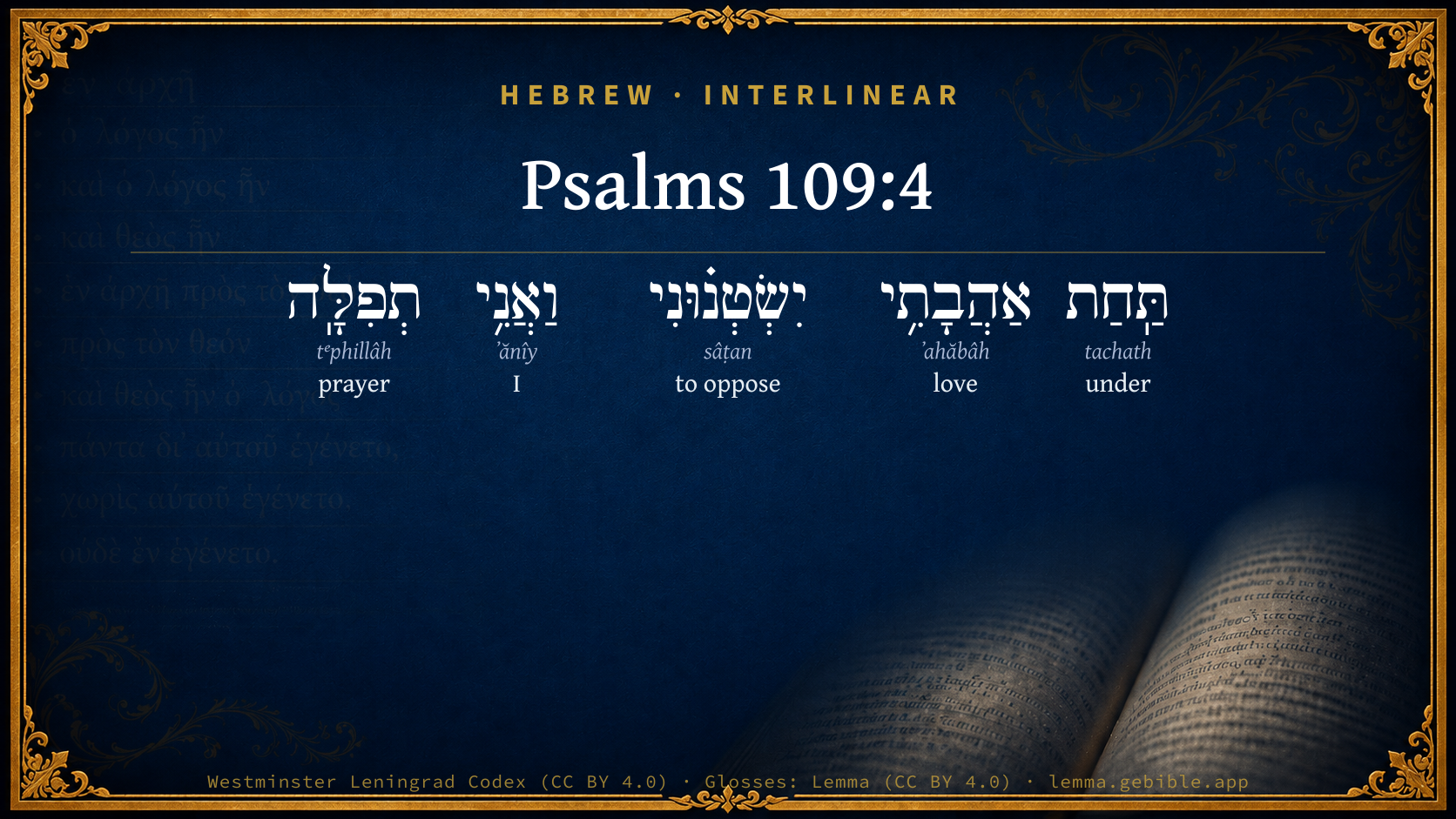
Psalms 109:4

Hebrew (Westminster Leningrad Codex) Psalms 109:4 appears in the Hebrew Old Testament. The text above is from the Westminster Leningrad Codex. Each word links to its Strong’s number, a concise gloss, and parsing drawn from the Open Scriptures Hebrew Bible morphology. Click any word for its full Brown-Driver-Briggs (BDB) entry.
Download image
Cite this verse

Psalms 109:4 (World English Bible). Public Domain. Lemma interlinear Bible study tool, https://lemma.gebible.app/v/psalms/109/4.

Show BibTeX & RIS
BibTeX
RIS
English Translation
In return for my love, they are my adversaries; But I am in prayer.
World English Bible · Public Domain
Download a study sheet

One document with this verse’s original text, its word-by-word gloss line, the meaning frame, cross-references with their text, attributed commentary, and full source and license credits — printable, and it pastes into notes with its structure intact.

This verse Autodidact and up

Study sheet (.html) Plain text (.txt)

A passage Seminary Student

Up to 50 verses in one chapter. A passage sheet keeps up to 6 commentary sources and 12 cross-references per verse, in the order this page ranks them, and says so on the sheet whenever that leaves anything out. Ask for a single verse and you get the Autodidact verse sheet above.

Everything on this page stays free to read, with no account — the sheet is a download of what is already on screen, not access to it.

Want to remove ads? Support Godless Engineer
Compare translations 3

The same verse in 3 English versions, stacked beneath the original-language interlinear above. Click any original word for its lexicon entry.

Each is an independent rendering of the whole verse — the interlinear is not word-aligned to these translations.

Highlighted words mark where these versions differ — a whole-verse word diff, not a word-by-word alignment.

  • World English Bible Public Domain
    In return for my love, they are my adversaries; But I am in prayer.
  • King James Version Public Domain
    For my love they are my adversaries: but I give myself unto prayer.
  • unfoldingWord Literal Text CC BY-SA 4.0
    In return for my love they accuse me, but I—prayer.

unfoldingWord Literal Text — © unfoldingWord, licensed CC BY-SA 4.0. Word-aligned USFM3 via Door43 (git.door43.org/unfoldingWord/en_ult).

Versions to compare (up to 4)

3 of 4 selected

Show all 18 translations

Every available English version of this verse, each an independent rendering of the whole verse.

  • World English Bible Public Domain
    In return for my love, they are my adversaries; But I am in prayer.
  • Berean Standard Bible Public Domain
    In return for my love they accuse me, but I am a man of prayer.
  • Majority Standard Bible Public Domain
    In return for my love they accuse me, but I am a man of prayer.
  • King James Version Public Domain
    For my love they are my adversaries: but I give myself unto prayer.
  • American Standard Version (1901) Public Domain
    For my love they are my adversaries: But I `give myself unto' prayer.
  • Revised Version (1885) Public Domain
    For my love they are my adversaries: but I give myself unto prayer.
  • Geneva Bible (1599) Public Domain
    For my friendship they were mine aduersaries, but I gaue my selfe to praier.
  • Douay-Rheims (1899) Public Domain
    Instead of making me a return of love, they detracted me: but I gave myself to prayer.
  • Young's Literal Translation Public Domain
    For my love they oppose me, and I -- prayer!
  • Literal Standard Version CC BY-SA 4.0
    For my love they oppose me, and I—prayer!
  • Unlocked Literal Bible CC BY-SA 4.0
    In return for my love they accuse me, but I pray for them.
  • unfoldingWord Literal Text CC BY-SA 4.0
    In return for my love they accuse me, but I—prayer.
  • Darby Bible Public Domain
    For my love they are mine adversaries; but I [give myself unto] prayer.
  • World Messianic Bible Public Domain
    In return for my love, they are my adversaries; but I am in prayer.
  • Webster's Bible Public Domain
    For my love they are my adversaries: but I give myself to prayer.
  • Free Bible Version CC BY-SA 4.0
    I love them, but they respond with hostility towards me, even while I'm praying for them!
  • Bible in Basic English Public Domain
    For my love they give me back hate; but I have given myself to prayer.
  • JPS Tanakh (1917) Public Domain
    In return for my love they are my adversaries; but I am all prayer.

Literal Standard Version (2020), Covenant Press — licensed CC BY-SA 4.0. Text via the HelloAO Bible API (eBible.org). Unlocked Literal Bible (unfoldingWord) — licensed CC BY-SA 4.0. Text via the HelloAO Bible API (eBible.org). unfoldingWord Literal Text — © unfoldingWord, licensed CC BY-SA 4.0. Word-aligned USFM3 via Door43 (git.door43.org/unfoldingWord/en_ult). Free Bible Version, Dr. Jonathan Gallagher — licensed CC BY-SA 4.0. Text via the HelloAO Bible API (eBible.org).

Word by word

More ways to search: Search by grammar → Find every occurrence → Compare this word →

Practice this passage: Drill this verse → Learn its vocabulary →

About this verse

These counts appear in no published source. They are computed here, from the morphology-tagged text and Lemma’s own curated glosses. What Lemma adds →

5
words
5
distinct lemmas
Wisdom
section

Notable vocabulary

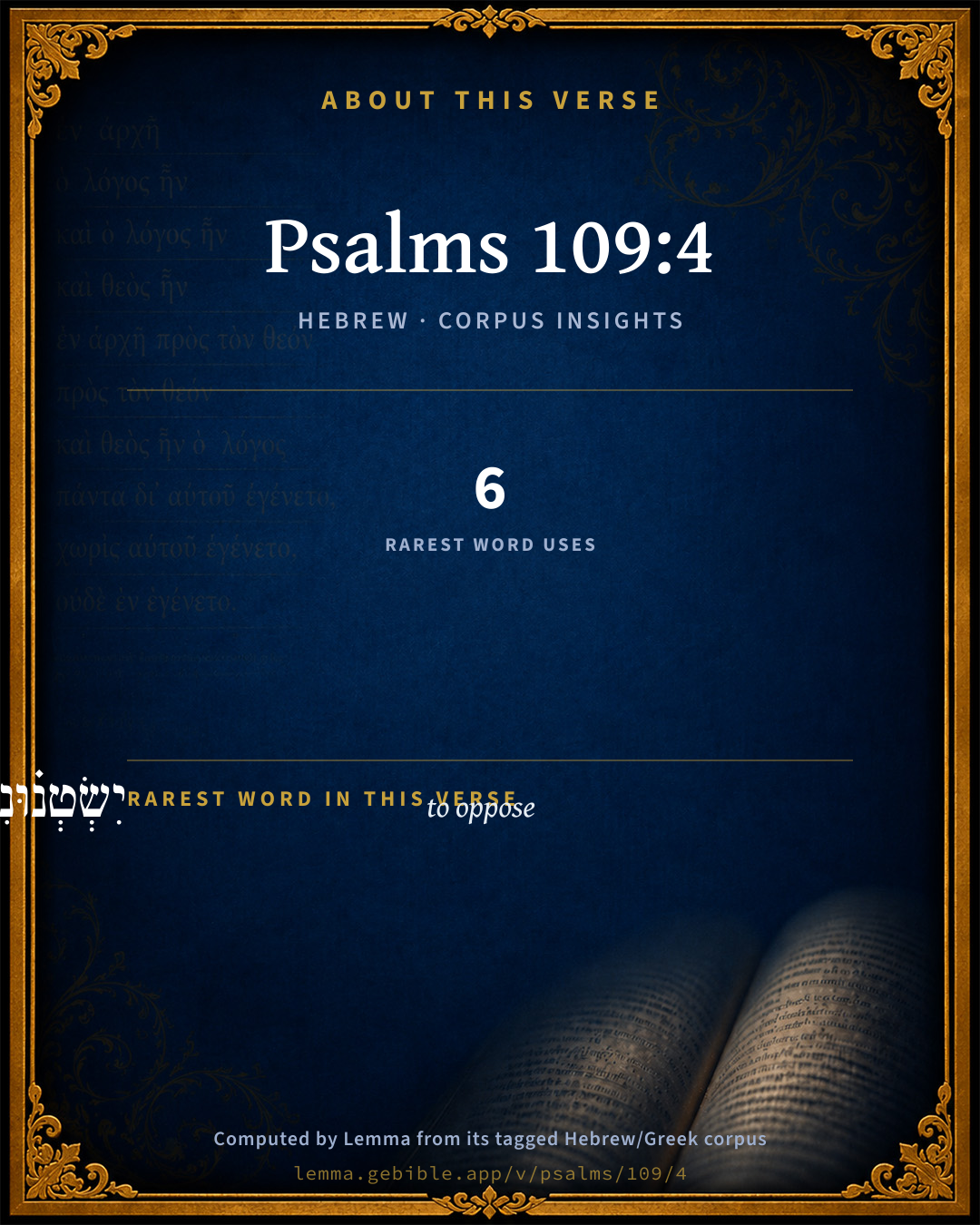
The rarest word here is יִשְׂטְנ֗וּנִי to oppose H7853 — appearing just 6 times in the whole Hebrew Bible.

Shared distinctive vocabulary

יִשְׂטְנ֗וּנִי to oppose H7853 occurs in 6 verses of the Hebrew Bible. Also found in:

Grammatical profile

  • 1 verb
  • 2 nouns
  • 1 pronoun
  • 1 preposition

Verb forms

  • יִשְׂטְנ֗וּנִי Qal · Imperfect

Hebrew & Septuagint length

In English translation the verse runs 14 words from the Hebrew and 13 from the Septuagint (LXX English) — closely comparable.

A rough comparison of the two English renderings, which tokenize alike — not a word-level alignment.

Word counts can differ between the Hebrew and the Greek without any difference in meaning — e.g. the Hebrew direct-object marker אֵת has no separate Greek word, and Greek often adds the article ὁ.

Cross-references

12

Topical passages linked to Psalms 109:4 in the Treasury of Scripture Knowledge — connected by theme and wording, ordered by reader-vote popularity; previews shown in the World English Bible.

  • Psalms 38:20 They who also render evil for good are adversaries to me, Because I follow what is good.
  • Psalms 35:7 For without cause they have hidden their net in a pit for me. Without cause they have dug a pit for my soul.
  • Psalms 69:12–13 Those who sit in the gate talk about me. I am the song of the drunkards.
  • Luke 23:34 Jesus said, "Father, forgive them, for they don't know what they are doing." Dividing his garments among them, they cast lots.
  • Psalms 55:16–17 As for me, I will call on God. Yahweh will save me.
  • Psalms 35:12 They reward me evil for good, To the bereaving of my soul.
  • Luke 6:11–12 But they were filled with rage, and talked with one another about what they might do to Jesus.
  • John 10:32 Jesus answered them, "I have shown you many good works from my Father. For which of those works do you stone me?"
  • 2 Corinthians 12:15 I will most gladly spend and be spent for your souls. If I love you more abundantly, am I loved the less?
  • Daniel 6:10 When Daniel knew that the writing was signed, he went into his house (now his windows were open in his chamber toward Jerusalem) and he kneeled on his knees three times a day, and prayed, and gave thanks before his God, as he did before.
  • 2 Samuel 15:31–32 One told David, saying, Ahithophel is among the conspirators with Absalom. David said, Yahweh, please turn the counsel of Ahithophel into foolishness.
  • 2 Samuel 13:39 [the soul of] king David longed to go forth to Absalom: for he was comforted concerning Amnon, seeing he was dead.

Cross-references courtesy of OpenBible.info (CC BY 4.0).

Hebrew and Greek witnesses Masoretic Hebrew ↔ Greek Septuagint

The same verse in the two great witnesses to the Old Testament, shown verse-for-verse.

You’re reading Greek Psalm 108 (Hebrew Psalm 109). The Septuagint counts the superscription, so verse numbers can differ from the Hebrew — chapter-level alignment, not verse-by-verse. Numbering follows Rahlfs.

These are two independent witnesses, not word-aligned to each other, and the Septuagint is shown in lemma (dictionary) form.

Hebrew Psalms 109:4 Masoretic · Westminster Leningrad Codex

תַּֽחַת אַהֲבָתִ֥י יִשְׂטְנ֗וּנִי וַאֲנִ֥י תְפִלָּֽה

In return for my love, they are my adversaries; But I am in prayer.

World English Bible · Public Domain

Greek LXX Greek Psalm 108:4 Septuagint · lemma form

ἀντί ὁ ἀγαπάω ἐγώ ἐν διαβάλλω ἐγώ ἐγώ δέ προςεὔχομαι

Instead of loving me, they falsely accused me: but I continued to pray.

LXX2012 (modern English Septuagint) · Public Domain

On this verse, Adam Clarke's Commentary discusses the Septuagint’s reading. Read the note in Commentary ↓

Hebrew: Westminster Leningrad Codex (CC BY 4.0). Greek: Septuagint (public domain); English from LXX2012 (modern English Septuagint) (Public Domain). How the Septuagint differs from the Hebrew →

Commentary

Notes on Psalms 109:4 from classic Christian and Jewish commentators (each source and its license shown beneath its notes). The classic Christian expositions comment on the surrounding passage and are grouped to its opening verse, so a note may address several verses; the Jewish commentaries on the Tanakh (Rashi and others) are per-verse, so they appear only where the commentator wrote on this verse.

Lemma curates 59 commentaries, every one of them public domain or Creative Commons licensed, each selected and text-cleaned for this edition rather than reprinted as found. About our sources →

Trapp's Complete Commentary

John Trapp

Psa 109:4 For my love they are my adversaries: but I [give myself unto] prayer.

Ver. 4. For my love they are mine adversaries] Heb. they satanically hate me. To render evil for evil is brutish, but to render evil for good is devilish.

But I give myself to prayer] Heb. But I am prayer, or, a man of prayer, as Psa 120:7, But I am peace. So, being defamed, we pray, 1Co 4:12. When our Saviour was wearied out with the people’s obstinace, he turned himself to God in prayer, Mat 11:26, and prayed for his crucifiers, Luk 23:34 Send me to my toads again (in the dungeon), where I may pray for your lordship’s conversion, said Saunders, the martyr, to Winchester.

John Trapp, A Commentary or Exposition upon All the Books of the Old and New Testament (1647–1656) — public domain. Text from a community e-Sword module.

The Biblical Illustrator

Joseph S. Exell

Psa_109:4

But I give myself unto prayer.

The universal suitability of prayer

This is the great resource of Gods children. Observe the disjunctive particle but with which the text begins. Let others do this or that (he would say), but I give myself unto prayer, or, as it stands in the original, But I--prayer; as though he meant to imply that prayer was everything to him;--I have no other resource, and I need none. What shall we do, asks the pious parent, to secure our children, who will soon be beyond the control of parental authority, and will have to encounter the snares of a world which lieth in wickedness? Give yourselves unto prayer. Let us take another case; namely, the feelings and anxieties of the junior touching the senior members of the household. Here I desire to speak a word in favour of family prayer. Give yourselves unto prayer, as Abraham did, who wherever he went, there he builded an altar unto the Lord, and called upon the name of the Lord. The opening of the new year calls for a review of the past, and that review is fraught with matter for humiliation. Be humbled: yet let not humiliation take the gloomy and unbelieving character of despondency. And in order to prevent this, give yourself unto prayer. (T. E. Hankinson, M.A.)

Constancy in prayer

When a pump is frequently used, but little pains are necessary to have water; the water pours out at the first stroke, because it is high. But if the pump has not been used for a long time, the water gets low, and when you want it you must pump a long while, and the water comes only after great effort. It is so with prayer; if we are instant in prayer, every little circumstance awakens the disposition to pray, and desires and words are always ready. But if we neglect prayer it is difficult for us to pray, for the water in the well gets low. (Felix Neff.)

The Biblical Illustrator, edited by Joseph S. Exell (c. 1880s–1900s) — public domain. Text from a community e-Sword module.

The Treasury of David

Charles H. Spurgeon

Ver. 4. For my love they are my adversaries. They hate me because I love them. One of our poets says of the Lord Jesus"Found guilty of excess of love." Surely it was his only fault. Our Lord might have used all the language of this complaint most emphaticallythey hated him without a cause and returned him hatred for love. What a smart this is to the soul, to be hated in proportion to the gratitude which it deserved, hated by those it loved, and hated because of its love. This was a cruel case, and the sensitive mind of the psalmist writhed under it.

But give myself unto prayer. He did nothing else but pray. He became prayer as they became malice. This was his answer to his enemies, he appealed from men and their injustice to the Judge of all the earth, who must do right. True bravery alone can teach a man to leave his traducers unanswered, and carry the case unto the Lord.

"Men cannot help but reverence the courage that walketh amid calumnies unanswering."

"He standeth as a gallant chief unheeding shot or shell."

Ver. 4. (first clause). None prove worse enemies than those that have received the greatest kindnesses, when once they turn unkind. As the sharpest vinegar is made of the purest wine, and pleasant meats turn to the bitterest humours in the stomach; so the highest love bestowed upon friends, being ill digested or corrupt, turns to the most unfriendly hatred, proximorum odia sunt acerrima. Abraham Wright.

Ver. 4. For my love they are my adversaries; that's an ill requital; but how did David requite them? We may take his own word for it; he tells us how, "But I give myself unto prayer"; yea, he seemed a man wholly given unto prayer. The elegant conciseness of the Hebrew is, "But I prayer"; we supply it thus, "But I give myself unto prayer." They are sinning against me, requiting my love with hatred, "But I give myself unto prayer." But for whom did he pray? Doubtless he prayed and prayed much for himself; he prayed also for them. We may understand these words, "I give myself unto prayer", two ways. First I pray against their plots and evil dealings with me (prayer was David's best strength always against his enemies), yet that was not all. But, secondly, "I give myself unto prayer", that the Lord would pardon their sin, and turn their hearts, when they are doing me mischief; or, though they have done me mischief, I am wishing them the best good. David (in another place) showed what a spirit of charity he was clothed with, when no reproof could hinder him from praying for others, Ps 141:5. Joseph Caryl.

Ver. 4. The translator of the Syriac version has inserted in Ps 109:4 Arabic "and I have prayed for them", as if he had copied them from the words of our Lord in Mt 5:44, where in the Syriac version of the New Testament we have exactly the same construction. It is in keeping with the inscription of the Psalm, which applies it directly to Christ. It would seem as if the Translator understood this verse of the crucifixion and of the Redeemer's prayer for his murderers, or as if the only way to understand the elliptical language of the Psalmist was from the teaching and example of our Lord. E.T. Gibson, of Crayford.

Ver. 4. I prayer. The Messiah says in this prophetic psalm, "I am prayer." During his pilgrimage on earth, his whole life was communion with God; and now in his glory, he is constantly making intercession for us. But this does not exhaust the idea, "I am prayer." He not merely prayed and is now praying, he not merely teaches and influences us to pray, but he is prayer, the fountain and source of all prayer, as well as the foundation and basis of all answers to our petitions. He is the Word in this sense also. From all eternity his Father heard him, heard him as interceding for that world which, created through him, he represented, and in which, through him, divine glory was to be revealed. In the same sense, therefore, in which he is light and gives light, in which he is life and resurrection, and therefore quickens, Jesus is prayer. Adolph Saphir, in Lectures on the Lord's Prayer, 1870.

Ver. 4. Persecuted saints are men of prayer, yea, they are as it were made up all of prayer. David prayed before; but, oh, when his enemies fell a persecuting of him, then he gave himself up wholly to prayer. Oh, then he was more earnest; more fervent, more frequent, more diligent, more constant, and more abundant in the work of prayer! When Numa, king of the Romans, was told that his enemies were in arms against him, he did but laugh at it, and answered, "And I do sacrifice"; so when persecutors arm themselves against the people of God, they do but divinely smile and laugh at it, and give themselves the more up to prayer. When men arm against them, then they arm themselves with all their might to the work of prayer; and woe, woe to them that have armies of prayers marching against them. Thomas Brooks.

Ver. 4. I give myself unto prayer. The instruction to ourselves from these words is most comforting and precious. Are we bowed down with sorrow and distress? "I give myself unto prayer." Are we persecuted, and reviled, and compassed about with words of hatred? "I give myself unto prayer." Has death entered our dwellings? And as we gaze in heart-broken anguish on the no longer answering look of one who was our earthly stay, and we feel as if all hope as well as all help were gone, still there remains the same blessed refuge for all the Lord's sorrowing ones, "I give myself unto prayer." In the allegory of the ancients. Hope was left at the bottom of the casket, as the sweetener of human life; but God, in far richer mercy, gives prayer as the balm of human trial. Barton Bouchier.

Ver. 4. A Christian is all over prayer: he prays at rising, at lying down, and as he walks: like a prime favourite at court, who has the key to the privy stairs, and can wake his prince by night. Augustus Montague Toplady, 1740-1778.

Ver. 4. On the excellency of prayer. See Expository Notes.

Ver. 4. Our Lord's adversaries, and his resort.

Ver. 4-5.

1. David's spirit and conduct towards his enemies. (a) His spirit is lovelove for hatred; hence his denunciations are against their sins, rather than against them. (b) His conduct. He returned good for evil; he interceded for them.

2. Their spirit and conduct towards him. (a) Hatred for love. (b) Evil for good. G.R.

Psalms 109:5*

Charles H. Spurgeon's The Treasury of David (1869–1885) — public domain. Psalms only. Text from a community e-Sword/MySword module.

J. A. Alexander on Psalms

Joseph Addison Alexander

4. (Psa 109:4) In return for my love they are my adversaries—and I (am) prayer. The first word in Hebrew strictly means instead or in lieu of. The unusual expression at the end can only mean, I am all prayer, I do nothing but pray, which some understand to signify, I bear their persecution meekly and continue my devotions undisturbed by their calumnies and insults. But as the whole context is descriptive, not of the sufferer's behaviour but of his enemies, a more probable sense is, I am forced to be continually praying for protection against them and deliverance from them.

Joseph Addison Alexander, The Psalms Translated and Explained (1850) — public domain. Text from a community e-Sword module.

Tyndale Open Study Notes

Tyndale Open Resources

109:4-5 The psalmist’s acts of kindness and godliness (see 35:12-14) have only met with stubborn opposition and expressions of hatred.

Tyndale Open Study Notes — © Tyndale Open Resources, licensed CC BY-SA 4.0. Text via the HelloAO Bible API.

Geneva Bible (1599)

Geneva Bible translators

To declare that I had no other refuge, but thee, in whom my conscience was at rest.

Geneva Bible (1599) marginal notes — public domain. Text via Bolls.life.

Adam Clarke's Commentary

Verse 4. For my love they are my adversaries] In their behalf I have performed many acts of kindness, and they are my adversaries notwithstanding; this shows principles the most vicious, and hearts the most corrupt. Many of the fathers and commentators have understood the principal part of the things spoken here as referring to our Lord, and the treatment he received from the Jews; and whatever the original intention was, they may safely be applied to this case, as the 2nd, 3rd, 4th, and 5th verses are as highly illustrative of the conduct of the Jewish rulers towards our Lord as the following verses are of the conduct of Judas; but allowing these passages to be prophetic, it is the Jewish state rather than an individual, against which these awful denunciations are made, as it seems to be represented here under the person and character of an extremely hardened and wicked man; unless we consider the curses to be those of David's enemies. See Clarke on Ps 109:20.

But I give myself unto prayer] ואני תפלה vaani thephillah; "And I prayer." The Chaldee: ואנא אצלי vaana atsalley, "but I pray." This gives a good sense, which is followed by the Vulgate, Septuagint, AEthiopic, Arabic, and Anglo-Saxon. The Syriac, "I will pray for them." This, not so correctly; as dreadful imprecations, not prayers, follow. But probably the whole ought to be interpreted according to the mode laid down, Ps 109:20. The translation and paraphrase in the old Psalter are very simple: -

Trans. For that thyng that thai sulde hafe lufed me, thai bakbited me; bot I prayed.

Par. That is, that sulde haf lufed me for I was godson, and thai bakbited me sayande, in Belzebub he castes oute fendes; bot I prayed for thaim.

Adam Clarke's Commentary on the Bible (1810–1826) — public domain. Text from a community e-Sword/MySword module.

John Calvin's Commentaries

4 On account of my love they have been opposed to me The Psalmist had already solemnly declared, that his adversaries, unprovoked by any injury inflicted upon them by him, and without any just cause, became, through mere diabolical rage, his most implacable foes. Here he confirms the truth of that declaration by saying, that he had been their friend. For there is far more merit in showing kindness to an enemy than simply abstaining from doing that which is evil. And from this we may perceive, that the influence of Satan must be awfully powerful when he takes the hearts of men captive at his will. For nothing can be more unnatural than to hate and cruelly persecute those who love us. To love he also adds deeds of kindness, meaning, that it was his aim to secure their good will by outward acts of beneficence.

John Calvin's Commentaries (1540-1563) — public domain. Text from the Calvin Translation Society English edition (1840s-50s) via the Christian Classics Ethereal Library (ccel.org). Calvin's coverage is partial (roughly two-thirds of the Bible); uncommented books and verses are honest gaps, never fabricated. The 19th-century editor's footnotes and remarks are omitted so the notes are faithfully Calvin's own voice.

Ellicott's Commentary for English Readers

(4) For my love . . .—i.e., in return for my love I give myself unto prayer. For a concise expression of the same kind as “I prayer,” see Psa_120:7, “I peace.” Of course the psalmist means, that in the face of all the taunts and reproaches of his maligners, he simply and naturally has recourse to prayer, and, as the context seems to indicate, prayer for them.

A Bible Commentary for English Readers, edited by Charles John Ellicott (1878–1897) — public domain. Text from a community e-Sword module.

The Cambridge Bible for Schools and Colleges

gen. ed. J. J. S. Perowne

4. In return for my love they behave as adversaries unto me,

Though I (gave myself unto) prayer.

Their hostility is not merely gratuitous (Psa_109:3); it is an actual return of evil for good. The Heb. word for ‘adversaries’ is characteristic of this Psalms , vv20, 29; cp. Psa_109:6 : elsewhere in the Psalter only in Psa_38:20; Psa_71:13. It may mean not ‘enemies’ in general, but ‘accusers,’ opponents in a court of law. For the forcible idiom I (was) prayer cp. Psa_120:7, “I am peace”; Psa_110:3, “Thy people are freewill offerings.” The A.V., But I give myself unto prayer, retained in R.V., takes the meaning to be that in his need he commits his cause to God (cp. Psa_69:13). But the parallel passage in Psa_35:13 is decidedly in favour of supposing that his prayers for them in past times are meant, and this explanation suits the context best. To these prayers he refers as the proof of his love, the good for which they are now (Psa_109:5) requiting him with evil.

The Cambridge Bible for Schools and Colleges (gen. ed. J. J. S. Perowne; Cambridge University Press, 1878–1918) — public domain. Text from a community e-Sword module.

John Gill's Exposition

For my love they are my adversaries,.... For the love that Christ showed to the Jews; to their bodies, in going about and healing all manner of diseases among them; to their souls, in preaching, the Gospel to them in each of their cities; and for the love he showed to mankind in coming into the world to save them, which should have commanded love again; but instead of this they became his implacable adversaries: they acted the part of Satan; they were as so many Satans to him, as the word signifies.

But I give myself unto prayer; or "I am a man of prayer" (y); as Aben Ezra and Kimchi supply it; so he was in the days of his flesh, Heb 5:7, he was constant at it, and fervent in it; sometimes a whole night together at it: his usual method was, when at Jerusalem, to teach in the temple in the daytime, and at night to go to the mount of Olives, and there abide and pray, Luk 6:12. This was the armour he alone made use of against his enemies, when they fought against him, and acted the part of an adversary to him; he betook himself to nothing else but prayer; he did not return railing for railing, but committed himself in prayer to God, who judgeth righteously, Pe1 2:23, yea, he prayed for those his adversaries: and so Aben Ezra and Kimchi interpret it, that he was a man of prayer for them, and prayed for them; as it is certain Christ did, when he was encompassed by his enemies, and they were venting all their spite and malice against him, Luk 23:34.

(y) "et ego vir orationis", Pagninus, Gejerus.

John Gill's Exposition of the Whole Bible (1746–1763) — public domain (CC PDM 1.0). Text via the HelloAO Bible API.

Albert Barnes' Notes on the Bible

For my love ... - As a recompence for my love; or, this is the return which I get for all the expressions of my love to them. The enemies referred to were those whom he had treated kindly; to whom he had done good. This is not uncommon in the world. It was illustrated in an eminent degree in the life of the Saviour.

But I give myself unto prayer - literally, “I - prayer;” that is, I am all prayer; I continually pray. This may mean, either, that he bore these trials with a meek spirit, and did not allow these things to disturb his devotions; or, more probably, that he prayed constantly “for them;” he desired their good, and sought it from above.

Albert Barnes' Notes on the Bible (1834–1885) — public domain. Text from a community e-Sword/MySword module.

Matthew Poole's English Annotations

For my love they are my adversaries; they requite my love and good will with enmity and mischief, as it is explained, Psa 109:5.

But I give myself unto prayer, Heb. but I prayer, i.e. I am a man of prayer, or I betake myself to prayer. Thus I peace is put for I am for peace, as we render it, Psa 120:7; and thy bread for the men of thy bread, or that eat thy bread, Ob 7. The sense is, Whilst they reproach and curse me, I pray either,

1. For them, as he did, Psa 35:13; or,

2. For myself: I did not render unto them evil for evil, but quietly committed myself and my cause to God by prayer, desiring him to plead my cause against them; and I had no other refuge.

Matthew Poole's English Annotations on the Holy Bible (1683–1685) — public domain. Text from a community e-Sword/MySword module.

Whedon's Commentary on the Bible

Daniel D. Whedon

4, 5. For my love—Instead of “my love,” or instead of returning love for “my love,” they are my adversaries. And so, Psa_109:5. This “rewarding evil for good and hatred for love” is the purest diabolism. Psa_109:3-5 set forth the true moral relation of David to his enemies, both as to past conduct and present feelings, and have an essential bearing on the import and true spirit of the psalm. It is impossible to construe the psalm in the spirit of personal hate or vindictiveness. But the higher application is to Christ and his persecutors.

But I give myself unto prayer—Literally, But I prayer; that is, “But I am wholly prayer.”—Furst. I use no other means of vindication or defence. The form is intensive, as in Psa_120:7, “I peace”—I am wholly given to peace. The hatred of the psalmist’s foes is not of to-day or of yesterday, but of old, and of years past.”—Canon Cook.

Daniel D. Whedon (gen. ed.), Commentary on the Old and New Testaments (1874–1909) — public domain. Text from a community e-Sword module.

The Pulpit Commentary

For my love they are my adversaries. The tenderness and kindness of the good towards wicked men does not soften them. Rather it provokes them to greater hostility. This was seen clearly in the instance of Saul. But I give myself unto prayer; literally, but I prayer; i.e. "but I am wholly prayer," "I do nothing during their attacks on me but pray for them.

HOMILIES BY R. TUCK Ver. 4. Complaining to God.

"I am for prayer." "I find refuge in prayer, committing myself and my cause unto thee." The point of the psalm which seems to be missed is this the psalmist, deeply moved in his feeling by the treacherous wrong done to him, nevertheless does not express his feeling to his fellow-men, nor act revengefully toward his enemies, but lets out his heart to God, speaking quite freely to him all that he thought and felt. It may, indeed, be said that the psalmist should not have felt so bitterly under any provocation. But we can clearly see that, if he did feel thus, he did what was altogether the wisest and most hopeful thing, when he spoke his bad feelings to God rather than to men. It is generally agreed that David was the author of the psalm, and that the treachery and wickedness of some individual is the cause of David"s extreme anger and distress. Doeg, Cush, Shimei, and Ahithophel have been suggested. The treachery of his trusted friend Ahithophel perhaps affected David more than any other wrong done to him. But Shimei was brutal in his enmity. The expressions David uses must be judged in the light of his age.

I ACTING IN VINDICATION OF SELF MAY BE WRONG. And acting includes speech and deed. In David"s case if the association is the rebellion of Absalom he could not act; he was helpless to defend himself. But if he had been able, it was clearly wiser not to attempt such defense. There are many forms of trouble to which men are subject which they must leave alone. Attempted vindications only make matters worse. Men often make grave mistakes through over-anxiety about self-vindication; and their own heat of feeling, and the public prejudice excited, make the methods of vindication imprudent, and the results ineffective. "Avenge not yourselves." On David"s side it should be urged that he did not attempt to avenge himself.

II APPEALING TO GOD FOR VINDICATION IS ALWAYS RIGHT. And he who goes to God may be, and should be, genuine with God; and if he does feel strongly, he should say what he feels. Illustrate by the way in which a mother encourages her boy to tell everything to her when he is in a passion. The boy tells how he hates, and wishes evil done to, the person who has injured him. The mother does not misunderstand, and her work is to get the boy soothed and calmed. We may freely speak out our bad feelings to our Father-God. That very unreserve he uses to bring us to our right minds. We may show how wrongly we feel by what we say to God, as David did; but the saying it to God is certainly right. Take your very anger to God in prayer. R.T.

The Pulpit Commentary (1880–1919), ed. H.D.M. Spence-Jones & Joseph S. Exell — public domain. Text from a community e-Sword module.

John Wesley's Explanatory Notes

Adversaries - They requite my love with enmity, as it is explained ver. 5.

John Wesley, Explanatory Notes Upon the Whole Bible (1754–1765) — public domain. Text via the GEBible commentary corpus.

unfoldingWord translationNotes

Door43 World Missions Community

In return for my love

"Although I loved them"

my love

"my love for them"

they accuse me

The word "they" refers to the people who are wicked and deceitful. You may need to make explicit that those who accuse the psalmist do so falsely. AT: "they accuse me falsely" or "they slander me"

translationWords

love

slander

pray

evil

good

unfoldingWord translationNotes — © Distant Shores Media and the Door43 World Missions Community, licensed CC BY-SA 4.0. Source: git.door43.org/Door43/en_tn.

Rashi

Rabbi Shlomo Yitzchaki (Rashi)

Instead of my love for You, they hinder me.

but I am at prayer But I pray to You constantly. I found:

Rashi on the Tanakh — English translations: “The Judaica Press complete Tanach with Rashi, translated by A. J. Rosenberg” (CC BY 4.0); “Pentateuch with Rashi's commentary by M. Rosenbaum and A.M. Silbermann, 1929-1934” (public domain); “The Metsudah Tanach series, Lakewood, N.J” (CC BY 4.0); and “The Book of Joshua, Metsudah Publications, 1997” (CC BY 4.0). Text via Sefaria.

Lesson kit

Teaching starters — assembled from the data on this page, not authored interpretation. Every prompt links to the verse data it draws on. Edit before teaching.

Psalms, in the Wisdom, opens this verse with 5 words (5 distinct Hebrew lemmas). Its most distinctive word is sâṭan (“to oppose”). A historical commentator’s framing appears above. Read the whole chapter for the surrounding context.

Discussion questions

  1. What does “to oppose” (sâṭan) contribute to the verse as a whole?
  2. Psalms 38:20 shares the word «to oppose» with this verse. How do the two illuminate each other?
  3. These translations render this verse differently. What is at stake in choosing one wording over another?
  4. The verb «יִשְׂטְנ֗וּנִי» is Qal Imperfect. How does its form color the action?
  5. Reading how Trapp's Complete Commentary and The Biblical Illustrator read this verse, where do the two commentators agree and where do they part?

Things to notice

Reading settings

Reading text

Shown beneath each verse's original-language words.

Old Testament
Old Testament edition

Read the OT as the Masoretic Hebrew (MT) or the Greek Septuagint (LXX).

English shown for the Greek Septuagint (in the Hebrew ↔ Greek comparison).

Comparing translations? Open the Compare panel on any verse page to stack up to four side by side.