
Jeremiah 33:14

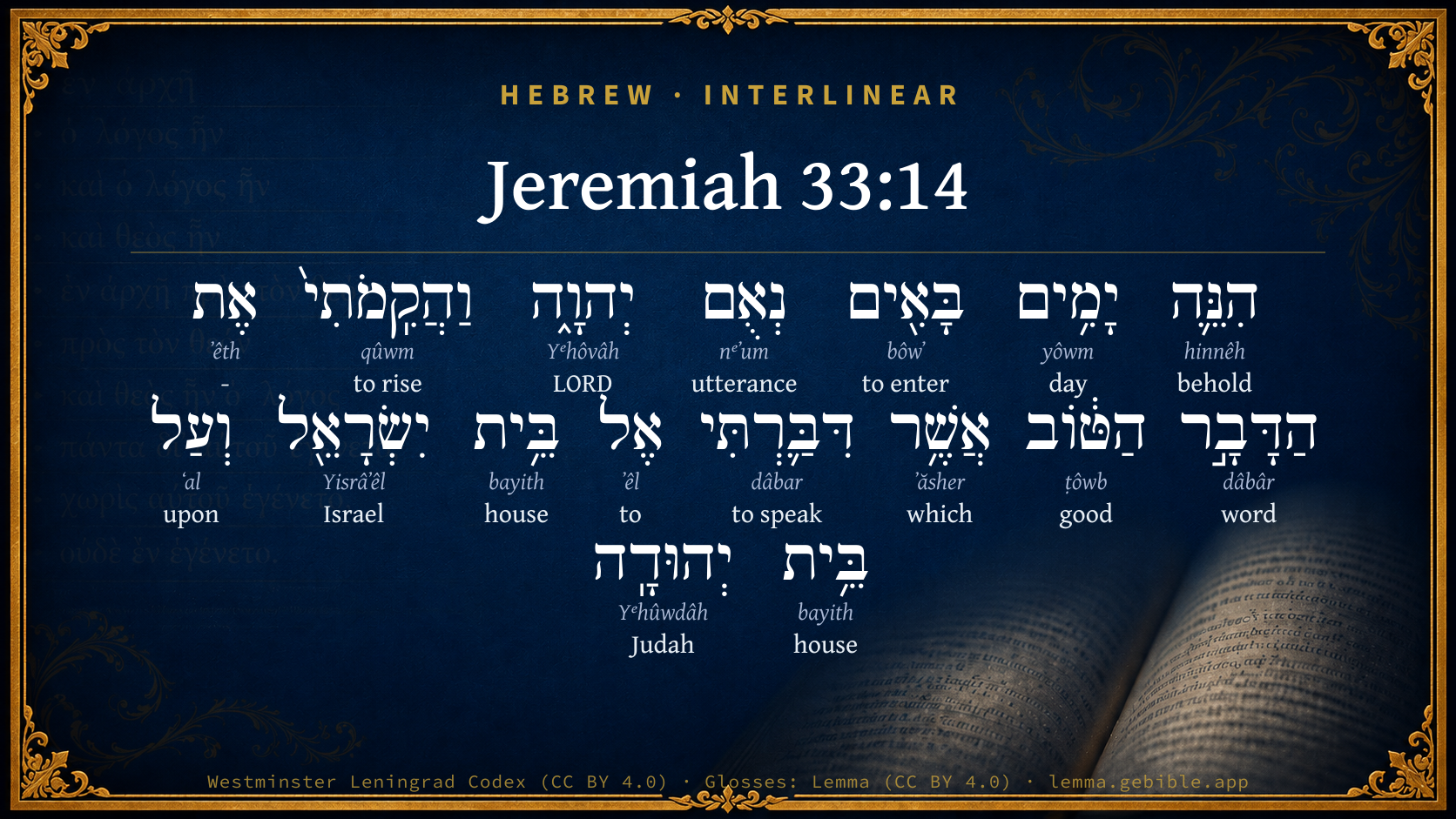
Hebrew (Westminster Leningrad Codex) Jeremiah 33:14 appears in the Hebrew Old Testament. The text above is from the Westminster Leningrad Codex. Each word links to its Strong’s number, a concise gloss, and parsing drawn from the Open Scriptures Hebrew Bible morphology. Click any word for its full Brown-Driver-Briggs (BDB) entry.
Download image
Cite this verse

Jeremiah 33:14 (World English Bible). Public Domain. Lemma interlinear Bible study tool, https://lemma.gebible.app/v/jeremiah/33/14.

Show BibTeX & RIS
BibTeX
RIS
English Translation
Behold, the days come, says Yahweh, that I will perform that good word which I have spoken concerning the house of Israel and concerning the house of Judah.
World English Bible · Public Domain
Download a study sheet

One document with this verse’s original text, its word-by-word gloss line, the meaning frame, cross-references with their text, attributed commentary, and full source and license credits — printable, and it pastes into notes with its structure intact.

This verse Autodidact and up

Study sheet (.html) Plain text (.txt)

A passage Seminary Student

Up to 50 verses in one chapter. A passage sheet keeps up to 6 commentary sources and 12 cross-references per verse, in the order this page ranks them, and says so on the sheet whenever that leaves anything out. Ask for a single verse and you get the Autodidact verse sheet above.

Everything on this page stays free to read, with no account — the sheet is a download of what is already on screen, not access to it.

Want to remove ads? Support Godless Engineer
Compare translations 3

The same verse in 3 English versions, stacked beneath the original-language interlinear above. Click any original word for its lexicon entry.

Each is an independent rendering of the whole verse — the interlinear is not word-aligned to these translations.

Highlighted words mark where these versions differ — a whole-verse word diff, not a word-by-word alignment.

  • World English Bible Public Domain
    Behold, the days come, says Yahweh, that I will perform that good word which I have spoken concerning the house of Israel and concerning the house of Judah.
  • King James Version Public Domain
    Behold, the days come, saith the LORD, that I will perform that good thing which I have promised unto the house of Israel and to the house of Judah.
  • unfoldingWord Literal Text CC BY-SA 4.0
    ‘Look! Days are coming—this is Yahweh’s declaration—when I will do what I have promised for the house of Israel and the house of Judah.

unfoldingWord Literal Text — © unfoldingWord, licensed CC BY-SA 4.0. Word-aligned USFM3 via Door43 (git.door43.org/unfoldingWord/en_ult).

Versions to compare (up to 4)

3 of 4 selected

Show all 18 translations

Every available English version of this verse, each an independent rendering of the whole verse.

  • World English Bible Public Domain
    Behold, the days come, says Yahweh, that I will perform that good word which I have spoken concerning the house of Israel and concerning the house of Judah.
  • Berean Standard Bible Public Domain
    Behold, the days are coming, declares the LORD, when I will fulfill the gracious promise that I have spoken to the house of Israel and the house of Judah.
  • Majority Standard Bible Public Domain
    Behold, the days are coming, declares the LORD, when I will fulfill the gracious promise that I have spoken to the house of Israel and the house of Judah.
  • King James Version Public Domain
    Behold, the days come, saith the LORD, that I will perform that good thing which I have promised unto the house of Israel and to the house of Judah.
  • American Standard Version (1901) Public Domain
    Behold, the days come, saith Jehovah, that I will perform that good word which I have spoken concerning the house of Israel and concerning the house of Judah.
  • Revised Version (1885) Public Domain
    Behold, the days come, saith the LORD, that I will perform that good word which I have spoken concerning the house of Israel and concerning the house of Judah.
  • Geneva Bible (1599) Public Domain
    Beholde, the dayes come, sayth the Lord, that I wil performe that good thing, which I haue promised vnto the house of Israel, and to the house of Iudah.
  • Douay-Rheims (1899) Public Domain
    Behold the days come, saith the Lord, that I will perform the good word that I have spoken to the house of Israel, and to the house of Juda.
  • Young's Literal Translation Public Domain
    Lo, days are coming, an affirmation of Jehovah, And I have established the good word That I spake unto the house of Israel, And concerning the house of Judah.
  • Literal Standard Version CC BY-SA 4.0
    “Behold, days are coming,” a declaration of YHWH, “And I have established the good word || That I spoke to the house of Israel, || And concerning the house of Judah.
  • Unlocked Literal Bible CC BY-SA 4.0
    'Look! Days are coming—this is Yahweh's declaration—when I will do what I have promised for the house of Israel and the house of Judah.
  • unfoldingWord Literal Text CC BY-SA 4.0
    ‘Look! Days are coming—this is Yahweh’s declaration—when I will do what I have promised for the house of Israel and the house of Judah.
  • Darby Bible Public Domain
    Behold, the days come, saith Jehovah, that I will perform the good word which I have spoken unto the house of Israel and unto the house of Judah.
  • World Messianic Bible Public Domain
    “Behold, the days come,” says the LORD, “that I will perform that good word which I have spoken concerning the house of Israel and concerning the house of Judah.
  • Webster's Bible Public Domain
    Behold, the days come, saith the LORD, that I will perform that good thing which I have promised to the house of Israel and to the house of Judah.
  • Free Bible Version CC BY-SA 4.0
    Look! The time is coming, declares the Lord, when I will keep my promise to do good to the people of Israel and Judah.
  • Bible in Basic English Public Domain
    See, the days are coming, says the Lord, when I will give effect to the good word which I have said about the people of Israel and the people of Judah.
  • JPS Tanakh (1917) Public Domain
    Behold, the days come, saith the LORD, that I will perform that good word which I have spoken concerning the house of Israel and concerning the house of Judah.

Literal Standard Version (2020), Covenant Press — licensed CC BY-SA 4.0. Text via the HelloAO Bible API (eBible.org). Unlocked Literal Bible (unfoldingWord) — licensed CC BY-SA 4.0. Text via the HelloAO Bible API (eBible.org). unfoldingWord Literal Text — © unfoldingWord, licensed CC BY-SA 4.0. Word-aligned USFM3 via Door43 (git.door43.org/unfoldingWord/en_ult). Free Bible Version, Dr. Jonathan Gallagher — licensed CC BY-SA 4.0. Text via the HelloAO Bible API (eBible.org).

Word by word

More ways to search: Search by grammar → Find every occurrence → Compare this word →

Practice this passage: Drill this verse → Learn its vocabulary →

נְאֻם
nᵉʼum
H5002
“utterance of”
Noun, Common, Masculine, Singular, Construct
Part of Speech
Noun
Type
Common
Gender
Masculine
Number
Singular
State
Construct
Full BDB Definition

Origin: from H5001

TWOT: 1272a

(Qal) utterance, declaration (of prophet) - utterance, declaration, revelation (of prophet in ecstatic state) - utterance, declaration (elsewhere always preceding divine name)
  1. הִנֵּ֛ה hinnêh H2009 “behold” Particle, Demonstrative
  2. יָמִ֥ים yôwm H3117 “days” Noun, Common, Masculine, Plural, Absolute
  3. בָּאִ֖ים bôwʼ H935 “entering” Verb, Qal, Participle Active, Masculine, Plural, Absolute
  4. יְהוָ֑ה Yᵉhôvâh H3068 “LORD” Noun, Proper
  5. וַהֲקִֽמֹתִי֙ qûwm H6965 “and · to rise” Conjunction + Verb, Hiphil, Sequential Perfect, 1st Person, Common, Singular
  6. אֶת ʼêth H853 “-” Particle, Direct Object
  7. הַדָּבָ֣ר dâbâr H1697 “the · word” Particle, Definite Article + Noun, Common, Masculine, Singular, Absolute
  8. הַטּ֔וֹב ṭôwb H2896 “the · good” Particle, Definite Article + Adjective, Adjective, Masculine, Singular, Absolute
  9. אֲשֶׁ֥ר ʼăsher H834 “which” Particle, Relative
  10. דִּבַּ֛רְתִּי dâbar H1696 “to speak” Verb, Piel, Perfect, 1st Person, Common, Singular
  11. אֶל ʼêl H413 “to” Preposition
  12. בֵּ֥ית bayith H1004 “house of” Noun, Common, Masculine, Singular, Construct
  13. יִשְׂרָאֵ֖ל Yisrâʼêl H3478 “Israel” Noun, Proper
  14. וְעַל ʻal H5921 “and · upon” Conjunction + Preposition
  15. בֵּ֥ית bayith H1004 “house of” Noun, Common, Masculine, Singular, Construct
  16. יְהוּדָֽה Yᵉhûwdâh H3063 “Judah” Noun, Proper

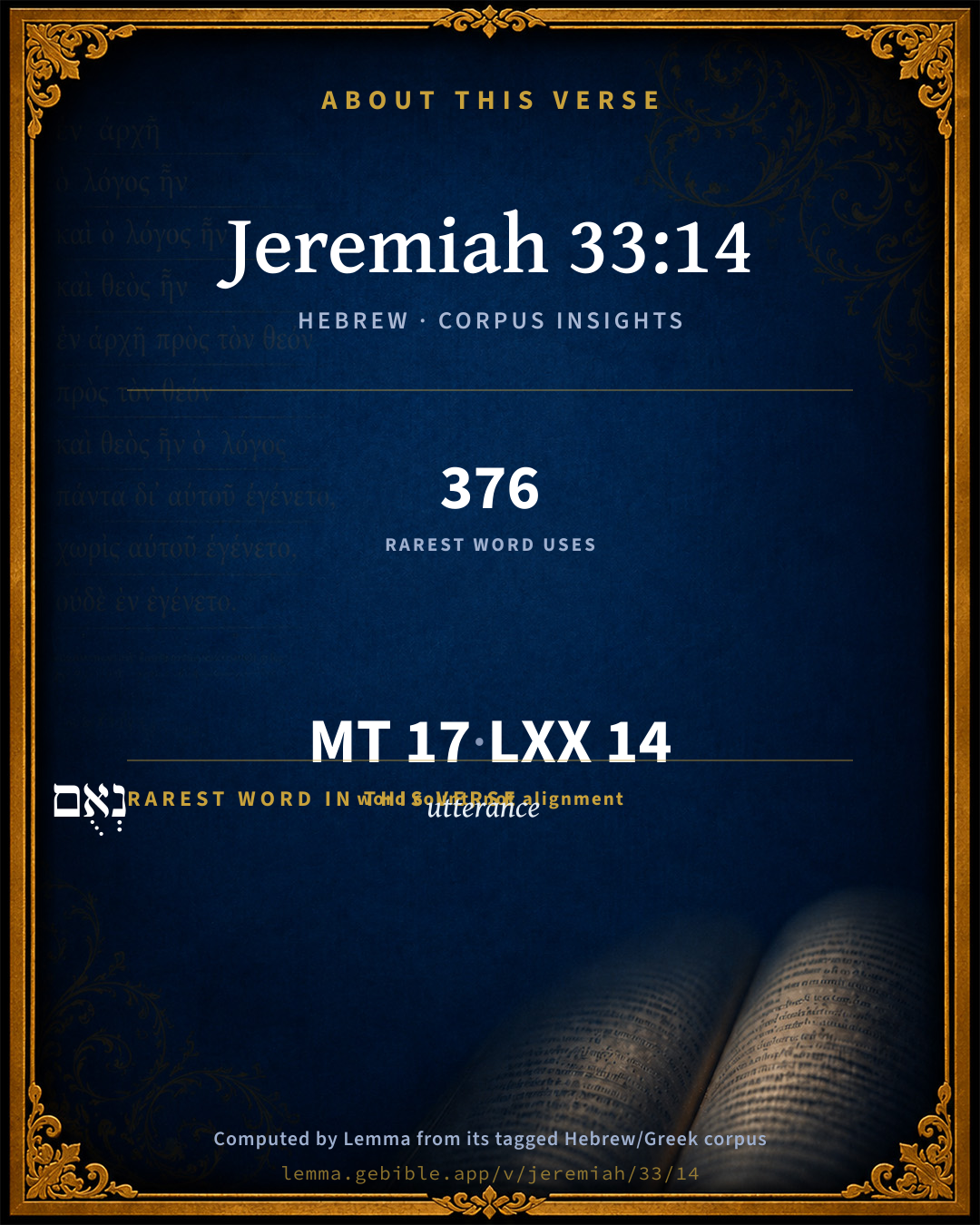
About this verse

These counts appear in no published source. They are computed here, from the morphology-tagged text and Lemma’s own curated glosses. What Lemma adds →

17
words
16
distinct lemmas
Prophets
section

Grammatical profile

  • 3 verbs
  • 8 nouns
  • 1 adjective
  • 2 prepositions
  • 3 particles

Verb forms

  • בָּאִ֖ים Qal · Participle Active
  • וַהֲקִֽמֹתִי֙ Hiphil · Sequential Perfect
  • דִּבַּ֛רְתִּי Piel · Perfect

Repetition

A word recurs within this verse — often emphatic in Hebrew:

  • בֵּ֥ית house H1004 ×2

Hebrew & Septuagint length

In the original languages it is 17 Hebrew tokens and 14 Greek tokens — but the two are counted differently (Hebrew bundles its prefixes and suffixes into one token; the Greek is in lemma form), so that isn’t a like-for-like length.

Cross-references

29

Topical passages linked to Jeremiah 33:14 in the Treasury of Scripture Knowledge — connected by theme and wording, ordered by reader-vote popularity; previews shown in the World English Bible.

  • Jeremiah 23:5 Behold, the days come, says Yahweh, that I will raise to David a righteous Branch, and he shall reign as king and deal wisely, and shall execute justice and righteousness in the land.
  • Haggai 2:6–9 For this is what Yahweh of Hosts says: 'Yet once, it is a little while, and I will shake the heavens, the earth, the sea, and the dry land;
  • 1 Chronicles 17:13–14 I will be his father, and he shall be my son: and I will not take my loving kindness away from him, as I took it from him that was before you;
  • 2 Corinthians 1:20 For however many are the promises of God, in him is the "Yes." Therefore also through him is the "Amen," to the glory of God through us.
  • Genesis 49:10 The scepter will not depart from Judah, Nor the ruler's staff from between his feet, Until he comes to whom it belongs. To him will the obedience of the peoples be.
  • Genesis 22:18 In your seed will all the nations of the earth be blessed, because you have obeyed my voice."
  • Isaiah 32:1–2 Behold, a king shall reign in righteousness, and princes shall rule in justice.
  • Jeremiah 29:10 For thus says Yahweh, After seventy years are accomplished for Babylon, I will visit you, and perform my good word toward you, in causing you to return to this place.
  • Jeremiah 31:31–34 Behold, the days come, says Yahweh, that I will make a new covenant with the house of Israel, and with the house of Judah:
  • Ezekiel 34:23–25 I will set up one shepherd over them, and he shall feed them, even my servant David; he shall feed them, and he shall be their shepherd.
  • Amos 9:11 In that day I will raise up the tent of David who is fallen, and close up its breaches, and I will raise up its ruins, and I will build it as in the days of old;
  • Zephaniah 3:15–17 Yahweh has taken away your judgments. He has thrown out your enemy. The King of Israel, Yahweh, is in the midst of you. You will not be afraid of evil any more.
  • Jeremiah 32:38–41 and they shall be my people, and I will be their God:
  • Luke 1:69–70 And has raised up a horn of salvation for us in the house of his servant David
  • Acts 13:32–33 We bring you good news of the promise made to the fathers,
  • Isaiah 7:14 Therefore the Lord himself will give you a sign. Behold, the virgin will conceive, and bear a son, and shall call his name Immanuel.
  • Isaiah 9:6–7 For to us a child is born, to us a son is given; and the government shall be on his shoulder: and his name shall be called Wonderful, Counselor, Mighty God, Everlasting Father, Prince of Peace.
  • Daniel 7:13–14 I saw in the night-visions, and, behold, there came with the clouds of the sky one like a son of man, and he came even to the ancient of days, and they brought him near before him.
  • Daniel 9:25 Know therefore and discern, that from the going forth of the commandment to restore and to build Jerusalem to the Anointed One, the prince, shall be seven weeks, and sixty-two weeks: it shall be built again, with street and moat, even in troubled times.
  • Micah 5:2 But you, Bethlehem Ephrathah, Being small among the clans of Judah, Out of you one will come forth to me that is to be ruler in Israel; Whose goings forth are from of old, from everlasting.
  • Malachi 3:1 "Behold, I send my messenger, and he will prepare the way before me; and the Lord, whom you seek, will suddenly come to his temple; and the messenger of the covenant, whom you desire, behold, he comes!" says Yahweh of hosts.
  • Luke 2:10–11 The angel said to them, "Don't be afraid, for behold, I bring you good news of great joy which will be to all the people.
  • Luke 10:24 for I tell you that many prophets and kings desired to see the things which you see, and didn't see them, and to hear the things which you hear, and didn't hear them."
  • Hebrews 11:40 God having provided some better thing concerning us, so that apart from us they should not be made perfect.
  • 1 Peter 1:10 Concerning this salvation, the prophets sought and searched diligently, who prophesied of the grace that would come to you,
  • Revelation 19:10 I fell down before his feet to worship him. He said to me, "Look! Don't do it! I am a fellow bondservant with you and with your brothers who hold the testimony of Jesus. Worship God, for the testimony of Jesus is the Spirit of Prophecy."
  • Jeremiah 31:27 Behold, the days come, says Yahweh, that I will sow the house of Israel and the house of Judah with the seed of man, and with the seed of animal.
  • Daniel 2:44 In the days of those kings shall the God of heaven set up a kingdom which shall never be destroyed, nor shall the sovereignty of it be left to another people; but it shall break in pieces and consume all these kingdoms, and it shall stand forever.
  • Zechariah 9:9–10 Rejoice greatly, daughter of Zion! Shout, daughter of Jerusalem! Behold, your king comes to you! He is righteous, and having salvation; Lowly, and riding on a donkey, Even on a colt, the foal of a donkey.

Cross-references courtesy of OpenBible.info (CC BY 4.0).

Hebrew and Greek witnesses Masoretic Hebrew ↔ Greek Septuagint

The same verse in the two great witnesses to the Old Testament, shown verse-for-verse.

These are two independent witnesses, not word-aligned to each other, and the Septuagint is shown in lemma (dictionary) form.

Hebrew Jeremiah 33:14 Masoretic · Westminster Leningrad Codex

הִנֵּ֛ה יָמִ֥ים בָּאִ֖ים נְאֻם יְהוָ֑ה וַהֲקִֽמֹתִי֙ אֶת הַדָּבָ֣ר הַטּ֔וֹב אֲשֶׁ֥ר דִּבַּ֛רְתִּי אֶל בֵּ֥ית יִשְׂרָאֵ֖ל וְעַל בֵּ֥ית יְהוּדָֽה

Behold, the days come, says Yahweh, that I will perform that good word which I have spoken concerning the house of Israel and concerning the house of Judah.

World English Bible · Public Domain

Greek LXX Structure differs

In the Septuagint, Jeremiah is about an eighth shorter than the Hebrew and arranges its material differently — the Oracles Against the Nations (Hebrew chapters 46–51) appear in the middle of the Greek book, after 25:13. Because the chapter and verse boundaries do not line up, a verse-for-verse comparison with the Hebrew is not shown.

A verse-for-verse comparison isn’t shown here because the chapters and verses don’t line up. Switch to the LXX edition with the MT / LXX toggle above to read the Greek directly.

On this verse, The Cambridge Bible for Schools and Colleges discusses the Septuagint’s reading. Read the note in Commentary ↓

Hebrew: Westminster Leningrad Codex (CC BY 4.0). Greek: Septuagint (public domain); English from a public-domain English Septuagint. How the Septuagint differs from the Hebrew →

Targum (Aramaic paraphrase)

1

The Targum is the ancient Jewish Aramaic paraphrase of the Hebrew Scriptures — an interpretive translation, not the Hebrew text itself. Onkelos (literal) and Pseudo-Jonathan (expansive) render the Torah, and Jonathan the Prophets. Coverage is partial: where no permissively-licensed English translation exists for a verse, only the Aramaic is shown. This is verse-level text, not a word-by-word alignment to the Hebrew.

  1. Targum Jonathan Prophets (Joshua–Malachi)
    הָא יוֹמַיָא אָתָן אֲמַר יְיָ וַאֲקֵים יַת פִּתְגְמָא תַקְנָא דְמָלֵילִית עַל בֵּית יִשְׂרָאֵל וְעַל בֵּית יְהוּדָה:

    (no public-domain English translation for this verse)

    Targum Jonathan — Aramaic: “Mikraot Gedolot” (public domain). English: “Sefaria Community Translation” (CC0 1.0 (public-domain dedication)); “London "Chaldee Paraphrase," 1871” (public domain). Text via Sefaria.

Commentary

Notes on Jeremiah 33:14 from classic Christian and Jewish commentators (each source and its license shown beneath its notes). The classic Christian expositions comment on the surrounding passage and are grouped to its opening verse, so a note may address several verses; the Jewish commentaries on the Tanakh (Rashi and others) are per-verse, so they appear only where the commentator wrote on this verse.

Lemma curates 59 commentaries, every one of them public domain or Creative Commons licensed, each selected and text-cleaned for this edition rather than reprinted as found. About our sources →

The Cambridge Bible for Schools and Colleges

gen. ed. J. J. S. Perowne

14–18. The Kingly and Priestly Offices shall be re-established.

14–26. See introd. summary to the section. This portion of the ch. is clearly later than Jeremiah’s time. The expression “Levitical priests” (see on Jer_33:18) is not one which he uses elsewhere. Moreover, there is a considerable amount of repetition in the passage (cp. Jer_33:14-16 with Jer_29:10, Jer_23:5 f., and Jer_33:17 with Jer_35:19, and Jer_33:20-26 with Jer_31:35 f.). Above all, it is lacking in the LXX. It is very improbable that those translators would have designedly omitted such a proclamation of the Messianic hope, of the permanence of David’s line, and of the importance of the priestly office. The generally hopeful character of the passage also would have appealed to them. Gi., though deciding against the genuineness of the passage, considers that the phrase “Levitical priests” is so suitable to Jeremiah’s time, that here it must be considered as an archaism employed by a later writer. Co. summarily rejects the passage, and substitutes Jer_23:7 f., as being most appropriate here, while at least suspicious in 23. in view of its varying position in MT. and LXX.

The Cambridge Bible for Schools and Colleges (gen. ed. J. J. S. Perowne; Cambridge University Press, 1878–1918) — public domain. Text from a community e-Sword module.

Trapp's Complete Commentary

John Trapp

Jer 33:14 Behold, the days come, saith the LORD, that I will perform that good thing which I have promised unto the house of Israel and to the house of Judah.

Ver. 14. I will perform that good thing.] Praestabo verbum istud optimum, as Tremellius well rendereth it. I will perform that best word or promise, viz., concerning Christ, in whom all the former and future promises are Yea and Amen, to the glory of God. {2Co 1:20}

“ Haec dicenda bono sunt bona verba die. ”

John Trapp, A Commentary or Exposition upon All the Books of the Old and New Testament (1647–1656) — public domain. Text from a community e-Sword module.

Joseph Benson's Commentary

Jer 33:14-16. Behold, the days come that I will perform that good thing, &c. — The Lord’s word is not yea and nay: he cannot lie, or repent. There shall come a time when he will verify every good word which he hath spoken to, or concerning, his people. In those days will I cause the Branch of righteousness to grow up to David — The kings they had hitherto had of the line of David were most of them unrighteous men; but God here promises that after the captivity they should have a branch of David that would execute judgment and righteousness in the land, for the protection and government of those that feared him. If this passage point at all to Zerubbabel, who was a good man, a descendant of David, and, though not a king, a ruler of the Jews, after their return from Babylon, and who governed with equity and not as Jehoiakim had done; yet it can only refer to him as a type of the Messiah, the branch out of the stem of Jesse, Isa 11:1; the branch of the Lord that was to be beautiful and glorious, Isa 4:2; and the righteous branch that was to be raised up unto David, as he is described Jer 23:5, a passage exactly similar to this, and undoubtedly meant of the same person. See the notes on these passages. In those days shall Judah be saved, &c. — If, a temporal salvation be here at all intended, it must be, not that which the Jews enjoyed for a short season under the government of Zerubbabel, a deliverance and protection from, or security against their enemies, which was very imperfect, and frequently interrupted; but that more perfect salvation, peace, and prosperity, which they shall enjoy in the latter days, after their conversion to Christianity, and restoration to their own land, according to the predictions contained in this and the three preceding chapters. But a spiritual and eternal salvation undoubtedly is chiefly intended here, as well as in the parallel passage, Jer 23:6. And this is the name wherewith ye shall be called, The Lord our righteousness — According to this reading it is here foretold, that the name which properly belongs to the Messiah shall be given to Jerusalem, that is, to the church; “to signify,” says Lowth, “that it is in a peculiar manner dedicated to him, he having chosen it for the place of his residence, (see Eze 48:35,) and that all the righteousness of the faithful, both their justification and sanctification, is derived from him. this seems,” adds he, “to be the genuine sense of the words, as may appear to any that will compare the original phrase here, יקרא לה, with Isa 62:4; Isa 62:12, where it is said of Zion, Thou shalt be called Hephzibah, or, my delight is in her, and sought out, a city not forsaken. Nor is there any greater impropriety in giving the name Jehovah to a city, than in calling an altar Jehovah-nissi, that is, Jehovah my banner, (Exo 17:15,) and Jehovah-shalom, Jehovah peace, (Jdg 6:24,) in token that the Lord was the author of those mercies of which the said altars were designed to be monuments. So the servants of God are described as having his name written upon their foreheads, Rev 3:12; Rev 14:1; but several interpreters, particularly Huetius, and our learned Bishop Pearson, (in his Exposition of the Creed, p. 165,) render the words thus: He that shall call her [to be his peculiar people] is the Lord our righteousness.” Thus also Dr. Waterland and others. But Blaney, who renders the last clause of Jer 23:6, This is the name by which Jehovah shall call him, OUR RIGHTEOUSNESS, translates this, And this is he whom Jehovah shall call OUR RIGHTEOUSNESS, judging that the הin לה, rendered her, is not the feminine pronoun affix, but the masculine, after the Chaldee form.

Joseph Benson's Commentary on the Old and New Testaments (1811–1818) — public domain. Text from a community e-Sword module.

Keil & Delitzsch

C. F. Keil & F. Delitzsch

The re-establishment of the Davidic monarchy and of the Levitical priesthood. - Jer 33:14. "Behold, days are coming, saith Jahveh, when I will perform the good word which I have spoken to the house of Israel, and concerning the house of Judah. Jer 33:15. In those days and at that time will I cause to sprout unto David a sprout of righteousness, and he shall do judgment and righteousness in the land. Jer 33:16. In those days shall Judah be saved, and Jerusalem shall dwell safely; and this is how she shall be called, 'Jahveh our righteousness.' Jer 33:17. For thus saith Jahveh: David shall never want a man to sit upon the throne of the house of Israel. Jer 33:18. Nor shall the Levitical priests want a man before me to offer a burnt-offering, to burn a meat-offering, or to perform sacrifice every day.

Jer 33:19. "And the word of Jahveh came unto Jeremiah, saying: Jer 33:20. Thus saith Jahveh, If ye shall be able to break my covenant (with) the day and my covenant (with) the night, so that there shall not be day and night in their proper time, Jer 33:21. Then also shall my covenant with David my servant be broken, so that he shall not have a son to reign upon his throne, and with the Levites, the priests, my ministers. Jer 33:22. As the host of heaven cannot be numbered, nor the sand of the sea measured, so will I multiply the seed of David my servant, and the Levites who serve me.

Jer 33:23. "And the word of Jahveh came to Jeremiah, saying: Jer 33:24. Hast thou not seen what this people have spoken, saying, 'The two families which the Lord hath chosen, these He hath rejected?' and my people they have despised, so that they are no longer a nation before them. Jer 33:25. Thus saith Jahveh: If my covenant with day and night doth not exist, if I have not appointed the laws of heaven and earth, Jer 33:26. Then also will I reject the seed of Jacob and David my servant, so as not to take any of his seed as rulers over the seed of Abraham, Isaac, and Jacob. For I will turn their captivity, and take pity on them."

Jer 33:14-21

Jer 33:14-18 contain the promise of the restoration of the monarchy and the priesthood. Jer 33:19-26 further present two special messages from God, in the form of supplements, which guarantee the eternal continuance of these institutions.

(Note: The portion contained within Jer 33:14-26 is wanting in the lxx; for this reason, and chiefly because of the promise of the eternal duration, not merely of the royal house of David, but also of the Levitical priests, and their innumerable increase, J. D. Michaelis and Jahn have considered it spurious. To these must be added Movers, who takes Jer 33:18, Jer 33:21-25 as later interpolations, and Hitzig, who treats the whole passage as a series of separate additions made in a later age. On the other side, Kueper, Wichelhaus, and Hengstenberg (Christology, vol. ii. pp. 459-461 of Clark's Translation) have shown the utter worthlessness of these reasons, and Graf also has defended the genuineness of the passage. So too has Ewald, who says (Propheten, ii. 269), "Nothing can be so preposterous and unreasonable as to find in this passage, Jer 33:19-26, or in Jer 30-33 generally, additions by a later prophet.")

The promise in Jer 33:14-16 has already been given in substance in Jer 23:5-6, and in our verses it is only formally extended, and thereby made more prominent. In Jer 33:14 it is designated as the establishment, i.e., the realization, of the good word which the Lord has spoken concerning Israel and Judah. "The good word" is, according to Deu 28:1-14, the blessing which the Lord has promised to His people if they obey His commands; cf. Kg1 8:56. Here also must "the good word" be taken in the same general meaning; for our verse forms the transition from the promise of the restoration and blessing of Israel in the future (Jer 33:6-13) to the special promise of the renewal and completion of the Davidic monarchy (Jer 33:15.). In Jer 29:10, on the contrary, "the good word" is specially referred, by the following infinitival clause, to the deliverance of the people from Babylon. But it is unlikely that "the good word" refers to the "sprout" of David, which is expressly promised in Jer 23:5., and repeated here, Jer 33:15.; for here a like promise to the Levites follows, while there is none in Jer 23, and it is here so closely linked with the promise regarding David, that it must be viewed as a portion of the "good word." In the change from אל to על in Jer 33:14, we must not, with Hengstenberg, seek a real difference; for in Jeremiah these prepositions often interchange without any difference of meaning, as in Jer 11:2; Jer 18:11; Jer 23:35, etc. The blessing promised to the people in the "good word" culminates in the promise, Jer 33:15., that the Lord will cause a righteous sprout to spring up for David. On the meaning of this promise, see the remarks on Jer 23:5-6. The difference made in the repetition of that promise is really unimportant. אצמיח instead of הקמתי does not change the sense. הצמיח, to cause to sprout of grow, corresponds to the figure of the צמח, under which the Messiah is represented in both passages. צמח צדקה is only a more sonorous expression for צמח צדּיק. The words "He shall rule as king and deal wisely," which in Jer 23:5 bring into prominence the contrast between the kingdom of the Messiah and that of the godless shepherd of the people, were unnecessary for the connection of our passage. Besides, in Jer 23:6 Israel is named together with Judah, instead of which, we have here, in Jer 33:16, Jerusalem; accordingly, the name "Jahveh Tsidkenu" is referred to Jerusalem, while in Jer 23:6 it is predicated of the sprout of David. The mention of Jerusalem instead of Israel is connected with the general scope of our prophecy, viz., to comfort the covenant people over the destruction of Jerusalem (Jer 33:4.). But that, through the mention simply of Judah and its capital, the ten tribes are not to be excluded from participation in the coming prosperity, may be seen even from Jer 33:14, where "the good word" is referred to Israel and Judah, and still more plainly from Jer 33:24, Jer 33:26, where this promise is made sure to the whole seed of Israel. The transference of the name Jahveh Tsidkenu from the sprout of David to the city of Jerusalem is connected with the fact, that the name only expresses what the Messiah will bring to the people (see Jer 23:6); the righteousness which He works in and on Jerusalem may, without changing the substance of the thought, be attributed to Jerusalem itself, inasmuch as Jerusalem reflects the righteousness which is bestowed on her by the Messiah.

This promise is, Jer 33:17, further confirmed by the renewal of that which the Lord had given King David, through Nathan the prophet, Sa2 7:12-16, and that, too, in the form in which David himself had expressed it in his address to Solomon, shortly before his death, Kg1 2:4, and in which Solomon had repeated it, Kg1 8:25 and Kg1 9:5. The formula לא יכּרת וגו, "there never will be cut off from David one sitting," etc., has the meaning, David will never want a descendant to occupy his throne; or, the posterity of David will possess the kingdom for ever. A temporary loss of the throne is not thereby excluded, but only such a permanent loss as would be caused by the family of David becoming extinct, or by the kingdom in Israel either passing over to some other family, or in some way or other coming to an end; see on Kg1 2:4. - The very same promise is given to the Levitical priests, i.e., the priests of the tribe or family of Levi (כּהנים as in Deu 17:9, Deu 17:18; Deu 18:1, etc.). They shall never want one to bring and prepare an offering before the Lord. Burnt-offering, meat-offering, and sin-offering are the three species of sacrifice which were to be brought, according to the law, as in Jer 17:26. By means of the apposition "the Levites," the priests are designated as the legitimate priesthood, established as such in virtue of God's choice of the tribe of Levi, in contrast with priests such as Jeroboam appointed, out of the common people, for the worship set up by him. Not only shall Israel have priests, but priests out of the tribe of Levi, which was chosen by God for the sacerdotal office, as the medium of communicating His gracious gifts. The designation of the priests as "the Levites" corresponds, accordingly, to the kings of the family of David. Such a view explains this addition to our passage, to which critics such as Hitzig have taken objection. The Davidic kingdom and the Levitical priesthood were the two pillars and bases of the Old Testament theocracy, on which its existence and continuance depended. The priesthood formed the medium of approach for the people into divine favour. The kingdom assured them of the divine guidance.

(Note: Continebatur autem salus populi duabus istis partibus. Nam, sine rege, erant veluti corpus truncum aut mutilum; sine sacerdote mera erat dissipatio. Nam sacerdos erat quasi medius inter Deum et populum, rex autem representabat Dei personam. - Calvin.)

Both of these pillars were broken with the destruction of Jerusalem and of the temple; the theocracy the appeared to have ceased to exist. At this time, when the kingdom, with its ordinances of justice and of grace, bestowed by God, was being dissolved, the Lord, in order to keep His people from despair, declares that these two institutions, in accordance with His promise, shall not fall to the ground, but shall stand for ever. By this, God's own people received a pledge for the re-establishment and renovation of the kingdom of God. Such is the object of this promise. - As to the kind and mode of reinstitution of both of these ordinances, which were abolished when the state came to ruin, the prophecy now before us gives no explanation; but in the emphatic confirmation of the prophecy which follows, we find brief indications which clearly show that the restoration spoken of will not be a reinstitution of the old form which is now perishing, but a renovation of it, in its essential features, to a permanent existence.

The confirmations of these promises, which follow them in Jer 33:19-26, are each introduced by separate headings, perhaps not merely to render them more prominent, but because the Lord revealed them separately to the prophet; but it by no means follows from this that they are later additions, without any connection. Jer 33:20. "If ye shall break my covenant with the day,...then also will my covenant with David...be broken." This if betokens the impossible; man cannot alter the arrangement in nature for the regular alternation of day and night. היום and הלּילה are in apposition to בּריתי, "my covenant the day - the night," for "my covenant with regard to the day and the night, which is this, that day and night shall return at their appointed times." The ו before לבלתּי is explanatory. יומם־ולילה are adverbs, "day and night," for "the regular alternation of day and night." These divine arrangements in nature are called a covenant; because God, after the flood, gave a pledge that they should uninterruptedly continue, in a covenant made with the human race; cf. Gen 9:9 with Gen 8:22. As this covenant of nature cannot be broken by men, so also the covenant of grace of the Lord with David and the Levites cannot be broken, i.e., annulled. The covenant with David consisted in the promise that his kingdom should endure for ever (see Jer 33:17); that with the Levites, in the eternal possession of the right to the priesthood. The institution of the priesthood is certainly not represented in the law as a covenant; it consisted merely in the choice of Aaron and his sons as priests by God, Exo 28:1. But, inasmuch as they were thereby brought into a peculiar relation to the Lord, and thus had vouchsafed to them not merely privileges and promises, but also had laid on them duties, the fulfilment of which was a condition of receiving the privileges, this relation might be called a covenant; and indeed, in Num 25:11., the promise given to Phinehas, that he should have the priesthood as an eternal possession, is called a covenant of peace and an eternal covenant of priesthood. This promise concerned the whole priesthood in the person of Phinehas, and the Levites also, inasmuch as the Levites were given to the priests; hence there is mention made in Mal 2:4, Mal 2:8, of a covenant with Levi. In this prophecy, too, mention is made of the priests alone. The general idea contained in the words "the Levites," placed first, is more clearly defined by the apposition "the priests," and restricted to the priests of the tribe of Levi.

Jer 33:22-26

In order to make still more impressive the pledge given, that the covenant with David and the Levitical priesthood can never be broken, the Lord adds the promise of a numerous increase of the seed of David and the Levites. אשׁר as correlative to כּן stands for כּאשׁר; for in the accusative lies the general reference to place, time, kind, and manner; cf. Ew. 360 a, 333 a. The comparison with the innumerable host of stars and the immeasurable quantity of the sand reminds us of the patriarchal promises, Gen 15:5; Gen 22:17. In this way, the promises that apply to all Israel are specially referred to the family of David and the Levites ("the Levites," Jer 33:22, is abbreviated from "the Levites, the priests," Jer 33:21). This transference, however, is not a mere hyperbole which misses the mark; for, as Jahn observes, an immense increase of the royal and priestly families would only have been a burden on the people (Graf). The import of the words of the verse is simply that the Lord purposes to fulfil the promise of His blessing, made to the patriarchs in favour of their whole posterity, in the shape of a numerous increase; but this promise will now be specially applied to the posterity of David and to the priests, so that there shall never be wanting descendants of David to occupy the throne, nor Levites to perform the service of the Lord. The question is not about a "change of the whole of Israel into the family of David and the tribe of Levi" (Hengstenberg); and if the increase of the family of David and the Levites correspond in multitude with the number of all the people of Israel, this increase cannot be a burden on the people. But the question, whether this promise is to be understood literally, of the increase of the ordinary descendants of David and the Levites, or spiritually, of their spiritual posterity, cannot be decided, as Hengstenberg and Ngelsbach think, by referring to the words of the Lord in Exo 19:6, that all Israel shall be a kingdom of priests, and to the prophetic passages, Isa 66:6, Isa 66:23., according to which the whole people shall be priests to God, while Levites also shall be taken from among the heathen. For this prophecy does not treat of the final glory of the people of God, but only of the innumerable increase of those who shall attain membership in the family of David and the Levitical priests. The question that has been raised is rather to be decided in accordance with the general promises regarding the increase of Israel; and in conformity with these, we answer that it will not result from the countless increase of the descendants of Jacob according to the flesh, but from the incorporation, among the people of God, of the heathen who return to the God of Israel. As the God-fearing among the heathen will be raised, for their piety, to be the children of Abraham, and according to the promise, Isa 66:20., even Levitical priests taken from among them, so shall the increase placed in prospect before the descendants of David and Levi be realized by the reception of the heathen into the royal and sacerdotal privileges of the people of God under the new covenant.

This view of our verse is confirmed by the additional proof given of the promised restoration of Israel, Jer 33:23-26; for here there is assurance given to the seed of Jacob and David, and therefore to all Israel, that they shall be kept as the people of God. The occasion of this renewed confirmation was the allegation by the people, that the Lord had rejected the two families, i.e., Israel and Judah (cf. Jer 31:27, Jer 31:31; Jer 32:20), called, Isa 8:14, the two houses of Israel. With such words they despised the people of the Lord, as being no longer a people before them, i.e., in their eyes, in their opinion. That those who spoke thus were Jews, who, on the fall of the kingdom of Judah, despaired of the continuance of God's election of Israel, is so very evident, that Hengstenberg may well find it difficult to understand how several modern commentators could think of heathens - Egyptians (Schnurrer), Chaldeans (Jahn), Samaritans (Movers), or neighbours of the Jews and of Ezekiel on the Chebar (Hitzig). The verdict pronounced on what these people said, "they despise, or contemn, my people," at once relieves us from any need for making such assumptions, as soon as we assign the full and proper force to the expression "my people" = the people of Jahveh. Just as in this passage, so too in Jer 29:32, "this people" is interchanged with "my people" as a designation of the Jews. Moreover, as Graf correctly says, the expression "this people" nowhere occurs in the prophets of the exile as applied to the heathen; on the contrary, it is very frequently employed by Jeremiah to designate the people of Judah in their estrangement from the Lord: Jer 4:10; Jer 5:14, Jer 5:23; Jer 6:19; Jer 7:33; Jer 8:5; Jer 9:14; Jer 13:10; Jer 14:10; Jer 15:1, Jer 15:20, and often elsewhere. "My people," on the other hand, marks Judah and Israel as the people of God. In contrast with such contempt of the people of God, the Lord announces, "If my covenant with day and night does not stand, if I have not appointed the laws of heaven and earth, then neither shall I cast away the seed of Jacob." The לא is repeated a second time before the verb. Others take the two antecedent clauses as one: "If I have not made my covenant with day and night, the laws of heaven and earth." This construction also is possible; the sense remains unchanged. בּריתי יומם ולילה is imitated from Jer 33:20. "The laws of heaven and earth" are the whole order of nature; cf. Jer 31:35. The establishment, institution of the order of nature, is a work of divine omnipotence. This omnipotence has founded the covenant of grace with Israel, and pledged its continuance, despite the present destruction of the kingdom of Judah and the temporary rejection of the guilty people. But this covenant of grace includes not merely the choosing of David, but also the choosing of the seed of Jacob, the people of Israel, on the ground of which David was chosen to be the ruler over Israel. Israel will therefore continue to exist, and that, too, as a nation which will have rulers out of the seed of David, the servant of the Lord. "The mention of the three patriarchs recalls to mind the whole series of the promises made to them" (Hengstenberg). The plural משׁלים does not, certainly, refer directly to the promise made regarding the sprout of David, the Messiah, but at the same time does not stand in contradiction with it; for the revival and continued existence of the Davidic rule in Israel culminates in the Messiah. On כּי cf. Jer 31:23; Jer 30:3, Jer 30:18, and the explanations on Jer 32:44. The Qeri אשׁיב rests on Jer 33:11, but is unnecessary; for אשׁוּב makes good enough sense, and corresponds better to ורחמתּים, in so far as it exactly follows the fundamental passage, Deu 30:3, where רחם is joined with שׁוּב את־שׁבוּת.

Keil & Delitzsch — Biblical Commentary on the Old Testament (1861–1891) — public domain (CC PDM 1.0). Text via the HelloAO Bible API. (Old Testament only.)

Lange's Commentary on the Holy Scriptures

5. THE GLORIOUS KINGDOM AND PRIESTHOOD OF THE FUTURE

Jer_33:14-18

14          Behold the days are coming, saith Jehovah, that I will fulfil

The good word that I have spoken of the house of Israel and the house of Judah.

15     In those days and that time will I cause9

The sprout of righteousness to spring to David,

And he shall execute10 justice and righteousness in the land.

16     In those days will Judah be saved and Jerusalem dwell safely,

And this will be her name, Jehovah our Righteousness.11

17     For thus saith Jehovah, a man shall never be wanting to David,

Who may sit upon the throne of the house of Israel.

18     And to the priests, the Levites, a man shall not be wanting before me,

Who may offer burnt-offerings and kindle meat-offerings,

And offer sacrifices continually.

EXEGETICAL AND CRITICAL

Passing from the general to the particular, the circumference to the centre, the prophet further declares with respect to the happy future, that in it the promise previously announced will be fulfilled (Jer_33:4), a sprout of righteousness shall spring from the stock of David, who will restore justice and righteousness in the land (Jer_33:15), and by whom Judah and Jerusalem will be raised to such a height of prosperity that the latter will actually bear the name “Jehovah our Righteousness” (Jer_33:16). The race of David shall never die out (Jer_33:17), nor the priestly tribe of Levi and the priestly service ever cease.

Jer_33:14-16. Behold, the days … our Righteousness. What is “the good word” in Jer_33:14? The expression occurs besides in Jeremiah only in Jer_29:10. There it refers, as is evident from the mention of the seventy years, to Jer_25:11. If the expression is to be taken there in a special sense, so also here. For here we have a still plainer reference to a former promise (Jer_23:5-6). The reference to the general salvation, i.e., to the most universal manifestation of salvation is thus not excluded. Though this view is favored by the circumstance that the prophet, as already remarked, proceeds in this chapter from the general to the special, yet the special salvation, to which Jer_33:15 sqq. refer, is the central point comprising all that has been said hitherto, being a condition of all salvation in the widest sense. Hengsenberg incorrectly accentuates the two prepositions אֵל and עַל. According to the usage of our prophet they are so like each other in signification, that one frequently stands for the other (comp. Jer_25:1 coll.; Jer_7:1; Jer_11:1 etc.; Jer_26:15), or by the side of the other with absolutely identical meaning (Jer_11:2; Jer_18:11; Jer_23:35; Jer_25:2; Jer_27:19; Jer_44:20).

Jer_33:15. In those days, etc. In these words the chronological statement in Jer_33:14 is resumed after the interruption, so that in sense this beginning coincides with that in Jer_23:5. The addition and that time here as in Jer 1:4, 20 possesses a merely rhetorical significance. It serves to render the declaration more solemn. The alteration from in his days (Jer_23:6) is unimportant. It is however important to note the change of Israel into Jerusalem, this being founded in the connection of the chapter. While the general object of the prophet, as is seen in Jer_33:14, is to show that the comforting prophecy given in former times, still holds good, notwithstanding the comfortless circumstances in which Jerusalem then was, being sorely pressed by the Chaldeans, yet he cannot avoid somewhat modifying the prophecy in accordance with the present occasion. This occasion according to Jer_33:4 is the sight of the houses thrown down in defence. In view of this mournful spectacle he had in Jer_33:6-7 to promise healing of wounds, rebuilding of the city. He has also here the city of Jerusalem especially in view, though he does not by any means forget Israel, but on the contrary diligently sets forth its share in the promise given to Judah (Jer_33:14). Hence the alteration to Jerusalem.—With this it is also connected that the last clause states the name which Jerusalem will bear as a significant symbolical inscription. Comp. rems. on Jer_23:6.

Jer_33:17-18. For thus saith Jehovah … continually. The principal statement refers neither to Jer_33:15 nor to Jer_33:16 exclusively, but to both. Improbable as it must then have appeared at the time of Zedekiah that the house of David, which was reduced so low both inwardly and outwardly, should send forth so excellent and glorious a scion, equally so must the happy condition promised to the people in Jer_33:16 have appeared. Both however are shown to be possible by the announcement in Jer_33:17 of the everlasting continuance of the house of David and of its dominion over Israel. Observe, moreover, that it is not said on the throne of David nor on his throne (Jer_33:21; Jer_13:13; Jer_22:4), but on the throne of the house of Israel. The house of Israel is evidently here the whole of Israel, and the eternal duration of David’s rule over it involves both the inner and outer rejuvenescence of the Davidic race, and the welfare of the people, which essentially depends thereon, since it may be subjected not to foreign rulers, but to their own native royal family.—A man shall never, etc. Comp. Jer_35:19. The sense of the expression is not, none shall ever be extirpated, but every one shall never be extirpated, so that none will be left. Herein is thus primarily contained only the promise of succession of rulers extending in perpetuum. Hengstenberg, however, calls attention to the circumstance (Christol., S. 516) [Eng. Tr., II., p. 461] that we are not to suppose a “perfectly uninterrupted succession,” but only one that is not broken off entirely. The prophet moreover reproduces almost verbatim the ancient promise given to the house of David, as it is repeated on the basis of 1Sa_7:16, by David in his parting words to Solomon (1Ki_2:4), and afterwards by the latter himself at his dedication of the temple (1Ki_8:25), and finally by the Lord Himself in His renewed promise to Solomon (1Ki_9:5).—And to the priests, etc. A second pillar on which rests the redemption and secure continuance of Israel (Jer_33:16) is the normal permanence of the national priesthood. This is the Levitic.—The Levites is therefore in apposition (comp. Deu_17:9; Deu_17:18; Jos_3:3; Eze_44:15 coll. Deu_21:5). The descendants of Levi, who according to the Mosaic law were alone eligible to the priesthood (Num_3:10; Num_16:40; Num_18:7), will be opposed to others who might possibly assume the priesthood to themselves. The question may here arise how this promise of the eternal continuance of the Levitic priesthood is related to other declarations, especially of the Epistle to the Hebrews, according to which this Levitical priesthood as only an inferior stage is to give way to a higher priesthood, viz., that after the order of Melchizedek (Hebrews 7-9. coll. Jer_3:16; Psa_110:4). I believe that this question must be decided according to the standard of Mat_5:17-18. As not a tittle of the law is absolutely abrogated, and thrown aside as worthless, but is kept by being fulfilled and thus being elevated to a higher potency, so also the Levitical priesthood being absorbed by a higher, is lost in its outward, temporal and local form, but in its ideal character is now first established. Hence the expressions of this passage (as well as the related ones in Ezekiel 40-42) neither contradict former declarations of Jeremiah (as Jer_3:16; Jer_31:31-33), nor the doctrine of the Epistle to the Hebrews. Comp. rems. on Jer_33:22 and my review of “Balmer—Rinck, The Prophet Ezekiel’s vision of the Temple” in Reuter’s Repertorium, 1860, Heft. III., S. 152.—Who may offer, etc. Comp. Exo_29:18; Lev_1:9; Lev_1:17; Lev_9:10; Num_18:17, etc.—The three species of offerings are mentioned also in Jer_17:26; Num_15:3-4.

DOCTRINAL AND ETHICAL

1. On Jer_32:3. “An effect of anger and a procedure almost like that of Ahab with the prophet Micah. The same spirit prevails now-a-days. For without entering on an investigation, with what right or reason men are found who often in pretty general expressions in a call to repentance, borrow from the prophet all sorts of judicial threatening and point to this or that city, we cannot avoid seeing why they are always put in arrest, viz.: for this cause, ‘Why dost thou prophesy what we do not like to hear?’ When one is sure of his cause, a noble disdain of such people would be the best means to use against them. But men cannot bear a bad conscience and threatenings of all sorts together, and the fear that it may be true has the foolish effect, that they cause the bearers of such unpleasant tidings to come to a bad end, in order to affright others from coming with similar messages.” Zinzendorf.

2. On Jer_32:7 sqq. “Fundatur in hoc textu locus classicus de contractibus emtionis et venditionis, quos improbant Anabaptistæ, probat Scriptura, sicut ostendunt hæc quæ jam sequuntur documenta: Pro_31:14; Mat_13:3.”Förster.

3. On Jer_32:15. “The prophet had often enough declared the land lost to the Chaldeans. Here, however, he must testify that it is not lost forever: his purchase was to restore confidence in the future to other troubled souls. Thus the most afflicted servant of God must again be the most hopeful.”—“When we are outwardly prosperous, we think no one can take our prosperity from us, and when trouble comes upon us, we again think that no one can help us. Both courses are, however, equally ungodly. Therefore God’s servants must contradict both those who are at ease, and those who are in despair. The reverse is always right. In good days humble thyself, and in bad days let thyself be exalted, for then it is a great thing to do.” Diedrich.

4. On Jer_32:9; Jer_32:16; Jer_32:24-25. “Jeremiah also contends, but as a servant of the Lord. First he obeys and afterwards speaks about it. This is a noble way, by which every teacher, who knows the Lord, may prove himself. As soon as he observes that the Lord wishes this or that, it is not the time to expostulate, but to act, not to call anything in question, but to set to work. If then any hesitation is left, or one and another scruple, it is time afterwards to consult with the Lord about it, when one has first shown obedience.” Zinzendorf. [“Though we are bound to follow God with an implicit obedience, yet we should endeavor that it may be more and more intelligent obedience. We must never dispute God’s statutes and judgments, but we may and must inquire, What mean these statutes and judgments? Deu_6:20.” Henry.—S. R. A.]

5. On Jer_32:25. Tertullian (c. Marc, L. IV., c. 40) sees in the words “Buy thee the field for money,” the prophetic passage to which Mat_27:9 refers, regarding the reading Ἰερεμίου as correct. Comp. Euseb. Demonstr. Ev., L. X., c. 4; Augustin, De consensu Evang., L. III., c. 7.

6. On Jer_32:27. To God there is no wonder [miracle]. There are wonders only on the lower stage of existence. Every higher stage is a wonder to the lower. Or is there only one stage of existence, and accordingly only one order of nature? When the North American savages cruelly murdered one of their number who had been on a visit to the Great Father in Washington, and told them of the wonders of civilization, as a demoniacally possessed liar, were they less in the right than our highly civilized savages, to whom it is a fundamental axiom, that there is no other world, but that which they can reach with their five senses? It is certainly not proved that there is a living, personal, omnipotent God. But this is not to be proved, it is to be felt from the heart. He who is born of God heareth His voice. To him also miracles cease to be aught irrational. He knows well how to distinguish between true and false miracles, but the former come to him like a voice from the higher world, in which he feels truly at home. For the stages of existence and orders of nature are not hermetically sealed towards each other, but the higher break through in order to lift the lower up to themselves.

7. On Jer_32:36 sqq. On the fulfilment of this prophecy comp. the Comm. on Jer_13:14, and the Doctrinal notes on Jer_3:18-25, No. 8. As the threatening that Israel should be dispersed among all nations from one end of the earth to the other (Deu_28:64-66) has been literally fulfilled, why should not this promise also be literally fulfilled, that they shall be collected from all lands whither the Lord has cast them out? Why cannot this people be destroyed? Why do they retain their peculiarities with such tenacity, that neither the most raging fanaticism, nor the most humane cosmopolitanism, which is much more dangerous than the former, can mingle them with other nations; so that we can follow the course of their national stream through the sea of nations, as it is said of the Rhine that its water flows unmingled through the lake of Constance? Assuredly this people must yet have a future. Only thus much is correct; that the real kernel of these prophecies is offered to us in a shell which the prophets prepared from contemporary events, but it is difficult to determine where the shell ceases and the kernel begins. Comp. Rinck, The Scripturalness of the doctrine of the Millennial reign defended against Hengstenberg. Eberfeld, 1866, S. 45 sqq.

8. On Jer_32:36 sqq. “Is the consummation of the redemptive work possible while Israel is rejected as a nation? According to the Old Testament this question must be unconditionally negatived. This knows only a temporary rejection of Israel, which at the same time has this result, that Israel does not perish as a nation, but is preserved for future restoration. Is this law aunulled since Israel despised the gracious visitation of the Messiah, the kingdom of God taken from them and given to a people which bring forth the fruits thereof? Are thus the predictions of the prophets, which treat of a glorification of Israel in the latter days, eternally abrogated on account of the nation’s sin? Or can their fulfilment be found only in a spiritual manner in the Christian church, the main trunk of which was formed by a chosen few from Israel? These questions are answered in the affirmative by Bertheau (Old Testament prophecy of Israel’s national glory in their own land. Jahrb. f. deutsche Theol., 1859 and 1860) in accordance with the older protestant theology (comp. especially Hollaz, Exam, theolog. ed. Teller, p. 1264 sqq.) as decidedly as according to our conviction they must, on the ground of Rom_1:25 sqq., be negatived. It seems to us to be irrefragably established that when the times of the world-nations are full (Luk_21:24), Israel will obey the gospel call, and thus be prepared to welcome the Messiah (Mat_23:39); that for this reason in its dispersion among the nations of the earth it has never been absorbed by them, but preserved in separate existence for its final destination, because God’s gifts of grace and calling are ἀμεταμέλητα.” Oehler in Herzog, R.-Enc., XVII., S. 658, 9.

9. On Jer_33:3. “This is the Lord’s declaration to His obedient servant Jeremiah. My dear child, He says, thou hast acted according to my will, without knowing why. Thou hast done well. But I will make it clear to thee, so that thou wilt wonder no more; I will tell thee that and yet more, so that thou wilt at last say., ‘Yes, let it be so.’ We find such connections a few times elsewhere in the Scriptures. The Lord says, ‘ How can I hide from Abraham the thing that I do!’ (Gen_18:17.) And the same Lord declares to His disciples, whence comes this inclination or predisposition to tell something new to His disciples, ‘ Henceforth I call you not servants, for the servant knoweth not what his Lord doeth, but I have called you friends, for all things that I have heard of my Father, I have made known unto you’ (Joh_15:16). So also is it here with Jeremiah.” Zinzendorf.

10. On Jer_33:6. Healing, restoration, joy and permanent prosperity are promised by the prophet to Jerusalem at a time when all seemed lost, and it seemed impossible to regain them. How desolate must it have then appeared in Jerusalem when one house after another was thrown down to furnish means of defence! How wildly raged the tumult of war, and how comfortless was the condition of the city shut in by the enemy and completely cut off from the rest of the country! To the mind of him, who then thought of Jerusalem in the future, pictures of destruction alone presented themselves. Jeremiah, however, whose sight was sharpened by the divine anointing, sees beyond the present abomination of desolation in the far distant future pictures of peace and, moreover, of everlasting peace, such as no eye has ever seen, nor hath it entered into the heart of man. There was the patience and faith of the saints (Rev_13:10). ‘Impossible’ is a word, which does not occur in God’s language.

11. On Jer_33:8. “After the stubborn race has been partly annihilated and partly humbled, God will turn the captivity of the nation, as a whole. Israel cannot perish eternally. God will purify the people from their sins, by forgiveness, the only way in which men can be really freed from sin. Grace and forgiveness are the only ground on which we stand as Christians. This seems nothing to the world, and yet it is more than heaven and earth.” Diedrich.

12. On Jer_33:7-13. “An important doctrine meets us in these words, that it is not the gifts of God which we should seek to apprehend, but the love of God which is manifested in that He imputes not our sin to us. Otherwise we treat the Divine benefits like the fishes which swallow the hook with the bait.” Heim and Hofmann. The major prophets expounded for edification, 1839, S. 509.

13. On Jer_33:14-17. “All God’s promises are at the same time fulfilled by the true man, the Son of Man, the pure sprout of David. He will be a King, in whom we have perfect protection from all destructive agencies, for He will help us from sin, procuring and executing on earth justice and righteousness for all mankind. As we all together inherited sin and death from Adam, so Jesus by His righteousness has brought justification of life for all men, if we would now only take it with joy. Jerusalem will itself bear the King’s name, as he was called in Jer_23:6 : Jehovah our Righteousness, i. e., that Jehovah bestows on us the righteousness, which is the bond, which at the same time unites us to the citizens of His celestial city.” Diedrich.

14. On Jer_33:15-16. [The Lord our righteousness. “This is to be explained by the union of the Church with Christ (see Rom_12:4-5; 1Co_10:17; 1Co_12:12; Eph_1:22; Eph_4:12; Eph_4:15-16; Eph_4:25; Eph_6:23; Col_1:18; Col_1:24) so that what belongs to Him is communicated to her (Calvin, Piscator, Muenster).—Thus, by virtue of her mystical union with Christ, and by the imputation of His merits, and the infusion of His Spirit, the Name of the Church may be said to be ‘ The Lord our righteousness;’ she hides herself in Him, and is seen by God as in Him; she is clothed with Christ the Sun of righteousness (see Rev_12:1) and is accepted in the Beloved (Eph_1:6).” Wordsworth.—S. R. A.]

15. On Jer_33:17. [“When the First-begotten was brought into the world it was declared concerning Him, The Lord God shall give unto Him the throne of His Father David, Luk_1:32.” Henry.—S.R. A.]

16. On Jer_33:13-22. [“Four words, each of them full of meaning, comprise the conceptions which we attribute to the Paradisaical state. They are these: Innocence, Love, Rural Life. Piety; and it is towards these conditions of earthly happiness that the human mind reverts, as often as it turns, sickened and disappointed, from the pursuit of whatever else it may have ever labored to acquire. The innocence we here think of is not virtue recovered, that has passed through its season of trial, but it is Moral Perfectness, darkened by no thought or knowledge of the contrary. This Paradisaical love is conjugal fondness, free from sensuous taint. This Rural Life is the constant flow of summer days, spent in gardens and afield, exempt from our exacted toil. This piety of Paradise is the grateful approach of the finite being to the Infinite,—a correspondence that is neither clouded, nor is apprehensive of a cloud.” Isaac Taylor, Spirit of Hebrew Poetry.—S. R. A.]

17. On Jer_33:19-22. [“The richest promises are confirmed by the strongest assurances.” Cowles.—S. R. A.] “As God’s arrangements in nature do not fail, still less can His word fail in His kingdom of grace, and all His word refers to the divine Son of David and His eternal kingdom of grace. Yea, the whole innumerable Israel, Abraham’s spiritual posterity, shall become Davids and Levites, i. e., priests and kings, as was designed even at the beginning of Israel. (Exo_19:6; 1Pe_2:9; Rev_5:6).” Diedrich.

18. On Jer_33:18-22. [Wordsworth rejects Hengstenberg’s explanation that these words are to be applied to all Christians indiscriminately, and approves of the argument derived by the ancient Christian fathers from the passage in favor of the threefold order of ministers in the Christian church. He adds “The Gospel of Christ and the Church of Christ possess the spiritual essence of whatever was commanded in the Levitical dispensations. Whatever was local and personal in those dispensations has passed away. The Tabernacle, the Temple, their Sacrifices, their Sabbaths, their Annual Festivals, their threefold Ministry, all these have been spiritualized in the Gospel. Sinai is perpetuated in Zion. The glory of the Law has been absorbed into that of the Gospel. See Psa_68:17, the great Pentecostal Psalm.”—S. R. A.]

19. On Jer_33:23-26. “In the first place they will not be warned, and afterwards they will not be comforted. The true prophet however announces death to sinners according to the law, but afterwards grace for renovation and for life. Despair is blasphemy. God’s kingdom stands and will be perfected, but the fainthearted will not enter it. God answers: so long as heaven and earth are preserved by Me, it is for the sake of My kingdom, and as a pledge that it will not fail. Israel or, what is the same thing, David’s seed shall be a royal seed, and the captivity which the people must now endure is transient. It is however impossible for the worldly to comprehend this, who persist in carnal repose as though no God could punish them, and again in affliction are so despondent, as though there were no God to help them any more.” Diedrich. [“Deep security commonly ends in deep despair; whereas those that keep up a holy fear at all times have a good hope to support themselves in the worst of times.” Henry.—S. R. A.]

HOMILETICAL AND PRACTICAL

1. On Jer_32:16. [“Before Jeremiah went to prayer he delivered the deeds that concerned his new purchase to Baruch, which may intimate to us, that when we are going to worship God we should get our minds as clear as may be from the cares and encumbrances of this world.—Note, Prayer is the salve of every sore.” Henry.—S. R. A.]

2. On Jer_32:17-25. The Divine promises our best consolation in every affliction. 1. There are promises of Divine help for every kind of distress in human life. 2. These promises often sound very wonderful (Jer_32:24-25). 3. Their fulfilment on the part of God is guaranteed by the perfection of the Divine nature (Jer_32:17-19). 4. Their fulfilment is on our part conditioned by faith.

3. On Jer_32:18-19. Harvest [Thanksgiving-day] Sermon. “To what should our admiration of the power and grace of God in the present harvest lead us? 1. To thank God. 2. To trust all to Him, that He has promised us. 3. To obey His voice.” Jentsch., Gesetz and Zeugniss, 1853.

4. On Jer_32:19. “The very serious and important truth, the eyes of the Lord are open to all the paths of the children of men. This should 1, shake us and awake us from our security, if some of our ways are sinful and such as the Lord must certainly disapprove; 2, humble us, if we are indeed under the discipline of God’s Spirit, and yet turn to our own self made courses, and have not yet allowed a fixed and sure heart to be imparted to us; 3, be for our comfort and encouragement, when we are often led in dark and difficult paths.” J. M. Mueller, Zeugnisse v. Christo. [Witnesses to Christ]. Neues Predigtbuch., Stuttgart, 1866, S. 757.

5. On Jer_32:19. [“The greatness of God’s wisdom and the abundance of His power. Proved from His nature. Rem. 1. God hath the power of making the deepest affliction of His children produce their highest happiness. 2. The contrivances of tyrants to oppress the church procure its establishment. 3. The triumphs of Satan turn to the destruction of his empire.” Saurin.—S. R. A.]

6. On Jer_32:39. Wedding-sermon, “The promise which the Lord gives to God-fearing couples. 1. One heart. 2. One way. 3. One blessing, which shall extend to their children.” Florey, 1862.

7. On Jer_32:40. Wedding-sermon. The nature and fruit of a true marriage. 1. Its nature: it is a covenant which a man and a woman conclude in the Lord, and with the Lord (put My fear in their hearts;—not depart from Me;—everlasting covenant). 2. Its fruit: good from the Lord without ceasing.

8. On Jer_32:40. [“Teachers may put good things into our heads, but it is God only that can put them into our hearts, that can work in us both to will and to do.” Henry.—S. R. A.]

9. On Jer_32:39-41. “The greatest and dearest of all the promises of God to a marriage in the highest degree happy and delightful.” G. Conr. Rieger.

10. On Jer_32:40-41. Baptismal Sermon. “The gracious promises of God, which He gives to a child of man in holy baptism.” Florey, 1862.

11. On Jer_32:42. “ In communion of suffering of pious Christians is also a blessed fellowship of consolation, since 1, when we as Christians bear with one another, we can also with each other and by each other obtain composure with respect to whatever has befallen us; 2, our heart is revived by what remains, viz., love on earth and hope in heaven; 3, we become strong for whatever duty is laid upon us, viz., labor and courage.” Florey, 1863.

12. On Jer_33:1. [“No confinement can deprive God’s people of His presence; no locks or bars can shut out His gracious visits, nay, oftentimes as their afflictions abound their consolations much more abound, and they have the most reviving communications of His favor then when the world frowns on them. Paul’s sweetest Epistles were those that bare date out of a prison.” Henry.—S. R. A.]

13. On Jer_33:6. “ The disease of our times is no other than a rebellious spirit, and the cause of this is no other than a want of reverence for God and His law.” Discourse on the Birth-day of the king by Deacon Hauber in Tübingen. Palmer, Ev Casualreden, 2te Folge, 1, 1850.

14. On Jer_33:14-16. “Jesus Christ a King. 1. From what a noble royal stock did He proceed! (Raised by God, descending from David, both by His deity and humanity heir of the throne). 2. How well has He exercised His rule with judgment and righteousness (He Himself is the Lord, who is our righteousness). 3. How far does His dominion extend! (From Jerusalem to the ends of the earth). 4. How safely does His people dwell by His help in peace !” Naumann, in Gesetz u. Zeugn., 1860, March.

15. On Jer_33:14-16. “Who is He announced to-day? 1. The long promised—with reference to His historical appearance. 2. The Son of David and at the same time God’s Son—this is His personal significance. 3. The Lord, who is our righteousness—this relates to His holy office and work.” Anacker, in Gesetz u. Zeugn., 1860, March.

Footnotes:

[9]Jer_33:15.—אצמיח. In Jer_23:5 we find וַחֲקִימֹתִי. The former corresponds better with the following צֶמַח while the reading in Jer_23:5 is $$occioned by the preceding הֲקִימֹתִי, Jer_33:4. Instead of צ׳ צַדִיק we have here צ׳ צְרָקָה, but the meaning is the same. The change shows in this case, as in that of most other differences, merely that the prophet quotes freely from memory.

[10]Jer_33:15.—ועשׂה וגו׳. Before these words וּמָלַךְ מֶלֶךְ וְּחִשְׂכִּיל is omitted. No essential alteration of the sense is thus produced, for the royal nature of the צמּח is clear even, besides this passage, from Jer_33:17; Jer_33:21; Jer_33:26.

[11]Jer_33:16.—The divergence of this passage from Jer_23:6, which is very troublesome to many of the old expositors, they seek either to paralyze by taking זה as a nominative referring to צמח= and he who will call it (the Ecclesia. New Testament) is Jehovah, our righteousness (Förster)—or by supplying הוּא after זֶח and taking וִקְרָא as passive and לָהּ as לְ auctoris, and he is the one who the city of Jerusalem will be called: the Lord, who is our righteousness (Cramer).

Lange's Commentary on the Holy Scriptures (Critical, Doctrinal, and Homiletical), ed. John Peter Lange, English translation edited by Philip Schaff (1864–1880) — public domain. Text from a community e-Sword module.

Tyndale Open Study Notes

Tyndale Open Resources

33:14-18 Picking up on the discussion of flaws in Zedekiah and the other kings of David’s dynasty (23:1-5), the Lord revealed the glories of the new ruler of the future.

33:14-15 The day will come. . . . In those days: These phrases point beyond the exiles’ return to a more distant event mentioned previously by the Lord’s prophets (Isa 32:1-2). They indicate the New Testament fulfillment of God’s plan in Jesus Christ, the Good Shepherd (John 10:11) and the righteous descendant (literally a righteous branch; Isa 4:2; 11:1; Zech 3:8; 6:12, 13). • He: An individual, not a remnant, would be a fair judge and bring justice with his pronouncements.

Tyndale Open Study Notes — © Tyndale Open Resources, licensed CC BY-SA 4.0. Text via the HelloAO Bible API.

Jamieson, Fausset & Brown

Robert Jamieson, A. R. Fausset & David Brown

perform--"I will make to rise"; God's promise having for a time seemed to "lie" dead and abortive [CALVIN].

Jamieson, Fausset & Brown — Commentary Critical and Explanatory on the Whole Bible (1871) — public domain (CC PDM 1.0). Text via the HelloAO Bible API.

Adam Clarke's Commentary

Verse 14. Behold the days come] See Jer 52:5; Jer 31:31.

That good thing which I have promised] By my prophets: for those who have predicted the captivity have also foretold its conclusion, though not in such express terms as Jeremiah did. See Ho 1:10, c. Ho 2:15, c. Ho 6:11, c. Am 9:14, c., and Jer 3:12, c. The end of the captivity has been foretold by Micah, Mic 7:9, &c. Zephaniah, Zep 3:10, c. and by Jeremiah, Jer 16:15 Jer 23:3; Jer 29:10; Jer 32:37. The Targum explains verses 14, 15, and 16 of the Messiah.

Adam Clarke's Commentary on the Bible (1810–1826) — public domain. Text from a community e-Sword/MySword module.

John Calvin's Commentaries

Jeremiah now shews why God had promised that there would be a quiet habitation for shepherds, so that no one would by force take away their flocks. For God declares, that his promise would not be void, as its effects would shortly be evident, even when his mercy was known by the ten tribes and by the kingdom of Judah. Hence he says, The days shall come; for it behoved the faithful to look farther than to their present condition. As they were then exposed to slaughter, though the unbelieving still entertained vain hopes, yet the children of God saw thousand deaths; so that it could not be but that terror almost drove them to despair; and in their exile they saw that they were far removed from their own country, without any hope of a return. That the Prophet then might still support these, he bids them to extend their thoughts to a future time; and he had prefixed, as we have before seen, seventy years. It is the same then as though he had said, that the favor of which he predicts could not be laid hold on, except the faithful held their minds in suspense, and patiently waited until the time of the promised deliverance came.

Coming then are the days, and I will rouse, or as some render it, “and I will establish;” and both meanings may suit; for קום kum, means to rise, but here in an active or transitive sense it means to make to rise. However, its meaning sometimes is to establish, and sometimes to rouse, so as to make that to appear which was before hidden. And this mode of speaking is fitly adopted as to the promises of God; for they seem for a time to he dormant without any effect, or seem to disappear or vanish away. Hence the stability of the promises then appears, and is seen when God raises them up, they being before hidden and concealed from the faithful. The meaning of the Prophet is, that God would at length render evident the power of his word, by fulfilling it.

But from this manner of speaking, a useful doctrine may be deduced: for we are thus reminded that the promises of God are not always so manifest, that their effect or accomplishment is evident to us, but on the contrary they may appear to be dead and void. When it is so, let us learn to exercise faith and patience, so that our souls may not tremble, though God’s promises may not every moment manifest their power by being actually fulfilled. In short, the true application of prophetic truth is, that we never lay hold on, and really embrace the promises of God, except we look forward to the days that are coming, that is, except we patiently wait for the time prefixed by God: and further, except our faith leans on the promises, when they seem to he dormant, it is not firm, and has no roots or foundations; for as the root which nourishes the tree is not seen, but lies hid in the earth, and as the foundation of a house is not visible to our eyes, so ought our faith to be in like manner founded, and to drive deep roots into God’s promises, so that its firmness may not be in the air, nor have a visible surface, but a hidden foundation. This then is the import and the proper application of this doctrine.

But God calls it his good word, because he had promised to be the deliverer of his people. The word of God, when it denounces all kinds of death, and contains nothing but terrors, is always good, if goodness be taken for what is just and right; and hence God, by Ezekiel, reproves the Jews, because his word was bitter to them, and says,

“Are the ways of the Lord crooked and thorny? Ye are awry,” he says, “and not my word.” (Ezekiel 18:25)

But here the goodness of the word is to be taken for the deliverance of the people; for when God shakes the despisers of his Law with terror, his word is called evil on account of its effect. At the same time, as I have already said, whether God offers to us his favor and mercy, or denounces vengeance on the unbelieving, his word is ever good and right, though it may not be pleasant. This then relates to the apprehensions of men when he says, I will rouse, or establish, my good word

He afterwards adds, which I have spoken;’by which clause he confirms the doctrine of Jeremiah, for he shews that he was its author, and that Jeremiah brought nothing from himself, but faithfully testified of his mercy and of the liberation of the people according to the commission he had received. We are at the same time reminded, that we are not presumptuously to hope for anything, except God has spoken. Let us then learn to embrace his promises, so that none of us may look for this or that, but know that then only he will be propitious to us, when we lean on his word. He afterwards speaks of the kingdom of Israel, and of the kingdom of Judah, to intimate that he would be merciful to the whole people, though the ten tribes had been for a long time separated from the tribe of Judah, and from the half tribe of Benjamin, as it has been stated elsewhere. It follows —

John Calvin's Commentaries (1540-1563) — public domain. Text from the Calvin Translation Society English edition (1840s-50s) via the Christian Classics Ethereal Library (ccel.org). Calvin's coverage is partial (roughly two-thirds of the Bible); uncommented books and verses are honest gaps, never fabricated. The 19th-century editor's footnotes and remarks are omitted so the notes are faithfully Calvin's own voice.

Ellicott's Commentary for English Readers

(14, 15) Behold, the days come, saith the Lord . . .—The words are manifestly a conscious reproduction of Jer_23:5-6. In “I have promised” we may indeed trace a distinct reference to that passage. Once more “the Branch of righteousness” (Isa_4:2; Isa_11:1)—the coming heir of the throne of David, the true King who is to execute judgment—is put forward, as seen in the vision of the prophet’s hopes.

A Bible Commentary for English Readers, edited by Charles John Ellicott (1878–1897) — public domain. Text from a community e-Sword module.

John Gill's Exposition

Behold, the days come, saith the Lord,.... Or, "are coming" (t); future times are respected; yet such as would quickly come; five or six hundred years more, and then would be fulfilled what is after promised. This is ushered in with a "behold", as being a matter of importance, and deserving attention, and even as calling for admiration. This is the principal of the great and mighty things the Lord promised to show to the prophet, Jer 33:3; even the coming of the Messiah, and what concerns his person and office:

that I will perform that good thing which I have promised unto the house of Israel and to the house of Judah; or, "that good word" (u); that gracious word concerning Christ and salvation by him; that mercy promised to the fathers; that good thing that came out of Nazareth: the good Shepherd that laid down his life for the sheep, preferable to the shepherds before spoken of: or rather, "that best word" (w); the positive used for the superlative, as frequent in the Hebrew language. Many good words or promises are made before, concerning the spiritual welfare and prosperity of the church; but this is the best of all; this is the better thing provided for saints under the Gospel dispensation, and promised to them, who are meant by the houses of Judah and Israel; for these phrases, as the Jews themselves allow, show that the words belong to the times of the Messiah; and which God, that is true and cannot lie, and who is faithful, that has promised, and is able to perform, will do.

(t) "venientes", Montanus, Schmidt. (u) "verbum bonum", V. L. Pagninus, Montanus, Cocceius. (w) "Verbum optimum", Junius & Tremellius, Piscator, Schmidt.

John Gill's Exposition of the Whole Bible (1746–1763) — public domain (CC PDM 1.0). Text via the HelloAO Bible API.

Albert Barnes' Notes on the Bible

That good thing - Better, the good word Jer 29:10, with reference to the promise already given Jer 23:5-6.

Albert Barnes' Notes on the Bible (1834–1885) — public domain. Text from a community e-Sword/MySword module.

Matthew Poole's English Annotations

The Lord is not yea and nay, he cannot lie nor repent. I speak not of the present time, but there shall be a time when God will justify every good word of this nature which he hath spoken to his ancient people.

Matthew Poole's English Annotations on the Holy Bible (1683–1685) — public domain. Text from a community e-Sword/MySword module.

The Pulpit Commentary

That good thing which I have promised; viz. in the parallel passage, Jer_23:5, 6 (which see).

Vers. 14-26. These verses are omitted in the Septuagint, and some leading critics think that both the style and the contents point to a different author from our prophet. In particular it is urged that the promise of a multitude of Levites and of descendants of David is isolated among the prophecies of Jeremiah, who elsewhere speaks of a single great representative of David as the object of pious hope, and of the intercourse between Jehovah and his people as being closer and more immediate than under the old Law. A variation in the form of expressing the Messianic hope is, however, not of much importance. Isaiah, for instance, sometimes refers to a single ideal king; (Isa_9:6, etc.) sometimes to a succession of noble, God-fearing kings. (Isa_32:1 Isa_33:17)

The Pulpit Commentary (1880–1919), ed. H.D.M. Spence-Jones & Joseph S. Exell — public domain. Text from a community e-Sword module.

unfoldingWord translationNotes

Door43 World Missions Community

Look

"Listen carefully"

Days are coming ... when I will do

Future time is spoken of as if the "Days are coming." See how you translated this metaphor in Jeremiah 7:32. AT: "In the future ... I will do" or "There will be a time ... when I will do" (See: Metaphor)

this is Yahweh's declaration

Yahweh speaks of himself by name to express the certainty of what he is declaring. See how you translated this in Jeremiah 1:8. AT: "this is what Yahweh has declared" or "this is what I, Yahweh, have declared" (See: First, Second, or Third Person)

the house of Israel

The word "house" is a metonym for the family that lives in the house. In this case it refers to the kingdom of Israel. See how you translated this in Jeremiah 3:18. AT: "Israel" or "the kingdom of Israel" (See: Metonymy)

the house of Judah

The word "house" is a metonym for the family that lives in the house. In this case it refers to the kingdom of Judah, which included the descendants of Judah and Benjamin. See how you translated this in Jeremiah 3:18. AT: "Judah" or "the kingdom of Judah" (See: Metonymy)

In those days and in that time

The phrase "in that time" means the same thing as, and intensifies the phrase "In those days." AT: "In those very days" or "At that very time" (See: Doublet)

I will make a righteous branch to grow for David

Yahweh speaks of a descendant of David as if he were a branch off of a tree trunk. AT: "I will cause a righteous man to come from and bring glory to the line of David" (See: Metaphor)

the land

the nation of Israel (See: Metonymy)

Judah ... Jerusalem

These towns' names are metonyms for the people who live in the towns. AT: "the people of Judah ... the people of Jerusalem" (See: Metonymy)

Judah will be saved

This can be translated in active form. AT: "I will save Judah" (See: Active or Passive)

Jerusalem will live in security

"the people of Judah will be safe from their enemies"

this is what she will be called

Yahweh speaks of Jerusalem as if the town were a woman. This can be translated in active form. AT: "this is what they will call her" or "this is what I will call the town" (See: Metaphor and Active or Passive)

translationWords

Yahweh

declare

promise

house

kingdom of Israel

kingdom of Judah

righteous

David

just

save

Jerusalem

life

unfoldingWord translationNotes — © Distant Shores Media and the Door43 World Missions Community, licensed CC BY-SA 4.0. Source: git.door43.org/Door43/en_tn.

Lesson kit

Teaching starters — assembled from the data on this page, not authored interpretation. Every prompt links to the verse data it draws on. Edit before teaching.

Jeremiah, in the Prophets, opens this verse with 17 words (16 distinct Hebrew lemmas). Its most distinctive word is nᵉʼum (“utterance”). A historical commentator’s framing appears above. Read the whole chapter for the surrounding context.

Discussion questions

  1. The word nᵉʼum carries the sense “utterance.” How does it shape the verse?
  2. Jeremiah 23:5 shares this passage’s theme. How do the two illuminate each other?
  3. “house” occurs 2× in this one verse. What is the effect of the repetition?
  4. These translations render this verse differently; the difference is in the English rendering, not the original. What questions does that raise?
  5. The verb «בָּאִ֖ים» is Qal Participle Active. How does its form color the action?
  6. Reading how The Cambridge Bible for Schools and Colleges and Trapp's Complete Commentary read this verse, where do the two commentators agree and where do they part?

Things to notice

Reading settings

Reading text

Shown beneath each verse's original-language words.

Old Testament
Old Testament edition

Read the OT as the Masoretic Hebrew (MT) or the Greek Septuagint (LXX).

English shown for the Greek Septuagint (in the Hebrew ↔ Greek comparison).

Comparing translations? Open the Compare panel on any verse page to stack up to four side by side.