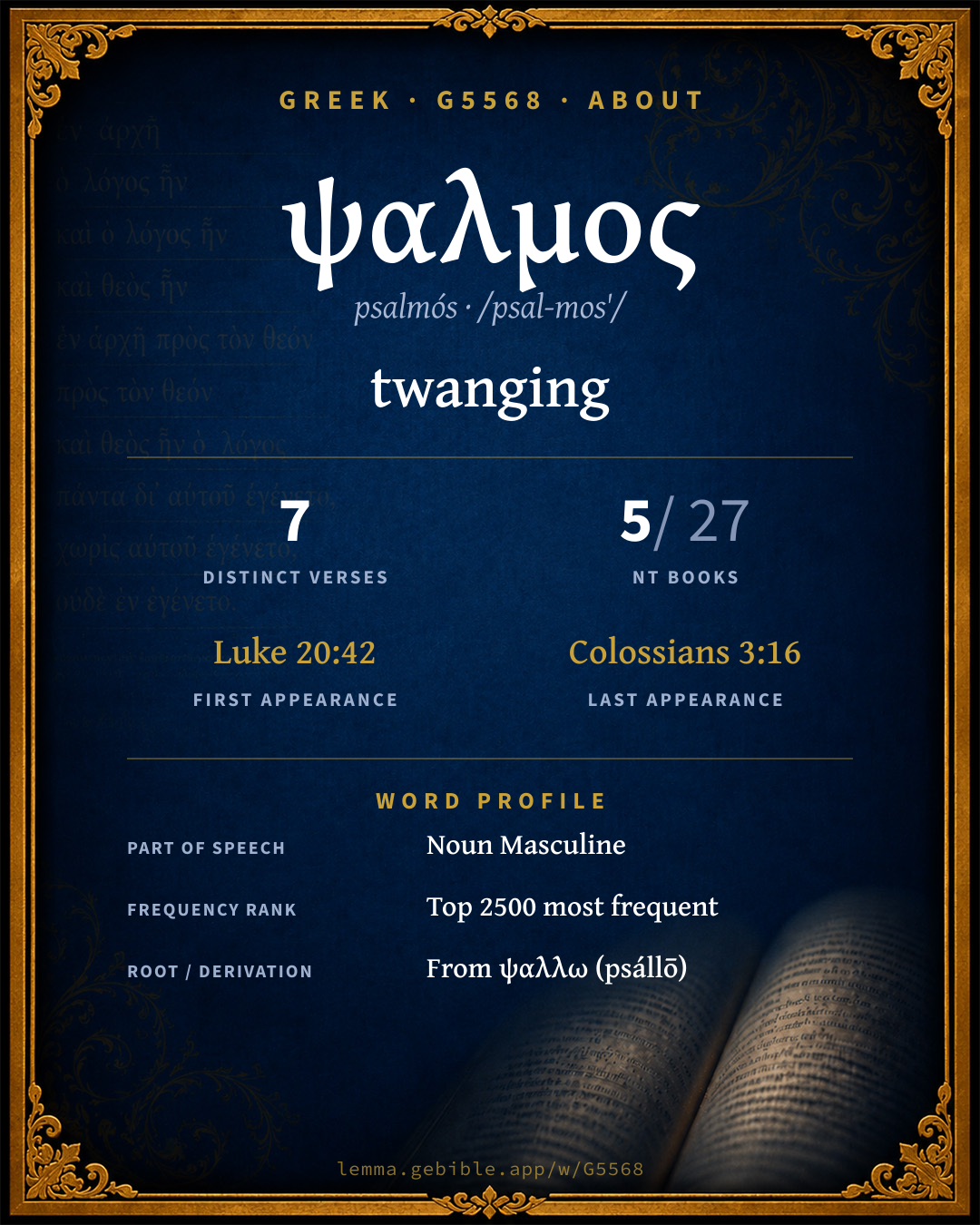
ψαλμός
twanging
‘twanging’ is one of 2 main senses fuller range ↓
Full lexicon entry — Thayer's Greek Lexicon
From Thayer's Greek Lexicon
Where this word appears
See every Dative-case word in the Greek New Testament →
Grammar key — what these labels mean
Part of speech
- Noun
- A naming word — a person, place, thing, or idea.
Case
- Dative
- The case of the indirect object, means, or location — “to / for / with / in.”
- Genitive
- The case of source, possession, or “of” — answers “whose / from what.”
- Accusative
- The case of the direct object and of extent.
Gender
- Masculine
- Grammatically masculine.
Number
- Plural
- More than one.
- Singular
- One.
Grammatical forms
- Noun, Dative, Plural, Masculine 3 times (43%)
- Noun, Genitive, Plural, Masculine 2 times (29%)
- Noun, Accusative, Singular, Masculine 1 time (14%)
- Noun, Dative, Singular, Masculine 1 time (14%)
Parsed forms decoded from the imported morphology (Robinson–Tischendorf, public domain), counted across 7 parsed occurrences — not distinct verses.
Every verse where G5568 appears — 7 distinct verses across 5 books. Click any verse to open its interlinear word-by-word view. Verse text shown in the World English Bible for context — . Each verse’s Greek form is shown with its reference; the English is not keyword-highlighted, since the data carries no word-level English alignment. Use “Compare translations” on any verse to read it across multiple English versions. This concordance covers the Greek New Testament; Septuagint (Greek Old Testament) occurrences of this word are not indexed here.
Luke 2 verses
- Luke 20:42 ψαλμῶν n gen pl masc David himself says in the book of Psalms, 'The Lord said to my Lord, "Sit at my right hand,
- Luke 24:44 ψαλμοῖς n dat pl masc He said to them, "This is what I told you, while I was still with you, that all things which are written in the law of Moses, the prophets, and the psalms, concerning me must be fulfilled."
Acts 2 verses
- Acts 1:20 ψαλμῶν n gen pl masc For it is written in the book of Psalms, 'Let his habitation be made desolate, Let no one dwell therein,' and, 'Let another take his office.'
- Acts 13:33 ψαλμῷ n dat sg masc that God has fulfilled the same to us, their children, in that he raised up Jesus. As it is also written in the second psalm, 'You are my Son. Today I have become your father.'
1 Corinthians 1 verse
Ephesians 1 verse
Colossians 1 verse
About this entry
At a glance — auto-summarized from this page’s data, not written by a person. Every figure links to its source below. This summary describes the numbers; it doesn’t interpret them.
ψαλμος (psalmós) is a Greek noun most often rendered “twanging.” Scripture first uses it in Luke 20:42. Spanning 7 verses in 5 books, it ranks among the uncommon words of the Greek New Testament. Luke dominates its distribution — 2 of 7 verses. Ranging over 2 senses, it is not a single-sense word. The sections below give every sense, occurrence, and version rendering.
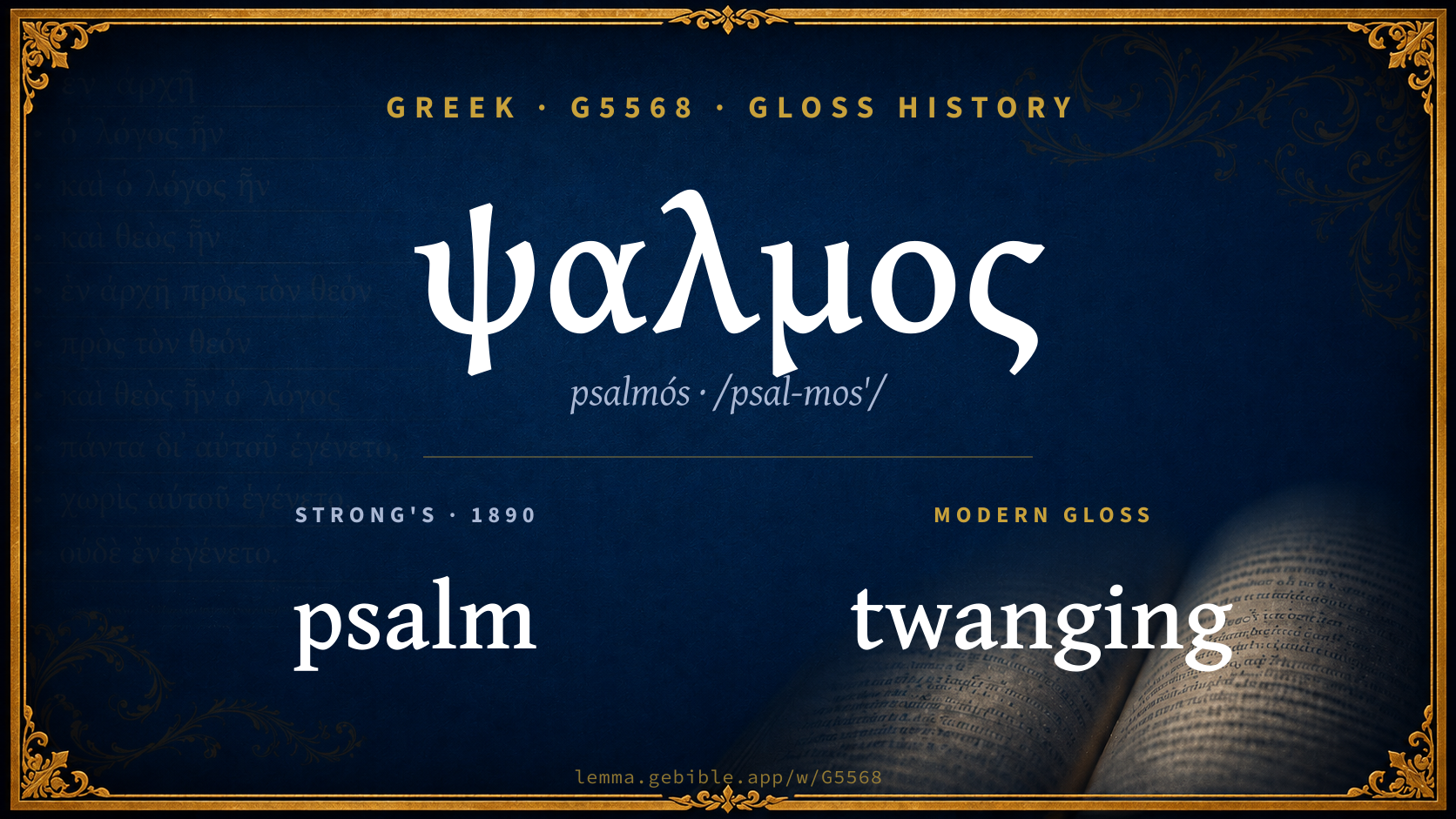
Gloss history
Strong's 1890 vs modern scholarship
About this word
Strong's G5568 catalogs a Greek word from the Greek New Testament.
These counts are not copied from any lexicon or concordance. They are computed here, from the morphology-tagged Greek New Testament. What Lemma adds →
- 7
- distinct verses
- The word appears in 7 distinct verses.
- 5 / 27
- NT books
- The word appears in 5 of 27 New Testament books.
- #1,358
- by frequency
- Top 2500 most frequent Greek words (rank 1,358 of 5,347 Greek words by occurrence).
View all 7 occurrences in the concordance →
Most concentrated in
- Luke 2 verses 29%
- Acts 2 verses 29%
- 1 Corinthians 1 verse 14%
By section of the New Testament
By traditional corpus
Conventional, traditional groupings — biblical authorship is debated, so this is a traditional corpus grouping, not an authorship claim. Some books belong to more than one corpus (Luke is in both the Gospels and the Lukan corpus, and so on), so these shares overlap and need not total 100%. Each figure is a share of the word’s 7 distinct verses.
- Lukan (Luke–Acts) 4 verses · 57%
- Pauline corpus 3 verses · 43%
- Gospels 2 verses · 29%
How translations render this word
Counts come from each version’s own published word-to-Strong’s tagging or interlinear alignment — an approximate guide to how each version renders this word, not a word-level alignment the data otherwise carries. Because each total is that version’s own tagged count, the per-version totals vary from one another and need not match the appearance or distinct-verse counts above. These counts may also differ from a printed concordance because Lemma counts each distinctly tagged rendering and does not collapse phrase taggings into a single head-word total. This is a fixed set of word-tagged versions (KJV, ASV, BSB, ULT) and does not change with the reading translation you choose elsewhere. Each version’s license is shown beside its name below (and on Sources).
- King James Version: Psalms 5×, Psalm 2×
- American Standard Version: Psalms 5×, Psalm 2×
- Berean Standard Bible: Psalms 5×, Psalm 2×
- unfoldingWord Literal Text: Psalms 5×, Psalm 2×
King James Version Public Domain
Renders G5568 across 7 tagged occurrences — most commonly:
American Standard Version Public Domain
Renders G5568 across 7 tagged occurrences — most commonly:
Berean Standard Bible Public Domain
Renders G5568 across 7 tagged occurrences — most commonly:
unfoldingWord Literal Text CC BY-SA 4.0
Renders G5568 across 7 tagged occurrences — most commonly:
Senses in Thayer's
The 2 senses Thayer's distinguishes for this word, in lexicon order (not ranked by frequency or importance). The full entry — with sub-senses — is in the Lexicon Entry tab.
- of a striking the chords of a musical instrument
- of a pious song, a psalm
Word origin
Derived from ψαλλω (psállō) (G5567) — to pluck.
Forms in the corpus
The 4 distinct written forms G5568 takes in the Greek New Testament, most frequent first — each parse links to that case’s occurrences in the concordance.
| Form | Parsing | Example | Uses |
|---|---|---|---|
| ψαλμοῖς psalmoîs | Noun, Dative, Plural, Masculine | Luke 24:44 | 3 |
| ψαλμῶν psalmō̂n | Noun, Genitive, Plural, Masculine | Luke 20:42 | 2 |
| ψαλμὸν psalmòn | Noun, Accusative, Singular, Masculine | 1 Corinthians 14:26 | 1 |
| ψαλμῷ psalmō̂ | Noun, Dative, Singular, Masculine | Acts 13:33 | 1 |
Same root — word family
Other Thayer's entries built from the same root as G5568, grouped by Strong’s listed origin. These share a root / origin per the lexicon — not necessarily a shared meaning. Each links to that word’s own entry.
Derives from
Shares the same root
Compare all same-root words → Showing 4 of 5 — not the complete family. They share a root, not necessarily a meaning.
Septuagint usage
The same Greek word ψαλμος appears 81 times in the Greek Old Testament (Septuagint), across 81 verses in 8 books.
- 81
- LXX occurrences
- Tagged occurrences of this Greek word in the Septuagint.
- 81
- verses
- Distinct Septuagint verses containing this word.
- 8 / 39
- OT books
- The word appears in 8 of the 39 Old Testament books.
Sample Septuagint occurrences
- 1 Samuel 16:18 ψαλμός
- 2 Samuel 23:1 ψαλμός
- Job 21:12 ψαλμός
- Psalms 3:1 ψαλμός
- Isaiah 66:20 ψαλμός
- Lamentations 3:14 ψαλμός
- Amos 5:23 ψαλμός
- Zechariah 6:14 ψαλμός
Septuagint occurrences (same lexeme)
Every verse where the same Strong’s number (G5568) appears in the Greek Septuagint — showing the first 50 of 81. Verse text shown in the World English Bible for context; the Greek form is the matched word — the English is not keyword-highlighted.
- 1 Samuel 16:18 ψαλμός Then answered one of the young men, and said, Behold, I have seen a son of Jesse the Bethlehemite, who is skillful in playing, and a mighty man of valor, and a man of war, and prudent in speech, and a comely person; and Yahweh is with him.
- 2 Samuel 23:1 ψαλμός Now these are the last words of David. David the son of Jesse says, The man who was raised on high says, The anointed of the God of Jacob, The sweet psalmist of Israel:
- Job 21:12 ψαλμός They sing to the tambourine and harp, And rejoice at the sound of the pipe.
- Job 30:31 ψαλμός Therefore is my harp turned to mourning, And my pipe into the voice of those who weep.
- Psalms 3:1 ψαλμός Yahweh, how my adversaries have increased! Many are those who rise up against me.
- Psalms 4:1 ψαλμός Answer me when I call, God of my righteousness. Give me relief from my distress. Have mercy on me, and hear my prayer.
- Psalms 5:1 ψαλμός Give ear to my words, Yahweh. Consider my meditation.
- Psalms 6:1 ψαλμός Yahweh, don't rebuke me in your anger, Neither discipline me in your wrath.
- Psalms 7:1 ψαλμός Yahweh, my God, I take refuge in you. Save me from all those who pursue me, and deliver me,
- Psalms 8:1 ψαλμός Yahweh, our Lord, how majestic is your name in all the earth, Who has set your glory above the heavens!
- Psalms 9:1 ψαλμός I will give thanks to Yahweh with my whole heart. I will tell of all your marvelous works.
- Psalms 10:1 ψαλμός Why do you stand far off, Yahweh? Why do you hide yourself in times of trouble?
- Psalms 11:1 ψαλμός In Yahweh, I take refuge. How can you say to my soul, "Flee as a bird to your mountain!"
- Psalms 12:1 ψαλμός Help, Yahweh; for the godly man ceases. For the faithful fail from among the children of men.
- Psalms 13:1 ψαλμός How long, Yahweh? Will you forget me forever? How long will you hide your face from me?
- Psalms 14:1 ψαλμός The fool has said in his heart, "There is no God." They are corrupt. They have done abominable works. There is none who does good.
- Psalms 18:1 ψαλμός I love you, Yahweh, my strength.
- Psalms 19:1 ψαλμός The heavens declare the glory of God. The expanse shows his handiwork.
- Psalms 20:1 ψαλμός May Yahweh answer you in the day of trouble. May the name of the God of Jacob set you up on high,
- Psalms 21:1 ψαλμός The king rejoices in your strength, Yahweh! How greatly he rejoices in your salvation!
- Psalms 22:1 ψαλμός My God, my God, why have you forsaken me? Why are you so far from helping me, and from the words of my groaning?
- Psalms 23:1 ψαλμός Yahweh is my shepherd: I shall lack nothing.
- Psalms 24:1 ψαλμός The earth is Yahweh's, with its fullness; The world, and those who dwell therein.
- Psalms 28:1 ψαλμός To you, Yahweh, I call. My rock, don't be deaf to me; Lest, if you are silent to me, I would become like those who go down into the pit.
- Psalms 29:1 ψαλμός Ascribe to Yahweh, you sons of the mighty, Ascribe to Yahweh glory and strength.
- Psalms 30:1 ψαλμός I will extol you, Yahweh, for you have raised me up, And have not made my foes to rejoice over me.
- Psalms 37:1 ψαλμός Don't fret because of evil-doers, Neither be envious against those who work unrighteousness.
- Psalms 39:1 ψαλμός I said, "I will watch my ways, so that I don't sin with my tongue. I will keep my mouth with a bridle while the wicked is before me."
- Psalms 40:1 ψαλμός I waited patiently for Yahweh. He turned to me, and heard my cry.
- Psalms 42:1 ψαλμός As the deer pants for the water brooks, So my soul pants after you, God.
- Psalms 43:1 ψαλμός Vindicate me, God, and plead my cause against an ungodly nation. Oh, deliver me from deceitful and wicked men.
- Psalms 45:1 ψαλμός My heart overflows with a noble theme. I recite my verses for the king. My tongue is like the pen of a skillful writer.
- Psalms 46:1 ψαλμός God is our refuge and strength, A very present help in trouble.
- Psalms 47:1 ψαλμός Oh clap your hands, all you nations. Shout to God with the voice of triumph!
- Psalms 48:1 ψαλμός Great is Yahweh, and greatly to be praised, In the city of our God, in his holy mountain.
- Psalms 49:1 ψαλμός Hear this, all you peoples. Listen, all you inhabitants of the world,
- Psalms 50:1 ψαλμός The Mighty One, God, Yahweh, speaks, And calls the earth from sunrise to sunset.
- Psalms 61:1 ψαλμός Hear my cry, God. Listen to my prayer.
- Psalms 62:1 ψαλμός My soul rests in God alone. My salvation is from him.
- Psalms 63:1 ψαλμός God, you are my God. I will earnestly seek you. My soul thirsts for you, My flesh longs for you, In a dry and weary land, where there is no water.
- Psalms 64:1 ψαλμός Hear my voice, God, in my complaint. Preserve my life from fear of the enemy.
- Psalms 65:1 ψαλμός Praise waits for you, God, in Zion. To you shall vows be performed.
- Psalms 66:1 ψαλμός Make a joyful shout to God, all the earth!
- Psalms 67:1 ψαλμός May God be merciful to us, bless us, And cause his face to shine on us. Selah.
- Psalms 70:22 ψαλμός
- Psalms 72:1 ψαλμός God, give the king your justice; Your righteousness to the royal son.
- Psalms 74:1 ψαλμός God, why have you rejected us forever? Why does your anger smolder against the sheep of your pasture?
- Psalms 75:1 ψαλμός We give thanks to you, God, We give thanks, for your Name is near. Men tell about your wondrous works.
- Psalms 76:1 ψαλμός In Judah, God is known. His name is great in Israel.
- Psalms 78:1 ψαλμός Hear my law, my people. Turn your ears to the words of my mouth.
These are occurrences of the same Greek lexeme (G5568) in the Septuagint — not a translation of any one Hebrew word. The store carries no word-level Hebrew↔Greek alignment, so no Hebrew original is asserted here. Counts come from the recovered LXX Strong's tagging — high-frequency vocabulary is well covered, while rare or late forms may be untagged — so they reflect tagged occurrences and may slightly undercount.