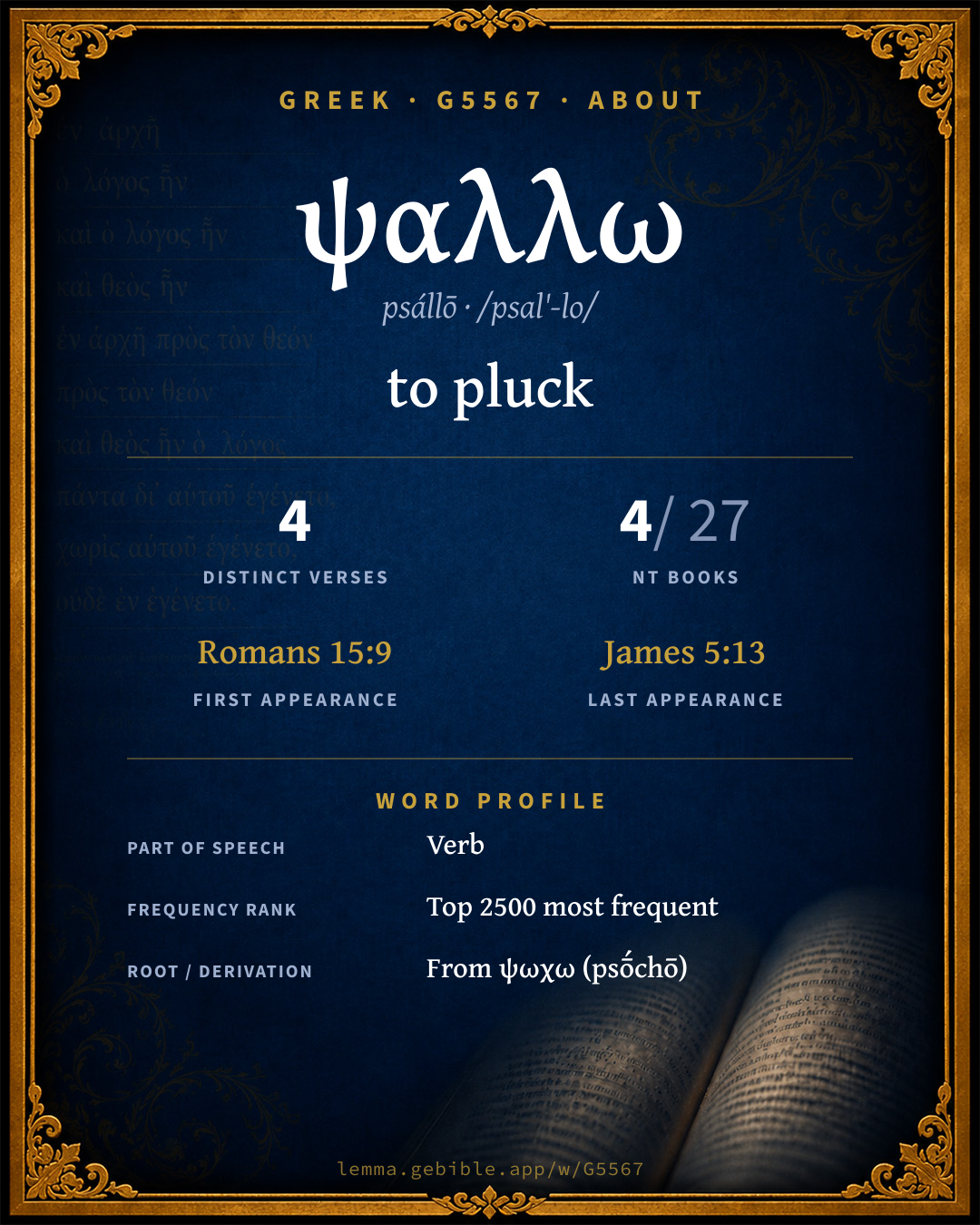
ψάλλω
to pluck
‘to pluck’ is one of 2 main senses fuller range ↓
Full lexicon entry — Thayer's Greek Lexicon
From Thayer's Greek Lexicon
Where this word appears
See every Future-tense verb in the Greek New Testament →
Grammar key — what these labels mean
Part of speech
- Verb
- An action or state-of-being word.
Tense
- Future
- Action expected in future time.
- Present
- Ongoing or general action in present time (imperfective aspect).
Voice
- Active
- The subject performs the action.
Mood
- Indicative
- States a fact or asks a factual question (the mood of reality).
- Imperative
- Expresses a command or request.
- Participle
- A verbal adjective (“writing,” “having written”).
Case
- Nominative
- The case of the subject (and the predicate nominative).
Person
- 1st person
- The speaker (“I / we”).
- 3rd person
- The one spoken about (“he / she / it / they”).
Gender
- Masculine
- Grammatically masculine.
Number
- Singular
- One.
- Plural
- More than one.
Grammatical forms
- Verb, Future, Active, Indicative, 1st person, Singular 3 times (60%)
- Verb, Present, Active, Imperative, 3rd person, Singular 1 time (20%)
- Verb, Present, Active, Participle, Nominative, Plural, Masculine 1 time (20%)
Parsed forms decoded from the imported morphology (Robinson–Tischendorf, public domain), counted across 5 parsed occurrences — not distinct verses.
Every verse where G5567 appears — 4 distinct verses across 4 books. Click any verse to open its interlinear word-by-word view. Verse text shown in the World English Bible for context — . Each verse’s Greek form is shown with its reference; the English is not keyword-highlighted, since the data carries no word-level English alignment. Use “Compare translations” on any verse to read it across multiple English versions. This concordance covers the Greek New Testament; Septuagint (Greek Old Testament) occurrences of this word are not indexed here.
Romans 1 verse
1 Corinthians 1 verse
Ephesians 1 verse
James 1 verse
About this entry
At a glance — auto-summarized from this page’s data, not written by a person. Every figure links to its source below. This summary describes the numbers; it doesn’t interpret them.
ψαλλω — transliterated psállō — is a Greek verb carrying the sense “to pluck.” The Greek New Testament uses it only 4 verses. Its uses concentrate in Romans (25% of all occurrences). Debuting at Romans 15:9, it then recurs through the corpus. Its lexical range runs to 2 senses. See the sense tree, 4-verse concordance, and the renderings breakdown below.
Gloss history
Strong's 1890 vs modern scholarship

About this word
Strong's G5567 catalogs a Greek word from the Greek New Testament.
These counts are not copied from any lexicon or concordance. They are computed here, from the morphology-tagged Greek New Testament. What Lemma adds →
- 4
- distinct verses
- The word appears in 4 distinct verses.
- 4 / 27
- NT books
- The word appears in 4 of 27 New Testament books.
- #1,648
- by frequency
- Top 2500 most frequent Greek words (rank 1,648 of 5,347 Greek words by occurrence).
View all 4 occurrences in the concordance →
Most concentrated in
- Romans 1 verse 25%
- 1 Corinthians 1 verse 25%
- Ephesians 1 verse 25%
By section of the New Testament
By traditional corpus
Conventional, traditional groupings — biblical authorship is debated, so this is a traditional corpus grouping, not an authorship claim. Some books belong to more than one corpus (Luke is in both the Gospels and the Lukan corpus, and so on), so these shares overlap and need not total 100%. Each figure is a share of the word’s 4 distinct verses.
- Pauline corpus 3 verses · 75%
- General (Catholic) Epistles 1 verse · 25%
How translations render this word
Counts come from each version’s own published word-to-Strong’s tagging or interlinear alignment — an approximate guide to how each version renders this word, not a word-level alignment the data otherwise carries. Because each total is that version’s own tagged count, the per-version totals vary from one another and need not match the appearance or distinct-verse counts above. These counts may also differ from a printed concordance because Lemma counts each distinctly tagged rendering and does not collapse phrase taggings into a single head-word total. This is a fixed set of word-tagged versions (KJV, ASV, BSB, ULT) and does not change with the reading translation you choose elsewhere. Each version’s license is shown beside its name below (and on Sources).
- King James Version: I will sing 2×
- American Standard Version: I will sing 2×
- Berean Standard Bible: He should sing praises 1×, I will also sing 1×, I will sing 1×
- unfoldingWord Literal Text: I will 1×, I will sing 1×, Let him sing praise 1×
King James Version Public Domain
Renders G5567 across 5 tagged occurrences — most commonly:
Plus 3 renderings that appear only once — usually multi-word phrases or single function words the recovered tagging swept in, not distinct renderings.
American Standard Version Public Domain
Renders G5567 across 5 tagged occurrences — most commonly:
Plus 3 renderings that appear only once — usually multi-word phrases or single function words the recovered tagging swept in, not distinct renderings.
Berean Standard Bible Public Domain
Renders G5567 across 5 tagged occurrences — most commonly:
unfoldingWord Literal Text CC BY-SA 4.0
Renders G5567 across 6 tagged occurrences — most commonly:
Senses in Thayer's
The 2 senses Thayer's distinguishes for this word, in lexicon order (not ranked by frequency or importance). The full entry — with sub-senses — is in the Lexicon Entry tab.
- to pluck off, pull out
- to cause to vibrate by touching, to twang
Word origin
Derived from ψωχω (psṓchō) (G5597) — to rub.
Probably strengthened from ψάω psaō (to rub or touch the surface; compare G5597 ); to twitch or twang that is to play on a stringed instrument ( celebrate the divine worship with music and accompanying odes): - make melody sing (psalms).
— Strong’s Exhaustive Concordance (1890), public domain.
Forms in the corpus
The 3 distinct written forms G5567 takes in the Greek New Testament, most frequent first — each parse links to that tense’s occurrences in the concordance.
| Form | Parsing | Example | Uses |
|---|---|---|---|
| ψαλῶ psalō̂ | Verb, Future, Active, Indicative, 1st person, Singular | Romans 15:9 | 3 |
| ψάλλοντες psállontes | Verb, Present, Active, Participle, Nominative, Plural, Masculine | Ephesians 5:19 | 1 |
| ψαλλέτω psallétō | Verb, Present, Active, Imperative, 3rd person, Singular | James 5:13 | 1 |
Same root — word family
Other Thayer's entries built from the same root as G5567, grouped by Strong’s listed origin. These share a root / origin per the lexicon — not necessarily a shared meaning. Each links to that word’s own entry.
Derives from
Shares the same root
Derived from this word
- ψαλμος psalmós G5568 twanging
- ψηλαφαω psēlapháō G5584 to touch
- ψιχιον psichíon G5589 crumb
- ψωχω psṓchō G5597 to rub
Compare all same-root words → Showing 4 of 6 — not the complete family. They share a root, not necessarily a meaning.
Septuagint usage
The same Greek word ψαλλω appears 42 times in the Greek Old Testament (Septuagint), across 39 verses in 5 books.
- 42
- LXX occurrences
- Tagged occurrences of this Greek word in the Septuagint.
- 39
- verses
- Distinct Septuagint verses containing this word.
- 5 / 39
- OT books
- The word appears in 5 of the 39 Old Testament books.
Sample Septuagint occurrences
- Judges 5:3 ψάλλω
- 1 Samuel 16:16 ψάλλω
- 2 Samuel 22:50 ψάλλω
- 2 Kings 3:15 ψάλλω
- Psalms 7:18 ψάλλω
Septuagint occurrences (same lexeme)
Every verse where the same Strong’s number (G5567) appears in the Greek Septuagint. Verse text shown in the World English Bible for context; the Greek form is the matched word — the English is not keyword-highlighted.
- Judges 5:3 ψάλλω Hear, you kings; give ear, you princes; I, [even] I, will sing to Yahweh; I will sing praise to Yahweh, the God of Israel.
- 1 Samuel 16:16 ψάλλω Let our lord now command your servants who are before you, to seek out a man who is a skillful player on the harp: and it shall happen, when the evil spirit from God is on you, that he shall play with his hand, and you shall be well.
- 1 Samuel 16:17 ψάλλω Saul said to his servants, Provide me now a man who can play well, and bring him to me.
- 1 Samuel 16:23 ψάλλω It happened, when the [evil] spirit from God was on Saul, that David took the harp, and played with his hand: so Saul was refreshed, and was well, and the evil spirit departed from him.
- 1 Samuel 19:9 ψάλλω An evil spirit from Yahweh was on Saul, as he sat in his house with his spear in his hand; and David was playing with his hand.
- 2 Samuel 22:50 ψάλλω Therefore I will give thanks to you, Yahweh, among the nations, Will sing praises to your name.
- 2 Kings 3:15 ψάλλω But now bring me a minstrel. It happened, when the minstrel played, that the hand of Yahweh came on him.
- Psalms 7:18 ψάλλω
- Psalms 9:3 ψάλλω When my enemies turn back, They stumble and perish in your presence.
- Psalms 9:12 ψάλλω For he who avenges blood remembers them. He doesn't forget the cry of the afflicted.
- Psalms 12:6 ψάλλω The words of Yahweh are flawless words, As silver refined in a clay furnace, purified seven times.
- Psalms 17:50 ψάλλω
- Psalms 20:14 ψάλλω
- Psalms 26:6 ψάλλω I will wash my hands in innocence, So I will go about your altar, Yahweh;
- Psalms 29:5 ψάλλω The voice of Yahweh breaks the cedars. Yes, Yahweh breaks in pieces the cedars of Lebanon.
- Psalms 29:13 ψάλλω
- Psalms 32:2 ψάλλω Blessed is the man to whom Yahweh doesn't impute iniquity, In whose spirit there is no deceit.
- Psalms 56:8 ψάλλω You number my wanderings. You put my tears into your bottle. Aren't they in your book?
- Psalms 56:10 ψάλλω In God, I will praise his word. In Yahweh, I will praise his word.
- Psalms 58:18 ψάλλω
- Psalms 60:9 ψάλλω Who will bring me into the strong city? Who has led me to Edom?
- Psalms 67:26 ψάλλω
- Psalms 68:13 ψάλλω While you sleep among the campfires, The wings of a dove sheathed with silver, Her feathers with shining gold.
- Psalms 70:22 ψάλλω
- Psalms 70:23 ψάλλω
- Psalms 74:10 ψάλλω How long, God, shall the adversary reproach? Shall the enemy blaspheme your name forever?
- Psalms 91:2 ψάλλω I will say of Yahweh, "He is my refuge and my fortress; My God, in whom I trust."
- Psalms 97:4 ψάλλω His lightning lights up the world. The earth sees, and trembles.
- Psalms 97:5 ψάλλω The mountains melt like wax at the presence of Yahweh, At the presence of the Lord of the whole earth.
- Psalms 100:2 ψάλλω Serve Yahweh with gladness. Come before his presence with singing.
- Psalms 103:33 ψάλλω
- Psalms 104:2 ψάλλω He covers himself with light as with a garment. He stretches out the heavens like a curtain.
- Psalms 107:2 ψάλλω Let the redeemed by Yahweh say so, Whom he has redeemed from the hand of the adversary,
- Psalms 107:4 ψάλλω They wandered in the wilderness in a desert way. They found no city to live in.
- Psalms 134:3 ψάλλω May Yahweh bless you from Zion; Even he who made heaven and earth.
- Psalms 137:1 ψάλλω By the rivers of Babylon, there we sat down. Yes, we wept, when we remembered Zion.
- Psalms 143:9 ψάλλω Deliver me, Yahweh, from my enemies. I flee to you to hide me.
- Psalms 146:7 ψάλλω Who executes justice for the oppressed; Who gives food to the hungry. Yahweh frees the prisoners.
- Psalms 149:3 ψάλλω Let them praise his name in the dance! Let them sing praises to him with tambourine and harp!
These are occurrences of the same Greek lexeme (G5567) in the Septuagint — not a translation of any one Hebrew word. The store carries no word-level Hebrew↔Greek alignment, so no Hebrew original is asserted here. Counts come from the recovered LXX Strong's tagging — high-frequency vocabulary is well covered, while rare or late forms may be untagged — so they reflect tagged occurrences and may slightly undercount.