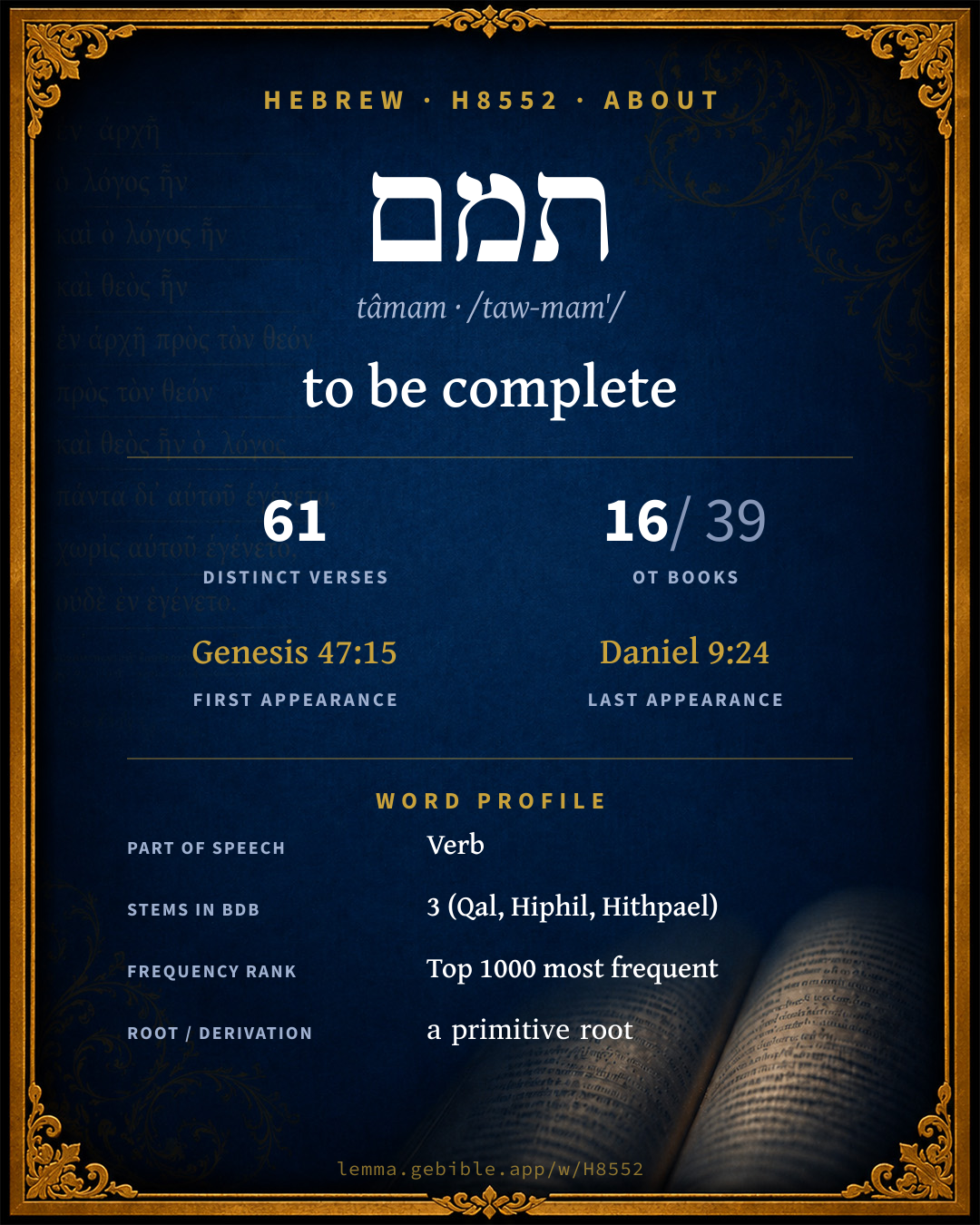
תָּמַם
to be complete
‘to be complete’ is one of 3 main senses fuller range ↓
Full lexicon entry — Brown-Driver-Briggs (BDB)
From Brown-Driver-Briggs (BDB)
Where this word appears
See every Qal verb in the Hebrew Bible →
Grammar key — what these labels mean
Part of speech
- Verb
- An action or state-of-being word.
Stem
- Qal
- The basic, simple active stem — the plain form of the verb (“he wrote”). Here: ‘be finished’
- Hithpael
- The reflexive or reciprocal stem (the subject acts on itself).
- Hiphil
- The causative active stem (“he caused / brought about”). Here: ‘finish’
Form
- Infinitive Construct
- A bound verbal noun, frequently with prepositions (“to write / in writing”).
- Perfect
- A completed action or state — Hebrew marks aspect (completeness) more than strict tense (“he wrote”).
- Imperfect
- An incomplete, ongoing, or future action (“he will / would write”).
- Sequential Perfect
- A perfect with prefixed waw continuing a preceding imperfect or command (waw-consecutive perfect).
- Sequential Imperfect
- An imperfect with prefixed waw — the standard past-narrative form (waw-consecutive imperfect).
- Infinitive Absolute
- An unbound verbal noun, often intensifying or standing in for a finite verb.
Person
- 3rd Person
- The one spoken about (“he / she / it / they”).
- 1st Person
- The speaker (“I / we”).
- 2nd Person
- The one addressed (“you”).
Gender
- Common
- Either gender — not distinguished for this form.
- Masculine
- Grammatically masculine.
- Feminine
- Grammatically feminine.
Number
- Plural
- More than one (in Hebrew, generally three or more).
- Singular
- One.
Grammatical forms 20 distinct
- Verb, Qal, Infinitive Construct 19 times (30%)
- Verb, Qal, Perfect, 3rd Person, Common, Plural 11 times (17%)
- Verb, Qal, Imperfect, 3rd Person, Masculine, Plural 5 times (8%)
- Verb, Qal, Perfect, 1st Person, Common, Plural 4 times (6%)
- Verb, Qal, Perfect, 3rd Person, Masculine, Singular 4 times (6%)
- Verb, Hiphil, Infinitive Construct 3 times (5%)
- Verb, Qal, Sequential Perfect, 3rd Person, Common, Plural 2 times (3%)
- Verb, Qal, Sequential Imperfect, 3rd Person, Feminine, Singular 2 times (3%)
+12 more forms (13 occurrences)
Parsed forms decoded from the imported morphology (morphhb / Westminster Leningrad Codex — WLC text public domain, morphhb tagging CC BY 4.0), counted across 63 parsed occurrences — not distinct verses.
Every verse where H8552 appears — 61 distinct verses across 16 books. Click any verse to open its interlinear word-by-word view. Verse text shown in the World English Bible for context — . Each verse’s Hebrew form is shown with its reference; the English is not keyword-highlighted, since the data carries no word-level English alignment. Use “Compare translations” on any verse to read it across multiple English versions. This concordance covers the Hebrew Bible; Septuagint (Greek Old Testament) occurrences are not indexed here.
Genesis 2 verses
- Genesis 47:15 וַ/יִּתֹּ֣ם conj + Qal wimpf 3ms When the money was all spent in the land of Egypt, and in the land of Canaan, all the Egyptians came to Joseph, and said, "Give us bread, for why should we die in your presence? For our money fails."
- Genesis 47:18 וַ/תִּתֹּם֮ תַּ֣ם conj + Qal wimpf 3fs Qal pf 3ms When that year was ended, they came to him the second year, and said to him, "We will not hide from my lord how our money is all spent, and the herds of cattle are my lord's. There is nothing left in the sight of my lord, but our bodies, and our lands.
Leviticus 1 verse
Numbers 4 verses
- Numbers 14:33 תֹּ֥ם Qal inf.cs Your children shall be wanderers in the wilderness forty years, and shall bear your prostitution, until your dead bodies be consumed in the wilderness.
- Numbers 14:35 יִתַּ֖מּוּ Qal impf 3mp I, Yahweh, have spoken, surely this will I do to all this evil congregation, who are gathered together against me: in this wilderness they shall be consumed, and there they shall die.
- Numbers 17:13 תַּ֖מְנוּ Qal pf 1cp Everyone who comes near, who comes near to the tent of Yahweh, dies: shall we perish all of us?
- Numbers 32:13 תֹּם֙ Qal inf.cs Yahweh's anger was kindled against Israel, and he made them wander back and forth in the wilderness forty years, until all the generation, who had done evil in the sight of Yahweh, was consumed.
Deuteronomy 6 verses
- Deuteronomy 2:14 תֹּ֨ם Qal inf.cs The days in which we came from Kadesh-barnea, until we were come over the brook Zered, were thirty-eight years; until all the generation of the men of war were consumed from the midst of the camp, as Yahweh swore to them.
- Deuteronomy 2:15 תֻּמָּֽ/ם Qal inf.cs + sfx pers 3mp Moreover the hand of Yahweh was against them, to destroy them from the midst of the camp, until they were consumed.
- Deuteronomy 2:16 תַּ֜מּוּ Qal pf 3cp So it happened, when all the men of war were consumed and dead from among the people,
- Deuteronomy 31:24 תֻּמָּֽ/ם Qal inf.cs + sfx pers 3mp It happened, when Moses had made an end of writing the words of this law in a book, until they were finished,
- Deuteronomy 31:30 תֻּמָּֽ/ם Qal inf.cs + sfx pers 3mp Moses spoke in the ears of all the assembly of Israel the words of this song, until they were finished.
- Deuteronomy 34:8 וַֽ/יִּתְּמ֔וּ conj + Qal wimpf 3mp The children of Israel wept for Moses in the plains of Moab thirty days: so the days of weeping in the mourning for Moses were ended.
Joshua 9 verses
- Joshua 3:16 תַּ֣מּוּ Qal pf 3cp that the waters which came down from above stood, and rose up in one heap, a great way off, at Adam, the city that is beside Zarethan; and those that went down toward the sea of the Arabah, even the Salt Sea, were wholly cut off: and the people passed over right against Jericho.
- Joshua 3:17 תַּ֨מּוּ֙ Qal pf 3cp The priests who bore the ark of the covenant of Yahweh stood firm on dry ground in the midst of the Jordan; and all Israel passed over on dry ground, until all the nation were passed clean over the Jordan.
- Joshua 4:1 תַּ֣מּוּ Qal pf 3cp It happened, when all the nation were clean passed over the Jordan, that Yahweh spoke to Joshua, saying,
- Joshua 4:10 תֹּ֣ם Qal inf.cs For the priests who bore the ark stood in the midst of the Jordan, until everything was finished that Yahweh commanded Joshua to speak to the people, according to all that Moses commanded Joshua: and the people hurried and passed over.
- Joshua 4:11 תַּ֥ם Qal pf 3ms It happened, when all the people had completely passed over, that the ark of Yahweh passed over, with the priests, in the presence of the people.
- Joshua 5:6 תֹּ֨ם Qal inf.cs For the children of Israel walked forty years in the wilderness, until all the nation, even the men of war who came forth out of Egypt, were consumed, because they didn't listen to the voice of Yahweh: to whom Yahweh swore that he wouldn't let them see the land which Yahweh swore to their fathers that he would give us, a land flowing with milk and honey.
- Joshua 5:8 תַּ֥מּוּ Qal pf 3cp It happened, when they had done circumcising all the nation, that they abode in their places in the camp, until they were whole.
- Joshua 8:24 תֻּמָּ֑/ם Qal inf.cs + sfx pers 3mp It happened, when Israel had made an end of killing all the inhabitants of Ai in the field, in the wilderness in which they pursued them, and they were all fallen by the edge of the sword, until they were consumed, that all Israel returned to Ai, and struck it with the edge of the sword.
- Joshua 10:20 תֻּמָּ֑/ם Qal inf.cs + sfx pers 3mp It happened, when Joshua and the children of Israel had made an end of killing them with a very great slaughter, until they were consumed, and the remnant which remained of them had entered into the fortified cities,
1 Samuel 1 verse
2 Samuel 3 verses
- 2 Samuel 15:24 תֹּ֥ם Qal inf.cs Behold, Zadok also [came], and all the Levites with him, bearing the ark of the covenant of God; and they set down the ark of God; and Abiathar went up, until all the people had done passing out of the city.
- 2 Samuel 20:18 הֵתַֽמּוּ Hiphil pf 3cp Then she spoke, saying, They were wont to speak in old time, saying, They shall surely ask [counsel] at Abel: and so they ended [the matter].
- 2 Samuel 22:26 תִּתַּמָּֽם Hithpael impf 2ms With the merciful you will show yourself merciful; With the perfect man you will show yourself perfect;
1 Kings 3 verses
- 1 Kings 6:22 תֹּ֣ם Qal inf.cs The whole house he overlaid with gold, until all the house was finished: also the whole altar that belonged to the oracle he overlaid with gold.
- 1 Kings 7:22 וַ/תִּתֹּ֖ם conj + Qal wimpf 3fs On the top of the pillars was lily-work: so was the work of the pillars finished.
- 1 Kings 14:10 תֻּמּֽ/וֹ Qal inf.cs + sfx pers 3ms therefore, behold, I will bring evil on the house of Jeroboam, and will cut off from Jeroboam every man-child, him who is shut up and him who is left at large in Israel, and will utterly sweep away the house of Jeroboam, as a man sweeps away dung, until it be all gone.
2 Kings 2 verses
- 2 Kings 7:13 תָּ֑מּוּ Qal pf 3cp One of his servants answered, Please let some take five of the horses that remain, which are left in the city (behold, they are as all the multitude of Israel who are left in it; behold, they are as all the multitude of Israel who are consumed); and let us send and see.
- 2 Kings 22:4 וְ/יַתֵּ֣ם conj + Hiphil impf 3ms Go up to Hilkiah the high priest, that he may sum the money which is brought into the house of Yahweh, which the keepers of the threshold have gathered of the people:
Job 2 verses
Psalms 7 verses
- Psalms 9:6 תַּ֥מּוּ Qal pf 3cp The enemy is overtaken by endless ruin. The very memory of the cities which you have overthrown has perished.
- Psalms 18:25 תִּתַּמָּֽם Hithpael impf 2ms With the merciful you will show yourself merciful. With the perfect man, you will show yourself perfect.
- Psalms 19:13 אֵיתָ֑ם Qal impf 1cs Keep back your servant also from presumptuous sins. Let them not have dominion over me. Then I will be upright, I will be blameless and innocent of great transgression.
- Psalms 64:6 תַּ֭מְנוּ Qal pf 1cp They plot injustice, saying, "We have made a perfect plan!" Surely man's mind and heart are cunning.
- Psalms 73:19 תַ֝֗מּוּ Qal pf 3cp How they are suddenly destroyed! They are completely swept away with terrors.
- Psalms 102:27 יִתָּֽמּוּ Qal impf 3mp But you are the same. Your years will have no end.
- Psalms 104:35 יִתַּ֤מּוּ Qal impf 3mp Let sinners be consumed out of the earth. Let the wicked be no more. Bless Yahweh, my soul. Praise Yah!
Isaiah 3 verses
- Isaiah 16:4 תַּ֥מּוּ Qal pf 3cp Let my outcasts dwell with you; as for Moab, be a covert to him from the face of the destroyer. For the extortioner is brought to nothing, destruction ceases, the oppressors are consumed out of the land.
- Isaiah 18:5 כְּ/תָם prep + Qal inf.cs For before the harvest, when the blossom is over, and the flower becomes a ripening grape, he will cut off the sprigs with pruning-hooks, and the spreading branches will he take away [and] cut down.
- Isaiah 33:1 כַּ/הֲתִֽמְ/ךָ֤ prep + Hiphil inf.cs + sfx pers 2ms Woe to you who destroy, and you weren't destroyed; and deal treacherously, and they didn't deal treacherously with you! When you have ceased to destroy, you shall be destroyed; and when you have made an end of dealing treacherously, they shall deal treacherously with you.
Jeremiah 10 verses
- Jeremiah 1:3 תֹּם֙ Qal inf.cs It came also in the days of Jehoiakim the son of Josiah, king of Judah, to the end of the eleventh year of Zedekiah, the son of Josiah, king of Judah, to the carrying away of Jerusalem captive in the fifth month.
- Jeremiah 6:29 תַּ֣ם Qal pf 3ms The bellows blow fiercely; the lead is consumed of the fire: in vain do they go on refining; for the wicked are not plucked away.
- Jeremiah 14:15 יִתַּ֔מּוּ Qal impf 3mp Therefore thus says Yahweh concerning the prophets who prophesy in my name, and I didn't send them, yet they say, Sword and famine shall not be in this land: By sword and famine shall those prophets be consumed.
- Jeremiah 24:10 תֻּמָּ/ם֙ Qal inf.cs + sfx pers 3mp I will send the sword, the famine, and the pestilence, among them, until they be consumed from off the land that I gave to them and to their fathers.
- Jeremiah 27:8 תֻּמִּ֥/י Qal inf.cs + sfx pers 1cs It shall happen, that the nation and the kingdom which will not serve the same Nebuchadnezzar king of Babylon, and that will not put their neck under the yoke of the king of Babylon, that nation will I punish, says Yahweh, with the sword, and with the famine, and with the pestilence, until I have consumed them by his hand.
- Jeremiah 36:23 תֹּם֙ Qal inf.cs It happened, when Jehudi had read three or four leaves, that [the king] cut it with the penknife, and cast it into the fire that was in the brazier, until all the scroll was consumed in the fire that was in the brazier.
- Jeremiah 37:21 תֹּ֥ם Qal inf.cs Then Zedekiah the king commanded, and they committed Jeremiah into the court of the guard; and they gave him daily a loaf of bread out of the bakers' street, until all the bread in the city was spent. Thus Jeremiah remained in the court of the guard.
- Jeremiah 44:12 וְ/תַ֨מּוּ יִתַּ֔מּוּ conj + Qal wpf 3cp Qal impf 3mp I will take the remnant of Judah, that have set their faces to go into the land of Egypt to sojourn there, and they shall all be consumed; in the land of Egypt shall they fall; they shall be consumed by the sword and by the famine; they shall die, from the least even to the greatest, by the sword and by the famine; and they shall be an object of horror, [and] an astonishment, and a curse, and a reproach.
- Jeremiah 44:18 תָּֽמְנוּ Qal pf 1cp But since we left off burning incense to the queen of the sky, and pouring out drink-offerings to her, we have wanted all things, and have been consumed by the sword and by the famine.
- Jeremiah 44:27 וְ/תַמּוּ֩ conj + Qal wpf 3cp Behold, I watch over them for evil, and not for good; and all the men of Judah who are in the land of Egypt shall be consumed by the sword and by the famine, until there be an end of them.
Lamentations 2 verses
- Lamentations 3:22 תָ֔מְנוּ Qal pf 1cp [It is of] Yahweh's loving kindnesses that we are not consumed, because his compassion doesn't fail.
- Lamentations 4:22 תַּם Qal pf 3ms The punishment of your iniquity is accomplished, daughter of Zion; he will no more carry you away into captivity: He will visit your iniquity, daughter of Edom; he will uncover your sins.
Ezekiel 4 verses
- Ezekiel 22:15 וַ/הֲתִמֹּתִ֥י conj + Hiphil wpf 1cs I will scatter you among the nations, and disperse you through the countries; and I will consume your filthiness out of you.
- Ezekiel 24:10 הָתֵ֖ם Hiphil inf.abs Heap on the wood, make the fire hot, boil well the flesh, and make thick the broth, and let the bones be burned.
- Ezekiel 24:11 תִּתֻּ֖ם Qal impf 3fs Then set it empty on the coals of it, that it may be hot, and the brass of it may burn, and that the filthiness of it may be molten in it, that the rust of it may be consumed.
- Ezekiel 47:12 יִתֹּ֣ם Qal impf 3ms By the river on the bank of it, on this side and on that side, shall grow every tree for food, whose leaf shall not wither, neither shall the fruit of it fail: it shall bring forth new fruit every month, because the waters of it issue out of the sanctuary; and the fruit of it shall be for food, and the leaf of it for healing.
Daniel 2 verses
- Daniel 8:23 כְּ/הָתֵ֖ם prep + Hiphil inf.cs In the latter time of their kingdom, when the transgressors are come to the full, a king of fierce face, and understanding dark sentences, shall stand up.
- Daniel 9:24 וּ/לְ/הָתֵ֤ם conj + prep + Hiphil inf.cs Seventy weeks are decreed on your people and on your holy city, to finish disobedience, and to make an end of sins, and to make reconciliation for iniquity, and to bring in everlasting righteousness, and to seal up vision and prophecy, and to anoint the most holy.
About this entry
At a glance — auto-summarized from this page’s data, not written by a person. Every figure links to its source below. This summary describes the numbers; it doesn’t interpret them.
תמם — transliterated tâmam — is a Hebrew verb carrying the sense “to be complete.” Its earliest occurrence is Genesis 47:15. Spanning 61 verses in 16 books, it ranks among the moderately common words of the Hebrew Bible. Different stems carry different senses — BDB groups them under 3 stems, among them Qal and Hiphil. Sharing its root, it stands alongside מתם, תם and תם. See the sense tree, 61-verse concordance, and the renderings breakdown below.
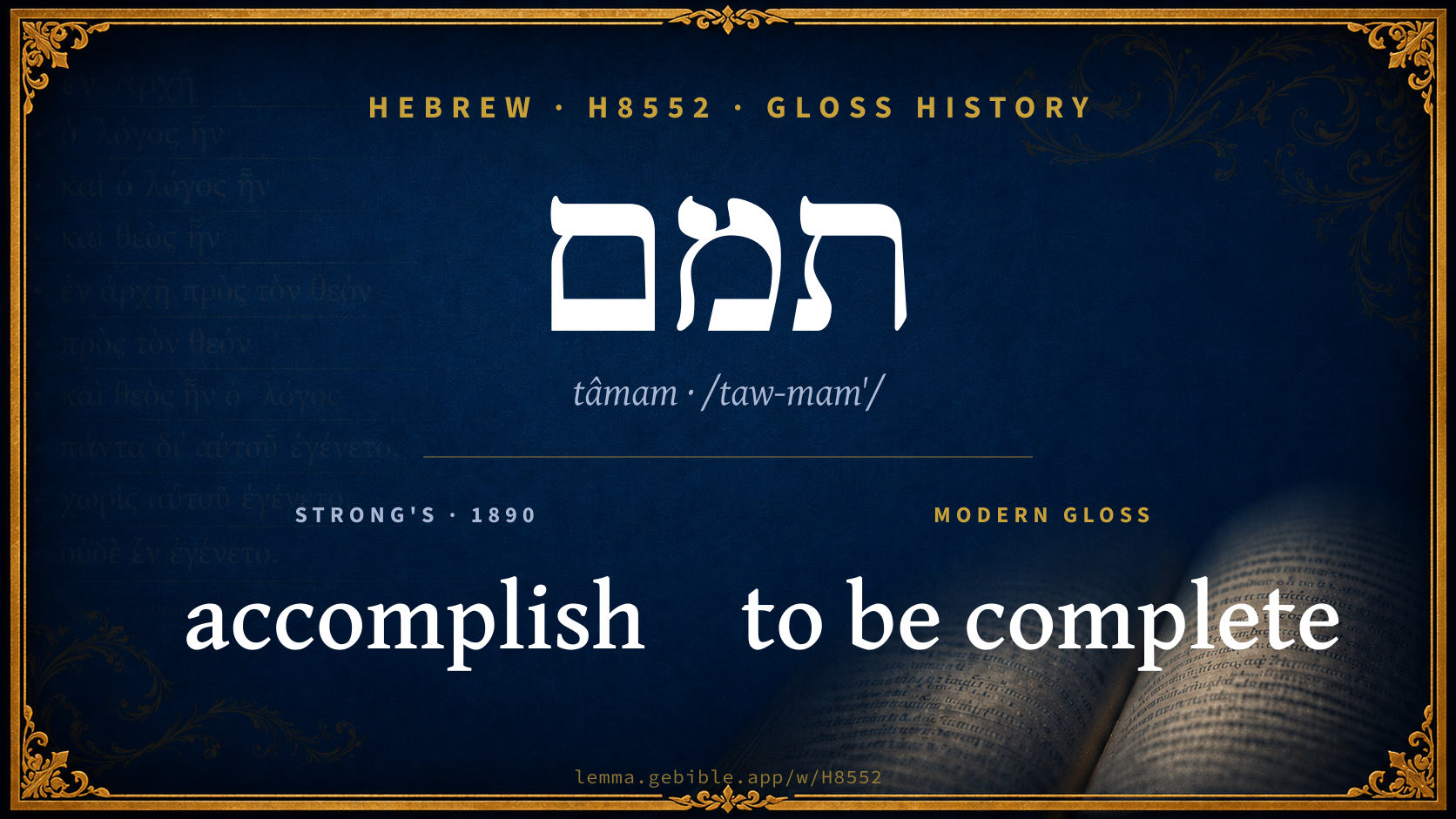
Gloss history
Strong's 1890 vs modern scholarship
About this word
Strong's H8552 catalogs a Hebrew word from the Hebrew Old Testament.
These counts are not copied from any lexicon or concordance. They are computed here, from the morphology-tagged Hebrew Old Testament. What Lemma adds →
- 61
- distinct verses
- The word appears in 61 distinct verses.
- 16 / 39
- OT books
- The word appears in 16 of 39 Old Testament books.
- #611
- by frequency
- Top 1000 most frequent Hebrew words (rank 611 of 8,640 Hebrew words by occurrence).
View all 61 occurrences in the concordance →
By section of the Old Testament
By traditional corpus
Conventional, traditional groupings — biblical authorship is debated, so this is a traditional corpus grouping, not an authorship claim. Each share is this word’s portion of its verses in that division of the Hebrew canon. Each figure is a share of the word’s 61 distinct verses.
- Prophets (Nevi'im) 35 verses · 57%
- Torah (Pentateuch) 13 verses · 21%
- Writings (Ketuvim) 13 verses · 21%
How translations render this word
Counts come from each version’s own published word-to-Strong’s tagging or interlinear alignment — an approximate guide to how each version renders this word, not a word-level alignment the data otherwise carries. Because each total is that version’s own tagged count, the per-version totals vary from one another and need not match the appearance or distinct-verse counts above. These counts may also differ from a printed concordance because Lemma counts each distinctly tagged rendering and does not collapse phrase taggings into a single head-word total. This is a fixed set of word-tagged versions (KJV, ASV, BSB, ULT) and does not change with the reading translation you choose elsewhere. Each version’s license is shown beside its name below (and on Sources).
- King James Version: Are consumed 2×, Be consumed 2×, End 2×
- American Standard Version: Be consumed 3×, Were consumed 3×, Are consumed 2×
- Berean Standard Bible: Is gone 3×, Was gone 3×, End 2×
- unfoldingWord Literal Text: Had finished 5×, And 4×, Finishing of 4×
King James Version Public Domain
Renders H8552 across 64 tagged occurrences — most commonly:
Plus 46 renderings that appear only once — usually multi-word phrases or single function words the recovered tagging swept in, not distinct renderings.
American Standard Version Public Domain
Renders H8552 across 60 tagged occurrences — most commonly:
Plus 44 renderings that appear only once — usually multi-word phrases or single function words the recovered tagging swept in, not distinct renderings.
Berean Standard Bible Public Domain
Renders H8552 across 56 tagged occurrences — most commonly:
Plus 42 renderings that appear only once — usually multi-word phrases or single function words the recovered tagging swept in, not distinct renderings. Not rendered by a distinct English word in 5 further occurrences.
unfoldingWord Literal Text CC BY-SA 4.0
Renders H8552 across 67 tagged occurrences — most commonly:
Plus 41 renderings that appear only once — usually multi-word phrases or single function words the recovered tagging swept in, not distinct renderings.
15 senses and sub-senses in the full BDB
Hebrew verbs can shift meaning by stem (binyan): Qal is the basic action, Niphal is often passive or reflexive, Piel often intensifies or makes it factitive, and Hiphil is typically causative. The senses below are grouped under the stem BDB assigns to each. This entry also uses Hithpael (reflexive or reciprocal).
What do BDB’s symbols mean?
BDB uses these scholarly abbreviations:
| Symbol | Meaning |
|---|---|
| 𝔊 | the Septuagint (the ancient Greek translation, LXX) |
| 𝔙 | the Vulgate (the Latin translation) |
| 𝔖 | the Syriac version (the Peshitta) |
| 𝔗 | the Targum (the Aramaic translation) |
| ψ | the Psalms |
| √ | root (the underlying root or stem) |
| ‖ | parallel passage (a synonymous or contrasted parallel) |
| † | the dagger: every passage where the word occurs is cited |
The 15 senses and sub-senses the full Brown-Driver-Briggs lexicon distinguishes for this word, in lexicon order (not ranked by frequency), with BDB’s own verbatim wording and sub-sense lettering. Shown in Hebrew script with BDB’s own scholarly abbreviations. The condensed entry is in the Lexicon Entry tab. See also the Forms in the corpus table below.
Qal
- Pf. 3 ms. תַּם Gn 47:18 + 3 times (+ Qr מֵאֵשׁ֯ תַּם Je 6:29); 3 pl. תַּמּוּ Dt 2:16 +; תָּ֑מּוּ 2 K 7:13; 1 pl. תַּמְנוּ (Ges§ 67 dd) Nu 17:28 ψ 64:7; תָּ֑מְנוּ Je 44:18; (La 3:22 read תַּמּוּ 𝔗 𝔖 Ew Löhr Bu); Impf. 3 ms. יִתֹּם (Ges§ 67g) Gn 47:15; Ez 47:12; 3 fs. תִּתֻּם Ez 24:11 (Ges§ 67q; del. Co), תִּתֹּם Gn 47:18 1 K 7:22; 1 s. אֵיתָ֑ם ψ 19:14; 3 mpl. יִתַּ֫מּוּ Nu 14:35 +, וַיִּתְּמוּ Dt 34:8; Inf. cstr. תֹּם Lv 25:29 + 10 times; תָּם־ Is 18:5; sf. תֻּמִּי Je 27:8 + 7 times sf.;— e.g. Genesis 47:18
- 1. be finished, completed; the writing of words Dt 31:24, 30 (v. Dr.; J), Jb 31:40; building of temple 1 K 6:22, cf. 7:22; fulfilled, י׳’s command (by obedience) Jos 4:10 (E); as auxil. + vb. fin. = completely, wholly, entirely, תַּמּוּ נִבְרָ֑תוּ Jos 3:16 (E) were wholly cut off; סָפוּ תַמּוּ ψ 73:19 entirely consumed; sq. ל inf.: תַּמּוּ לעבור were finished in regard to, etc., i.e. were entirely passed over Jos 3:17; 4:1, 11 (JE) 2 S 15:24; להמּול Jos 5:8 (E) entirely circumcised, Nu 17:28. e.g. Deuteronomy 31:24
- 2. be finished, come to an end, cease: the year, Gn 47:18 (J), Lv 25:29 (P), Je 1:3; the years of י׳ have no end ψ 102:28; days of weeping Dt 34:8 (P), cf. La 4:22; also Is 18:5; La 3:22. e.g. Genesis 47:18
- 3. be complete, of number, 1 S 16:11. e.g. 1 Samuel 16:11
- 4. be consumed, exhausted, spent: silver Gn 47:15, 18 (J); strength Lv 26:20 (H); lead Je 6:29 (Qr); bread 37:21; fruit Ez 47:12; rust 24:11. e.g. Genesis 47:15
- 5. be finished, consumed, destroyed: people Nu 14:33 (J), v 35 17:28 (P; ‖ מות), 32:13 (J), Jos 8:24; 10:20 (JE), Dt 2:14, 15, 16; Jos 5:6 (D), 1 K 14:10; 2 K 7:13; Is 16:4; Je 14:15; 24:10; 27:8; 36:23; 44:12(×2), 18, 27 ψ 9:7 (but read דַּמּוּ), 104:35. e.g. Numbers 14:33
- 6. be complete, sound, unimpaired, ethically, ψ 19:14 (‖ נִקָּה; late). e.g. Psalms 19:14
- 7. twice, very strangely, si vera l., trans.: ψ 64:7 תמנו we have completed (read prob. הֲתִמֹּנוּ); Je 27:8 עַד־תֻּמִּי אֹתָם בְּיָדוֹ (read with Gr תִּתִּי). e.g. Psalms 64:7
Hiphil
- Pf. 1 s. הֲתִמֹּ֫תִי Ez 22:15; 3 mpl. הֵחַ֫מּוּ 2 S 20:18; Impf. יַתֵּם 2 K 22:4; 2 ms. תַּתֵּם Jb 22:3 (Ges§ 67 y); Inf. abs. הָתֵם Ez 24:10; cstr., id., Dn 8:23 + 9:24 Qr (v. Dr.); sf. הֲתִֽמְךָ (Ges§ 67 v) Is 33:1;— e.g. Ezekiel 22:15
- 1. finish, complete, perfect, a matter 2 S 20:18 (but Qal, come to an end, c. ה interrog., We Dr al.); flesh in cooking Ez 24:10. e.g. 2 Samuel 20:18
- 2. finish, cease doing a thing, sq. pt. (Ges§ 120 b), שׁוֹדֵד Is 33:1. e.g. Isaiah 33:1
- 3. complete, sum up, c. acc. money 2 K 22:4 (other conj. Klo Gr Gi); transgressors Dn 8:23; sin 9:24 (Qr; Kt חתם). e.g. 2 Kings 22:4
- 4. destroy uncleanness, c. מן from, Ez 22:15. e.g. Ezekiel 22:15
- 5. causative (of Qal 6): acc. דרכיך Jb 22:3 make sound thy ways. e.g. Job 22:3
Hithpael
- Impf. 2 ms. תִּתַּמָּם 2 S 22:26, c. עִם deal integrity with = ψ18:26 (late, v. Qal 6). e.g. 2 Samuel 22:26
Senses from the full Brown-Driver-Briggs lexicon (Brown, Driver, Briggs; Oxford 1906 — public domain), digitized via Sefaria, supplemented by the OpenScriptures HebrewLexicon (CC BY 4.0). Full attribution on Sources.
Word origin
vb. be complete, finished (Arabic تَمَّ id., Ph. תם, Syriac ܬܰܡ der. spec. and deriv.; cf. NH = BH (rare), Aramaic תְּמִימָא, ܬܰܡܺܝܡܳܐ perfect);—
— Brown-Driver-Briggs (Oxford 1906, public domain), digitized via Sefaria, supplemented by the OpenScriptures HebrewLexicon (CC BY 4.0). See Sources.
Origin: a primitive root
Jastrow Dictionary
A second Hebrew/Aramaic lexicon for comparison, covering Aramaic and post-biblical (Talmudic, Targumic, Midrashic) usage that the biblical-Hebrew BDB does not. Matched by lemma rather than by Strong’s number, so a lemma may carry more than one Jastrow headword (shown separately below), and the entries cover usage well beyond the Bible.
תָּמַם
- v. תָּאַם) [to join, be joined,] to be whole, finished, perfect; to end, be gone. Bekh. 44ᵃ שתַּמּוּ, v. תִּימוֹז. Gen. R. s. 94 (ref. to התמו, II Sam. XX, 18) עד כאן תמו דברי תורה are the words of the Lord so far gone (to be ignored)?; Midr. Sam. ch. XXXII על כן תמו וכ׳ (corr. acc.). Sabb. 55ᵃ תַּמָּה זכות אבות the protecting influence of the fathers has ceased. Ber. 57ᵃ הרואה ת̇מ̇רים בחלום ת̇מ̇ו עונותיו if one sees dates in his dream, his sins are ended (forgiven); a. fr.—Cant. R. to V, 2 תַּמָּתִי תַּמּוֹתִי וכ׳ tammathi, read tammothi, I am complete, for they attached themselves &c., v. infra. e.g. 2 Samuel 20:18
- to complete, fulfill. Snh. 39ᵇ לתַמֵּם, v. חִזָּיוֹן I.
- 1. to make perfect. Y. Yoma VII, end, 44ᶜ תומים שהן מְתִימִּין לפניהם וכ׳ they are called Tummim, because they perfect the way before them. Ned. 32ᵃ כל המַתְמִים עצמו שעה עומדת לו if one perfects himself (tries to be perfect), time will stand by him (he will succeed in life, with ref. to Gen. XVII, 1, a. 4). e.g. Genesis 17:1
- 2. (denom. of תָּמִים) to be upright, frank. Ib. כל המתמים עצמו הקב"ה מתמים עמו if one perfects himself (tries to be upright), God will deal uprightly with him (with ref. to II Sam. XXII, 26); Yalk. Sam. 161; a. e. e.g. 2 Samuel 22:26
- ; Nithpa. נִתְתַּמֵּם (cmp. שָׁלַם) to be joined; to ally one’s self. Ex. R. s. 2 (ref. to תמתי, Cant. V, 2) שנִתְתַּמּוּ עמי בסיני they attached themselves to me at Sinai and said (Ex. XXIV, 7), all that &c.; Cant. R. l. c. (v. supra) שנִתְמְמוּ (or שנִתַּמְּמוּ); Pesik. Haḥod., p. 47ᵃ שנִיתּמּוּ; Pesik. R. s. 15 שנותמו (corr. acc.). e.g. Song of Solomon 5:2
A Dictionary of the Targumim, the Talmud Babli and Yerushalmi, and the Midrashic Literature (Marcus Jastrow; London, Luzac, 1903) — Public Domain. Digitized via Sefaria. Digitized via Sefaria. Full attribution on Sources.
Forms in the corpus
The 48 distinct written forms H8552 takes in the Hebrew Bible, most frequent first — each parse links to that stem’s occurrences in the concordance. Hebrew forms include their vowel points and cantillation, so a single lemma takes many written forms.
Same root — word family
Other BDB entries built from the same root as H8552, grouped by Strong’s listed origin. These share a root / origin per the lexicon — not necessarily a shared meaning. Each links to that word’s own entry.
Derived from this word
Compare all same-root words → Showing 4 of 5 — not the complete family. They share a root, not necessarily a meaning.
Septuagint verse parallels
This word appears in 56 verses that also exist in the Greek Old Testament (Septuagint), out of the 61 Hebrew verses it occurs in. You can read those verses in Greek by switching the Old Testament edition to the Septuagint.
Read these verses in the Septuagint
- Genesis 47:15
- Leviticus 26:20
- Numbers 14:33
- Deuteronomy 2:14
- Joshua 3:16
- 1 Samuel 16:11
- 2 Samuel 15:24
- 1 Kings 6:22
- 2 Kings 7:13
- Job 22:3
- Psalms 9:6
- Isaiah 16:4
This is a verse-level parallel only — the same verses exist in both the Hebrew and Greek Old Testaments. No word-level Hebrew↔Greek correspondence is claimed: the data carries no such alignment, so no Greek word is shown as this Hebrew word’s translation. Coverage is not total — the Septuagint omits the deuterocanon and renumbers the Psalms, so some Hebrew verses have no direct Greek parallel.