Jeremiah 6:29

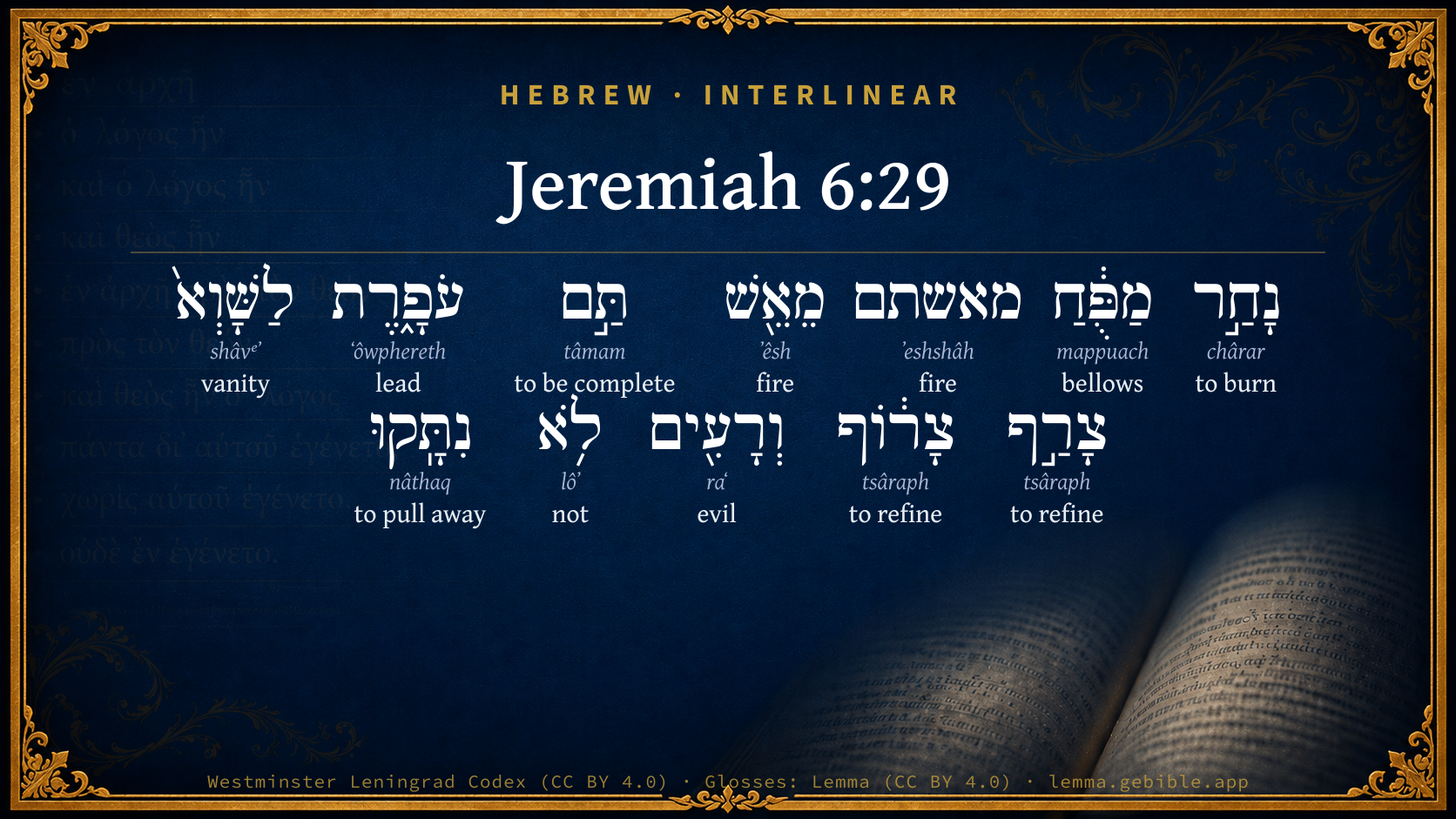
Hebrew (Westminster Leningrad Codex) Jeremiah 6:29 appears in the Hebrew Old Testament. The text above is from the Westminster Leningrad Codex. Each word links to its Strong’s number, a concise gloss, and parsing drawn from the Open Scriptures Hebrew Bible morphology. Click any word for its full Brown-Driver-Briggs (BDB) entry.
Download image
Cite this verse

Jeremiah 6:29 (World English Bible). Public Domain. Lemma interlinear Bible study tool, https://lemma.gebible.app/v/jeremiah/6/29.

Show BibTeX & RIS
BibTeX
RIS
English Translation
The bellows blow fiercely; the lead is consumed of the fire: in vain do they go on refining; for the wicked are not plucked away.
World English Bible · Public Domain
Highlights
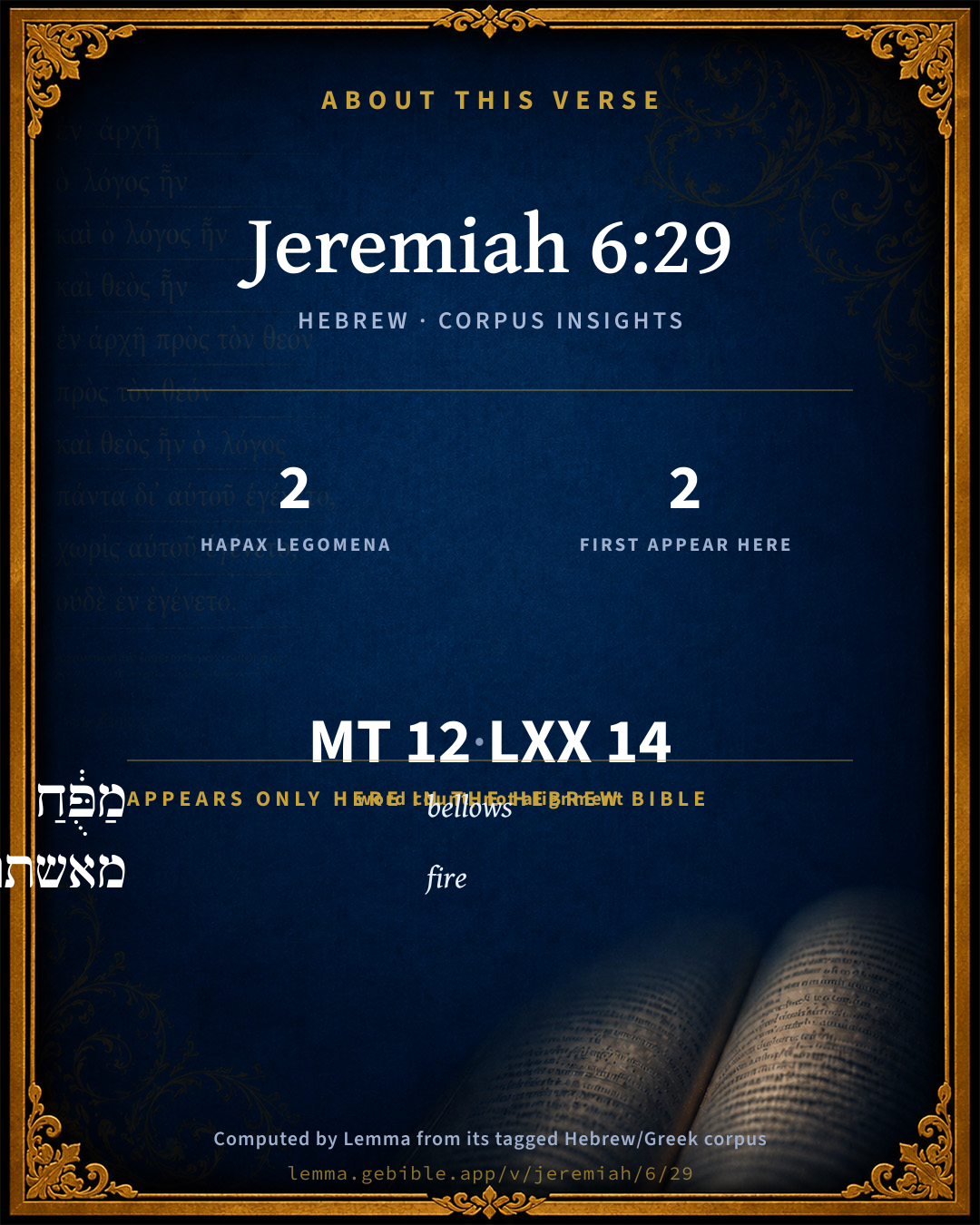
  • 2 hapax legomena — only here in the Hebrew Bible
  • 2 first appearances in the Hebrew Bible
Full analysis ↓
Download a study sheet

One document with this verse’s original text, its word-by-word gloss line, the meaning frame, cross-references with their text, attributed commentary, and full source and license credits — printable, and it pastes into notes with its structure intact.

This verse Autodidact and up

Study sheet (.html) Plain text (.txt)

A passage Seminary Student

Up to 50 verses in one chapter. A passage sheet keeps up to 6 commentary sources and 12 cross-references per verse, in the order this page ranks them, and says so on the sheet whenever that leaves anything out. Ask for a single verse and you get the Autodidact verse sheet above.

Everything on this page stays free to read, with no account — the sheet is a download of what is already on screen, not access to it.

Want to remove ads? Support Godless Engineer
Compare translations 3

The same verse in 3 English versions, stacked beneath the original-language interlinear above. Click any original word for its lexicon entry.

Each is an independent rendering of the whole verse — the interlinear is not word-aligned to these translations.

Highlighted words mark where these versions differ — a whole-verse word diff, not a word-by-word alignment.

  • World English Bible Public Domain
    The bellows blow fiercely; the lead is consumed of the fire: in vain do they go on refining; for the wicked are not plucked away.
  • King James Version Public Domain
    The bellows are burned, the lead is consumed of the fire; the founder melteth in vain: for the wicked are not plucked away.
  • unfoldingWord Literal Text CC BY-SA 4.0
    The bellows fiercely blow the lead from their fire. In vain he refines to refine, but the evil things are not torn away.

unfoldingWord Literal Text — © unfoldingWord, licensed CC BY-SA 4.0. Word-aligned USFM3 via Door43 (git.door43.org/unfoldingWord/en_ult).

Versions to compare (up to 4)

3 of 4 selected

Show all 18 translations

Every available English version of this verse, each an independent rendering of the whole verse.

  • World English Bible Public Domain
    The bellows blow fiercely; the lead is consumed of the fire: in vain do they go on refining; for the wicked are not plucked away.
  • Berean Standard Bible Public Domain
    The bellows blow fiercely, blasting away the lead with fire. The refining proceeds in vain, for the wicked are not purged.
  • Majority Standard Bible Public Domain
    The bellows blow fiercely, blasting away the lead with fire. The refining proceeds in vain, for the wicked are not purged.
  • King James Version Public Domain
    The bellows are burned, the lead is consumed of the fire; the founder melteth in vain: for the wicked are not plucked away.
  • American Standard Version (1901) Public Domain
    The bellows blow fiercely; the lead is consumed of the fire: in vain do they go on refining; for the wicked are not plucked away.
  • Revised Version (1885) Public Domain
    The bellows blow fiercely; the lead is consumed of the fire: in vain do they go on refining; for the wicked are not plucked away.
  • Geneva Bible (1599) Public Domain
    The bellowes are burnt: the lead is consumed in the fire: the founder melteth in vaine: for the wicked are not taken away.
  • Douay-Rheims (1899) Public Domain
    The bellows have failed, the lead is consumed in the fire, the founder hath melted in vain: for their wicked deeds are not consumed.
  • Young's Literal Translation Public Domain
    The bellows have been burnt, By fire hath the lead been consumed, In vain hath a refiner refined, And the wicked have not been drawn away.
  • Literal Standard Version CC BY-SA 4.0
    The bellows have been burned, || The lead has been consumed by fire, || A refiner has refined in vain, || And the wicked have not been drawn away.
  • Unlocked Literal Bible CC BY-SA 4.0
    The bellows are scorched by the fire that is burning them; the lead is consumed in the flames. The refining continues among them, but it is useless, because the evil is not removed.
  • unfoldingWord Literal Text CC BY-SA 4.0
    The bellows fiercely blow the lead from their fire. In vain he refines to refine, but the evil things are not torn away.
  • Darby Bible Public Domain
    The bellows are burned, the lead is consumed by the fire; they have melted, and melted in vain; and the bad are not plucked away.
  • World Messianic Bible Public Domain
    The bellows blow fiercely. The lead is consumed in the fire. In vain they go on refining, for the wicked are not plucked away.
  • Webster's Bible Public Domain
    The bellows is burned, the lead is consumed by the fire; the founder melteth in vain: for the wicked are not plucked away.
  • Free Bible Version CC BY-SA 4.0
    The bellows in the refiner's furnace blow powerfully, burning away the lead. But this refining is pointless, because the wicked are not purified.
  • Bible in Basic English Public Domain
    The blower is blowing strongly, the lead is burned away in the fire: they go on heating the metal to no purpose, for the evil-doers are not taken away.
  • JPS Tanakh (1917) Public Domain
    The bellows blow fiercely, the lead is consumed of the fire; in vain doth the founder refine, for the wicked are not separated.

Literal Standard Version (2020), Covenant Press — licensed CC BY-SA 4.0. Text via the HelloAO Bible API (eBible.org). Unlocked Literal Bible (unfoldingWord) — licensed CC BY-SA 4.0. Text via the HelloAO Bible API (eBible.org). unfoldingWord Literal Text — © unfoldingWord, licensed CC BY-SA 4.0. Word-aligned USFM3 via Door43 (git.door43.org/unfoldingWord/en_ult). Free Bible Version, Dr. Jonathan Gallagher — licensed CC BY-SA 4.0. Text via the HelloAO Bible API (eBible.org).

Word by word

More ways to search: Search by grammar → Find every occurrence → Compare this word →

Practice this passage: Drill this verse → Learn its vocabulary →

מַפֻּ֔חַ
mappuach
H4647
“bellows”
Noun, Common, Masculine, Singular, Absolute
Part of Speech
Noun
Type
Common
Gender
Masculine
Number
Singular
State
Absolute
Full BDB Definition

Origin: from H5301

TWOT: 1390b

bellows
  1. נָחַ֣ר chârar H2787 “to burn” Verb, Qal, Perfect, 3rd Person, Masculine, Singular
  2. מאשתם ʼeshshâh H800 “from · fire · their” Preposition + Noun, Common, Feminine, Singular, Construct + Suffix, Personal, 3rd Person, Masculine, Plural
  3. מֵאֵ֖שׁ ʼêsh H784 “from · fire” Preposition + Noun, Common, Both, Singular, Absolute
  4. תַּ֣ם tâmam H8552 “to be complete” Verb, Qal, Perfect, 3rd Person, Masculine, Singular
  5. עֹפָ֑רֶת ʻôwphereth H5777 “lead” Noun, Common, Feminine, Singular, Absolute
  6. לַשָּׁוְא֙ shâvᵉʼ H7723 “to/for the · vanity” Preposition, Determined + Noun, Common, Masculine, Singular, Absolute
  7. צָרַ֣ף tsâraph H6884 “to refine” Verb, Qal, Perfect, 3rd Person, Masculine, Singular
  8. צָר֔וֹף tsâraph H6884 “to refine” Verb, Qal, Infinitive Absolute
  9. וְרָעִ֖ים raʻ H7451 “and · evil” Conjunction + Adjective, Adjective, Masculine, Plural, Absolute
  10. לֹ֥א lôʼ H3808 “not” Particle, Negative
  11. נִתָּֽקוּ nâthaq H5423 “to pull away” Verb, Niphal, Perfect, 3rd Person, Common, Plural

About this verse

These counts appear in no published source. They are computed here, from the morphology-tagged text and Lemma’s own curated glosses. What Lemma adds →

12
words
11
distinct lemmas
Prophets
section

Notable vocabulary

2 hapax legomena — words that appear only here in the entire Hebrew Bible:

  • מַפֻּ֔חַ bellows H4647
  • מאשתם fire H800

First appearance in Scripture

These words make their first canonical appearance in the Hebrew Bible here:

  • מַפֻּ֔חַ bellows H4647
  • מאשתם fire H800

Shared distinctive vocabulary

עֹפָ֑רֶת lead H5777 occurs in 9 verses of the Hebrew Bible. Also found in:

Grammatical profile

  • 5 verbs
  • 5 nouns
  • 1 adjective
  • 1 particle

Verb forms

  • נָחַ֣ר Qal · Perfect
  • תַּ֣ם Qal · Perfect
  • צָרַ֣ף Qal · Perfect
  • צָר֔וֹף Qal · Infinitive Absolute
  • נִתָּֽקוּ Niphal · Perfect

Repetition

A word recurs within this verse — often emphatic in Hebrew:

  • צָרַ֣ף to refine H6884 ×2

Hebrew & Septuagint length

In the original languages it is 12 Hebrew tokens and 14 Greek tokens — but the two are counted differently (Hebrew bundles its prefixes and suffixes into one token; the Greek is in lemma form), so that isn’t a like-for-like length.

Cross-references

9

Topical passages linked to Jeremiah 6:29 in the Treasury of Scripture Knowledge — connected by theme and wording, ordered by reader-vote popularity; previews shown in the World English Bible.

  • Proverbs 17:3 The refining pot is for silver, and the furnace for gold, But Yahweh tests the hearts.
  • Isaiah 49:4 But I said, I have labored in vain, I have spent my strength for nothing and vanity; yet surely the justice [due] to me is with Yahweh, and my recompense with my God.
  • Jeremiah 9:7 Therefore thus says Yahweh of Hosts, Behold, I will melt them, and try them; for how [else] should I do, because of the daughter of my people?
  • Ezekiel 24:13 In your filthiness is lewdness: because I have cleansed you and you weren't cleansed, you shall not be cleansed from your filthiness any more, until I have caused my wrath toward you to rest.
  • Hosea 11:7 My people are determined to turn from me. Though they call to the Most High, He certainly won't exalt them.
  • Zechariah 13:9 I will bring the third part into the fire, And will refine them as silver is refined, And will test them like gold is tested. They will call on my name, and I will hear them. I will say, 'It is my people;' And they will say, 'Yahweh is my God.'"
  • Malachi 3:2–3 "But who can endure the day of his coming? And who will stand when he appears? For he is like a refiner's fire, and like launderer's soap;
  • 1 Peter 4:12 Beloved, don't be astonished at the fiery trial which has come upon you, to test you, as though a strange thing happened to you.
  • 1 Peter 1:7 that the proof of your faith, which is more precious than gold that perishes even though it is tested by fire, may be found to result in praise, glory, and honor at the revelation of Jesus Christ--

Cross-references courtesy of OpenBible.info (CC BY 4.0).

Hebrew and Greek witnesses Masoretic Hebrew ↔ Greek Septuagint

The same verse in the two great witnesses to the Old Testament, shown verse-for-verse.

These are two independent witnesses, not word-aligned to each other, and the Septuagint is shown in lemma (dictionary) form.

Hebrew Jeremiah 6:29 Masoretic · Westminster Leningrad Codex

נָחַ֣ר מַפֻּ֔חַ מאשתם מֵאֵ֖שׁ תַּ֣ם עֹפָ֑רֶת לַשָּׁוְא֙ צָרַ֣ף צָר֔וֹף וְרָעִ֖ים לֹ֥א נִתָּֽקוּ

The bellows blow fiercely; the lead is consumed of the fire: in vain do they go on refining; for the wicked are not plucked away.

World English Bible · Public Domain

Greek LXX Structure differs

In the Septuagint, Jeremiah is about an eighth shorter than the Hebrew and arranges its material differently — the Oracles Against the Nations (Hebrew chapters 46–51) appear in the middle of the Greek book, after 25:13. Because the chapter and verse boundaries do not line up, a verse-for-verse comparison with the Hebrew is not shown.

A verse-for-verse comparison isn’t shown here because the chapters and verses don’t line up. Switch to the LXX edition with the MT / LXX toggle above to read the Greek directly.

Hebrew: Westminster Leningrad Codex (CC BY 4.0). Greek: Septuagint (public domain); English from a public-domain English Septuagint. How the Septuagint differs from the Hebrew →

Targum (Aramaic paraphrase)

1

The Targum is the ancient Jewish Aramaic paraphrase of the Hebrew Scriptures — an interpretive translation, not the Hebrew text itself. Onkelos (literal) and Pseudo-Jonathan (expansive) render the Torah, and Jonathan the Prophets. Coverage is partial: where no permissively-licensed English translation exists for a verse, only the Aramaic is shown. This is verse-level text, not a word-by-word alignment to the Hebrew.

  1. Targum Jonathan Prophets (Joshua–Malachi)
    הָא כְּמֵשֵׁב נַפְּחִין דַחֲרִיךְ בְּגַוָאָה דְנוּרָא כֵּן חֲשָׁא קָלְהוֹן דִנְבִיַיָא דְמִתְנַבָּן לְהוֹן תּוּבוֹ לְאוֹרַיְתָא וְלָא תָבוּ וְכַאֲבָרָא דְמִתְמְסֵי בְּגוֹ כוּרָא כֵּן הֲוָאָה בְּטִילִין בְּעֵינֵיהוֹן מִלֵי נְבִיַיָא דְמִתְנַבָּן לְהוֹן לָא לְהַנָאָה אֲלִיפוּנוּן מַלְפֵיהוֹן וְעוֹבָדֵיהוֹן בִּישַׁיָא לָא שְׁבָקוּ:

    (no public-domain English translation for this verse)

    Targum Jonathan — Aramaic: “Mikraot Gedolot” (public domain). English: “Sefaria Community Translation” (CC0 1.0 (public-domain dedication)); “London "Chaldee Paraphrase," 1871” (public domain). Text via Sefaria.

Commentary

Notes on Jeremiah 6:29 from classic Christian and Jewish commentators (each source and its license shown beneath its notes). The classic Christian expositions comment on the surrounding passage and are grouped to its opening verse, so a note may address several verses; the Jewish commentaries on the Tanakh (Rashi and others) are per-verse, so they appear only where the commentator wrote on this verse.

Lemma curates 59 commentaries, every one of them public domain or Creative Commons licensed, each selected and text-cleaned for this edition rather than reprinted as found. About our sources →

Trapp's Complete Commentary

John Trapp

Jer 6:29 The bellows are burned, the lead is consumed of the fire; the founder melteth in vain: for the wicked are not plucked away.

Ver. 29. The bellows are burnt.] The prophet’s lungs are spent; all their pains spilt upon a perverse people. See Eze 24:6; Eze 24:12-13. Jeremiah had blowed hard, as a smith or metallary doth with his bellows; he had suffered, as it were, by the heat of a most ardent fire in trying and melting his ore; he had used his best art also by casting in lead, as today they do quicksilver, to melt it the more easily, and with less loss and waste; but all to no purpose at all. Let us, to the wearing of our tongues to the stumps, preach never so much, men will on in sin, said Bradford. {a}

The lead is consumed.] All the melting judgments which, as lead is cast into the furnace to make it the hotter, God added to the ministry of the prophets to make the Word more operative, they will do no good.

The founder melteth in vain.] Whether God, the master founder, or the prophets, God’s co-founders or fellow workmen, as the apostle calleth them. {1Co 6:1}

The wicked are not plucked away.] Or, Their wickednesses; they will not part with their dross, or be divorced from their dilecta delicta, beloved sins. The vile person will speak villany, and his heart will work iniquity, to practise hypocrisy, and to utter error against the Lord. {Isa 32:6}

{a} Mr Case’s Treatise of Afflictions.

John Trapp, A Commentary or Exposition upon All the Books of the Old and New Testament (1647–1656) — public domain. Text from a community e-Sword module.

The Biblical Illustrator

Joseph S. Exell

Jer_6:29-30

The bellows are burnt.

The bellows burnt

Apply to--

I. The prophet himself. The prophet was exhausted before the people were impressed. So also with Noah, Isaiah, John the Baptist, Jesus Himself. Nor since, by apostles, confessors, zeal-consuming preachers, has the iron-hearted world become melted; but they themselves have suffered and perished amid their work.

1. It is the preachers business to continue labouring till he is worn out.

2. The Gospel he preaches is the infallible test between the precious and the vile.

II. The afflictions which God sends upon ungodly men. Sent to see if they will melt in the furnace or not. But where there is no grace in affliction the afflictions are sooner exhausted than the sinners heart is made to melt under the heat caused thereby--e.g., Pharaoh, not softened by all the plagues. Ahaz, when he was afflicted, he sinned yet more and more. Jerusalem, often chastised, yet incorrigible. Sinners, upon whom Gods judgments exert no melting power.

III. The chastisements which God sends upon His own people. The great Refiner will have His gold pure, and will utterly remove our tin. Do not let it be said that the bellows are used till they are worn out before our afflictions melt us to repentance and cause us to let go our sins.

IV. The time is coming when the excitement of ungodly men will fail them. Many activities are kept up by outward energies inciting men.

1. Excitement in pursuit of wealth. Yet how little will the joys of wealth stimulate you in your last moments!

2. Excitement in pursuing fame. Alas! men burn away their lives for the approbation of fellow creatures; and these fires will die down into darkness.

3. Living for pleasure; but satiety follows, and the flame of joy goes out.

4. Hypocrisy is with some their bellows; but this feigned zeal and pretended piety will end in black despair.

V. Those excitements which keep alive the Christians zeal. In certain Churches we have seen great blazings of enthusiasm, misnamed revivals, mere agitations. Genuine revivals I love, but these spurious things are fanaticism. Why was it the fire soon went out? The man who blew the bellows left the scene of excitement, and darkness ensued. Our earnestness is worthless which depends on such special ministrations. Is the fire in our soul burning less vehemently than in years past? Our obligations to live for Christ are the same; our Masters claims on our love are as strong; the objects for which we served God in the past are as important. Should we grow less heavenly the nearer we come to the New Jerusalem? (C. H. Spurgeon.)

The prophets consuming zeal and the peoples unresponsiveness

He likens the people of Israel to a mass of metal. This mass of metal claimed to be precious ore, such as gold or silver. It was put into the furnace, the object being to fuse it, so that the pure metal should be extracted from the dross. Lead was put in with the ore to act as a flux (that being relied upon by the ancient smelters, as quicksilver now is in these more instructed days); a fire was kindled, and then the bellows were used to create an intense heat, the bellows being the prophet himself. He complains that he spake with such pathos, such energy, such force of heart, that he exhausted himself without being able to melt the peoples hearts; so hard was the ore, that the bellows were burned before the metal was melted--the prophet was exhausted before the people were impressed; he had worn out his lungs, his powers of utterance; he had exhausted his mind, his powers of thought; he had broken his heart, his powers of emotion; but he could not divide the people from their sins, and separate the precious from the vile. (C. H. Spurgeon.)

The lead is consumed of the fire.

Refining fire

We mean precisely the same thing as the Hebrew prophet meant when we say, as nowadays we are so apt to say, that life is a school. People still are puzzled by the punishments of life. The discipline is strict. The rules are rigid. Oftentimes we suffer. It is not by any means all play. But there are lessons to be learned, and forbearance to be used, and suffering to be borne. It seems to us narrow and foolish of Jeremiah to have fancied that the Lord raised up those great Assyrian and Babylonian nations simply for the purpose of trying and testing the Jewish people. It was narrow also of the Jews to fancy themselves the chosen people, whom God particularly loved and wished to save. Yet all of us today are similarly narrow in one sense, and we have to be. We cannot free ourselves, you and I and others like us, from the conviction that we, as men and women, by virtue of the very life that is in us, are the centre and meaning of this entire universe. Believe this in some degree we must. Doubt it, and the very heavens are bleak and bare. Every system in philosophy, every article of religious faith, every discovery in science, is based, more or less directly, upon the supposition of this distinct relationship between the outer universe and the life of man. Let us use, for convenience sake, the analogy of the prophet. We will suppose that we are placed here as the crude ore is thrown into the furnace, in order to be refined. Along what lines should the process of refinement work? Nothing is more familiar than the claim that sorrow chastens us, and hardships strengthen, and trials test. As Goethe said, Talent is perfected in retirement, but character only in the stream of life. They tell this concerning Wendell Phillips. Whenever the great orator tended to become a little prosy in his speeches, and to lose some of his customary fire, certain young Abolitionists used to get together near the door and start a hiss. The note of disapproval never failed to arouse the lion in the speaker, and he was electrified at once into matchless eloquence. The worlds agencies of trial and toil and difficulty are indeed in vain, the bellows of life are consumed most uselessly, if you and I are not made more courageous and calm and self-reliant by the process. And yet the hard things of this world ought not to be the only ones to have this refining influence. We are weak and ungrateful, and made of anything but precious metal, if we are not purified by the privileges of life, hallowed by its happiness, humbled by success. In everyday life most of us are not deficient in gratitude. We appreciate the kindness and generosity of our friends. But how few of us in comparison fall to our knees in an hour of newborn joy, or reverently think of lifes higher meaning, and resolve on a rigider performance of our duties, when success has bathed us in its golden sunshine! There is no much surer test of character than this: What effect has good fortune had? If the person is innately weak to whom some power or privilege has come, he answers it by pride and selfishness and vain indulgence. He feels himself exalted; and, instead of looking up in reverence and humility to his God, he looks down with coldness on his fellow men. Shall I tell you what is to me one of the most inspiring, beautiful sights in all the wide range of human activity and character? It is to see and know of anyone truly great who has been humbled by success, and touched into infinite modesty by the consciousness of superlative ability. It is to find people refined into simplicity and gentle devoutness by the worlds blandishments and distinctions and honours. And this has been the refining influence to which the noblest and the truest ones have answered. You all know, too, the saying of the distinguished, world-honoured discoverer, Sir Isaac Newton,--that he was nothing but a helpless child gathering pebbles on a boundless shore, with the great ocean of undiscovered truth stretching away beyond him. I have spoken of sorrow and of joy--the two extremes of existence--as having properly this purifying influence on life. Let, me now speak broadly of certain phases of refinement which ought to appear as the result of the worlds great processes.

1. First, there is the refining fire of glory, which is so abundant in the outward world. It is for us to answer it by what is known as reverence. We have not the pure metal which is sought, if we are not so refined by the wonders of the world as to kneel in worship, and uplift our souls in awe. This world is not for him who does not worship, said an ancient Persian sage; and our kindred souls give back the truth across the centuries, This world is not for him who does not worship.

2. Again, there is the burning fact of law. All things around us are done with persistency. Everything is regular. The smallest function is precise. Surely the knowledge of such constancy should have its influence on us. It should take what is pure within us. It should appeal to the clear metal of our better selves, and make us trust.

3. Finally, the fire of utter impartiality surrounds us. The world is laid at each ones feet. The Divine bounty is not given to this person, and denied to that one; but all of us receive. And the answering refinement which should come from receptive human beings, who may doubt its nature or its need? A suggestive legend comes to us from Mohammedan writings. Abraham, it is said, once received an old man in his tent, who, in sitting down to eat, neglected to repeat a grace. My custom, he said, in explanation, is that of the fire worshipper.--Whereupon the Jewish patriarch in wrath undertook to drive him from his door. But suddenly God appeared to him, and, restraining the churlish impulse, cried: Abraham, for one hundred years the Divine bounty has flowed out to you in sunshine and in rain; and is it for you to deny shelter to this man because his worship is not thine? Even thus does nature speak a silent yet severe rebuke to our narrowness, our lack of sympathy, our petty distinctions and rivalries in social life. Be broad, she cries. Let love control your acts; to those who need, extend a helping hand. (P. R. Frothingham.)

.

The Biblical Illustrator, edited by Joseph S. Exell (c. 1880s–1900s) — public domain. Text from a community e-Sword module.

Tyndale Open Study Notes

Tyndale Open Resources

6:29 To expose their wickedness, God was fanning the flames with the bellows of his judgment. But no valuable silver appeared; only the dross of wickedness remained (Zech 13:9; Mal 3:3).

Tyndale Open Study Notes — © Tyndale Open Resources, licensed CC BY-SA 4.0. Text via the HelloAO Bible API.

Geneva Bible (1599)

Geneva Bible translators

All the pain and labor that hath been taken with them, is lost.

Geneva Bible (1599) marginal notes — public domain. Text via Bolls.life.

Jamieson, Fausset & Brown

Robert Jamieson, A. R. Fausset & David Brown

bellows . . . burned--So intense a heat is made that the very bellows are almost set on fire. ROSENMULLER translates not so well from a Hebrew root, "pant" or "snort," referring to the sound of the bellows blown hard.

lead--employed to separate the baser metal from the silver, as quicksilver is now used. In other words, the utmost pains have been used to purify Israel in the furnace of affliction, but in vain (Jer 5:3; Pe1 1:7).

consumed of the fire--In the Chetib, or Hebrew text, the "consumed" is supplied out of the previous "burned." Translating as ROSENMULLER, "pant," this will be inadmissible; and the Keri (Hebrew Margin) division of the Hebrew words will have to be read, to get "is consumed of the fire." This is an argument for the translation, "are burned."

founder--the refiner.

wicked . . . not plucked away--answering to the dross which has no good metal to be separated, the mass being all dross.

Jamieson, Fausset & Brown — Commentary Critical and Explanatory on the Whole Bible (1871) — public domain (CC PDM 1.0). Text via the HelloAO Bible API.

John Calvin's Commentaries

He says, that the bellows was consumed by the fire and without any advantage. The whole sentence is metaphorical. Interpreters refer it simply to what was taught; and hence they consider the mouth of the Prophet to be the bellows, by which the fire was kindled. So the meaning would be, — that the Prophet was as it were burnt, through his incessant crying, like the bellows, which by being continually used is at length consumed, especially when the fire burns fiercely. They then suppose that the Prophet complains that his throat had dried up, like the bellows, which being burnt by the fire can no longer do its work. But what if we refer this to the punishments and judgments by which God had chastised his people, and yet without benefit? For so he complains in the first chapter of Isaiah, and in other places.

“In vain, “he says, “have I chastised thee:”

and Jeremiah has before said,

“In vain have I chastised my children; they have not received correction.” (Jeremiah 2:30)

So also it is said by Isaiah,

“Alas! vengeance must I take on my enemies,” (Isaiah 1:24)

but to what purpose? He afterwards adds, that it was without any benefit, because their wickedness was incurable.

The first meaning, however, is not to be rejected, for it was not unsuitable to say, that the tongue of the Prophet was worn out with constant crying, that his throat was nearly dried up. But I approve more of what I have just stated. Let each make his own choice. If we consider prophetic teaching to be here intended, we may also draw another meaning, — that the Prophet’s mouth was consumed by God’s terrors; for it was like burning, whenever God threatened the people with final destruction. The Prophet then does not without reason say, that his throat was burnt by fire, even the threatenings of God.

He afterwards adds, that the lead was entire This sentence rather favors the view, that Jeremiah is speaking of the judgments by which God sought to humble the people and to lead them to repentance; for it cannot be suitably applied to doctrine or teaching, that the lead was unmixt. By lead I understand dross. Some consider it to be silver, and say that lead was mixed with silver, in order that the silver might more easily be melted. As I am not skillful in that art, I cannot say whether this is done or not. But the Prophet says that the lead was unmixt; that is, that nothing was found but dross and filth.

He then adds, In vain has the melter melted, for evils have not been purged away; that is, the dross had not been removed so as to leave behind the pure metal. He means, in short, that there was nothing but dross and filth in the people, and not a particle of pure silver. It hence followed, that they had been as it were in vain melted. Now, this applies more fitly to punishment than to teaching, as all must see. I hence do not doubt but that the Prophet shews here, that the Jews were not only wicked and apostates and despisers of God, but were also so obstinate that God had often tried in vain to purify them. And it is a kind of speaking, we know, which occurs often in the prophets and throughout Scripture, that God is said to melt, to purge, to refine men, when he chastises them. But the Prophet says that there was only filth in that people, that lead was found, and that they were not melted. And hence we learn how great was their hardness: though they were tried by fire, they yet melted not, but continued in their perverseness. He afterwards adds —

John Calvin's Commentaries (1540-1563) — public domain. Text from the Calvin Translation Society English edition (1840s-50s) via the Christian Classics Ethereal Library (ccel.org). Calvin's coverage is partial (roughly two-thirds of the Bible); uncommented books and verses are honest gaps, never fabricated. The 19th-century editor's footnotes and remarks are omitted so the notes are faithfully Calvin's own voice.

Ellicott's Commentary for English Readers

(29) The bellows are burned.—Better, burn, or glow. In the interpretation of the parable the “bellows” answer to the life of the prophet as filled with the breath or spirit of Jehovah. He is, as it were, consumed with that fiery blast, and yet his work is faulty.

The lead is consumed . . .—Better, from their fire is lead only. A different punctuation gives, The bellows burn with fire; yet lead is the only outcome. The point lies in the fact that lead was used as a flux in smelting silver ore. The founder in the case supposed went on with his work till the lead was melted, but he found no silver after all.

Plucked away.—Better, separated or purified, as in keeping with the metaphor.

A Bible Commentary for English Readers, edited by Charles John Ellicott (1878–1897) — public domain. Text from a community e-Sword module.

The Cambridge Bible for Schools and Colleges

gen. ed. J. J. S. Perowne

29. The figure from refining metals is continued from Jer_6:27. “In refining, the alloy containing the gold or silver is mixed with lead, and fused in a furnace on a vessel of earth or bone-ash: a current of air is turned upon the molten mass (not upon the fire); the lead then oxidizes, and acting as a flux, carries away the alloy, leaving the gold or silver pure (I. Napier, The Ancient Workers in Metal, 1856, pp. 20, 23). In the case here imagined by the prophet, so inextricably is the alloy mixed with the silver, that, though the bellows blow, and the lead is oxidised by the heat, no purification is effected; only impure silver remains.” Dr. p. 39.

The Cambridge Bible for Schools and Colleges (gen. ed. J. J. S. Perowne; Cambridge University Press, 1878–1918) — public domain. Text from a community e-Sword module.

John Gill's Exposition

The bellows are burnt,.... Which Kimchi interprets of the mouth and throat of the prophet, which, through reproving the people, were dried up, and become raucous and hoarse, and without any profit to them; and so the Targum,

"lo, as the refiner's blower, that is burnt in the midst of the fire, so the voice of the prophets is silent, who prophesied to them, turn to the law, and they turned not;''

or the judgments and chastisements of God upon the Jews may be meant, which were inflicted upon them to no purpose:

the lead is consumed of the fire; lead being used formerly, as is said (f), instead of quicksilver, in purifying of silver; which being consumed, the refining is in vain: or it may be rendered,

out of the fire it is perfect lead (g); or wholly lead, a base metal, no gold and silver in it, to which the Jews are compared:

the founder melteth in vain; to whom either the prophet is likened, whose reproofs, threatenings, and exhortations, answered no end; or the Lord himself, whose corrections and punishments were of no use to reform this people:

for the wicked are not plucked away; from their evil way, as Jarchi; or from good men, they are not separated the one from the other; or, "evils (sins) are not plucked away" (h); from sinners: their dross is not purged away from them; neither the words of the prophet, nor the judgments of God, had any effect upon them. The Targum of the latter part of the verse is,

"and as lead which is melted in the midst of the furnace, so the words of the prophets which prophesied to them were nothing in their eyes; and without profit their teachers taught them and they did not leave their evil works.''

(f) By Mathiolus, Agricola and others, in Poli Synops. (g) "ab igne, et integrum est plumbum", Munster, Calvin, Tigurine version. (h) "et mala non sunt evulsa", Piscator, so some in Vatablus; "mala avelli non pussunt", Junius & Tremellius.

John Gill's Exposition of the Whole Bible (1746–1763) — public domain (CC PDM 1.0). Text via the HelloAO Bible API.

Albert Barnes' Notes on the Bible

The bellows are burned - Worn out by continual blowing. The prophet has exhausted all his efforts. His heart, consumed by the heat of divine inspiration, can labor no more. Others translate “The bellows snort,” i. e., blow furiously. More probably, “The bellows glow” with the strong heat of the fire.

Plucked away - Separated. The smelter’s object is to separate the metal from the dross.

Albert Barnes' Notes on the Bible (1834–1885) — public domain. Text from a community e-Sword/MySword module.

Haydock's Catholic Bible Commentary

Bellows, or crucible. --- Lead, which was intermixed to purify the dross (St. Jerome) of gold and silver. But brass and iron could not be thus purified. All would be lost labour. Afflictions do not correct the obstinate. (Calmet)

George Leo Haydock (1774–1849), Haydock's Catholic Family Bible and Commentary, 1859 edition — public domain. Excludes Psalms (Douay-Rheims chapter numbering differs from Protestant) and Deuterocanonical books (Catholic canon only).

Matthew Poole's English Annotations

The bellows are burned: the prophet prosecutes his metaphor taken from refining of metals, intimating herein that the prophets had spent their lungs to no purpose; see the like Psa 22:15; 69:3; and their strength was consumed by their so much labour and pains: q.d. The terror of the Lord is as a fire in my throat.

The lead is consumed; some read it, the lead was entire, viz. their dross did still remain in them, the lead put for their dross; but I see no reason for nor need of this reading, but rather hereby is understood either that means which was used to prevail with them, his words compared to lead for the weight of them, and the use of them; or the judgments, which were heavy as lead, that God mixed among them, the more easily to prevail with them; it was all upon them; as lead is used in melting silver, that it may melt the easier; it is all wasted, and doth no good.

The founder melteth in vain; let the artist use his greatest skill and industry, yet is it all in vain; He can make nothing of it: the prophets did but lose their labour in all the pains they took, Psa 58:5, after they had wearied themselves.

The wicked are not plucked away, or drawn away, as the word is, Jos 8:16; Jdg 20:32. Their dross and corruption, their wickedness and filthiness, is not removed, Isa 32:6; for wicked may be read wickedness.

Matthew Poole's English Annotations on the Holy Bible (1683–1685) — public domain. Text from a community e-Sword/MySword module.

Whedon's Commentary on the Bible

Daniel D. Whedon

29. The lead is consumed, etc. — There is an uncertainty here as to the original text, and this has given rise to various renderings. That of the Authorized Version expresses the sense that the process is continued until the very lead used as a flux is consumed, and yet no silver is found. Keil translates, “Burned are the bellows by the fire; at an end is the lead; in vain they melt and melt; and wicked ones are not separated.” Nagelsbach, “The bellows glows; out of its fire comes — lead! in vain one melts and melts; the base are not separated.” Of these the translation of Keil is to be preferred, though, in one place, it overrides the Masoretic accents, and, in another, breaks up one word of the Kethib into two.

Daniel D. Whedon (gen. ed.), Commentary on the Old and New Testaments (1874–1909) — public domain. Text from a community e-Sword module.

The Pulpit Commentary

The bellows are burned. The objection to this rendering is that the burning of the bellows would involve the interruption of the process of assaying. We might, indeed, translate "are scorched", (on the authority of Eze_15:4) and attach the word rendered "of the fire" to the first clause; the half-verse would then run: "The bellows are scorched through the fire; the lead is consumed," i.e. the bellows are even scorched through the heat of the furnace, and the lead has become entirely oxydized. But this requires us to alter the verb from the masculine to the feminine form of third sing. perf. (reading tammah). It is better, therefore, to give the verb (which will be Kal, if the nun be radical) the sense of "snorting," which it has in Aramaic and in Arabic, and which the corresponding noun has in Hebrew. (Jer_8:16 Job_39:20 Job_41:12) The masculine form of the verb rendered "is consumed" is still a difficulty; but we have a better right to suppose that the first letter of tittom was dropped, owing to its identity with the second letter, than to append (as the first view would require us) an entirely different letter at the end. This being done, the whole passage becomes clear: "The bellows puff, (that) the lead may be consumed of the fire." In any case, the general meaning is obvious. The assayer has spared no trouble, all the rules of his art have been obeyed, but no silver appears as the result of the process. Lead is mentioned, because, before quicksilver was known, it was employed as a flux in the operation of smelting, Plucked away; rather, separated, like the dross from the silver.

"The bellows are burned.

The text is a homely and unusual one, but its graphic force may help all the more to impress the truth taught by it. "The prophet likens the people of Israel to a mass of metal. This mass of metal claimed to be precious ore, such as gold or silver. It was put into the furnace, the object being to fuse it, so that the pure metal should be extracted from the dross. Lead was put in with the ore to act as a flux (that being relied upon by the ancient smelters as quicksilver now is in these more instructed days). A fire was kindled, and then the bellows were used. to create an intense heat, the bellows being the prophet himself. He complains that he spoke with much pathos, much energy, much force of heart, that he exhausted himself, without being able to melt the people"s hearts; so hard was the ore that the bellows were burned before the metal was melted the prophet was exhausted before the people were impressed; he had worn out his lungs, his powers of utterance; he had exhausted his mind, his powers of thought; he had broken his heart, his powers of emotion; but he could not divide his people from their sins, and separate the precious from the vile" (C.H. Spurgeon). Now, from the text learn

I IT IS THE PURPOSE OF GOD SO TO MELT AND SUBDUE THE HEART OF MAN THAT HE MAY MOULD IT AFRESH, AND ACCORDING TO HIS OWN GRACIOUS WILL. NOW to this end there are needed:

1. A Divine fire which shall bear upon the heart of man. But the Holy Spirit is such a fire, which, if it be quenched, woe is unto us!

2. That that fire shall glow with fervent heat.

II To SECURE THIS HE MAKES USE OF MANY AND VARIED APPLIANCES WHICH THE PROPHET HERE LIKENS TO "BELLOWS.

1. The prophets own ministry in the case of Judah and Jerusalem at that time.

2. The faithful ministry of his truth by his prophets now.

3. His Law, his Word, the varied means of grace.

4. His mercies, especially the mercy of God in Christ.

5. His chastisements and judgments. These more especially referred to here. Such are some of these appliances.

III Now, IT IS POSSIBLE FOR ALL THESE TO BECOME UTTERLY INEFFECTUAL. This is what is here meant. God"s messengers, Law, faeries, chastisements, all in vain. And such things happen now . There are those whom naught can move. What is the cause? Not that the Divine heat did not bear upon the heart that was to be melted. Not that those appliances were left unused whereby the understanding, the conscience, the affections, and the win might be rendered more susceptible of the Divine influences. But the obduracy of the heart. The perversity and evil of that baffled all the earnest endeavors of God"s grace in regard to that heart.

IV NOW, WHEN "THE BELLOWS ARE BURNED," WHEN ALL MEANS HAVE BEEN TRIED AND FAILED TO WIN THE HEART FOR GOD, NO CONDITION CAN BE MORE AWFUL OR DEPLORABLE.

1. It is sad for Gods ministers. Jeremiah, Paul, Christ, and thousands of his ministers since have prayed and wept over obdurate hearts.

2. But it is far more sad for these hard-hearted ones themselves.

a. They are without excuse.

b. There is no hope of their repentance.

c. They are in danger of eternal sin.

CONCLUSION.

1. Christ"s ministers must expect that, so far as they can see, they will, at times, labor in vain in regard to the salvation of souls. The bellows will be burned, and the ore remain unmelted still.

2. They are to be sustained by the thought that God will deal with them, not according to the results of their work, but according to its fidelity.

3. Let the impenitent be warned. C.

The Pulpit Commentary (1880–1919), ed. H.D.M. Spence-Jones & Joseph S. Exell — public domain. Text from a community e-Sword module.

John Wesley's Explanatory Notes

The bellows - The prophet prosecutes his metaphor taken from refining of metals, intimating, that the prophets had spent their breath to no purpose, and their strength was consumed by their labour. The lead - The judgments which were heavy, as lead upon them, are all wasted, and do no good. In vain - Let the artist use his greatest skill and industry, yet is it all in vain.

John Wesley, Explanatory Notes Upon the Whole Bible (1754–1765) — public domain. Text via the GEBible commentary corpus.

Keil & Delitzsch

C. F. Keil & F. Delitzsch

The trial of the people has brought about no purification, no separation of the wicked ones. The trial is viewed under the figure of a long-continued but resultless process of smelting. נחר, Niph. from חרר, to be burnt, scorched, as in Eze 15:4. מאשׁתּם is to be broken up, as in the Keri, into two words: מאשׁ and תּם (from תמם). For there does not occur any feminine form אשּׁה from אשׁ, nor any plural אשּׁת (even אשּׁה forms the plur. אשּׁים), so as to admit of our reading מאשּׁתם or מאשּׁתם. Nor would the plur., if there were one, be suitable; Ew.'s assertion that אשּׁות means flames of fire is devoid of all proof. We connect מאשׁ with what precedes: Burnt are the bellows with fire, at an end is the lead. Others attach "by the fire" to what follows: By the fire is the lead consumed. The thought is in either case the same, only תּם is not the proper word for: to be consumed. Sense: the smelting has been carried on so perseveringly, that the bellows have been scorched by the heat of the fire, and the lead added in order to get the ore into fusion is used up; but they have gone on smelting quite in vain. צרף with indefinite subject, and the infin. absol. added to indicate the long duration of the experiment. In the last clause of the verse the result is mentioned in words without a figure: The wicked have not been separated out (prop., torn asunder from the mass).

Keil & Delitzsch — Biblical Commentary on the Old Testament (1861–1891) — public domain (CC PDM 1.0). Text via the HelloAO Bible API. (Old Testament only.)

Rashi

Rabbi Shlomo Yitzchaki (Rashi)

The bellows is heated This is an allegory. When they refine silver, they blow with a bellows, and they always put lead into the crucible, which helps for the refining. But you—I have come to refine you. The bellows is heated and parched because of the fire, and the lead is completely consumed. נחר is an expression related to (Job 42:7) “My wrath has been kindled (חרה)”; (ibid. 30:30) “And my bones are burned (חרה) with heat,” (esrast in O.F.).

in vain In vain does the founder refine, for it is of no avail

and the wicked ones have not been separated from their evil way. That is to say that the prophets toiled to reprove, but it did not avail them.

Separated Heb. נתקו, (furent de... in O.F.). (Another version:) and the wicked ones. This is like רשעים.

Rashi on the Tanakh — English translations: “The Judaica Press complete Tanach with Rashi, translated by A. J. Rosenberg” (CC BY 4.0); “Pentateuch with Rashi's commentary by M. Rosenbaum and A.M. Silbermann, 1929-1934” (public domain); “The Metsudah Tanach series, Lakewood, N.J” (CC BY 4.0); and “The Book of Joshua, Metsudah Publications, 1997” (CC BY 4.0). Text via Sefaria.

Lesson kit

Teaching starters — assembled from the data on this page, not authored interpretation. Every prompt links to the verse data it draws on. Edit before teaching.

Jeremiah, in the Prophets, opens this verse with 12 words (11 distinct Hebrew lemmas). Its most distinctive word is mappuach (“bellows”). A historical commentator’s framing appears above. Read the whole chapter for the surrounding context.

Discussion questions

  1. How does “bellows” (mappuach) shape what this verse is saying?
  2. This verse holds 2 words here found nowhere else in the Hebrew Bible. What might the rare words draw attention to?
  3. 2 words here appear for the first time in Scripture. What is being introduced at this debut?
  4. Exodus 15:10 shares the word «lead» with this verse. How do the two illuminate each other?
  5. “to refine” occurs 2× in this one verse. What is the effect of the repetition?
  6. These translations render this verse differently; the difference is in the English rendering, not the original. What questions does that raise?
  7. The verb «נָחַ֣ר» is Qal Perfect. How does its form color the action?
  8. Reading how Trapp's Complete Commentary and The Biblical Illustrator read this verse, where do the two commentators agree and where do they part?

Things to notice

  • 2 words in this verse appear nowhere else in the Hebrew Bible.
  • 2 words make their first canonical appearance in Scripture here.
  • This verse counts 12 Hebrew ↔ 14 Greek words.
  • These translations choose different wording for 16 words in this verse.
  • “to refine” occurs 2× in this single verse.

Reading settings

Reading text

Shown beneath each verse's original-language words.

Old Testament
Old Testament edition

Read the OT as the Masoretic Hebrew (MT) or the Greek Septuagint (LXX).

English shown for the Greek Septuagint (in the Hebrew ↔ Greek comparison).

Comparing translations? Open the Compare panel on any verse page to stack up to four side by side.