
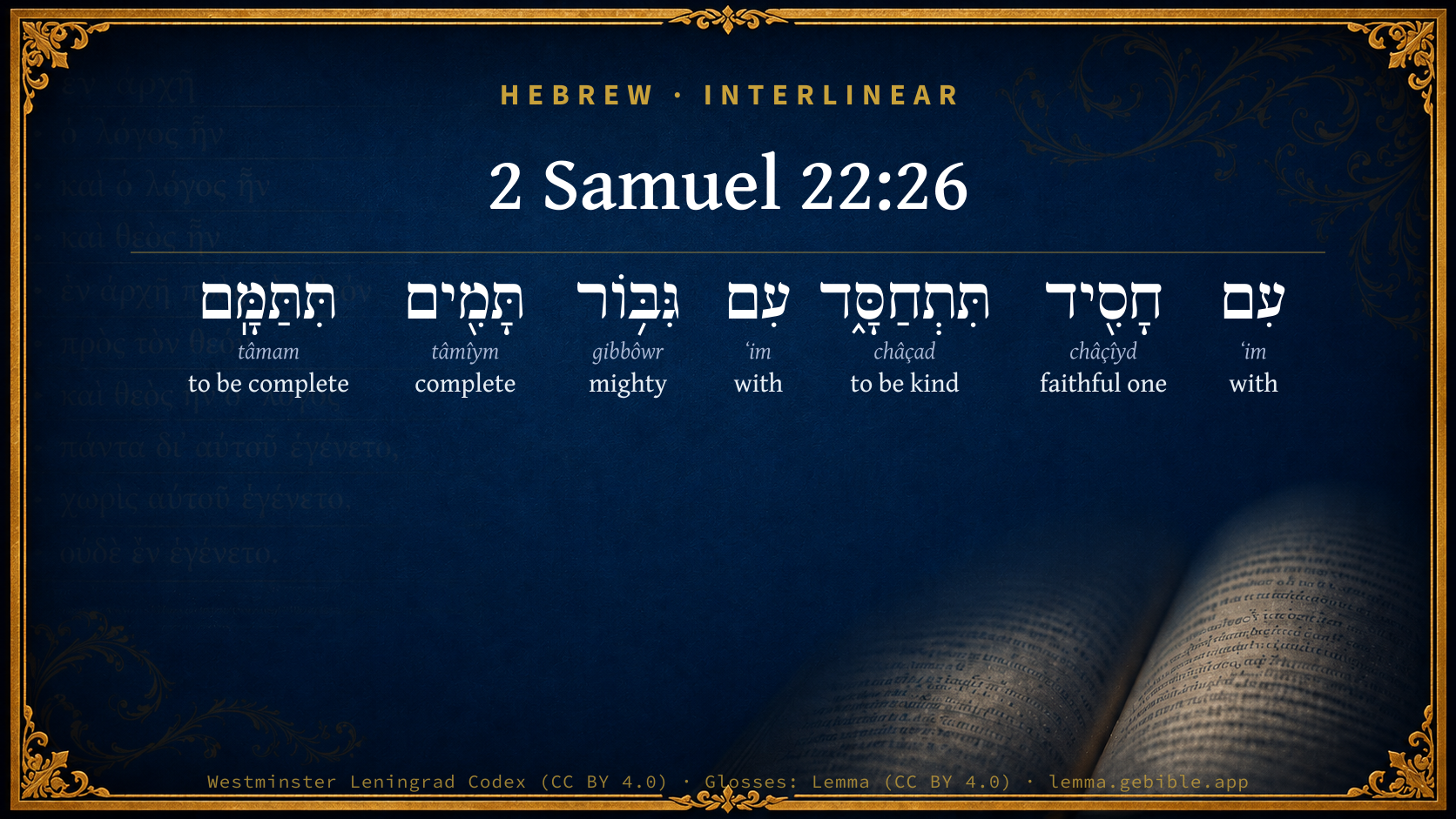
2 Samuel 22:26

Hebrew (Westminster Leningrad Codex) 2 Samuel 22:26 appears in the Hebrew Old Testament. The text above is from the Westminster Leningrad Codex. Each word links to its Strong’s number, a concise gloss, and parsing drawn from the Open Scriptures Hebrew Bible morphology. Click any word for its full Brown-Driver-Briggs (BDB) entry.
Download image
Cite this verse

2 Samuel 22:26 (World English Bible). Public Domain. Lemma interlinear Bible study tool, https://lemma.gebible.app/v/2-samuel/22/26.

Show BibTeX & RIS
BibTeX
RIS
English Translation
With the merciful you will show yourself merciful; With the perfect man you will show yourself perfect;
World English Bible · Public Domain
Highlights
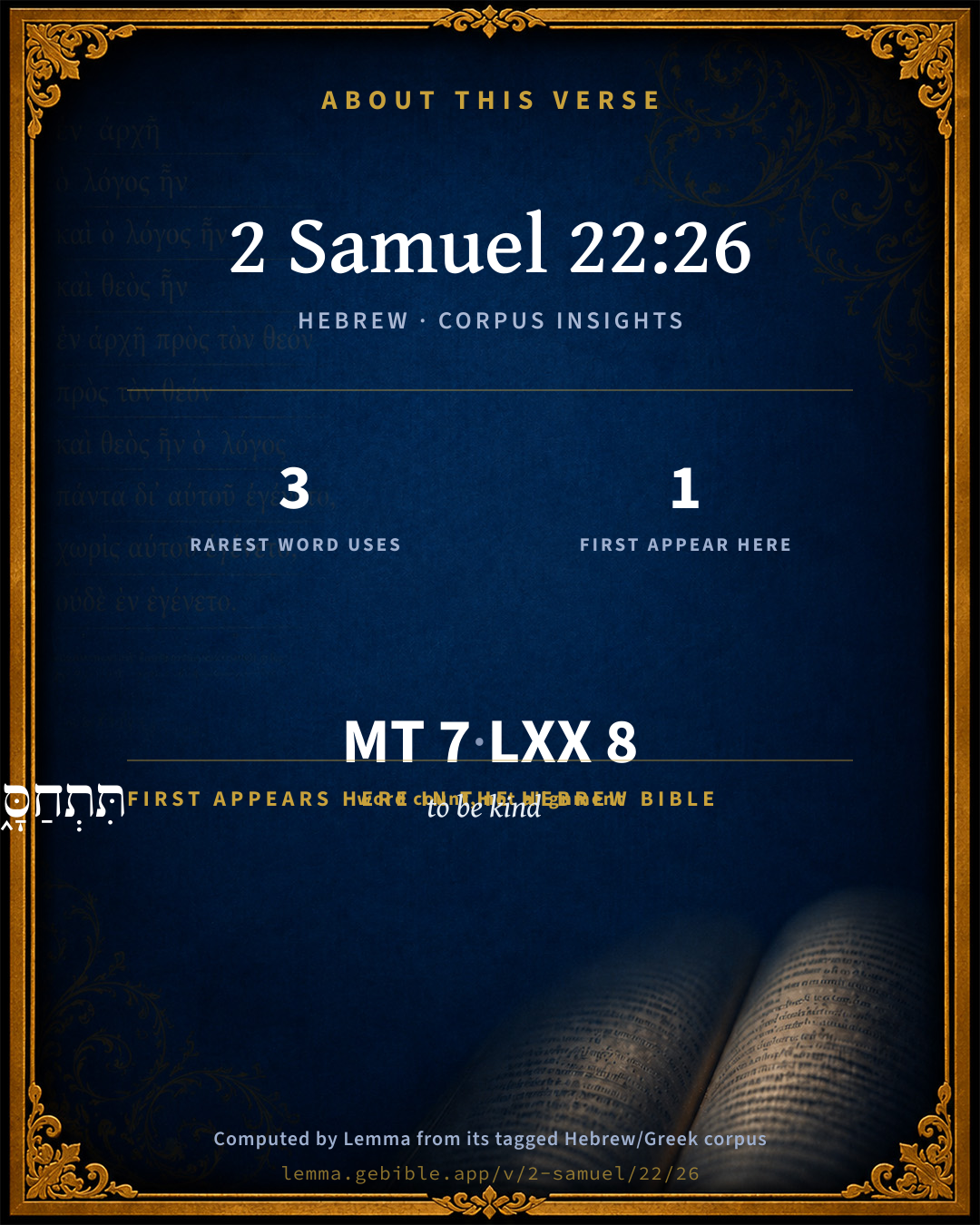
  • 1 first appearance in the Hebrew Bible
Full analysis ↓
Download a study sheet

One document with this verse’s original text, its word-by-word gloss line, the meaning frame, cross-references with their text, attributed commentary, and full source and license credits — printable, and it pastes into notes with its structure intact.

This verse Autodidact and up

Study sheet (.html) Plain text (.txt)

A passage Seminary Student

Up to 50 verses in one chapter. A passage sheet keeps up to 6 commentary sources and 12 cross-references per verse, in the order this page ranks them, and says so on the sheet whenever that leaves anything out. Ask for a single verse and you get the Autodidact verse sheet above.

Everything on this page stays free to read, with no account — the sheet is a download of what is already on screen, not access to it.

Want to remove ads? Support Godless Engineer
Compare translations 3

The same verse in 3 English versions, stacked beneath the original-language interlinear above. Click any original word for its lexicon entry.

Each is an independent rendering of the whole verse — the interlinear is not word-aligned to these translations.

Highlighted words mark where these versions differ — a whole-verse word diff, not a word-by-word alignment.

  • World English Bible Public Domain
    With the merciful you will show yourself merciful; With the perfect man you will show yourself perfect;
  • King James Version Public Domain
    With the merciful thou wilt show thyself merciful, and with the upright man thou wilt show thyself upright.
  • unfoldingWord Literal Text CC BY-SA 4.0
    With the faithful you show yourself faithful; with the mighty blameless, you show yourself blameless.

unfoldingWord Literal Text — © unfoldingWord, licensed CC BY-SA 4.0. Word-aligned USFM3 via Door43 (git.door43.org/unfoldingWord/en_ult).

Versions to compare (up to 4)

3 of 4 selected

Show all 18 translations

Every available English version of this verse, each an independent rendering of the whole verse.

  • World English Bible Public Domain
    With the merciful you will show yourself merciful; With the perfect man you will show yourself perfect;
  • Berean Standard Bible Public Domain
    To the faithful You show Yourself faithful, to the blameless You show Yourself blameless;
  • Majority Standard Bible Public Domain
    To the faithful You show Yourself faithful, to the blameless You show Yourself blameless;
  • King James Version Public Domain
    With the merciful thou wilt show thyself merciful, and with the upright man thou wilt show thyself upright.
  • American Standard Version (1901) Public Domain
    With the merciful thou wilt show thyself merciful; With the perfect man thou wilt show thyself perfect;
  • Revised Version (1885) Public Domain
    With the merciful thou wilt shew thyself merciful, with the perfect man thou wilt shew thyself perfect;
  • Geneva Bible (1599) Public Domain
    With the godly thou wilt shewe thy selfe godly: with the vpright man thou wilt shew thy selfe vpright.
  • Douay-Rheims (1899) Public Domain
    With the holy one thou wilt be holy: and with the valiant perfect.
  • Young's Literal Translation Public Domain
    With the kind Thou shewest Thyself kind, With the perfect man Thou shewest Thyself perfect,
  • Literal Standard Version CC BY-SA 4.0
    With the kind You show Yourself kind, || With the perfect man You show Yourself perfect,
  • Unlocked Literal Bible CC BY-SA 4.0
    To one who is faithful, you show yourself to be faithful; to a man who is blameless, you show yourself to be blameless.
  • unfoldingWord Literal Text CC BY-SA 4.0
    With the faithful you show yourself faithful; with the mighty blameless, you show yourself blameless.
  • Darby Bible Public Domain
    With the gracious thou dost shew thyself gracious; With the upright man thou dost shew thyself upright;
  • World Messianic Bible Public Domain
    With the merciful you will show yourself merciful. With the perfect man you will show yourself perfect.
  • Webster's Bible Public Domain
    With the merciful thou wilt show thyself merciful, and with the upright man thou wilt show thyself upright.
  • Free Bible Version CC BY-SA 4.0
    You show trust to those who are trusting; you show integrity to those with integrity,
  • Bible in Basic English Public Domain
    On him who has mercy you will have mercy; to the upright you will be upright;
  • JPS Tanakh (1917) Public Domain
    With the merciful Thou dost show Thyself merciful, with the upright man Thou dost show Thyself upright,

Literal Standard Version (2020), Covenant Press — licensed CC BY-SA 4.0. Text via the HelloAO Bible API (eBible.org). Unlocked Literal Bible (unfoldingWord) — licensed CC BY-SA 4.0. Text via the HelloAO Bible API (eBible.org). unfoldingWord Literal Text — © unfoldingWord, licensed CC BY-SA 4.0. Word-aligned USFM3 via Door43 (git.door43.org/unfoldingWord/en_ult). Free Bible Version, Dr. Jonathan Gallagher — licensed CC BY-SA 4.0. Text via the HelloAO Bible API (eBible.org).

Word by word

More ways to search: Search by grammar → Find every occurrence → Compare this word →

Practice this passage: Drill this verse → Learn its vocabulary →

About this verse

These counts appear in no published source. They are computed here, from the morphology-tagged text and Lemma’s own curated glosses. What Lemma adds →

7
words
6
distinct lemmas
Historical
section

Notable vocabulary

The rarest word here is תִּתְחַסָּ֑ד to be kind H2616 — appearing just 3 times in the whole Hebrew Bible.

First appearance in Scripture

This word makes its first canonical appearance in the Hebrew Bible here:

  • תִּתְחַסָּ֑ד to be kind H2616

Shared distinctive vocabulary

תִּתְחַסָּ֑ד to be kind H2616 occurs in 3 verses of the Hebrew Bible. Also found in:

Grammatical profile

  • 2 verbs
  • 3 adjectives
  • 2 prepositions

Verb forms

  • תִּתְחַסָּ֑ד Hithpael · Imperfect
  • תִּתַּמָּֽם Hithpael · Imperfect

Repetition

A word recurs within this verse — often emphatic in Hebrew:

Hebrew & Septuagint length

In English translation the verse runs 17 words from the Hebrew and 16 from the Septuagint (LXX English) — closely comparable.

A rough comparison of the two English renderings, which tokenize alike — not a word-level alignment.

Word counts can differ between the Hebrew and the Greek without any difference in meaning — e.g. the Hebrew direct-object marker אֵת has no separate Greek word, and Greek often adds the article ὁ.

In the original languages it is 7 Hebrew tokens and 8 Greek tokens — but the two are counted differently (Hebrew bundles its prefixes and suffixes into one token; the Greek is in lemma form), so that isn’t a like-for-like length.

Cross-references

2

Topical passages linked to 2 Samuel 22:26 in the Treasury of Scripture Knowledge — connected by theme and wording, ordered by reader-vote popularity; previews shown in the World English Bible.

  • Matthew 5:7 Blessed are the merciful, For they shall obtain mercy.
  • James 2:13 For judgment is without mercy to him who has shown no mercy. Mercy triumphs over judgment.

Cross-references courtesy of OpenBible.info (CC BY 4.0).

Hebrew and Greek witnesses Masoretic Hebrew ↔ Greek Septuagint

The same verse in the two great witnesses to the Old Testament, shown verse-for-verse.

These are two independent witnesses, not word-aligned to each other, and the Septuagint is shown in lemma (dictionary) form.

Hebrew 2 Samuel 22:26 Masoretic · Westminster Leningrad Codex

עִם חָסִ֖יד תִּתְחַסָּ֑ד עִם גִּבּ֥וֹר תָּמִ֖ים תִּתַּמָּֽם

With the merciful you will show yourself merciful; With the perfect man you will show yourself perfect;

World English Bible · Public Domain

Greek LXX 2 Samuel 22:26 Septuagint · lemma form

μετά ὅσιος ὁσιόω καί μετά ἀνήρ τέλειος τελειόω

With the holy you will be holy, and with the perfect man you will be perfect,

LXX2012 (modern English Septuagint) · Public Domain

Hebrew: Westminster Leningrad Codex (CC BY 4.0). Greek: Septuagint (public domain); English from LXX2012 (modern English Septuagint) (Public Domain). How the Septuagint differs from the Hebrew →

Targum (Aramaic paraphrase)

1

The Targum is the ancient Jewish Aramaic paraphrase of the Hebrew Scriptures — an interpretive translation, not the Hebrew text itself. Onkelos (literal) and Pseudo-Jonathan (expansive) render the Torah, and Jonathan the Prophets. Coverage is partial: where no permissively-licensed English translation exists for a verse, only the Aramaic is shown. This is verse-level text, not a word-by-word alignment to the Hebrew.

  1. Targum Jonathan Prophets (Joshua–Malachi)
    עִם אַבְרָהָם דְאִשְׁתְּכַח חֲסִיד קֳדָמָךְ בְּכֵן אֲסְגֵיתָא לְמֶעֱבַּד חִסְדָא עִם זַרְעֵיהּ יִצְחָק דַהֲוָה שְׁלִים בִּדְחַלְתָּךְ בְּכֵן אַשְׁלֵמְתָּא מֵימַר רְעוּתָךְ לְמֶעְבַּד עִמֵיהּ:

    (no public-domain English translation for this verse)

    Targum Jonathan — Aramaic: “Mikraot Gedolot” (public domain). English: “Sefaria Community Translation” (CC0 1.0 (public-domain dedication)); “London "Chaldee Paraphrase," 1871” (public domain). Text via Sefaria.

Commentary

Notes on 2 Samuel 22:26 from classic Christian and Jewish commentators (each source and its license shown beneath its notes). The classic Christian expositions comment on the surrounding passage and are grouped to its opening verse, so a note may address several verses; the Jewish commentaries on the Tanakh (Rashi and others) are per-verse, so they appear only where the commentator wrote on this verse.

Lemma curates 59 commentaries, every one of them public domain or Creative Commons licensed, each selected and text-cleaned for this edition rather than reprinted as found. About our sources →

The Biblical Illustrator

Joseph S. Exell

2Sa_22:26-27

With the merciful thou wilt show thyself merciful.

God does not forgive the unforgiving

You say that the desert is a desert, because no rain falls upon it; but this is only half the truth. No rain falls upon it because it is a desert. The heated air rushing up from its arid surface disperses the vapours that would descend in rain. Some moisture there must be on the earth, else there cannot be rain from heaven. So in your heart this forgiving disposition must be, else you cannot rejoice in the fulness of Gods forgiving grace. The pardon may wait in the sky for you, but it cannot descend to you until that spirit is in you which was also in Christ Jesus.

The Biblical Illustrator, edited by Joseph S. Exell (c. 1880s–1900s) — public domain. Text from a community e-Sword module.

Whedon's Commentary on the Bible

Daniel D. Whedon

26. With the kind thou… kind — The statements of 2Sa_22:26-28 are an expansion of the proposition of 2Sa_22:25, that God rewards men according to their righteousness.

Daniel D. Whedon (gen. ed.), Commentary on the Old and New Testaments (1874–1909) — public domain. Text from a community e-Sword module.

The Cambridge Bible for Schools and Colleges

gen. ed. J. J. S. Perowne

26. the merciful] Or pious: the word includes love to God as well as to man. See note on 1Sa_2:9, and cp. Mat_5:7.

the upright man] Lit. the upright hero: the man who is valiant in maintaining his integrity.

26–28. The law of God’s dealings with men

The truth here enunciated is that God’s attitude towards men is regulated by men’s attitude towards God (cp. 1Sa_2:30; 1Sa_15:23); not (though this is also true) that men’s conceptions of God are the reflection of their own characters.

The Cambridge Bible for Schools and Colleges (gen. ed. J. J. S. Perowne; Cambridge University Press, 1878–1918) — public domain. Text from a community e-Sword module.

John Gill's Exposition

And that bringeth me forth from mine enemies: thou also hast lifted me up on high above them that rose up against me: thou hast delivered me from the violent man. See Gill on Psa 18:48.

.

2 Samuel 22:50

sa2 22:50

sa2 22:50

sa2 22:50Therefore I will give thanks unto thee, O Lord, among the heathen, and I will sing praises unto thy name. See Gill on Psa 18:49.

John Gill's Exposition of the Whole Bible (1746–1763) — public domain (CC PDM 1.0). Text via the HelloAO Bible API.

Haydock's Catholic Bible Commentary

Holy; treating all according to their deserts. (Haydock)

George Leo Haydock (1774–1849), Haydock's Catholic Family Bible and Commentary, 1859 edition — public domain. Excludes Psalms (Douay-Rheims chapter numbering differs from Protestant) and Deuterocanonical books (Catholic canon only).

The Pulpit Commentary

Vers. 26-28.

With the pious man thou wilt show thyself pious; With the perfect man thou wilt show thyself perfect; With the pure thou wilt show thyself pure; And with the crooked thou wilt show thyself perverse. And the afflicted people thou wilt save; And thine eyes are upon the haughty, to bring them down.

Having affirmed his integrity, and that God therefore had pleasure in him and rewarded him, David now asserts that this is the unfailing rule of God"s dealings with men. The general current of their lives is so ordered as to be in harmony with their characters. It is not by luck or good fortune that prosperity attends the righteous, nor is it by chance that things go awry with the fraudulent, but it is by the law of God"s providence. Pious. The Hebrew word means "pious" in the original sense of the word, which includes kindness to men as well as love to God. Perverse. In the Authorized Version "unsavoury." Really it is the same word as that used in Psa_18:26, and signifies "thou wilt make thyself twisted," only the form is archaic, as is the case with some other words here. Experience confirms the psalmist"s verdict. For constantly a strange perversity of fortune and an untowardness of events are the lot of those whose hearts are crooked. Afflicted. The word in the original includes the idea of humility, and so leads naturally on to the thought of the abasement of the proud. In the psalm the somewhat harsh expression used here has been softened into the more easy phrase, "The haughty eyes thou wilt bring down.

Vers. 26-28. (Psa_18:25-27)

Divine rectitude.

Consider the righteousness of God as it appears in:

1. The supreme importance which he attaches to moral distinctions amongst men. Such distinctions are often made light of in comparison with wisdom, might, and riches; (Jer_9:23) and those who possess the latter despise and trample upon the ignorant, the weak, and the poor (ver. 27). But God has chiefly respect to men in their moral attitude toward himself, their relation to the law of right, their personal character. (1Sa_2:30) With him the great distinction is that between the righteous and the wicked. (Psa_34:15, Psa_34:16) Whilst his infinite greatness dwarfs earthly power and honour into insignificance, his perfect righteousness exalts moral worth beyond measure.

2. The different treatment which he adopts toward men of different character. In himself he is always the same; (1Sa_15:29) but the aspect which his character and dealings assume toward them is determined by their own character and conduct, and is the necessary manifestation of his unchangeable rectitude on the one hand, toward the "loving," etc., full of love (all that is kind, desirable, and excellent); on the other, toward the "perverse," perverse (contrary, antagonistic, "as an enemy," (Lam_2:5; Lev_26:23, Lev_26:24; Hos_2:6) inflicting severe chastisement. "There is a higher law of grace, whereby the sinfulness of man but draws forth the tenderness of a father"s pardoning pity; and the brightest revelation of his love is made to froward prodigals. But this is not the psalmist"s view here, nor does it interfere with the law of retribution in its own sphere" (Maclaren).

3. The signal change which he makes in their relative positions; saving and exalting the oppressed and afflicted, and humbling the proud oppressor; his purpose therein being to vindicate, honour, and promote righteousness, and to restrain, correct, and put an end to iniquity. (1Sa_2:8, 1Sa_2:10) "What is God doing now?" it was asked of Rabbi Jose, and the reply was, "He makes ladders on which he causes the poor to ascend and the rich to descend" (The Midrash). D.

Vers. 26, 27.

Correspondence between the character of men and the conduct of God towards them.

The psalmist, having spoken of God"s treatment of himself according to his righteousness, now shows that his case was no exception to the general rule of the Divine proceedings, but an illustration of it; that, universally, God renders to men according to their character and works.

I THE MERCIFUL EXPERIENCE HIS MERCY. Our Lord declares the same truth, when he says, "Blessed are the merciful: for they shall obtain mercy"; (Mat_5:7) and when he declares, "If ye forgive men their trespasses, your heavenly Father will also forgive you"; (Mat_6:14) and teaches us to pray, "Forgive us our debts, as we also have forgiven our debtors". (Mat_6:12, Revised Version) But how does this consist with the doctrine of justification by faith? It must be in harmony with it, since both are Divine. If it do not accord with some human statements of the doctrine, it must be because these are erroneous or defective. Faith is not a mere assent to the truth, or reliance on the atonement of Christ and the mercy of God in him; but it involves acceptance of Christ as Teacher and Lord as well as Redeemer, and therefore a willing obedience to his instructions, of which part is that we should be forgiving, and that only those who are shall be forgiven only the merciful shall find mercy. Moreover, faith in the love of God in Christ works love in the heart; a faith which does not is of no avail. From another point of view, "repentance toward God" is as essential to salvation as "faith toward our Lord Jesus Christ", (Act_20:21) and will be produced by it. It is vain, therefore, for the unmerciful to trust in the mercy of God, or to cry to him for mercy; his mercy is shown only to the merciful. But to them it is shown; and that not only in the forgiveness of their sins, but in the bestowment of all needful blessings. They also should bear in mind that their enjoyment of the love of God will be in proportion to the love which they cherish and display; and that every degree of selfishness will deprive them of some blessing.

II THE UPRIGHT EXPERIENCE GOD"S UPRIGHTNESS. He is essentially upright, just, faithful; but the happy experience of his uprightness is for those who "walk uprightly" (Psa_84:11) those who are sincere and true hearted towards God and men. To these he will show himself upright by manifesting to them his favour, and fulfilling to them all his promises; (comp. Psa_92:12-15) while to others he will show the same quality by the execution of his threatenings.

III THE PURE EXPERIENCE HIS PURITY. "Blessed are the pure in heart: for they shall see God". (Mat_5:8)

1. Genuine Christians are holy. Truly so, though not perfectly. They have been cleansed by the Word and Spirit of God, and "the blood of Jesus Christ his Son". (1Jn_1:7) They have turned from sin, and it is their abhorrence. They watch and pray against it; and, when they fall into it, mourn with sincere grief. They cherish purity of heart, lip, and life. They desire and strive after perfect holiness.

2. To such God shows himself holy.

(1) He reveals to them his holiness. They are capable of such a revelation, because of their purity of heart. Sin blinds the soul, incapacitating it from discerning and appreciating the holy.

(2) He acts towards them holily. He requires holiness of them, and works it in them. All his dealings with them are in accordance with holiness, and have for their end to promote their sanctification. Hence he does not indulge his children, but, when necessary, afflicts them, that they may become more and more "partakers of his holiness". (Heb_12:10) He will not be satisfied until they perfectly reflect his image, and he can "present them holy and unblameable and unreproveable in his sight". (Col_1:22)

IV THE FROWARD FIND HIM FROWARD.

1. Sinners are froward. They are perverse, unreasonable, ungovernable, impracticable. They show this in their feeling and conduct towards God, his Word and ways. They will not submit to his instructions or obey his commands. They "walk contrary unto" him, (Lev_26:21) do the opposite to that which he enjoins.

2. To them God shows himself froward. It is a bold expression, and therefore, perhaps, the translators of this book softened it into "unsavonry," or distasteful. But the same word is rightly translated in Psa_18:26, "froward." The meaning is clear. God acts as if perverse towards the perverse. As they will not pay regard to his will, he will not to their desires and prayers. As they oppose him, he opposes them, thwarts their purposes, disappoints their hopes. As they "walk contrary unto" him, he "will also walk contrary unto" them. (Lev_26:24) It is a universal truth, discernible:

(1) In nature. If we would have nature work good to us, we must learn and obey its laws. If we will not, they will work us harm.

(2) In the affairs of life in business and association with men. If we will not ascertain and live according to the laws which should regulate our conduct, they will avenge themselves, inflicting pain, loss, perhaps utter ruin.

(3) In respect to religion and salvation. These originate in the benevolent will of God; and if we would experience their benefits, we must have humble and obedient regard to that will. We must ask of him, "What must I do to be saved?" and "What wilt thou have me to do?" If we choose to reject the Divine revelations and requirements, and in pride and perversity take a course opposed to them, the Almighty will not alter his plans to please us, but will bring upon us the just consequences of our frowardness. He will appear froward to the froward, in that, when they call upon him, he will not answer; when they seek him early, they shall not find him. (see Pro_1:24-29) It is vain and foolish for man to assert his own proud, capricious will; he will find that there is another and stronger will, that will assert itself to his discomfiture and destruction, unless he repent. G.W.

The Pulpit Commentary (1880–1919), ed. H.D.M. Spence-Jones & Joseph S. Exell — public domain. Text from a community e-Sword module.

unfoldingWord translationNotes

Door43 World Missions Community

General Information:

David continues his song to Yahweh.

you are perverse to the twisted

Here "perverse" means to be cunning or crafty, and "twisted" means to turn away from what is good and right. This means God is wise in how he deals with wicked people.

translationWords

faithful

blameless

pure

unfoldingWord translationNotes — © Distant Shores Media and the Door43 World Missions Community, licensed CC BY-SA 4.0. Source: git.door43.org/Door43/en_tn.

Rashi

Rabbi Shlomo Yitzchaki (Rashi)

To the Kind, Sincere, Pure. [These three nouns] represent the three Patriarchs. God paid the reward of their righteousness to their children.

Rashi on the Tanakh — English translations: “The Judaica Press complete Tanach with Rashi, translated by A. J. Rosenberg” (CC BY 4.0); “Pentateuch with Rashi's commentary by M. Rosenbaum and A.M. Silbermann, 1929-1934” (public domain); “The Metsudah Tanach series, Lakewood, N.J” (CC BY 4.0); and “The Book of Joshua, Metsudah Publications, 1997” (CC BY 4.0). Text via Sefaria.

Lesson kit

Teaching starters — assembled from the data on this page, not authored interpretation. Every prompt links to the verse data it draws on. Edit before teaching.

2 Samuel, in the Historical, opens this verse with 7 words (6 distinct Hebrew lemmas). Its most distinctive word is châçad (“to be kind”). A historical commentator’s framing appears above. Read the whole chapter for the surrounding context.

Discussion questions

  1. The word châçad carries the sense “to be kind.” How does it shape the verse?
  2. This is the first place “to be kind” appears in Scripture (first appears here). What does its debut here establish?
  3. How does Psalms 18:25, which shares the word «to be kind», read alongside this verse?
  4. What does the repetition of “with” (2× in this one verse) do in this verse?
  5. The translations on this page render this verse differently — a whole-verse word diff, not a word-by-word alignment. What might account for the different wordings?
  6. «תִּתְחַסָּ֑ד» is a Hithpael Imperfect verb. How does that grammatical form shape the action described?
  7. Compare how The Biblical Illustrator and Whedon's Commentary on the Bible read this verse. Where do they agree or differ?

Things to notice

Reading settings

Reading text

Shown beneath each verse's original-language words.

Old Testament
Old Testament edition

Read the OT as the Masoretic Hebrew (MT) or the Greek Septuagint (LXX).

English shown for the Greek Septuagint (in the Hebrew ↔ Greek comparison).

Comparing translations? Open the Compare panel on any verse page to stack up to four side by side.