
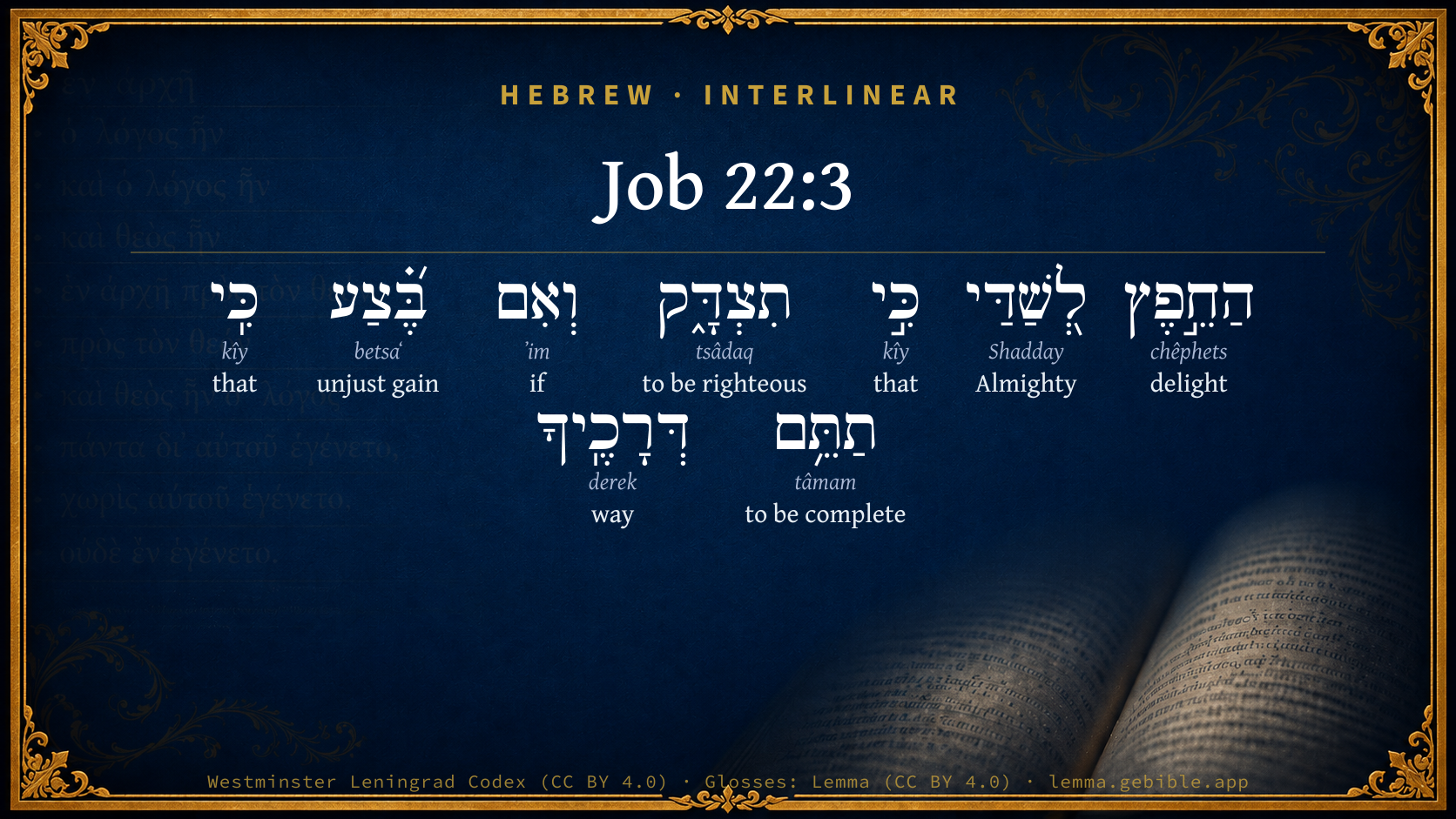
Job 22:3

Hebrew (Westminster Leningrad Codex) Job 22:3 appears in the Hebrew Old Testament. The text above is from the Westminster Leningrad Codex. Each word links to its Strong’s number, a concise gloss, and parsing drawn from the Open Scriptures Hebrew Bible morphology. Click any word for its full Brown-Driver-Briggs (BDB) entry.
Download image
Cite this verse

Job 22:3 (World English Bible). Public Domain. Lemma interlinear Bible study tool, https://lemma.gebible.app/v/job/22/3.

Show BibTeX & RIS
BibTeX
RIS
English Translation
Is it any pleasure to the Almighty, that you are righteous? Or does it benefit him, that you make your ways perfect?
World English Bible · Public Domain
Download a study sheet

One document with this verse’s original text, its word-by-word gloss line, the meaning frame, cross-references with their text, attributed commentary, and full source and license credits — printable, and it pastes into notes with its structure intact.

This verse Autodidact and up

Study sheet (.html) Plain text (.txt)

A passage Seminary Student

Up to 50 verses in one chapter. A passage sheet keeps up to 6 commentary sources and 12 cross-references per verse, in the order this page ranks them, and says so on the sheet whenever that leaves anything out. Ask for a single verse and you get the Autodidact verse sheet above.

Everything on this page stays free to read, with no account — the sheet is a download of what is already on screen, not access to it.

Want to remove ads? Support Godless Engineer
Compare translations 3

The same verse in 3 English versions, stacked beneath the original-language interlinear above. Click any original word for its lexicon entry.

Each is an independent rendering of the whole verse — the interlinear is not word-aligned to these translations.

Highlighted words mark where these versions differ — a whole-verse word diff, not a word-by-word alignment.

  • World English Bible Public Domain
    Is it any pleasure to the Almighty, that you are righteous? Or does it benefit him, that you make your ways perfect?
  • King James Version Public Domain
    Is it any pleasure to the Almighty, that thou art righteous? or is it gain to him, that thou makest thy ways perfect?
  • unfoldingWord Literal Text CC BY-SA 4.0
    pleasure to the Almighty that you are righteous? Or if gain that you perfect your ways?

unfoldingWord Literal Text — © unfoldingWord, licensed CC BY-SA 4.0. Word-aligned USFM3 via Door43 (git.door43.org/unfoldingWord/en_ult).

Versions to compare (up to 4)

3 of 4 selected

Show all 18 translations

Every available English version of this verse, each an independent rendering of the whole verse.

  • World English Bible Public Domain
    Is it any pleasure to the Almighty, that you are righteous? Or does it benefit him, that you make your ways perfect?
  • Berean Standard Bible Public Domain
    Does it delight the Almighty that you are righteous? Does He profit if your ways are blameless?
  • Majority Standard Bible Public Domain
    Does it delight the Almighty that you are righteous? Does He profit if your ways are blameless?
  • King James Version Public Domain
    Is it any pleasure to the Almighty, that thou art righteous? or is it gain to him, that thou makest thy ways perfect?
  • American Standard Version (1901) Public Domain
    Is it any pleasure to the Almighty, that thou art righteous? Or is it gain `to him', that thou makest thy ways perfect?
  • Revised Version (1885) Public Domain
    Is it any pleasure to the Almighty, that thou art righteous? or is it gain to him, that thou makest thy ways perfect?
  • Geneva Bible (1599) Public Domain
    Is it any thing vnto the Almightie, that thou art righteous? or is it profitable to him, that thou makest thy wayes vpright?
  • Douay-Rheims (1899) Public Domain
    What doth it profit God if thou be just? or what dost thou give him if thy way be unspotted?
  • Young's Literal Translation Public Domain
    Is it a delight to the Mighty One That thou art righteous? is it gain, That thou makest perfect thy ways?
  • Literal Standard Version CC BY-SA 4.0
    Is it a delight to the Mighty One || That you are righteous? Is it gain, || That you make your ways perfect?
  • Unlocked Literal Bible CC BY-SA 4.0
    Is it any pleasure to the Almighty if you are righteous? Is it gain to him if you make your ways blameless?
  • unfoldingWord Literal Text CC BY-SA 4.0
    pleasure to the Almighty that you are righteous? Or if gain that you perfect your ways?
  • Darby Bible Public Domain
    Is it any pleasure to the Almighty if thou art righteous? And is it gain [to him] that thou makest thy ways perfect?
  • World Messianic Bible Public Domain
    Is it any pleasure to the Almighty that you are righteous? Or does it benefit him that you make your ways perfect?
  • Webster's Bible Public Domain
    Is it any pleasure to the Almighty, that thou art righteous? or is it gain to him, that thou makest thy ways perfect?
  • Free Bible Version CC BY-SA 4.0
    Is it any benefit to the Almighty if you're a good person? What does he gain if you do what's right?
  • Bible in Basic English Public Domain
    Is it of any interest to the Ruler of all that you are upright? or is it of use to him that your ways are without sin?
  • JPS Tanakh (1917) Public Domain
    Is it any advantage to the Almighty, that thou art righteous? Or is it gain to Him, that thou makest thy ways blameless?

Literal Standard Version (2020), Covenant Press — licensed CC BY-SA 4.0. Text via the HelloAO Bible API (eBible.org). Unlocked Literal Bible (unfoldingWord) — licensed CC BY-SA 4.0. Text via the HelloAO Bible API (eBible.org). unfoldingWord Literal Text — © unfoldingWord, licensed CC BY-SA 4.0. Word-aligned USFM3 via Door43 (git.door43.org/unfoldingWord/en_ult). Free Bible Version, Dr. Jonathan Gallagher — licensed CC BY-SA 4.0. Text via the HelloAO Bible API (eBible.org).

Word by word

More ways to search: Search by grammar → Find every occurrence → Compare this word →

Practice this passage: Drill this verse → Learn its vocabulary →

About this verse

These counts appear in no published source. They are computed here, from the morphology-tagged text and Lemma’s own curated glosses. What Lemma adds →

9
words
8
distinct lemmas
Wisdom
section

Notable vocabulary

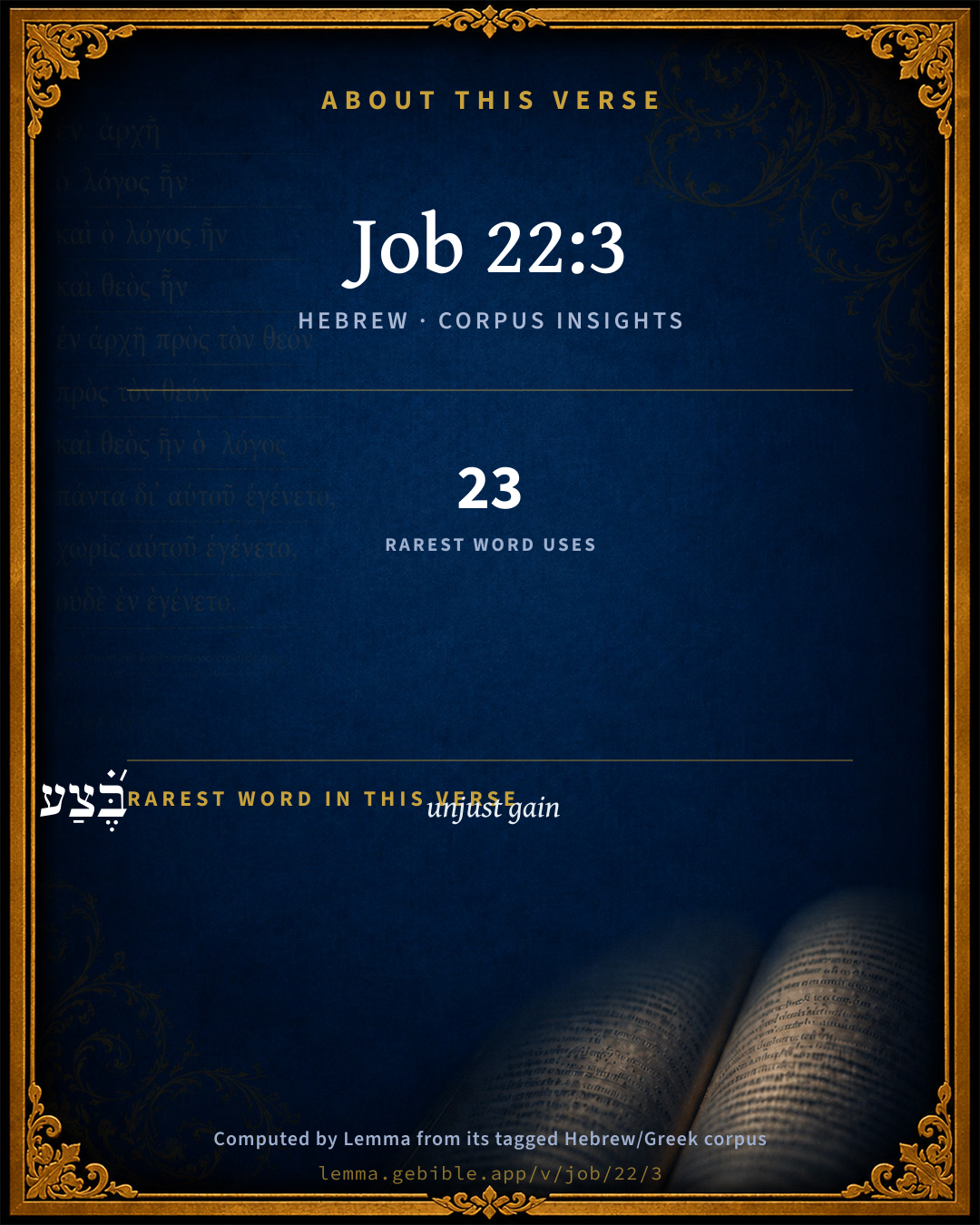
The rarest word here is בֶּ֝֗צַע unjust gain H1215 — appearing just 23 times in the whole Hebrew Bible.

Shared distinctive vocabulary

בֶּ֝֗צַע unjust gain H1215 occurs in 23 verses of the Hebrew Bible. Also found in:

Grammatical profile

  • 2 verbs
  • 4 nouns
  • 3 conjunctions

Verb forms

  • תִצְדָּ֑ק Qal · Imperfect
  • תַתֵּ֥ם Hiphil · Imperfect

Repetition

A word recurs within this verse — often emphatic in Hebrew:

  • כִּ֣י that H3588 ×2

Hebrew & Septuagint length

In English translation the verse runs 22 words from the Hebrew and 24 from the Septuagint (LXX English) — closely comparable.

A rough comparison of the two English renderings, which tokenize alike — not a word-level alignment.

Word counts can differ between the Hebrew and the Greek without any difference in meaning — e.g. the Hebrew direct-object marker אֵת has no separate Greek word, and Greek often adds the article ὁ.

Cross-references

14

Topical passages linked to Job 22:3 in the Treasury of Scripture Knowledge — connected by theme and wording, ordered by reader-vote popularity; previews shown in the World English Bible.

  • Proverbs 15:8 The sacrifice made by the wicked is an abomination to Yahweh, But the prayer of the upright is his delight.
  • 2 Corinthians 7:1 Having therefore these promises, beloved, let us cleanse ourselves from all defilement of flesh and spirit, perfecting holiness in the fear of God.
  • Psalms 147:10–11 He doesn't delight in the strength of the horse. He takes no pleasure in the legs of a man.
  • Proverbs 11:1 A false balance is an abomination to Yahweh, But accurate weights are his delight.
  • Proverbs 12:22 Lying lips are an abomination to Yahweh, But those who do the truth are his delight.
  • 1 Chronicles 29:17 I know also, my God, that you try the heart, and have pleasure in uprightness. As for me, in the uprightness of my heart I have willingly offered all these things: and now have I seen with joy your people, that are present here, offer willingly to you.
  • Job 23:10–12 But he knows the way that I take. When he has tried me, I shall come forth like gold.
  • Psalms 39:1 I said, "I will watch my ways, so that I don't sin with my tongue. I will keep my mouth with a bridle while the wicked is before me."
  • Psalms 119:3–6 Yes, they do nothing wrong. They walk in his ways.
  • Psalms 119:59 I considered my ways, And turned my steps to your statutes.
  • Proverbs 11:20 Those who are perverse in heart are an abomination to Yahweh, But those whose ways are blameless are his delight.
  • Malachi 2:17 You have wearied Yahweh with your words. Yet you say, 'How have we wearied him?' In that you say, 'Everyone who does evil is good in the sight of Yahweh, and he delights in them;' or 'Where is the God of justice?'
  • Acts 24:16 Herein I also practice always having a conscience void of offense toward God and men.
  • Philippians 4:18 But I have all things, and abound. I am filled, having received from Epaphroditus the things that came from you, a sweet-smelling fragrance, an acceptable and well-pleasing sacrifice to God.

Cross-references courtesy of OpenBible.info (CC BY 4.0).

Hebrew and Greek witnesses Masoretic Hebrew ↔ Greek Septuagint

The same verse in the two great witnesses to the Old Testament, shown verse-for-verse.

These are two independent witnesses, not word-aligned to each other, and the Septuagint is shown in lemma (dictionary) form.

Hebrew Job 22:3 Masoretic · Westminster Leningrad Codex

הַחֵ֣פֶץ לְ֭שַׁדַּי כִּ֣י תִצְדָּ֑ק וְאִם בֶּ֝֗צַע כִּֽי תַתֵּ֥ם דְּרָכֶֽיךָ

Is it any pleasure to the Almighty, that you are righteous? Or does it benefit him, that you make your ways perfect?

World English Bible · Public Domain

Greek LXX Job 22:3 Septuagint · lemma form

τίς γάρ μέλω ὁ κύριος ἐάν σύ εἰμί ὁ ἔργον ἄμεμπτος ἤ ὠφέλεια ὅτι ἁπλόω ὁ ὁδός σύ

For what matters it to the Lord, if you were blameless in your works? or is it profitable that you should perfect your way?

LXX2012 (modern English Septuagint) · Public Domain

Hebrew: Westminster Leningrad Codex (CC BY 4.0). Greek: Septuagint (public domain); English from LXX2012 (modern English Septuagint) (Public Domain). How the Septuagint differs from the Hebrew →

Commentary

Notes on Job 22:3 from classic Christian and Jewish commentators (each source and its license shown beneath its notes). The classic Christian expositions comment on the surrounding passage and are grouped to its opening verse, so a note may address several verses; the Jewish commentaries on the Tanakh (Rashi and others) are per-verse, so they appear only where the commentator wrote on this verse.

Lemma curates 59 commentaries, every one of them public domain or Creative Commons licensed, each selected and text-cleaned for this edition rather than reprinted as found. About our sources →

Trapp's Complete Commentary

John Trapp

Job 22:3 [Is it] any pleasure to the Almighty, that thou art righteous? or [is it] gain [to him], that thou makest thy ways perfect?

Ver. 3. Is it any pleasure to the Almighty, that thou art righteous?] Num volupe est Omnipotenti? &c. Is anything added to his joy? Or needeth he thy manners and virtues to the making up of his perfection? Nothing less, surely. True it is, that he soliciteth suitors, Joh 4:23, and is well pleased with our performances, Psa 51:6. But it is for our sakes, and to our benefit, and not his own. Like as the sun, when he casteth abroad his beams in the world, seemeth to receive light from some other creatures, whereas in truth they all receive light from him, and not he from them; so it is here: and as the same sun draws up vapours from the earth, not for itself, but to render them again to the earth, to moisten and fatten it; so God, the true Sun of our souls, draweth from us our sighs and services, not for his own profit, but to rain them down again upon us in so many blessings.

John Trapp, A Commentary or Exposition upon All the Books of the Old and New Testament (1647–1656) — public domain. Text from a community e-Sword module.

The Biblical Illustrator

Joseph S. Exell

Job_22:3

Is it any pleasure to the Almighty that thou art righteous?

Gods pleasure in mans righteousness

To this Eliphaz we cannot take kindly. There is so much in him that reminds us of the Pharisee of our Lords day. With all his conscientiousness--and it is remarkable what sins against God and our brother are committed under the garb of conscientiousness--he seems to be one of those who speak wickedly for God. Looking at the argument of the Temanite in this chapter, it is, at best, a piece of sophistry. The words of the text seem humble words, so calculated to move us in the direction of self-repression; but we are not required to build humility upon a lie.

1. This verse is but an expansion of the thought contained in the previous verse, which reads thus, Can a man be profitable unto God, as he that is wise may be profitable unto himself? The force of this comparison tends to disarm criticism, for the least taught among Christian people can never think they are doing God the service they are rendering themselves. In those cases in which men think they are in some way doing God a splendid service, their presumption is its own condemnation. But such a thought does not enter Christian believing minds. What are they to say to the challenge of the next verse? Is there not something true within us that rises up against its merciless and terrible conclusion? A man may be far from as profitable to God as unto himself. He must feel that all the weight of obligation is on his side, since God alone is the source of all his goodness and power; and yet he may, I think he must, if he have a spark of the Divine life and light in him, resist so fearful and disheartening a conclusion as that God has no pleasure in his rectitude, and that he is all loss and no gain to God.

(1) Such a conclusion is most disheartening to endeavours after goodness. Practically carried into the inner life of men, it would be fatal to that goodness. There can be little faith in a goodness that is not nurtured by love and fed by willing cheerfulness. The difference between a Divine compulsion and the sort of thing called compulsion among men, is that the former is made up of affection, the other of necessity. A Divine compulsion, beginning with love, creates an obedience which becomes more and more congenial and native to the soul of the subject of it. We all need educating in virtue and goodness. Human nature has to be raised and sanctified by the energy of Divine grace. The righteous man is the creation of that Divine grace which comes to the aid of the struggling one in his contest with dark, evil forces. And the more successful will he be in that contest, the more clearly he discerns what that Divine force is which is helping him. Most discouraging is it to all endeavours after a better life that we should doubt the pleasure of the Eternal in those endeavours. If we do so, we misjudge our relation to the Infinite. It will be as new life to us when we learn to believe in the words of Jesus about the Father. Against the unfaith of men in this Divine Fatherhood, we have constantly to contend.

(2) Such a conclusion is also dishonouring to God. It is against the entire scope and tone of Divine revealings from age to age, up to the day when John, the latest seer of the New Testament, spoke of the God of love. It dishonours Him, because it takes away from Him some of those finer instincts which all men worthy of the name have. We take pleasure in endeavours to please us--else we are scarcely human. We allow for infirmity and frailty; and it were indeed a hard and cruel faith about God to deny Him such instincts. And surely God must be pleased with that work into which He throws most of His own pure soul and Spirit. The more of the Divine self in anyone, the truer and more complete the Divine satisfaction.

2. Consider what of truth we can find in these words.

(1) It would be vastly mischievous were we to come to look upon that righteousness as our own, and so try to sever the stream from the fount. It is ours only because it is Gods gift. All our righteousness is of God.

(2) There may be a high-mindedness in Christian service which finds needed correction in the thought that God is not so much served by us as we are served by Him.

3. We need to feel that all the weight of obligations is on our side. When we think of the Divine pleasure and gain, we cannot but think how beneficent that pleasure is. We cannot serve God without a recompense. Yet there are many who shrink from God, as though He were the receiver, instead of the Giver, of all good. They start back from duty as though it would be fatal to their joy. Nothing He commands but for your good. Nothing He orders but for your eternal delight. (G. J. Proctor.)

The Biblical Illustrator, edited by Joseph S. Exell (c. 1880s–1900s) — public domain. Text from a community e-Sword module.

Joseph Benson's Commentary

Job 22:3. Is it any pleasure to the Almighty that thou art righteous? — That is, any such pleasure as he needs in order to his happiness? Heath renders it, any advantage. God, we know, approves of and accepts the good actions of his people, and is often said in Scripture to delight in them; but certainly cannot be advantaged by them. He needs not us or our services. We are undone, for ever undone, without him: but he is happy, for ever happy, without us.

Joseph Benson's Commentary on the Old and New Testaments (1811–1818) — public domain. Text from a community e-Sword module.

Jamieson, Fausset & Brown

Robert Jamieson, A. R. Fausset & David Brown

pleasure--accession of happiness; God has pleasure in man's righteousness (Psa 45:7), but He is not dependent on man's character for His happiness.

Jamieson, Fausset & Brown — Commentary Critical and Explanatory on the Whole Bible (1871) — public domain (CC PDM 1.0). Text via the HelloAO Bible API.

Adam Clarke's Commentary

Verse 3. Is it any pleasure to the Almighty] Infinite in his perfections, he can neither gain nor lose by the wickedness or righteousness of men.

Adam Clarke's Commentary on the Bible (1810–1826) — public domain. Text from a community e-Sword/MySword module.

The Cambridge Bible for Schools and Colleges

gen. ed. J. J. S. Perowne

3. Is it any pleasure] Or, advantage, concern; see on ch. Job_21:21. The idea that men’s actions cannot affect God is common in the Book, see ch. Job_7:20, Job_35:5-8. Job_22:2-3 go together, and express this single conception that God’s treatment of men is not due to any respect He has to Himself, but is strictly according to the character of men.

The Cambridge Bible for Schools and Colleges (gen. ed. J. J. S. Perowne; Cambridge University Press, 1878–1918) — public domain. Text from a community e-Sword module.

John Gill's Exposition

Will he reprove thee for fear of thee?.... That is, chastise, correct, and afflict, for fear that hurt should be done unto him; no, he will not; for as the goodness of men does not profit him, the sinfulness of men does not hurt him, see Job 35:6. Kings and civil magistrates sometimes chastise offenders, not only to do justice to them, but through fear of them, lest, if spared or connived at, they should be hurtful to the state, and overturn it; but though sin is an act of hostility against God, and strikes at his being and government, yet he is in no fear of being ruined or dethroned, or of having his government taken out of his hands, and therefore does not chastise men on that account: or "for thy fear" (m), for thy fear of God, thy piety; or "for thy religion", as Mr. Broughton translates the word. Job had often suggested that good men, such that truly feared God, are afflicted by him, and therefore his own afflictions were no objection to his character, as a man that feared God, and eschewed evil, Job 1:1; and in this sense Eliphaz uses the word, Job 4:6; and here he intimates, as if, according to the notion of Job, that God afflicted him, and other good men, because they feared him, and which he observes, as a great absurdity; whereas, on the contrary, he chastised him for his sins, as Job 22:5 shows; but though God does not afflict men for their goodness, but for sins, yet they are only such that fear him, and whom he loves, that he chastises in a fatherly way, see Heb 12:6;

will he enter with thee into judgment? that is, will he, in reverence to thee, out of respect to so great a person (speaking ironically), in condescension to one of so much consequence, will he regard thy request, so often made, as to come into judgment with thee, and to admit of thy cause being pleaded before him, and to give the hearing of it, and decide the affair in controversy? or rather, will he not plead against thee, and condemn thee for thy sins, as follow? in this sense it is to be deprecated, and not desired, see Psa 143:2.

(m) "an de religione tua", Junius & Tremellius; "ob timorem tuum", so some in Drusius; "num ob pietatem tuam", others in Michaelis.

John Gill's Exposition of the Whole Bible (1746–1763) — public domain (CC PDM 1.0). Text via the HelloAO Bible API.

Albert Barnes' Notes on the Bible

Is it any pleasure to the Almighty that thou art righteous? - This is the same sentiment which was advanced in the previous verse. The meaning is, that it can be no advantage to God that a man is righteous. He is not dependent on man for happiness, and cannot be deterred from dealing justly with him because he is in danger of losing anything. In this sense, it is true. God “has” pleasure in holiness wherever it is, and is pleased when people are righteous; but it is not true that he is dependent on the character of his creatures for his own happiness, or that people can lay him under obligation by their own righteousness. Eliphaz applies this general truth to Job, probably, because he understood him as complaining of the dealings of God with him, as if he had laid God under obligation by his upright life. He supposes that it was implied in the remarks of Job, that he had been so upright, and had been of so much consequence, that God “ought” to have continued him in a state of prosperity. This supposition, if Job ever had it, Eliphaz correctly meets, and shows him that he was not so profitable to God that he could not do without him. Yet, do people not often feel thus? Do ministers of the gospel not sometimes feel thus? Do we not sometimes feel thus in relation to some man eminent for piety, wisdom, or learning? Do we not feel as if God could not do without him, and that there was a sort of necessity that he should keep him alive? Yet, how often are such people cut down, in the very midst of their usefulness, to show

(1) that God is not dependent on them; and

(2) to keep them from pride, as if they were necessary to the execution of the divine plans; and

(3) to teach his people their dependence on “Him,” and not on frail, erring mortals. When the church places its reliance on a human arm, God very often suddenly knocks the prop away.

Albert Barnes' Notes on the Bible (1834–1885) — public domain. Text from a community e-Sword/MySword module.

Haydock's Catholic Bible Commentary

Profit. God rules all with justice or with mercy: since, therefore, he punishes, it must be for some guilt, and not for his own advantage. But he might still chastise for the good of man, or to manifest his own power, John ix. 3. God also punishes the sinner for the wrong which he does to himself. (St. Augustine, Confessions iii. 8.) Any one may discover the sophism of Eliphaz. If God were indifferent with regard to our virtue, who would be able to advance one step towards him? (Calmet) --- Man is unprofitable indeed to God, but he may reap great advantage from piety himself; and this is what God desires, as well as his own glory, Matthew v. 17. (Worthington)

George Leo Haydock (1774–1849), Haydock's Catholic Family Bible and Commentary, 1859 edition — public domain. Excludes Psalms (Douay-Rheims chapter numbering differs from Protestant) and Deuterocanonical books (Catholic canon only).

Matthew Poole's English Annotations

Any pleasure, i.e. such a pleasure as he needs for his own ease and contentment, without which he could not be happy, as appears by the foregoing and following words; for otherwise God is oft said to delight in the good actions of his people, to wit, so far as to approve and accept them.

That thou makest thy ways perfect; that thy life is free from blemish, as thou pretendest, but falsely, as I shall show.

Matthew Poole's English Annotations on the Holy Bible (1683–1685) — public domain. Text from a community e-Sword/MySword module.

Whedon's Commentary on the Bible

Daniel D. Whedon

3. Pleasure to the Almighty — חפצ, same word as in Job_21:21, which see. It is the necessity of every moral being to delight in those moral qualities that are like its own. A righteous God must take pleasure in that which is righteous. Perhaps there is no object so pleasing to the divine mind as holiness, matured through suffering and trial.

Daniel D. Whedon (gen. ed.), Commentary on the Old and New Testaments (1874–1909) — public domain. Text from a community e-Sword module.

The Pulpit Commentary

Is it any pleasure to the Almighty, that thou art righteous? As "our goodness extendeth not to God," and as his all-perfect happiness knows neither increase nor diminution, we cannot he said to advantage him by our goodness. Still "good works, which are the fruits of faith, and follow after justification, are pleasing and acceptable to God in Christ;" and God himself condescends to say that he "takes pleasure in his people," "in them that fear him". (Psa_147:11 Psa_149:4) Or is it gain to him that thou makest thy ways perfect? Of course, the "gain" is to the man himself, and not to God. He saves his soul alive. God has one more worshipper in the courts of heaven, one more voice added to the choir which hymns his praise for evermore, But what is one drop added to an ocean?

The Pulpit Commentary (1880–1919), ed. H.D.M. Spence-Jones & Joseph S. Exell — public domain. Text from a community e-Sword module.

John Wesley's Explanatory Notes

Is it - Such a pleasure as he needs for his own ease and contentment. Nay, God needs not us, or our services. We are undone, forever undone without him: but he is happy, forever happy without us.

John Wesley, Explanatory Notes Upon the Whole Bible (1754–1765) — public domain. Text via the GEBible commentary corpus.

Rashi

Rabbi Shlomo Yitzchaki (Rashi)

Does the Almighty care Like (above 21:21), “For what does He care (חפצו) about his house after him?” What pleasure or concern does He have if you are righteous in your deeds, that you reason with Him that He come with you to contest your words?

or...any gain i.e., monetary gain for Him if you perfect your ways?

Rashi on the Tanakh — English translations: “The Judaica Press complete Tanach with Rashi, translated by A. J. Rosenberg” (CC BY 4.0); “Pentateuch with Rashi's commentary by M. Rosenbaum and A.M. Silbermann, 1929-1934” (public domain); “The Metsudah Tanach series, Lakewood, N.J” (CC BY 4.0); and “The Book of Joshua, Metsudah Publications, 1997” (CC BY 4.0). Text via Sefaria.

Lesson kit

Teaching starters — assembled from the data on this page, not authored interpretation. Every prompt links to the verse data it draws on. Edit before teaching.

Job, in the Wisdom, opens this verse with 9 words (8 distinct Hebrew lemmas). Its most distinctive word is betsaʻ (“unjust gain”). A historical commentator’s framing appears above. Read the whole chapter for the surrounding context.

Discussion questions

  1. What does “unjust gain” (betsaʻ) contribute to the verse as a whole?
  2. Genesis 37:26 shares the word «unjust gain» with this verse. How do the two illuminate each other?
  3. “that” occurs 2× in this one verse. What is the effect of the repetition?
  4. These translations render this verse differently. What is at stake in choosing one wording over another?
  5. The verb «תִצְדָּ֑ק» is Qal Imperfect. How does its form color the action?
  6. Reading how Trapp's Complete Commentary and The Biblical Illustrator read this verse, where do the two commentators agree and where do they part?

Things to notice

Reading settings

Reading text

Shown beneath each verse's original-language words.

Old Testament
Old Testament edition

Read the OT as the Masoretic Hebrew (MT) or the Greek Septuagint (LXX).

English shown for the Greek Septuagint (in the Hebrew ↔ Greek comparison).

Comparing translations? Open the Compare panel on any verse page to stack up to four side by side.