
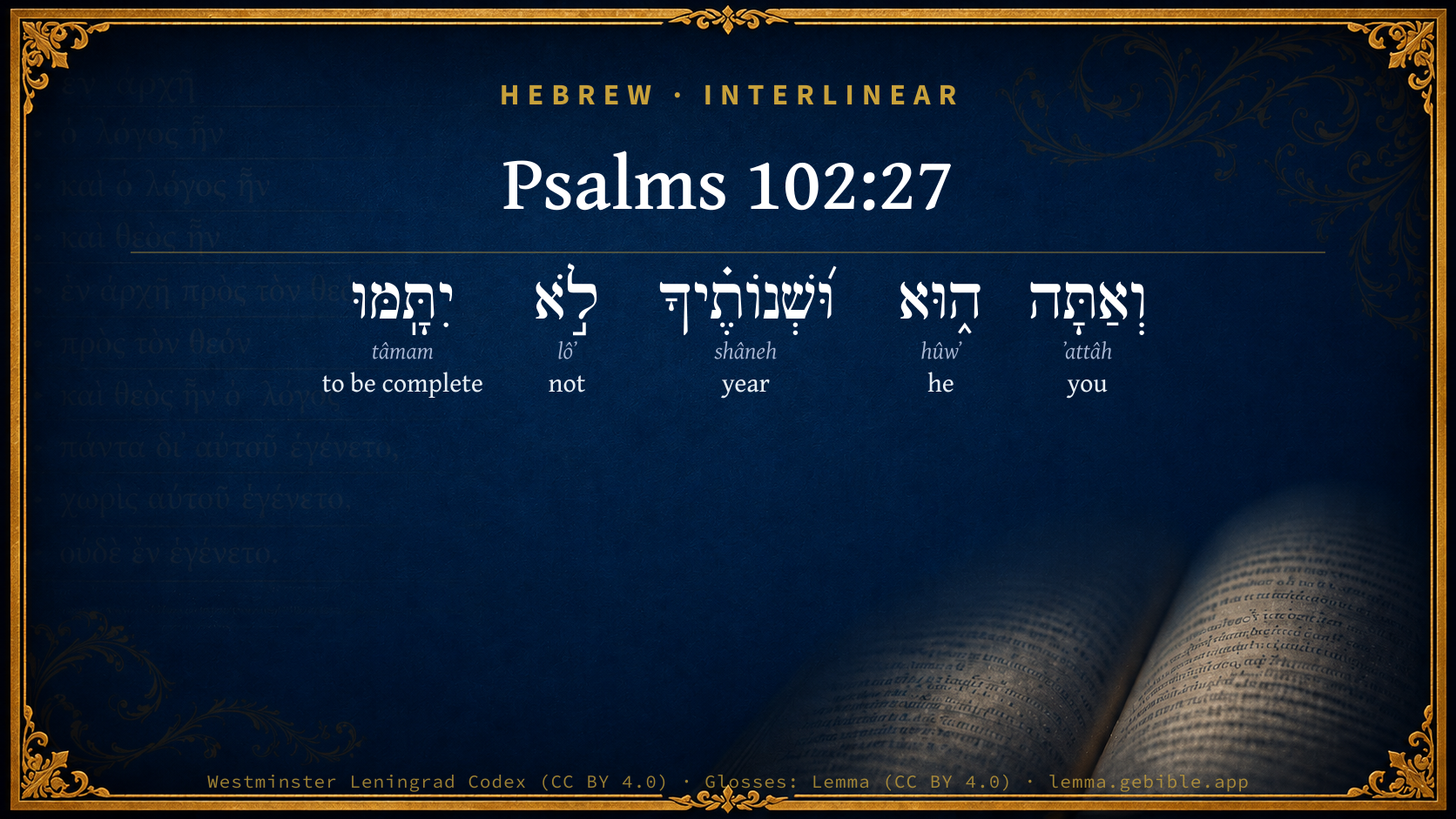
Psalms 102:27

Hebrew (Westminster Leningrad Codex) Psalms 102:27 appears in the Hebrew Old Testament. The text above is from the Westminster Leningrad Codex. Each word links to its Strong’s number, a concise gloss, and parsing drawn from the Open Scriptures Hebrew Bible morphology. Click any word for its full Brown-Driver-Briggs (BDB) entry.
Download image
Cite this verse

Psalms 102:27 (World English Bible). Public Domain. Lemma interlinear Bible study tool, https://lemma.gebible.app/v/psalms/102/27.

Show BibTeX & RIS
BibTeX
RIS
English Translation
But you are the same. Your years will have no end.
World English Bible · Public Domain
Download a study sheet

One document with this verse’s original text, its word-by-word gloss line, the meaning frame, cross-references with their text, attributed commentary, and full source and license credits — printable, and it pastes into notes with its structure intact.

This verse Autodidact and up

Study sheet (.html) Plain text (.txt)

A passage Seminary Student

Up to 50 verses in one chapter. A passage sheet keeps up to 6 commentary sources and 12 cross-references per verse, in the order this page ranks them, and says so on the sheet whenever that leaves anything out. Ask for a single verse and you get the Autodidact verse sheet above.

Everything on this page stays free to read, with no account — the sheet is a download of what is already on screen, not access to it.

Want to remove ads? Support Godless Engineer
Compare translations 3

The same verse in 3 English versions, stacked beneath the original-language interlinear above. Click any original word for its lexicon entry.

Each is an independent rendering of the whole verse — the interlinear is not word-aligned to these translations.

Highlighted words mark where these versions differ — a whole-verse word diff, not a word-by-word alignment.

  • World English Bible Public Domain
    But you are the same. Your years will have no end.
  • King James Version Public Domain
    But thou art the same, and thy years shall have no end.
  • unfoldingWord Literal Text CC BY-SA 4.0
    But you he, and your years will not end.

unfoldingWord Literal Text — © unfoldingWord, licensed CC BY-SA 4.0. Word-aligned USFM3 via Door43 (git.door43.org/unfoldingWord/en_ult).

Versions to compare (up to 4)

3 of 4 selected

Show all 18 translations

Every available English version of this verse, each an independent rendering of the whole verse.

  • World English Bible Public Domain
    But you are the same. Your years will have no end.
  • Berean Standard Bible Public Domain
    But You remain the same, and Your years will never end.
  • Majority Standard Bible Public Domain
    But You remain the same, and Your years will never end.
  • King James Version Public Domain
    But thou art the same, and thy years shall have no end.
  • American Standard Version (1901) Public Domain
    But thou art the same, And thy years shall have no end.
  • Revised Version (1885) Public Domain
    But thou art the same, and thy years shall have no end.
  • Geneva Bible (1599) Public Domain
    But thou art the same, and thy yeeres shall not fayle.
  • Douay-Rheims (1899) Public Domain
    They shall perish but thou remainest: and all of them shall grow old like a garment: And as a vesture thou shalt change them, and they shall be changed.
  • Young's Literal Translation Public Domain
    And Thou `art' the same, and Thine years are not finished.
  • Literal Standard Version CC BY-SA 4.0
    And You [are] the same, and Your years are not finished.
  • Unlocked Literal Bible CC BY-SA 4.0
    But you are the same, and your years will have no end.
  • unfoldingWord Literal Text CC BY-SA 4.0
    But you he, and your years will not end.
  • Darby Bible Public Domain
    But thou art the Same, and thy years shall have no end.
  • World Messianic Bible Public Domain
    But you are the same. Your years will have no end.
  • Webster's Bible Public Domain
    \\102:26\\They shall perish, but thou wilt endure: yes, all of them shall grow old like a garment; as a vesture wilt thou change them, and they shall be changed:
  • Free Bible Version CC BY-SA 4.0
    But you are the one who always is; your years never come to an end.
  • Bible in Basic English Public Domain
    But you are the unchanging One, and your years will have no end.
  • JPS Tanakh (1917) Public Domain
    (102-28) But Thou art the selfsame, and Thy years shall have no end.

Literal Standard Version (2020), Covenant Press — licensed CC BY-SA 4.0. Text via the HelloAO Bible API (eBible.org). Unlocked Literal Bible (unfoldingWord) — licensed CC BY-SA 4.0. Text via the HelloAO Bible API (eBible.org). unfoldingWord Literal Text — © unfoldingWord, licensed CC BY-SA 4.0. Word-aligned USFM3 via Door43 (git.door43.org/unfoldingWord/en_ult). Free Bible Version, Dr. Jonathan Gallagher — licensed CC BY-SA 4.0. Text via the HelloAO Bible API (eBible.org).

Word by word

More ways to search: Search by grammar → Find every occurrence → Compare this word →

Practice this passage: Drill this verse → Learn its vocabulary →

יִתָּֽמּוּ
tâmam
H8552
“to be complete”
Verb, Qal, Imperfect, 3rd Person, Masculine, Plural
Part of Speech
Verb
Stem
Qal
Form
Imperfect
Person
3rd Person
Gender
Masculine
Number
Plural
Full BDB Definition

Origin: a primitive root

TWOT: 2522

to be complete, be finished, be at an end - (Qal) - to be finished, be completed - completely, wholly, entirely (as auxiliary with verb) - to be finished, come to an end, cease - to be complete (of number) - to be consumed, be exhausted, be spent - to be finished, be consumed, be destroyed - to be complete, be sound, be unimpaired, be upright - to complete, finish - to be completely crossed over - (Niphal) to be consumed - (Hiphil) - to finish, complete, perfect - to finish, cease doing, leave off doing - to complete, sum up, make whole - to destroy (uncleanness) - to make sound - (Hithpael) to deal in integrity, act uprightly
  1. וְאַתָּה ʼattâh H859 “and · you” Conjunction + Pronoun, Personal, 2nd Person, Masculine, Singular
  2. ה֑וּא hûwʼ H1931 “he” Pronoun, Personal, 3rd Person, Masculine, Singular
  3. וּ֝שְׁנוֹתֶ֗יךָ shâneh H8141 “and · years · your” Conjunction + Noun, Common, Feminine, Plural, Construct + Suffix, Personal, 2nd Person, Masculine, Singular
  4. לֹ֣א lôʼ H3808 “not” Particle, Negative

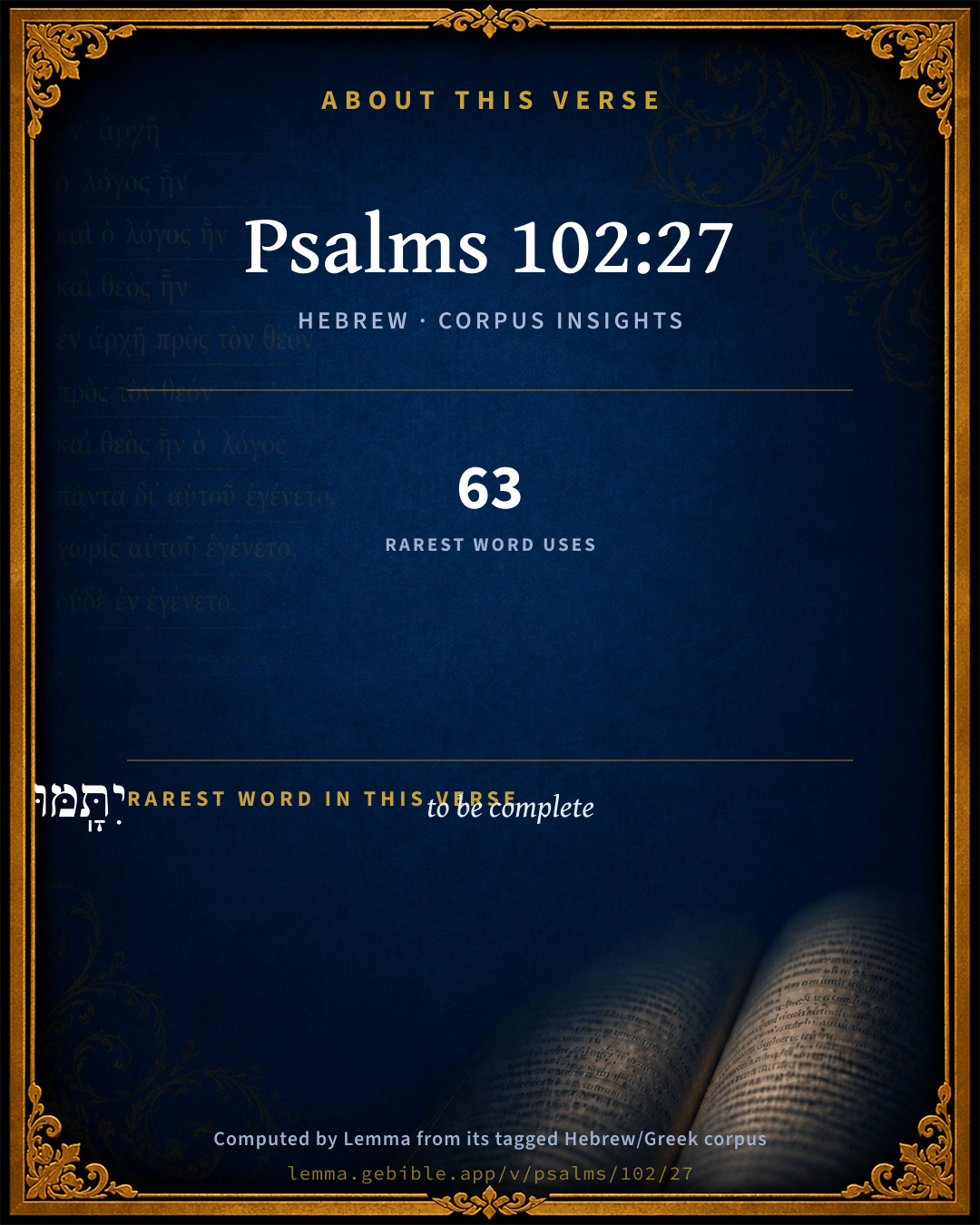
About this verse

These counts appear in no published source. They are computed here, from the morphology-tagged text and Lemma’s own curated glosses. What Lemma adds →

5
words
5
distinct lemmas
Wisdom
section

Grammatical profile

  • 1 verb
  • 1 noun
  • 2 pronouns
  • 1 particle

Verb forms

  • יִתָּֽמּוּ Qal · Imperfect

Hebrew & Septuagint length

In English translation the verse runs 11 words from the Hebrew and 11 from the Septuagint (LXX English) — the same length.

A rough comparison of the two English renderings, which tokenize alike — not a word-level alignment.

Word counts can differ between the Hebrew and the Greek without any difference in meaning — e.g. the Hebrew direct-object marker אֵת has no separate Greek word, and Greek often adds the article ὁ.

Cross-references

8

Topical passages linked to Psalms 102:27 in the Treasury of Scripture Knowledge — connected by theme and wording, ordered by reader-vote popularity; previews shown in the World English Bible.

  • Hebrews 13:8 Jesus Christ is the same yesterday, today, and forever.
  • Malachi 3:6 "For I, Yahweh, don't change; therefore you, sons of Jacob, are not consumed.
  • James 1:17 Every good gift and every perfect gift is from above, coming down from the Father of lights, with whom can be no variation, nor turning shadow.
  • Revelation 1:8 "I am the Alpha and the Omega," says the Lord God, "who is and who was and who is to come, the Almighty."
  • Job 36:26 Behold, God is great, and we don't know him. The number of his years is unsearchable.
  • Psalms 90:4 For a thousand years in your sight Are but as yesterday when it is past, As a watch in the night.
  • Revelation 1:17–18 When I saw him, I fell at his feet like a dead man. He laid his right hand on me, saying, "Don't be afraid. I am the first and the last,
  • John 8:58 Jesus said to them, "Most assuredly, I tell you, before Abraham came into existence, I AM."

Cross-references courtesy of OpenBible.info (CC BY 4.0).

Hebrew and Greek witnesses Masoretic Hebrew ↔ Greek Septuagint

The same verse in the two great witnesses to the Old Testament, shown verse-for-verse.

You’re reading Greek Psalm 101 (Hebrew Psalm 102). The Septuagint counts the superscription, so verse numbers can differ from the Hebrew — chapter-level alignment, not verse-by-verse. Numbering follows Rahlfs.

These are two independent witnesses, not word-aligned to each other, and the Septuagint is shown in lemma (dictionary) form.

Hebrew Psalms 102:27 Masoretic · Westminster Leningrad Codex

וְאַתָּה ה֑וּא וּ֝שְׁנוֹתֶ֗יךָ לֹ֣א יִתָּֽמּוּ

But you are the same. Your years will have no end.

World English Bible · Public Domain

Greek LXX Greek Psalm 101:27 Septuagint · lemma form

αὐτός ἀποὀλλύω σύ δέ διαμένω καί πᾶς ὡς ἱμάτιον παλαιόω καί ὡσεί περιβόλαιον ἀλλάσσω αὐτός καί ἀλλάσσω

But you are the same, and your years shall not fail.

LXX2012 (modern English Septuagint) · Public Domain

On this verse, J. A. Alexander on Psalms discusses the Septuagint’s reading. Read the note in Commentary ↓

Hebrew: Westminster Leningrad Codex (CC BY 4.0). Greek: Septuagint (public domain); English from LXX2012 (modern English Septuagint) (Public Domain). How the Septuagint differs from the Hebrew →

Commentary

Notes on Psalms 102:27 from classic Christian and Jewish commentators (each source and its license shown beneath its notes). The classic Christian expositions comment on the surrounding passage and are grouped to its opening verse, so a note may address several verses; the Jewish commentaries on the Tanakh (Rashi and others) are per-verse, so they appear only where the commentator wrote on this verse.

Lemma curates 59 commentaries, every one of them public domain or Creative Commons licensed, each selected and text-cleaned for this edition rather than reprinted as found. About our sources →

Trapp's Complete Commentary

John Trapp

Psa 102:27 But thou [art] the same, and thy years shall have no end.

Ver. 27. But thou art the same] Tu es tu (Arabic). Therefore immutable, because eternal, ut nihil tibi possit accedere vel decidere,

John Trapp, A Commentary or Exposition upon All the Books of the Old and New Testament (1647–1656) — public domain. Text from a community e-Sword module.

The Biblical Illustrator

Joseph S. Exell

Psa_102:27

But Thou art the same, and Thy years shall have no end.

The immutability of God

God is unchangeable in His essence, nature, and perfections. This unchangeableness of God was anciently represented by the figure of a cube, a piece of metal or wood framed four square; when every side is exactly of the same equality, cast it which way you will, it will always be in the same posture, because it is equal to itself in all its dimensions. He was therefore said to be the centre of all things, and other things the circumference; the centre is never moved, while the circumference is; it remains immovable in the midst of the circle. Shadows and variations have no place in the eternal Father of lights; He hath not the least spot or diminution of brightness; nothing can cloud Him or eclipse Him.

I. In what respects God is unchangeable.

1. God is unchangeable in His essence. He is unalterably fixed in His being, that not a particle of it can be lost from it, nor a mite added to it. God is the first being, an independent being; He was not produced of Himself, or of any other, but by nature always hath been, and therefore cannot by Himself, or by any other, be changed from what He is in His own nature: that which is not may as well assume to itself a being as He who hath and is all being have the least change from what He is. Again, because He is a Spirit, He is not subject to those mutations which are found in corporeal and bodily natures; because He is an absolutely simple Spirit, not having the least particle of composition, He is not capable of those changes which may be in created spirits.

2. God is immutable in regard of knowledge. God hath known from all eternity all that which He can know, so that nothing is hid from Him; He knows not at present any more than He hath known from eternity, and that which He knows now He always knows (Heb_4:13).

3. God is unchangeable in regard of His will and purpose (Isa_55:11; Isa_46:11; Num_23:19).

4. God is unchangeable in regard of place. Therefore observe, that when God is said to draw near to us when we draw near to Him (Jam_4:8), it is not by local motion or change of place, but by special and spiritual influences, by exciting and supporting grace.

II. The reasons to prove God immutable.

1. The name Jehovah signifies this attribute (Exo_3:14). ]f we say not of Him He was, nor He will be, but only He is, whence should any change arrive?

2. If God were changeable, He could not be the most perfect being. God is the most perfect being, and possesses in Himself infinite and essential goodness (Mat_5:48). If He could change from that perfection, He were not the highest exemplar and copy for us to write after.

3. God were not the most simple being if He were not immutable. But God is the most simple being; for that which is first in nature, having nothing beyond it, cannot by any means be thought to be compounded; for whatsoever is so depends upon the parts whereof it is compounded, and so is not the first being. Now, God being infinitely simple, hath nothing in Himself which is not Himself, and therefore cannot will any change in Himself, He being His own essence and existence.

4. God were not eternal if He were mutable. God cannot be eternally what He was; that is, He cannot have a true eternity, if He had a new knowledge, new purpose, a new essence; if He were sometimes this and sometimes that, sometimes know this and sometimes know that, sometimes purpose this and afterwards hath a new purpose, He would be partly temporary and partly eternal, not truly and universally eternal. All changeableness implies a corruptibility.

5. If God were changeable, He were not infinite and almighty. All change ends in addition or diminution; if anything be added, He was not infinite before; if anything be diminished, He is not infinite after. All change implies bounds and limits to that which is changed; but God is infinite, His greatness is unsearchable (Psa_145:3).

III. Immutability is proper to God, and incommunicable to any creature.

1. The changeableness of all creatures is evident.

(1) Of corporeal creatures it is evident to sense. All plants and animals, as they have their duration bounded in certain limits, so while they do exist they proceed from their rise to their fall; they pass through many sensible alterations, from one degree of growth to another, from buds to blossoms, from blossoms to flowers and fruits; they come to their pitch that nature hath set them, and are torn back to the state from whence they sprung; there is not a clay but they make some acquisition, or suffer some loss; they die and spring up every day; nothing in them more certain than their inconstancy (Rom_8:20). The heavenly bodies are changing their place; the sun every day is running his race, and stays not in the same point; and though they are not changed in their essence, yet they are in their place; some indeed say there is a continual generation of light in the sun, as there is a loss of light by the casting out its beams, as in a fountain there is a flowing out of the streams, and a continual generation of supply. But in man the change is perpetually visible; every day there is a change from ignorance to knowledge, from one will to another, from passion to passion, sometimes sad, and sometimes cheerful, sometimes craving this and presently nauseating it. His body changes from health to sickness, or from weakness to strength; some alteration there is either in body or mind.

(2) Spiritual natures, as angels. They change not in their being, but that is from the indulgence of God; they change not in their goodness, but that is not from their nature, but Divine grace in their confirmation; but they change in their knowledge, they know more by Christ than they did by creation (1Ti_3:16).

2. No creature can be unchangeable in its nature.

(1) Because every creature rose from nothing. As they rose from nothing, so they bend to nothing, unless they are preserved by God.

(2) Because every creature depends purely upon the will of God. He that created them by a word, can by a word destroy them.

(3) Because no creature is absolutely perfect. The perfections of all creatures are searchable, the perfection of God only is unsearchable (Job_11:6), and therefore He only immutable.

IV. Some propositions to clear this unchanceableness of God from anything that seems contrary to it.

1. There was no change in God when He began to create the world in time. The creation was a real change, but the change was not subjectively in God, but in the creature; the creature began to be what it was not before.

2. There was no change in the Divine nature of the Son when He assumed human nature. There was an union of the two natures, but no change of the Deity into the humanity, or of the humanity into the Deity, both preserved their peculiar properties.

3. Repentance and other affections ascribed to God in Scripture argue no change in God.

4. The not fulfilling of some predictions in Scripture, which seem to imply a changeableness of the Divine will, do not argue any change in it. God declared what would follow by natural causes, or by the demerit of man, not what He would absolutely Himself do; and in many of those predictions, though the condition be not expressed, yet it is to be understood; so the promises of God are to be understood with the condition of perseverance in well-doing, and threatenings with a clause of revocation annexed to them, provided that men repent. And this God lays down as a general case, always to be remembered as a rule for the interpreting His threatenings against a nation, and the same reason will hold in threatenings against a particular person (Jer_18:7-10).

5. God is not changed, when of loving to any creatures He becomes angry with them, or of angry He becomes appeased. The change in these cases is in the creature; there is a change in the dispensation of God, as there is a change in the creature, making Himself capable of such dispensations.

6. A change of laws by God argues no change in God, when God abrogates some laws which He had settled in the Church, and enacts others. God commanded one thing to the Jews, when the Church was in an infant state, and removed those laws when the Church came to growth (Gal_4:3). A mother feeds not the infant with the same diet as she doth when it is grown up. Our Saviour acquainted not His disciples with some things at one time which He did at another, because they were not able to bear them. (S. Charnock.)

Divine immutability

I. It is an undoubted fact. This is clear--

1. From reason. Immutability enters into the essence of our idea of Deity.

2. From nature, which in its essence seems immovable.

3. From the Bible.

II. It is peculiar to Himself. Mutation is the law of the material universe, so far as its laws are concerned. Geology shows that the history of the earth is the history of revolutions. The mountains falling come to nought, etc. Astronomy tells of planets that once shone in the heavens, that are gone, and of new ones that appear. The vegetable and animal systems of the earth are changing every hour. Mutation is also the law of the spiritual universe. Human minds are constantly changing in thoughts, feelings, purposes, character. Angels changed. Some have fallen from heaven to hell. But God sits enthroned above all these changes, more fixed than the sun above the shifting clouds, or the rock amidst the surging waters. God alone is unchangeable.

III. It is a blessing to the universe. Were God unholy, untruthful, malevolent, the universe might well pray for a change in Him. But He is eternally opposite to all this. He is infinitely holy, true, and loving, and a change in Him would be a terrible calamity. We would not have Him change. We rejoice that we can look up to Him midst all the false and morally foul and infernally malignant, and feel that there is One who is ever pure, ever true, ever merciful and good. (Homilist.)

A revelation of the immutability of God

The chemist in his laboratory, as he questions Nature, may be almost said to put her to the torture when, tried in his hottest furnace, or probed by his searching analysis to her innermost arcana, she by a spark or an explosion, or an effervescence, or an evolving substance, makes her distinct replies to his investigations. And . . . in every quarter of the globe her answer is the same--so that, let the experiment, though a thousand times repeated, only be alike in all its circumstances, the result which cometh forth is as rigidly alike, without deficiency, and without deviation . . . But there is a God who liveth and sitteth there, and these unvarying responses of Nature are all prompted by Himself, and are but the utterances of His immutability. They are the replies of a God who never changes, and who hath adapted the whole materialism of creation to the demonstration of it. The certainties of Nature and of science are, in fact, the vocables by which God announces His truth to the world; and when told how impossible it is that Nature can fluctuate, we are only told how impossible it is that the God of Nature can deceive us. (T. Chalmers, D.D.)

The Biblical Illustrator, edited by Joseph S. Exell (c. 1880s–1900s) — public domain. Text from a community e-Sword module.

Joseph Benson's Commentary

Psa 102:27. But thou art the same. &c. — “Amidst the changes and chances of this mortal life,” says Dr. Horne, “one topic of consolation will ever remain, namely, the eternity and immutability of God our Saviour, of him who was, and is, and is to come. Kingdoms and empires may rise and fall; nay, the heavens and the earth, as they were originally produced and formed by the WORD of God, the Son, or second person in the Trinity, to whom the psalmist here addresses himself; (see Heb 1:10;) so will they, at the day appointed, be folded up, and laid aside, as an old and worn-out garment; but Jehovah is ever the same; his years have no end, nor can his promise fail, any more than himself. Heaven and earth, saith he, shall pass away, but my words shall not pass away, Mat 24:35.”

Joseph Benson's Commentary on the Old and New Testaments (1811–1818) — public domain. Text from a community e-Sword module.

J. A. Alexander on Psalms

Joseph Addison Alexander

28. (Psa 102:27) And Thou (art) He—and thy years shall not be finished. The construction of the first clause is disputed. Some read it, Thou thyself and thy years shall not end. Others, Thou art the same, giving the same sense with the Greek, which is actually used here to translate it in the Septuagint. In favour of the version first above given, is its agreement with the usage of the Hebrew words, with the analogy of Deu 32:39, and Isa 43:10, and with the context here. The meaning then is, Thou art the Unchangeable One just described. Or, it is Thou, and nothing else, that shall thus endure. Be finished, spent, consumed, as the Hebrew word invariably means. What is elsewhere literally said of the violent destruction of human life is here transferred to the lapse of time.

Joseph Addison Alexander, The Psalms Translated and Explained (1850) — public domain. Text from a community e-Sword module.

Adam Clarke's Commentary

Verse 27. But thou art the same] ואתה הוא veattah HU, but thou art HE, that is, The ETERNAL; and, consequently, he who only has immortality.

Thy years shall have no end.] לא יתמו lo yittammu, "they shall not be completed." Every thing has its revolution-its conception, growth, perfection, decay, dissolution, and death, or corruption. It may be said that regeneration restores all these substances; and so it does in a measure, but not without deterioration. The breed of animals, as well as vegetables, wears out; but God's eternal round has no completion. I repeat it, - what is necessarily eternal is unchangeable and imperishable; all created beings are perishable and mutable, because not eternal. God alone is eternal; therefore God alone is imperishable and immutable.

Adam Clarke's Commentary on the Bible (1810–1826) — public domain. Text from a community e-Sword/MySword module.

The Cambridge Bible for Schools and Colleges

gen. ed. J. J. S. Perowne

27. thou art the same] Lit., as in Deu_32:39; Isa_41:4; Isa_43:10; Isa_43:13; Isa_46:4; Isa_48:12, Thou art He, an emphatic assertion of the personality of Jehovah, which is in its very nature unchanging.

Psa_102:25-27 are quoted in Heb_1:10-12, from the LXX, and applied to Christ. The Psalmist is addressing Jehovah, Whom he expects to manifest Himself as the Redeemer of Israel. As the mystery of the Godhead was disclosed in the progress of revelation, it was seen that the words might be applied with equal right to the Eternal Word through Whom all things were made, and Who was manifested for the redemption of the world.

The Cambridge Bible for Schools and Colleges (gen. ed. J. J. S. Perowne; Cambridge University Press, 1878–1918) — public domain. Text from a community e-Sword module.

John Gill's Exposition

The children of thy servants shall continue,.... The "servants" of the Lord are the apostles of Christ, and ministers of the word, in all successive generations, with whom Christ will be to the end of the world: their "children" are such whom they have begotten again, through the Gospel, to whom they are spiritual fathers; regenerated souls are meant; of these there will be a succession in all ages, until latter day glory takes place; these are the church's seed, and her seed's seed, from whom the word of the Lord, the Gospel, will never depart, Isa 59:21, or these "shall inhabit" (i), as the word may be rendered, the earth, as the Targum adds; that is, the new heavens, and the new earth, when the old ones are passed away; here they shall dwell with the Lord, who is the same today, yesterday, and for ever:

and their seed shall be established before thee; the same with the children, the spiritual seed of the church and of faithful minister; these, with the church, in which they are born and brought up, shall be established in Christ; the church will be no more in an unstable and fluctuating state, but will he as a tabernacle, that shall not be taken down; yea, shall be established upon the top of the mountains, and exalted above the hills; see Isa 2:2.

(i) "habitabunt", V. L. Pagninus, Montanus, Junius & Tremellius, Piscator, Cocceius, Gejerus; so Sept.

Next: Psalms Chapter 103

John Gill's Exposition of the Whole Bible (1746–1763) — public domain (CC PDM 1.0). Text via the HelloAO Bible API.

The Treasury of David

Charles H. Spurgeon

Ver. 27. But thou art the same, or, "thou art he." As a man remains the same when he has changed his clothing, so is the Lord evermore the unchanging One, though his works in creation may be changed, and the operations of his providence may vary. When heaven and earth shall flee away from the dread presence of the great Judge, he will be unaltered by the terrible confusion, and the world in conflagration will effect no change in him; even so, the Psalmist remembered that when Israel was vanquished, her capital destroyed, and her temple levelled with the ground, her God remained the same self-existent, all-sufficient being, and would restore his people, even as he will restore the heavens and the earth, bestowing at the same time a new glory never known before. The doctrine of the immutability of God should be more considered than it is, for the neglect of it tinges the theology of many religious teachers, and makes them utter many things of which they would have seen the absurdity long ago if they had remembered the divine declaration, "I am God, I change not, therefore ye sons of Jacob are not consumed."

And thy years shall have no end. God lives on, no decay can happen to him, or destruction overtake him. What a joy is this! We may lose our dearest earthly friends, but not our heavenly Friend. Men's days are often suddenly cut short, and at the longest they are but few, but the years of the right hand of the Most High cannot be counted, for they have neither first nor last, beginning nor end. O my soul, rejoice thou in the Lord always, since he is always the same.

Ver. 27. Thou art the same. The essence of God, with all the perfections of his nature, are pronounced the same, without any variation from eternity to eternity. So that the text doth not only assert the eternal duration of God, but his immutability in that duration; his eternity is signified in that expression, "thou shalt endure; "his immutability in this, "thou art the same." To endure, argues indeed this immutability as well as eternity; for what endures is not changed, and what is changed doth not endure. "But thou art the same, "awx xta, doth more fully signify it. He could not be the same if he could be changed into any other thing than what he is. The Psalmist therefore puts, not thou hast been or shall be, but thou art the same, without any alteration; thou art the same, that is, the same God, the same in essence and nature, the same in will and purpose, thou dost change all other things as thou pleaseth; but thou art immutable in every respect, and receivest no shadow of change, thought never so light and small. The Psalmist here alludes to the name Jehovah, I am, and doth not only ascribe immutability to God, but exclude everything else from partaking in that perfection. Stephen Charnock.

Psalms 102:28*

Charles H. Spurgeon's The Treasury of David (1869–1885) — public domain. Psalms only. Text from a community e-Sword/MySword module.

Whedon's Commentary on the Bible

Daniel D. Whedon

27. But thou art the same—Hebrew, But thou art he. Equal to, Thou art the unchangeable One. Compare “I am he,” Isa_41:4; Isa_46:4

Daniel D. Whedon (gen. ed.), Commentary on the Old and New Testaments (1874–1909) — public domain. Text from a community e-Sword module.

The Pulpit Commentary

But thou art the same; literally, but thou art HE; (comp. Isa_44:4 Isa_46:4) i.e. "thou art the one eternal and unchangeable existence the one reality." And thy years shall have no end. It is by an accommodation to human modes of thought that God"s "years" are spoken of. An eternal existence is a unity not made up of years and days.

The Pulpit Commentary (1880–1919), ed. H.D.M. Spence-Jones & Joseph S. Exell — public domain. Text from a community e-Sword module.

Rashi

Rabbi Shlomo Yitzchaki (Rashi)

like raiment You will turn them over like a person who turns his garment inside out to take it off.

Rashi on the Tanakh — English translations: “The Judaica Press complete Tanach with Rashi, translated by A. J. Rosenberg” (CC BY 4.0); “Pentateuch with Rashi's commentary by M. Rosenbaum and A.M. Silbermann, 1929-1934” (public domain); “The Metsudah Tanach series, Lakewood, N.J” (CC BY 4.0); and “The Book of Joshua, Metsudah Publications, 1997” (CC BY 4.0). Text via Sefaria.

Lesson kit

Teaching starters — assembled from the data on this page, not authored interpretation. Every prompt links to the verse data it draws on. Edit before teaching.

Psalms, in the Wisdom, opens this verse with 5 words (5 distinct Hebrew lemmas). Its most distinctive word is tâmam (“to be complete”). A historical commentator’s framing appears above. Read the whole chapter for the surrounding context.

Discussion questions

  1. How does “to be complete” (tâmam) shape what this verse is saying?
  2. Hebrews 13:8 shares this passage’s theme. How do the two illuminate each other?
  3. These translations render this verse differently. What is at stake in choosing one wording over another?
  4. The verb «יִתָּֽמּוּ» is Qal Imperfect. How does its form color the action?
  5. Reading how Trapp's Complete Commentary and The Biblical Illustrator read this verse, where do the two commentators agree and where do they part?

Things to notice

Reading settings

Reading text

Shown beneath each verse's original-language words.

Old Testament
Old Testament edition

Read the OT as the Masoretic Hebrew (MT) or the Greek Septuagint (LXX).

English shown for the Greek Septuagint (in the Hebrew ↔ Greek comparison).

Comparing translations? Open the Compare panel on any verse page to stack up to four side by side.