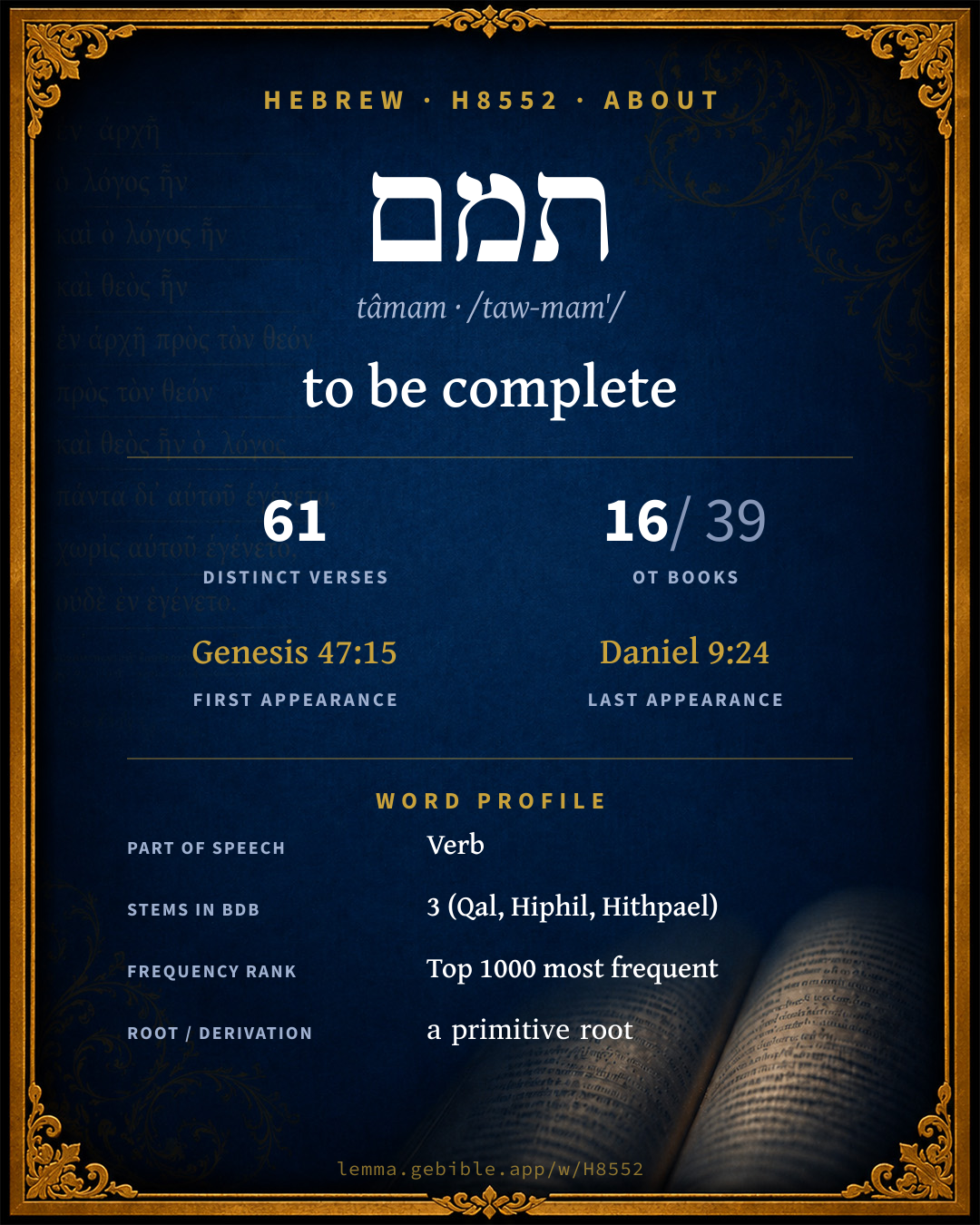
תָּמַם
to be complete
‘to be complete’ is one of 3 main senses fuller range ↓
Full lexicon entry — Brown-Driver-Briggs (BDB)
From Brown-Driver-Briggs (BDB)
Where this word appears
Grammar key — what these labels mean
Part of speech
- Verb
- An action or state-of-being word.
Stem
- Qal
- The basic, simple active stem — the plain form of the verb (“he wrote”). Here: ‘be finished’
- Hithpael
- The reflexive or reciprocal stem (the subject acts on itself).
- Hiphil
- The causative active stem (“he caused / brought about”). Here: ‘finish’
Form
- Infinitive Construct
- A bound verbal noun, frequently with prepositions (“to write / in writing”).
- Perfect
- A completed action or state — Hebrew marks aspect (completeness) more than strict tense (“he wrote”).
- Imperfect
- An incomplete, ongoing, or future action (“he will / would write”).
- Sequential Perfect
- A perfect with prefixed waw continuing a preceding imperfect or command (waw-consecutive perfect).
- Sequential Imperfect
- An imperfect with prefixed waw — the standard past-narrative form (waw-consecutive imperfect).
- Infinitive Absolute
- An unbound verbal noun, often intensifying or standing in for a finite verb.
Person
- 3rd Person
- The one spoken about (“he / she / it / they”).
- 1st Person
- The speaker (“I / we”).
- 2nd Person
- The one addressed (“you”).
Gender
- Common
- Either gender — not distinguished for this form.
- Masculine
- Grammatically masculine.
- Feminine
- Grammatically feminine.
Number
- Plural
- More than one (in Hebrew, generally three or more).
- Singular
- One.
Every verse where H8552 appears in the Book of 1 Kings — 3 distinct verses. Click any verse to open its interlinear word-by-word view. Verse text shown in the World English Bible for context — . Each verse’s Hebrew form is shown with its reference; the English is not keyword-highlighted, since the data carries no word-level English alignment. Use “Compare translations” on any verse to read it across multiple English versions. This concordance covers the Hebrew Bible; Septuagint (Greek Old Testament) occurrences are not indexed here.
1 Kings
- 1 Kings 6:22 תֹּ֣ם Qal inf.cs The whole house he overlaid with gold, until all the house was finished: also the whole altar that belonged to the oracle he overlaid with gold.
- 1 Kings 7:22 וַ/תִּתֹּ֖ם conj + Qal wimpf 3fs On the top of the pillars was lily-work: so was the work of the pillars finished.
- 1 Kings 14:10 תֻּמּֽ/וֹ Qal inf.cs + sfx pers 3ms therefore, behold, I will bring evil on the house of Jeroboam, and will cut off from Jeroboam every man-child, him who is shut up and him who is left at large in Israel, and will utterly sweep away the house of Jeroboam, as a man sweeps away dung, until it be all gone.
About this entry
At a glance — auto-summarized from this page’s data, not written by a person. Every figure links to its source below. This summary describes the numbers; it doesn’t interpret them.
תמם — transliterated tâmam — is a Hebrew verb carrying the sense “to be complete.” Its earliest occurrence is Genesis 47:15. Spanning 61 verses in 16 books, it ranks among the moderately common words of the Hebrew Bible. Different stems carry different senses — BDB groups them under 3 stems, among them Qal and Hiphil. Sharing its root, it stands alongside מתם, תם and תם. See the sense tree, 61-verse concordance, and the renderings breakdown below.
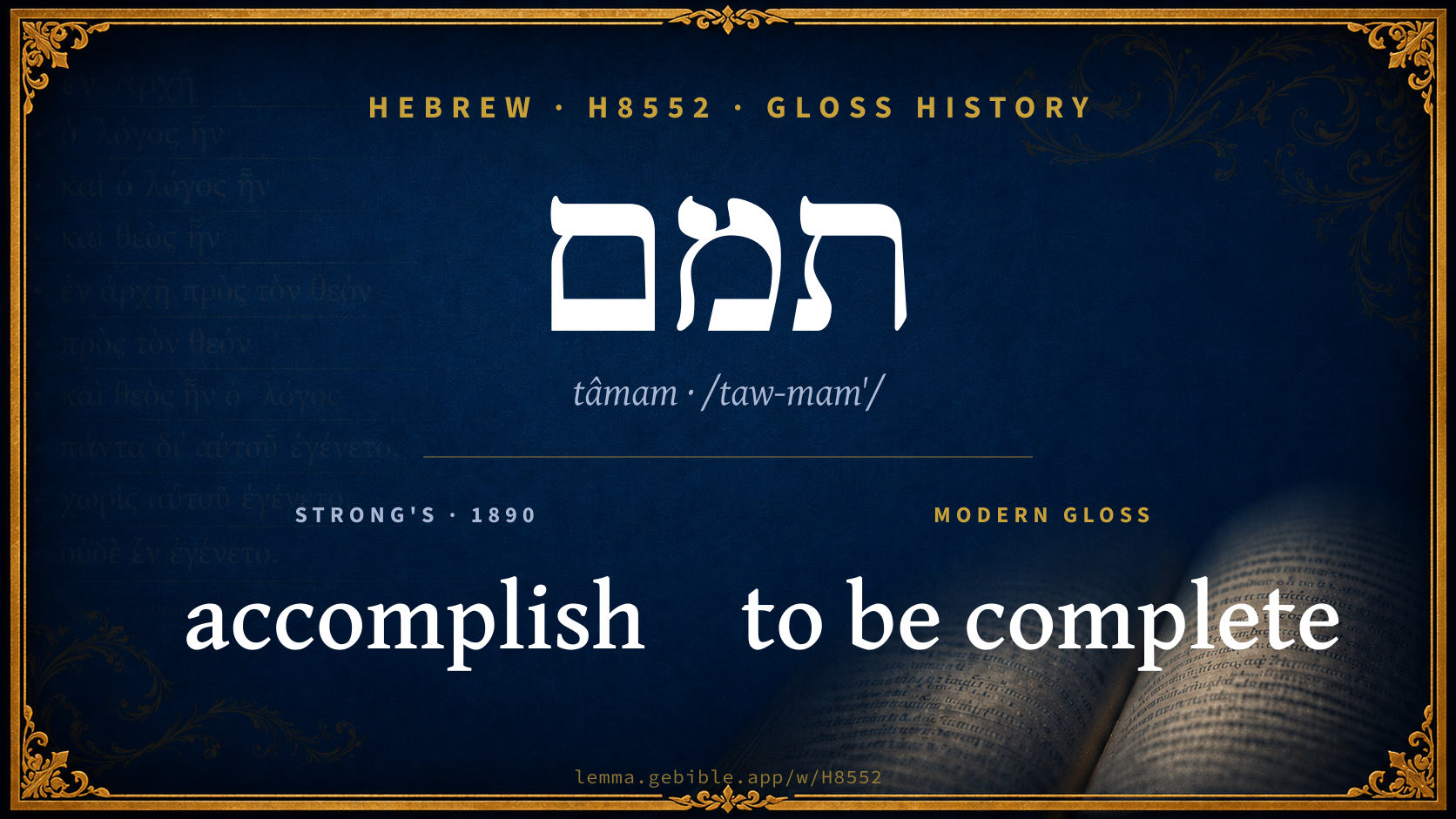
Gloss history
Strong's 1890 vs modern scholarship
About this word
Strong's H8552 catalogs a Hebrew word from the Hebrew Old Testament.
These counts are not copied from any lexicon or concordance. They are computed here, from the morphology-tagged Hebrew Old Testament. What Lemma adds →
- 61
- distinct verses
- The word appears in 61 distinct verses.
- 16 / 39
- OT books
- The word appears in 16 of 39 Old Testament books.
- #611
- by frequency
- Top 1000 most frequent Hebrew words (rank 611 of 8,640 Hebrew words by occurrence).
View all 61 occurrences in the concordance →
By section of the Old Testament
By traditional corpus
Conventional, traditional groupings — biblical authorship is debated, so this is a traditional corpus grouping, not an authorship claim. Each share is this word’s portion of its verses in that division of the Hebrew canon. Each figure is a share of the word’s 61 distinct verses.
- Prophets (Nevi'im) 35 verses · 57%
- Torah (Pentateuch) 13 verses · 21%
- Writings (Ketuvim) 13 verses · 21%
How translations render this word
Counts come from each version’s own published word-to-Strong’s tagging or interlinear alignment — an approximate guide to how each version renders this word, not a word-level alignment the data otherwise carries. Because each total is that version’s own tagged count, the per-version totals vary from one another and need not match the appearance or distinct-verse counts above. These counts may also differ from a printed concordance because Lemma counts each distinctly tagged rendering and does not collapse phrase taggings into a single head-word total. This is a fixed set of word-tagged versions (KJV, ASV, BSB, ULT) and does not change with the reading translation you choose elsewhere. Each version’s license is shown beside its name below (and on Sources).
- King James Version: Are consumed 2×, Be consumed 2×, End 2×
- American Standard Version: Be consumed 3×, Were consumed 3×, Are consumed 2×
- Berean Standard Bible: Is gone 3×, Was gone 3×, End 2×
- unfoldingWord Literal Text: Had finished 5×, And 4×, Finishing of 4×
King James Version Public Domain
Renders H8552 across 64 tagged occurrences — most commonly:
Plus 46 renderings that appear only once — usually multi-word phrases or single function words the recovered tagging swept in, not distinct renderings.
American Standard Version Public Domain
Renders H8552 across 60 tagged occurrences — most commonly:
Plus 44 renderings that appear only once — usually multi-word phrases or single function words the recovered tagging swept in, not distinct renderings.
Berean Standard Bible Public Domain
Renders H8552 across 56 tagged occurrences — most commonly:
Plus 42 renderings that appear only once — usually multi-word phrases or single function words the recovered tagging swept in, not distinct renderings. Not rendered by a distinct English word in 5 further occurrences.
unfoldingWord Literal Text CC BY-SA 4.0
Renders H8552 across 67 tagged occurrences — most commonly:
Plus 41 renderings that appear only once — usually multi-word phrases or single function words the recovered tagging swept in, not distinct renderings.
15 senses and sub-senses in the full BDB
Hebrew verbs can shift meaning by stem (binyan): Qal is the basic action, Niphal is often passive or reflexive, Piel often intensifies or makes it factitive, and Hiphil is typically causative. The senses below are grouped under the stem BDB assigns to each. This entry also uses Hithpael (reflexive or reciprocal).
What do BDB’s symbols mean?
BDB uses these scholarly abbreviations:
| Symbol | Meaning |
|---|---|
| 𝔊 | the Septuagint (the ancient Greek translation, LXX) |
| 𝔙 | the Vulgate (the Latin translation) |
| 𝔖 | the Syriac version (the Peshitta) |
| 𝔗 | the Targum (the Aramaic translation) |
| ψ | the Psalms |
| √ | root (the underlying root or stem) |
| ‖ | parallel passage (a synonymous or contrasted parallel) |
| † | the dagger: every passage where the word occurs is cited |
The 15 senses and sub-senses the full Brown-Driver-Briggs lexicon distinguishes for this word, in lexicon order (not ranked by frequency), with BDB’s own verbatim wording and sub-sense lettering. Shown in Hebrew script with BDB’s own scholarly abbreviations. The condensed entry is in the Lexicon Entry tab. See also the Forms in the corpus table below.
Qal
- Pf. 3 ms. תַּם Gn 47:18 + 3 times (+ Qr מֵאֵשׁ֯ תַּם Je 6:29); 3 pl. תַּמּוּ Dt 2:16 +; תָּ֑מּוּ 2 K 7:13; 1 pl. תַּמְנוּ (Ges§ 67 dd) Nu 17:28 ψ 64:7; תָּ֑מְנוּ Je 44:18; (La 3:22 read תַּמּוּ 𝔗 𝔖 Ew Löhr Bu); Impf. 3 ms. יִתֹּם (Ges§ 67g) Gn 47:15; Ez 47:12; 3 fs. תִּתֻּם Ez 24:11 (Ges§ 67q; del. Co), תִּתֹּם Gn 47:18 1 K 7:22; 1 s. אֵיתָ֑ם ψ 19:14; 3 mpl. יִתַּ֫מּוּ Nu 14:35 +, וַיִּתְּמוּ Dt 34:8; Inf. cstr. תֹּם Lv 25:29 + 10 times; תָּם־ Is 18:5; sf. תֻּמִּי Je 27:8 + 7 times sf.;— e.g. Genesis 47:18
- 1. be finished, completed; the writing of words Dt 31:24, 30 (v. Dr.; J), Jb 31:40; building of temple 1 K 6:22, cf. 7:22; fulfilled, י׳’s command (by obedience) Jos 4:10 (E); as auxil. + vb. fin. = completely, wholly, entirely, תַּמּוּ נִבְרָ֑תוּ Jos 3:16 (E) were wholly cut off; סָפוּ תַמּוּ ψ 73:19 entirely consumed; sq. ל inf.: תַּמּוּ לעבור were finished in regard to, etc., i.e. were entirely passed over Jos 3:17; 4:1, 11 (JE) 2 S 15:24; להמּול Jos 5:8 (E) entirely circumcised, Nu 17:28. e.g. Deuteronomy 31:24
- 2. be finished, come to an end, cease: the year, Gn 47:18 (J), Lv 25:29 (P), Je 1:3; the years of י׳ have no end ψ 102:28; days of weeping Dt 34:8 (P), cf. La 4:22; also Is 18:5; La 3:22. e.g. Genesis 47:18
- 3. be complete, of number, 1 S 16:11. e.g. 1 Samuel 16:11
- 4. be consumed, exhausted, spent: silver Gn 47:15, 18 (J); strength Lv 26:20 (H); lead Je 6:29 (Qr); bread 37:21; fruit Ez 47:12; rust 24:11. e.g. Genesis 47:15
- 5. be finished, consumed, destroyed: people Nu 14:33 (J), v 35 17:28 (P; ‖ מות), 32:13 (J), Jos 8:24; 10:20 (JE), Dt 2:14, 15, 16; Jos 5:6 (D), 1 K 14:10; 2 K 7:13; Is 16:4; Je 14:15; 24:10; 27:8; 36:23; 44:12(×2), 18, 27 ψ 9:7 (but read דַּמּוּ), 104:35. e.g. Numbers 14:33
- 6. be complete, sound, unimpaired, ethically, ψ 19:14 (‖ נִקָּה; late). e.g. Psalms 19:14
- 7. twice, very strangely, si vera l., trans.: ψ 64:7 תמנו we have completed (read prob. הֲתִמֹּנוּ); Je 27:8 עַד־תֻּמִּי אֹתָם בְּיָדוֹ (read with Gr תִּתִּי). e.g. Psalms 64:7
Hiphil
- Pf. 1 s. הֲתִמֹּ֫תִי Ez 22:15; 3 mpl. הֵחַ֫מּוּ 2 S 20:18; Impf. יַתֵּם 2 K 22:4; 2 ms. תַּתֵּם Jb 22:3 (Ges§ 67 y); Inf. abs. הָתֵם Ez 24:10; cstr., id., Dn 8:23 + 9:24 Qr (v. Dr.); sf. הֲתִֽמְךָ (Ges§ 67 v) Is 33:1;— e.g. Ezekiel 22:15
- 1. finish, complete, perfect, a matter 2 S 20:18 (but Qal, come to an end, c. ה interrog., We Dr al.); flesh in cooking Ez 24:10. e.g. 2 Samuel 20:18
- 2. finish, cease doing a thing, sq. pt. (Ges§ 120 b), שׁוֹדֵד Is 33:1. e.g. Isaiah 33:1
- 3. complete, sum up, c. acc. money 2 K 22:4 (other conj. Klo Gr Gi); transgressors Dn 8:23; sin 9:24 (Qr; Kt חתם). e.g. 2 Kings 22:4
- 4. destroy uncleanness, c. מן from, Ez 22:15. e.g. Ezekiel 22:15
- 5. causative (of Qal 6): acc. דרכיך Jb 22:3 make sound thy ways. e.g. Job 22:3
Hithpael
- Impf. 2 ms. תִּתַּמָּם 2 S 22:26, c. עִם deal integrity with = ψ18:26 (late, v. Qal 6). e.g. 2 Samuel 22:26
Senses from the full Brown-Driver-Briggs lexicon (Brown, Driver, Briggs; Oxford 1906 — public domain), digitized via Sefaria, supplemented by the OpenScriptures HebrewLexicon (CC BY 4.0). Full attribution on Sources.
Word origin
vb. be complete, finished (Arabic تَمَّ id., Ph. תם, Syriac ܬܰܡ der. spec. and deriv.; cf. NH = BH (rare), Aramaic תְּמִימָא, ܬܰܡܺܝܡܳܐ perfect);—
— Brown-Driver-Briggs (Oxford 1906, public domain), digitized via Sefaria, supplemented by the OpenScriptures HebrewLexicon (CC BY 4.0). See Sources.
Origin: a primitive root
Jastrow Dictionary
A second Hebrew/Aramaic lexicon for comparison, covering Aramaic and post-biblical (Talmudic, Targumic, Midrashic) usage that the biblical-Hebrew BDB does not. Matched by lemma rather than by Strong’s number, so a lemma may carry more than one Jastrow headword (shown separately below), and the entries cover usage well beyond the Bible.
תָּמַם
- v. תָּאַם) [to join, be joined,] to be whole, finished, perfect; to end, be gone. Bekh. 44ᵃ שתַּמּוּ, v. תִּימוֹז. Gen. R. s. 94 (ref. to התמו, II Sam. XX, 18) עד כאן תמו דברי תורה are the words of the Lord so far gone (to be ignored)?; Midr. Sam. ch. XXXII על כן תמו וכ׳ (corr. acc.). Sabb. 55ᵃ תַּמָּה זכות אבות the protecting influence of the fathers has ceased. Ber. 57ᵃ הרואה ת̇מ̇רים בחלום ת̇מ̇ו עונותיו if one sees dates in his dream, his sins are ended (forgiven); a. fr.—Cant. R. to V, 2 תַּמָּתִי תַּמּוֹתִי וכ׳ tammathi, read tammothi, I am complete, for they attached themselves &c., v. infra. e.g. 2 Samuel 20:18
- to complete, fulfill. Snh. 39ᵇ לתַמֵּם, v. חִזָּיוֹן I.
- 1. to make perfect. Y. Yoma VII, end, 44ᶜ תומים שהן מְתִימִּין לפניהם וכ׳ they are called Tummim, because they perfect the way before them. Ned. 32ᵃ כל המַתְמִים עצמו שעה עומדת לו if one perfects himself (tries to be perfect), time will stand by him (he will succeed in life, with ref. to Gen. XVII, 1, a. 4). e.g. Genesis 17:1
- 2. (denom. of תָּמִים) to be upright, frank. Ib. כל המתמים עצמו הקב"ה מתמים עמו if one perfects himself (tries to be upright), God will deal uprightly with him (with ref. to II Sam. XXII, 26); Yalk. Sam. 161; a. e. e.g. 2 Samuel 22:26
- ; Nithpa. נִתְתַּמֵּם (cmp. שָׁלַם) to be joined; to ally one’s self. Ex. R. s. 2 (ref. to תמתי, Cant. V, 2) שנִתְתַּמּוּ עמי בסיני they attached themselves to me at Sinai and said (Ex. XXIV, 7), all that &c.; Cant. R. l. c. (v. supra) שנִתְמְמוּ (or שנִתַּמְּמוּ); Pesik. Haḥod., p. 47ᵃ שנִיתּמּוּ; Pesik. R. s. 15 שנותמו (corr. acc.). e.g. Song of Solomon 5:2
A Dictionary of the Targumim, the Talmud Babli and Yerushalmi, and the Midrashic Literature (Marcus Jastrow; London, Luzac, 1903) — Public Domain. Digitized via Sefaria. Digitized via Sefaria. Full attribution on Sources.
Forms in the corpus
The 48 distinct written forms H8552 takes in the Hebrew Bible, most frequent first — each parse links to that stem’s occurrences in the concordance. Hebrew forms include their vowel points and cantillation, so a single lemma takes many written forms.
Same root — word family
Other BDB entries built from the same root as H8552, grouped by Strong’s listed origin. These share a root / origin per the lexicon — not necessarily a shared meaning. Each links to that word’s own entry.
Derived from this word
Compare all same-root words → Showing 4 of 5 — not the complete family. They share a root, not necessarily a meaning.
Septuagint verse parallels
This word appears in 56 verses that also exist in the Greek Old Testament (Septuagint), out of the 61 Hebrew verses it occurs in. You can read those verses in Greek by switching the Old Testament edition to the Septuagint.
Read these verses in the Septuagint
- Genesis 47:15
- Leviticus 26:20
- Numbers 14:33
- Deuteronomy 2:14
- Joshua 3:16
- 1 Samuel 16:11
- 2 Samuel 15:24
- 1 Kings 6:22
- 2 Kings 7:13
- Job 22:3
- Psalms 9:6
- Isaiah 16:4
This is a verse-level parallel only — the same verses exist in both the Hebrew and Greek Old Testaments. No word-level Hebrew↔Greek correspondence is claimed: the data carries no such alignment, so no Greek word is shown as this Hebrew word’s translation. Coverage is not total — the Septuagint omits the deuterocanon and renumbers the Psalms, so some Hebrew verses have no direct Greek parallel.