
Psalms 18:25

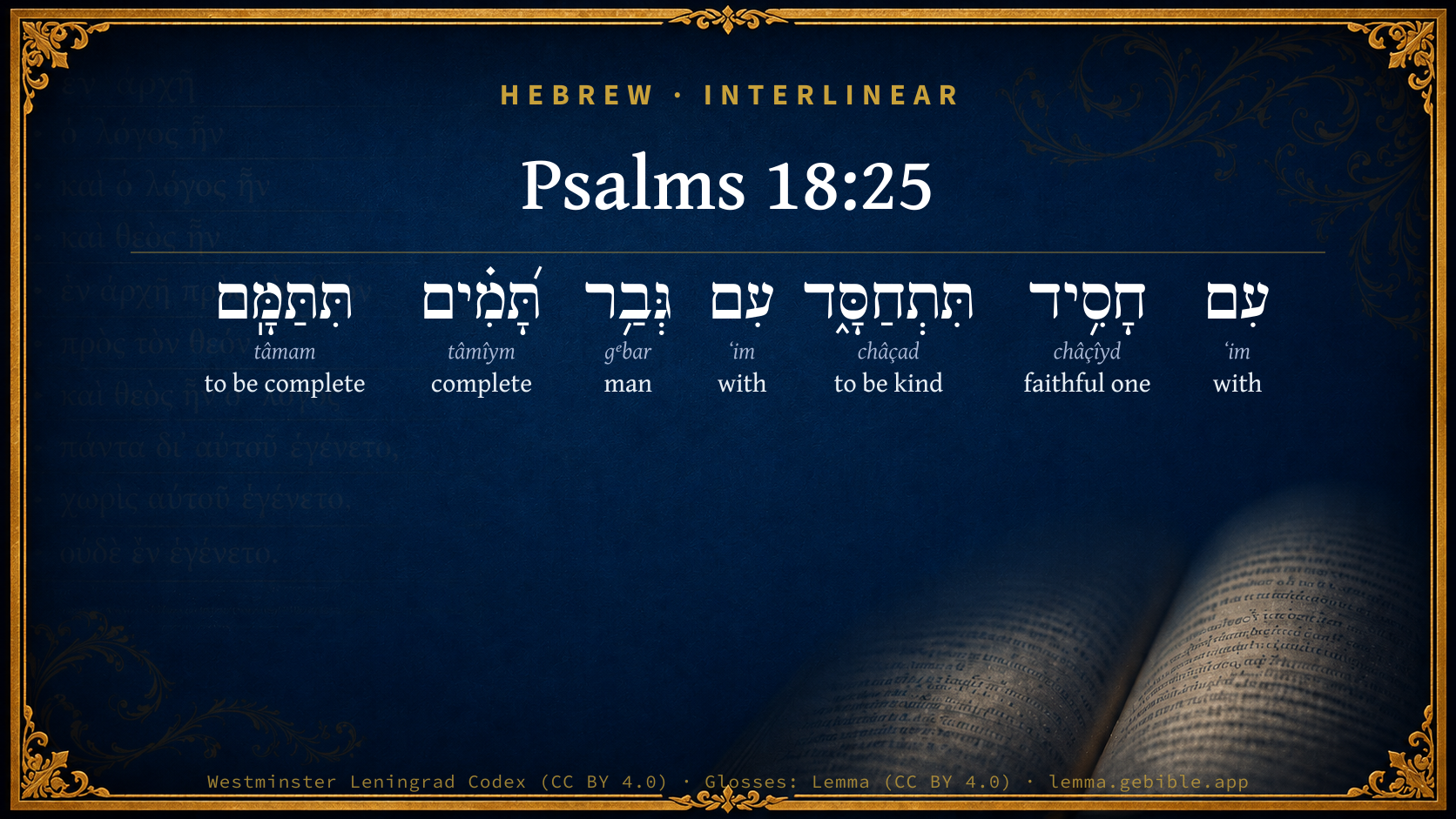
Hebrew (Westminster Leningrad Codex) Psalms 18:25 appears in the Hebrew Old Testament. The text above is from the Westminster Leningrad Codex. Each word links to its Strong’s number, a concise gloss, and parsing drawn from the Open Scriptures Hebrew Bible morphology. Click any word for its full Brown-Driver-Briggs (BDB) entry.
Download image
Cite this verse

Psalms 18:25 (World English Bible). Public Domain. Lemma interlinear Bible study tool, https://lemma.gebible.app/v/psalms/18/25.

Show BibTeX & RIS
BibTeX
RIS
English Translation
With the merciful you will show yourself merciful. With the perfect man, you will show yourself perfect.
World English Bible · Public Domain
Highlights
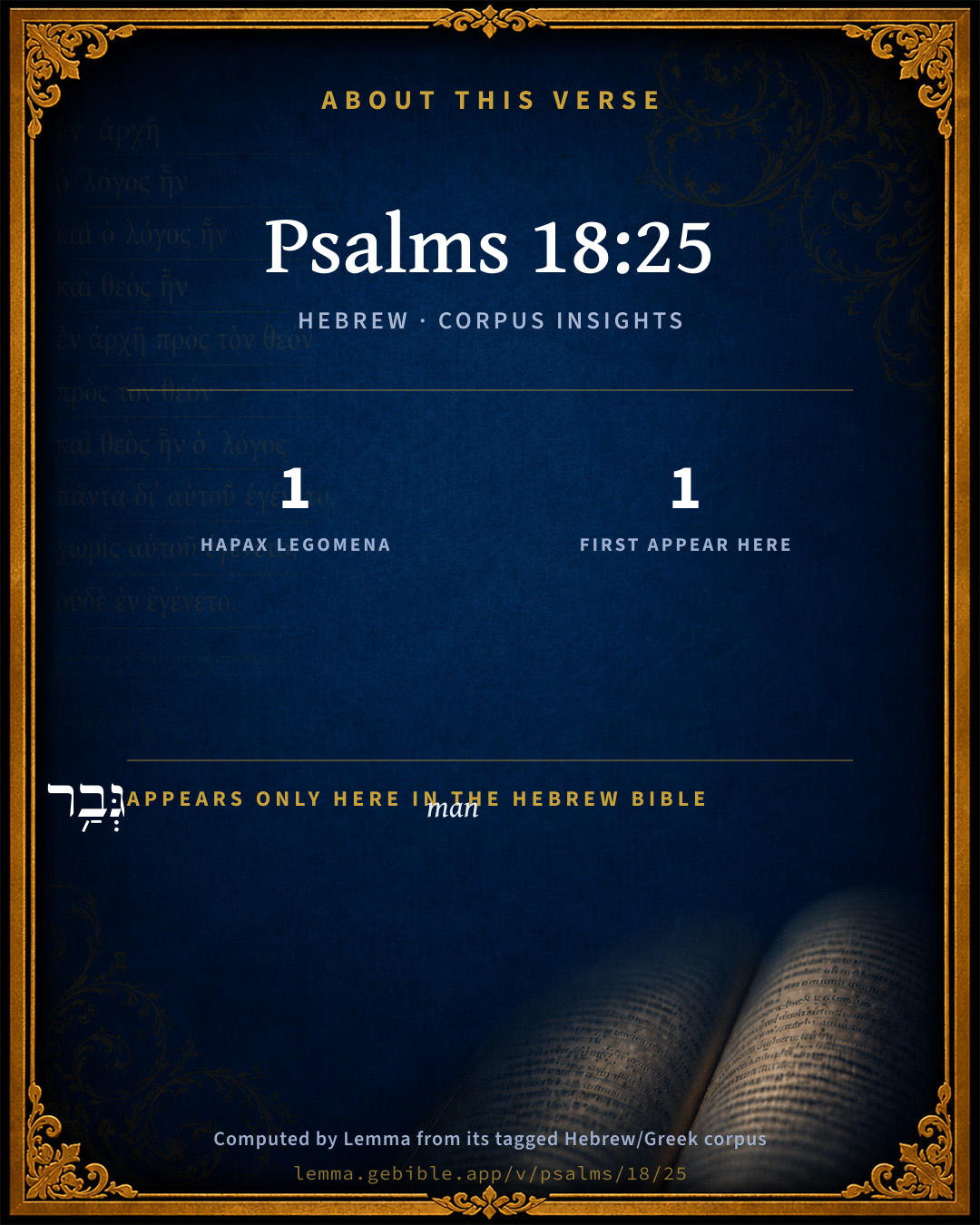
  • 1 hapax legomenon — only here in the Hebrew Bible
  • 1 first appearance in the Hebrew Bible
Full analysis ↓
Download a study sheet

One document with this verse’s original text, its word-by-word gloss line, the meaning frame, cross-references with their text, attributed commentary, and full source and license credits — printable, and it pastes into notes with its structure intact.

This verse Autodidact and up

Study sheet (.html) Plain text (.txt)

A passage Seminary Student

Up to 50 verses in one chapter. A passage sheet keeps up to 6 commentary sources and 12 cross-references per verse, in the order this page ranks them, and says so on the sheet whenever that leaves anything out. Ask for a single verse and you get the Autodidact verse sheet above.

Everything on this page stays free to read, with no account — the sheet is a download of what is already on screen, not access to it.

Want to remove ads? Support Godless Engineer
Compare translations 3

The same verse in 3 English versions, stacked beneath the original-language interlinear above. Click any original word for its lexicon entry.

Each is an independent rendering of the whole verse — the interlinear is not word-aligned to these translations.

Highlighted words mark where these versions differ — a whole-verse word diff, not a word-by-word alignment.

  • World English Bible Public Domain
    With the merciful you will show yourself merciful. With the perfect man, you will show yourself perfect.
  • King James Version Public Domain
    With the merciful thou wilt shew thyself merciful; with an upright man thou wilt shew thyself upright;
  • unfoldingWord Literal Text CC BY-SA 4.0
    With the faithful you show yourself faithful; with a blameless man, you show yourself blameless.

unfoldingWord Literal Text — © unfoldingWord, licensed CC BY-SA 4.0. Word-aligned USFM3 via Door43 (git.door43.org/unfoldingWord/en_ult).

Versions to compare (up to 4)

3 of 4 selected

Show all 18 translations

Every available English version of this verse, each an independent rendering of the whole verse.

  • World English Bible Public Domain
    With the merciful you will show yourself merciful. With the perfect man, you will show yourself perfect.
  • Berean Standard Bible Public Domain
    To the faithful You show Yourself faithful, to the blameless You show Yourself blameless;
  • Majority Standard Bible Public Domain
    To the faithful You show Yourself faithful, to the blameless You show Yourself blameless;
  • King James Version Public Domain
    With the merciful thou wilt shew thyself merciful; with an upright man thou wilt shew thyself upright;
  • American Standard Version (1901) Public Domain
    With the merciful thou wilt show thyself merciful; With the perfect man thou wilt show thyself perfect;
  • Revised Version (1885) Public Domain
    With the merciful thou wilt shew thyself merciful; with the perfect man thou wilt shew thyself perfect;
  • Geneva Bible (1599) Public Domain
    With the godly thou wilt shewe thy selfe godly: with the vpright man thou wilt shew thy selfe vpright.
  • Douay-Rheims (1899) Public Domain
    And the Lord will reward me according to my justice; and according to the cleanness of my hands before his eyes.
  • Young's Literal Translation Public Domain
    With the kind Thou showest Thyself kind, With a perfect man showest Thyself perfect.
  • Literal Standard Version CC BY-SA 4.0
    With the kind You show Yourself kind, || With a perfect man You show Yourself perfect.
  • Unlocked Literal Bible CC BY-SA 4.0
    To anyone who is faithful, you show yourself to be faithful; to a man who is blameless, you show yourself to be blameless.
  • unfoldingWord Literal Text CC BY-SA 4.0
    With the faithful you show yourself faithful; with a blameless man, you show yourself blameless.
  • Darby Bible Public Domain
    With the gracious thou dost shew thyself gracious; with the upright man thou dost shew thyself upright;
  • World Messianic Bible Public Domain
    With the merciful you will show yourself merciful. With the perfect man, you will show yourself perfect.
  • Webster's Bible Public Domain
    \\18:24\\Therefore hath the LORD recompensed me according to my righteousness, according to the cleanness of my hands in his sight.
  • Free Bible Version CC BY-SA 4.0
    You show trust to those who trust; you show integrity to those with integrity,
  • Bible in Basic English Public Domain
    On him who has mercy you will have mercy; to the upright you will be upright;
  • JPS Tanakh (1917) Public Domain
    (18-26) With the merciful Thou dost show Thyself merciful, with the upright man Thou dost show Thyself upright;

Literal Standard Version (2020), Covenant Press — licensed CC BY-SA 4.0. Text via the HelloAO Bible API (eBible.org). Unlocked Literal Bible (unfoldingWord) — licensed CC BY-SA 4.0. Text via the HelloAO Bible API (eBible.org). unfoldingWord Literal Text — © unfoldingWord, licensed CC BY-SA 4.0. Word-aligned USFM3 via Door43 (git.door43.org/unfoldingWord/en_ult). Free Bible Version, Dr. Jonathan Gallagher — licensed CC BY-SA 4.0. Text via the HelloAO Bible API (eBible.org).

Word by word

More ways to search: Search by grammar → Find every occurrence → Compare this word →

Practice this passage: Drill this verse → Learn its vocabulary →

About this verse

These counts appear in no published source. They are computed here, from the morphology-tagged text and Lemma’s own curated glosses. What Lemma adds →

7
words
6
distinct lemmas
Wisdom
section

Notable vocabulary

1 hapax legomenon — a word that appears only here in the entire Hebrew Bible:

  • גְּבַ֥ר man H1399

First appearance in Scripture

This word makes its first canonical appearance in the Hebrew Bible here:

  • גְּבַ֥ר man H1399

Shared distinctive vocabulary

תִּתְחַסָּ֑ד to be kind H2616 occurs in 3 verses of the Hebrew Bible. Also found in:

Grammatical profile

  • 2 verbs
  • 1 noun
  • 2 adjectives
  • 2 prepositions

Verb forms

  • תִּתְחַסָּ֑ד Hithpael · Imperfect
  • תִּתַּמָּֽם Hithpael · Imperfect

Repetition

A word recurs within this verse — often emphatic in Hebrew:

Hebrew & Septuagint length

In English translation the verse runs 17 words from the Hebrew and 16 from the Septuagint (LXX English) — closely comparable.

A rough comparison of the two English renderings, which tokenize alike — not a word-level alignment.

Word counts can differ between the Hebrew and the Greek without any difference in meaning — e.g. the Hebrew direct-object marker אֵת has no separate Greek word, and Greek often adds the article ὁ.

Cross-references

13

Topical passages linked to Psalms 18:25 in the Treasury of Scripture Knowledge — connected by theme and wording, ordered by reader-vote popularity; previews shown in the World English Bible.

  • Matthew 5:7 Blessed are the merciful, For they shall obtain mercy.
  • Psalms 62:12 Also to you, Lord, belongs loving kindness, For you reward every man according to his work.
  • Matthew 18:33–35 Shouldn't you also have had mercy on your fellow servant, even as I had mercy on you?'
  • 1 Kings 8:32 then hear you in heaven, and do, and judge your servants, condemning the wicked, to bring his way on his own head, and justifying the righteous, to give him according to his righteousness.
  • Nehemiah 9:17 and refused to obey, neither were mindful of your wonders that you did among them, but hardened their neck, and in their rebellion appointed a captain to return to their bondage. But you are a God ready to pardon, gracious and merciful, slow to anger, and abundant in loving kindness, and didn't forsake them.
  • Psalms 41:1–4 Blessed is he who considers the poor: Yahweh will deliver him in the day of evil.
  • Psalms 112:4–6 Light dawns in the darkness for the upright, Gracious, merciful, and righteous.
  • Ezekiel 18:25–30 Yet you say, The way of the Lord is not equal. Hear now, house of Israel: Is my way not equal? Aren't your ways unequal?
  • Isaiah 26:7 The way of the just is uprightness: you that are upright do direct the path of the just.
  • Isaiah 57:1–2 The righteous perishes, and no man lays it to heart; and merciful men are taken away, none considering that the righteous is taken away from the evil [to come].
  • Isaiah 58:7–8 Isn't it to deal your bread to the hungry, and that you bring the poor who are cast out to your house? when you see the naked, that you cover him; and that you not hide yourself from your own flesh?
  • Luke 6:35–38 But love your enemies, and do good, and lend, expecting nothing back; and your reward will be great, and you will be children of the Most High; for he is kind toward the unthankful and evil.
  • Romans 9:14 What shall we say then? Is there unrighteousness with God? May it never be!

Cross-references courtesy of OpenBible.info (CC BY 4.0).

Hebrew and Greek witnesses Masoretic Hebrew ↔ Greek Septuagint

The same verse in the two great witnesses to the Old Testament, shown verse-for-verse.

You’re reading Greek Psalm 17 (Hebrew Psalm 18). The Septuagint counts the superscription, so verse numbers can differ from the Hebrew — chapter-level alignment, not verse-by-verse. Numbering follows Rahlfs.

These are two independent witnesses, not word-aligned to each other, and the Septuagint is shown in lemma (dictionary) form.

Hebrew Psalms 18:25 Masoretic · Westminster Leningrad Codex

עִם חָסִ֥יד תִּתְחַסָּ֑ד עִם גְּבַ֥ר תָּ֝מִ֗ים תִּתַּמָּֽם

With the merciful you will show yourself merciful. With the perfect man, you will show yourself perfect.

World English Bible · Public Domain

Greek LXX Greek Psalm 17:25 Septuagint · lemma form

καί ἀντι ἀποδίδωμι ἐγώ κύριος κατά ὁ δικαιοσύνη ἐγώ καί κατά ὁ καθαριότης ὁ χείρ ἐγώ ἐνώπιον ὁ ὀφθαλμός αὐτός

With the holy you will be holy; and with the innocent man you will be innocent.

LXX2012 (modern English Septuagint) · Public Domain

Hebrew: Westminster Leningrad Codex (CC BY 4.0). Greek: Septuagint (public domain); English from LXX2012 (modern English Septuagint) (Public Domain). How the Septuagint differs from the Hebrew →

Commentary

Notes on Psalms 18:25 from classic Christian and Jewish commentators (each source and its license shown beneath its notes). The classic Christian expositions comment on the surrounding passage and are grouped to its opening verse, so a note may address several verses; the Jewish commentaries on the Tanakh (Rashi and others) are per-verse, so they appear only where the commentator wrote on this verse.

Lemma curates 59 commentaries, every one of them public domain or Creative Commons licensed, each selected and text-cleaned for this edition rather than reprinted as found. About our sources →

Ellicott's Commentary for English Readers

(25) Man.—The text of Samuel has “hero” (gebôr instead of gebar).

(25-27) It is better to change all the futures into our present. We cannot explain this description of God’s attitude to man, as if the poet were merely dealing with the conception of the Divine formed in the breast. No doubt his words are amply true in this sense. The human heart makes its God like itself, and to the pure and just He will be a pure and just God, to the cruel and unjust, cruel and unjust. But the definite mention of recompense in Psa_18:24, and the reference to active interposition in behalf of the just in Psa_18:27, leave us no option but to understand by “shew thyself” in Psa_18:25-26, not an inward conception, but an external manifestation. It is, in fact, nothing more than a re-statement of the truth of which the history of Pharaoh is the most signal historic declaration, and which we maintain whenever we speak of the natural consequences of sin as retributive justice, the truth which is summed up in the text, “whatsoever a mau soweth that shall he also reap.” We must at the same time remember that the form of the statement in the psalm is due to the view current in Israel before the development of the conception of Satanic agency, that all suggestions, evil as well as good, came from the mind of the Supreme Disposer of events.

A Bible Commentary for English Readers, edited by Charles John Ellicott (1878–1897) — public domain. Text from a community e-Sword module.

Trapp's Complete Commentary

John Trapp

Psa 18:25 With the merciful thou wilt shew thyself merciful; with an upright man thou wilt shew thyself upright;

Ver. 25. With the merciful, &c.] Hypothesin hic ad thesin transfert. It is as if he should say, I and mine enemies are a pattern of thy truth and justice, that thou wilt do good to those that are good, and to them that are upright in their hearts. As for such as turn aside unto their crooked paths, thou, Lord, shalt lead them forth with the workers of iniquity, Psa 125:4-5.

John Trapp, A Commentary or Exposition upon All the Books of the Old and New Testament (1647–1656) — public domain. Text from a community e-Sword module.

The Biblical Illustrator

Joseph S. Exell

Psa_18:25-26

With the merciful Thou wilt show Thyself merciful.

Poetic justice actual justice

What we call poetic justice pervades the whole Bible. We feel ill the advancing civilisations that there is a reaching more and more to a realisation of this justice. In Job we have its full exemplification. There the latter end of the history of the mart vindicates all. It is a dangerous teaching that some people try to wring out of the New Testament, that good people must not expect success in this world; that only the children of this world are wise in their generation, and can secure to themselves worldly prosperity. The opposite teaching is not near so dangerous, and not so wide of the truth, that all things will come out well in this life for those who do right. It does not always so turn out, but this is the tendency. We do not believe it is a good policy even in the material world to be bad. With the merciful God is merciful, and with the pure He is pure, and with the froward He is froward. Let us go beyond the physical world into the moral world. God is present with His world, governing it constantly. I do not believe that He is unknowable. He has wrought Himself in all His work, and is, of all powers, the most perpetually forced upon our attention. All science, all art, all of our studies are theological studies. Now, God reveals Himself as always on the side of right. In the moral world penalty follows wrong, and reward follows right with unfailing certainty. There is no confusion, there is no uncertainty in the moral world. Judgment is present everywhere. Of all scepticism, that is the most dangerous that questions the fundamental difference between right and wrong in their nature and tendencies. Plutarch speaks of the delay of judgment. There is no such delay. It comes, and comes at once. There are various elements that go to make up this penalty. Remorse, which is everywhere present in greater or less degree. Various social and civil penalties. The actual loss in our moral natures. Our idea of God is determined largely by our own character. The vision we have of God in the plain of the intellectual perception is a reflection of our own selves. The God of each man is different from the God of other men. As you are, so is your God. (John W. Chadwick.)

Gods mercy among Christians

It is only in a rough sort of way at the best, as far as observation of individuals will carry us, that we see distinction made by Providence between the upright and the froward. But as no one knew better than the author of this Psalm, it is not to the fortunes of men, but to their whole experience as rational and spiritual beings, that we have to look in order to see how true it is that God shows Himself to every man according to what every man is.

I. In the first place, our life is experience of God; for in Him most literally we live and move and have our being. If we find that this set of actions has one result and that set has another--this, as far as it goes, is a most authentic revelation to us of God. To say, therefore, that life is different to different men, above all as they differ in point of spiritual character, is to say that God shows Himself to them as so many different gods. To an honest man life is different from what it is to a rogue; different to a merciful man from what it is to a churl or a miser; different to a pure man from what it is to a sot or a debauchee. To take the illustration which is nearest at hand--David would have had a different experience from Saul whether he had or had not got Sauls place. The one man could be eminently happy with a shepherds crook, and it mattered little to either so long as each was what he was in character. No two men could have had a more different experience in their lives; but the difference, such as it was, we can see, was in themselves--not made by their fortunes, but by their characters; not by the events of peace or war, but by the quality of mercy in the one case and of wilfulness in the other. Thus justice is done between man and man where justice is sure, and where it is perfect--in themselves. Many good people at the present time are haunted by an alarm which is altogether visionary. Look, they say, how many who live vicious lives know nothing of remorse! If there be no such thing as eternal punishment for the wicked, then there is no punishment; if there be no hell, there is no harm. But this is to take a very narrow view of human experience. There is much more remorse in peoples hearts than they wear upon their sleeves. Many a smiling face, if you could get behind that mask, would show you grim enough features. At the same time, I grant readily that if remorse, so called, were all the difference between man and man on the score of character, the difference might seem to be trifling. It is the best and not the worst natures which know most of remorse. A good man falls into sin, and he knows what hell is. The wicked have no bands in their death. Consciences, which ought to burn, are seared; they should be live coals, and they are white cold ashes. I grant all this. But is there nothing besides remorse in question as between life and life? For apart from remorse and everything like it, and in the nature of things, and everywhere and always, it is one thing to be upright and another to be wilful, it is one thing to be a kind man and another to be an unkind, one thing to be pure and another to be impure. The good of being good is ill being so, and not in having no remorse; and the evil of being evil is in being so, and not in having remorse. Why will people so constantly forget this or overlook it? It is not that these different men have here and there, at odd moments, different or contrary experiences, but that the world in which each lives is a wholly different world. I know, for certain, that he who loves righteousness and truth and goodness would think that fate the cruellest of all possible which condemned him to be a rogue or a hypocrite. Thus, in the first place, because life is experience of God, to different men God is different. But I hasten now to remark that to different men--

II. He is also different as an object of study and reflection. On many other subjects, or rather on most, if people agree they do agree, and if they differ they differ, and there is an end of it. But it is different with regard to the highest object of human thought--God. People may agree, and do agree, in their language respecting Him, who have little or nothing in common in their thought and meaning. In point of fact, I venture to say, in the first place, among us, who all profess the same creed, there are Gods many and Lords many. Wesley, it is said, remonstrated with Whitfield as to his ideas of God, telling him, your God is my devil. And is it not obvious that something of the same sort might be said by sets of Christians at the present day to other sets? It is not what you read in sacred books, but the common notions of men that shape the common beliefs about God. Protestants do not believe in the God of the Romanist, nor he in heirs, though they have the same Bible and the same great articles of faith. To be condemned to think of God, as some men think of Him, and must think of Him, their life being stronger than their creed, not as a being to be loved, but as one to be feared or hated--this is punishment. If the light that is in you be darkness, how great is that darkness? If your religion is night, where is your day? If God is a bugbear, what is your life? What other gain, or reward, or happiness, on the other hand, would you desire than the religion of Christ--to love righteousness and truth and goodness with all your heart and soul and strength and mind, and to believe that God, who is over all, and is the Beginning and the End of all, is all that you love? What other reward, gain, happiness would you have than that? Christianity is a sorry gain, I admit, to many who profess it, except it be the only escape from the bottomless pit, and from the lake of fire and brimstone. It is a sorry gain to those, and they are many, whose notion is that something which God can give them, or some place in which He can put them, will be heaven. But that which makes God Himself our heaven is great gain, without reference to any life but this. With this a man might live and die, and doubt if he is to live again, and with his last breath bless God--the merciful mans God, and his exceeding great reward.

III. I have but to add, then, last of all, as the practical lesson which we get from all this--a man may change his Church and his creed and not change his God; but he changes his God when he changes his life. Let us, by trying to do the will of God in our daily life, learn of the truth whether it be of God. Otherwise we shall never learn it. (J. Service.)

The attitude of God towards good and bad men

Even as the sun, which unto eyes being sound and without disease is very pleasant and wholesome, but unto the same eyes, when they are feeble, sore, and weak, is very troublesome and hurtsome, yet the sun is ever all one and the self same that was before; so God hath ever shown Himself benign and bountiful to those who are kind and tender hearted towards His saints, and are merciful to those who show mercy. But unto the same men, when they fall into wickedness, and grow and are full of cruelty, the Lord showeth Himself to be very wrathful and angry, and yet is one and the same immutable God from everlasting to everlasting. (Robert Cawdray.)

The Biblical Illustrator, edited by Joseph S. Exell (c. 1880s–1900s) — public domain. Text from a community e-Sword module.

Joseph Benson's Commentary

Psa 18:25-27. In these verses David lays down the general method of the procedure of God’s providence and moral government, which, in the issue, will be according to the moral character and conduct of men themselves. With the merciful, &c. — A declaration similar to that of our Lord, Blessed are the merciful, for they shall obtain mercy. With an upright man thou wilt show thyself upright — An invariable friend to his integrity; just to reward it, and faithful in all thy promises to encourage it. With the pure thou wilt show thyself pure — That is, the lover of purity, righteousness, and truth, and ever acting toward those whose character this is, according to the perfect rectitude and unspotted purity of thy own nature. With the froward thou wilt show thyself froward — Hebrew, עם עקשׁ תתפתל, gnim gnickesh Tithpattal, cum perverso eluctaris, Buxtorff. With the perverse thou strugglest, or, rather, wilt struggle or wrestle; that is, says Ab. Ezra, donec deviceris, until thou shalt conquer him. The word rendered froward signifies one of a perverse disposition, who twists and twines himself, just as his humour, passions, and interest lead him; or, a crafty, wily person, who accustoms himself to all the wiles of deceit. With one of this character, the psalmist says, God will wrestle. The meaning is, that he will deal with perverse, designing, and crafty men, according to their deserts; will oppose them in their designs, struggle against, and walk contrary to them, Lev 26:23-24; that he will disappoint them in all their subtlest devices, and cause them to fall by those very wiles by which they endeavour to deceive and ruin others. See Chandler and Dodd. For thou wilt save the afflicted people — Thou art wont to deliver those who are poor and distressed when they humbly wait upon thee; but wilt bring down high looks — Wilt lay those low who, proud of their power, insolently oppress them; or, those proud persons who discover the pride of their hearts by their haughty looks and overbearing conduct.

Joseph Benson's Commentary on the Old and New Testaments (1811–1818) — public domain. Text from a community e-Sword module.

J. A. Alexander on Psalms

Joseph Addison Alexander

26, 27. (Psa 18:25-26). With the gracious thou wilt shew thyself gracious; with the perfect man thou wilt shew thyself perfect; with the purified thou wilt shew thyself pure; and with the crooked thou wilt shew thyself perverse. What he had previously mentioned as the method of God's dealings towards himself, he now describes as a general law of the divine administration. The essential idea is that God is, in a certain sense, to men precisely what they are to him. The particular qualities specified are only given as examples, and might have been exchanged for others without altering the general sense. The form of expression is extremely strong and bold, but scarcely liable to misapprehension, even in that God can act perversely even to the most perverse. But the same course of proceeding which would be perverse in itself or towards a righteous person, when pursued towards a sinner becomes a mere act of vindicatory justice. In the first clause of Psa 18:26 (25), the ambiguous word gracious has been chosen to represent the similar term, for the comprehensive use of which we see above, on Psa 4:4 (3), Psa 12:2 (1). Perfect has the same sense as in Psa 18:23 (22), namely, that of freedom from hypocrisy and malice. The verbs are all of the reflexive form and might be rendered, thou wilt make thyself gracious, thou wilt act the gracious, or simply thou wilt be gracious, &c., but the common version approaches nearest to the force of the original expression. The first verb of Psa 18:27 (26) occurs once elsewhere (Dan 12:10), the rest only here. The forms may have been coined for the occasion, to express the bold conception of the writer. The resemblance of the last clause of Psa 18:27 (26) to Lev 26:23-24, makes it highly probable that the whole form of this singular dictum was suggested by that passage, the rather as this Psalm abounds in allusions to the Pentateuch and imitations of it.

Joseph Addison Alexander, The Psalms Translated and Explained (1850) — public domain. Text from a community e-Sword module.

Tyndale Open Study Notes

Tyndale Open Resources

18:25-29 The faithful God remains true to his character. He loves faithfulness, blamelessness, and purity, and he hates the perverse (see 1:6).

Tyndale Open Study Notes — © Tyndale Open Resources, licensed CC BY-SA 4.0. Text via the HelloAO Bible API.

Geneva Bible (1599)

Geneva Bible translators

Here he speaketh of God according to our capacity, who showeth mercy to his and punisheth the wicked, as is said also, Lev. 26:21, 24.

Geneva Bible (1599) marginal notes — public domain. Text via Bolls.life.

Jamieson, Fausset & Brown

Robert Jamieson, A. R. Fausset & David Brown

God renders to men according to their deeds in a penal, not vindictive, sense (Lev 26:23-24).

merciful--or, "kind" (Psa 4:3).

Jamieson, Fausset & Brown — Commentary Critical and Explanatory on the Whole Bible (1871) — public domain (CC PDM 1.0). Text via the HelloAO Bible API.

Adam Clarke's Commentary

Verse 25. With the merciful thou wilt show thyself merciful] Thou wilt deal with men as they deal with each other. This is the general tenor of God's providential conduct towards mankind; well expressed by Mr. Pope in his universal prayer: -

"Teach me to feel another's wo;

To hide the fault I see:

The mercy I to others show,

That mercy show to me."

It is in reference to this that our Lord teaches us to pray: "Forgive us our trespasses, as we forgive them that trespass against us." If we act feelingly and mercifully towards our fellow creatures, God will act tenderly and compassionately towards us. The merciful, the upright, and the pure, will ever have the God of mercy, uprightness, and purity, to defend and support them.

Adam Clarke's Commentary on the Bible (1810–1826) — public domain. Text from a community e-Sword/MySword module.

John Calvin's Commentaries

25. With the merciful, etc. David here prosecutes the same subject. In considering the grace of God by which he had been delivered, he brings it forward as a proof of his integrity, and thus triumphs over the unfounded and disgraceful calumnies of his enemies. Hypocrites, I confess, are also accustomed to act in the same way; for prosperity and the success of their affairs so elates them that they are not ashamed proudly to vaunt themselves not only against men, but even against God. As such persons, however, openly mock God, when, by his long-suffering, he allures them to repentance, their wicked and unhappy presumption has no resemblance to the boasting by which we here see David encouraging himself. He does not abuse the forbearance and mercy of God by palliating or spreading a specious varnish over his iniquities, because God bears with them; but having, by the manifold aids he had received from God, experienced beyond doubt that he was merciful to him, he justly viewed them as evident testimonies of the divine favor towards him. And we ought to mark well this difference between the ungodly and the faithful, namely, that the former, intoxicated with prosperity, unblushingly boast of being acceptable to God, while yet they disregard him, and rather sacrifice to Fortune, and make it their God; “Ils sacrifient plustest a Fortune, et en font leur Dieu.” — Fr.

“God will make my righteousness to return upon me.”

The scope of the discourse is, that the people of God should entertain good hope, and encourage themselves to practice uprightness and integrity, since every man shall reap the fruit of his own righteousness.

John Calvin's Commentaries (1540-1563) — public domain. Text from the Calvin Translation Society English edition (1840s-50s) via the Christian Classics Ethereal Library (ccel.org). Calvin's coverage is partial (roughly two-thirds of the Bible); uncommented books and verses are honest gaps, never fabricated. The 19th-century editor's footnotes and remarks are omitted so the notes are faithfully Calvin's own voice.

The Cambridge Bible for Schools and Colleges

gen. ed. J. J. S. Perowne

25. With the merciful &c.] The man whose conduct in life is governed by the spirit of lovingkindness will himself experience the lovingkindness of Jehovah. Cp. Mat_5:7; Mat_6:12; Mat_6:14-15; and for the meaning of merciful see notes on Psa_4:3, Psa_12:1, and Appendix, Note I.

with an upright man &c.] Rather as R.V., with the perfect man thou wilt shew thyself perfect. Singlehearted devotion will find a response of unswerving faithfulness.

The text in 2 Sam. has “the perfect hero,” the man who is valiant in maintaining his own integrity. But the reading is questionable.

The Cambridge Bible for Schools and Colleges (gen. ed. J. J. S. Perowne; Cambridge University Press, 1878–1918) — public domain. Text from a community e-Sword module.

John Gill's Exposition

With the pure thou wilt show thyself pure,.... None of Adam's posterity are pure by nature; they are all defiled with sin; and though some are pure in their own eyes, they are far from being cleansed from their filthiness; such only are pure who are sanctified by the Spirit of God, have clean hearts created in them, and whose hearts are purified by faith in the blood of Christ; who are justified by Christ's righteousness, and are washed from their sins in his blood; and who, in consequence of such grace, love, pureness of heart, speak a pure language, hold the mystery of faith in a pure conscience, and with a pure conversation, and live soberly, righteously, and godly: and whereas God is a pure and holy Being, his perfections, works, and word, are pure; he shows himself to be so to such persons, by providing for the honour of his purity and holiness in their redemption, sanctification, and salvation; by making all things to be pure to them; by granting them his presence, and blessing them with the vision of himself here and hereafter; see Mat 5:8; this may likewise be understood of Christ, who, in his human nature, is pure from all sin, both original and actual: he indeed took upon him the sins of his people, and bore them, and made satisfaction for them, and brought in everlasting righteousness; which being done, God has showed himself pure to him, by justifying, acquitting, and discharging him from all such sins; by accepting his righteousness, and imputing it to those for whom he wrought it;

and with the froward thou wilt show thyself froward; or "thou wrestlest" (b), or wilt contend with them until they are destroyed: the same word is here used which Naphtali has his name from, Gen 30:8. The froward are such as are of perverse dispositions, and of stubborn and obstinate tempers, and whose ways are crooked and distorted; and such were the people of the Jews in the times of Moses, and of Christ, Deu 32:5; and who seem here to be designed; even the Jews in Christ's time, who were just the reverse of the above characters, were cruel and unmerciful, faithless and hypocritical, filthy and pure, disbelieved the Messiah, rejected and crucified him, were contrary to God, and to all men; and therefore God walked contrary to them, as he threatened, Lev 26:27; the same as showing himself froward to them; for God is not froward and perverse in himself, nor in his ways, which are all equal, just, and pure: and though there is one and the same word used in our version, yet there are two different words in the Hebrew text; the same word that is used of the froward is not used of God; that which is used of God, as before observed, signifies wrestling, and designs God's contending with the people of the Jews, in a way of wrath and fury, which came upon them to the uttermost, and issued in their entire ruin as a people and nation; the words here had their fulfilment in the destruction of Jerusalem.

(b) "eluctaris", Junius & Tremellius; "colluctaris", Aben Ezra; "reluctaris", Gejerus; "certas", Schmidt.

John Gill's Exposition of the Whole Bible (1746–1763) — public domain (CC PDM 1.0). Text via the HelloAO Bible API.

Albert Barnes' Notes on the Bible

With the merciful - From the particular statement respecting the divine dealings with himself the psalmist now passes to a general statement (suggested by what God had done for him) in regard to the general principles of the divine administration. That general statement is, that God deals with men according to their character; or, that he will adapt his providential dealings to the conduct of men. They will find him to be such toward them as they have shown themselves to be toward him. The word merciful refers to one who is disposed to show kindness or compassion to those who are guilty, or to those who injure or wrong us.

Thou wilt show thyself merciful - Thou wilt evince toward him the same character which he shows to others. It is in accordance with this that the Saviour teaches us to pray, “And forgive us our debts, as we forgive our debtors,” Mat 6:12. And in accordance also with this he said, “For if ye forgive men their trespasses, your heavenly Father will also forgive you: but if ye forgive not men their trespasses, neither will your Father forgive your trespasses,” Mat 6:14-15.

With an upright man - literally, a perfect man. See Job 1:1, where the same word is used in the original, and rendered perfect. The idea is that of a man who is consistent, or whose character is complete in all its parts. See the note at Job 1:1.

Thou wilt show thyself upright - Thou wilt deal with him according to his character. As he is faithful and just, so will he find that he has to do with a God who is faithful and just.

Albert Barnes' Notes on the Bible (1834–1885) — public domain. Text from a community e-Sword/MySword module.

Matthew Poole's English Annotations

Upright, or sincere, to wit, in performing what thou hast promised to such persons, this being a great part or act of sincerity, when one’s deeds and words, or professions, agree together; as, on the contrary, for those that deal hypocritically and wickedly with thee, thou wilt make them to know thy breach of promise, as it is expressed, Num 14:34. The sense of the verse is, Thou metest to every one the same measure which he meteth out to others, and givest to him the fruit of his own doings, and therefore thou wilt perform mercy and truth to those who are merciful and true to others, as through thy mercy I have been.

Matthew Poole's English Annotations on the Holy Bible (1683–1685) — public domain. Text from a community e-Sword/MySword module.

The Treasury of David

Charles H. Spurgeon

Ver. 25. The dealings of the Lord in his own case, cause the grateful singer to remember the usual rule of God's moral government; he is just in his dealings with the sons of men, and metes out to each man according to his measure.

With the merciful thou wilt shew thyself merciful; with an upright man thou wilt shew thyself upright. Every man shall have his meat weighed in his own scales, his corn meted in his own bushel, and his land measured with his own rod. No rule can be more fair, to ungodly men more terrible, or to the generous man more honourable. How would men throw away their light weights, and break their short yards, if they could but believe that they themselves are sure to be in the end the losers by their knavish tricks! Note that even the merciful need mercy; no amount of generosity to the poor, or forgiveness to enemies, can set us beyond the need of mercy. Lord, have mercy upon me, a sinner.

Ver. 25. With the merciful thou wilt shew thyself merciful; with an upright man thou wilt shew thyself upright. "An upright" the same word is oft translated "perfect, "he is good throughout, though not thoroughly; not one that personates religion, but that is a religious person. He is perfect, because he would be so. So Noah is termed (Ge 6:9); "Noah was a just man and perfect (i.e., upright) in his generation:" he was a good man in a bad age. He was like a glowing spark of fire in a sea of water, which is perfect goodness; and therefore the Holy Ghost doth so hang upon his name, as if he could not give overit is an excellent preacher's observation Ge 6:8, "But Noah was a just man and perfect in his generations, and Noah walked with God. And Noah found grace in the eyes of the Lord. These are the generations of Noah: Noah begat three sons." Noah, Noah, Noah, I love the sound of thy name; and so are all your names precious to God, though hated by men, if the name of God be dear and sweet to you. 'Tis also sometimes translated "plain." Ge 25:27. Jacob was Mt vya, "a plain, "that is, an upright man, "dwelling in tents." Esau was "a cunning hunter, "but Jacob was a plain man without welt or gard; you might well know his heart by his tongue, save once when Rebekah put a cunning trick into his head, otherwise he was a most "upright, "downright man. And the plain meaning of it is, a simple, cordial, unfeigned, and exact man: this is the man we are looking for. "Man." This substansive the Hebrews use to drown in the adjective, but here the Holy Ghost exhibits a word, and a choice one too, signifying a strong, valiant man; the same word (Ps 45:3), "O mighty man!" that's meant of our Lord Christ, who was a most strong and valiant man, that could meet the wrath of God, the malice of the devil, and the sin of man, in the face, and come off with triumph. And so the Dutch translate this clause in 2Samuel 22: "With the right valiant person, you behave yourself upright." In short, if the words were literally translated, they run thus: a man of uprightness: that is, every way you behold him, an upright man: like an even die, cast him which way you will he will be found square and right; a stiff and strong man to tread down both lusts within and temptations without; an Athanasius contra mundum, a Luther contra Roman; this is a man of an excellent spirit, and such is our upright man. "Thou wilt shew thyself upright, "or, "wilt be upright with him; "for one word in the Hebrew makes all these six, "Thou wilt upright it with him." If men will deal plainly with God, he will deal plainly with them. He that is upright in performing his duty shall find God upright in performing his promises. It is God's way to carry to men as they carry to him. If thou hast a design to please him, he will have a design to please thee; if thou wilt echo to him when he calls, he will echo to thee when thou callest. On the other side; if a man will wrestle with God, he will wrestle with him; if thou wilt be fast and loose with him, and walk frowardly towards him, thou shalt have as good as thou bringest; if thou wilt provoke him with never ending sins, he will pursue thee with never ending torments; if thou wilt sin in tuo eterno, thou must suffer in suo eterno, and every man shall find like for like...An upright heart is single without division. Unto an hypocrite there be "gods many and lords many, "and he must have an heart for each; but to the upright there is but one God the Father, and one Lord Jesus Christ, and one heart will serve them both. He that fixes his heart upon the creatures, for every creature he must have an heart, and the dividing of his heart destroys him. Ho 10:2. Worldly profits knock at the door, he must have an heart for them; carnal pleasures present themselves, he must have an heart for them also; sinful preferments appear, they must have an heart tooNecessariorum numerus parvus, opinionum nullus; of necessary objects the number is few, of needless vanities the number is endless. The upright man hath made choice of God and hath enough. Richard Steele.

Ver. 25. With the merciful, etc. In Jupiter's hall floor there are set two barrels of gifts, the one of good gifts or blessings, the other of evil gifts or plagues. Thus spake Homer falsely of Jupiter; it may truly be spoken of the true God, Jehovah; that he hath in his hand two cups, the one of comforts, the other of crosses, which he poureth out indifferently for the good and for the bad; with the kind (or merciful) he will shew himself kind, and with the froward, froward. Now this is not to make God the author of evil, but of justice, which is good; qrorum deus non est author eorum est justus ultor, saith Augustine; "God is not the author of sin, but he punishes the sinner justly." Miles Smith (Bishop), 1632.

Ver. 25. Equity of the divine procedure. C. Simeon.

Psalms 18:26*

Charles H. Spurgeon's The Treasury of David (1869–1885) — public domain. Psalms only. Text from a community e-Sword/MySword module.

The Pulpit Commentary

Vers. 25-28. A short didactic digression is here interposed, extending the principles on which God has dealt with David and his enemies, to mankind generally (vers. 25-27); after which a return is made to God"s special dealings with David (ver. 28).

With the merciful thou wilt show thyself merciful. The main principle is that God will act towards men as they act towards him. If they are kindly, gracious, loving towards him for this is what the word chasid means he will be kindly, gracious, loving towards them, and vice versa, as explained in vers. 26, 27. With an upright man thou wilt show thyself upright; or, a perfect man (Revised Version). The word is the same as that used in Psa_4:3 Psa_12:1 Psa_31:23 Psa_34:6 Psa_37:28, etc., and generally translated "godly," or, in the plural, "saints.

Vers. 25, 26. God"s revelation of himself is suited to man"s capacity.

"With the merciful," etc. We see what we have eyes to see; hear what we have ears to hear; feel what we have capacity to feel. Suppose four listeners to the same piece of music. To one, with a critical ear, it is a rendering, good or ill, of the musician"s composition; to a second, a strain of national music; to a third, full of memories of childhood; to a fourth, who has no ear for music, a tedious noise. Suppose a group watching a lamb skipping in a field. One is a painter; another, a naturalist; another, a shepherd; another, a butcher. Each sees something the rest cannot see. Perhaps a simple Christian coming by sees what none of them perceives a reminder of the good Shepherd, who gathers the lambs in his arms. As in outward things, so in spiritual. As with bodily sight, hearing, feeling, so with spiritual perception. He that has eyes will see. "He that hath ears to hear, let him hear." Therefore the lesson of the text is a great and widely applicable truth God"s revelation of himself is suited to mens spiritual capacity. Different souls get different views of God.

I THIS IS TRUE OF GOD"S DEALINGS.

1. They appear different to different eyes. Visit two homes, perhaps in the same street, in which there is similar trouble sick-ness, or bereavement, or failure in business, or sore poverty. In one, all is gloom, repining, comfortless perplexity. In the other, there is light in the darkness, a rainbow on the storm. To one sufferer God"s ways are hard, dark, mysterious; he is even ready to think them unjust. The other says, "I could not bear it in my own strength, but the Lord stands by me and strengthens me. God"s will must be right. He cannot make mistakes or be unfaithful. He is my Refuge and Strength." So with God"s government of the world and general providence. One mind fastens on the pain, sorrow, calamity, which every hour records pestilence, earthquake, tempest, and so forth. Another sees that the universal design and general working of all natural laws is for good and happiness, not evil; that the main part of human suffering has its root in sin; that "the earth is full of the goodness of the Lord;" and trusts God for the rest.

2. God"s dealings not only appear different; they are and must be different, according to the temper and attitude of our souls. To the soul that bows under God"s hand, trusts his Word, clings closer to him in trial, it is "chastening full of mercy, rich in result. (Heb_12:6, etc.) The proud, stubborn heart, that resents and rebels against affliction, is hardened by it, like Pharaoh.

II IT IS SO WITH GOD"S WORD. Come to the Scriptures in a cavilling, critical, hostile spirit, and they will teem with difficulties. Read them carelessly, scornfully; they will be dull and lifeless. Search them, with an earnest desire to know the truth, with prayer for the Holy Spirit"s teaching, with candour and humility; they will "talk with thee", (Pro_6:22) and unfold their secrets. Thou shalt hear God"s own voice speaking to thy soul; and find what the Thessalonians found. (1Th_2:13)

III SO IT WAS WITH OUR LORD JESUS. Isaiah"s prediction was fulfilled. (Isa_53:2, Isa_53:3) Scrupulously religious persons, but blinded by self-righteousness, could no more see his glory than sceptics, hypocrites, or scoffing triflers. (Mat_13:14, Mat_13:15) But his disciples those who first believed on him, and then lived in close converse with him could say, "We beheld his glory". (Joh_1:14)

CONCLUSION. SO it is to-day. This is a universal lawWhat God is to you what Christ is to you, shows what you are, and determines what you shall be. The gospel is an open secret, but still a secret, from proud, worldly hearts. The physician is for those who are sick and know it. The Saviour is for sinners who feel themselves sinners. The living water will not flow into a vessel turned upside down. Heaven itself would be no heaven to a heart full of love of the world, of self, of sin, and void of love to God.

The Pulpit Commentary (1880–1919), ed. H.D.M. Spence-Jones & Joseph S. Exell — public domain. Text from a community e-Sword module.

John Wesley's Explanatory Notes

Upright - Thou metest to every one the same measure, which he meteth out to others; and therefore thou wilt perform mercy and truth, to those who are merciful and true to others.

John Wesley, Explanatory Notes Upon the Whole Bible (1754–1765) — public domain. Text via the GEBible commentary corpus.

unfoldingWord translationNotes

Door43 World Missions Community

General Information:

The writer speaks to Yahweh.

To anyone who is faithful

Here "faithful" means to do what God commands one to do. You can state this clearly. AT: "to those who faithfully obey your commandments" or "to those who faithfully do your covenant" (See: Assumed Knowledge and Implicit Information)

to a man who is blameless ... you show yourself pure

Both of these clauses have similar meanings. The writer repeats these ideas for emphasis. (See: Parallelism)

you are clever toward anyone who is twisted

"you outwit anyone who is not honest"

translationWords

faithful

blameless

pure

unfoldingWord translationNotes — © Distant Shores Media and the Door43 World Missions Community, licensed CC BY-SA 4.0. Source: git.door43.org/Door43/en_tn.

Lesson kit

Teaching starters — assembled from the data on this page, not authored interpretation. Every prompt links to the verse data it draws on. Edit before teaching.

Psalms, in the Wisdom, opens this verse with 7 words (6 distinct Hebrew lemmas). Its most distinctive word is gᵉbar (“man”). A historical commentator’s framing appears above. Read the whole chapter for the surrounding context.

Discussion questions

  1. The word gᵉbar carries the sense “man.” How does it shape the verse?
  2. This verse holds 1 word here found nowhere else in the Hebrew Bible. What might the rare word draw attention to?
  3. The word “man” first appears here in Scripture. What is being introduced at this debut?
  4. 2 Samuel 22:26 shares the word «to be kind» with this verse. How do the two illuminate each other?
  5. “with” occurs 2× in this one verse. What is the effect of the repetition?
  6. The translations on this page render this verse differently — a whole-verse word diff, not a word-by-word alignment. What might account for the different wordings?
  7. The verb «תִּתְחַסָּ֑ד» is Hithpael Imperfect. How does its form color the action?
  8. Reading how Ellicott's Commentary for English Readers and Trapp's Complete Commentary read this verse, where do the two commentators agree and where do they part?

Things to notice

  • 1 word in this verse appears nowhere else in the Hebrew Bible.
  • 1 word makes its first canonical appearance in Scripture here.
  • These translations choose different wording for 12 words in this verse.
  • “with” occurs 2× in this single verse.
  • 6 distinct Hebrew lemmas span 7 words in this verse.

Reading settings

Reading text

Shown beneath each verse's original-language words.

Old Testament
Old Testament edition

Read the OT as the Masoretic Hebrew (MT) or the Greek Septuagint (LXX).

English shown for the Greek Septuagint (in the Hebrew ↔ Greek comparison).

Comparing translations? Open the Compare panel on any verse page to stack up to four side by side.