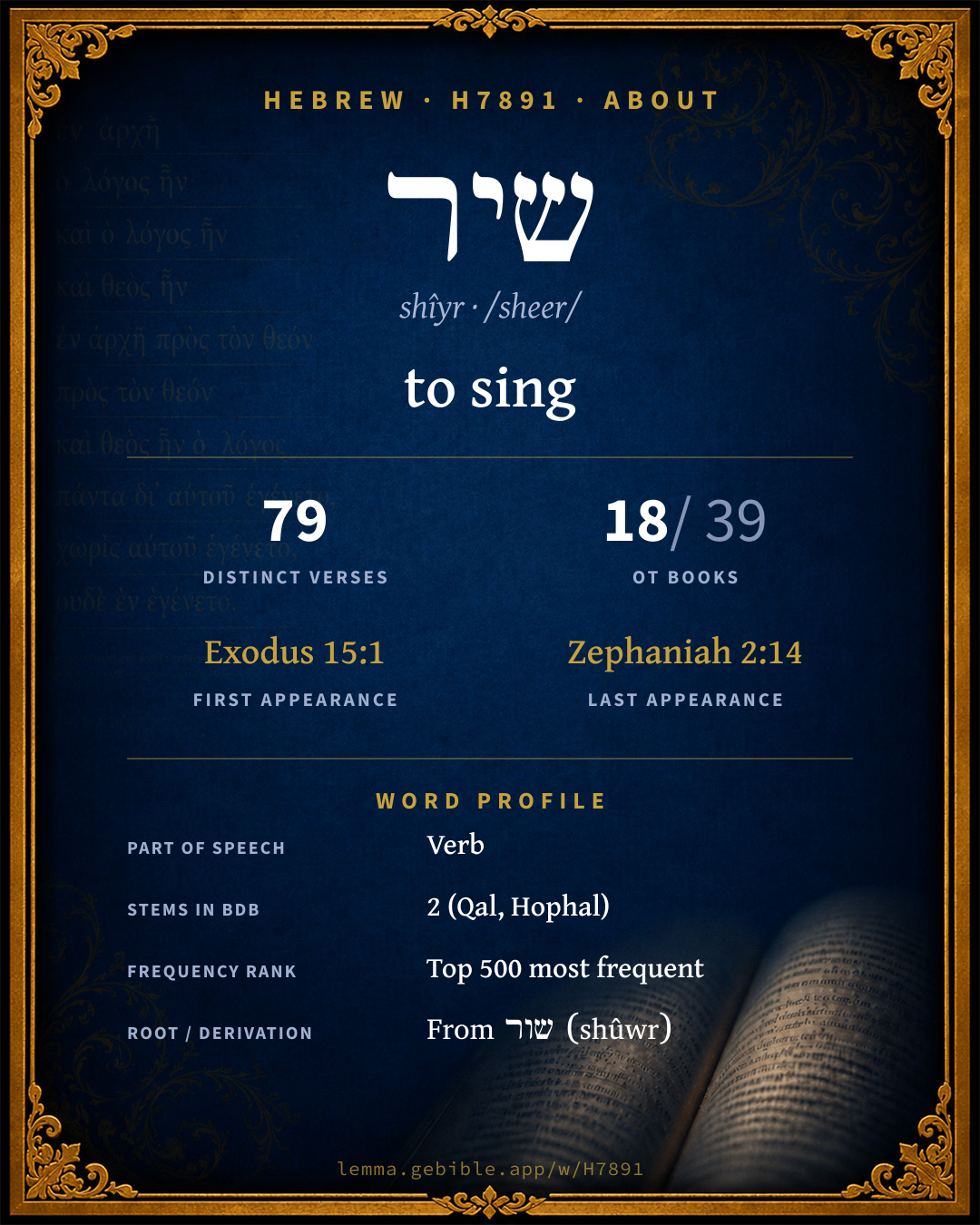
שִׁיר
to sing
‘to sing’ is one of 2 main senses fuller range ↓
Full lexicon entry — Brown-Driver-Briggs (BDB)
From Brown-Driver-Briggs (BDB)
Where this word appears
See every Qal verb in the Hebrew Bible →
Grammar key — what these labels mean
Part of speech
- Verb
- An action or state-of-being word.
Stem
- Polel
- A stem of hollow/geminate roots functioning like the Piel — intensive active.
- Qal
- The basic, simple active stem — the plain form of the verb (“he wrote”).
- Hophal
- The passive counterpart of the Hiphil (“he was caused to…”). Here: ‘be sung’
Form
- Participle Active
- A verbal adjective expressing ongoing or characteristic action (“writing / one who writes”).
- Imperative
- A direct command (“write!”).
- Cohortative
- A first-person volitional form expressing wish or resolve (“let me / let us write”).
- Infinitive Construct
- A bound verbal noun, frequently with prepositions (“to write / in writing”).
- Imperfect
- An incomplete, ongoing, or future action (“he will / would write”).
- Sequential Imperfect
- An imperfect with prefixed waw — the standard past-narrative form (waw-consecutive imperfect).
- Perfect
- A completed action or state — Hebrew marks aspect (completeness) more than strict tense (“he wrote”).
State
- Absolute
- The independent form of a noun, not bound to a following word.
Person
- 2nd Person
- The one addressed (“you”).
- 1st Person
- The speaker (“I / we”).
- 3rd Person
- The one spoken about (“he / she / it / they”).
Gender
- Masculine
- Grammatically masculine.
- Common
- Either gender — not distinguished for this form.
- Feminine
- Grammatically feminine.
Number
- Plural
- More than one (in Hebrew, generally three or more).
- Singular
- One.
34 distinct verses where H7891 appears in the Polel stem, across 6 books. Filtered view — show all forms. Click any verse to open its interlinear word-by-word view. Verse text shown in the World English Bible for context — . Each verse’s Hebrew form is shown with its reference; the English is not keyword-highlighted, since the data carries no word-level English alignment. Use “Compare translations” on any verse to read it across multiple English versions. This concordance covers the Hebrew Bible; Septuagint (Greek Old Testament) occurrences are not indexed here.
1 Chronicles 5 verses
- 1 Chronicles 6:33 הַ/מְשׁוֹרֵ֔ר ptcl def.art + Polel ptcp.act ms These are those who waited, and their sons. Of the sons of the Kohathites: Heman the singer, the son of Joel, the son of Samuel,
- 1 Chronicles 9:33 הַ֠/מְשֹׁרְרִים ptcl def.art + Polel ptcp.act mp These are the singers, heads of fathers' [houses] of the Levites, [who lived] in the chambers [and were] free [from other service]; for they were employed in their work day and night.
- 1 Chronicles 15:16 הַ/מְשֹׁ֣רְרִ֔ים ptcl def.art + Polel ptcp.act mp David spoke to the chief of the Levites to appoint their brothers the singers, with instruments of music, psalteries and harps and cymbals, sounding aloud and lifting up the voice with joy.
- 1 Chronicles 15:19 וְ/הַ/מְשֹׁ֣רְרִ֔ים conj + ptcl def.art + Polel ptcp.act mp So the singers, Heman, Asaph, and Ethan, [were appointed] with cymbals of brass to sound aloud;
- 1 Chronicles 15:27 וְ/הַ/מְשֹׁ֣רְרִ֔ים הַ/מְשֹֽׁרְרִ֑ים conj + ptcl def.art + Polel ptcp.act mp ptcl def.art + Polel ptcp.act mp David was clothed with a robe of fine linen, and all the Levites who bore the ark, and the singers, and Chenaniah the master of the song [with] the singers: and David had on him an ephod of linen.
2 Chronicles 6 verses
- 2 Chronicles 5:12 הַ/מְשֹׁרֲרִ֣ים ptcl def.art + Polel ptcp.act mp also the Levites who were the singers, all of them, even Asaph, Heman, Jeduthun, and their sons and their brothers, arrayed in fine linen, with cymbals and psalteries and harps, stood at the east end of the altar, and with them one hundred twenty priests sounding with trumpets;)
- 2 Chronicles 5:13 וְ/לַ/מְשֹֽׁרֲרִ֜ים conj + prep det + Polel ptcp.act mp it happened, when the trumpeters and singers were as one, to make one sound to be heard in praising and thanking Yahweh; and when they lifted up their voice with the trumpets and cymbals and instruments of music, and praised Yahweh, [saying], For he is good; for his loving kindness endures forever; that then the house was filled with a cloud, even the house of Yahweh,
- 2 Chronicles 20:21 מְשֹֽׁרֲרִים֙ Polel ptcp.act mp When he had taken counsel with the people, he appointed those who should sing to Yahweh, and give praise in holy array, as they went out before the army, and say, Give thanks to Yahweh; for his loving kindness endures forever.
- 2 Chronicles 23:13 וְ/הַ/מְשֽׁוֹרֲרִים֙ conj + ptcl def.art + Polel ptcp.act mp and she looked, and, behold, the king stood by his pillar at the entrance, and the captains and the trumpets by the king; and all the people of the land rejoiced, and blew trumpets; the singers also [played] on instruments of music, and led the singing of praise. Then Athaliah tore her clothes, and said, Treason! treason!
- 2 Chronicles 29:28 מְשׁוֹרֵ֔ר Polel ptcp.act ms All the assembly worshiped, and the singers sang, and the trumpeters sounded; all this [continued] until the burnt offering was finished.
- 2 Chronicles 35:15 וְ/הַ/מְשֹֽׁרֲרִ֨ים conj + ptcl def.art + Polel ptcp.act mp The singers the sons of Asaph were in their place, according to the commandment of David, and Asaph, and Heman, and Jeduthun the king's seer; and the porters were at every gate: they didn't need to depart from their service; for their brothers the Levites prepared for them.
Ezra 5 verses
- Ezra 2:41 הַֽ/מְשֹׁרְרִ֑ים ptcl def.art + Polel ptcp.act mp The singers: the children of Asaph, one hundred twenty-eight.
- Ezra 2:65 מְשֹׁרְרִ֥ים וּֽ/מְשֹׁרְר֖וֹת Polel ptcp.act mp conj + Polel ptcp.act fp besides their men-servants and their maid-servants, of whom there were seven thousand three hundred thirty-seven: and they had two hundred singing men and singing women.
- Ezra 2:70 וְ/הַ/מְשֹׁרְרִ֧ים conj + ptcl def.art + Polel ptcp.act mp So the priests, and the Levites, and some of the people, and the singers, and the porters, and the Nethinim, lived in their cities, and all Israel in their cities.
- Ezra 7:7 וְ/הַ/מְשֹׁרְרִ֧ים conj + ptcl def.art + Polel ptcp.act mp There went up some of the children of Israel, and of the priests, and the Levites, and the singers, and the porters, and the Nethinim, to Jerusalem, in the seventh year of Artaxerxes the king.
- Ezra 10:24 הַ/מְשֹׁרְרִ֖ים ptcl def.art + Polel ptcp.act mp Of the singers: Eliashib. Of the porters: Shallum, and Telem, and Uri.
Nehemiah 16 verses
- Nehemiah 7:1 וְ/הַ/מְשֹׁרְרִ֖ים conj + ptcl def.art + Polel ptcp.act mp Now it happened, when the wall was built, and I had set up the doors, and the porters and the singers and the Levites were appointed,
- Nehemiah 7:44 הַֽ/מְשֹׁרְרִ֑ים ptcl def.art + Polel ptcp.act mp The singers: the children of Asaph, one hundred forty-eight.
- Nehemiah 7:67 מְשֹֽׁרֲרִים֙ וּ/מְשֹׁ֣רֲר֔וֹת Polel ptcp.act mp conj + Polel ptcp.act fp besides their men-servants and their maid-servants, of whom there were seven thousand three hundred thirty-seven: and they had two hundred forty-five singing men and singing women.
- Nehemiah 7:73 וְ/הַ/מְשֹׁרְרִ֨ים conj + ptcl def.art + Polel ptcp.act mp So the priests, and the Levites, and the porters, and the singers, and some of the people, and the Nethinim, and all Israel, lived in their cities. When the seventh month was come, the children of Israel were in their cities.
- Nehemiah 10:28 הַ/מְשֹׁרְרִ֜ים ptcl def.art + Polel ptcp.act mp The rest of the people, the priests, the Levites, the porters, the singers, the Nethinim, and all those who had separated themselves from the peoples of the lands to the law of God, their wives, their sons, and their daughters, everyone who had knowledge, and understanding;
- Nehemiah 10:39 וְ/הַ/מְשֹׁרְרִ֑ים conj + ptcl def.art + Polel ptcp.act mp For the children of Israel and the children of Levi shall bring the heave-offering of the grain, of the new wine, and of the oil, to the chambers, where are the vessels of the sanctuary, and the priests who minister, and the porters, and the singers: and we will not forsake the house of our God.
- Nehemiah 11:22 הַ/מְשֹׁ֣רְרִ֔ים ptcl def.art + Polel ptcp.act mp The overseer also of the Levites at Jerusalem was Uzzi the son of Bani, the son of Hashabiah, the son of Mattaniah, the son of Mica, of the sons of Asaph, the singers, over the business of the house of God.
- Nehemiah 11:23 הַ/מְשֹׁרְרִ֖ים ptcl def.art + Polel ptcp.act mp For there was a commandment from the king concerning them, and a settled provision for the singers, as every day required.
- Nehemiah 12:28 הַ/מְשֹׁרְרִ֑ים ptcl def.art + Polel ptcp.act mp The sons of the singers gathered themselves together, both out of the plain round about Jerusalem, and from the villages of the Netophathites;
- Nehemiah 12:29 הַ/מְשֹׁ֣רֲרִ֔ים ptcl def.art + Polel ptcp.act mp also from Beth Gilgal, and out of the fields of Geba and Azmaveth: for the singers had built them villages round about Jerusalem.
- Nehemiah 12:42 הַ/מְשֹׁ֣רְרִ֔ים ptcl def.art + Polel ptcp.act mp and Maaseiah, and Shemaiah, and Eleazar, and Uzzi, and Jehohanan, and Malchijah, and Elam, and Ezer. The singers sang loud, with Jezrahiah their overseer.
- Nehemiah 12:45 וְ/הַ/מְשֹׁרְרִ֖ים conj + ptcl def.art + Polel ptcp.act mp They kept the charge of their God, and the charge of the purification, and [so did] the singers and the porters, according to the commandment of David, and of Solomon his son.
- Nehemiah 12:46 הַ/מְשֹׁ֣רְרִ֔ים ptcl def.art + Polel ptcp.act mp For in the days of David and Asaph of old there was a chief of the singers, and songs of praise and thanksgiving to God.
- Nehemiah 12:47 הַ/מְשֹׁרְרִ֥ים ptcl def.art + Polel ptcp.act mp All Israel in the days of Zerubbabel, and in the days of Nehemiah, gave the portions of the singers and the porters, as every day required: and they set apart [that which was] for the Levites; and the Levites set apart [that which was] for the sons of Aaron.
- Nehemiah 13:5 וְ/הַ/מְשֹׁרְרִ֖ים conj + ptcl def.art + Polel ptcp.act mp had prepared for him a great chamber, where before they laid the meal-offerings, the frankincense, and the vessels, and the tithes of the grain, the new wine, and the oil, which were given by commandment to the Levites, and the singers, and the porters; and the heave-offerings for the priests.
- Nehemiah 13:10 וְ/הַ/מְשֹׁרְרִ֖ים conj + ptcl def.art + Polel ptcp.act mp I perceived that the portions of the Levites had not been given them; so that the Levites and the singers, who did the work, were fled everyone to his field.
Job 1 verse
Zephaniah 1 verse
About this entry
At a glance — auto-summarized from this page’s data, not written by a person. Every figure links to its source below. This summary describes the numbers; it doesn’t interpret them.
שיר (shîyr) is a Hebrew verb most often rendered “to sing.” It first appears in Exodus 15:1. Spanning 79 verses in 18 books, it ranks among the moderately common words of the Hebrew Bible. Psalms dominates its distribution — 26 of 79 verses. Read the stem: it spans 2 stems, including Qal and Hophal. The sections below give every sense, occurrence, and version rendering.
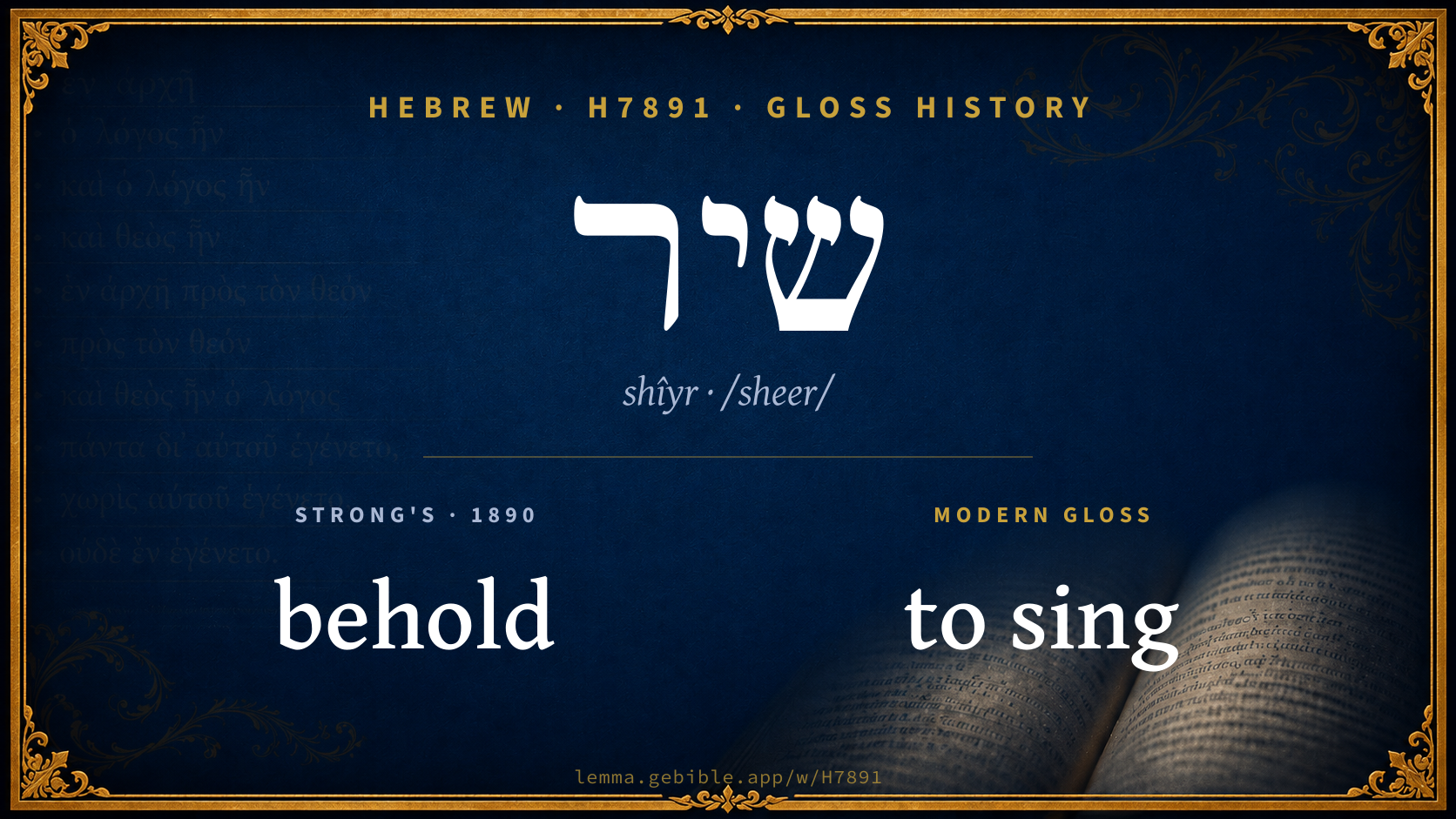
Gloss history
Strong's 1890 vs modern scholarship
About this word
Strong's H7891 catalogs a Hebrew word from the Hebrew Old Testament.
These counts are not copied from any lexicon or concordance. They are computed here, from the morphology-tagged Hebrew Old Testament. What Lemma adds →
- 79
- distinct verses
- The word appears in 79 distinct verses.
- 18 / 39
- OT books
- The word appears in 18 of 39 Old Testament books.
- #467
- by frequency
- Top 500 most frequent Hebrew words (rank 467 of 8,640 Hebrew words by occurrence).
View all 79 occurrences in the concordance →
Most concentrated in
- Psalms 26 verses 33%
- Nehemiah 16 verses 20%
- 2 Chronicles 8 verses 10%
By section of the Old Testament
By traditional corpus
Conventional, traditional groupings — biblical authorship is debated, so this is a traditional corpus grouping, not an authorship claim. Each share is this word’s portion of its verses in that division of the Hebrew canon. Each figure is a share of the word’s 79 distinct verses.
- Writings (Ketuvim) 65 verses · 82%
- Prophets (Nevi'im) 11 verses · 14%
- Torah (Pentateuch) 3 verses · 4%
How translations render this word
Counts come from each version’s own published word-to-Strong’s tagging or interlinear alignment — an approximate guide to how each version renders this word, not a word-level alignment the data otherwise carries. Because each total is that version’s own tagged count, the per-version totals vary from one another and need not match the appearance or distinct-verse counts above. These counts may also differ from a printed concordance because Lemma counts each distinctly tagged rendering and does not collapse phrase taggings into a single head-word total. This is a fixed set of word-tagged versions (KJV, ASV, BSB, ULT) and does not change with the reading translation you choose elsewhere. Each version’s license is shown beside its name below (and on Sources).
BDB lists this Strong’s number as 2 distinct words (homographs). Each count above pools all of them and is not split by sense — see the Senses section below. A low-frequency rendering may belong to a different one of those words, not the primary meaning.
- King James Version†: Singers 28×, Sing 14×, I will sing 10×
- American Standard Version†: Singers 26×, Sing 11×, I will sing 10×
- Berean Standard Bible†: Singers 23×, Sing 15×, I will sing 9×
- unfoldingWord Literal Text†: Sing 16×, Singers 15×, Ones who sang 14×
King James Version Public Domain
Renders H7891 across 87† tagged occurrences — most commonly:
Plus 24 renderings that appear only once — usually multi-word phrases or single function words the recovered tagging swept in, not distinct renderings.
American Standard Version Public Domain
Renders H7891 across 86† tagged occurrences — most commonly:
Plus 26 renderings that appear only once — usually multi-word phrases or single function words the recovered tagging swept in, not distinct renderings.
Berean Standard Bible Public Domain
Renders H7891 across 83† tagged occurrences — most commonly:
Plus 24 renderings that appear only once — usually multi-word phrases or single function words the recovered tagging swept in, not distinct renderings. Not rendered by a distinct English word in 4 further occurrences.
unfoldingWord Literal Text CC BY-SA 4.0
Renders H7891 across 93† tagged occurrences — most commonly:
Plus other, less common renderings. Plus 17 renderings that appear only once — usually multi-word phrases or single function words the recovered tagging swept in, not distinct renderings.
Senses in the full BDB
Hebrew verbs can shift meaning by stem (binyan): Qal is the basic action, Niphal is often passive or reflexive, Piel often intensifies or makes it factitive, and Hiphil is typically causative. The senses below are grouped under the stem BDB assigns to each. This entry also uses Hophal (the passive of Hiphil).
What do BDB’s symbols mean?
BDB uses these scholarly abbreviations:
| Symbol | Meaning |
|---|---|
| 𝔊 | the Septuagint (the ancient Greek translation, LXX) |
| 𝔙 | the Vulgate (the Latin translation) |
| 𝔖 | the Syriac version (the Peshitta) |
| 𝔗 | the Targum (the Aramaic translation) |
| ψ | the Psalms |
| √ | root (the underlying root or stem) |
| ‖ | parallel passage (a synonymous or contrasted parallel) |
| † | the dagger: every passage where the word occurs is cited |
The 5 senses and sub-senses the full Brown-Driver-Briggs lexicon distinguishes for this word, in lexicon order (not ranked by frequency), with BDB’s own verbatim wording and sub-sense lettering. Shown in Hebrew script with BDB’s own scholarly abbreviations. The condensed entry is in the Lexicon Entry tab. See also the Forms in the corpus table below.
שיר I song (NH id.
- 1. lyric song, + מָשָׁל 1 K 5:12, opp. קִינָה Am 8:10; joyous Gn 31:27 (J) Is 30:29; שׁ׳ עגבים Ez 33:32; triumphal Ju 5:12; love song Ct 1:1(×2) (title שִׁיר הַשִּׁירִים), ψ 45:1 (שִׁיר יְדִידֹת); noisy Am 5:23 Ez 26:13, in drunken revels Is 24:9, cf. 23:16; שׁ׳ כסילים Ec 7:5; not for sorrow Pr 25:20 ψ 137:3(×2); בְּנוֹת הַשִּׁיר Ec 12:4 songstresses (prob. birds). e.g. 1 Kings 5:12
- 2. religious song, in worship, ‖ תפלה ψ 42:9; usually praise, הלל בשׁיר 69:31; מִשִּׁירִי אֲהוֹדֶנּוּ 28:7; שִׁיר תְּהִלָּה וְהוֹדוֹת Ne 12:46; שׁיר י׳ ψ 137:4 2 Ch 29:27; שׁיר חדשׁ Is 42:10 (fresh outburst), + 6 times, v. חָדָשׁ; in ψ-titles, שׁיר 46:1, cf. Is 26:1; שׁיר המעלות pilgrim songs ψ 120:1 + 14 times (v. ii. מַעֲלָה p. 752); c. מִזְמוֹר ψ 48:1 + 12 times (v. מִז׳ p. 274); מַשְׂכִּיל שִׁיר 45:1; (שׁ׳ orig. alone in all except 30:1; 92:1; 108:1, v. BrJBL xviii (1899), 138). e.g. Psalms 42:9
- 3. specif. song of Levitical choirs, with musical accomp., 1 Ch 6:16, 17; 13:8 (so read also ‖ 2 S 6:5 for בְּרוֹשִׁים, 𝔊 Th and mod., cf. ב׳), 25:6, 7; 2 Ch 23:18; 29:28 Ne 12:27; כלי (ה)שׁיר instrument to accompany song 1 Ch 15:16 + 6 times (v. כְּלִי 2 b); cf. Am 6:5. e.g. 1 Chronicles 6:16
שיר II sing (denom. according to NöZMG xxxvii (1883), 537 Gerb172, but, if so, an old one)
Qal
- Pf. 3 ms. שָׁר ψ 7:1; Impf. 3 ms. יָשִׁיר Ex 15:1 Nu 21:17 (read יָשִׁר Jb 33:27 for יָשׁר, √ II. שׁוּר, so SS Bu Gerb; in this sense also Ew De Di RV and all mod.); 3 fs. וַתָּ֫שַׁר Ju 5:1, etc.; Imv. mpl. שִׁירוּ Ex 15:21 +; Inf. cstr. לָשׁוּר 1 S 18:6 Kt (לָשִׁיר, so Bu; 𝔊B om., cf. Dr KitKau HPS Now); Pt. שָׁר Pr 25:20; pl. שָׁרִים 2 S 19:36 +; f. שָׁרוֹת 2 S 19:36 + 2 times + Am 8:3 (read for שִׁירוֹת; v. שִׁירָה);—sing, c. acc. שִׁיר Is 42:10 ψ 33:3 + 5 times; שִׁירָה Ex 15:1; Nu 21:17 (E) Is 5:1; שׁ׳ בשׁרים Pr 25:20; מִשִּׁיר צִיּוֹן ψ 137:3; שׁגיון 7:1 (𝔊 מזמור), תהלה 106:12; c. acc. of theme 59:17; 89:2; abs. Ju 5:1; 1 S 18:6; c. לְ ψ 13:6; 96:1, 2 = 1 Ch 16:23, Ex 15:1, 21; Je 20:13; ‖ זמּר ψ 68:5, 33; 101:1; 104:33; 105:2 = 1 Ch 16:9; Ju 5:3; + זמּר abs. ψ 57:8 = 108:2; c. acc. theme 21:14; c. לְ pers. 27:6; of nature 65:14 (after הַתְרוֹעֵעַ); על אנשׁים Jb 33:27 (v. supra); pt. שָׁרִים singers 2 S 19:36 1 K 10:12 + 6 times (Ez 40:44 read שְׁתַּיִם 𝔊 Hi Co mod.); שָׁרוֹת songstresses 2 S 19:36; 2 Ch 35:25; Ec 2:8 + Am 8:3 (v. supra).—ψ 138:5 read וְיָשִׂיחוּ. Pōʿl.36 Pf. 3 mpl. שֹׁרְרוּ Jb 36:24; Impf. 3 ms. יְשׁוֹרֵר Zp 2:14; Pt. מְשׁוֹרֵר 1 Ch 6:18; 2 Ch 29:28; pl. מְשֹׁרְרִים Ezr 2:65 +, etc.;—sing: birds Zp 2:14; men Jb 36:24; elsewhere pt. of Levitical singers 1 Ch 6:18; 9:33 + 31 times, + fpl. Ezr 2:65 songstresses = Ne 7:67. e.g. Psalms 7:1
Hophal
- be sung: Impf. יוּשַׁר הַשִׁיר הַזֶּה Is 26:1. e.g. Isaiah 26:1
Senses from the full Brown-Driver-Briggs lexicon (Brown, Driver, Briggs; Oxford 1906 — public domain), digitized via Sefaria, supplemented by the OpenScriptures HebrewLexicon (CC BY 4.0). Full attribution on Sources.
Word origin
I. n.m. song (NH id.; so Ecclus 40:21 +);—שׁ׳ abs. Ju 5;12 +, cstr. 2 Ch 29:27 +; sf. שִׁירִי ψ 28:7, etc.; pl. שִׁירִים 1 Ch 13:8; Ct 1:1; שִׁרִים Gn 31:27; Pr 25:20; sf. שִׁרֶ֫יךָ Am 5:23, etc.;—
II. vb. sing (denom. according to NöZMG xxxvii (1883), 537 Gerb172, but, if so, an old one);—
— Brown-Driver-Briggs (Oxford 1906, public domain), digitized via Sefaria, supplemented by the OpenScriptures HebrewLexicon (CC BY 4.0). See Sources.
Derived from שור (shûwr) (H7788) — to travel.
Jastrow Dictionary
A second Hebrew/Aramaic lexicon for comparison, covering Aramaic and post-biblical (Talmudic, Targumic, Midrashic) usage that the biblical-Hebrew BDB does not. Matched by lemma rather than by Strong’s number, so a lemma may carry more than one Jastrow headword (shown separately below), and the entries cover usage well beyond the Bible.
שְׁוַר
- , v. שְׁוַור, שַׁוָּור.
שְׁיָר
- , v. שְׁיָיר
שִׁיר I
- denom. of next w.) to sing. Ber. 14ᵇ ושַׁרְנוּ לך and we sang (praises) unto thee. Snh. 91ᵇ (ref. to Ex. XV, 1) שָׁר לא נאמר אלא יָשִׁיר it does not read, ‘he sang’; but, ‘he shall sing’; Mekh. B’shall., Shir., s. 1; a. e. e.g. Exodus 15:1
- ) שׁוֹרֵר same. Num. R. s. 3 (play on ב̇כ̇וש̇ר̇ות, Ps. LXVIII, 7) אותן שהיו ב̇וכ̇ין … מְ֗ש̇ו̇רְ֗רִין עכשיו those who formerly wept …, were now singing. Ib. ועבד מְשׁוֹרֵר וכ׳ and the slave sings, because he is relieved &c. B. Bath. 120ᵃ מְשׁוֹרְרִים לפניה went singing (bridal songs) before her; a. fr.—[Midr. Till. to Ps. CXVI באין ושוררין, read: ושׁוֹרִין, v. שָׁרָה II.]—מְשׁוֹרֵר singer, esp. Temple singer (Levite). Arakh. 11ᵇ מ׳ ששיער ומשוער ששורר if one designated as a singer acts as gate-guard, or a gate-guard acts as singer; a. fr.—Pl. מְשׁוֹרְרִים, מְשׁוֹרְרִין. Ib. שאתה מן המ׳ וכ׳ for thou belongest to the singers, and not to the gate-guards; a. fr. e.g. Psalms 68:7
שִׁיר II
- [chain, string; cmp. חָרַז,] verse, song, poetry, music. Tam. V, 6 שאחיו … לדבר בש׳ that his brother Levites were assembling to sing in chorus. Ib. VII, 4 הש׳ שהיו הלוים וכ׳ these are the psalms that the Levites recited severally on each day; a. fr.—R. Hash. 28ᵃ התוקע לש׳ he who blows the Shofar (on the New Year’s Day) as a musical exercise (Ms. M. לשֵׁד to drive off a demon); ib. 33ᵇ (Ms. M. לשֵׁיד).—כלי ש׳ musical instruments (used in the Temple during the offering of sacrifices). Taan. IV (III), 3; a. e.—Pl. שִׁירִים, שִׁירִין. Cant. R. to I, 1 דוד אמר ש׳ ושלמה אמר ש׳ David composed songs, and so did Solomon. Ib. end (expl. שיר השירים) המעולה שבש׳; המסולסל שבש׳, v. סִלְסֵל. Ib. נאמר ש׳ ונשבח למי שעשאנו ש׳ בעולם let us recite songs and praise to him who has made us to be songs (proclaimers of God’s praise) in the world; נאמר ש׳ … שיורים לעולם let us recite songs to him who made us remnants (has preserved us) for the world; a. fr.—שיר הש׳ the Book of Song of Songs (Canticum). Ib.; B. Bath. 14ᵇ; a. fr.
שֵׁיר
- שֵׁרוֹת pl.; preced.) chain, necklace, bracelet, ring. Sabb. V, 1 סוס בש׳ the horse may be let out (on the Sabbath) with his chain (or ring); וכל בעלי הש׳ וכ׳ and all chain-wearing animals &c.; Tosef. ib. IV (V), 4. B. Mets. 25ᵃ כש׳ if the coins found lie arranged like a ring (or necklace). Y. Sabb. VI, 8ᵇ top ובלבד … לא בש׳ וכ׳ save that he does not put it (the amulet) in a necklace or a signet ring; a. e.—Pl. שֵׁירִין. Gen. R. s. 98 וחיו משליכות עליו ש׳ וכ׳ (not שיריין) and they (the Egyptian women) threw at him (Joseph) chains and necklaces &c.
שֵׁיר ²
- Targ. Ps. CV, 18 (fem.). Targ. Job XXX, 11 שֵׁירִי Ms. (h. text יתרי; Ms. Var. שושילתי, נימי, אטוני; ed. שושלתי ונימי אטוני, embodying all the Variants). Ib. XL, 26 Ms. Var. (ed. סלוא). Targ. Esth. VIII, 15; a. e.—Lam. R. to II, 12 סב לך חד ש׳ וכ׳ take a bracelet or a ring, and go to market &c.—Pl. שֵׁירִין, שֵׁירַיָּא, שֵׁירֵי. Targ. Ez. XXIX, 4 (ed. Wil. שִׁי׳; h. text חחים). Targ. Is. XXXVII, 29 (ed. Wil. שִׁי׳; Ar. שֵׁירִי; h. text חחי). Targ. Ps. CVII, 10 (ed. Wil. שׁרֵי). Targ. O. Num. XXXI, 50 שֵׁירִין ed. Berl. (ed. Amst. שְׁרִין, read: שֵׁ׳); Y. שִׁירַיָּא (ed. Vien. שִׁי׳; h. text אצעדה); a. fr.—[Targ. Y. I Ex. XXVIII, 32 שִׁירַיָּא, v. שִׁירָיָא.]—Y. Sabb. VI, 8ᵇ bot. (expl. צמיד, Num. l. c.) שיריא (bracelets).
שִׁיר
- = h. שִׁיר. Targ. Cant. I, 1. Targ. Ps. LXVI, 1; a. fr.—Pl. שִׁירִין, שִׁירַיָּא. Targ. Cant. l. c. Targ. Ps. CXXXVII, 3; a. e.—[שִׁירָא f., v. שִׁירְתָא.]
A Dictionary of the Targumim, the Talmud Babli and Yerushalmi, and the Midrashic Literature (Marcus Jastrow; London, Luzac, 1903) — Public Domain. Digitized via Sefaria. Digitized via Sefaria. Full attribution on Sources.
Forms in the corpus
The 60 distinct written forms H7891 takes in the Hebrew Bible, most frequent first — each parse links to that stem’s occurrences in the concordance. Hebrew forms include their vowel points and cantillation, so a single lemma takes many written forms.
Same root — word family
Other BDB entries built from the same root as H7891, grouped by Strong’s listed origin. These share a root / origin per the lexicon — not necessarily a shared meaning. Each links to that word’s own entry.
Derives from
Shares the same root
Derived from this word
Compare all same-root words → Showing 4 of 7 — not the complete family. They share a root, not necessarily a meaning.
Septuagint verse parallels
This word appears in 62 verses that also exist in the Greek Old Testament (Septuagint), out of the 79 Hebrew verses it occurs in. You can read those verses in Greek by switching the Old Testament edition to the Septuagint.
Read these verses in the Septuagint
- Exodus 15:1
- Numbers 21:17
- Judges 5:1
- 1 Samuel 18:6
- 2 Samuel 19:35
- 1 Kings 10:12
- 1 Chronicles 6:33
- 2 Chronicles 5:12
- Ezra 2:41
- Job 36:24
- Psalms 7:1
- Proverbs 25:20
This is a verse-level parallel only — the same verses exist in both the Hebrew and Greek Old Testaments. No word-level Hebrew↔Greek correspondence is claimed: the data carries no such alignment, so no Greek word is shown as this Hebrew word’s translation. Coverage is not total — the Septuagint omits the deuterocanon and renumbers the Psalms, so some Hebrew verses have no direct Greek parallel.